

Paper Menu >>
Journal Menu >>
 Psychology 2013. Vol.4, No.11, 804-807 Published Online November 2013 in SciRes (http://www.scirp.org/journal/psych) http://dx.doi.org/10.4236/psych.2013.411115 Open Access 804 Subliminal Priming of Motivation Magnitude Fabian Steinberg, Otmar Bock, Sebastian Dern Institute of Physiology and Anatomy, German Sport University Cologne, Cologne, Germany Email: [email protected] Received August 5th, 2013; revised September 4th, 2013; accepted October 5th, 2013 Copyright © 2013 Fabian Steinberg et al. This is an open access article distributed under the Creative Commons Attribution License, which permits unrestricted use, distribution, and reproduction in any medium, provided the original work is properly cited. Word primes have been successfully used in the past to facilitate the processing of other words (semantic priming), but also to modify mental states such as emotion, cognition and motivation (conceptual prim- ing). This work documented that the direction of motivational drive can be successfully changed, but left open whether its magnitude can be influenced as well. To find out, we asked subjects to point at sublimi- nally presented (30 ms) words that denoted low motivation (13 subjects) or high motivation (13 subjects). Afterwards, subjects completed a questionnaire of learning-specific motivation. No effect of priming was found for pointing parameters such as reaction time, but an effect emerged for self-assessed motivation level. The subject group primed with high-motivation words rated their motivation higher than the group primed with low-motivation words. The results indicate that not only the direction, but also the level of motivation can be manipulated subliminally, and supports the view that motivation can influence behavior without actor’s explicit knowledge. Keywords: Semantic Priming; Subliminal Priming; Motivation; Conceptual Priming Introduction Since the influential work of Meyer and Schvaneveldt (1971), it is known that subliminally presented words can facilitate the processing of subsequent, semantically related words. This so- called “semantic priming” has been attributed to spreading ac- tivation in brain circuits that store semantically similar words in neighboring locations (Collins & Loftus, 1975): prime words activate an extended region within those circuits and thus fa- cilitate the processing of subsequent target words (Kiesel, Kunde, & Hoffmann, 2007). While semantic priming is a ro- bust phenomenon, it also is limited in duration to less than 100 ms (Greenwald, Draine, & Abrams, 1996). Semantic priming is distinct from another phenomenon call- ed “conceptual priming”: Presented words not only influence the processing of other words, they also can change the reader’s attitudes and cognitive styles. For example, words with a hos- tile connotation biased subjects’ ratings of other persons’ per- sonality towards more hostile scores (Smith & Branscombe, 1988), words expressing distrust increased subjects’ creativity (Mayer & Mussweiler, 2011) and words denoting narrowness or wideness narrowed or widened, respectively, subjects’ focus of attention (Hüttermann, Memmert, & Bock, 2012). Concep- tual priming doesn’t require awareness as it was found with subliminally presented targets (Hüttermann et al., 2012) and in completely amnestic patients (Levy, Stark, & Squire, 2004). More importantly, the prime words remained effective even after a pause as long as one week. Unlike semantic priming, conceptual priming can therefore be administered in a blocked design, with one block dedicated to the presentation of prime words, and a later block to the measurement of the outcome. The present study evaluates whether conceptual priming can be used to modify a person’s level of motivation. This could be of practical interest, e.g., when a teacher wants to elevate her students’ eagerness to learn, or a health consultant wants her clients not only to make plans for a healthy lifestyle, but also to put those plans into action. However, a survey of available li- terature shows that, surprisingly, conceptual priming has only been used to redirect the motivational drive, not to change its magnitude. Thus, subjects’ motivation has been successfully shifted towards either achievement or joy (Hart & Albaraccin, 2009), either controlled or autonomous self-determination (Ra- del, Sarrazin, Legrain, & Gobancé, 2009), and either a promo- tion or a prevention focus (Steinberg & Bock, under review). This could indicate that contextual priming of the motivation level has not yet been considered by scientists or, alternatively, that it has been considered but failed to produce statistically significant, publishable effects. Our study was designed to de- cide between these alternatives. Method Preliminary Procedure: Word Selection 30 native German speakers (23 male, 7 female, 21.1 ± 2.1 years) participated. They were university students, healthy by self-report, and unfamiliar with related research. Subjects were given a list of 90 words, selected by the experimenters from a Thesaurus with the aim that 45 words represent a high and 45 words a low motivation level. The high-motivation words were taken from the categories power, energy, strength, activity and hope, and the low-motivation words from the categories weak- ness, inactivity, dullness and hopelessness. Participants were asked to rate the motivation level invoked by those words on a ten-point Likert scale, arranged from “low” 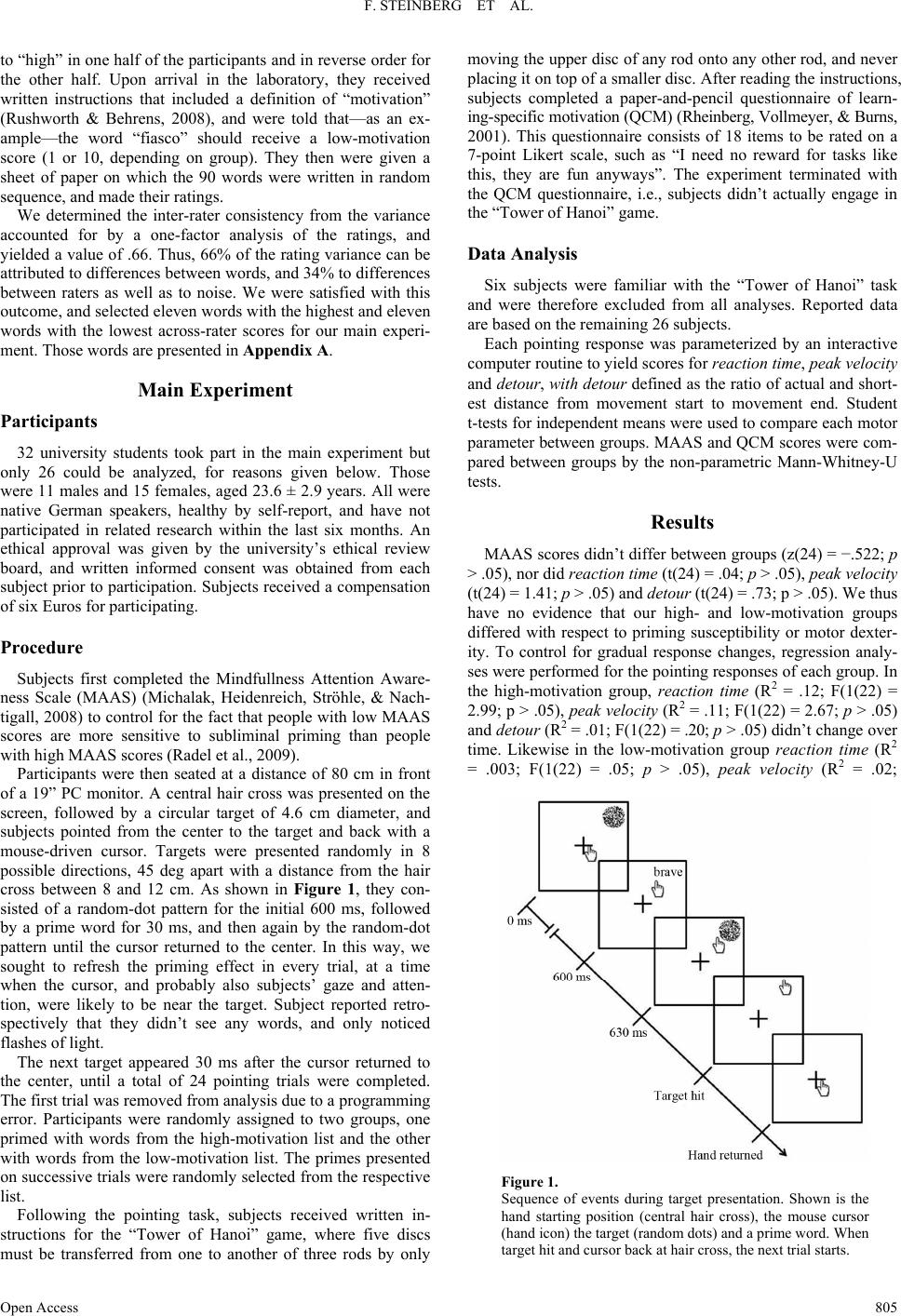 F. STEINBERG ET AL. to “high” in one half of the participants and in reverse order for the other half. Upon arrival in the laboratory, they received written instructions that included a definition of “motivation” (Rushworth & Behrens, 2008), and were told that—as an ex- ample—the word “fiasco” should receive a low-motivation score (1 or 10, depending on group). They then were given a sheet of paper on which the 90 words were written in random sequence, and made their ratings. We determined the inter-rater consistency from the variance accounted for by a one-factor analysis of the ratings, and yielded a value of .66. Thus, 66% of the rating variance can be attributed to differences between words, and 34% to differences between raters as well as to noise. We were satisfied with this outcome, and selected eleven words with the highest and eleven words with the lowest across-rater scores for our main experi- ment. Those words are presented in Appendix A. Main Experiment Participants 32 university students took part in the main experiment but only 26 could be analyzed, for reasons given below. Those were 11 males and 15 females, aged 23.6 ± 2.9 years. All were native German speakers, healthy by self-report, and have not participated in related research within the last six months. An ethical approval was given by the university’s ethical review board, and written informed consent was obtained from each subject prior to participation. Subjects received a compensation of six Euros for participating. Procedure Subjects first completed the Mindfullness Attention Aware- ness Scale (MAAS) (Michalak, Heidenreich, Ströhle, & Nach- tigall, 2008) to control for the fact that people with low MAAS scores are more sensitive to subliminal priming than people with high MAAS scores (Radel et al., 2009). Participants were then seated at a distance of 80 cm in front of a 19” PC monitor. A central hair cross was presented on the screen, followed by a circular target of 4.6 cm diameter, and subjects pointed from the center to the target and back with a mouse-driven cursor. Targets were presented randomly in 8 possible directions, 45 deg apart with a distance from the hair cross between 8 and 12 cm. As shown in Figure 1, they con- sisted of a random-dot pattern for the initial 600 ms, followed by a prime word for 30 ms, and then again by the random-dot pattern until the cursor returned to the center. In this way, we sought to refresh the priming effect in every trial, at a time when the cursor, and probably also subjects’ gaze and atten- tion, were likely to be near the target. Subject reported retro- spectively that they didn’t see any words, and only noticed flashes of light. The next target appeared 30 ms after the cursor returned to the center, until a total of 24 pointing trials were completed. The first trial was removed from analysis due to a programming error. Participants were randomly assigned to two groups, one primed with words from the high-motivation list and the other with words from the low-motivation list. The primes presented on successive trials were randomly selected from the respective list. Following the pointing task, subjects received written in- structions for the “Tower of Hanoi” game, where five discs must be transferred from one to another of three rods by only moving the upper disc of any rod onto any other rod, and never placing it on top of a smaller disc. After reading the instructions, subjects completed a paper-and-pencil questionnaire of learn- ing-specific motivation (QCM) (Rheinberg, Vollmeyer, & Burns, 2001). This questionnaire consists of 18 items to be rated on a 7-point Likert scale, such as “I need no reward for tasks like this, they are fun anyways”. The experiment terminated with the QCM questionnaire, i.e., subjects didn’t actually engage in the “Tower of Hanoi” game. Data Analysis Six subjects were familiar with the “Tower of Hanoi” task and were therefore excluded from all analyses. Reported data are based on the remaining 26 subjects. Each pointing response was parameterized by an interactive computer routine to yield scores for reaction time, peak velocity and detour, with detour defined as the ratio of actual and short- est distance from movement start to movement end. Student t-tests for independent means were used to compare each motor parameter between groups. MAAS and QCM scores were com- pared between groups by the non-parametric Mann-Whitney-U tests. Results MAAS scores didn’t differ between groups (z(24) = −.522; p > .05), nor did reaction time (t(24) = .04; p > .05), peak velocity (t(24) = 1.41; p > .05) and detour (t(24) = .73; p > .05). We thus have no evidence that our high- and low-motivation groups differed with respect to priming susceptibility or motor dexter- ity. To control for gradual response changes, regression analy- ses were performed for the pointing responses of each group. In the high-motivation group, reaction time (R2 = .12; F(1(22) = 2.99; p > .05), peak velocity (R2 = .11; F(1(22) = 2.67; p > .05) and detour (R2 = .01; F(1(22) = .20; p > .05) didn’t change over time. Likewise in the low-motivation group reaction time (R2 = .003; F(1(22) = .05; p > .05), peak velocity (R2 = .02; Figure 1. Sequence of events during target presentation. Shown is the hand starting position (central hair cross), the mouse cursor (hand icon) the target (random dots) and a prime word. When target hit and cursor back at hair cross, the next trial starts. Open Access 805 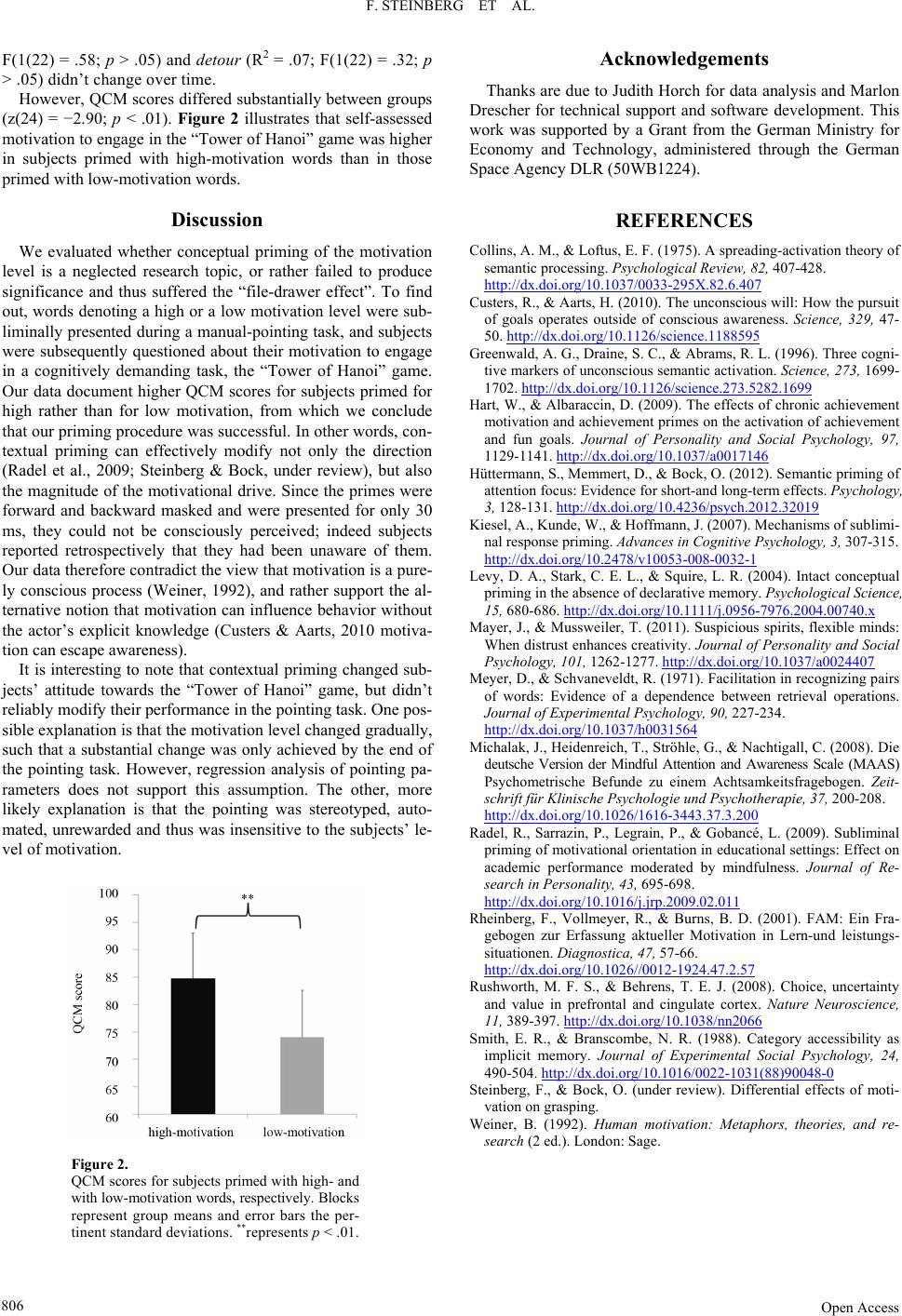 F. STEINBERG ET AL. F(1(22) = .58; p > .05) and detour (R2 = .07; F(1(22) = .32; p > .05) didn’t change over time. However, QCM scores differed substantially between groups (z(24) = −2.90; p < .01). Figure 2 illustrates that self-assessed motivation to engage in the “Tower of Hanoi” game was higher in subjects primed with high-motivation words than in those primed with low-motivation words. Discussion We evaluated whether conceptual priming of the motivation level is a neglected research topic, or rather failed to produce significance and thus suffered the “file-drawer effect”. To find out, words denoting a high or a low motivation level were sub- liminally presented during a manual-pointing task, and subjects were subsequently questioned about their motivation to engage in a cognitively demanding task, the “Tower of Hanoi” game. Our data document higher QCM scores for subjects primed for high rather than for low motivation, from which we conclude that our priming procedure was successful. In other words, con- textual priming can effectively modify not only the direction (Radel et al., 2009; Steinberg & Bock, under review), but also the magnitude of the motivational drive. Since the primes were forward and backward masked and were presented for only 30 ms, they could not be consciously perceived; indeed subjects reported retrospectively that they had been unaware of them. Our data therefore contradict the view that motivation is a pure- ly conscious process (Weiner, 1992), and rather support the al- ternative notion that motivation can influence behavior without the actor’s explicit knowledge (Custers & Aarts, 2010 motiva- tion can escape awareness). It is interesting to note that contextual priming changed sub- jects’ attitude towards the “Tower of Hanoi” game, but didn’t reliably modify their performance in the pointing task. One pos- sible explanation is that the motivation level changed gradually, such that a substantial change was only achieved by the end of the pointing task. However, regression analysis of pointing pa- rameters does not support this assumption. The other, more likely explanation is that the pointing was stereotyped, auto- mated, unrewarded and thus was insensitive to the subjects’ le- vel of motivation. Figure 2. QCM scores for subjects primed with high- and with low-motivation words, respectively. Blocks represent group means and error bars the per- tinent standard deviations. **represents p < .01. Acknowledgements Thanks are due to Judith Horch for data analysis and Marlon Drescher for technical support and software development. This work was supported by a Grant from the German Ministry for Economy and Technology, administered through the German Space Agency DLR (50WB1224). REFERENCES Collins, A. M., & Loftus, E. F. (1975). A spreading-activation theory of semantic processing. Psychological Review, 82, 407-428. http://dx.doi.org/10.1037/0033-295X.82.6.407 Custers, R., & Aarts, H. (2010). The unconscious will: How the pursuit of goals operates outside of conscious awareness. Science, 329, 47- 50. http://dx.doi.org/10.1126/science.1188595 Greenwald, A. G., Draine, S. C., & Abrams, R. L. (1996). Three cogni- tive markers of unconscious semantic activation. Science, 273, 1699- 1702. http://dx.doi.org/10.1126/science.273.5282.1699 Hart, W., & Albaraccin, D. (2009). The effects of chronic achievement motivation and achievement primes on the activation of achievement and fun goals. Journal of Personality and Social Psychology, 97, 1129-1141. http://dx.doi.org/10.1037/a0017146 Hüttermann, S., Memmert, D., & Bock, O. (2012). Semantic priming of attention focus: Evidence for short-and long-term effects. Psychology, 3, 128-131. http://dx.doi.org/10.4236/psych.2012.32019 Kiesel, A., Kunde, W., & Hoffmann, J. (2007). Mechanisms of sublimi- nal response priming. Advances in Cognitive Psyc h o l o gy, 3, 307-315. http://dx.doi.org/10.2478/v10053-008-0032-1 Levy, D. A., Stark, C. E. L., & Squire, L. R. (2004). Intact conceptual priming in the absence of declarative memory. Psychol og ic a l Sc i en ce , 15, 680-686. http://dx.doi.org/10.1111/j.0956-7976.2004.00740.x Mayer, J., & Mussweiler, T. (2011). Suspicious spirits, flexible minds: When distrust enhances creativity. Journal of Personality and Social Psychology, 101, 1262-1277. http://dx.doi.org/10.1037/a0024407 Meyer, D., & Schvaneveldt, R. (1971). Facilitation in recognizing pairs of words: Evidence of a dependence between retrieval operations. Journal of Experimental Ps ych olog y, 90, 227-234. http://dx.doi.org/10.1037/h0031564 Michalak, J., Heidenreich, T., Ströhle, G., & Nachtigall, C. (2008). Die deutsche Version der Mindful Attention and Awareness Scale (MAAS) Psychometrische Befunde zu einem Achtsamkeitsfragebogen. Zeit- schrift für Klinische P sychologie und Psychotherapie, 37, 200-208. http://dx.doi.org/10.1026/1616-3443.37.3.200 Radel, R., Sarrazin, P., Legrain, P., & Gobancé, L. (2009). Subliminal priming of motivational orientation in educational settings: Effect on academic performance moderated by mindfulness. Journal of Re- search in Personality, 43, 695-698. http://dx.doi.org/10.1016/j.jrp.2009.02.011 Rheinberg, F., Vollmeyer, R., & Burns, B. D. (2001). FAM: Ein Fra- gebogen zur Erfassung aktueller Motivation in Lern-und leistungs- situationen. Diagnostica , 47, 57-66. http://dx.doi.org/10.1026//0012-1924.47.2.57 Rushworth, M. F. S., & Behrens, T. E. J. (2008). Choice, uncertainty and value in prefrontal and cingulate cortex. Nature Neuroscience, 11, 389-397. http://dx.doi.org/10.1038/nn2066 Smith, E. R., & Branscombe, N. R. (1988). Category accessibility as implicit memory. Journal of Experimental Social Psychology, 24, 490-504. http://dx.doi.org/10.1016/0022-1031(88)90048-0 Steinberg, F., & Bock, O. (under review). Differential effects of moti- vation on grasping. Weiner, B. (1992). Human motivation: Metaphors, theories, and re- search (2 ed.). London: Sage. Open Access 806  F. STEINBERG ET AL. Open Access 807 Appendix A High-Motivation Wor d s: exzellent [excellent]; kraftvoll [vigorous]; wirksam [effi- cient]; mutig [brave]; lebhaft [vivid]; können [ability]; aus- sichtsreich [promising]; unwiderstehlich [irresistible]; macht- voll [powerful]; enthusiastisch [enthusiastic]; effektiv [effec- tive]. Low-Motiv ation Words: Schwach [weak]; sinnlos [meaningless]; schlaff [slack]; in- effektiv [ineffective]; geschmachklos [crude]; wertlos [worth- less]; absturz [crash]; hilflos [helpless]; lustlos [dull]; unrenta- bel [unprofitable]; gezwungen [forced]. |