

Paper Menu >>
Journal Menu >>
 Open Journal of Orthopedics, 2013, 3, 291-295 Published Online November 2013 (http://www.scirp.org/journal/ojo) http://dx.doi.org/10.4236/ojo.2013.37053 Open Access OJO 291 Comparitive Study between Proximal Femoral Nailing and Dynamic Hip Screw in Intertrochanteric Fracture of Femur* Ujjal Bhakat#, Ranadeb Bandyopadhayay Bankura Sammilani Medical College, Bankura, India. Email: #[email protected], ra[email protected] Received September 11th, 2013; revised October 15th, 2013; accepted October 25th, 2013 Copyright © 2013 Ujjal Bhakat, Ranadeb Bandyopadhayay. This is an open access article distributed under the Creative Commons Attribution License, which permits unrestricted use, distribution, and reproduction in any medium, provided the original work is properly cited. ABSTRACT Background: Internal fixation is appropriate for most intertrochanteric fractures. Optimal fixation is based on the sta- bility of fracture. The mainstay of treatment of intertrochanteric fracture is fixation with a screw slide plate device or intramedullary device. So it is a matter of debate that which one is the best treatment, dynamic hip screw or proximal femoral nailing. Method: A prospective randomized and comparative study of 2 years duration was conducted on 60 patients admitted in the Department of Orthopedics in our hospital with intertrochanteric femur fracture. They were treated by a dynamic hip screw and proximal femoral nail. Patients were operated under image intensifier control. The parameters studied were functional outcome of Harris hip score, total duration of operation, rate of union, amount of collapse. These valu es were statistically evaluated and two tailed p-values were calculated and both groups were statis- tically compared. Result: The average age of our patient is 67.8 years. Among the fracture, 31% were stable, 58% were unstable, 11% were reverse oblique fracture. The average blood loss was 100 and 250 ml in PFN and DHS group, re- spectively. In PFN there was more no. of radiation exposure intra-operatively. The average operating time for the pa- tients treated with PFN was 45 min as compared to 70 min in patients treated with DHS. The patients treated with PFN started early ambulation as they had better Harris Hip Score in the early period (at 1 and 3 months). In the long term both the implants had almost similar functional outcomes. Conclusion: In our study we have found that the unstable pattern was more common in old aged patients with higher grade of osteoporosis and PFN group has a better outcome in this unstable and osteoporotic fracture. PFN group has less blood loss and less operating time compared to DHS group. In PFN group patients have started early ambulation compared to DHS group. Keywords: Intertrochanteric Fracture; Dynamic Hip Screw (DHS); Proximal Femoral Nail (PFN); P Value 1. Introduction Extracapsular fractures (intertrochanteric and sub-tro- chanteric fractures) primarily involve cortical and com- pact cancellousbone. Because of the complex stress con- figuration in this region and its nonhomogeneous osseous structure and geometry, fractures occur along the path of least resistance through the proximal femur [1]. Gulberg et al. has predicted that the total number of hip fractures will reach 2.6 million by 2025 and 4.5 mil- lion by 2050 [2]. In 1990 26% of all hip fractures oc- curred in Asia whereas this figure could rise to 37% in 2025 and 45% in 2050 [3]. The various treatment options for intertrochanteric fractures are operative and non-operative. The non-op- erative method was used to be a treatment of choice in early 19th century when the operative technique was not evolved enough to do stable fixation. Non-operative treatment should only be considered in non-ambulatory or chronic dementia patients with pain that is controllable with analgesics and rest, terminal diseases with less than 6 weeks of life expectancy, unresolved medical comor- bidities that preclude surgical treatment, active infectious disease that itself is a contraindication for insertion of a surgical implant and in complete pertrochanteric fractures diagnosed by MRI. Intertrochanteric fractures can be *The authors declare that they have no conflict of interest related to the p ublication of this manuscript. #Corresponding autho r . 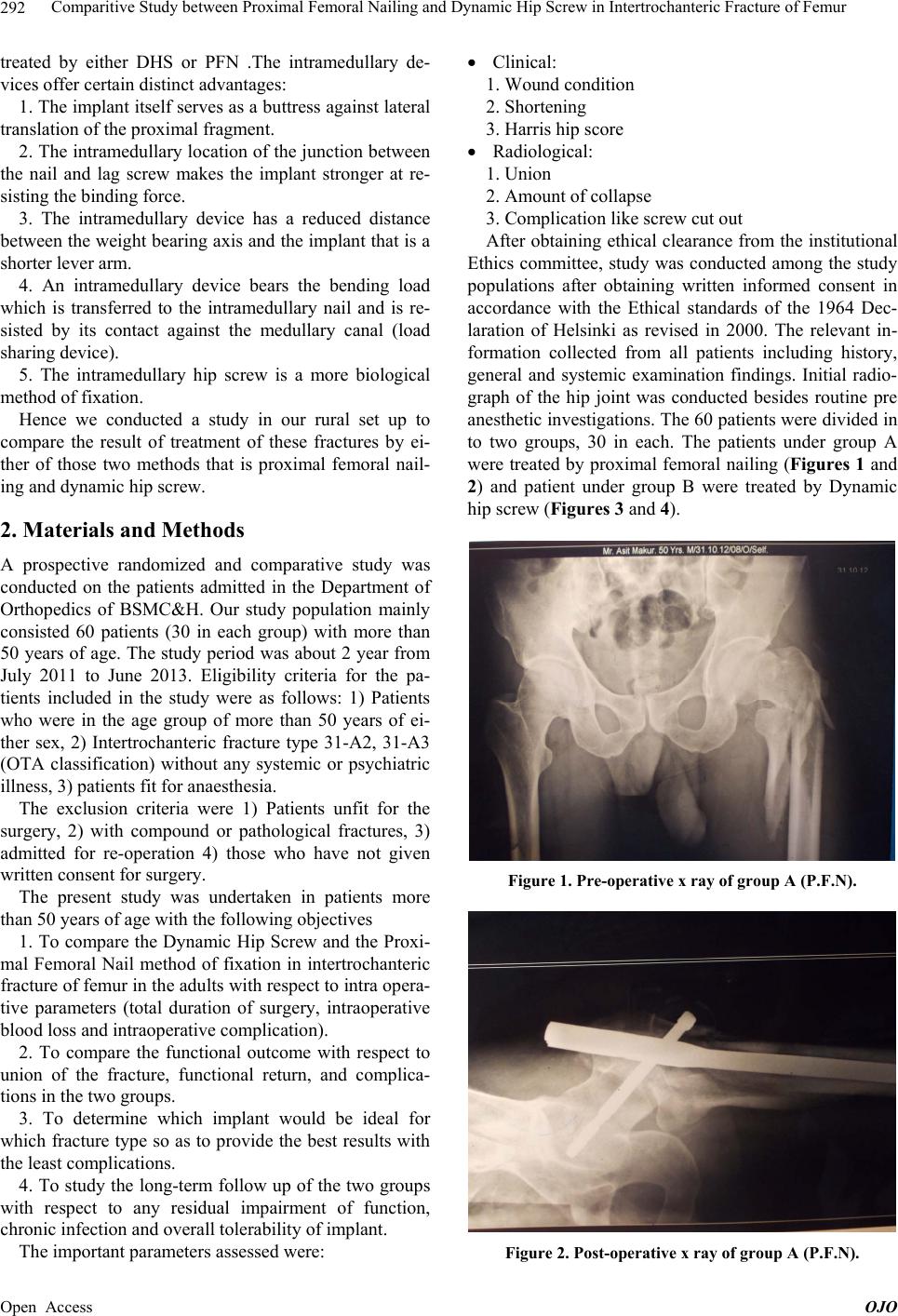 Comparitive Study between Proximal Femoral Nailing and Dynamic Hip Screw in Intertrochanteric Fracture of Femur 292 treated by either DHS or PFN .The intramedullary de- vices offer certain distinct advantages: 1. The implant itself serves as a buttress again st lateral translation of the proximal fragment. 2. The intramedullary location of the junction between the nail and lag screw makes the implant stronger at re- sisting the binding force. 3. The intramedullary device has a reduced distance between the weight b earing axis and the implant th at is a shorter lever arm. 4. An intramedullary device bears the bending load which is transferred to the intramedullary nail and is re- sisted by its contact against the medullary canal (load sharing device). 5. The intramedullary hip screw is a more biological method o f fi xation. Hence we conducted a study in our rural set up to compare the result of treatment of these fractures by ei- ther of those two methods that is proximal femoral nail- ing and dynamic hip screw. 2. Materials and Methods A prospective randomized and comparative study was conducted on the patients admitted in the Department of Orthopedics of BSMC&H. Our study population mainly consisted 60 patients (30 in each group) with more than 50 years of age. The study per iod was about 2 year from July 2011 to June 2013. Eligibility criteria for the pa- tients included in the study were as follows: 1) Patients who were in the age group of more than 50 years of ei- ther sex, 2) Intertrochanteric fracture type 31-A2, 31-A3 (OTA classification) without any systemic or psychiatric illness, 3) patients fit for anaesthesia. The exclusion criteria were 1) Patients unfit for the surgery, 2) with compound or pathological fractures, 3) admitted for re-operation 4) those who have not given written consent for surgery. The present study was undertaken in patients more than 50 years of age with the following objectives 1. To compare the Dynamic Hip Screw and the Proxi- mal Femoral Nail method of fixation in intertrochanteric fracture of femur in the adults with respect to intra opera- tive parameters (total duration of surgery, intraoperative blood loss and intraope rative complication). 2. To compare the functional outcome with respect to union of the fracture, functional return, and complica- tions in the two groups. 3. To determine which implant would be ideal for which fracture type so as to provide the best results with the least complications. 4. To study the long-term follow up of the two groups with respect to any residual impairment of function, chronic infection and overall tolerability of implant. The important parameters assessed were: Clinical: 1. Wound condition 2. Shorte ning 3. Harris hip sc ore Radiological: 1. Union 2. Amount of c ol l a pse 3. Complication like screw cut out After obtaining ethical clearance from the institutional Ethics committee, study was conducted among the study populations after obtaining written informed consent in accordance with the Ethical standards of the 1964 Dec- laration of Helsinki as revised in 2000. The relevant in- formation collected from all patients including history, general and systemic examination findings. Initial radio- graph of the hip joint was conducted besides routine pre anesthetic investigations. The 60 patients were divided in to two groups, 30 in each. The patients under group A were treated by proximal femoral nailing (Figures 1 and 2) and patient under group B were treated by Dynamic hip screw ( Figures 3 and 4). Figure 1. Pre-operative x ray of group A (P.F.N). Figure 2. Post-operative x ray of group A (P.F.N). Open Access OJO 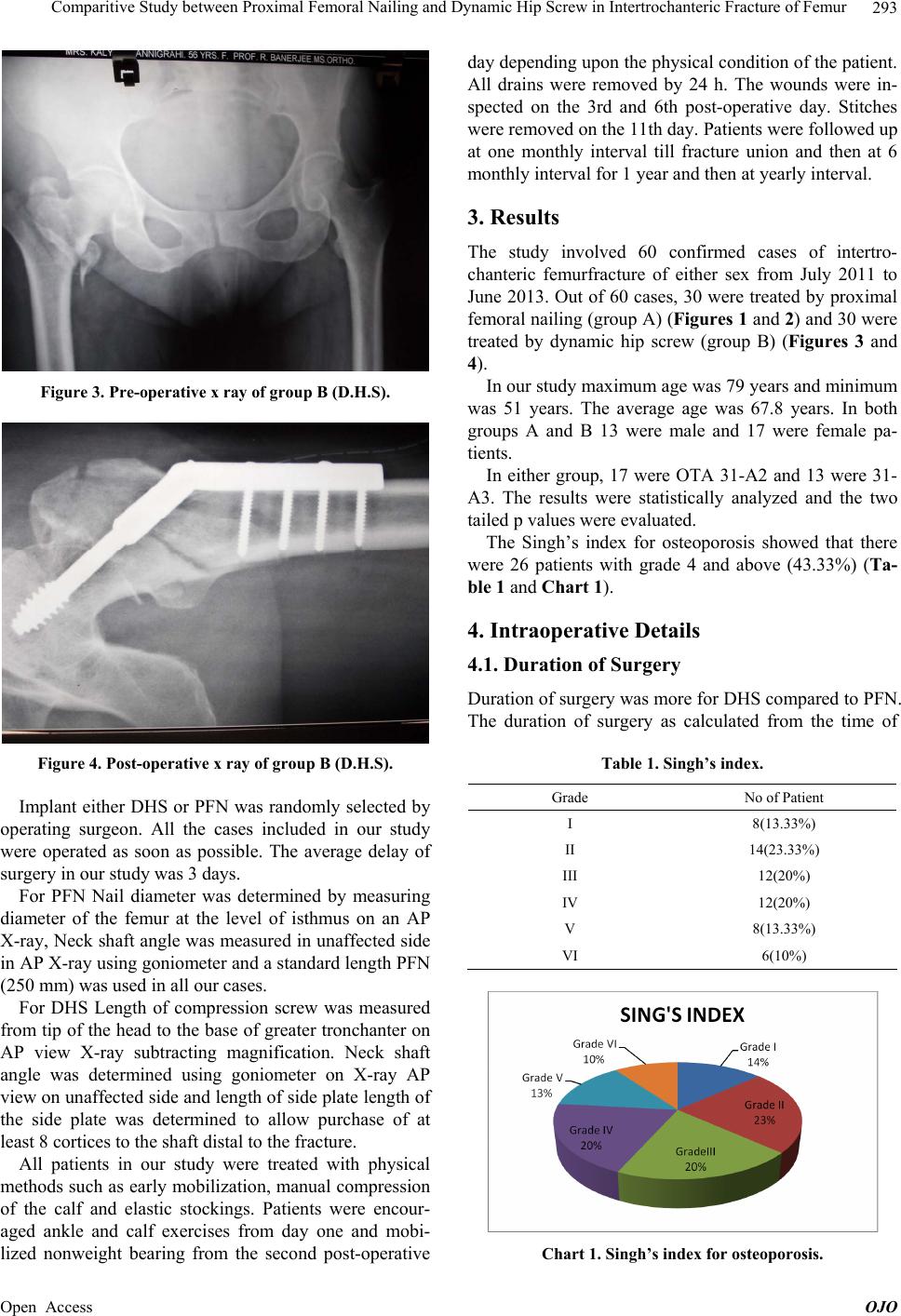 Comparitive Study between Proximal Femoral Nailing and Dynamic Hip Screw in Intertrochanteric Fracture of Femur 293 Figure 3. Pre-operative x ray of group B (D.H.S). Figure 4. Post-operative x ray of group B (D.H.S). Implant either DHS or PFN was randomly selected by operating surgeon. All the cases included in our study were operated as soon as possible. The average delay of surgery in our st udy was 3 days. For PFN Nail diameter was determined by measuring diameter of the femur at the level of isthmus on an AP X-ray, Neck shaft angle was measured in unaffected side in AP X-ray using goniometer and a standard length PFN (250 mm) was used in all our cases. For DHS Length of compression screw was measured from tip of the head to the base of greater tronchanter on AP view X-ray subtracting magnification. Neck shaft angle was determined using goniometer on X-ray AP view on unaffected side and length of side plate length of the side plate was determined to allow purchase of at least 8 cortices to the sh aft distal to the fracture. All patients in our study were treated with physical methods such as early mobilization, manual compression of the calf and elastic stockings. Patients were encour- aged ankle and calf exercises from day one and mobi- lized nonweight bearing from the second post-operative day depending upon th e physical cond ition of the patien t. All drains were removed by 24 h. The wounds were in- spected on the 3rd and 6th post-operative day. Stitches were removed on the 11th day. Patients were followed up at one monthly interval till fracture union and then at 6 monthly interval for 1 year and then at yearly interval. 3. Results The study involved 60 confirmed cases of intertro- chanteric femurfracture of either sex from July 2011 to June 2013. Out of 60 cases, 30 were treated by proximal femoral nailing (group A) (Figures 1 and 2) and 30 were treated by dynamic hip screw (group B) (Figures 3 and 4). In our study maximum age was 79 years and minimum was 51 years. The average age was 67.8 years. In both groups A and B 13 were male and 17 were female pa- tients. In either group, 17 were OTA 31-A2 and 13 were 31- A3. The results were statistically analyzed and the two tailed p values were evaluated. The Singh’s index for osteoporosis showed that there were 26 patients with grade 4 and above (43.33%) (Ta- ble 1 and Chart 1). 4. Intraoperative Details 4.1. Duration of Surgery Duration of surgery was more for DHS compared to PFN. The duration of surgery as calculated from the time of Table 1. Singh’s index. Grade No of Patient I 8(13.33%) II 14(23.33%) III 12(20%) IV 12(20%) V 8(13.33%) VI 6(10%) Chart 1. Singh’s index for osteoporosis. Open Access OJO 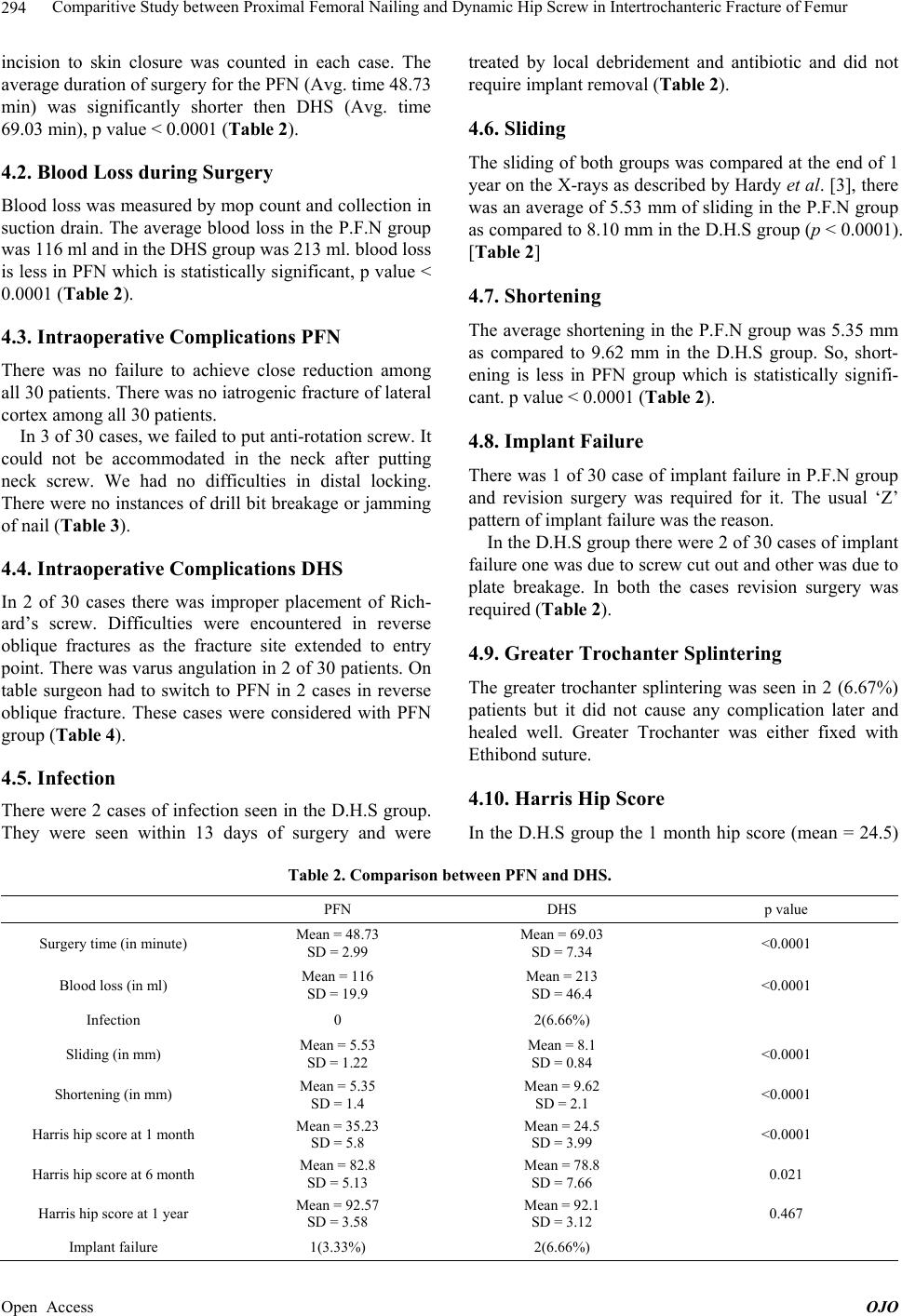 Comparitive Study between Proximal Femoral Nailing and Dynamic Hip Screw in Intertrochanteric Fracture of Femur Open Access OJO 294 incision to skin closure was counted in each case. The average duration of surgery for the PFN (Avg. time 48.73 min) was significantly shorter then DHS (Avg. time 69.03 min), p v al ue < 0.00 0 1 ( Table 2). 4.2. Blood Loss during Surgery Blood loss was measured by mop count and collection in suction drain. The average blood loss in the P.F.N group was 116 ml and in the DHS group was 213 ml. blood loss is less in PFN which is statistically significan t, p value < 0.0001 (Table 2). 4.3. Intraoperative Complications PFN There was no failure to achieve close reduction among all 30 patients. There was no iatrogenic fracture of lateral cortex among all 30 patients. In 3 of 30 cases, we failed to put anti-rotation screw. It could not be accommodated in the neck after putting neck screw. We had no difficulties in distal locking. There were no instances of drill bit breakage or jamming of nail (Table 3). 4.4. Intraoperative Complications DHS In 2 of 30 cases there was improper placement of Rich- ard’s screw. Difficulties were encountered in reverse oblique fractures as the fracture site extended to entry point. There was varus angulation in 2 of 30 patients. On table surgeon had to switch to PFN in 2 cases in reverse oblique fracture. These cases were considered with PFN group (Table 4). 4.5. Infection There were 2 cases of infection seen in the D.H.S group. They were seen within 13 days of surgery and were treated by local debridement and antibiotic and did not require implant removal (Table 2). 4.6. Sliding The sliding of both groups was compared at the end of 1 year on the X-rays as descr ibed by Hardy et al. [3], ther e was an average of 5.53 mm of sliding in the P.F.N grou p as compared to 8.10 mm in the D.H.S group (p < 0.0001). [Table 2] 4.7. Shortening The average shortening in the P.F.N group was 5.35 mm as compared to 9.62 mm in the D.H.S group. So, short- ening is less in PFN group which is statistically signifi- cant. p value < 0.000 1 ( Table 2). 4.8. Implant Failure There was 1 of 30 case of implan t failure in P.F.N group and revision surgery was required for it. The usual ‘Z’ pattern of implant failure was the reason. In the D.H.S group ther e were 2 of 30 cases of implant failure one was due to screw cut out and other was due to plate breakage. In both the cases revision surgery was required (Table 2). 4.9. Greater Trochanter Splintering The greater trochanter splintering was seen in 2 (6.67%) patients but it did not cause any complication later and healed well. Greater Trochanter was either fixed with Ethibond suture. 4.10. Harris Hip Score In the D.H.S group the 1 month hip score (mean = 24.5) Table 2. Comparison betwee n PFN and DHS. PFN DHS p value Surgery time (in minute) Mean = 48.73 SD = 2.99 Mean = 69.03 SD = 7.34 <0.0001 Blood loss (in ml) Mean = 116 SD = 19.9 Mean = 213 SD = 46.4 <0.0001 Infection 0 2(6.66%) Sliding (in mm) Mean = 5.53 SD = 1.22 Mean = 8.1 SD = 0.84 <0.0001 Shortening (in mm) Mean = 5.35 SD = 1.4 Mean = 9.62 SD = 2.1 <0.0001 Harris hip score at 1 month Mean = 35.23 SD = 5.8 Mean = 24.5 SD = 3.99 <0.0001 Harris hip score at 6 month Mean = 82.8 SD = 5.13 Mean = 78.8 SD = 7.66 0.021 Harris hip score at 1 year Mean = 92.57 SD = 3.58 Mean = 92.1 SD = 3.12 0.467 Implant failure 1(3.33%) 2(6.66%) 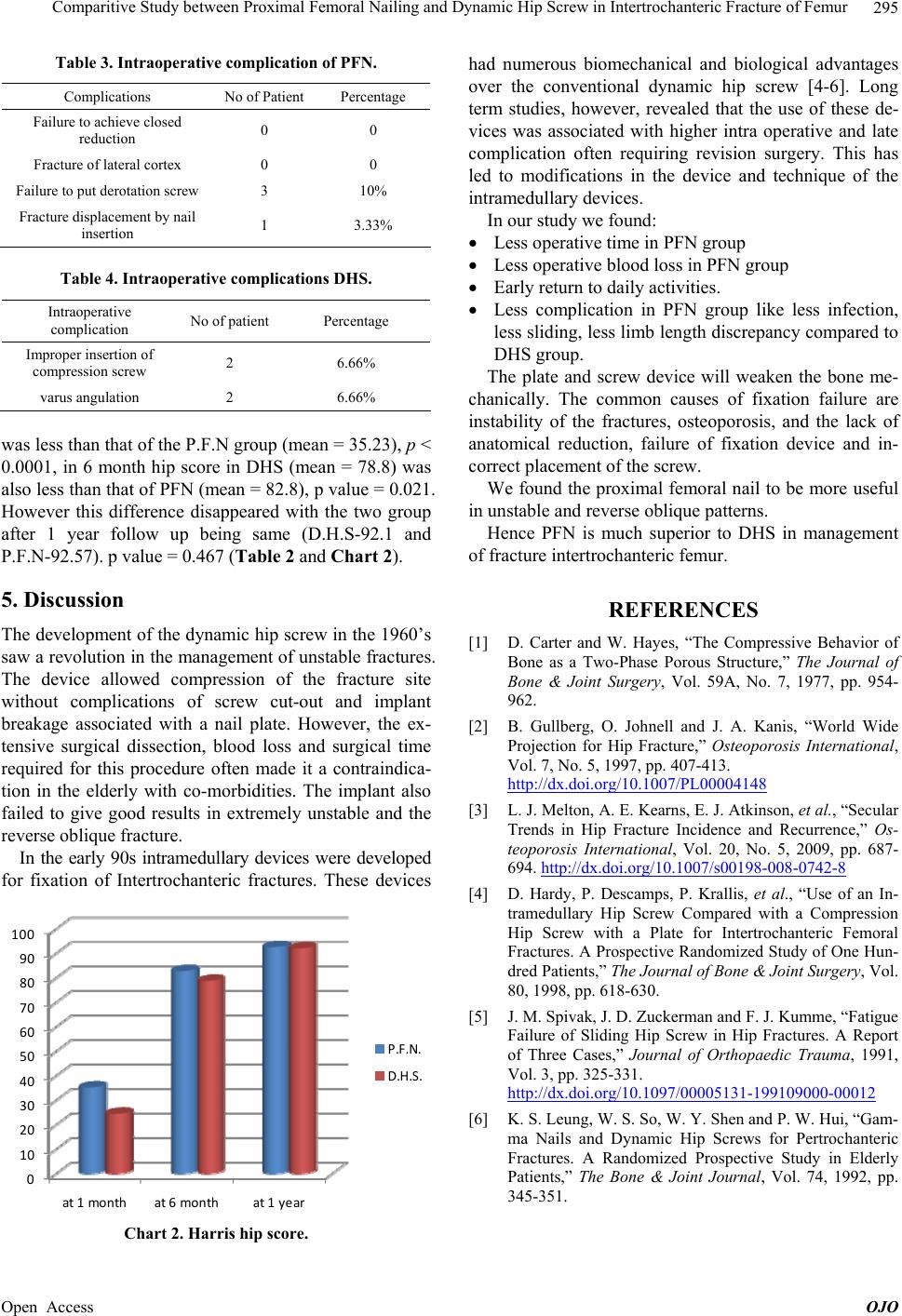 Comparitive Study between Proximal Femoral Nailing and Dynamic Hip Screw in Intertrochanteric Fracture of Femur 295 Table 3. Intraoperative complication of PFN. Complications No of Patient Percentage Failure to achieve closed reduction 0 0 Fracture of lateral cortex 0 0 Failure to put derotation screw 3 10% Fracture displacement by nai l insertion 1 3.33% Table 4. Intraoperative complications DHS. Intraoperative complication No of patient Percentage Improper ins ertion of compression screw 2 6.66% varus angulation 2 6.66% was less than that of the P.F.N group (mean = 35.23), p < 0.0001, in 6 month hip score in DHS (mean = 78.8) was also less than that of PFN (mean = 82.8) , p value = 0.021. However this difference disappeared with the two group after 1 year follow up being same (D.H.S-92.1 and P.F.N-92.57). p value = 0.467 (Table 2 and Chart 2). 5. Discussion The development of the dynamic hip screw in the 1960’s saw a revolution in the management of unstable fractures. The device allowed compression of the fracture site without complications of screw cut-out and implant breakage associated with a nail plate. However, the ex- tensive surgical dissection, blood loss and surgical time required for this procedure often made it a contraindica- tion in the elderly with co-morbidities. The implant also failed to give good results in extremely unstable and the reverse obli que fracture. In the early 90s intramedullary devices were developed for fixation of Intertrochanteric fractures. These devices 0 10 20 30 40 50 60 70 80 90 100 at 1 monthat 6 monthat 1 year P.F.N. D.H.S. Chart 2. Harris hip score. had numerous biomechanical and biological advantages over the conventional dynamic hip screw [4-6]. Long term studies, however, revealed that the use of these de- vices was associated with higher intra operative and late complication often requiring revision surgery. This has led to modifications in the device and technique of the intramedullary devices. In our study we found: Less operative time in PFN group Less operative b l o od loss in PFN gro up Early return to daily activities. Less complication in PFN group like less infection, less sliding, less limb length discrepancy compared to DHS group. The plate and screw device will weaken the bone me- chanically. The common causes of fixation failure are instability of the fractures, osteoporosis, and the lack of anatomical reduction, failure of fixation device and in- correct placement of the screw. We found the proximal femoral nail to be more useful in unstable and reverse oblique patterns. Hence PFN is much superior to DHS in management of fracture intertrochanteric femur. REFERENCES [1] D. Carter and W. Hayes, “The Compressive Behavior of Bone as a Two-Phase Porous Structure,” The Journal of Bone & Joint Surgery, Vol. 59A, No. 7, 1977, pp. 954- 962. [2] B. Gullberg, O. Johnell and J. A. Kanis, “World Wide Projection for Hip Fracture,” Osteoporosis International, Vol. 7, No. 5, 1997, pp. 407-413. http://dx.doi.org/10.1007/PL00004148 [3] L. J. Melton, A. E. Kearns, E. J. Atkinson, et al., “Secular Trends in Hip Fracture Incidence and Recurrence,” Os- teoporosis International, Vol. 20, No. 5, 2009, pp. 687- 694. http://dx.doi.org/10.1007/s00198-008-0742-8 [4] D. Hardy, P. Descamps, P. Krallis, et al., “Use of an In- tramedullary Hip Screw Compared with a Compression Hip Screw with a Plate for Intertrochanteric Femoral Fractures. A Prospective Randomized Study of One Hun- dred Patients,” The Journal of Bone & Joint Surgery, Vol. 80, 1998, pp. 618-630. [5] J. M. Spivak, J. D. Zuckerma n and F. J. Kumme, “Fa tigue Failure of Sliding Hip Screw in Hip Fractures. A Report of Three Cases,” Journal of Orthopaedic Trauma, 1991, Vol. 3, pp. 325-331. http://dx.doi.org/10.1097/00005131-199109000-00012 [6] K. S. Leung, W. S. So, W. Y. Shen and P. W. Hui, “Gam- ma Nails and Dynamic Hip Screws for Pertrochanteric Fractures. A Randomized Prospective Study in Elderly Patients,” The Bone & Joint Journal, Vol. 74, 1992, pp. 345-351. Open Access OJO |