

Paper Menu >>
Journal Menu >>
 Open Journal of Anesthesiology, 2013, 3, 408-412 Published Online November 2013 (http://www.scirp.org/journal/ojanes) http://dx.doi.org/10.4236/ojanes.2013.39086 Open Access OJAnes Errors during Paediatric Cardiac Anaesthesia: Reporting and Learning Mohammad Hamid, Mohammad Irfan Akhtar, Fauzia Nasim Minai, Amar Lal Gangwani Department of Anaesthesiology, Aga Khan University, Karachi, Pakistan. Email: mohammad[email protected] Received August 20th, 2013; revised September 21st, 2013; accepted October 2nd, 2013 Copyright © 2013 Mohammad Hamid et al. This is an open access article distributed under the Creative Commons Attribution Li- cense, which permits unrestricted use, distribution, and reproduction in any medium, provided the original work is properly cited. ABSTRACT Incident reporting is a reliable quality assurance tool, frequently used in anaesthesia to identify errors. It was introduced in anaesthesia by Cooper in 1978 and since then several institutions have adopted this system to find adverse events and near misses. We think that the incident reporting would be more beneficial for prolonged and technically complex pro- cedures like paediatric cardiac surgery. Methods: All paediatric CHD patients scheduled for cardiac surgery were in- cluded in this audit. Thoracic and general surgery patients were excluded. Any event in preoperative area, induction room, operating room and during transfer to cardiac ICU was documented in a predesigned proforma by resident/con- sultant. This proforma included information regarding demographics, the type and severity and responsible factors for the event. Results: 134 patients were included in this two and half years audit. 88 patients were male (65.7%) and 46 (34.3%) were female. The age of the patients ranged from one day to 15 years. Total 105 incidents were noticed in 61 patients. 46 incidents were declared as major events which were potentially serious while 59 events were of minor na- ture. Cuffed endotracheal tube was used in 73% patients. The majority of events occurred in the pre-bypass period. Most of the incidents were related to cardiovascular system (73%), followed by pharmacological incidents. Human fac- tors (74%) were mainly responsible for the incidents. Conclusion: Incident reporting is a reliable and feasible method of improving quality care in developing countries. It helps in identifying areas which need improvement and helps in developing guidelines to improve safety. Keywords: Paediatric; Congenital Heart Surgery; Anaesthesia; Errors 1. Introduction Incident reporting is a reliable quality assurance tool, fre- quently used in anaesthesia to identify errors. It was in- troduced in anaesthesia by Cooper [1] in 1978 and since then several departments have used voluntary incident re- porting to find adverse events and near misses. Incident reporting is probably more important for pro- longed and technically complex procedures like paediat- ric cardiac surgery which requires longer hospital stay. Adverse event is a major concern during the management of paediatric cardiac surgery patients due to the presence of intracardiac defect, severity of disease and complexity of surgery in these patients. Errors in medical manage- ment can occur at several steps including pre bypass, bypass, post bypass period, during the transfer of patient to CICU and in the CICU but the possibility of untoward incident is higher in OR [2] than ICU or wards. Incident reporting is a well established and an effec- tive way of identifying these events. Incident reporting not only helps in identification of actual adverse events but also near misses and no harm events can be identified. The severity of the incident affects the outcome of the patient, ranging from transient damage to full recovery or increasing length of hospital stay and in the worst cases death. We started incident reporting in paediatric congenital heart disease (CHD) surgery patients with the aim of improving the quality of care. Critical Incident for this audit is defined as “An incident that affected or could have affected, if uncorrected, the safety of patient during the period of care. Our aim of this audit was to prospec- tively compile the critical incidents in paediatric cardiac anaesthesia, review the root cause, analyze and provide recommendations to improve patient safety. 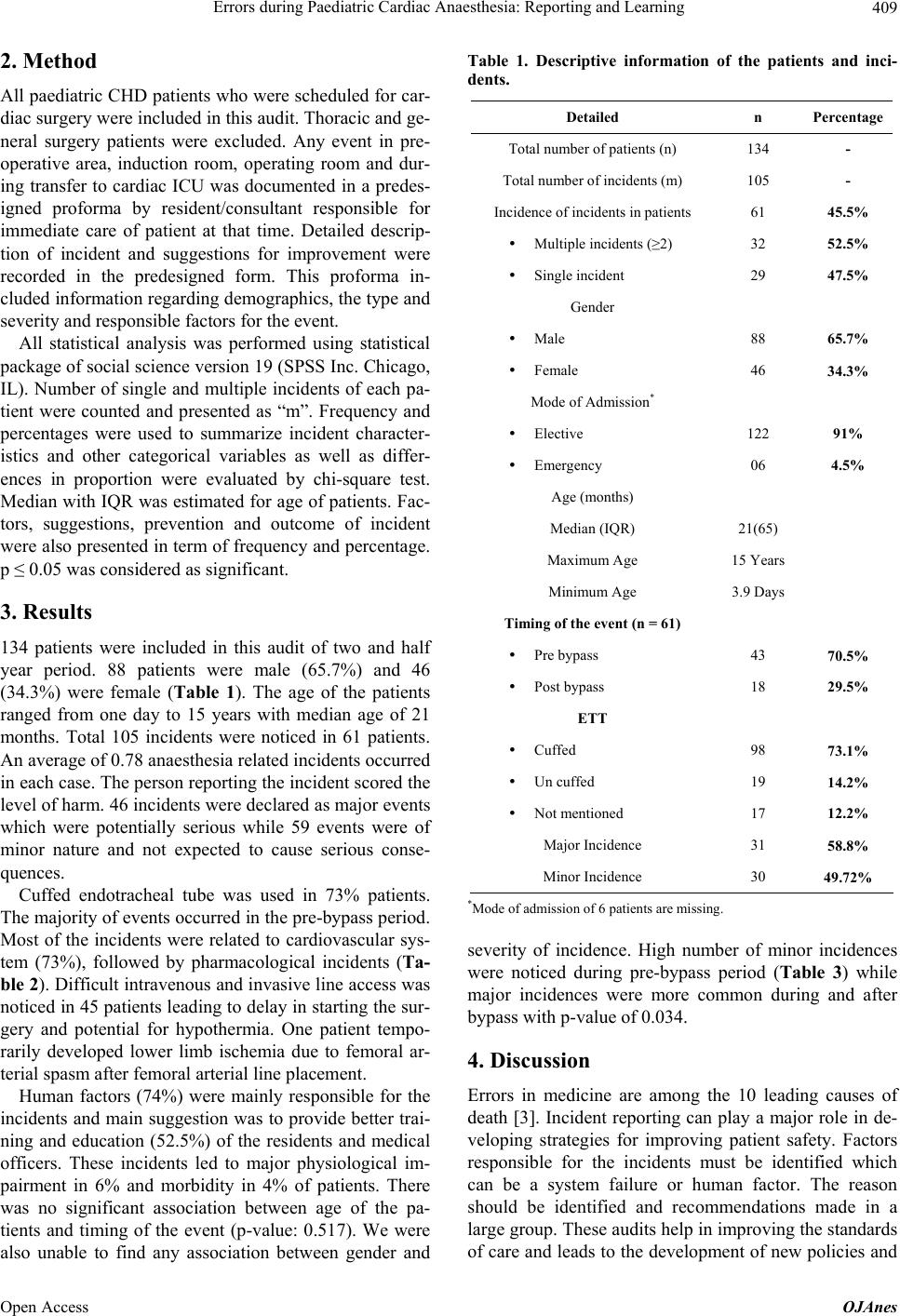 Errors during Paediatric Cardiac Anaesthesia: Reporting and Learning 409 2. Method All paediatric CHD patients who were scheduled for car- diac surgery were included in this audit. Thoracic and ge- neral surgery patients were excluded. Any event in pre- operative area, induction room, operating room and dur- ing transfer to cardiac ICU was documented in a predes- igned proforma by resident/consultant responsible for immediate care of patient at that time. Detailed descrip- tion of incident and suggestions for improvement were recorded in the predesigned form. This proforma in- cluded information regarding demographics, the type and severity and responsible factors for the event. All statistical analysis was performed using statistical package of social science version 19 (SPSS Inc. Chicago, IL). Number of single and multiple incidents of each pa- tient were counted and presented as “m”. Frequency and percentages were used to summarize incident character- istics and other categorical variables as well as differ- ences in proportion were evaluated by chi-square test. Median with IQR was estimated for age of patients. Fac- tors, suggestions, prevention and outcome of incident were also presented in term of frequency and percentage. p ≤ 0.05 was considered as significant. 3. Results 134 patients were included in this audit of two and half year period. 88 patients were male (65.7%) and 46 (34.3%) were female (Table 1). The age of the patients ranged from one day to 15 years with median age of 21 months. Total 105 incidents were noticed in 61 patients. An average of 0.78 anaesthesia related incidents occurred in each case. The person reporting the incident scored the level of harm. 46 incidents were declared as major events which were potentially serious while 59 events were of minor nature and not expected to cause serious conse- quences. Cuffed endotracheal tube was used in 73% patients. The majority of events occurred in the pre-bypass period. Most of the incidents were related to cardiovascular sys- tem (73%), followed by pharmacological incidents (Ta- ble 2). Difficult intravenous and invasive line access was noticed in 45 patients leading to delay in starting the sur- gery and potential for hypothermia. One patient tempo- rarily developed lower limb ischemia due to femoral ar- terial spasm after femoral arterial line placement. Human factors (74%) were mainly responsible for the incidents and main suggestion was to provide better trai- ning and education (52.5%) of the residents and medical officers. These incidents led to major physiological im- pairment in 6% and morbidity in 4% of patients. There was no significant association between age of the pa- tients and timing of the event (p-value: 0.517). We were also unable to find any association between gender and Table 1. Descriptive information of the patients and inci- dents. Detailed n Percentage Total number of patients (n) 134 - Total number of incidents (m) 105 - Incidence of incidents in patients 61 45.5% Multiple incidents (≥2) 32 52.5% Single incident 29 47.5% Gender Male 88 65.7% Female 46 34.3% Mode of Admission* Elective 122 91% Emergency 06 4.5% Age (months) Median (IQR) 21(65) Maximum Age 15 Years Minimum Age 3.9 Days Timing of the event (n = 61) Pre bypass 43 70.5% Post bypass 18 29.5% ETT Cuffed 98 73.1% Un cuffed 19 14.2% Not mentioned 17 12.2% Major Incidence 31 58.8% Minor Incidence 30 49.72% *Mode of admission of 6 patients are missing. severity of incidence. High number of minor incidences were noticed during pre-bypass period (Table 3) while major incidences were more common during and after bypass with p-value of 0.034. 4. Discussion Errors in medicine are among the 10 leading causes of death [3]. Incident reporting can play a major role in de- veloping strategies for improving patient safety. Factors responsible for the incidents must be identified which can be a system failure or human factor. The reason should be identified and recommendations made in a large group. These audits help in improving the standards of care and leads to the development of new policies and Open Access OJAnes 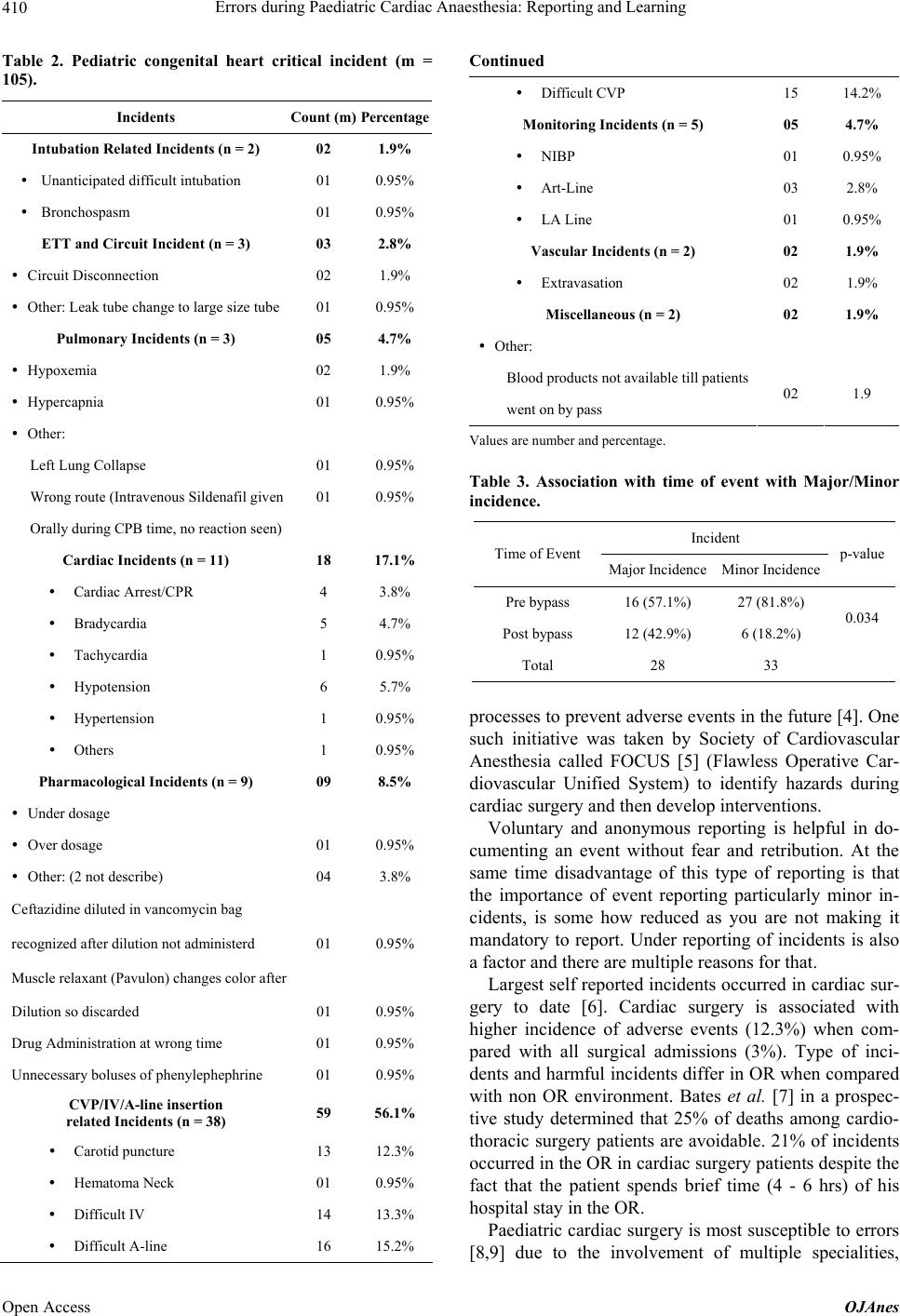 Errors during Paediatric Cardiac Anaesthesia: Reporting and Learning 410 Table 2. Pediatric congenital heart critical incident (m = 105). Incidents Count (m)Percentage Intubation Related Incidents (n = 2) 02 1.9% Unanticipated difficult intubation 01 0.95% Bronchospasm 01 0.95% ETT and Circuit Incident (n = 3) 03 2.8% Circuit Disconnection 02 1.9% Other: Leak tube change to large size tube 01 0.95% Pulmonary Incidents (n = 3) 05 4.7% Hypoxemia 02 1.9% Hypercapnia 01 0.95% Other: Left Lung Collapse 01 0.95% Wrong route (Intravenous Sildenafil given 01 0.95% Orally during CPB time, no reaction seen) Cardiac Incidents (n = 11) 18 17.1% Cardiac Arrest/CPR 4 3.8% Bradycardia 5 4.7% Tachycardia 1 0.95% Hypotension 6 5.7% Hypertension 1 0.95% Others 1 0.95% Pharmacological Incidents (n = 9) 09 8.5% Under dosage Over dosage 01 0.95% Other: (2 not describe) 04 3.8% Ceftazidine diluted in vancomycin bag recognized after dilution not administerd 01 0.95% Muscle relaxant (Pavulon) changes color after Dilution so discarded 01 0.95% Drug Administration at wrong time 01 0.95% Unnecessary boluses of phenylephephrine 01 0.95% CVP/IV/A-line insertion related Incidents (n = 38) 59 56.1% Carotid puncture 13 12.3% Hematoma Neck 01 0.95% Difficult IV 14 13.3% Difficult A-line 16 15.2% Continued Difficult CVP 15 14.2% Monitoring Incidents (n = 5) 05 4.7% NIBP 01 0.95% Art-Line 03 2.8% LA Line 01 0.95% Vascular Incidents (n = 2) 02 1.9% Extravasation 02 1.9% Miscellaneous (n = 2) 02 1.9% Other: Blood products not available till patients went on by pass 02 1.9 Values are number and percentage. Table 3. Association with time of event with Major/Minor incidence. Incident Time of Event Major Incidence Minor Incidence p-value Pre bypass 16 (57.1%) 27 (81.8%) Post bypass 12 (42.9%) 6 (18.2%) 0.034 Total 28 33 processes to prevent adverse events in the future [4]. One such initiative was taken by Society of Cardiovascular Anesthesia called FOCUS [5] (Flawless Operative Car- diovascular Unified System) to identify hazards during cardiac surgery and then develop interventions. Voluntary and anonymous reporting is helpful in do- cumenting an event without fear and retribution. At the same time disadvantage of this type of reporting is that the importance of event reporting particularly minor in- cidents, is some how reduced as you are not making it mandatory to report. Under reporting of incidents is also a factor and there are multiple reasons for that. Largest self reported incidents occurred in cardiac sur- gery to date [6]. Cardiac surgery is associated with higher incidence of adverse events (12.3%) when com- pared with all surgical admissions (3%). Type of inci- dents and harmful incidents differ in OR when compared with non OR environment. Bates et al. [7] in a prospec- tive study determined that 25% of deaths among cardio- thoracic surgery patients are avoidable. 21% of incidents occurred in the OR in cardiac surgery patients despite the fact that the patient spends brief time (4 - 6 hrs) of his hospital stay in the OR. Paediatric cardiac surgery is most susceptible to errors [8,9] due to the involvement of multiple specialities, Open Access OJAnes 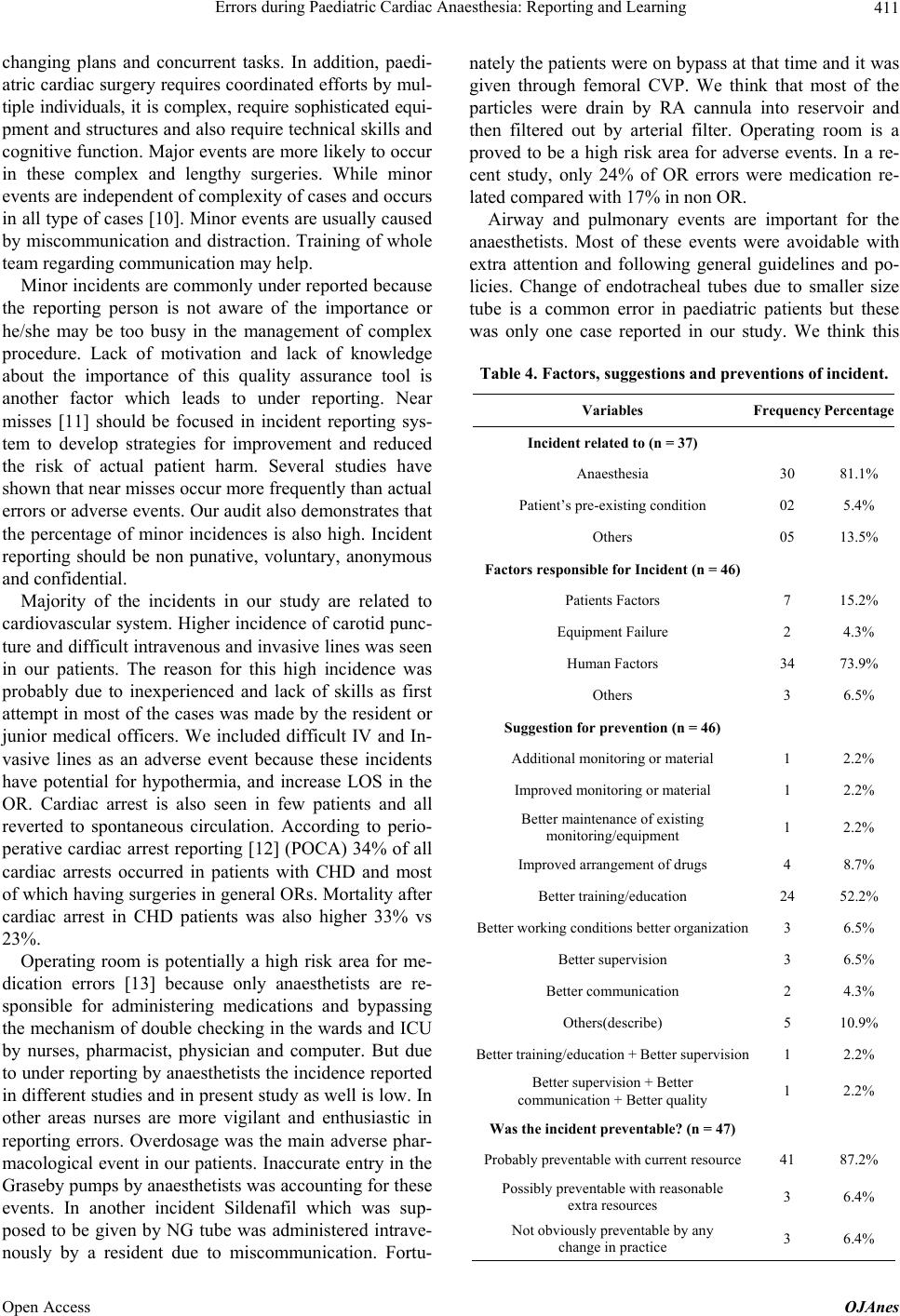 Errors during Paediatric Cardiac Anaesthesia: Reporting and Learning 411 changing plans and concurrent tasks. In addition, paedi- atric cardiac surgery requires coordinated efforts by mul- tiple individuals, it is complex, require sophisticated equi- pment and structures and also require technical skills and cognitive function. Major events are more likely to occur in these complex and lengthy surgeries. While minor events are independent of complexity of cases and occurs in all type of cases [10]. Minor events are usually caused by miscommunication and distraction. Training of whole team regarding communication may help. Minor incidents are commonly under reported because the reporting person is not aware of the importance or he/she may be too busy in the management of complex procedure. Lack of motivation and lack of knowledge about the importance of this quality assurance tool is another factor which leads to under reporting. Near misses [11] should be focused in incident reporting sys- tem to develop strategies for improvement and reduced the risk of actual patient harm. Several studies have shown that near misses occur more frequently than actual errors or adverse events. Our audit also demonstrates that the percentage of minor incidences is also high. Incident reporting should be non punative, voluntary, anonymous and confidential. Majority of the incidents in our study are related to cardiovascular system. Higher incidence of carotid punc- ture and difficult intravenous and invasive lines was seen in our patients. The reason for this high incidence was probably due to inexperienced and lack of skills as first attempt in most of the cases was made by the resident or junior medical officers. We included difficult IV and In- vasive lines as an adverse event because these incidents have potential for hypothermia, and increase LOS in the OR. Cardiac arrest is also seen in few patients and all reverted to spontaneous circulation. According to perio- perative cardiac arrest reporting [12] (POCA) 34% of all cardiac arrests occurred in patients with CHD and most of which having surgeries in general ORs. Mortality after cardiac arrest in CHD patients was also higher 33% vs 23%. Operating room is potentially a high risk area for me- dication errors [13] because only anaesthetists are re- sponsible for administering medications and bypassing the mechanism of double checking in the wards and ICU by nurses, pharmacist, physician and computer. But due to under reporting by anaesthetists the incidence reported in different studies and in present study as well is low. In other areas nurses are more vigilant and enthusiastic in reporting errors. Overdosage was the main adverse phar- macological event in our patients. Inaccurate entry in the Graseby pumps by anaesthetists was accounting for these events. In another incident Sildenafil which was sup- posed to be given by NG tube was administered intrave- nously by a resident due to miscommunication. Fortu- nately the patients were on bypass at that time and it was given through femoral CVP. We think that most of the particles were drain by RA cannula into reservoir and then filtered out by arterial filter. Operating room is a proved to be a high risk area for adverse events. In a re- cent study, only 24% of OR errors were medication re- lated compared with 17% in non OR. Airway and pulmonary events are important for the anaesthetists. Most of these events were avoidable with extra attention and following general guidelines and po- licies. Change of endotracheal tubes due to smaller size tube is a common error in paediatric patients but these was only one case reported in our study. We think this Table 4. Factors, suggestions and preventions of incident. Variables FrequencyPercentage Incident related to (n = 37) Anaesthesia 30 81.1% Patient’s pre-existing condition 02 5.4% Others 05 13.5% Factors responsible for Incident (n = 46) Patients Factors 7 15.2% Equipment Failure 2 4.3% Human Factors 34 73.9% Others 3 6.5% Suggestion for prevention (n = 46) Additional monitoring or material 1 2.2% Improved monitoring or material 1 2.2% Better maintenance of existing monitoring/equipment 1 2.2% Improved arrangement of drugs 4 8.7% Better training/education 24 52.2% Better working conditions better organization 3 6.5% Better supervision 3 6.5% Better communication 2 4.3% Others(describe) 5 10.9% Better training/education + Better supervision 1 2.2% Better supervision + Better communication + Better quality 1 2.2% Was the incident preventable? (n = 47) Probably preventable with current resource 41 87.2% Possibly preventable with reasonable extra resources 3 6.4% Not obviously preventable by any change in practice 3 6.4% Open Access OJAnes  Errors during Paediatric Cardiac Anaesthesia: Reporting and Learning Open Access OJAnes 412 has been under reported and this needs to be emphasize in group meetings [14]. Equipment related errors [15] are high in cardiac an- aesthesia in comparison to non cardiac group (37% vs 9%). Very low incidence of equipment failure leading to monitoring errors in our study is also due to under re- porting. ECG monitoring problem is very common in paediatric cardiac surgery but we no such incident is mentioned in any patient. Anaesthetists unusually avoid mentioning such minor but incidences which could have caused disastrous results. Human error was the major responsible for the events in our study (Table 4). These events were of minor na- ture. Factors like judgement errors, lack of experience and skills and miscommunication were identified. Most of the invasive lines were started by junior residents in paediatric CHD patients. These were closely supervised by the consultants but still we have seen higher incidence of carotid puncture and delays in inserting invasive lines. Human factors includes error of judgement, failure to check, technical failure of skills, lack of care, inexperi- ence, inattention or delusion, communication and teach- ing. Chance of error correction is usually possible in pre- bypass period but correction is difficult during bypass and post bypass period. Present audit has also shown that most of the major incidents occurred during this time, which in few cases led to major physiological derange- ment and morbidities. 5. Conclusion Present article provides support for the idea of imple- menting Incident reporting as a quality assurance tool in developing countries as well. It is cheap, feasible and helps in identifying areas which need improvement. On the basis of these findings, we can develop quality im- provement guidelines to enhance patient safety. REFERENCES [1] J. B. Cooper, R. S. Newbower, C. D. Long and B. Mc- Peek, “Preventable Anesthesia Mishaps: A Study of Hu- man Factors,” Anesthesiology, Vol. 49, No. 6, 1978, pp. 399-406. http://dx.doi.org/10.1097/00000542-197812000-00004 [2] A. A. Gawande, M. J. Zinner, D. M. Studdert and T. A. Brennan, “Analysis of Errors Reported by Surgeons at Three Teaching Hospitals,” Surgery, Vol. 133, No. 6, 2003, pp. 614-621. http://dx.doi.org/10.1067/msy.2003.169 [3] L. Homsted, “Institute of Medicine Report: To Err Is Hu- man: Building a Safer Health Care System,” The Florida Nurse, Vol. 48, No. 1, 2000, p. 6. [4] P. Sirivararom, T. Virankabutra, N. Hungsawanich, P. Premsamran and W. Sriraj, “The Thai Anesthesia Inci- dents Monitoring Study (Thai AIMS) of Adverse Events after Spinal Anesthesia: An Analysis of 1996 Incident Reports,” Journal of the Medical Association of Thailand, Vol. 92, No. 8, 2009, pp. 1033-1039. [5] E. A. Martinez, J. A. Marsteller, D. A. Thompson, et al., “The Society of Cardiovascular Anesthesiologists’ FO- CUS Initiative: Locating Errors through Networked Sur- veillance (LENS) Project Vision,” Anesthesia & Analge- sia, Vol. 110, No. 2, 2010, pp. 307-311. http://dx.doi.org/10.1213/ANE.0b013e3181c92b9c [6] E. A. Martinez, A. Shore, E. Colantuoni, et al., “Cardiac Surgery Errors: Results from the UK National Reporting and Learning System,” International Journal for Quality in Health Care, Vol. 23, No. 2, 2011, pp. 151-158. [7] D. W. Bates, D. J. Cullen, N. Laird, et al., “Incidence of Adverse Drug Events and Potential Adverse Drug Events, Implications for Prevention. ADE Prevention Study Group,” The Journal of the American Medical Association, Vol. 274, No. 1, 1995, pp. 29-34. [8] P. Barach, J. K. Johnson, A. Ahmad, et al., “A Prospec- tive Observational Study of Human Factors, Adverse Events, and Patient Outcomes in Surgery for Pediatric Cardiac Disease,” The Journal of Thoracic and Cardio- vascular Surgery, Vol. 136, No. 6, 2008, pp. 1422-1428. [9] S. K. R. Catchpole, A. E. Giddings, M. R. de Leval, et al., “Identification of Systems Failures in Successful Paediat- ric Cardiac Surgery,” Ergonomics, Vol. 49, No. 5-6, 2006, pp. 567-588. http://dx.doi.org/10.1080/00140130600568865 [10] R. P. Mahajan, “Critical Incident Reporting and Learn- ing,” The British Journal of Anaesthesia, Vol. 105, No. 1, 2010, pp. 69-75. http://dx.doi.org/10.1093/bja/aeq133 [11] M. Ricci, A. P. Goldman, M. R. de Leval, G. A. Cohen, F. Devaney and J. Carthey, “Pitfalls of Adverse Event Re- porting in Paediatric Cardiac Intensive Care,” Archives of Disease in Childhood, Vol. 89, No. 9, 2004, pp. 856-859. http://dx.doi.org/10.1136/adc.2003.040154 [12] J. M. Steven, “Congenital Heart Disease and Anesthe- sia-Related Cardiac Arrest: Connecting the Dots,” Anes- thesia & Analgesia, Vol. 110, No. 5, 2010, pp. 1255-1256. http://dx.doi.org/10.1213/ANE.0b013e3181d7c059 [13] A. D. Paix, M. F. Bullock, W. B. Runciman and J. A. Williamson, “Crisis Management during Anaesthesia: Pro- blems Associated with Drug Administration during An- aesthesia,” Quality & Safety in Health Care, Vol. 14, No. 3, 2005, p. E15. http://dx.doi.org/10.1136/qshc.2002.004119 [14] R. Maaloe, M. la Cour, A. Hansen, et al., “Scrutinizing Incident Reporting in Anaesthesia: Why Is an Incident Perceived as Critical?” Acta Anaesthesiologica Scandi- navica, Vol. 50, No. 8, 2006, pp. 1005-1013. http://dx.doi.org/10.1111/j.1399-6576.2006.01092.x [15] M. Chakravarthy, “Errors in Cardiac Anesthesia—A De- terrent to Patient Safety,” Annals of Cardiac Anaesthesia, Vol. 13, No. 2, 2010, pp. 87-88. http://dx.doi.org/10.4103/0971-9784.62925 |