

Paper Menu >>
Journal Menu >>
 Open Journal of Anesthesiology, 2013, 3, 388-392 Published Online November 2013 (http://www.scirp.org/journal/ojanes) http://dx.doi.org/10.4236/ojanes.2013.39082 Open Access OJAnes The Third Year Anesthesiology Residents’ Knowledge Regarding Pediatric Postoperative Pain Management Somboon Thienthong1, Jirawadee Seeh a no o1, Wimonrat Sriraj1, Suwannee Suraseranivongse2, Allen Finley3 1Department of Anesthesia, Faculty of Medicine, Khon Kaen University, Khon Kaen, Thailand; 2Department of Anesthesia, Faculty of Medicine, Siriraj Hospital, Mahidol University, Bangkok, Thailand; 3Department of Anesthesia, IWK Health Center, Dalhousie University, Halifax, Canada. Email: [email protected] Received September 15th, 2013; revised October 12th, 2013; accepted October 24th, 2013 Copyright © 2013 Somboon Thienthong et al. This is an open access article distributed under the Creative Commons Attribution License, which permits unrestricted use, distribution, and reproduction in any medium, provided the original work is properly cited. ABSTRACT Background: There are six Anesthesiology training centers in Thailand that are approved to operate the training pro- gram. An evidence of residents’ knowledge about pediatric postoperative pain management is needed for improving the program. Objective: To assess the third year anesthesiology residents’ knowledge about pediatric postoperative pain management. Materials and Methods: The questionnaire was adapted from previous studies. The questionnaire has 35 questions consisted of 17 multiple choice questions and 18 true or false questions to cover 2 domains: 1) use of age-appropriate pediatric pain assessment (10 questions) and 2) pediatric pain treatment (25 questions). Minimal pass- ing level of the questionnaire rated by three young anesthesiology staffs was 76.2%. All 62 participants were the 3rd year anesthesiology residents from 6 training centers. Data were analyzed by descriptive statistics. Results: The re- sponse rate was 95.2%. Seventy-one percent of participants reported that they had learned about pediatric pain treat- ment. Of those, 55.9% rated their remaining knowledg e at median level. The proportion of the correct score was 67.7% (mean 23.7 ± 2.9 SD) which was lower than the minimal passing level. The highest score was 29 and the lowest score was 16. For pain assessment domain; the mean proportion of correct score was 65% (range 90% - 40%). For pain treatment domain; the mean proportion of correct score was 68.8% (range 88% - 44%). Conclusion: Anesthesiology residents’ knowledge about pediatric postoperative pain management needs to be improved. Keywords: Anesthesiology Resident; Knowledge; Pediatric; Postoperative Pain Management 1. Introduction The Faculty of Medicine, Khon Kaen University per- formed 3725 cases of surgery on childr en and adolescent age below 20 years in 2010. It is important to provide adequate pain management to those patients as it can improve their recovery or decreases complications to avoid unnecessary prolonged hospital stay which in- creases the cost of treatment [1,2]. Until now, inadequ ate postoperative pain management for children continues to be reported in the literature. W. L. Chen [3] reported that parents and nurses also concerned about postoperative pain in children. The same concern was reported, about 45% of Canadian parents [4] and about 78% of Thai parents [5]. Among the factors influencing the outcomes of pain management, the age of children is an important one. For example, a good modality for pain relief like a patient-controlled analgesia pump could not be used by small children [6]. Another important factor is the know- ledge and attitude of health care providers about postop- erative pain management [7], especially anesthesiology residents who work closely with those patients. Saroyan et al. [8] reported that anesthesiology residents per- formed better than pediatric and orthopedic residents in answering questions related to their knowledge of acute pain management. The superior outcomes of anesthesi- ology residents were related to an opportunity of the di- rected educational programs. In 2012, there are six anes- thesiology training centers in Thailand that provide edu- cation for about 60 - 70 residents every year. All these training centers have to follow the same 3-year curricu- lum that is controlled by the Royal Colleg e of Anesthesi- ology Thailand. Even so, the situation of the six centers 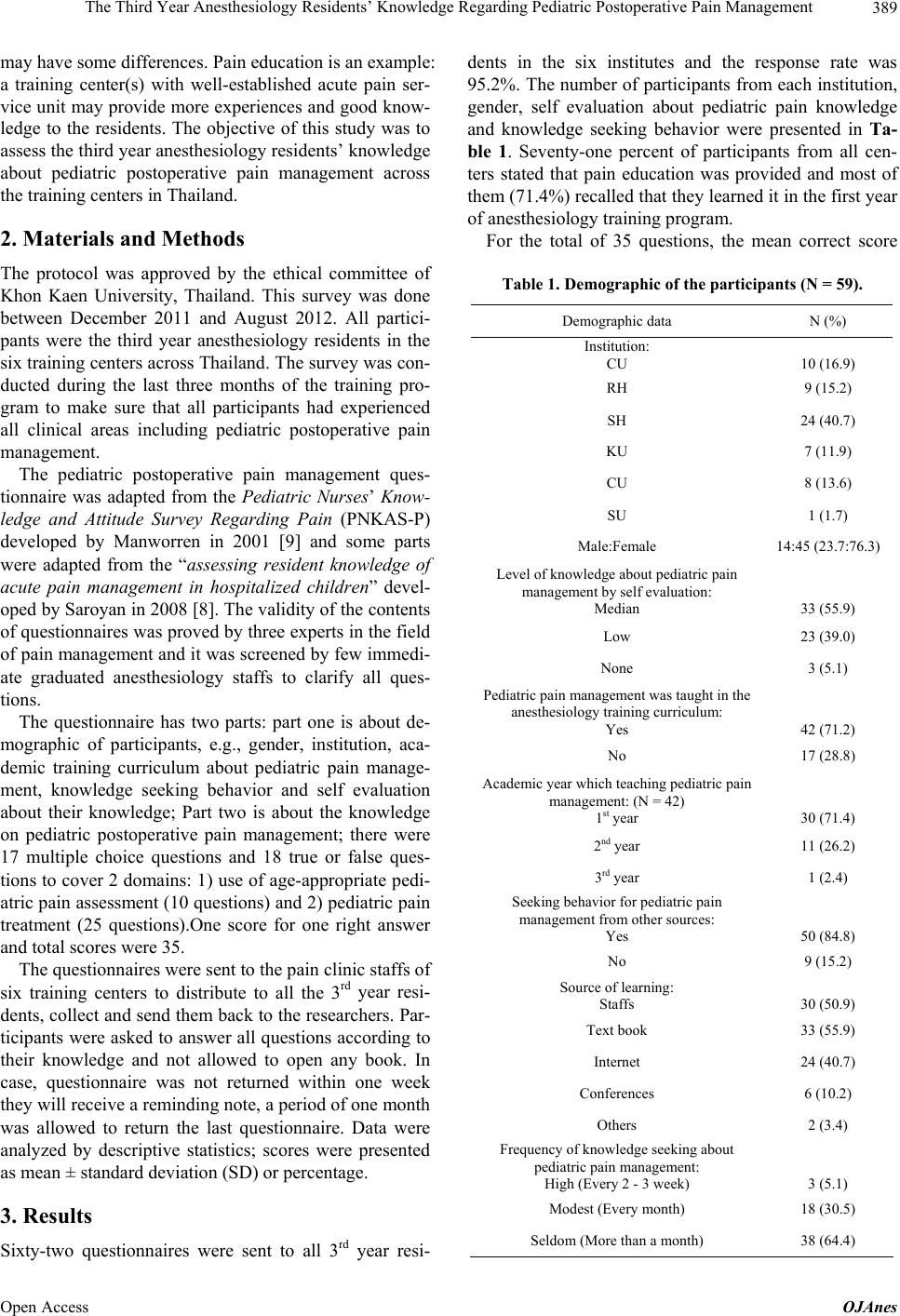 The Third Year Anesthesiology Residents’ Knowl edge Regarding Pediatric Postoperative Pain Management 389 may have some differences. Pain education is an example: a training center(s) with well-established acute pain ser- vice unit may provide more ex periences and good know- ledge to the residents. The objective of this study was to assess the third year anesthesiology residents’ knowledge about pediatric postoperative pain management across the training centers in Thailand. 2. Materials and Methods The protocol was approved by the ethical committee of Khon Kaen University, Thailand. This survey was done between December 2011 and August 2012. All partici- pants were the third year anesthesiology residents in the six training centers across Thailand. The survey was con- ducted during the last three months of the training pro- gram to make sure that all participants had experienced all clinical areas including pediatric postoperative pain management. The pediatric postoperative pain management ques- tionnaire was adapted from the Pediatric Nurses’ Know- ledge and Attitude Survey Regarding Pain (PNKAS-P) developed by Manworren in 2001 [9] and some parts were adapted from the “assessing resident knowledge of acute pain management in hospitalized children” devel- oped by Saroyan in 2008 [8]. The validity of the contents of questionnaires was proved by three experts in the field of pain management and it was screened by few immedi- ate graduated anesthesiology staffs to clarify all ques- tions. The questionnaire has two parts: part one is about de- mographic of participants, e.g., gender, institution, aca- demic training curriculum about pediatric pain manage- ment, knowledge seeking behavior and self evaluation about their knowledge; Part two is about the knowledge on pediatric postoperative pain management; there were 17 multiple choice questions and 18 true or false ques- tions to cover 2 domains: 1) use of age-appropriate pedi- atric pain assessment (10 questions) and 2) pediatric pain treatment (25 questions).One score for one right answer and total scores were 35. The questionnaires were sent to the pain clinic staffs of six training centers to distribute to all the 3rd year resi- dents, collect and send them back to the researchers. Par- ticipants were asked to answer all questions according to their knowledge and not allowed to open any book. In case, questionnaire was not returned within one week they will receive a reminding note, a period of one month was allowed to return the last questionnaire. Data were analyzed by descriptive statistics; scores were presented as mean ± standard deviation (SD) or percentage. 3. Results Sixty-two questionnaires were sent to all 3rd year resi- dents in the six institutes and the response rate was 95.2%. The number of participants from each institution, gender, self evaluation about pediatric pain knowledge and knowledge seeking behavior were presented in Ta- ble 1. Seventy-one percent of participants from all cen- ters stated that pain education was provided and most of them (71.4%) recalled that they learn ed it in th e first year of anesthesiology training program. For the total of 35 questions, the mean correct score Table 1. Demographic of the participants (N = 59). Demographic data N (%) Institution: CU 10 (16.9) RH 9 (15.2) SH 24 (40.7) KU 7 (11.9) CU 8 (13.6) SU 1 (1.7) Male:Female 14:45 (23.7:76.3) Level of knowledge about pediatric pain management by self evaluation: Median 33 (55.9) Low 23 (39.0) None 3 (5.1) Pediatric pain management was taught in the anesthesiology training curriculum: Yes 42 (71.2) No 17 (28.8) Academic year which teaching pediatric pain management: (N = 42) 1st year 30 (71.4) 2nd year 11 (26.2) 3rd year 1 (2.4) Seeking behavior for pediatric pain management from other sources: Yes 50 (84.8) No 9 (15.2) Source of learning: Staffs 30 (50.9) Text book 33 (55.9) Internet 24 (40.7) Conferences 6 (10.2) Others 2 (3.4) Frequency of knowledge seeking about pediatric pain management: High (Every 2 - 3 week) 3 (5.1) Modest (Every month) 18 (30.5) Seldom (More than a month) 38 (64.4) Open Access OJAnes 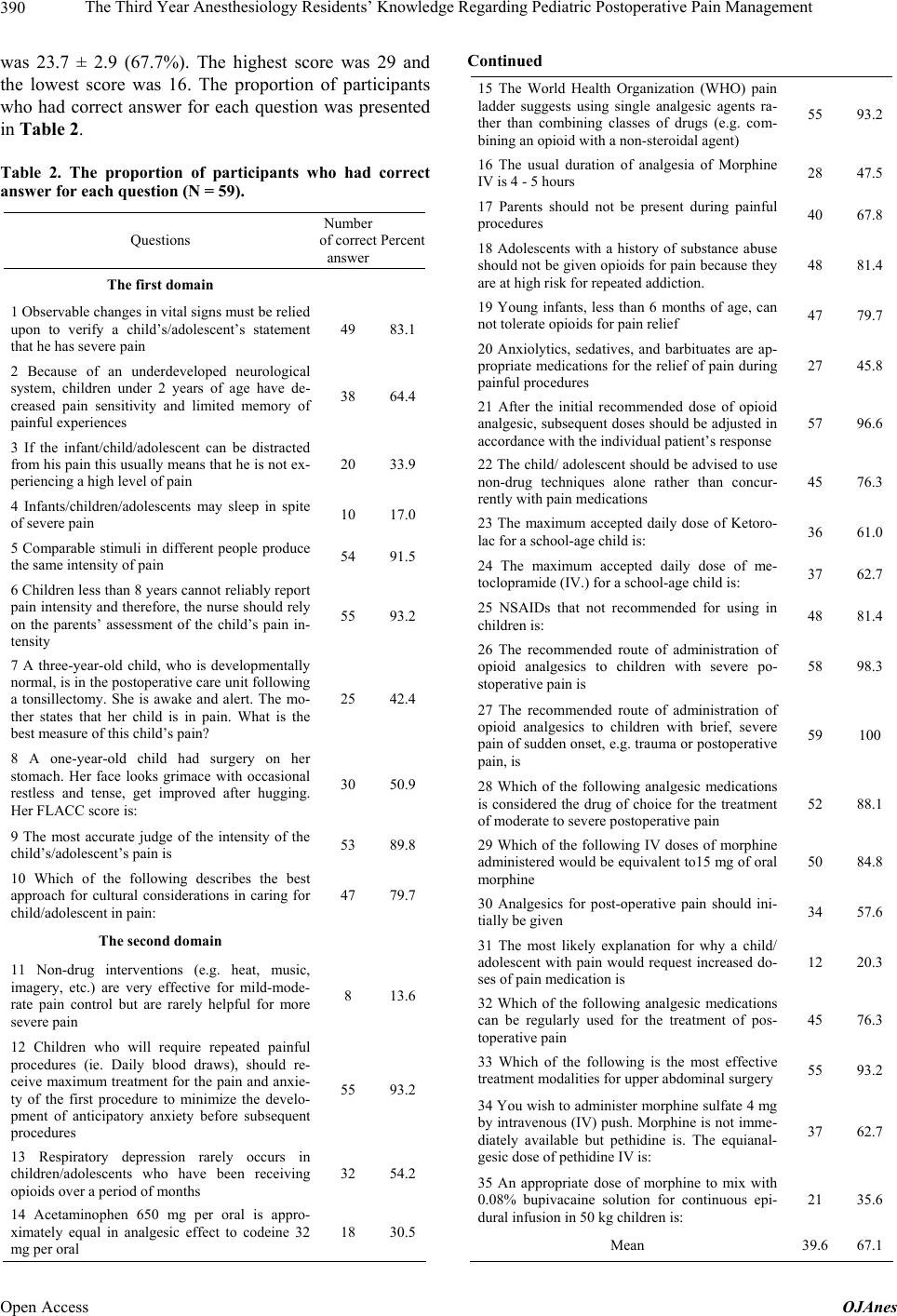 The Third Year Anesthesiology Residents’ Knowledge Regarding Pediatric Postoperative Pain Management 390 was 23.7 ± 2.9 (67.7%). The highest score was 29 and the lowest score was 16. The proportion of participants who had correct answer for each question was presented in Table 2. Table 2. The proportion of participants who had correct answer for each question (N = 59). Questions Number of correct answer Percent The first domain 1 Observable changes in vital signs must be relied upon to verify a child’s/adolescent’s statement that he has severe pain 49 83.1 2 Because of an underdeveloped neurological system, children under 2 years of age have de- creased pain sensitivity and limited memory of painful experiences 38 64.4 3 If the infant/child/adolescent can be distracted from his pain this usually means that he is not ex- periencing a high level of pain 20 33.9 4 Infants/children/adolescents may sleep in spite of severe pain 10 17.0 5 Comparable stimuli in different people produce the same intensity of pain 54 91.5 6 Children less than 8 years cannot reliably report pain intensity and therefore, the nurse should rely on the parents’ assessment of the child’s pain in- tensity 55 93.2 7 A three-year-old child, who is developmentally normal, is in the postoperative care unit following a tonsillectomy. She is awake and alert. The mo- ther states that her child is in pain. What is the best measure of this child’s pain? 25 42.4 8 A one-year-old child had surgery on her stomach. Her face looks grimace with occasional restless and tense, get improved after hugging. Her FLACC score is: 30 50.9 9 The most accurate judge of the intensity of the child’s/adolescent’s pain is 53 89.8 10 Which of the following describes the best approach for cultural considerations in caring for child/adolescent in pain: 47 79.7 The second domain 11 Non-drug interventions (e.g. heat, music, imagery, etc.) are very effective for mild-mode- rate pain control but are rarely helpful for more severe pain 8 13.6 12 Children who will require repeated painful procedures (ie. Daily blood draws), should re- ceive maximum treatment for the pain and anxie- ty of the first procedure to minimize the develo- pment of anticipatory anxiety before subsequent procedures 55 93.2 13 Respiratory depression rarely occurs in children/adolescents who have been receiving opioids over a pe riod of months 32 54.2 14 Acetaminophen 650 mg per oral is appro- ximately equal in analgesic effect to codeine 32 mg per oral 18 30.5 Continued 15 The World Health Organization (WHO) pain ladder suggests using single analgesic agents ra- ther than combining classes of drugs (e.g. com- bining an opioid with a non-steroidal agent) 55 93.2 16 The usual duration of analgesia of Morphine IV is 4 - 5 hours 28 47.5 17 Parents should not be present during painful procedures 40 67.8 18 Adolescents with a history of substance abuse should not be given opioids for pain because they are at high risk for repeated addiction. 48 81.4 19 Young infants, less than 6 months of age, can not tolerate opioids for pain relief 47 79.7 20 Anxiolytics, sedatives, and barbituates are ap- propriate medications for the relief of pain during painful procedures 27 45.8 21 After the initial recommended dose of opioid analgesic, subsequent doses should be adjusted in accordance with the individual patient’s response 57 96.6 22 The child/ adolescent should be advised to use non-drug techniques alone rather than concur- rently with pain medications 45 76.3 23 The maximum accepted daily dose of Ketoro- lac for a school-age child is: 36 61.0 24 The maximum accepted daily dose of me- toclopramid e (IV.) for a school -age child is: 37 62.7 25 NSAIDs that not recommended for using in children is: 48 81.4 26 The recommended route of administration of opioid analgesics to children with severe po- stoperative pain is 58 98.3 27 The recommended route of administration of opioid analgesics to children with brief, severe pain of sudden onset, e.g. trauma or postoperative pain, is 59 100 28 Which of the following analgesic medications is considered the drug of choice for the treatment of moderate to severe postoperative pain 52 88.1 29 Which of the following IV doses of morphine administered would be equivalent to15 mg of oral morphine 50 84.8 30 Analgesics for post-operative pain should ini- tially be given 34 57.6 31 The most likely explanation for why a child/ adolescent with pain would request increased do- ses of pain med i c a t i o n i s 12 20.3 32 Which of the following analgesic medications can be regularly used for the treatment of pos- toperative pain 45 76.3 33 Which of the following is the most effective treatment modalities for upper abdominal surgery 55 93.2 34 You wish to administer morphine sulfate 4 mg by intravenous (IV) push. Morphine is not imme- diately available but pethidine is. The equianal- gesic dose of pethidine IV is: 37 62.7 35 An appropriate dose of morphine to mix with 0.08% bupivacaine solution for continuous epi- dural infusion in 50 kg children is: 21 35.6 Mean 39.6 67.1 Open Access OJAnes  The Third Year Anesthesiology Residents’ Knowl edge Regarding Pediatric Postoperative Pain Management 391 For 10 questions about the use of age-appropriate pe- diatric pain assessment domain, the mean correct score was 6.5 (65%). The highest score was 9 (90%) and the lowest score was 4 (40%). There were 3 questions from this domain that less than 50% of participants gave cor- rect answers. For 25 questions about the pediatric pain treatment domain; the mean correct score was 17.2 (68.8%). The highest score was 22 (88%) and the lowest score was 11 (44%). There were 5 questions from this domain that less than 50% of participants gave correct answers. 4. Discussion Children’s pain is often underestimated and undertreated. Our previou s survey found that pediatric health care pro- viders in the Northeastern Thailand needed to improve their knowledge and skills about pediatric pain manage- ment [10]. It is common that knowledge and skills gra- dually decrease after learning so mething, especially, when the knowledge is not integrated into practice. Therefore, adequate knowledge and skills about pediatric pain ma- nagement are necessary for anesthesiology residents be- fore their graduation. Although many numbers of ques- tions in this study were adapted from the nurses’ knowl- edge and attitudes regarding pediatric pain [9], those questions were the general knowledge and were inte- grated well in the qu estionnaire. Thus, it is ap propriate to use those questions to evaluate any pediatric care provi- ders’ competency in pain management. In the present study, 71% of the participants from 6 centers recalled that pain education was provided during the anesthesiol- ogy training program. In addition to the training program, about 50% of the residents continued their self-study either by reading books (55.9%), internet based learning (40.7%) or other ways. The level of knowledge evaluated by the residents themselves was modest and was corre- lated with the mean correct score (67.7%) of the test. The present study assessed only th e anesthesiology re- sidents’ knowledge but not compared with that of the residents in other disciplines. Saroyan et al. [8] assessed pediatric pain knowledge among 3 residency training pro- grams and found that anesthesiology residents had better knowledge compared to orthopedic or pediatric residents. The mean correct score of anesthesiology residents in the present study was not different from the study on radio- therapy residents done by Porzio et al. [11] in 2005 (67.7% vs 63.7%). Although the questionnaire in their stu- dy had less number of items compared to the present stu- dy (16 items vs 35 items) and they had only 3 questions that specific to pediatric pain management. Hameedand Sweedan [12] assessed the knowledge of 101 pediatric resident doctors in 3 training centers in Baghdad about neonatal pain and found that knowledge is increasing by the year of training (21.7% in the 1st year, 55.2% in the 2nd year and 57.1% in the 3rd year) but their knowledge was still inadequate when compared to other studies in developing countries [13,14]. There were 8 questions in the present study that the correct answer was given by less than 50% of partici- pants. The reasons for this poor performance were not clear because it might be related to the questions them- selves (difficult questions or unclear questions) or related to students’ factor or other factors. We knew that all 6 training centers had both pain specialists and pediatric anesthesia specialists to con tribute to give knowledge for their residents. If the training program provides more time for residents to rotate in the pediatric area, the qual- ity of knowledge about pediatric postoperative pain ma- nagement would be improved further. A know-do gap of physicians was another aspect that should be concerned because it played a major role in pediatric pain management. The present study did not assess directly about attitudes and practices of the resi- dents. In the previous study by V. R. Breakey et al. [15], the attitudes and practices for analgesia and sedation during lumbar puncture to pediatric patients were com- pared between pediatric residents and emergency medi- cine residents, and they found that pediatric residents used less injectable local anesthetic and used more seda- tion for lumbar puncture than did emergency medicine residents. There were some limitations in the present study: fir- stly, one of the six training centers, there was only one 3rd year resident. Therefore his score might not represent a real mean score of that center. Secondly, the question- naires were evaluated for content validity and did a few cases pilot surveys but the coefficient of validity was no t calculated. The reasons to explain 8 questions with low proportion of correct answer remain un clear and may re- quire further modification. In conclusion, Pain education has been provided dur- ing Anesthesiology training programs in Thailand. How- ever, the third year anesthesiology residents’ knowledge about pediatric postoperative pain management needs to be improved. 5. Acknowledgements The authors would like to thank anesthesiology residents who had participated in this survey, pain clinic staffs whose supported data collection and Professor Yukifumi Nawa for assistance in manuscript preparation. This re- searchwas made possible by a Teasdale-Corti Team Grant from the Global Health Research Initiative, admi- nistered by the International Development Research Centre (IDRC), Canada. REFERENCES [1] F. Bonnet and E. Marret, “Postoperative Pain Manage- Open Access OJAnes  The Third Year Anesthesiology Residents’ Knowledge Regarding Pediatric Postoperative Pain Management Open Access OJAnes 392 ment and Outcome after Surgery,” Best Practice & Re- search Clinical Anaesthesiology, Vol. 21, No. 1, 2007, pp. 99-107. http://dx.doi.org/10.1016/j.bpa.2006.12.007 [2] M. L. Peters, M. Sommer, M. van Kleef and M. A. Marcu, “Predictors of Physical and Emotional Recovery 6 and 12 Months after Surgery,” 2011. http://onlinelibrary.wiley.com [3] W. L. Chen, “Nurses’ an d Parents’ Attitudes toward Pain Management & Parental Participation in Postoperative Care of Children,” 2011. http://eprints.qut.edu.au/16127/ [4] N. Sikich, A. S. Carr and J. Lerman, “Parental Percep- tions, Expectations and Preferences for the Post-Anaes- thetic Recovery of Children,” Pediatric Anesthesia, Vol. 7, No. 2, 1997, pp. 139-142. http://dx.doi.org/10.1046/j.1460-9592.1997.d01-62.x [5] W. Krisanaprakornkit, W. Chaiwong, M. Thananan, R. Khamhom and D. Nonlaopol, “Parental Requirements for Peri-Operative Information in Srinagarind Hospital,” 64th Annual Meeting, Royal College of Anesthesiologists of Thailand, Bangkok, 20 August 2006, p. 19. [6] C. L. Monitto, R. S. Greenberg, S. Kost-Byerly, et al., “The Safety and Efficacy of Parent-/Nurse-Controlled Analgesia in Patients Less than Six Years of Age,” Anes- thesia & Analgesia, Vol. 91, No. 3, 2000, pp. 573-579. http://dx.doi.org/10.1213/00000539-200009000-00014 [7] A. Twycross and A. Williams, “Establishing the Validity and Reliability of a Pediatric Pain Knowledge and Atti- tudes Questionnaire,” Pain Management Nursing, Vol. 14, No. 3, 2011, pp. E47-E53. http://dx.doi.org/10.1016/j.pmn.2011.03.001 [8] J. M. Saroyan, W. S. Schechter, M. E. Tresgallo, et al., “Assessing Resident Knowledge of Acute Pain Manage- ment in Hospitalized Children: A Pilot Study,” Journal of Pain and Symptom Management, Vol. 36, No. 6, 2008, pp. 628-638. http://dx.doi.org/10.1016/j.jpainsymman.2007.12.006 [9] R. C. Manworren, “Development and Testing of the Pe- diatric Nurses’ Knowledge and Attitudes Survey Regard- ing Pain,” Pediatric Nursing, Vol. 27, No. 2, 2011, pp. 151-158. [10] P. A. Forgeron, D. Jongudomkarn, J. Evans, G. A. Finley, S. Thienthong, P. Siripul, et al., “Children’s Pain As- sessment in Northeastern Thailand: Perspectives of Health Professionals,” Qualitative Health Research, Vol. 19, No. 1, 2009, pp. 71-81. [11] G. Porzio, M. Valenti, F. Aielli, L. Verna, F. Narducci, M. Valeriani, et al., “Pain Evaluation and Management: A Survey of Italian Radiotherapists,” Supportive Care in Cancer, Vol. 13, No. 4, 2005, pp. 215-218. http://dx.doi.org/10.1007/s00520-004-0687-1 [12] N. N. Hameed and B. H. Sweedan, “Assessment of Knowledge of Pediatric Resident Doctors about Neonatal Pain,” The Iraqi Postgraduate Medical Journal, Vol. 11, No. 4, 2012, pp. 443-452. [13] P. Heaton, D. Herd, A. Fernando, D. Herd and A. Fer- nand, “Pain Relief for Simple Procedures in New Zealand Neonatal Units Practice Change over Six Years,” Journal of Paediatrics and Child Health, Vol. 43, No. 5, 2007, pp. 394-397. http://dx.doi.org/10.1111/j.1440-1754.2007.01086.x [14] P. H. Gray, J. A. Trotter, P. Langbridge and C. V. Do- herty, “Pain Relief for Neonates in Australian Hospital: A Need to Improve Evidence-Based Practice,” Journal of Paediatrics and Child Health, Vol. 42, No. 1-2, 2006, pp. 10-13. http://dx.doi.org/10.1111/j.1440-1754.2006.00782.x [15] V. R. Breakey, J. Pirie and R. D. Goldman, “Pediatric and Emergency Medicine Residents’ Attitudes and Practices for Analgesia and Sedation during Lumbar Puncture in Pediatric Patients,” Pediatrics, Vol. 119, No. 3, 2007, pp. E631-E636. http://dx.doi.org/10.1542/peds.2006-0727 |