

Paper Menu >>
Journal Menu >>
 Open Journal of Anesthesiology, 2013, 3, 379-382 Published Online November 2013 (http://www.scirp.org/journal/ojanes) http://dx.doi.org/10.4236/ojanes.2013.39080 Open Access OJAnes 379 Comparison between 0.06% and 0.1% Levobupivacaine Combined with 2 μg/mL of Fentanyl for Epidural Labor Analgesia Takako Hamada, Mariko Baba, Masaki Sato, Takayuki Saito, Keisuke Murakami, Hiroyuki Sumikura* Obstetric Anesthesia Department, National Center for Child Health and Development, Tokyo, Japan. Email: *[email protected] Received September 9th, 2013; revised September 27th, 2013; accepted October 8th, 2013 Copyright © 2013 Takako Hamada et al. This is an open access article distributed under the Creative Commons Attribution License, which permits unrestricted use, distribution, and reproduction in any medium, provided the original work is properly cited. ABSTRACT Purpose: Levobupivacaine is thought to be a good alternative to bupivacaine for epidural labor analgesia because of its pharmacologic profile. However, the optimal concentration of levobupivacaine for labor analgesia has not been ade- quately studied. The objective of this retrospective study was to compare the analgesic effect of levobupivacaine be- tween 0.06% and 0.1% both combined with 2 μg/mL of fentanyl. Methods: Primiparous women (ASA I, II) who deliv- ered their babies to our hospital using combined spinal epidural analgesia and patient-controlled epidural analgesia be- tween August 1, 2011 and September 30, 2011 were included into this retrospective study. The analgesic solution for epidural administration was 0.06% levobupivacaine with 2 μg/mL of fentanyl between August 1 and 31, and 0.1% levobupivacaine with 2 μg/mL of fentanyl between September 1 and 30. Their anesthetic and obstetric charts were re- viewed to compare obstetric outcome, anesthetic intervention, and patients’ satisfaction. Results: There were 46 women fulfilling the inclusion criteria: 23 women in 0.06% group, and 23 women in 0.1% group. The number of patients who needed more than 3 requests for one actual bolus was significantly higher in the 0.06% group (P < 0.05). Conclusion: Our results revealed that 0.06% levobupivacaine combined with 2 μg/mL fentanyl does not provide sufficient analgesic effects for epidural labor analgesia. It seems that levobupivacaine has not been adequately studied after its withdrawal from the US market. Further studies should be conducted to determine the optimal concentration of levobupivacaine for epidural labor analgesia. Keywords: PCEA; CSEA; Labor Analgesia; Levobupivacaine 1. Introduction Levobupivacaine is a pure S(−) enantiomer of racemic bupivacaine, whereas bupivacaine consists of both an S(–) enantiomer and R(+) enantiomer [1,2]. Levobupivacaine is thought to be a good alternative to racemic bupiva- caine for epidural labor analgesia because the S(−) enan- tiomer has less affinity for the sodium channels and thus has fewer depressant effects on the cardiovascular and central nervous systems than the R(+) enantiomer. How- ever, the optimal concentration of levobupivacaine for la- bor analgesia has not been adequately studied. At the National Center for Child Health and Develop- ment, where combined spinal epidural analgesia (CSEA) followed by patient-controlled epidural analgesia (PCEA) has been adopted as a standard technique for labor anal- gesia, a combination of 0.1% ropivacaine with 2 μg/mL of fentanyl had been used effectively as a PCEA solution until the end of July in 2011. However, our pharmaceu- tical department needed to reduce the number of items of local anesthetics, and decided to delete ropivacaine from the list for regular stock. Hence, we had to change the lo- cal anesthetic for labor analgesia from ropivacaine to le- vobupivacaine. Although levobupivacaine has been used for labor an- algesia in some countries [3], we found that an optimal concentration of levobupivacaine has not been well stud- ied by reviewing textbooks and literatures describing levobupivacaine for epidural labor analgesia. Therefore *Corresponding author. 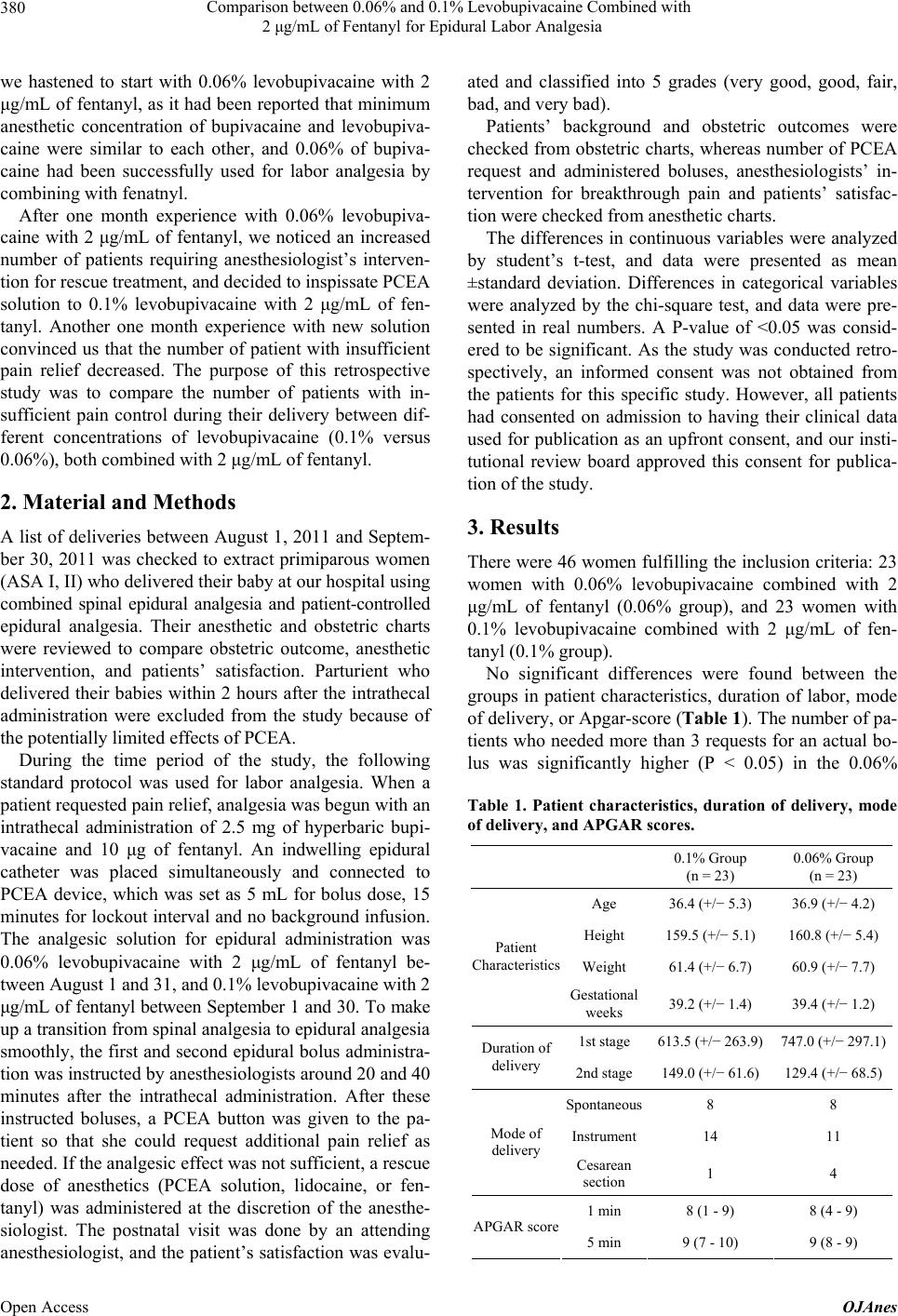 Comparison between 0.06% and 0.1% Levobupivacaine Combined with 2 μg/mL of Fentanyl for Epidural Labor Analgesia 380 we hastened to start with 0.06% levobupivacaine with 2 μg/mL of fentanyl, as it had been reported that minimum anesthetic concentration of bupivacaine and levobupiva- caine were similar to each other, and 0.06% of bupiva- caine had been successfully used for labor analgesia by combining with fenatnyl. After one month experience with 0.06% levobupiva- caine with 2 μg/mL of fentanyl, we noticed an increased number of patients requiring anesthesiologist’s interven- tion for rescue treatment, and decided to inspissate PCEA solution to 0.1% levobupivacaine with 2 μg/mL of fen- tanyl. Another one month experience with new solution convinced us that the number of patient with insufficient pain relief decreased. The purpose of this retrospective study was to compare the number of patients with in- sufficient pain control during their delivery between dif- ferent concentrations of levobupivacaine (0.1% versus 0.06%), both combined with 2 μg/mL of fentanyl. 2. Material and Methods A list of deliveries between August 1, 2011 and Septem- ber 30, 2011 was checked to extract primiparous women (ASA I, II) who delivered their baby at our hospital using combined spinal epidural analgesia and patient-controlled epidural analgesia. Their anesthetic and obstetric charts were reviewed to compare obstetric outcome, anesthetic intervention, and patients’ satisfaction. Parturient who delivered their babies within 2 hours after the intrathecal administration were excluded from the study because of the potentially limited effects of PCEA. During the time period of the study, the following standard protocol was used for labor analgesia. When a patient requested pain relief, analgesia was begun with an intrathecal administration of 2.5 mg of hyperbaric bupi- vacaine and 10 μg of fentanyl. An indwelling epidural catheter was placed simultaneously and connected to PCEA device, which was set as 5 mL for bolus dose, 15 minutes for lockout interval and no background infusion. The analgesic solution for epidural administration was 0.06% levobupivacaine with 2 μg/mL of fentanyl be- tween August 1 and 31, and 0.1% levobupivacaine with 2 μg/mL of fentanyl between September 1 and 30. To make up a transition from spinal analgesia to epidural analgesia smoothly, the first and second epidural bolus administra- tion was instructed by anesthesiologists around 20 and 40 minutes after the intrathecal administration. After these instructed boluses, a PCEA button was given to the pa- tient so that she could request additional pain relief as needed. If the analgesic effect was not sufficient, a rescue dose of anesthetics (PCEA solution, lidocaine, or fen- tanyl) was administered at the discretion of the anesthe- siologist. The postnatal visit was done by an attending anesthesiologist, and the patient’s satisfaction was evalu- ated and classified into 5 grades (very good, good, fair, bad, and very bad). Patients’ background and obstetric outcomes were checked from obstetric charts, whereas number of PCEA request and administered boluses, anesthesiologists’ in- tervention for breakthrough pain and patients’ satisfac- tion were checked from anesthetic charts. The differences in continuous variables were analyzed by student’s t-test, and data were presented as mean ±standard deviation. Differences in categorical variables were analyzed by the chi-square test, and data were pre- sented in real numbers. A P-value of <0.05 was consid- ered to be significant. As the study was conducted retro- spectively, an informed consent was not obtained from the patients for this specific study. However, all patients had consented on admission to having their clinical data used for publication as an upfront consent, and our insti- tutional review board approved this consent for publica- tion of the study. 3. Results There were 46 women fulfilling the inclusion criteria: 23 women with 0.06% levobupivacaine combined with 2 μg/mL of fentanyl (0.06% group), and 23 women with 0.1% levobupivacaine combined with 2 μg/mL of fen- tanyl (0.1% group). No significant differences were found between the groups in patient characteristics, duration of labor, mode of delivery, or Apgar-score (Table 1). The number of pa- tients who needed more than 3 requests for an actual bo- lus was significantly higher (P < 0.05) in the 0.06% Table 1. Patient characteristics, duration of delivery, mode of delivery, and APGAR scores. 0.1% Group (n = 23) 0.06% Group (n = 23) Age 36.4 (+/− 5.3) 36.9 (+/− 4.2) Height 159.5 (+/− 5.1) 160.8 (+/− 5.4) Weight 61.4 (+/− 6.7) 60.9 (+/− 7.7) Patient Characteristics Gestational weeks 39.2 (+/− 1.4) 39.4 (+/− 1.2) 1st stage 613.5 (+/− 263.9) 747.0 (+/− 297.1) Duration of delivery 2nd stage149.0 (+/− 61.6) 129.4 (+/− 68.5) Spontaneous8 8 Instrument14 11 Mode of delivery Cesarean section 1 4 1 min 8 (1 - 9) 8 (4 - 9) APGAR score 5 min 9 (7 - 10) 9 (8 - 9) Open Access OJAnes 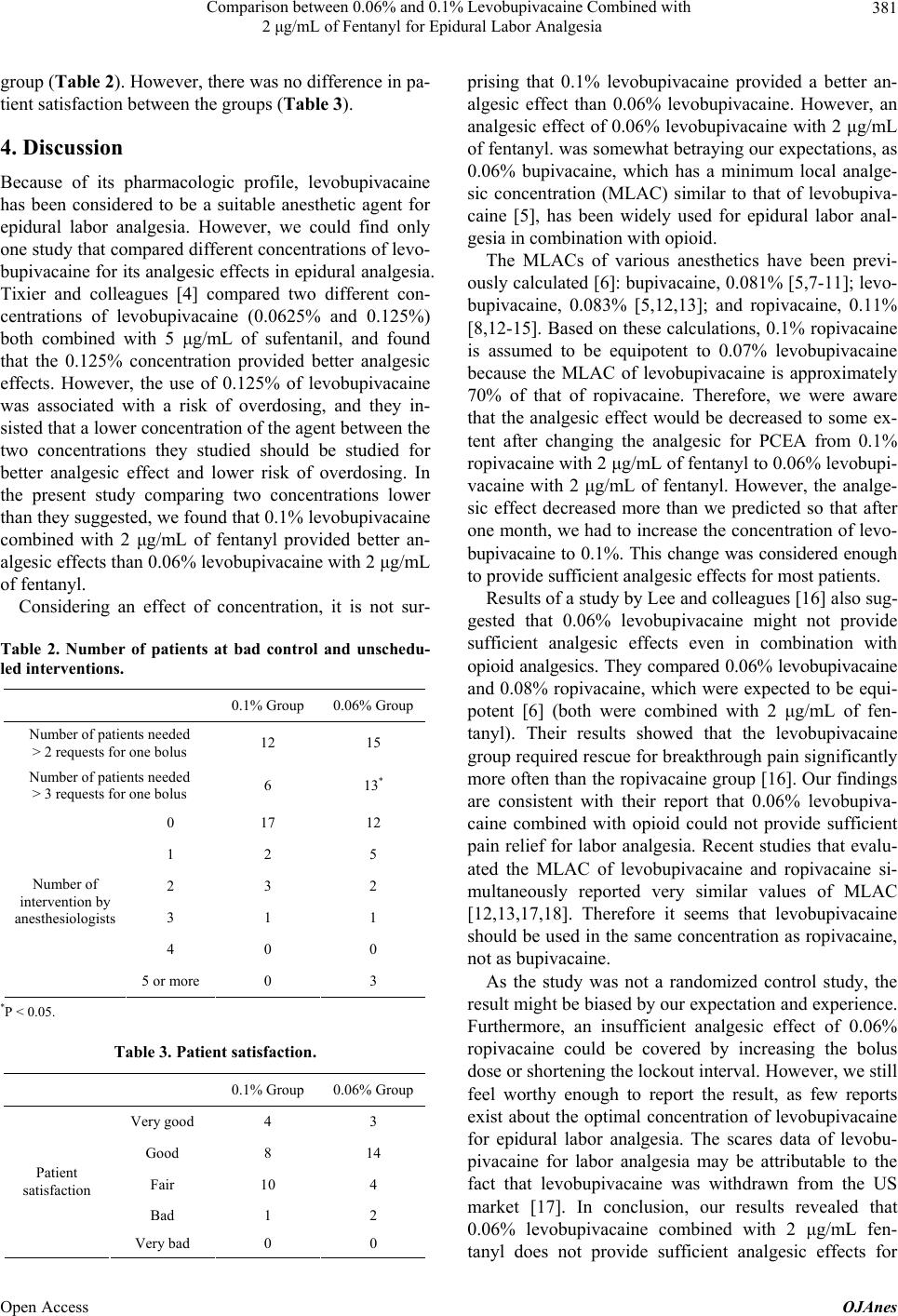 Comparison between 0.06% and 0.1% Levobupivacaine Combined with 2 μg/mL of Fentanyl for Epidural Labor Analgesia 381 group (Table 2). However, there was no difference in pa- tient satisfaction between the groups (Table 3). 4. Discussion Because of its pharmacologic profile, levobupivacaine has been considered to be a suitable anesthetic agent for epidural labor analgesia. However, we could find only one study that compared different concentrations of levo- bupivacaine for its analgesic effects in epidural analgesia. Tixier and colleagues [4] compared two different con- centrations of levobupivacaine (0.0625% and 0.125%) both combined with 5 μg/mL of sufentanil, and found that the 0.125% concentration provided better analgesic effects. However, the use of 0.125% of levobupivacaine was associated with a risk of overdosing, and they in- sisted that a lower concentration of the agent between the two concentrations they studied should be studied for better analgesic effect and lower risk of overdosing. In the present study comparing two concentrations lower than they suggested, we found that 0.1% levobupivacaine combined with 2 μg/mL of fentanyl provided better an- algesic effects than 0.06% levobupivacaine with 2 μg/mL of fentanyl. Considering an effect of concentration, it is not sur- Table 2. Number of patients at bad control and unschedu- led interventions. 0.1% Group 0.06% Group Number of patients needed > 2 requests for one bolus 12 15 Number of patients needed > 3 requests for one bolus 6 13* 0 17 12 1 2 5 2 3 2 3 1 1 4 0 0 Number of intervention by anesthesiologists 5 or more 0 3 *P < 0.05. Table 3. Patient satisfaction. 0.1% Group 0.06% Group Very good 4 3 Good 8 14 Fair 10 4 Bad 1 2 Patient satisfaction Very bad 0 0 prising that 0.1% levobupivacaine provided a better an- algesic effect than 0.06% levobupivacaine. However, an analgesic effect of 0.06% levobupivacaine with 2 μg/mL of fentanyl. was somewhat betraying our expectations, as 0.06% bupivacaine, which has a minimum local analge- sic concentration (MLAC) similar to that of levobupiva- caine [5], has been widely used for epidural labor anal- gesia in combination with opioid. The MLACs of various anesthetics have been previ- ously calculated [6]: bupivacaine, 0.081% [5,7-11]; levo- bupivacaine, 0.083% [5,12,13]; and ropivacaine, 0.11% [8,12-15]. Based on these calculations, 0.1% ropivacaine is assumed to be equipotent to 0.07% levobupivacaine because the MLAC of levobupivacaine is approximately 70% of that of ropivacaine. Therefore, we were aware that the analgesic effect would be decreased to some ex- tent after changing the analgesic for PCEA from 0.1% ropivacaine with 2 μg/mL of fentanyl to 0.06% levobupi- vacaine with 2 μg/mL of fentanyl. However, the analge- sic effect decreased more than we predicted so that after one month, we had to increase the concentration of levo- bupivacaine to 0.1%. This change was considered enough to provide sufficient analgesic effects for most patients. Results of a study by Lee and colleagues [16] also sug- gested that 0.06% levobupivacaine might not provide sufficient analgesic effects even in combination with opioid analgesics. They compared 0.06% levobupivacaine and 0.08% ropivacaine, which were expected to be equi- potent [6] (both were combined with 2 μg/mL of fen- tanyl). Their results showed that the levobupivacaine group required rescue for breakthrough pain significantly more often than the ropivacaine group [16]. Our findings are consistent with their report that 0.06% levobupiva- caine combined with opioid could not provide sufficient pain relief for labor analgesia. Recent studies that evalu- ated the MLAC of levobupivacaine and ropivacaine si- multaneously reported very similar values of MLAC [12,13,17,18]. Therefore it seems that levobupivacaine should be used in the same concentration as ropivacaine, not as bupivacaine. As the study was not a randomized control study, the result might be biased by our expectation and experience. Furthermore, an insufficient analgesic effect of 0.06% ropivacaine could be covered by increasing the bolus dose or shortening the lockout interval. However, we still feel worthy enough to report the result, as few reports exist about the optimal concentration of levobupivacaine for epidural labor analgesia. The scares data of levobu- pivacaine for labor analgesia may be attributable to the fact that levobupivacaine was withdrawn from the US market [17]. In conclusion, our results revealed that 0.06% levobupivacaine combined with 2 μg/mL fen- tanyl does not provide sufficient analgesic effects for Open Access OJAnes  Comparison between 0.06% and 0.1% Levobupivacaine Combined with 2 μg/mL of Fentanyl for Epidural Labor Analgesia Open Access OJAnes 382 epidural labor analgesia. Further studies should be con- ducted to determine the optimal concentration of levobu- pivacaine for epidural labor analgesia. REFERENCES [1] R. H. Foster and A. Markham, “Levobupivacaine: A Re- view of Its Pharmacology and Use as a Local Anaes- thetic,” Drugs, Vol. 59, No. 3, 2000, pp. 551-579. http://dx.doi.org/10.2165/00003495-200059030-00013 [2] K. M. Kuczkowski, “Levobupivacaine and Ropivacaine: The New Choices for Labor Analgesia,” International Journal of Clinical Practice, Vol. 58, No. 6, 2004, pp. 604-605. http://dx.doi.org/10.1111/j.1368-5031.2004.00114.x [3] R. A. Fanning, L. P. Briggs and M. F. Carey, “Epidural Analgesia Practices for Labour: Results of a 2005 National Survey in Ireland,” European Journal of Anaesthesiology, Vol. 26, No. 3, 2009, pp. 235-244. http://dx.doi.org/10.1097/EJA.0b013e32831a459e [4] S. Tixier, M. Bonnin, F. Bolandard, L. Vernis, B. Lavergne, J. E. Bazin, et al., “Continuous Patient-Controlled Epidu- ral Infusion of Levobupivacaine plus Sufentanil in La- bouring Primiparous Women: Effects of Concentration,” Anaesthesia, Vol. 65, No. 6, 2010 , pp. 573-580. http://dx.doi.org/10.1111/j.1365-2044.2010.06369.x [5] G. Lyons, M. Columb, R. C. Wilson and R. V. Johnson, “Epidural Pain Relief in Labour: Potencies of Levobupi- vacaine and Racemic Bupivacaine,” British Journal of Anaesthesia, Vol. 81, No. 6, 1998, pp. 899-901. http://dx.doi.org/10.1093/bja/81.6.899 [6] S. Halpern, “Choice of Local Anesthetic for Labor and Delivery Bupvacaine, Ropivcaine and Levoupivacaine,” In: S. Halpern and M Doughlas, Eds., Evidence-Based Obstetric Anesthesia. BMJ Books, 2005, pp. 56-67. [7] L. S. Polley, M. O. Columb, N. N. Naughton, D. S. Wag- ner and C. J. van de Ven, “Effect of Epidural Epinephrine on the Minimum Local Analgesic Concentration of Epi- dural Bupivacaine in Labor,” Anesthesiology, Vol. 96, No. 5, 2002, pp. 1123-1128. http://dx.doi.org/10.1097/00000542-200205000-00015 [8] G. Capogna, D. Celleno, P. Fusco, G. Lyons and M. Columb, “Relative Potencies of Bupivacaine and Ropiva- caine for Analgesia in Labour,” British Journal of Anaes- thesia, Vol. 82, No. 3, 1999, pp. 371-373. http://dx.doi.org/10.1093/bja/82.3.371 [9] M. O. Columb and G. Lyons, “Determination of the Mini- mum Local Analgesic Concentrations of Epidural Bupi- vacaine and Lidocaine in Labor,” Anesthesia & Analgesia, Vol. 81, No. 4, 1995, pp. 833-837. [10] G. Lyons, M. Columb, L. Hawthorne and M. Dresner, “Extradural Pain Relief in Labour: Bupivacaine Sparing by Extradural Fentanyl Is Dose Dependent,” British Jour- nal of Anaesthesia, Vol. 78, No. 5, 1997, pp. 493-497. http://dx.doi.org/10.1093/bja/78.5.493 [11] L. S. Polley, M. O. Columb, D. S. Wagner and N. N. Naughton, “Dose-Dependent Reduction of the Minimum Local Analgesic Concentration of Bupivacaine by Sufen- tanil for Epidural Analgesia in Labor,” Anesthesiology, Vol. 89, No. 3, 1998, pp. 626-632. http://dx.doi.org/10.1097/00000542-199809000-00011 [12] L. S. Polley, M. O. Columb, N. N. Naughton, D. S. Wag- ner, C. J. van de Ven and K. H. Goralski, “Relative An- algesic Potencies of Levobupivacaine and Ropivacaine for Epidural Analgesia in Labor,” Anesthesiology, Vol. 99, No. 6, 2003, pp. 1354-1358. http://dx.doi.org/10.1097/00000542-200312000-00017 [13] D. Benhamou, C. Ghosh and F. J. Mercier, “A Random- ized Sequential Allocation Study to Determine the Mini- mum Effective Analgesic Concentration of Levobupiva- caine and Ropivacaine in Patients Receiving Epidural Analgesia for Labor,” Anesthesiology, Vol. 99, No. 6, 2003, pp. 1383-1386. http://dx.doi.org/10.1097/00000542-200312000-00022 [14] C. Aveline, S. El Metaoua, A. Masmoudi, P. Y. Boelle and F. Bonnet, “The Effect of Clonidine on the Minimum Local Analgesic Concentration of Epidural Ropivacaine during Labor,” Anesthesia & Analgesia, Vol. 95, No. 3, 2002, pp. 735-740. [15] L. S. Polley, M. O. Columb, N. N. Naughton, D. S. Wag- ner and C. J. van de Ven, “Relative Analgesic Potencies of Ropivacaine and Bupivacaine for Epidural Analgesia in Labor: Implications for Therapeutic Indexes,” Anesthe- siology, Vol. 90, No.4, 1999, pp. 944-950. http://dx.doi.org/10.1097/00000542-199904000-00003 [16] H. L. Lee, L. M. Lo, C. C. Chou and E. C. Chuah, “Com- parison between 0.08% Ropivacaine and 0.06% Levobu- pivacaine for Epidural Analgesia during Nulliparous La- bor: A Retrospective Study in a Single Center,” Chang Gung Medical Journal, Vol. 34, No. 3, 2011, pp. 286- 292. [17] Y. Beilin, N. R. Guinn, H. H. Bernstein, J. Zahn, S. Hos- sain and C. A. Bodian, “Local Anesthetics and Mode of Delivery: Bupivacaine versus Ropivacaine versus Levo- bupivacaine,” Anesthesia & Analgesia, Vol. 105, No. 3, 2007, pp. 756-763. http://dx.doi.org/10.1213/01.ane.0000278131.73472.f4 [18] V. Boulier, P. Gomis, C. Lautner, H. Visseaux, M. Palot and J. M. Malinovsky, “Minimum Local Analgesic Con- centrations of Ropivacaine and Levobupivacaine with Su- fentanil for Epidural Analgesia in Labour,” International Journal of Obstetric Anesthesia, Vol. 18, No. 3, 2009, pp. 226-230. http://dx.doi.org/10.1016/j.ijoa.2009.02.002 |