

Paper Menu >>
Journal Menu >>
 Vol.4, No.11, 608-613 (2013) Agricultural Sciences http://dx.doi.org/10.4236/as.2013.411081 Induced systemic resistance to Meloidogyne spp by β,amino butyric acid in tomato Shamaael S. Mutar, Farkad A. Fattah* Department of Plant Protection, College of Agriculture, University of Baghdad, Baghdad, Iraq; *Corresponding Author: [email protected] Received 17 September 2013; revised 16 October 2013; accepted 27 October 2013 Copyright © 2013 Shamaael S. Mutar, Farkad A. Fattah. This is an open access article distributed under the Creative Commons At- tribution License, which permits unrestricted use, distribution, and reproduction in any medium, provided the original work is prop- erly cited. ABSTRACT β,amino butyric acid (BABA) induced resistance against Meloigogyne spp in tomato. Signifi- cantly (p = 0.05) less, 41.11 second stage juve- niles (J2) enter the roots of treated than, 116.66 J2 in untreated control plants. Root fresh and dry weight (Rfw, Rdw) were 2.87 and 0.12 g in treated compared with 4.78 and 0.30 g in nema- tode infected control plants respectively, 30 d after nematode inoculation. Sfw and Sdw were 8.62 and 0.60 g compared with 3.94 and 0.22 g in control plants. Foliage spray at 40 and 20 mM of BABA was more effective than 10 and 5 mM treatments. The former two concentrations re- corded the lowest, average gall index, 2.11 com- pared with 3.33, 4.11, and 5 for the latter two concentrations and nematode infected control respectively. Results also indicated that treat- ments with BABA prior to nematode inoculation were superior in inducing resistance to Meloi- dogyne spp over treatment at the time or after nematode inoculation. Keywords: Induced Resistance; β,Amino Butyric Acid; Meloigogyne spp; Tomato 1. INTRODUCTION Tomato, Solanum lycopersicum L., formerly known as Lycopersicon esculentum Mill., is the second most im- portant vegetable crop after potato with annual world production of about 152.9 million ton in 2009 [1]. An- nual tomato production in Iraq was estimated at 830.000 tons in 2008 [2]. Tomato plants are subjected to infection by many important plant pathogens including the root knot nematodes, Meloidogyne spp which are considered as the most important nematode species worldwide and in Iraq. Many effective control measures were used to manage these pathogens such as soil solarization chemi- cal and biological control. Induced systemic resistance to plant pathogen provides an ideal control measures against plant pathogens [3]. Chemical, physical and bio- logical inducers to control the root knot nematodes were used [4]. In recent years, various chemical, physical and biological agents were used to induce resistance to many plant pathogens. β-1,3 amino butyric acid (BABA), Ben- zol [1-3] thaiadiazole-7-carbothionic acid S-methyl ester and salicylic acid are among the most widely studied chemical inducers [5-7]. These chemicals activate resis- tance against different plant pathogens like fungi, bacte- ria, viruses and nematodes [8]. BABA was reported to induce resistance against members of solanacea, cucur- bitacea, legumenacea, cruciferea, and rosacea [9]. Jakob et al. [10], reported that BABA induced resistance to dif- ferent plant pathogens such as fungi, bacteria, viruses, and plant parasitic nematodes. Only few studies on in- duced resistance by BABA against plant nematodes are reported. BABA was reported to reduce damage due to root knot nematode on tomato [11] and M. javanica and Rotylenchulus reniformis on pineapple [12] and induce resistance against M. javanica in cucumber [4]. This study was undertaken to assess the ability of β, aminobutyric acid to induce acquired systemic resistance against the root knot nematodes, Meloidogyne spp in to- mato plants. 2. MATERIALS AND METHODS Experiments were performed in a greenhouse (27 ± 5 C) and tomato, Solanum lycopersicum L. cv. “Supper Re- gina” highly susceptible to Meloidogyne spp was used. Plants were grown and maintained in1kg plastic pots throughout th e experiments. 2.1. Nematode Inoculation Soil from cucumber grown plastic house heavily in- Copyright © 2013 SciRes. OPEN ACCESS 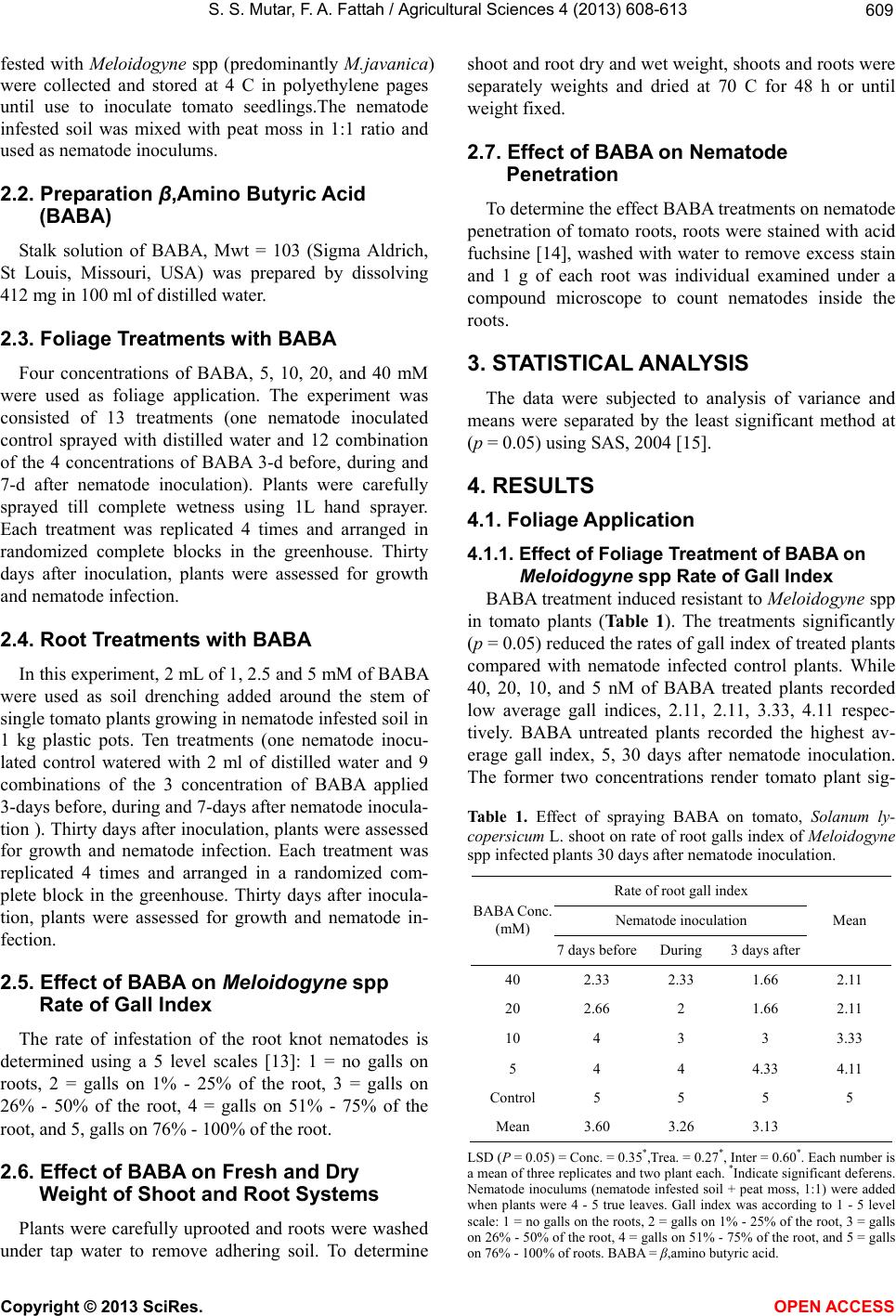 S. S. Mutar, F. A. Fattah / Agricultural Sciences 4 (2013) 608-613 609 fested with Meloidogyne spp (predominantly M.javanica) were collected and stored at 4 C in polyethylene pages until use to inoculate tomato seedlings.The nematode infested soil was mixed with peat moss in 1:1 ratio and used as nematode inoculums. 2.2. Preparation β,Amino Butyric Acid (BABA) Stalk solution of BABA, Mwt = 103 (Sigma Aldrich, St Louis, Missouri, USA) was prepared by dissolving 412 mg in 100 ml of distilled water. 2.3. Foliage Treatments with BABA Four concentrations of BABA, 5, 10, 20, and 40 mM were used as foliage application. The experiment was consisted of 13 treatments (one nematode inoculated control sprayed with distilled water and 12 combination of the 4 concentrations of BABA 3-d before, during and 7-d after nematode inoculation). Plants were carefully sprayed till complete wetness using 1L hand sprayer. Each treatment was replicated 4 times and arranged in randomized complete blocks in the greenhouse. Thirty days after inoculation, plants were assessed for growth and nematode infection. 2.4. Root Treatments with BABA In this experiment, 2 mL of 1, 2.5 and 5 mM of BABA were used as soil drenching added around the stem of single tomato plants growing in n ematode infested so il in 1 kg plastic pots. Ten treatments (one nematode inocu- lated control watered with 2 ml of distilled water and 9 combinations of the 3 concentration of BABA applied 3-days before, during and 7-days after nematode inocula- tion ). Thirty days after inoculation, plants were assessed for growth and nematode infection. Each treatment was replicated 4 times and arranged in a randomized com- plete block in the greenhouse. Thirty days after inocula- tion, plants were assessed for growth and nematode in- fection. 2.5. Effect of BABA on Meloidogyne spp Rate of Gall Index The rate of infestation of the root knot nematodes is determined using a 5 level scales [13]: 1 = no galls on roots, 2 = galls on 1% - 25% of the root, 3 = galls on 26% - 50% of the root, 4 = galls on 51% - 75% of the root, and 5, galls on 76% - 100% of the root. 2.6. Effect of BABA on Fresh and Dry Weight of Shoot and Root Systems Plants were carefully uprooted and roots were washed under tap water to remove adhering soil. To determine shoot and root dry and wet weight, shoots and roots were separately weights and dried at 70 C for 48 h or until weight fixed. 2.7. Effect of BABA on Nematode Penetration To determine the effect BABA treatments on nematode penetration of tomato roots, roots were stained with acid fuchsine [14], washed with water to remove excess stain and 1 g of each root was individual examined under a compound microscope to count nematodes inside the roots. 3. STATISTICAL ANALYSIS The data were subjected to analysis of variance and means were separated by the least significant method at (p = 0.05) using SAS, 200 4 [1 5]. 4. RESULTS 4.1. Foliage Application 4.1.1. Effect of Foliage Treatment of BABA on Meloidogyne spp Rate of Gall Index BABA treatment induced resistant to Meloidogyne spp in tomato plants (Ta bl e 1). The treatments significantly (p = 0.05) reduced the rates of gall index of treated plants compared with nematode infected control plants. While 40, 20, 10, and 5 nM of BABA treated plants recorded low average gall indices, 2.11, 2.11, 3.33, 4.11 respec- tively. BABA untreated plants recorded the highest av- erage gall index, 5, 30 days after nematode inoculation. The former two concentrations render tomato plant sig- Table 1. Effect of spraying BABA on tomato, Solanum ly- copersicum L. shoot on rate of root galls index of Meloidogyne spp infected plants 30 days after nematode inoculation. Rate of root gall index Nematode inocu l ation BABA Conc. (mM) 7 days beforeDuring 3 days after Mean 40 2.33 2.33 1.66 2.11 20 2.66 2 1.66 2.11 10 4 3 3 3.33 5 4 4 4.33 4.11 Control 5 5 5 5 Mean 3.60 3.26 3.13 LSD (P = 0.05) = Conc. = 0.35*,Trea. = 0.27*, Inter = 0.60*. Each number is a mean of t hree r epli cates an d two plan t each. *Indicate significant deferens. Nematode inoculums (nematode infested soil + peat moss, 1:1) were added when plants were 4 - 5 true leaves. Gall index was according to 1 - 5 level scale: 1 = no galls on the roots, 2 = galls on 1% - 25% of the root, 3 = galls on 26% - 50% of the root, 4 = galls on 51% - 75% of the root, and 5 = galls on 76% - 100% of roots. BABA = β,amino butyric acid. Copyright © 2013 SciRes. OPEN ACCESS 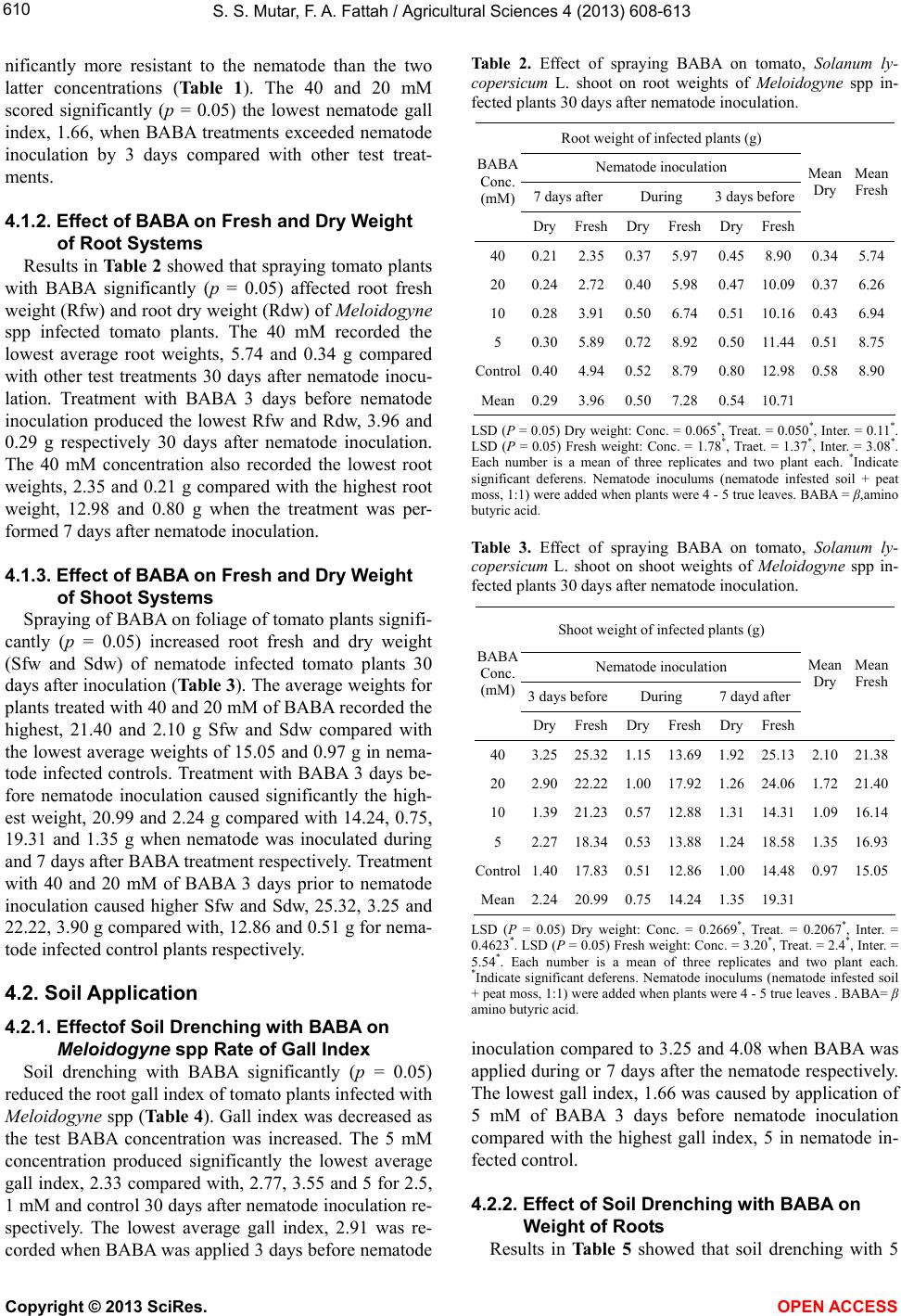 S. S. Mutar, F. A. Fattah / Agricultural Sciences 4 (2013) 608-613 610 nificantly more resistant to the nematode than the two latter concentrations (Table 1). The 40 and 20 mM scored significantly (p = 0.05) the lowest nematode gall index, 1.66, when BABA treatments exceeded nematode inoculation by 3 days compared with other test treat- ments. 4.1.2. Effect of BABA on Fresh and Dry Weight of Root Systems Results in Tabl e 2 sho wed that spraying tomato p lants with BABA significantly (p = 0.05) affected root fresh weight (Rfw) and root dry weight (Rdw) of Meloidogyne spp infected tomato plants. The 40 mM recorded the lowest average root weights, 5.74 and 0.34 g compared with other test treatments 30 days after nematode inocu- lation. Treatment with BABA 3 days before nematode inoculation produced the lowest Rfw and Rdw, 3.96 and 0.29 g respectively 30 days after nematode inoculation. The 40 mM concentration also recorded the lowest root weights, 2.35 and 0.21 g compared with the highest root weight, 12.98 and 0.80 g when the treatment was per- formed 7 days after nematode inoc ul a t i on. 4.1.3. Effect of BABA on Fresh and Dry Weight of Shoot Systems Spraying of BABA on foliage of tomato plants signifi- cantly (p = 0.05) increased root fresh and dry weight (Sfw and Sdw) of nematode infected tomato plants 30 days after inoculation (Table 3). The average w eights f or plants treated with 40 and 20 mM of BABA r ecorded the highest, 21.40 and 2.10 g Sfw and Sdw compared with the lowest average weights of 15.05 and 0.97 g in nema- tode infected controls. Treatment with BABA 3 days be- fore nematode inoculation caused significantly the high- est weight, 20.99 and 2.24 g compared with 14.24, 0.75, 19.31 and 1.35 g when nematode was inoculated during and 7 days after BABA treatment respectively. Treatment with 40 and 20 mM of BABA 3 days prior to nematode inoculation caused higher Sfw and Sdw, 25.32, 3.25 and 22.22, 3.90 g compared with, 12.86 and 0.51 g for nema- tode infected control plants respectively. 4.2. Soil Application 4.2.1. Effectof Soil Drenching with BABA on Meloidogyne spp Rate of Gall Index Soil drenching with BABA significantly (p = 0.05) reduced the root ga ll ind ex of to mato plan ts infected with Meloidogyne spp (Tab le 4). Gall index was decreased as the test BABA concentration was increased. The 5 mM concentration produced significantly the lowest average gall index, 2.33 compared with, 2.77, 3.55 and 5 for 2.5, 1 mM and control 30 days after nematode inoculation r e- spectively. The lowest average gall index, 2.91 was re- corded when BABA was applied 3 days before nematode Table 2. Effect of spraying BABA on tomato, Solanum ly- copersicum L. shoot on root weights of Meloidogyne spp in- fected plants 30 days after nematod e inocu lation. Root weight of infected plants (g) Nematode inocu l ation 7 days afterDuring 3 days before BABA Conc. (mM) DryFreshDryFresh Dry Fresh Mean Dry Mean Fresh 40 0.212.350.375.97 0.45 8.90 0.345.74 20 0.242.720.405.98 0.47 10.09 0.376.26 10 0.283.910.506.74 0.51 10.16 0.436.94 5 0.305.890.728.92 0.50 11.44 0.518.75 Control0.404.940.528.79 0.80 12.98 0.588.90 Mean 0.293.960.507.28 0.54 10.71 LSD (P = 0.05) Dry weight: Conc. = 0.065*, Treat. = 0.050*, Inter. = 0.11*. LSD (P = 0.05) Fresh weight: Conc. = 1.78*, Traet. = 1.37*, Inter. = 3.08*. Each number is a mean of three replicates and two plant each. *Indicate significant deferens. Nematode inoculums (nematode infested soil + peat moss, 1:1) were added when plants were 4 - 5 true leaves. BABA = β,amino butyric acid. Table 3. Effect of spraying BABA on tomato, Solanum ly- copersicum L. shoot on shoot weights of Meloidogyne spp in- fected plants 30 days after nematod e inocu lation. Shoot weight of infected plants (g) Nematode inocu l ation 3 days beforeDuring 7 dayd after BABA Conc. (mM) DryFreshDryFresh Dry Fresh Mean Dry Mean Fresh 40 3.2525.321.1513.69 1.92 25.13 2.1021.38 20 2.9022.221.0017.92 1.26 24.06 1.7221.40 10 1.3921.230.5712.88 1.31 14.31 1.0916.14 5 2.2718.340.5313.88 1.24 18.58 1.3516.93 Control1.4017.830.5112.86 1.00 14.48 0.9715.05 Mean2.2420.990.7514.24 1.35 19.31 LSD (P = 0.05) Dry weight: Conc. = 0.2669*, Treat. = 0.2067*, Inter. = 0.4623*. LSD (P = 0.05) Fresh weight: Conc. = 3.20*, Treat. = 2 .4*, Inter. = 5.54*. Each number is a mean of three replicates and two plant each. *Indicate significant deferens. Nematode inoculums (nematode infested soil + peat moss, 1:1) were added when plants were 4 - 5 true leaves . BABA= β amino butyric acid. inoculation compared to 3.25 and 4.08 when BABA was applied during or 7 days after the nematode re spectively. The lowest gall index, 1.66 was caused by application of 5 mM of BABA 3 days before nematode inoculation compared with the highest gall index, 5 in nematode in- fected control. 4.2.2. Effect of Soil Drenching with BABA on Weight of Roots Results in Ta bl e 5 showed that soil drenching with 5 Copyright © 2013 SciRes. OPEN ACCESS 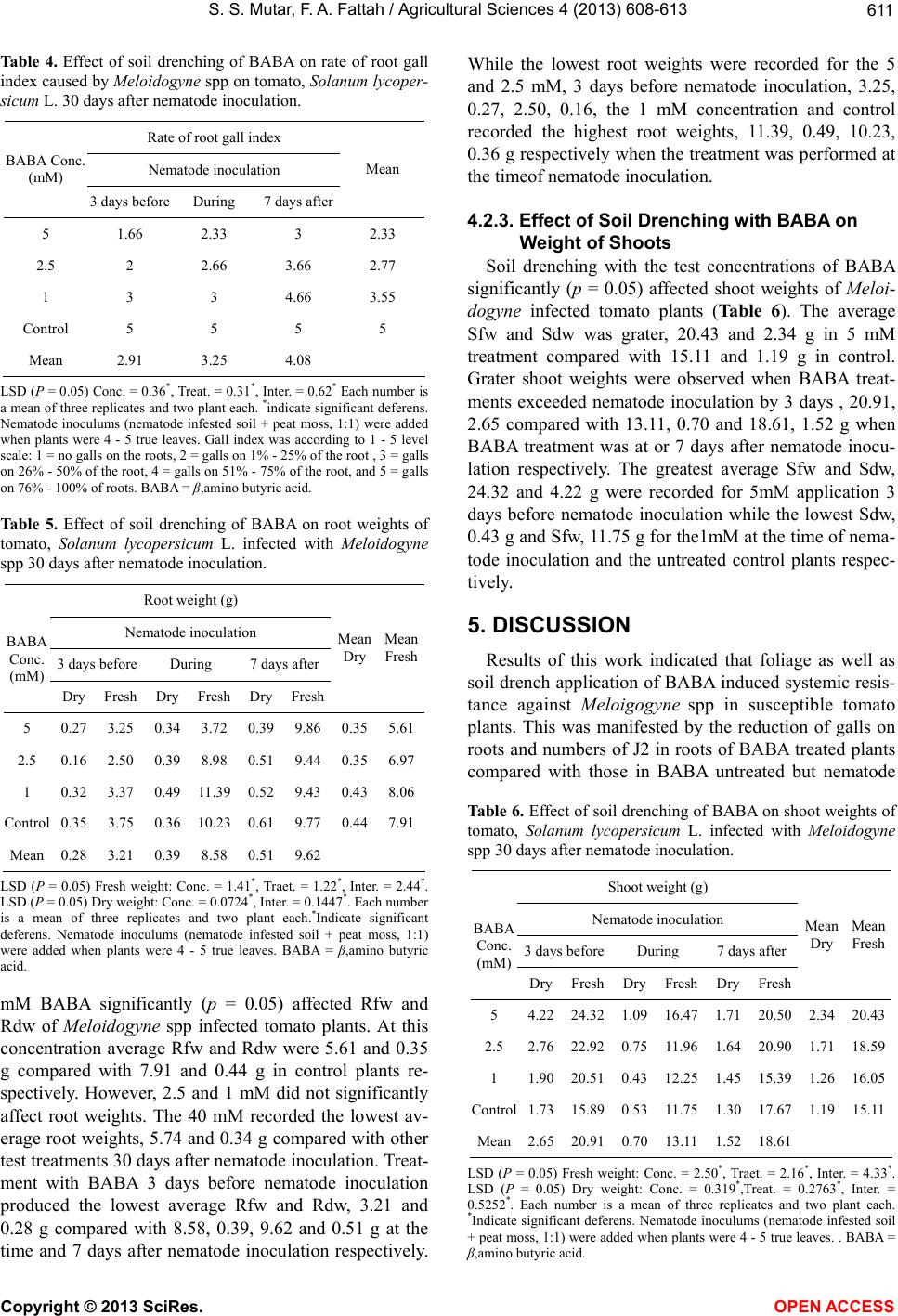 S. S. Mutar, F. A. Fattah / Agricultural Sciences 4 (2013) 608-613 611 Table 4 . Effect of soil drenching of BABA on rate of root gall index caused by Meloidogyne spp on tomato, Solanum lycoper- sicum L. 30 days after nematode inoculation. Rate of root gall index Nematode inocu l ation BABA Conc. (mM) 3 days before During 7 days after Mean 5 1.66 2.33 3 2.33 2.5 2 2.66 3.66 2.77 1 3 3 4.66 3.55 Control 5 5 5 5 Mean 2.91 3.25 4.08 LSD (P = 0.05) Conc. = 0.36*, Treat. = 0.31*, Inter. = 0.62* Each number is a mean of th ree repli cates and two plan t each. *indicate significant deferens. Nematode inoculums (nematode infested soil + peat moss, 1:1) were added when plants were 4 - 5 true leaves. Gall index was according to 1 - 5 level scale: 1 = no galls on the roots, 2 = galls on 1% - 25% of the root , 3 = galls on 26% - 50% of the root, 4 = galls on 51% - 75% of the root, and 5 = galls on 76% - 100% of roots. BABA = β,amino butyric acid. Ta b l e 5 . Effect of soil drenching of BABA on root weights of tomato, Solanum lycopersicum L. infected with Meloidogyne spp 30 days after nematode inoculation. Root weight (g) Nematode inocu l ation 3 days before During 7 days after BABA Conc. (mM) Dry Fresh Dry FreshDry Fresh Mean Dry Mean Fresh 5 0.27 3.25 0.34 3.720.39 9.86 0.355.61 2.5 0.16 2.50 0.39 8.980.51 9.44 0.356.97 1 0.32 3.37 0.49 11.39 0.52 9.43 0.438.06 Control 0.35 3.75 0.36 10.23 0.61 9.77 0.447.91 Mean 0.28 3.21 0.39 8.580.51 9.62 LSD (P = 0.05) Fresh weight: Conc. = 1.41*, Traet. = 1.22*, Inter. = 2.44*. LSD (P = 0.05) Dry weight: Conc. = 0.0724*, Inter. = 0.1447*. Each number is a mean of three replicates and two plant each.*Indicate significant deferens. Nematode inoculums (nematode infested soil + peat moss, 1:1) were added when plants were 4 - 5 true leaves. BABA = β,amino butyric acid. mM BABA significantly (p = 0.05) affected Rfw and Rdw of Meloidogyne spp infected tomato plants. At this concentration average Rfw and Rdw were 5.61 and 0.35 g compared with 7.91 and 0.44 g in control plants re- spectively. However, 2.5 and 1 mM did not significantly affect root weights. The 40 mM recorded the lowest av- erage root weights, 5.74 and 0.34 g compared with other test treatments 30 days after nematode inoculation. Treat- ment with BABA 3 days before nematode inoculation produced the lowest average Rfw and Rdw, 3.21 and 0.28 g compared with 8.58, 0.39, 9.62 and 0.51 g at the time and 7 days after nematode inoculation respectively. While the lowest root weights were recorded for the 5 and 2.5 mM, 3 days before nematode inoculation, 3.25, 0.27, 2.50, 0.16, the 1 mM concentration and control recorded the highest root weights, 11.39, 0.49, 10.23, 0.36 g respectively when the treatment was performed at the timeof nematode inoculation. 4.2.3. Effect of Soil Drenching with BABA on Weight of Shoots Soil drenching with the test concentrations of BABA significantly (p = 0.05) affected shoot weights of Meloi- dogyne infected tomato plants (Table 6). The average Sfw and Sdw was grater, 20.43 and 2.34 g in 5 mM treatment compared with 15.11 and 1.19 g in control. Grater shoot weights were observed when BABA treat- ments exceeded nematode inoculation by 3 days , 20.91, 2.65 compared with 13.11, 0.70 and 18.61, 1.52 g when BABA treatment was at or 7 days after nematode inocu- lation respectively. The greatest average Sfw and Sdw, 24.32 and 4.22 g were recorded for 5mM application 3 days before nematode inoculation while the lowest Sdw, 0.43 g and Sfw, 11.75 g for the1mM at the time of nema- tode inoculation and the untreated control plants respec- tively. 5. DISCUSSION Results of this work indicated that foliage as well as soil drench applicatio n of BABA induced systemic resis- tance against Meloigogyne spp in susceptible tomato plants. This was manifested by the reduction of galls on roots and numbers of J2 in roots of BABA treated plants compared with those in BABA untreated but nematode Table 6. Effect of soil drenching of BABA on shoot weights of tomato, Solanum lycopersicum L. infected with Meloidogyne spp 30 days after nematode inoculation. Shoot weight (g) Nematode inocu l ation 3 days beforeDuring 7 days after BABA Conc. (mM) DryFreshDryFresh Dry Fresh Mean Dry Mean Fresh 5 4.2224.321.0916.47 1.71 20.50 2.3420.43 2.52.7622.920.7511.96 1.64 20.90 1.7118.59 1 1.9020.510.4312.25 1.45 15.39 1.2616.05 Control1.7315.890.5311.75 1.30 17.67 1.1915.11 Mean2.6520.910.7013.11 1.52 18.61 LSD (P = 0.05) Fresh weight: Conc. = 2.50*, Traet. = 2.16*, Inter. = 4.33*. LSD (P = 0.05) Dry weight: Conc. = 0.319*,Treat. = 0.2763*, Inter. = 0.5252*. Each number is a mean of three replicates and two plant each. *Indicate significant deferens. Nematode inoculums (nematode infested soil + peat moss, 1:1) were added when plants were 4 - 5 true leaves. . BABA = β,amino butyric acid. Copyright © 2013 SciRes. OPEN ACCESS  S. S. Mutar, F. A. Fattah / Agricultural Sciences 4 (2013) 608-613 612 infected plants. The growth of the nematode infected plants by decreasing root weight and increasing shoot weight of BABA treated tomato plants. These findings also support previous reports indicating that treatments with β,amino butyric acid reduced root knot disease through decreased penetration of J2, gall number on roots and nematode development [4,11,12]. Root weight increase in heavy Meloidogyne spp infection was previ- ously reported and thought to be caused due to biomass accumulations in infected roots [16]. Meloigogyne spp infection is known to have negative effects on water and nutrient elements as well as photosynthesis [17]. It was reported that M. incognita infection caused biomass ac- cumulation in roots and this is controlled by the effi- ciency of the pathogen in capturing the light energy and directing it in favor of the pathogen or the infected host [18]. Because of the relative large size of females of Meloigogyne spp and its ability to produce large number of eggs, it requires large amount of energy. Beside this energy requirement, these pathogens caused obvious distortion in xylem vessels, swellings of root cells and formation of giant feeding cells which alter root normal functions. Treatments of nematode infected plants with the high concentration of BABA produced more shoots compared with untreated nematode infected plant. This is mainly due to the fact that Meloidogyne infections em- bed photosynthesis and chlorophyll synthesis which ne- gatively influences plant growth [17]. It was clear from the results of this study that treatments with BABA was more effective when applied before nematode inocula- tion, which is probably due to the mechanism of induce resistance of this chemical inducer. The mechanism of induce resistance to Meloidogyne in tomato by BABA is not fully understood. It was believed that treatments with this inducer render roots less attractive to J2 through al- tered plant nutrient assimilation or render plant cell walls harder to penetrate by J2 or that giant cells were smaller or not able to provide enough nutrients for the develop- ing nematodes [11]. Treatments with BABA were re- ported to increase levels of salicylic acid (SA) and patho- genesis related proteins (PRP) [19], and enzymes like catalase (CAT), polyphenoloxidase (PPO) and guaiacol peroxidase (GPOX) [4,7] and phenol compounds [20]. BABA was also reported to induce the accumulations of PPO, GPOX, H2O2, CAT and phenols in M.javanica in- fected cucumber roots [21]. Results of this research work clearly indicate and in- dorse previous reports on the effectiveness of β,amino- butyric acid to the induced systemic resistance as envi- ronmentally sound alternative for the control of Meloi- dogyne sp p on t omato. 6. ACKNOWLEDGEMENTS The authors would like to thank Mr. Dhulfiqar Layth (Graduate stu- dent, Dept., of Plant Protection, College of Agriculture,Univ. of Bagh- dad, Baghdad, Iraq) for his valuable assistance. REFERENCES [1] Anonymos (2009) www.Frehplaza.com/news. [2] FAOSTAT (2008) List of countries by tomato production. https://www.google.com/search [3] Kumagai, T. (1988) Photocontrol of fungal development. Photochemistry and Photobiology, 47, 889-896. http://dx.doi.org/10.1111/j.1751-1097.1988.tb01672.x [4] Sahebani, N. and Hadavi, N.S. (2011) The effects of β-amino-butyric acid on resistance of cucumber against root-knot nematode, Meloidogyne javanica. Journal of Plant Physiology, 33, 443-450. [5] Gorlach, J., Volrath, S., Knauf-Beiter, G., Hengy, G., Beckhove, U., Kogel, Oostendorp, M., Staub, T., Ward, E., Kessmann, H. and Ryals, J. (1996) Benzothiadiazole, a novel class of inducers of systemic acquired resistance, activates gene expression and disease resistance in wheat. Plant Cell, 8, 629-643. [6] He, C.Y. and Wolyn, D.J. (2005) Potential role for sali- cylic acid in inducedresistance of asparagus roots to Fusariumoxysporumf. sp. asparagi. Plant Pathol. 54, 227- 232. http://dx.doi.org/10.1111/j.1365-3059.2005.01163.x [7] Sahebani, N. and Hadavi, N.S. (2009) Induction of H2O2 and related enzymes in tomato roots infected with root knot nematode (M. javanica) by several chemical and microbial elicitors. Biocontrol Science and Technology, 19, 301-313. [8] Kessmann, H., Staub, T., Hofmann, C., Maetzke, T., Herzog, J., Ward, E., Uknes, S. and Ryals, J. (1994) In- duction of systemic acquired resistancein plants by che- micals. Annual Review of Phytopathology, 32, 439-459. [9] Cohen, Y. (2002) β-aminobutyric acid-induced resistance against plant pathogens. Plant Disease, 86, 448-457. http://dx.doi.org/10.1094/PDIS.2002.86.5.448 [10] Jacab, G., Cottrier, V., Toquin, V., Rigoli, G., Zimmerli, L., Metraux, J.P. and Mauch-Mani, B. (2001) β-aminobutyric acid-induced resistance in plants. European Journal of Plant Pathology, 107, 29-37. http://dx.doi.org/10.1023/A:1008730721037 [11] Oka, Y, Cohen, Y. and Speigel, Y. (1999) Local and sys- temic inducec resistance to the root-knot nematode in to- mato by DL-b-aminon-butyric acid. Phytopathology, 89, 1138-1143. http://dx.doi.org/10.1094/PHYTO.1999.89.12.1138 [12] Chinnasri, B., Sipes, B.S. and Schmitt, D. P. (2006) Effect of inducer of systemic acquired resistance on reproduc- tion of Meloidogyne javanica. Journal of Nematology, 38, 319-325. [13] Dube, B. and Smart, G.C.J. (1987) Biological control of Meloidogyne incognita by paecilomyceslilacinuc and pasturiapenetrans. Journal of Nematology, 9, 222-227. [14] Byrd, D.W., Kirkpatrick, T., Barker, K.R. (1983) An im- proved technique for learing and staining plant tissue for detection of nematodes. Journal of Nematology, 15, 142- Copyright © 2013 SciRes. OPEN ACCESS  S. S. Mutar, F. A. Fattah / Agricultural Sciences 4 (2013) 608-613 Copyright © 2013 SciRes. OPEN ACCESS 613 143. [15] SAS (2004) SAS user’s guide for personal, computers. SAS Institute Inc., Cary. [16] Fortnum, B.A., Decoteau, D.R., Kasperbauer, M.J. and Bridges, W. (1995) Effect of colored mulch on rootknot of tomato. Phytopathology, 85, 312-318. http://dx.doi.org/10.1094/Phyto-85-312 [17] Melakeberhan, H. (2004) Physiological interactions be- tween Nematodes and Their Host Plants. In: Chen, Z.X., Chen, S.Y. and Dickson, D.W., Eds., Nematode Manage- ment and Utilization II, CABI Publishing, p. 786. [18] Melakebrhan, H. and Ferris, H. (1988) Growth and en- ergy demand of Meloidogyne incognita on susceptible and resistance Vitis vinifera cultivars. Journal of Nema- tology, 20, 545-554. [19] Hwang, B.K., Sunwoo, J.Y., Kim, Y.J. and Kim, B.S. (1997) Accumulation of beta-1,3-glucanase and chitinase isoforms, and salicylic acid in the DL-beta-amino-n-bu- tyric acid-induced resistance response of pepper stems to Phytophthoracapsici. Physiological and Molecular Plant Pathology, 51, 305-322. http://dx.doi.org/10.1006/pmpp.1997.0119 [20] M’Piga, P., Belanger, R.R., Paulitz, T. and Benhamou, N. (1997) Increasedresistance to Fusariumoxysporum f. sp. radicis-lycopersici in tomato plants treated with the en- dophytic bacterium Pseudomonas fluorescens strain 63- 28. Physiological and Molecular Plant Pathology, 50, 301-320. http://dx.doi.org/10.1006/pmpp.1997.0088 [21] Siegrist, J., Orober M. and Buchenauer, H. (2000) β- amino butyric acid mediated enhancement of resistance in tobacco to tobaccomosaic virus depends on the accumu- lation of salicylic acid. Physiological and Molecular Plant Pathology, 56, 95-106. |