

Paper Menu >>
Journal Menu >>
 World Journal of Condensed Matter Physics, 2013, 3, 203-206 Published Online November 2013 (http://www.scirp.org/journal/wjcmp) http://dx.doi.org/10.4236/wjcmp.2013.34034 Open Access WJCMP 203 A Quantum Monte Carlo Study of Lanthanum Nagat Elkahwagy1, Atif Ismail1, Sana Maize2, Kamal Reyad Mahmoud1 1Physics Department, Faculty of Science, Kafrelsheikh University, Kafr El-Sheikh, Egypt; 2Physics Department, Faculty of Science, Menoufia University, Shebin El-Kom, Egypt. Email: [email protected] Received August 25th, 2013; revised October 6th, 2013; accepted October 21st, 2013 Copyright © 2013 Nagat Elkahwagy et al. This is an open access article distributed under the Creative Commons Attribution License, which permits unrestricted use, distribution, and reproduction in any medium, provided the original work is properly cited. ABSTRACT Pseudopotential calculations of the ground state energies of the Lanthanum neutral atom, first and second corresponding cations by means of the variational Monte Carlo (VMC) and the diffusion Monte Carlo (DMC) methods are performed. The first and the second ionization potentials have been calculated for Lanthanum. The obtained results are satisfactory and comparable with the available experimental data. Studying the DMC energy of the La atom at different time steps, gave us a time step error of the order 0.0019 Hartree for the smallest time step, τ = 0.0001 Hartree−1, and −0.0104 Har- tree for the largest time step, τ = 0.01 Hartree−1. This paper demonstrates the ability of extending the QMC method for lanthanides and obtaining highly accurate results. Keywords: Variational Monte Carlo; Diffusion Monte Carlo; Lanthanum; Hartree; Time Step 1. Introduction Quantum Monte Carlo (QMC) is a powerful technique by which one can perform computational electronic struc- ture calculations with high accuracy. One of the advan- tages of the QMC technique is that its computational efforts scales with N3 where N is the number of electrons in the system. This technique is favorable over other computational many-body methods. The most common QMC techniques, for atoms and molecules, are the varia- tional Monte Carlo (VMC) and the diffusion Monte Carlo (DMC). Accurate calculations for extremely light atoms using QMC methods are performed by a large number of researchers [1-4]. For the atoms heavier than Ne, the situation is more difficult. However, there have been some studies which gave satisfactory results [5-8]. For our knowledge, it is the first time Qwalk code is to be used in dealing with lanthanides. The study of chemical systems that contain f-elements is still a particularly challenging branch of computational chemistry. The difficulties presented by f-elements in quantum mechanical calculations arise from the large magnitude of the relativistic effect and the limitation in the electron correlation treatment. In the present work, by means of VMC and DMC methods, we have done calculations for the ground state energies of La atom and its charged cations with the hope “achieving high accuracy”. In addition, we study the DMC energies at different time steps and the accurate extrapolated value of the ground state energy of La atom is derived. To allow the QMC calculations of this heavy atom, pseudopotential valence-only calculations have been performed, since the presence of the inert core electrons introduces a large fluctuation in the energies and this reduces the computational efficiency. In our study, the basic form of the wave function is the Slater-Jastrow wave function which is considered the most common and simplest one. In the next section, we outline a brief description of the QMC methods. The results are then presented and discussed. Atomic units are used throughout this work unless otherwise indicated. 2. Computational Methods Quantum Monte Carlo methods have been extensively described in the literatures [9-11], so we give here a brief description of the two methods, the variational and diffu- sion Monte Carlo methods. The variational Monte Carlo (VMC) technique de- pends on the familiar variational principle for finding the ground energies of quantum mechanical systems. By the variational principle, the expectation value of the ground state energy of a many body system of N particles evalu-  A Quantum Monte Carlo Study of Lanthanum 204 ated with a trial wavefunction ψT is given by * 0 * ˆ TT T TT RH R EE RRdR (1) which provide an upper bound to the exact ground state energy E0. The VMC method rewrites the last integral in the fol- lowing form: 2 2 ˆT T T T T HR Rd R E RdR R (2) where ˆT T H R R is the local energy EL of an electronic configuration, and 2 TR is the probability density for the configuration R. The Metropolis algorithm is used to sample a series of points, Ri, from the probability density in the configura- tion space. At each of these points the local energy EL is evaluated [12]. After a sufficient number of evaluations of the local energy have been made, the average is taken VMC 1 ˆ 1NTi iTi H R ENR (3) So the VMC is a simple technique in which the statistical efficiency of the results depends on the whole on the trial wavefunction. The better the wavefunction guess, the more efficient the VMC result. The more accurate diffusion Monte Carlo (DMC) method is a stochastic projector method for solving the imaginary time many-body Schrödinger equation: 2 1 , 2T RVE ,R (4) where τ is the imaginary time, τ = it and ET is the energy offset. Importance sampling with a trial wavefunction is used to improve the statistical accuracy of the simulation and this is can be achieved by multiplying Equation (4) by and rearranging TR TR 2 ,1, 2 , DLT fR fR fRv REE fR , (5) where ,, T f RR R interpreted as a prob- ability density and ˆT L T H R ER R is the local en- ergy. This equation can be simulated with a random walk having diffusion, a draft, and a branching step and may be written in the integral form: ,,;, f RGRRfR dR (6) where the Green’s function ,;GRR is a solution of the same initial Equation (5) and can be interpreted as a probability of transition from a state R to R'. It is pos- sible to use QMC method to solve the integral in Equa- tion (6) but the difficulty is that the precise form of ,;GRR is not known. Fortunately the comparison of the Schrodinger equation with the diffusion equation gives us a clue about how one might approximate the unknown Green’s function. The evolution during the long time interval τ can be generated repeating a large number of short time steps τ. In the limit 0 , one can make use of the short time approximation for Green’s function [13]: 32 2 2 ,; 2π ln exp 2 exp2 2 N T LL T GRR RR ER ERE (7) But due to the fermionic nature of electrons, the wavefunction must have positive and negative parts and this is opposite to the assumed nature of ψ which is a probability distribution. So the fixed-node approximation [14] had been used to treat the fermionic antisymmetry which constrains the nodal surface of ψ to equal that of the antisymmetric trial wavefunction ψT. So far, the main difference between VMC and DMC is: In VMC, a Monte Carlo method evaluates the many- dimensional integral to calculate quantum mechanical expectation values. Accuracy of the results depends cru- cially on the quality of the trial wavefunction, which is controlled by the functional form of the wavefunction and the optimization of the wavefunctions parameters. DMC removes most of the error in the trial wavefunc- tion by stochastically projecting out the ground state us- ing an integral form of the imaginary-time Schrödinger equation [15]. The form of the trial wavefunction is therefore very important; it must be both accurate and easy to evaluate. The simplest and most common wavefunction used in QMC is the Slater Jastrow wavefunction which consists of a Slater determinant multiplied by the exponential Jas- trow correlation factor which includes the dynamic cor- relation among the electrons so it plays a crucial role in treating many-body systems. The basic functional form of the Slater-Jastrow wavefunction is JR sjn n n Re cDR (8) Open Access WJCMP  A Quantum Monte Carlo Study of Lanthanum 205 where 12 ,, N Rrr r denote the space coordinate of N electrons, J(R) is the Jastrow factor, cn are coefficient, and Dn(R) is a Slater determinant of single particle orbi- tals which usually obtained from self-consistent DFT or Hartree-Fock calculations. 3. Results and Discussion All our QMC calculations were performed by means of Qwalk code [16]. The basic form of the wavefunction is a product of Slater determinants for spin-up and spin- down electrons multiplied by a Jastrow correlation factor. The initial orbitals of the trial wavefunction are gener- ated in GAMESS package [17] via spin-restricted open Hartree-Fock calculations. In the present work we have performed pseudopotential calculations by using the CRENBS ECP basis set [18] which eliminates 54 elec- trons (Xe-core) so three electrons only are treated as va- lence electrons in the Lanthanum atom. The usage of large pseudopotential introduces additional errors but the Monte Carlo errors are much decreased. We used a mean population of 2000 configurations. At first, all our calcu- lations in Table 1 were performed with a time step of τ = 0.0001 H−1. In Table 1, we present pseudopotential calculations of the Hartree Fock, EHF, the variational Monte Carlo, EVMC, and the diffusion Monte Carlo, EDMC, ground state ener- gies for the Lanthanum atom, first and second charged cations, alongside with the fluctuations of the local en- ergy; σ, for each method. In the last column, we measure the accuracy of the Jastrow factor by estimating which is the percentage of the DMC correlation energy retrieved within VMC HF VMC HF DMC 100% EE EE (9) It is worth mentioning here that because of the lack of experimental data we didn’t able to make a comparison for the estimated values of the pseudopotential ground state energies for La. To our knowledge, these are the first values for La published to date by the QMC method. The tabulated results in Table 1 tell us that we have performed high accuracy QMC calculations. As expected the best values for fluctuations is the diffusion Monte Carlo one, σDMC. Indeed, we obtained the results with high efficiency, η, which is greater than 90% for the La atom and its doubly charged cation, La+2, and greater than 80% for its singly charged cation La+1. From the estimated DMC energies for the La atom and its cations, we calculated the first and second ionization potentials for La and compared it with the experimental values [19]. These values are shown in Table 2. The first ionization potential is in a good agreement with the ex- perimental value while the error is larger for the second ionization potential, we attributed this to the large dif- ference in the fluctuations of the estimated diffusion Monte Carlo energies, σDMC, between the La atom and its double charged cation, La+2. Practical calculations of the DMC energy suffer from the time step error that originates from the use of finite time step in the short time approximation. To investigate the time step error in our diffusion Monte Carlo calcula- tions for La atom, we made calculations for several val- ues of τ to get an accurate extrapolation to zero time step. Table 3 presents a number of calculations of the DMC energies at different steps. The values of the DMC en- ergy of La atom as a function of the time step are plotted in Figure 1. From Figure 1, it can be seen that the relation between Table 1. Ground state total energies computed within Har- tree Fock, EHF, variational Monte Carlo, EVMC, and diffu- sion Monte Carlo, EDMC, for La, first and second charged cations. All energies are in Hartrees. EHF σHF EVMCσVMC EDMC σDMCη% La −1.21380.31 −1.2511 0.20 −1.2535 0.1493.95 La+1 −1.01060.35 −1.0374 0.19 −1.0431 0.1782.46 La+2 −0.66430.23 −0.6724 0.04 −0.6727 0.0396.42 Table 2. First and second ionization potentials for the La atom computed within diffusion Monte Carlo, IPDMC, com- pared to the available experimental values, IPEXP. The ioni- zation potentials are in (eV). IPDMC (eV) IPEXP (eV) First 5.72 5.58 Second 15.80 11.06 Table 3. Time step depende nce of the diffusion Monte Carlo Energy, EDMC, for the La atom. The last column indicates the values of the time step errors. Time step (Hartree)−1EDMC (Hartree) Time step error (Hartree) 0.00010 −1.2535 0.0019 0.00025 −1.2557 −0.0003 0.00050 −1.2567 −0.0013 0.00100 −1.2594 −0.0040 0.00150 −1.2610 −0.0056 0.00200 −1.2582 −0.0028 0.00400 −1.2624 −0.0070 0.00600 −1.2639 −0.0085 0.00800 −1.2654 −0.0100 0.01000 −1.2658 −0.0104 Open Access WJCMP 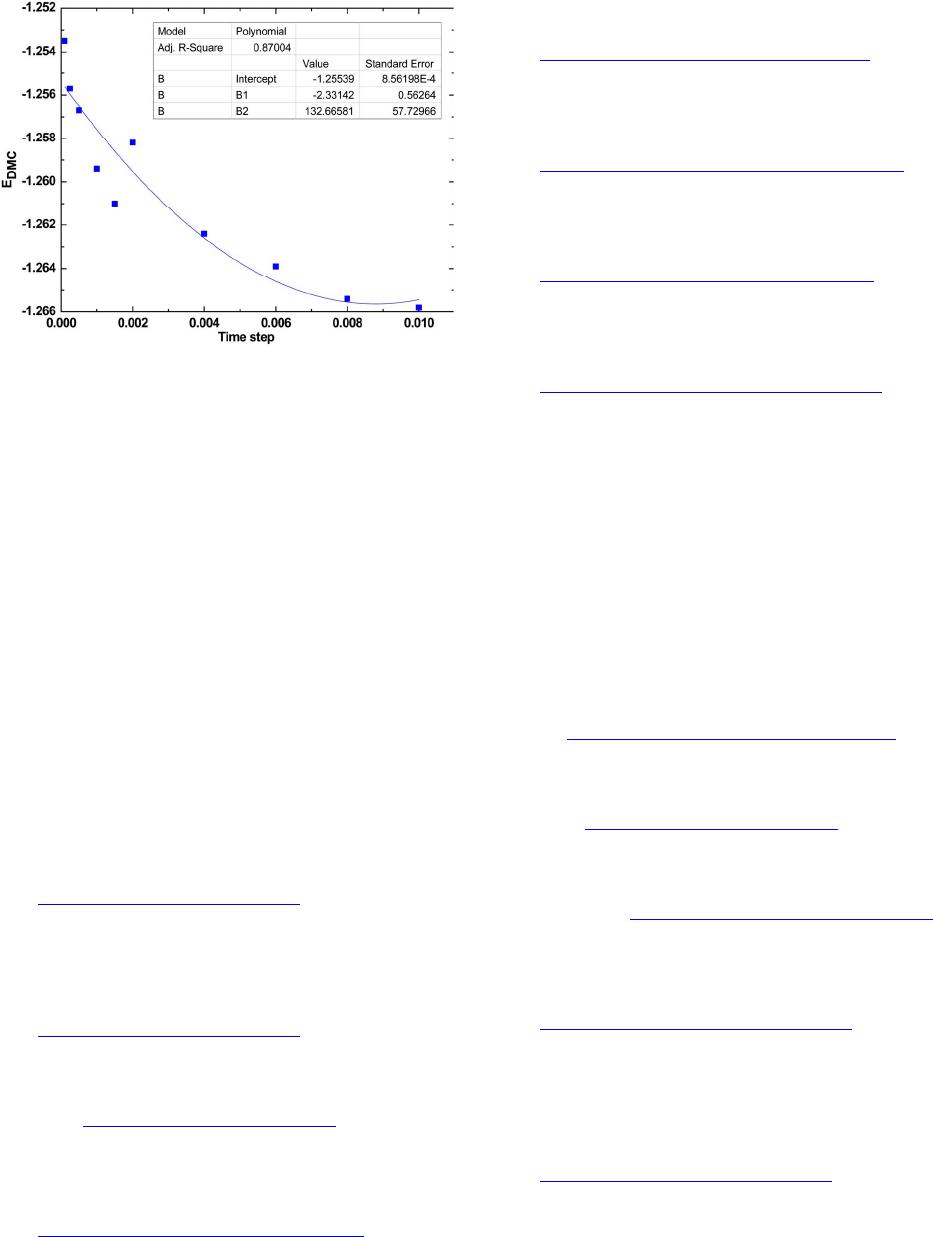 A Quantum Monte Carlo Study of Lanthanum Open Access WJCMP 206 Figure 1. Time step dependence of the diffusion Monte Carlo (DMC) energies for La atom. the DMC energies and the time steps follows a polyno- mial relationship, this is because the presence of Jastrow factor that introduces polynomial behavior in the energy as a function of time step. We performed a polynomial extrapolation of the energies to zero time step. The ex- trapolated value at τ = 0 for La is −1.25659 ± 0.000839 H. For the smallest time step, τ = 0.0001 H−1, we found a time step error of 0.0019 H and for the largest time step, τ = 0.01 H−1, a value of −0.0104 H has been found. In conclusion, the small statistical errors which have been reported for La and its charged cations in this paper open the way to the possibility for performing high ac- curacy QMC calculations for the lanthanides. REFERENCES [1] M. D. Brown, J. R. Trail, P. LoPez Rios and R. J. Needs, “Energies of the First Row Atoms from Quantum Monte Carlo,” The Journal of Chemical Physics, Vol. 126, No. 22, 2007, Article ID: 224110. http://dx.doi.org/10.1063/1.2743972 [2] J. Toulouse and C. J. Umrigar, “Full Optimization of Jastrow-Slater Wave Functions with Application to the First-Flow Atoms and Homonuclear Diatomic Mole- cules,” The Journal of Chemical Physics, Vol. 128, No. 17, 2008, Article ID: 174101. http://dx.doi.org/10.1063/1.2908237 [3] K. E. Schmidt and J. W. Moskowitz, “Correlated Monte Carlo Wave Functions for the Atoms He through Ne,” The Journal of Chemical Physics, Vol. 93, No. 6, 1990, p. 4172. http://dx.doi.org/10.1063/1.458750 [4] S. D. Kenny, G. Rajagopal and R. J. Needs, “Relativistic Corrections to Atomic Energies from Quantum Monte Carlo Calculations,” Physical Review A, Vol. 51, No. 3, 1995, pp. 1898-1904. http://dx.doi.org/10.1103/PhysRevA.51.1898 [5] E. Buendia, F. J. Galvez and A. Sarsa, “Correlated Wave Functions for the Ground State of the Atoms Li through Kr,” Chemical Physics Letters, Vol. 428, No. 4-6, 2006, pp. 241-244. http://dx.doi.org/10.1016/j.cplett.2006.07.027 [6] L. Wagner and L. Mitas, “A Quantum Monte Carlo Study of Electron Correlation in Transition Metal Oxygen Molecules,” Chemical Physics Letters, Vol. 370, No. 3-4, 2003, pp. 412-417. http://dx.doi.org/10.1016/S0009-2614(03)00128-3 [7] X. P. Li, D. M. Ceperley and R. M. Martin, “Cohesive Energy of Silicon by the Green’s-Function Monte Carlo Method,” Physical Review B, Vol. 44, No. 19, 1991, pp. 10929-10932. http://dx.doi.org/10.1103/PhysRevB.44.10929 [8] A. Ma, N. D. Drummond, M. D. Towler and R. J. Needs, “All-Electron Quantum Monte Carlo Calculations for the Noble Gas Atoms He to Xe,” Physical Review E, Vol. 71, No. 6, 2005, Article ID: 066704. http://dx.doi.org/10.1103/PhysRevE.71.066704 [9] J. B. Anderson, “Quantum Monte Carlo. Origins, Devel- opment, Applications,” Oxford University Press, Oxford, 2007. [10] M. P. Nightingale and C. J. Umrigar, “Quantum Monte Carlo Methods in Physics and Chemistry,” Kluwer Aca- demic Publishers, Berlin, 1999. [11] L. M. Sobol, “A Primer for the Monte Carlo Method,” CRC Press, Boca Raton, 1994. [12] C. J. Cramer, “Essentials of Computational Chemistry: Theories and Models,” John Wiley & Sons Ltd, England, 2004. [13] W. M. C. Foulkes, L. Mitas, R. J. Needs and G. Ra- jagopal, “Quantum Monte Carlo Simulations of Solids,” Reviews of Modern Physics, Vol. 73, No. 1, 2001, pp. 33- 83. http://dx.doi.org/10.1103/RevModPhys.73.33 [14] J. B. Anderson, “Quantum Chemistry by Random Walk. H 2P, H+3 D3h 1A′1, H2 3Σ+u, H4 1Σ+g, Be 1SJ,” The Journal of Chemical Physics, Vol. 65, No. 10, 1976, p. 4121. http://dx.doi.org/10.1063/1.432868 [15] A. Alkauskas, P. Deàk, J. Neugebauer, A. Pasquarello and C. Van de Walle, “Advanced Calculations for Defects in Materials,” Wiley-VCH Verlag & Co. K GaA, Wein- heim, 2011. http://dx.doi.org/10.1002/9783527638529 [16] L. K. Wagner, M. Bajdich and L. Mitas, “Qwalk: A Quantum Monte Carlo Program for Electronic Structure,” Journal of Computational Physics, Vol. 228, No. 9, 2009, pp. 3390-3404. http://dx.doi.org/10.1016/j.jcp.2009.01.017 [17] M. W. Schmidt, J. A. Boatz, K. K. Baldridge, S. T. Elbert, M. S. Gordon, J. H. Jensen, S. Koseki, N. Matsunaga, K. A. Nguyen, S. Su, T. L. windus, M. Dupuis and J. A. Montgomery, “General Atomic and Molecular Electronic Structure System,” Journal of Computational Chemistry, Vol. 14, No. 11, 1993, 1347-1363. http://dx.doi.org/10.1002/jcc.540141112 [18] https://bse.pnl.gov/bse/portal [19] C. E. Moore, “Ionization Potential and Ionization Limits Derived from the Analyses of Optical Spectra,” National Bureau of Standards, Washington, 1970. |