

Paper Menu >>
Journal Menu >>
 Vol.3, No.4B, 31-35 (2013) Open Journal of Animal Sciences http://dx.doi.org/10.4236/ojas.2013.34A2004 Group rearing leads to long-term changes in locomotor activity of Drosophila males Anna A. Panova, Julia V. Bragina, Larisa V. Danilenkova, Natalia G. Besedina, Elena A. Kamysheva, Sergey A. Fe dotov, Nikolay G. Kamyshev Pavlov Institute of Physiology, Russian Academy of Sciences, St. Petersburg, Russia; [email protected] Received 17 August 2013; revised 21 September 2013; accepted 6 October 2013 Copyright © 2013 Anna A. Panova et al. This is an open access article distributed under the Creative Commons Attribution License, which permits unrestricted use, distribution, and reproduction in any medium, provided the original work is properly cited. ABSTRACT Previous social experience may affect subse- quent behavior. It was shown by other authors that Drosophila melanogaster males kept indi- vidually are more aggr essiv e and se xually activ e than males kept in a group. In the present study, we tested the locomotor activity of individual males and females previously reared either in- dividually, or in a group. We found that keeping 20 young males for three days together led to a strong long-term (up to 5 days) reduction in their further locomotor activity as individuals. Rear- ing of young males in groups of other sizes (2, 5, 10, and 30) produced a smaller or no after-effect. At the same time, we have not found any differ- ence in subsequent behavior of individual fe- males previously kept either individually, or in a group. We suppose that in a group, flies learned to suppress their locomotor activity to prevent unpleasant contacts with other animals (operant learning). It seems that in males this learning is more efficient because of the higher level of ag- gression producing the stronger negative rein- forcement. Keyw ords: Drosophila; Social Experience; Group Situation; Locomotor Activity 1. INTRODUCTION It is known that previous social experience can modify further behavior. It is true not only for the social animals but for animals without developed sociality, like Droso- phila, too. Today little is known about social interactions and their consequences in subsequent Drosophila behav- ior. In addition to better understanding of animal behave- ior, such studies may have implications for creation of animal models of human psychiatric disorders, where social isolation or interaction is a contributing factor. The main interactions between Drosophila individuals are presented by courtship, aggressive and aggregation behaviors. Flies cooperate into aggregation being at- tracted by volatile pheromone cis-vaccenyl acetate [1-2]. It was shown in Drosophila mutants that keeping flies in a group leads to significant life extension [3]. But it is not still clear what is more stressful for Drosophila: staying alone or in a group. It was shown that each fly prefers to maintain individ- ual distance free from other flies [4]. Close contacts are accompanied by kicks, wing threats and jumps [5-6]. Also, in a group situation flies spent more time in preen- ing, this behavior was considered as a visual signal pre- venting contacts [7]. Previously, we found that in a group situation, Drosophila melanogaster females showed two unconditioned responses: 1) running from the fly break- ing the individual distance, that increased their run fre- quency, and 2) stopping when continuation of the run threatened collision with another female, that decreased their run duration. By the trial and error method (operant learning) females learn to decrease their locomotor activ- ity that results in reduction of unpleasant contacts with other individuals [8]. After isolation from a group situa- tion, females restored their level of activity very rapidly showing fast extinction of operant conditioning. How- ever, the classical conditioning in heterogeneous envi- ronment was found, when threat from other flies it was associated with context stimuli, and further presentation of context in absence of other flies was sufficient to in- hibit activity [8]. One more attempt to understand the process of coop- eration of flies in a group was made by Tinette group. [9]. They suggest that flies may act in a cooperative manner to perform food searching, namely that there are two types of flies: “primers” and “followers”. The former in- vestigate food substrate and choose the best one. The latter, “followers”, move to that food source and aggre- Copyright © 2013 SciRes. OPEN ACCESS 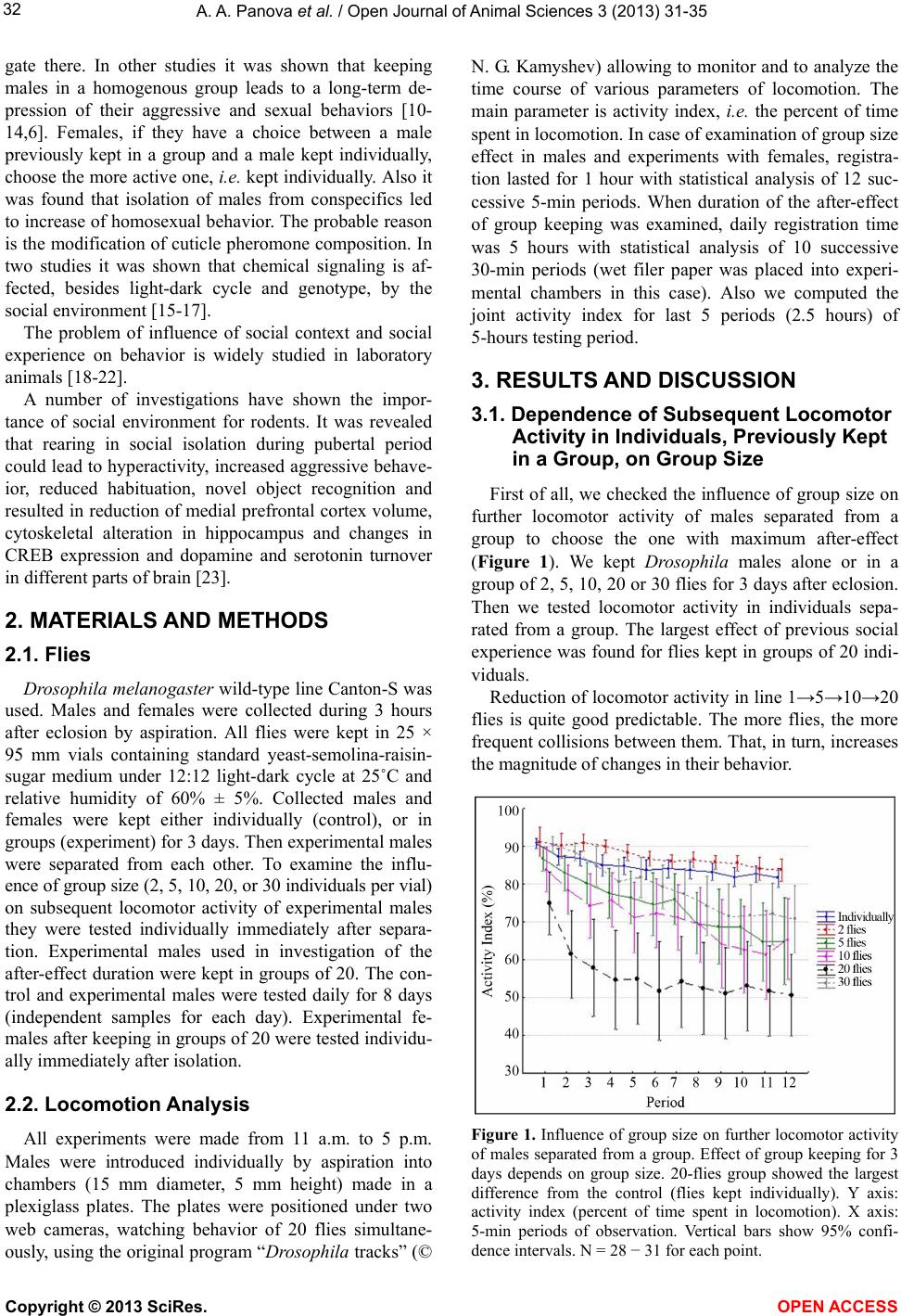 A. A. Panova et al. / Open Jou r nal of Animal Sciences 3 (2013) 31-35 32 gate there. In other studies it was shown that keeping males in a homogenous group leads to a long-term de- pression of their aggressive and sexual behaviors [10- 14,6]. Females, if they have a choice between a male previously kept in a group and a male kept individually, choose the more active one, i. e . kept individually. Also it was found that isolation of males from conspecifics led to increase of homosexual behavior. The probable reason is the modification of cuticle pheromone composition. In two studies it was shown that chemical signaling is af- fected, besides light-dark cycle and genotype, by the social environment [15-17]. The problem of influence of social context and social experience on behavior is widely studied in laboratory animals [18-22]. A number of investigations have shown the impor- tance of social environment for rodents. It was revealed that rearing in social isolation during pubertal period could lead to hyperactivity, increased aggressive behave- ior, reduced habituation, novel object recognition and resulted in reduction of medial prefrontal cortex volume, cytoskeletal alteration in hippocampus and changes in CREB expression and dopamine and serotonin turnover in different parts of brain [23]. 2. MATERIALS AND METHODS 2.1. Flies Drosophila melanoga ster wild-type line Canton-S was used. Males and females were collected during 3 hours after eclosion by aspiration. All flies were kept in 25 × 95 mm vials containing standard yeast-semolina-raisin- sugar medium under 12:12 light-dark cycle at 25˚C and relative humidity of 60% ± 5%. Collected males and females were kept either individually (control), or in groups (experiment) for 3 days. Then experimental males were separated from each other. To examine the influ- ence of group size (2, 5, 10, 20, or 30 individuals per vial) on subsequent locomotor activity of experimental males they were tested individually immediately after separa- tion. Experimental males used in investigation of the after-effect duration were kept in groups of 20. The con- trol and experimental males were tested daily for 8 days (independent samples for each day). Experimental fe- males after keeping in groups of 20 were tested individu- ally immediately after isolation. 2.2. Locomotion Analysis All experiments were made from 11 a.m. to 5 p.m. Males were introduced individually by aspiration into chambers (15 mm diameter, 5 mm height) made in a plexiglass plates. The plates were positioned under two web cameras, watching behavior of 20 flies simultane- ously, using the original program “Drosophila tracks” (© N. G. Kamyshev) allowing to monitor and to analyze the time course of various parameters of locomotion. The main parameter is activity index, i.e. the percent of time spent in locomotion. In case of examination of group size effect in males and experiments with females, registra- tion lasted for 1 hour with statistical analysis of 12 suc- cessive 5-min periods. When duration of the after-effect of group keeping was examined, daily registration time was 5 hours with statistical analysis of 10 successive 30-min periods (wet filer paper was placed into experi- mental chambers in this case). Also we computed the joint activity index for last 5 periods (2.5 hours) of 5-hours testing period. 3. RESULTS AND DISCUSSION 3.1. Dependence of Subsequent Locomotor Activity in Individuals, Previously Kept in a Group, on Group Size First of all, we checked the influence of group size on further locomotor activity of males separated from a group to choose the one with maximum after-effect (Figure 1). We kept Drosophila males alone or in a group of 2, 5, 10, 20 or 30 flies for 3 days after eclosion. Then we tested locomotor activity in individuals sepa- rated from a group. The largest effect of previous social experience was found for flies kept in groups of 20 indi- viduals. Reduction of locomotor activity in line 1→5→10→20 flies is quite good predictable. The more flies, the more frequent collisions between them. That, in turn, increases the magnitude of changes in their behavior. Figure 1. Influence of group size on further locomotor activity of males separated from a group. Effect of group keeping for 3 days depends on group size. 20-flies group showed the largest difference from the control (flies kept individually). Y axis: activity index (percent of time spent in locomotion). X axis: 5-min periods of observation. Vertical bars show 95% confi- dence intervals. N = 28 − 31 for each point. Copyright © 2013 SciRes. OPEN ACCESS  A. A. Panova et al. / Open Jou r nal of Animal Sciences 3 (2013) 31-35 33 One exclusion from this rule is no or even opposite after-effect of group keeping, when a group consists only of two males. When two males meet in a vial, it can be assumed, they prefer to stay separately. Probably, every accidental meeting stimulates them to run away. As flies do not encounter many obstacles, they need not stop run- ning. As a result we can see a slight activation of activity in comparison to males kept individually. In contrast, the group density of 5 (in given experimental conditions) is already sufficient to provide inhibition of locomotor ac- tivity in a group situation. The most surprising are the meanings of locomotor ac- tivity of flies kept in 30-individuals group. Although at the beginning of observation these flies show no differ- ence from control, by the end of 1 hour their locomotor activity became less than activity of individual ones. Nevertheless, they are more active than flies kept in 20-flies group. If to agree (see Introduction and Conclusion) that in- hibition of locomotor activity after group rearing results from learning, this may imply that group density of 30 flies per vial leads to cognitive disfunctions. The reasons for that may consist in the worsening of life conditions due to great number of negative interactions including loss in concurrency for food resources. 3.2. Previous Group Keeping Leads to Changes of Male, but not Female Locomotor Activity To verify the previous data about the lack of after-ef- fect of group keeping in females [8], we compared lo- comotor activity in females kept for 3 days after eclosion either individually, or in a 20-flies group (Figure 2). Our results confirm the fact that females do not change their behavior after group keeping. The effects of previous social experience, is yet poorly investigated. In rodents, it was shown that rearing in social isolation during pu- bertal period led to hyperactivity, reduced habituation, novel object recognition and floating time in forced swim tests [23]. But all these effects concern both males and females. Our results show that consequences of so- cial experience in Drosophila are quite different for two sexes. It may be assumed that Drosophila females are less aggressive than males and provoke collisions with other flies less frequently (normally, they do not show homosexual behavior). 3.3. Keeping Drosophila Males in a Group Leads to a Long-Term Locomotion Inhibition To investigate the duration of behavioral changes after group rearing we kept males in 20-flies groups during 3 days. Then we isolated them from each other and tested experimental and control flies immediately and for next 7 days, each day for 5 hours. Because the most signify- cant difference between experimental and control flies were observed during last 2.5 hours, the joint activity index for this time interval was analyzed (Figure 3). There is a great difference between males kept indi- vidually and males kept in a group, which retains until 5 days after isolation of experimental males. Importantly, these behavioral changes are temporary. This excludes the possibility that they are based on alteration of brain structures that was found in rodents [24,25]. According to our previous investigations [8] we suppose that this locomotor suppression is the result of operant learning Figure 2. Absence of after-effect of group keeping in Droso- phila females. In contrast to Drosophila males, females do not change their locomotor activity after 3-days keeping in a group. Y axis: activity index (percent of time spent in locomotion). X axis: 5-min periods of observation. Vertical bars show 95% confidence intervals. N = 40 − 50 for each point. Figure 3. Group keeping leads to long-term changes in Droso- phila male locomotor activity. Y axis: activity index calculated for the last 2.5 hours of 5-h observation. X axis: days after iso- lation from a group. Vertical bars show 95% confidence inter- vals. N = 40 − 50 for each point. Copyright © 2013 SciRes. OPEN ACCESS  A. A. Panova et al. / Open Jou r nal of Animal Sciences 3 (2013) 31-35 34 occurred in a group. Being in a group situation, flies learn to avoid contacts with other individuals because they are accompanied with threats and fighting playing a role of negative reinforcement. As a result, flies prefer to stay in rest than being active. 4. CONCLUSIONS Previous studies have shown that keeping Drosophila males in a group leads to increase of aggression and de- crease of sexual activity in comparison with males kept individually [10-14,6]. In our research we showed that previous social experience is extremely important for further behaviour. Keeping males together for 3 days in groups of 20 flies leads to a long-term strong reduction of their locomotor activity maintained for 5 days after separation. This may be a result of operant learning similar to learning described earlier [Kamyshev et al. 2002] in females. It was shown that in a group the flies try to avoid close unpleasant contacts accompanied by kicks and wing threats from other insects. Therefore, they run from the individuals, which came too near, and stop their running to prevent meeting with another fe- male. Trial and error learning forces them to suppress their locomotor activity and stay at rest; as a result they have a less number of unpleasant contacts. But in the case of females this learning leads to no after-effects in absence of the appropriate contextual cues. Males, in contrast, possibly due to more intensive aggression, re- tain the altered behavior for a long time independently of the context, in which they experienced aggression from other individuals. Ascertainment of underlying physiological and mo- lecular mechanisms of these phenomena may illuminate the basic processes of Drosophila social interactions. These results will help to standardize laboratory proto- cols of Drosophila housing. Also, the fruit fly, as well as rodents, can be used as a model for investigation of so- cial stress and its effects on development of neuropsy- chiatric disorders. 5. ACKNOWLEDGEMENTS This study was supported by grants No. 13-04-02153 and No. 13-04- 12030 from Russian Foundation for Basic Researches, by Programs of Presidium of the Russian Academy of Sciences No. 7 and No. 30. REFERENCES [1] Threlkeld, S.F., Procwat, R.A., Abbot, K.S. and Yeung, A.D. (1974) Genetically based behavior patterns in Dro- sophila. Nature, 247, 232-233. http://dx.doi.org/10.1038/247232a0 [2] Bartelt, R., Schaner, A. and Jackson, L. (1985) Cis-vac- cenyl acetate as an aggregation pheromone in Drosophila melanogaster. Journal of Chemical Ecology, 11, 1747-1756. http://dx.doi.org/10.1007/BF01012124 [3] Ruan, H. and Wu, C. F. (2008) Social Social interaction- mediated lifespan extension of Drosophila Cu/Zn super- oxide dismutase mutants. Proceedings of the National Academy of Sciences of the United States of America, 21, 7506-7510. http://dx.doi.org/10.1073/pnas.0711127105 [4] Sexton, O.J. and Stalker, H.D. (1961) Spacing patterns of female D. paramelanica. Animal Behaviour, 9, 77-81. http://dx.doi.org/10.1016/0003-3472(61)90053-7 [5] Manning, A. (1959) The sexual behaviour of two sibling Drosophila. Behaviour, 15, 123-145. http://dx.doi.org/10.1163/156853960X00133 [6] Bastock, M. and Manning, A. (1955) The courtship of Drosophila melanogaster. Behaviour, 8, 85-111. http://dx.doi.org/10.1163/156853955X00184 [7] Connolly, K.J. (1968) The social facilitation of preening behaviour in D. melanogaster. Animal Behaviour, 16, 385-391. http://dx.doi.org/10.1016/0003-3472(68)90023-7 [8] Kamyshev, N.G., Smirnova, G.P., Kamysheva, E.A., Nikiforov, O.N., Parafenyuk, I.V. and Ponomarenko, V.V. (2002) Plasticity of social behavior in Drosophila. Neu- roscience and Behavioral Physiology, 32, 401-408. http://dx.doi.org/10.1023/A:1015832328023 [9] Tinette, S., Zhang, L. and Robichon, A. (2004) Coopera- tion between Drosophila flies in searching behavior. Genes, Brain and Behavior, 3, 39-50. http://dx.doi.org/10.1046/j.1601-183x.2003.0046.x [10] Hoffmann, A.A. (1990) The influence of age and experi- ence with conspecifics on territorial behavior in Droso- phila melanogaster. Journal of Insect Behavior, 3, 1-12. http://dx.doi.org/10.1007/BF01049191 [11] Svetec, N. and Ferveur, J.-F. (2005) Social experience and pheromonal perception can change male-male inter- actions in Drosophila melanogaster. The Journal of Ex- perimental Biology, 208, 891-898. http://dx.doi.org/10.1242/jeb.01454 [12] Maynard, S.J. (1956) Fertilly, mating behavior and sexual selection in Drosophila subobscura. Journal of Genetics, 54, 261-279. http://dx.doi.org/10.1007/BF02982781 [13] Kim, Y.-K., Ehrman, L. and Koepfer, H.R. (1996) De- velopmental isolation and subsequent adult behavior of Drosophila paulistorum. I Survey of the six semispecies. Behavior Genetics, 22, 545-556. http://dx.doi.org/10.1007/BF01074307 [14] Kim, Y-K., Ehrman, L. and Koepfer, H.R. (1996) De- velopmental isolation and subsequent adult behavior of Drosophila paulistorum. II. Prior experience. Behavior Genetics, 26, 15-25. http://dx.doi.org/10.1007/BF02361155 [15] Kent, C., Azanchi, R., Smith, B., Formosa, A. and Levine, J. D. (2008) Social context influences chemical commu- nication in D. melanogaster males. Current Biology, 18, 1384-1389. http://dx.doi.org/10.1016/j.cub.2008.07.088 [16] Krupp, J. J., Kent, C., Billeter, J.C., Azanchi, R., So, A. K., Schonfeld, J.A., Smith, B.P., Lucas, C. and Levine, J.D. (2008) Social experience modifies pheromone ex- Copyright © 2013 SciRes. OPEN ACCESS  A. A. Panova et al. / Open Jou r nal of Animal Sciences 3 (2013) 31-35 Copyright © 2013 SciRes. OPEN ACCESS 35 pression and mating behavior in male Drosophila me- lanogaster. Current Biology, 18, 1373-1383. http://dx.doi.org/10.1016/j.cub.2008.07.089 doi:10.1016/j.cub.2008.07.089 [17] Ritchie, M.G. (2008) Behavioural genetics: The social fly. Current Biology, 23, 862-864. http://dx.doi.org/10.1016/j.cub.2008.08.009 [18] Galef, B.G. Jr. and Giraldeau, L. A. (2001) Social influ- ences on foraging in vertebrates: Causal mechanisms and adaptive functions. Animal Behaviour, 61, 3-15. http://dx.doi.org/10.1006/anbe.2000.1557 [19] Free, J.B. (1987) A social insect: the biology of the honey bee. Science, 238, 1591-1592. http://dx.doi.org/10.1126/science.238.4833.1591 [20] Rosengaus, R.B., Jordan, C., Lefebvre, M.L. and Traniello, J.F. (1999) Pathogen alarm behavior in a termite: A new form of communication in social insects. Naturwissen- schaften, 86, 544-548. http://dx.doi.org/10.1007/s001140050672 [21] Rull, J, Procopy, R.J. and Vargas, R.I. (2003) Effects of conspecific presence on arrival and use of hosts in Cerati- tis capitata flies. Journal of Insect Behavior, 16, 329-346. http://dx.doi.org/10.1023/A:1024871908372 [22] Coolen, I., Dangles, O. and Casas, J. (2005) Social learn- ing in noncolonial insects? Current Biology, 15, 1931- 1935. http://dx.doi.org/10.1016/j.cub.2005.09.015 [23] Kercmar, J., Büdefeld, T., Grgurevic, N., Tobet, S.A. and Majdic, G. (2011) Adolescent social isolation changes so- cial recognition in adult mice. Behavioural Brain Re- search, 216, 647-651. http://dx.doi.org/10.1016/j.bbr.2010.09.007 [24] Schubert, M. I., Porkess, M.V., Dashdorj, N., Fone, K.C. and Auer, D.P. (2009) Effects of social isolation rearing on the limbic brain: A combined behavioral and magnetic resonance imaging volumetry study in rats. Neuroscience, 159, 21-30. http://dx.doi.org/10.1016/j.neuroscience.2008.12.019 [25] Bianchi, M., Fone, K.F., Azmi, N., Heidbreder, C.A., Hagan, J.J. and Marsden, C.A. (2006) Isolation rearing induces recognition memory deficits accompanied by cy- toskeletal alterations in rat hippocampus. European Jour- nal of Neuroscience, 24, 2894-2902. http://dx.doi.org/10.1111/j.1460-9568.2006.05170.x |