

Paper Menu >>
Journal Menu >>
 Open Journal of Nursing, 2013, 3, 467-471 OJN http://dx.doi.org/10.4236/ojn.2013.37063 Published Online November 2013 (http://www.scirp.org/journal/ojn/) OPEN ACCESS Patients with disturbances in consciousness as observed by clinical nurses: Analysis of nursing records Ryoko Tsuchiya1, Kasumi Mikami2, Keiko Aidu2, Yoshiko Nishizawa2 1Hirosaki University School of Medicine & Hospital, Aomori, Japan 2Hirosaki University Graduate School of Health sciences, Aomori, Japan Email: [email protected] Received 31 August 2013; revised 1 October 2013; accepted 15 October 2013 Copyright © 2013 Ryoko Tsuchiya et al. This is an open access article distributed under the Creative Commons Attribution License, which permits unrestricted use, distribution, and reproduction in any medium, provided the original work is properly cited. ABSTRACT The objective of the present study was to discuss pa- tients with disturbances in consciousness by analyzing nursing records. Observations from clinical nurses as well as patients’ responses about their care were se- lected from nursing records. Nursing records from one week of patient care were examined for patients who were unable to speak during hospitalization wi- thin a neuro-surgery ward of the hospital. Selected records were classified into the following eight cate- gories: results from monitoring; results from obser- vation; opening and moving the eyes to stimulus; movement of the limbs to stimulus; vocalization to stimulus; facial expression to stimulus; patient’s re- sponse to care; and miscellaneous. Patients comprised two groups. One group encompassed eight patients with Japan Coma Scale (JCS) II and the other was a group of eight patients with JCS III. When nurses use the JCS to assess patients with disturbances in con- sciousness, patients who awaken to stimulus are clas- sified as JCS II, while those who do not are JCS III. The total nursing records selected for JCS II were 1551 and 1160 for JCS III. The category of “results from monitoring” was the most selected category within nursing records and accounted for 42.8% of the JCS III group, while “results from observation” accounted for 38.4% of the JCS II group. Further- more, results indicated that the categories of “results from monitoring”, “results from observation”, and “movement of the limbs for stimulus” had peaked after two to three days, and then abruptly decreased. There were only a few records for the categories of “vocalization to stimulus” and “facial expression to stimulus”, both for the JCS II and the JCS III groups. Even though patients could not verbally indicate their intentions due to problems with consciousness, it is essential for nurses to pay careful attention to the details of patients’ reactions. Keywords: Patients; Disturbances in Consciousnes s ; Nurses; Observation; Nu rsin g Records 1. INTRODUCTION Nursing provides great support for health-related needs. Communication is the process that gives meaning to the content and the relation of messages. Communication is a key basis of nursing because communication plays an important part in understanding patients, winning their confidence, sympathizing with them, and supporting their needs. The sender exchanges thoughts with the receiver, and both interact with one another. However, when nurses care for patients with disturbances in their consciousness, communication may be unclear and dif- ficult to decipher. This may be the reason why nurses feel uneasy, and confusion is not rare in these circumstances. Therefore, by accurately assessing a patient’s level of consciousness, the nurse is able to detect neurological changes and communicate with the medical staff to ini- tiate prompt action, in order to improve survival out- comes and minimize long-term sequelae [1]. Therefore, studies of patients with consciousness disturbances have been investigated in order to verify the reliability and accuracy of assessment tools for assessing various levels of consciousness such as the Glasgow Coma Scale and the National Institutes of Health Stroke Scale [2-8]. In Japan, the previous studies investigating patients with consciousness disturbances mainly focused on verifying the validity of nursing care aimed at life assis- tance, functional improvement, and consciousness reco- very [9-11]. Studies that have developed a new consciousness eva- luation scale [12], and analyzed it for use within different situations [13] have been conducted. Moreover, although the viewpoints of nursing assess- ments during consciousness level have been investigated [14,15], there have been only a few studies which have  R. Tsuchiya et al. / Open Journal of Nursing 3 (2013) 467-471 Copyright © 2013 SciRes. OPEN ACCESS 468 investigated observations from nurses who were perfor- ming these observations to grasp the concept of nursing. In Japan, nursing records are regarded as one of a nur- se’s chief duties. Nursing records show a nurse’s enforce- ment and judgment and should reflect nursing practice and methodology. It was expected that an analysis of nursing records (a nurse’s thoughts, judgments, and ob- servations) could clarify patient status. Thus, the objective of the present study was to clearly define clinical nurse’s observations of patients with con- sciousness disturbance through the analysis of nursing records. 2. METHODS 2.1. Sample The nursing records for one week from patients who could not speak during hospitalization within a neuro- surgery ward of a hospital. Patients were classified into two groups: a group of eight patients with Japan Coma Scale (JCS) II and a group of eight patients with JCS III. Nursing records were specified by nurses from January of 2008 to April of 2012. 2.2. Data Collection The nursing records indicated within the period were chosen from patient ID numbers at random. All data were collected in 2012. 2.3. Ethical Considerations The ethics committee at Hirosaki University Graduate School of Medicine provided ethical approval and the study was registered. We informed potential participants about the study through poster printouts explaining the contents of the study, aspects of confidentiality and that the study was strictly voluntary. Study posters were placed in hospitals within the neuro-surgery ward and in outpatient clinics. 2.4. Analysis We selected observations and patient’s responses to their care from nursing records. Selected records were clas- sified into eight categories. We denoted the eight categories as follows: results from monitoring, results from observations, opening and moving the eyes to stimulus; movement of the limbs to stimulus; vocalization to stimulus; facial expression to stimulus; patient’s response to care; and miscellaneous vocalization. We referred to the previous literature for guidance in constructing the category names [15] as well as using the Kohnan score [16,17]. We totaled these records and compared the number of categories ob served for one week, in them JCS II with JCS III. All statistical analyses were performed using the Statistical Package for Social Science 12.0 for Windows and the level of significanc e used was p < 0.05. 3. RESULTS 3.1. Patient Characteristics Table 1 shows the patient characteristics. The main diagnosis of the patients was a subarachnoid hemorrhage or a cerebral hemorrhage. The average age of the patients was 63.4 ± 19.8 for the JCS II gr oup, and 66 .4 ± 22.8 for the JCS III group. The average number of nurses working on nursing records w as 10 ± 2.0 people fo r JCS II, and 8.6 ± 2.1 people for JCS III. This difference was not significant. 3.2. Number of Categories within One Week Table 2 shows the number of selected nursing records. The total number of nursing records was 1551 for patients in JCS II, and 1160 for patients in JCS III. According to these nursing records, the category of “results from monitoring” was selected the most and accounted for 42.8% of the JCS III group, while “results from observations” accounted for 38.4% of the JCS II group. The category of “results from monitoring” was significantly different between the JCS II and JCS III groups. On the other hand, “results from observation”, “opening and moving the eyes to stimulus”, “movement of the limbs to stimulus”, and “vocalization to stimulus” were more prevalent in the JCS II group. 3.3. Fluctuation in the Number of Categories Table 3 shows the fluctuation in the number of cate- gories for one week. Results from monitoring, results from observation, and movement of the limbs to stimulus had peaked within two to three days (of monitoring ), and subsequently decreased. The categories of “opening and moving the eyes to stimulus” and “patient’s response to care” had peaked within two to three days, repeatedly increasing and decreasing. There were more records of “vocalization to stimulus” in the JCS II group than in the JCS III group. The fluctuation in records of “vocalization to stimulus” was uniformly maintained. The category “facial expression to stimulus” was rarely recorded for patients in both groups. 4. DISCUSSION 4.1. Number of Categories within One Week The present study’s results indicated that more patient states were recorded for the JCS II than for JCS III. Even though patients h ad disturbances in consciousness, it was 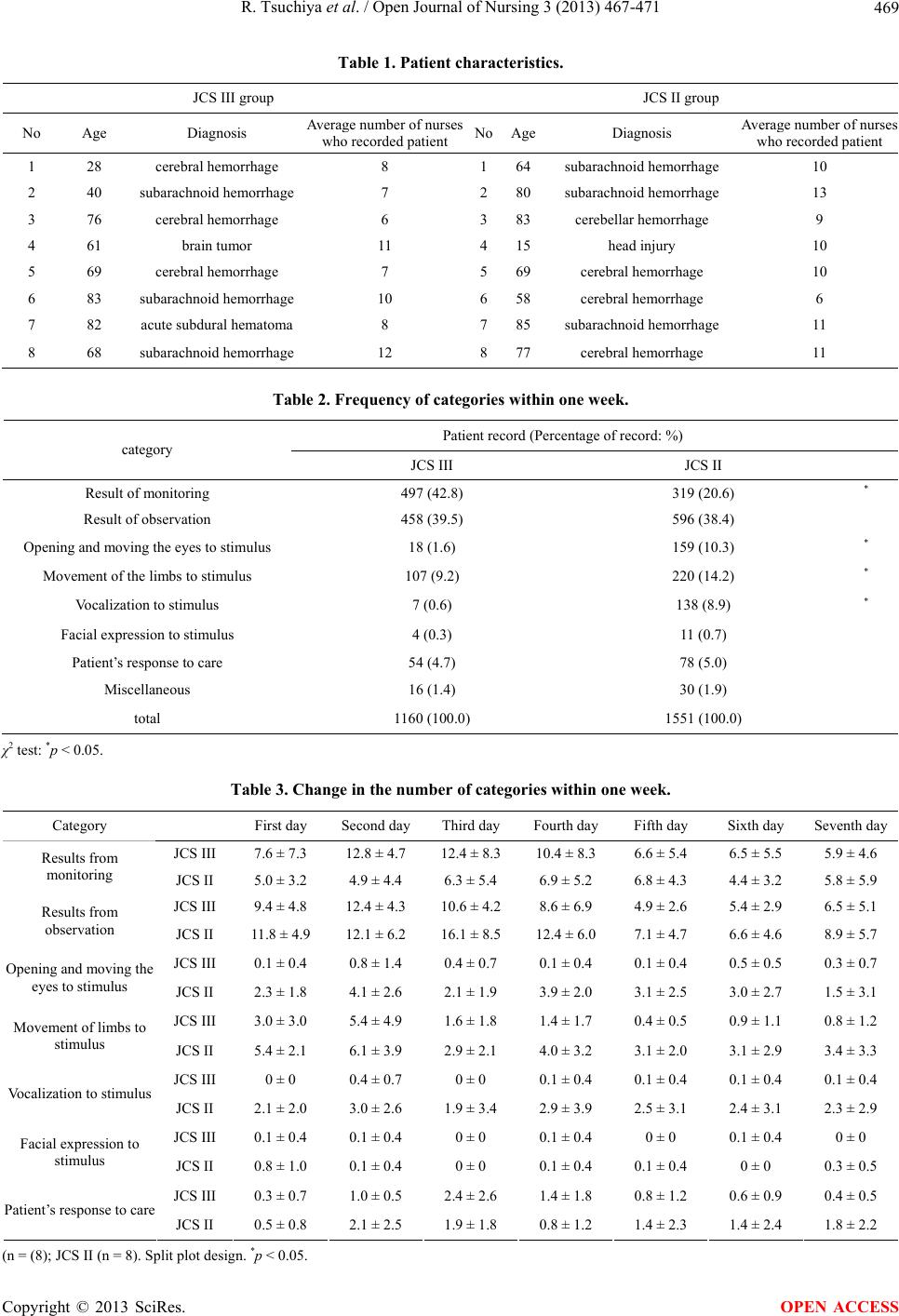 R. Tsuchiya et al. / Open Journal of Nursing 3 (2013) 467-471 Copyright © 2013 SciRes. OPEN ACCESS 469 Table 1. Patient characteristics. JCS III group JCS II group No Age Diagnosis Average num b er of nurses who recorded patient No AgeDiagnosis Average num b er of nurses who recorded patient 1 28 cerebral hemorrhage 8 1 64subarachnoid hemorrhage 10 2 40 subarachnoid hemorrhage 7 2 80suba rachnoid hemorrhage 13 3 76 cerebral hemorrhage 6 3 83cerebellar hemorrhage 9 4 61 brain tumor 11 4 15head injury 10 5 69 cerebral hemorrhage 7 5 69cerebral hemorrhage 10 6 83 subarachnoid hemorrhage 10 6 58cerebral hemorrhage 6 7 82 acute subdural hematoma 8 7 85subarachnoid hemorrhage 11 8 68 subarachnoid hemorrhage 12 8 77cerebral hemorrhage 11 Table 2. Frequency of categories within one week. Patient record (Percentage of record: %) category JCS III JCS II Result of monit o ring 497 (42.8) 319 (20.6) * Result of observation 458 (39.5) 596 (38.4) Opening and moving the eyes to stimulus 18 (1.6) 159 (10.3) * Movement of the limbs to stimulus 107 (9.2) 220 (14.2) * Vo calization to stimulus 7 (0.6) 138 (8.9) * Facial expression to stimulus 4 (0.3) 1 1 (0.7) Patient’s response to care 54 (4.7) 78 (5.0) Miscellaneous 16 (1.4) 30 (1.9) total 1160 (100.0) 1551 (100.0) χ2 test: *p < 0.05. Table 3. Change in the number of categories within one week. Category First day Second dayThird day Fourth day Fifth day Sixth day Seventh day JCS III 7.6 ± 7.3 12.8 ± 4.7 12.4 ± 8.3 10.4 ± 8.3 6.6 ± 5.4 6.5 ± 5.5 5.9 ± 4.6 Results from monitoring JCS II 5.0 ± 3.2 4.9 ± 4.4 6.3 ± 5.4 6.9 ± 5.2 6.8 ± 4.3 4.4 ± 3.2 5.8 ± 5.9 JCS III 9.4 ± 4.8 12.4 ± 4.3 10.6 ± 4.2 8.6 ± 6.9 4.9 ± 2.6 5.4 ± 2.9 6.5 ± 5.1 Results from observation JCS II 11.8 ± 4.9 12.1 ± 6.2 16.1 ± 8.5 12.4 ± 6.0 7.1 ± 4.7 6.6 ± 4.6 8.9 ± 5.7 JCS III 0.1 ± 0.4 0.8 ± 1.4 0.4 ± 0.7 0.1 ± 0.4 0.1 ± 0.4 0.5 ± 0.5 0.3 ± 0.7 Opening and moving the eyes to stimulus JCS II 2.3 ± 1.8 4.1 ± 2.6 2.1 ± 1.9 3.9 ± 2.0 3.1 ± 2.5 3.0 ± 2.7 1.5 ± 3.1 JCS III 3.0 ± 3.0 5.4 ± 4.9 1.6 ± 1.8 1.4 ± 1.7 0.4 ± 0.5 0.9 ± 1.1 0.8 ± 1.2 Movement of limbs to stimulus JCS II 5.4 ± 2.1 6.1 ± 3.9 2.9 ± 2.1 4.0 ± 3.2 3.1 ± 2.0 3.1 ± 2.9 3.4 ± 3.3 JCS III 0 ± 0 0.4 ± 0.7 0 ± 0 0.1 ± 0.4 0.1 ± 0.4 0.1 ± 0.4 0.1 ± 0.4 Vo calization to stimulus JCS II 2.1 ± 2.0 3.0 ± 2.6 1.9 ± 3.4 2.9 ± 3.9 2.5 ± 3.1 2.4 ± 3.1 2.3 ± 2.9 JCS III 0.1 ± 0.4 0.1 ± 0.4 0 ± 0 0.1 ± 0.4 0 ± 0 0.1 ± 0.4 0 ± 0 Facial expression to stimulus JCS II 0.8 ± 1.0 0.1 ± 0.4 0 ± 0 0.1 ± 0.4 0.1 ± 0.4 0 ± 0 0.3 ± 0.5 JCS III 0.3 ± 0.7 1.0 ± 0.5 2.4 ± 2.6 1.4 ± 1.8 0.8 ± 1.2 0.6 ± 0.9 0.4 ± 0.5 Patient’s response to care JCS II 0.5 ± 0.8 2.1 ± 2.5 1.9 ± 1.8 0.8 ± 1.2 1.4 ± 2.3 1.4 ± 2.4 1.8 ± 2.2 (n = (8); JCS II (n = 8). Split plot design. *p < 0.05.  R. Tsuchiya et al. / Open Journal of Nursing 3 (2013) 467-471 Copyright © 2013 SciRes. OPEN ACCESS 470 considered that responses for JCS II were more prevalent than for JCS III. Because the patients were diagnosed as seriously ill, nurses had recorded various characteristics, including the patients circulation, respiration, nerve mo- vements, blood pressure, and papillary reflex for the ca- tegories of “results from monitoring” and “results from observation”. In the present study, it was suspected that medical practice as well as nurses may place great im- portance on life support methods. It may be assumed that the categories of “opening and moving the eyes to stimu- lus”, and “movement of the limbs to stimulus” were re- corded more frequently than the category of “facial ex- pression to stimulus” because a change in a patient’s eye movements or limb movement was probably more easily observed than a change in their facial expression. 4.2. Fluctuation in the Number of Categories A peak in the number of nursing records were seen for many of the categories on the second or third day, which corresponds to the acute period when patients took ill and were hospitalized; this is known from a clear change in status in the patient analyzed. Moreover, since there were patients among the analyzed who were hospitalized during the night, it was thought that the number in the contents for the first record decreased compared to the other day s . There were only a few records for the categories of “vocalization to stimulus” and “facial expression to sti- mulus”, both for JCS II and JCS III. Sugimoto et al. [18] stated that when nurses felt that a patient was behaving abnormally, they caught nonverbal signs, and catching these signs and considering their meaning was important. Moreover, accurately reading a patient’s minute changes is an important ability for a nurse. Even though patients could not verbally indicate their intentions due to pro- blems with consciousness, it is essential for nurses to pa y careful attention to the details of patients’ reactions. 5. LIMITATIONS OF THE REVIEW We suspected that nurses may not have recorded every- thing they observed. Because it is evident that nurses have certain cues and signs they focus on and pay more attention to, a more detailed study of nursing records is necessary. 6. CONCLUSIONS In order to study clinical nurses’ observations of patients with consciousness disturbance, we analyzed nursing re- cords of patient progress. Nursing records were indicated more for patients with JCS II than for patients in JCS III. “Results from moni- toring” and “results from observation” were found to be the most recorded categories in nursing records. REFERENCES [1] Waterhouse, C. (2005) The Glasgow Co ma Scale and other neurological observations. Nursing Standard, 19, 56-64. http://dx.doi.org/10.7748/ns2005.04.19.33.56.c3857 [2] Juarez, V.J. and Lyons, M. (1995) Interrater reliability of the Glasgow Coma Scale. Journal of Neuroscience Nurs- ing, 27, 283-286. http://dx.doi.org/10.1097/01376517-199510000-00008 [3] Dewey, H.M., Donnan, G.A., Freeman, E.J., Sharples, C.M., Macdonell, R.A. and McNeil, J.J. (1999) Interrater reliability of the National Institutes of Health Stroke Scale: Rating by neurologists and nurses in a community- based stroke incidence study. Cerebrovascular Disorders, 9, 323-327. http://dx.doi.org/10.1159/000016006 [4] Joao, F.F., Simoes, L., Luis, M.T., Je sus, D.V., Sa-Couto, P., Fernandes, J. and Morgado, M. (2011) Assessment of comatose patients: A Portuguese instrument based on the coma recovery scale-revised and using nursing standard terminology. Journal of Advance Nursing, 65, 1129- 114 1 . [5] Cheung, R.T.F., Lyden, P.D., Tsoi, T.H., Huang, Y., Liu, M., Hon, S.F.K., Raman, R. and Liu, L. (2010) Produc- tion and validation of putonghua-and cantonese-Chinese Language National Institutes of Health Stroke Scale trai- ning and certification videos. World Stroke Organization International Journal of Stroke, 5, 74-79. h ttp://dx.doi .org/10 .1111/ j.1747-4949.2010.00411.x [6] Dawes, E., Lloyd, H. and Durham. L. (2007) Monitoring and recording patients’ neurological observations. Nurs- ing Standard, 22, 40-45. http://dx.doi.org/10.7748/ns2007.11.22.10.40.c6237 [7] Formisano, R., Carlesimo, G.A., Sabbadini, M., Loasses, A., Penta, F., Vinicola, V. and Caltagirone, C. (2004) Cli- nical predictors and neuropsychological outcome in se- vere traumatic brain injury patients. Acta Neurochirur- gica, 146, 457-462. http://dx.doi.org/10.1007/s00701-004-0225-4 [8] Phuping, A. (2009) Endorsement of the four Score for consiciousness assessment in neurosurgical patients. Neu- rologia Medico-Chirurgica, 49, 565-571. http://dx.doi.org/10.2176/nmc.49.565 [9] Hinoura, Y. and Watanabe, K. (2008) The methods and future tasks nursing intervention for patients in persistent vegetative state. Bulletin of School of Health Sciences Faculty of Medicine, Niigata University, 9, 189-197. (in Japanese). [10] Kumiko, M. and Yuko, H. (2013) Review of nursing lite- rature on patients with persistent disturbance of con- sciousness in Japan. Journal of comprehensive nursing research, 14, 3-16. (in Japanese). [11] Mitsue, S., Kazuo, Y., Hiroshi, K. and Takeshi, K. (2011) Study on evaluation indices for care to the patients with persistent unconsciousness. 3rd Report, Eastern Medicine, 27, 39-49. (in Japanese). [12] Takahashi, C., Okudera, H., et al. (2007) What is an ex- cellent coma scale? Comparative study of the JCS and  R. Tsuchiya et al. / Open Journal of Nursing 3 (2013) 467-471 Copyright © 2013 SciRes. OPEN ACCESS 471 ECS-first report. Neurosurgical Emergency, 12, 129-135. (in Japanese). [13] Yoshisaki, M. and Okudera, H. (2010) Current status of clinical evaluation on consciousness level in nursing practice. Journal of Regional Emergency and Disaster Medicine Research, 9, 23-27. (in Japanese). [14] Shimomura, A. (2004) The indicators of nurses’ assess- ment for judging level of consciousness. Rehabilitation Nursing, 3, 17-25. ( in Japane se). [15] Okubo, N., Shiro, M., et al. (2002) Analysis of clinical nurses’ observations of patients with protracted consciou- sness disturbance-basis for determining improvement of their consciousness level. The Society for Treatment of Coma, 11, 27-32. [16] Satoru, F., Nobukazu, N., Kuniaki, O., et al. (1993) Eva- luation of the severity of prolonged consciousness dis- turbances after head injury: A scoring system developed in our department. The Society for Treatment of Coma, 2, 173-183. [17] Satoru, F., Nobukazu, N. and Yoshihide, N. (1997) Reli- ability and factorial structure of a rating scale for persis- tent vegetative state. Brain and Nerve, 49, 1139-1145. (in Japanese) [18] Sugimoto A., Horikosi M., et al. (2005) Clinical Deci- sion-making by nursing staff according to their percep- tions of patients’ abnormalities. The Kitakanto Medical Journal, 55, 123-131. (in Japanese). http://dx.doi.org/10.2974/kmj.55.123 |