

Paper Menu >>
Journal Menu >>
 American Journal of Plant Sciences, 2013, 4, 2186-2192 Published Online November 2013 (http://www.scirp.org/journal/ajps) http://dx.doi.org/10.4236/ajps.2013.411271 Open Access AJPS Effect of Gamma Irradiation on Morpho-Agronomic Characteristics of Groundnut (Arachis hypogaea L.) L. Tshilenge-Lukanda1,2, A. Kalonji-Mbuyi1,2, K. K. C. Nkongolo3*, R. V. Kizungu2,4 1Department of Genetics and Plant Breeding, Regional Nuclear Energy Centre, Kinshasa, DR-Congo; 2Faculty of Agronomy, Uni- versity of Kinshasa, Kinshasa, DR-Congo; 3Department of Biological Sciences, Laurentian University, Sudbury, Canada; 4National Institute for Research and Agronomic Studies (INERA), Kinshasa, DR-Congo. Email: *[email protected] Received August 17th, 2013; revised September 17th, 2013; accepted October 19th, 2013 Copyright © 2013 L. Tshilenge-Lukanda et al. This is an open access article distributed under the Creative Commons Attribution License, which permits unrestricted use, distribution, and reproduction in any medium, provided the original work is properly cited. ABSTRACT Induced mutation in plant improvement has been used in several crops to generate new sources of genetic variations. A study was conducted to determine the effect of different doses of gamma irradiation on different morpho-agronomic characteristics. Agronomic traits that were analyzed included: grain yield, number of pods/plant, number of seeds/plant and weight of 100 seeds and numbers of days to 50% flowering. Morphometric characterisation of the descriptive data included plant height, stem diameter, number of leaves/plant, leaflet length, leaflet width and number of ramification/ plant. Groundnut seeds were treated with various doses of gamma rays (100, 200, 400 and 600 Gy). Among the various dose treatments, gamma rays treatment at 100 Gy resulted in a higher increase of grain yield and other morpho-agro- nomic parameters especially for the JL24 variety. In fact the gamma irradiation at 100 Gy increased significantly grain yield by 14% for JL24, and 4 % for JL12. The number of pods per plant was increased by 2% for JL12 and 37% for JL24. For the number of seeds per plant, there was a significant increase of 8% for JL12, and 62% for JL24 at 100 Gy. A similar trend was observed for the JL24 at 200 Gy dose. Higher doses of gamma rays (400 and 600 Gy) reduced sig- nificantly plant growth and grain yield. The usefulness of the mutants identified in a groundnut breeding program is discussed. Keywords: Gamma Ray Radiation; Groundnut; Arachis h ypogea; Grain Yield; DR-Congo 1. Introduction Groundnut (Arachis hypogaea L.) is an important oil seed crop and grain legume worldwide. However, it is self pollinating and possesses limited variability. Conse- quently, the extent to which groundnut cultivars may be improved through conventional breeding methods is lim- ited. Mutation breeding supplements conventional plant breeding as a source of increasing variability and could confer specific improvement without significantly alter- ing its phenotype [1]. The successful utilization of gam- ma rays to generate genetic variability in plant breeding has been reported in soybean [2-4] and other crops [5- 10]. It has been demonstrated in many studies that genetic variability for several desired characters can be induced successfully through mutations and its practical value in plant improvement programmes has been well estab- lished [11]. The main advantage of mutation breeding is the possibility of improving one or two characters with- out changing the rest of the genotype. Groundnut breed- ing in Central Africa has been limited and the majorities of varieties that are available in national gene pools are from international programs and they are not always adapted to local growing conditions. The main objective of the present study was to deter- mine the effect of different doses of gamma irradiation on different morpho-agronomic characteristics and to identify mutant lines with some potential of high grain yield. 2. Materials and Methods 2.1. Gamma Radiation The study was carried out in the DR-Congo. Groundnut *Corresponding author. 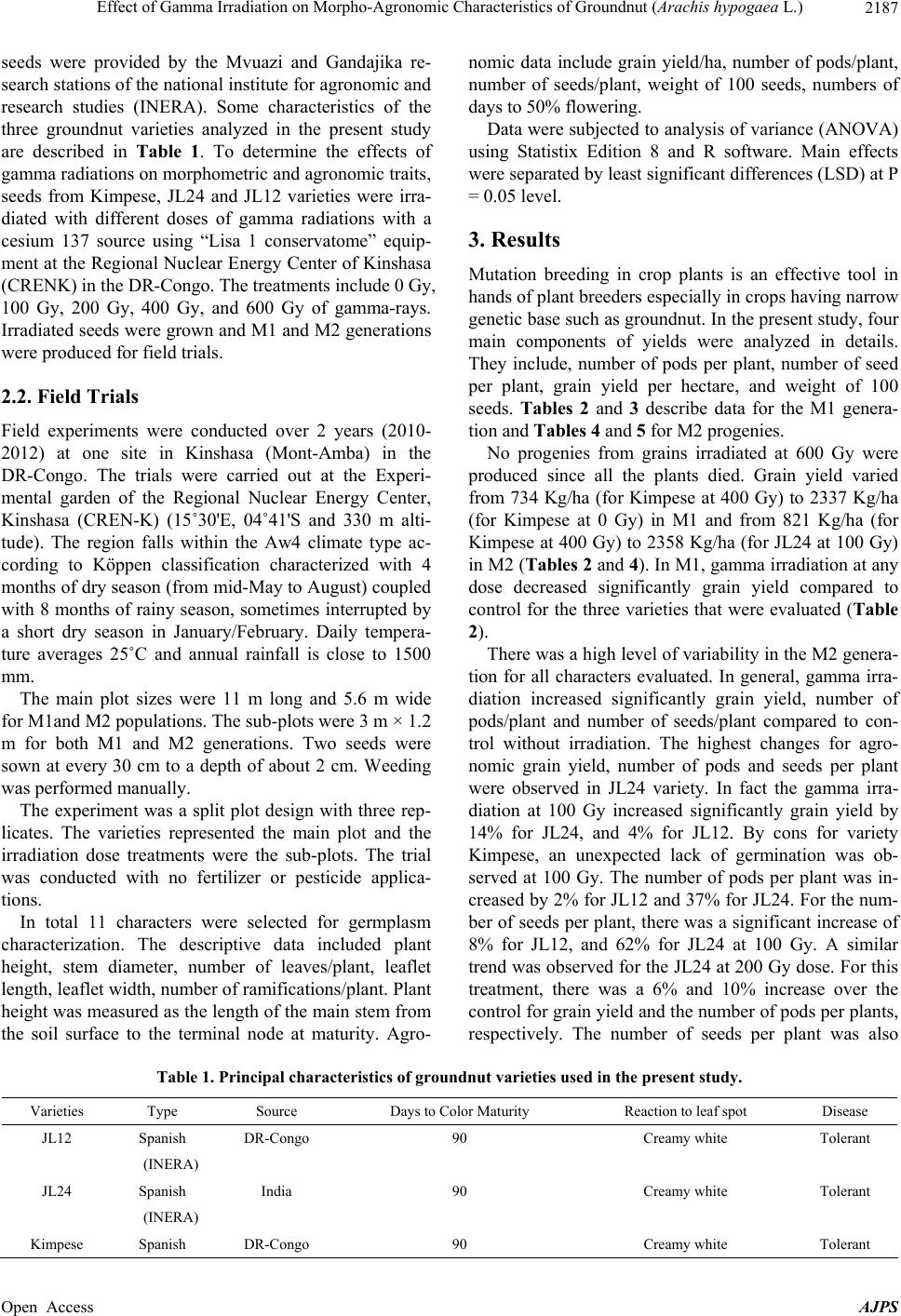 Effect of Gamma Irradiation on Morpho-Agronomic Characteristics of Groundnut (Arachis hypogaea L.) 2187 seeds were provided by the Mvuazi and Gandajika re- search stations of the national institute for agronomic and research studies (INERA). Some characteristics of the three groundnut varieties analyzed in the present study are described in Table 1. To determine the effects of gamma radiations on morphometric and agronomic traits, seeds from Kimpese, JL24 and JL12 varieties were irra- diated with different doses of gamma radiations with a cesium 137 source using “Lisa 1 conservatome” equip- ment at the Regional Nuclear Energy Center of Kinshasa (CRENK) in the DR-Congo. The treatments include 0 Gy, 100 Gy, 200 Gy, 400 Gy, and 600 Gy of gamma-rays. Irradiated seeds were grown and M1 and M2 generations were produced for field trials. 2.2. Field Trials Field experiments were conducted over 2 years (2010- 2012) at one site in Kinshasa (Mont-Amba) in the DR-Congo. The trials were carried out at the Experi- mental garden of the Regional Nuclear Energy Center, Kinshasa (CREN-K) (15˚30'E, 04˚41'S and 330 m alti- tude). The region falls within the Aw4 climate type ac- cording to Köppen classification characterized with 4 months of dry season (from mid-May to August) coupled with 8 months of rainy season, sometimes interrupted by a short dry season in January/February. Daily tempera- ture averages 25˚C and annual rainfall is close to 1500 mm. The main plot sizes were 11 m long and 5.6 m wide for M1and M2 populations. The sub-plots were 3 m × 1.2 m for both M1 and M2 generations. Two seeds were sown at every 30 cm to a depth of about 2 cm. Weeding was performed manually. The experiment was a split plot design with three rep- licates. The varieties represented the main plot and the irradiation dose treatments were the sub-plots. The trial was conducted with no fertilizer or pesticide applica- tions. In total 11 characters were selected for germplasm characterization. The descriptive data included plant height, stem diameter, number of leaves/plant, leaflet length, leaflet width, number of ramifications/plant. Plant height was measured as the length of the main stem from the soil surface to the terminal node at maturity. Agro- nomic data include grain yield/ha, number of pods/plant, number of seeds/plant, weight of 100 seeds, numbers of days to 50% flowering. Data were subjected to analysis of variance (ANOVA) using Statistix Edition 8 and R software. Main effects were separated by least significant differences (LSD) at P = 0.05 level. 3. Results Mutation breeding in crop plants is an effective tool in hands of plant breeders especially in crops having narrow genetic base such as groundnut. In the present study, four main components of yields were analyzed in details. They include, number of pods per plant, number of seed per plant, grain yield per hectare, and weight of 100 seeds. Tables 2 and 3 describe data for the M1 genera- tion and Tables 4 and 5 for M2 progenies. No progenies from grains irradiated at 600 Gy were produced since all the plants died. Grain yield varied from 734 Kg/ha (for Kimpese at 400 Gy) to 2337 Kg/ha (for Kimpese at 0 Gy) in M1 and from 821 Kg/ha (for Kimpese at 400 Gy) to 2358 Kg/ha (for JL24 at 100 Gy) in M2 (Tables 2 and 4). In M1, gamma irradiation at any dose decreased significantly grain yield compared to control for the three varieties that were evaluated (Table 2). There was a high level of variability in the M2 genera- tion for all characters evaluated. In general, gamma irra- diation increased significantly grain yield, number of pods/plant and number of seeds/plant compared to con- trol without irradiation. The highest changes for agro- nomic grain yield, number of pods and seeds per plant were observed in JL24 variety. In fact the gamma irra- diation at 100 Gy increased significantly grain yield by 14% for JL24, and 4% for JL12. By cons for variety Kimpese, an unexpected lack of germination was ob- served at 100 Gy. The number of pods per plant was in- creased by 2% for JL12 and 37% for JL24. For the num- ber of seeds per plant, there was a significant increase of 8% for JL12, and 62% for JL24 at 100 Gy. A similar trend was observed for the JL24 at 200 Gy dose. For this treatment, there was a 6% and 10% increase over the control for grain yield and the number of pods per plants, respectively. The number of seeds per plant was also Table 1. Principal characteristic s of gr oundnu t varieties used in the prese nt study. Varieties Type Source Days to Color Maturity Reaction to leaf spot Disease JL12 Spanish DR-Congo 90 Creamy white Tolerant (INERA) JL24 Spanish India 90 Creamy white Tolerant (INERA) Kimpese Spanish DR-Congo 90 Creamy white Tolerant Open Access AJPS 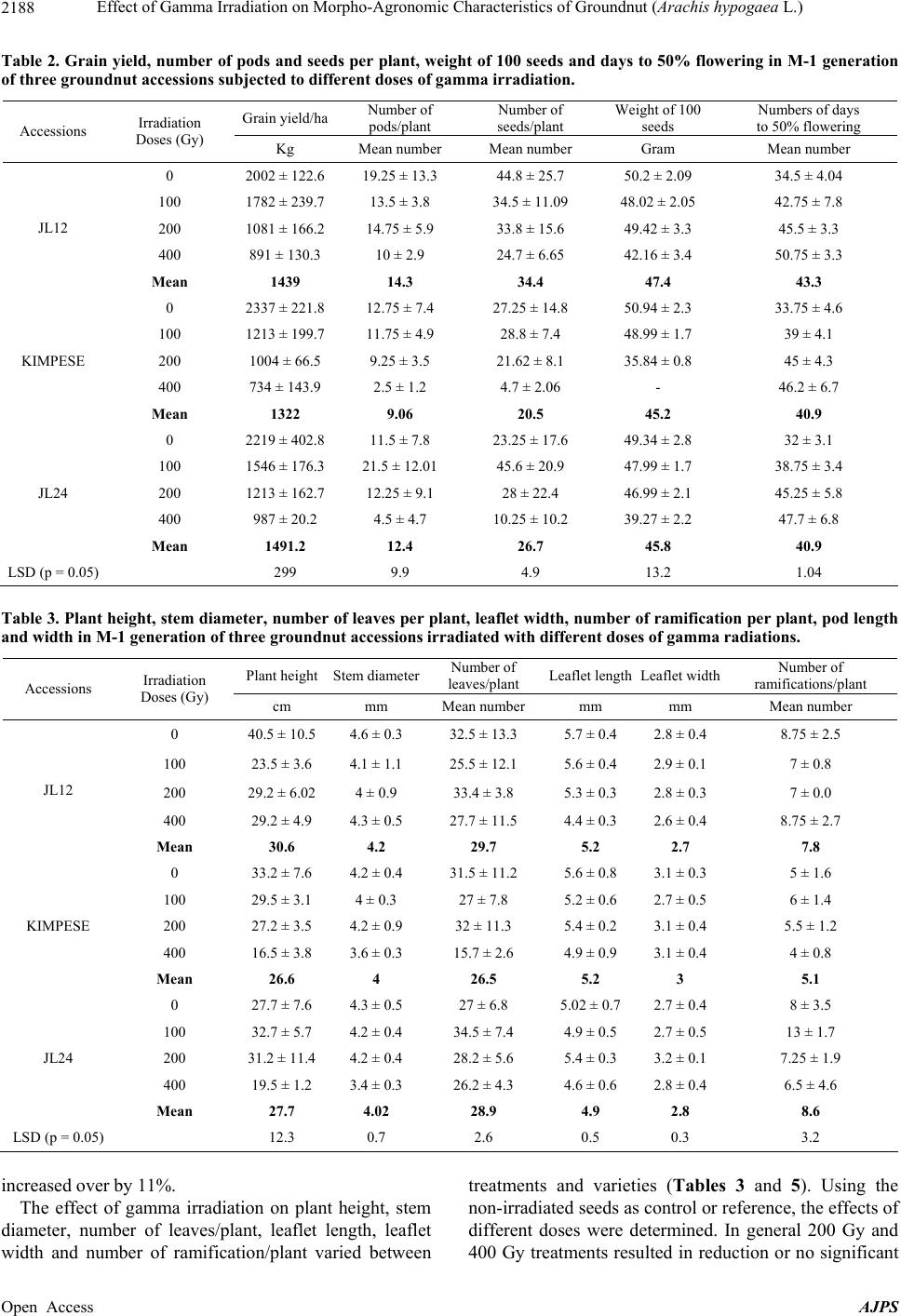 Effect of Gamma Irradiation on Morpho-Agronomic Characteristics of Groundnut (Arachis hypogaea L.) 2188 Table 2. Grain yield, number of pods and seeds per plant, weight of 100 seeds and days to 50% flowering in M-1 generation of three groundnut accessions subjected to different doses of gamma irradiation. Grain yield/ha Number of pods/plant Number of seeds/plant Weight of 100 seeds Numbers of days to 50% flowering Accessions Irradiation Doses (Gy) Kg Mean number Mean number Gram Mean number 0 2002 ± 122.6 19.25 ± 13.3 44.8 ± 25.7 50.2 ± 2.09 34.5 ± 4.04 100 1782 ± 239.7 13.5 ± 3.8 34.5 ± 11.09 48.02 ± 2.05 42.75 ± 7.8 200 1081 ± 166.2 14.75 ± 5.9 33.8 ± 15.6 49.42 ± 3.3 45.5 ± 3.3 400 891 ± 130.3 10 ± 2.9 24.7 ± 6.65 42.16 ± 3.4 50.75 ± 3.3 JL12 Mean 1439 14.3 34.4 47.4 43.3 0 2337 ± 221.8 12.75 ± 7.4 27.25 ± 14.8 50.94 ± 2.3 33.75 ± 4.6 100 1213 ± 199.7 11.75 ± 4.9 28.8 ± 7.4 48.99 ± 1.7 39 ± 4.1 200 1004 ± 66.5 9.25 ± 3.5 21.62 ± 8.1 35.84 ± 0.8 45 ± 4.3 400 734 ± 143.9 2.5 ± 1.2 4.7 ± 2.06 - 46.2 ± 6.7 KIMPESE Mean 1322 9.06 20.5 45.2 40.9 0 2219 ± 402.8 11.5 ± 7.8 23.25 ± 17.6 49.34 ± 2.8 32 ± 3.1 100 1546 ± 176.3 21.5 ± 12.01 45.6 ± 20.9 47.99 ± 1.7 38.75 ± 3.4 200 1213 ± 162.7 12.25 ± 9.1 28 ± 22.4 46.99 ± 2.1 45.25 ± 5.8 400 987 ± 20.2 4.5 ± 4.7 10.25 ± 10.2 39.27 ± 2.2 47.7 ± 6.8 JL24 Mean 1491.2 12.4 26.7 45.8 40.9 LSD (p = 0.05) 299 9.9 4.9 13.2 1.04 Table 3. Plant height, stem diameter, numbe r of leaves per plant, leaflet width, number of ramification per plant, pod length and width in M-1 generation of three groundnut accessions irradiated with different doses of gamma radiations. Plant height Stem diameterNumber of leaves/plant Leaflet lengthLeaflet width Number of ramifications/plant Accessions Irradiation Doses (Gy) cm mm Mean number mm mm Mean number 0 40.5 ± 10.5 4.6 ± 0.3 32.5 ± 13.3 5.7 ± 0.4 2.8 ± 0.4 8.75 ± 2.5 100 23.5 ± 3.6 4.1 ± 1.1 25.5 ± 12.1 5.6 ± 0.4 2.9 ± 0.1 7 ± 0.8 200 29.2 ± 6.02 4 ± 0.9 33.4 ± 3.8 5.3 ± 0.3 2.8 ± 0.3 7 ± 0.0 400 29.2 ± 4.9 4.3 ± 0.5 27.7 ± 11.5 4.4 ± 0.3 2.6 ± 0.4 8.75 ± 2.7 JL12 Mean 30.6 4.2 29.7 5.2 2.7 7.8 0 33.2 ± 7.6 4.2 ± 0.4 31.5 ± 11.2 5.6 ± 0.8 3.1 ± 0.3 5 ± 1.6 100 29.5 ± 3.1 4 ± 0.3 27 ± 7.8 5.2 ± 0.6 2.7 ± 0.5 6 ± 1.4 200 27.2 ± 3.5 4.2 ± 0.9 32 ± 11.3 5.4 ± 0.2 3.1 ± 0.4 5.5 ± 1.2 400 16.5 ± 3.8 3.6 ± 0.3 15.7 ± 2.6 4.9 ± 0.9 3.1 ± 0.4 4 ± 0.8 KIMPESE Mean 26.6 4 26.5 5.2 3 5.1 0 27.7 ± 7.6 4.3 ± 0.5 27 ± 6.8 5.02 ± 0.7 2.7 ± 0.4 8 ± 3.5 100 32.7 ± 5.7 4.2 ± 0.4 34.5 ± 7.4 4.9 ± 0.5 2.7 ± 0.5 13 ± 1.7 200 31.2 ± 11.4 4.2 ± 0.4 28.2 ± 5.6 5.4 ± 0.3 3.2 ± 0.1 7.25 ± 1.9 400 19.5 ± 1.2 3.4 ± 0.3 26.2 ± 4.3 4.6 ± 0.6 2.8 ± 0.4 6.5 ± 4.6 JL24 Mean 27.7 4.02 28.9 4.9 2.8 8.6 LSD (p = 0.05) 12.3 0.7 2.6 0.5 0.3 3.2 increased over by 11%. The effect of gamma irradiation on plant height, stem diameter, number of leaves/plant, leaflet length, leaflet width and number of ramification/plant varied between treatments and varieties (Tables 3 and 5). Using the non-irradiated seeds as control or reference, the effects of different doses were determined. In general 200 Gy and 400 Gy treatments resulted in reduction or no significant Open Access AJPS 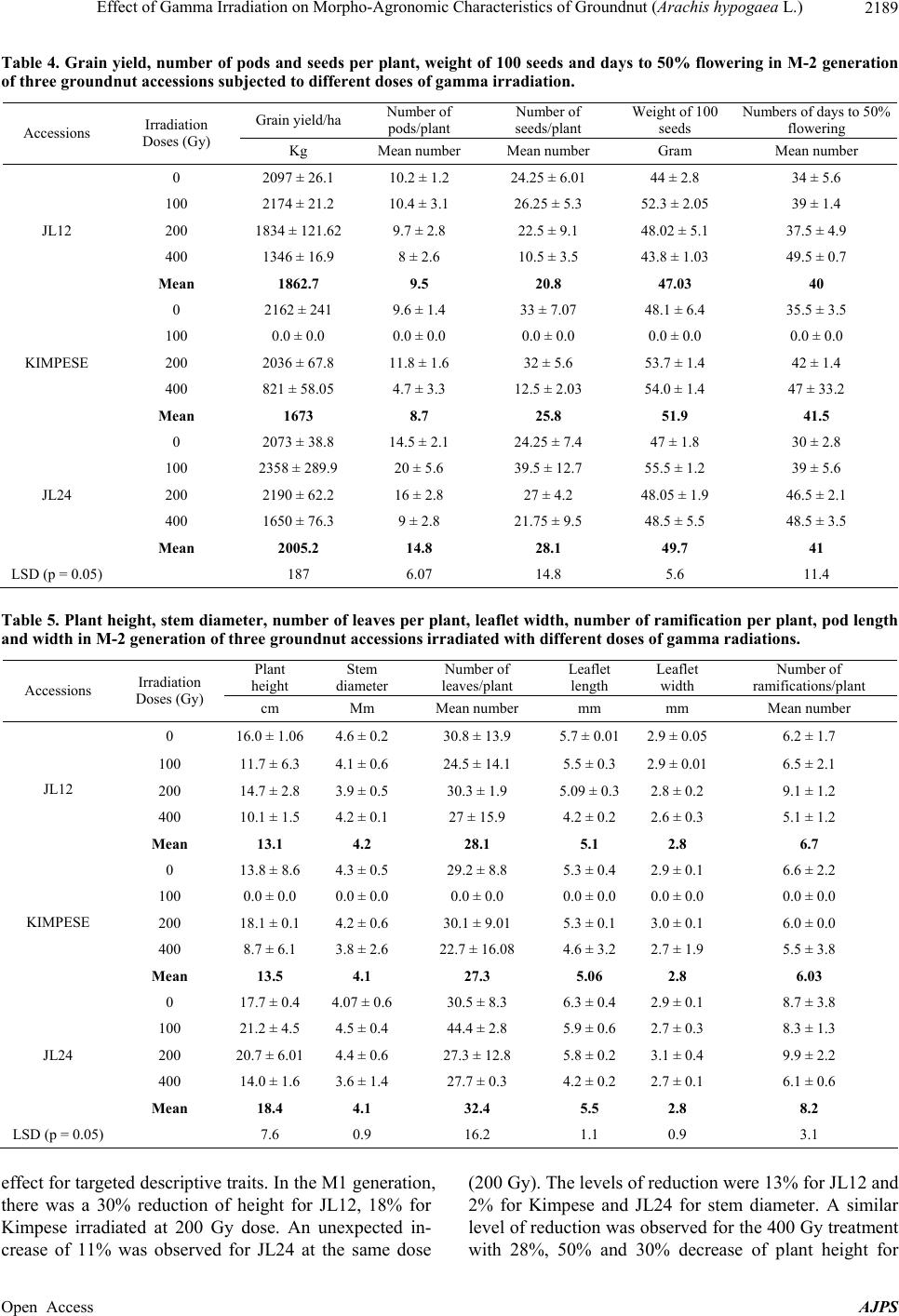 Effect of Gamma Irradiation on Morpho-Agronomic Characteristics of Groundnut (Arachis hypogaea L.) 2189 Table 4. Grain yield, number of pods and seeds per plant, weight of 100 seeds and days to 50% flowering in M-2 generation of three groundnut accessions subjected to different doses of gamma irradiation. Grain yield/ha Number of pods/plant Number of seeds/plant Weight of 100 seeds Numbers of days to 50% flowering Accessions Irradiation Doses (Gy) Kg Mean number Mean number Gram Mean number 0 2097 ± 26.1 10.2 ± 1.2 24.25 ± 6.01 44 ± 2.8 34 ± 5.6 100 2174 ± 21.2 10.4 ± 3.1 26.25 ± 5.3 52.3 ± 2.05 39 ± 1.4 200 1834 ± 121.62 9.7 ± 2.8 22.5 ± 9.1 48.02 ± 5.1 37.5 ± 4.9 400 1346 ± 16.9 8 ± 2.6 10.5 ± 3.5 43.8 ± 1.03 49.5 ± 0.7 JL12 Mean 1862.7 9.5 20.8 47.03 40 0 2162 ± 241 9.6 ± 1.4 33 ± 7.07 48.1 ± 6.4 35.5 ± 3.5 100 0.0 ± 0.0 0.0 ± 0.0 0.0 ± 0.0 0.0 ± 0.0 0.0 ± 0.0 200 2036 ± 67.8 11.8 ± 1.6 32 ± 5.6 53.7 ± 1.4 42 ± 1.4 400 821 ± 58.05 4.7 ± 3.3 12.5 ± 2.03 54.0 ± 1.4 47 ± 33.2 KIMPESE Mean 1673 8.7 25.8 51.9 41.5 0 2073 ± 38.8 14.5 ± 2.1 24.25 ± 7.4 47 ± 1.8 30 ± 2.8 100 2358 ± 289.9 20 ± 5.6 39.5 ± 12.7 55.5 ± 1.2 39 ± 5.6 200 2190 ± 62.2 16 ± 2.8 27 ± 4.2 48.05 ± 1.9 46.5 ± 2.1 400 1650 ± 76.3 9 ± 2.8 21.75 ± 9.5 48.5 ± 5.5 48.5 ± 3.5 JL24 Mean 2005.2 14.8 28.1 49.7 41 LSD (p = 0.05) 187 6.07 14.8 5.6 11.4 Table 5. Plant height, stem diameter, numbe r of leaves per plant, leaflet width, number of ramification per plant, pod length and width in M-2 generation of three groundnut accessions irradiated with different doses of gamma radiations. Plant height Stem diameter Number of leaves/plant Leaflet length Leaflet width Number of ramifications/plant Accessions Irradiation Doses (Gy) cm Mm Mean number mm mm Mean number 0 16.0 ± 1.06 4.6 ± 0.2 30.8 ± 13.9 5.7 ± 0.012.9 ± 0.05 6.2 ± 1.7 100 11.7 ± 6.3 4.1 ± 0.6 24.5 ± 14.1 5.5 ± 0.3 2.9 ± 0.01 6.5 ± 2.1 200 14.7 ± 2.8 3.9 ± 0.5 30.3 ± 1.9 5.09 ± 0.32.8 ± 0.2 9.1 ± 1.2 400 10.1 ± 1.5 4.2 ± 0.1 27 ± 15.9 4.2 ± 0.2 2.6 ± 0.3 5.1 ± 1.2 JL12 Mean 13.1 4.2 28.1 5.1 2.8 6.7 0 13.8 ± 8.6 4.3 ± 0.5 29.2 ± 8.8 5.3 ± 0.4 2.9 ± 0.1 6.6 ± 2.2 100 0.0 ± 0.0 0.0 ± 0.0 0.0 ± 0.0 0.0 ± 0.0 0.0 ± 0.0 0.0 ± 0.0 200 18.1 ± 0.1 4.2 ± 0.6 30.1 ± 9.01 5.3 ± 0.1 3.0 ± 0.1 6.0 ± 0.0 400 8.7 ± 6.1 3.8 ± 2.6 22.7 ± 16.08 4.6 ± 3.2 2.7 ± 1.9 5.5 ± 3.8 KIMPESE Mean 13.5 4.1 27.3 5.06 2.8 6.03 0 17.7 ± 0.4 4.07 ± 0.6 30.5 ± 8.3 6.3 ± 0.4 2.9 ± 0.1 8.7 ± 3.8 100 21.2 ± 4.5 4.5 ± 0.4 44.4 ± 2.8 5.9 ± 0.6 2.7 ± 0.3 8.3 ± 1.3 200 20.7 ± 6.01 4.4 ± 0.6 27.3 ± 12.8 5.8 ± 0.2 3.1 ± 0.4 9.9 ± 2.2 400 14.0 ± 1.6 3.6 ± 1.4 27.7 ± 0.3 4.2 ± 0.2 2.7 ± 0.1 6.1 ± 0.6 JL24 Mean 18.4 4.1 32.4 5.5 2.8 8.2 LSD (p = 0.05) 7.6 0.9 16.2 1.1 0.9 3.1 effect for targeted descriptive traits. In the M1 generation, there was a 30% reduction of height for JL12, 18% for Kimpese irradiated at 200 Gy dose. An unexpected in- crease of 11% was observed for JL24 at the same dose (200 Gy). The levels of reduction were 13% for JL12 and 2% for Kimpese and JL24 for stem diameter. A similar level of reduction was observed for the 400 Gy treatment with 28%, 50% and 30% decrease of plant height for Open Access AJPS  Effect of Gamma Irradiation on Morpho-Agronomic Characteristics of Groundnut (Arachis hypogaea L.) 2190 JL12, Kimpese and JL24, respectively. Reduction of stem diameter was 6.5% for JL12, 14% for Kimpese and 30% for JL24. Significant decrease of the number of leaves per plant, leaflet length, and number of ramifica- tions per plant was observed only for the 400 Gy treat- ment. In fact, for this treatment, 15%, 50% and 3% de- crease of the number of leaves per plant were observed for JL12, Kimpese and JL24, respectively. Leaflet length change was observed at 400 Gy treatment for JL12 (−23%), Kimpese (−12.5%) and JL24 (−8%). For the number of ramifications per plant, the change was noted with 20% and 19% reductions in Kimpese and JL24, respectively. There were significant differences in plant height and other morphological traits in the M2 generation derived from seeds treated with 100 Gy for the three varieties (Table 5). The level of reduction was 27% for JL12. By cons for JL24, the gamma irradiation at 100 Gy increased significantly plant height by 20%. The 200 Gy irradiation induced a significant reduction of plant height in JL12 (8%), an increase (31%) in Kimpese and JL24 (17%). A decrease of the leaflet length (11%) in JL12 and JL24 (8%), and an increase of number of ramifications per plant for JL12 (46%) and JL24 (14%) were observed. 4. Discussion The results of the present study illustrated that gamma ray radiation is an efficient tool for increasing genetic variability and grain yield in groundnut varieties. The positive effect of low doses of gamma rays irradiation (100 Gy) on plant growth may be due to the stimulation of cell division or elongation, or the alteration of meta- bolic processes that affect the synthesis of phytohor- mones or nucleic acids [12,13]. In addition, high doses of gamma irradiation were reported to be harmful in several studies like that of Ramachandran and Goud [14], who reported that higher doses of gamma irradiation reduced plant height, number of leaves and branching capacity of safflower. By comparison of the different treatments (different radiation doses) and the control (not irradiated), it was observed that there were significant alterations in the plant development and production in the M1 generation for all the gamma rays doses. Significant reduction of all the agro-morphometric characteristics was observed at that stage. Seeds treated at irradiation dose of 600 Gy did not survive to produce progenies for evaluation. Higher exposures of gamma rays caused injury to seeds and affected seedling development. These data are consistent with other reports by Devi and Mullainathan [10] in blackgram, and Yakoob and Ahamad [15] in mungbeans. Many studies have shown that treatment with higher dose of gamma rays were inhibitory, whereas lower exposures were sometimes stimulatory. Gamma rays produce radicals that can damage and affect differ- entially plant morphology, anatomy, biochemistry, and physiology depending on the irradiation level. On the other hand, the results of the M2 generation reported in the present study showed that it is possible to increase grain yields components to a dose of 100 Gy. Improvement of agronomic characteristics by using gamma radiation has been reported in several studies. Khan et al. [16] reported a significant increase of chick- pea grain yield using gamma irradiation at 600 Gy. Gustafson et al. [17] developed a high yielding and early maturing barley by mutation breeding methods. Mudibu et al. [4] reported the highest grain yield increase in soy- bean irradiated with 200 Gy of gamma rays. In the present study, an increase of number of pods per plant was observed in the varieties JL12 and JL24 for gamma irradiation at 100 Gy dose. Khan et al. [16] re- ported a decrease of pod number at 400 Gy treatment and an increase at 500 Gy without a change in the number of seed per pod. Similar results have been reported by Sha- koor et al. [18] in mungbean, Devi and Mullianathan [10] in blackgram, and Kumar and Ratnam [19] in sunflower. There were no significant changes of plant height be- tween different irradiation treatments compared to the control in M2 generation. This is consistent with report by Shakoor et al., Rao, and Khan et al. [16,18,20] in mungbean, and Mudibu et al. [4] in soybean. The reports of Rao [20] in pigeon pea and Khan et al. [21] in sor- ghum did not agree with these results. They observed that plant height increased with the application of gamma irradiation. This may be due to the different genetic ma- terial and environmental conditions. The dose of gamma rays radiation is important for in- ducing genetic variation that can lead to positive effect in mutants. In fact, molecular analysis of similar set of groundnut using ISSR markers in a previous study has shown that gamma ray irradiation at a dose of 100 Gy gamma rays increased the level of genetic variability [22]. In fact the level of polymorphic loci observed was sig- nificantly increased by more than 37% when 100 Gy gamma rays treatment was compared with the control for the JL24 variety [22]. Bensliman and Khelifi [8] and, Ramani and Jadon [23] also reported that the highest genetic variation in M2 generation of groundnut was observed with the 100 Gy treatment. The analysis of M1 and M2 generations indicate that the grain yield gain and other beneficial effects generated with gamma ray radia- tion are heritable. 5. Conclusion Mutation induction has proven to be a workable, sustain- able, highly efficient, environmentally acceptable, flexi- ble, unregulated, non-hazardous and a low-cost technol- ogy in the breeder’s toolbox to enhance crop improve- Open Access AJPS  Effect of Gamma Irradiation on Morpho-Agronomic Characteristics of Groundnut (Arachis hypogaea L.) 2191 ment. In the present study, the agronomic and morpho- logical characteristics were improved by gamma ray treatments. Among the various dose treatments, 100 Gy of gamma rays treatment resulted in higher genetic vari- ability and grain yield increase. This genetic gain can be stabilized over few generations through selfing. Overall, the results of the present study indicate that groundnut mutant lines will increase the variability of the current groundnut genepool in the DR-Congo. Additional agro- nomic, nutritional, and organoleptic analyses of the se- lected groundnut mutants are underway before multi- location evaluation. 6. Acknowledgements This research was conducted through a partnership be- tween Laurentian University (Ontario, Canada) and Uni- versity of Kinshasa (DR-Congo). The authors are grate- ful to the Canadian International Development agency (CIDA) for financial support and the Regional Nuclear Energy Center of Kinshasa (CRNK) for logistics support for field trial and seed irradiation. REFERENCES [1] A. O. Ojomo, O. Omueti, J. A. Raji and O. Omueti, “Studies in Induced Mutation in Cowpea, 5. The Variation in Protein Content Following Ionizing Radiation,” Jour- nal of Applied Science, Vol. 21, 1979, pp. 61-64. [2] Y. Takagi and T. Anai, “Development of Novel Fatty Acid Composition in Soybean Oil by Induced Mutation,” Oleoscience, Vol. 6, No. 4, 2006, pp. 195-203. http://dx.doi.org/10.5650/oleoscience.6.195 [3] J. Mudibu, K. K. Nkongolo, M. Mehes-Smith and A. Kalonji-Mbuyi, “Genetic Analysis of a Soybean Genetic Pool Using ISSR Marker: Effect of Gamma Radiation on Genetic Variability,” International Journal of Pla nt Breed- ing and Genetics, Vol. 5, No. 3, 2011, pp. 235-245. http://dx.doi.org/10.3923/ijpbg.2011.235.245 [4] J. Mudibu, K. K. Nkongolo, A. Kalonji-Mbuyi and R. Kizungu, “Effect of Gamma Irradiation on Morpho-Ag- ronomic Characteristics of Soybeans (Glycine max L.),” American Journal of Plant Science, Vol. 3, No. 3, 2010, pp. 331-337. http://dx.doi.org/10.4236/ajps.2012.33039 [5] R. Avila and B. R. Murty, “Cowpea and Mungbean Im- provement by Mutation Induction,” Mutation Breeding Newsletter, Vol. 21, 1983, p. 9. [6] A. Micke, “Improvement of Grain Legume Production Using Induced Mutations,” International Atomic Energy Agency (IAEA), Pullman, 1-5 July 1986, pp. 1-51. [7] B. N. Routaray, R. G. Mishra and S. N. Das, “Genetic Variability and Effectiveness of Some Chemical Mutagens on Blackgram in Relation to Resistance Source against Meloidogyne incognita,” Current Agricultural Research, Vol. 8, No. 3-4, 1995, pp. 113-118. [8] N. Benslimani and L. Khelifi, “Induction of Dormancy in Spanish Groundnut Seeds (Arachis hypogaea L.) Using Cobalt 60 Gamma Irradiation,” In: Q. Y. Shu, Ed., In- duced Plant Mutations in the Genomics Era, Food and Agriculture Organization of the United Nations (FAO), Rome, 2009, pp. 381-384. [9] H. L. Nadaf, S. B. Kaveri, K. Madhusudan and B. N. Motagi, “Induced Genetic Variability for Yield and Yield Components in Peanut (Arachis hypogaea L.),” In: Q. Y. Shu, Ed., Induced Plant Mutations in the Genomics Era., Food and Agriculture Organization of the United Nations (FAO), Rome, 2009, pp. 346-348. [10] S. A. Devi and L. Mullainathan, “Effect of Gamma Rays and Ethyl Methane Sulphonate (EMS) in M3 Generation of Blackgram (Vigna mungo L. Hepper),” African Jour- nal of Biotechnology, Vol. 11, No. 15, 2012, pp. 3548- 3552. [11] V. L. Chopra, “Mutagenesis: Investigating the Process and Processing the Outcome for Crop Improvement,” Current Science, Vol. 89, No. 2, 2005, pp. 353-359. [12] M. A. Pitirmovae, “Effect of Gamma Rays and Mutagens on Barley Seeds,” Fiziol. Res., Vol. 6, 1979, pp. 127-131. [13] H. L. Hanan, M. A. Abdalla and S. A. Farag, “Radio- Stimulation of Phytohormons and Bioactive Components of Coriander Seedlings,” Turkish Journal of Biochemistry, Vol. 36, No. 3, 2011, pp. 230-236. [14] M. Ramachandran and J. V. Goud, “Mutagenesis in Saf- flower (Carthamus tinctorius). I. Differential Radiosensi- tivity,” Genetic Agraria, Vol. 37, 1983, pp. 309-318. [15] M. Yaqoob and B. Ahmad, “Induced Mutation Studies in Some Mung Beans Cultivars,” Sarhad Journal of Agri- culture, Vol. 1, 2003, pp. 301-365. [16] M. R. Khan, A. S. Qureshi, S. A. Hussain and M. Ibrahim, “Genetic Variability Induced by gamma irradiation and Its Modulation with Gibberellic Acid in M2 Generation of Chickpea (Cicer arietinum L.),” Pakistan Journal of Botany, Vol. 37, No. 2, 2005, pp. 285-292. [17] A. Gustafsson, A. Hagberg, G. Persson and K. Wikland, “Induced Mutation and Barley Improvement,” Theoreti- cal Applied Genetics, Vol. 41, No. 6, 1971, pp. 239-248. http://dx.doi.org/10.1007/BF00277792 [18] A. Shakoor, M. A. Haq and M. Sadiq, “Induced Genetic Variability in M2 and Evaluation of Promising Mutant Lines in M4 Generation of Mung Bean,” Pakistan Jour- nal of Agricultural Science, Vol. 5, No. 1-2, 1978, pp. 1- 6. [19] P. R. S. Kumar and S. V. Ratnam, “Mutagenic Effective- ness and Efficiency in Varieties of Sunflower (Helianthus annuus L.) by Separate and Combined Treatment with Gamma-Rays and Sodium Azide,” African Journal of Biotechnology, Vol. 9, No. 39, 2010, pp. 6517-6521. [20] S. K. Rao, “Gamma Ray Induced Morphological and Physiological Variations in Cicer arietinum L.,” Indian Journal of Botany, Vol. 11, No. 1, 1988, pp. 29-32. [21] A. Khan, K. Hayat, S. Hassan, M. Sadiq and M. Hashim, “Gamma Radiation Induced Variation in Some Genetic Parameters in Sorghum Cultivars in M2 Generation,” Sarhad Journal of Agriculture, Vol. 5, No. 2, 1989, pp. 199-203. [22] L. Tshilenge-Lukanda, K. K. C. Nkongolo, R. Narendrula, Open Access AJPS  Effect of Gamma Irradiation on Morpho-Agronomic Characteristics of Groundnut (Arachis hypogaea L.) Open Access AJPS 2192 A. Kalonji-Mbuyi and R. V. Kizungu, “Molecular Char- acterization of Groundnut (Arachis hypogaea L.) Acces- sions from a Gene Pool: Application of Gamma Ray Ra- diations,” Journal of Plant Breeding and Crop Science, Vol. 4, No. 11, 2012, pp. 175-183. [23] G. M. Ramani and B. S. Jadon, “Induced Variability in Groundnut in M2 Generation,” Gujarat Agricultural Uni- versity Research Journal, Vol. 16, No. 2, 1991, pp. 23-26. |