

Paper Menu >>
Journal Menu >>
 American Journal of Plant Sciences, 2013, 4, 2181-2185 Published Online November 2013 (http://www.scirp.org/journal/ajps) http://dx.doi.org/10.4236/ajps.2013.411270 Open Access AJPS 2181 Evaluation of Antibacterial and Antidiarrhoeal Activities of Feronia limonia Leaf Extract Mohammad Abdul Motalib Momin1, Mizanur Rahaman Khan2, Johir Rayhan1, Afrina Afrose1, Sohel Rana1, Anjuman Ara Begum1* 1Department of Pharmacy, Jahangirnagar University, Savar, Bangladesh; 2Department of Pharmacy, University of Science and Technology Chittagong, Chittagong, Bangladesh. Email: *[email protected] Received August 19th, 2013; revised September 20th, 2013; accepted October 15th, 2013 Copyright © 2013 Mohammad Abdul Motalib Momin et al. This is an open access article distributed under the Creative Commons Attribution License, which permits unrestricted use, distribution, and reproduction in any medium, provided the original work is properly cited. ABSTRACT The present study was carried out to investigate possible antibacterial and antidiarrhoeal activities of ethanol extract of Feronia limonia leaves. Phytochemical analysis of the crude extract was performed to detect presence of different kinds of phytoconstituents. The antibacterial activity was investigated against four Gram positive and four Gram negative bacteria by using disc diffusion method. The plant extract showed moderate antibacterial activity against Gram positive bacteria namely Staphylococcus saprophyticus and Staphylococcus pyogenes and all tested Gram negative bacteria namely Escherichia coli, Shigella boydii, Shigella dysentery and Shigella flexneri in dose dependant manner. The re- sults of castor oil-induced diarrhoeal study showed that Feronia limonia extract significantly reduced the severity & frequency of diarrhoea in mice at a higher dose of 500 mg/kg compared with the standard drug loperamide (25 mg/kg). The present study clearly supports the medicinal value of this plant. The overall results indicate the possibility of pres- ence of some active principles in the plant extract possessing antibacterial and antidiarrhoeal actions. Keywords: Phytochemical Screening; Antimicrobial; Antidiarrhoeal; Feronia limonia 1. Introduction Antibiotic resistance developed by bacteria has become a vital issue all over the world. A good number of antibi- otics are found to be inactive in recent years largely due to resistance development through the inappropriate and injudicious uses of commercial antimicrobial drugs com- monly employed in the treatment of infectious diseases [1]. So to combat the problem of microbial resistance and for substitution with effective ones the developments of new antibacterial agents are necessary. Diarrhoea is an- other important health problem around the world, re- sponsible for more than 5 million deaths annually [2,3]. The investigation of the antimicrobial and antidiarrhoeal properties of plants has brought attention to the opportu- nity of producing a safe, economical and easily available source that could replace the synthetic antimicrobial and antidiarrhoeal compounds [4,5]. Feronia limonia is a deciduous, slow-growing, erect tree belonging to family Rutaceae and subfamily Auran- tioideae [6]. It is distributed in deciduous and arid land- scapes of several countries in South Asia [7]. Feronia limonia as a whole, or its parts such as unriped fruit, riped fruit, root, bark, trunk gum and leaves have a broad spectrum of traditionally established therapeutic proper- ties including antimicrobial and antidiarrhoeal effects [8,9]. Literature survey revealed that leaf extract of the plant has antioxidant [10], hepatoprotective [10], lar- vicidal [11], antitumor [12], antidiabetic [13], and CNS depressant potentials [14]. In the present study, assess- ment of antibacterial and antidiarrhoeal activities of the leaves of F. limonia was conducted to find out medici- nal properties and to justify their traditional use for ail- ments of diseases. 2. Materials and Methods 2.1. Collection and Preparation of the Plant Material The plant material was collected from Khulna district, *Corresponding author.  Evaluation of Antibacterial and Antidiarrhoeal Activities of Feronia limonia Leaf Extract 2182 Bangladesh and identified by the taxonomist of Bangla- desh National Herbarium, Dhaka (Accession No. DACB- 34397). The voucher specimens of the plants have been deposited in the herbarium for future reference. The leaves of collected plant were sun-dried for one week. The plant parts were then converted into a coarse powder with a suitable grinder. The powder was stored in an air- tight container and kept in a cool, dark and dry place until analysis commenced. 2.2. Preparation of Plant Extract About 150 gm of powered material was taken in a clean, flat bottomed glass container and soaked in 600 ml of 95% ethanol. The container with its contents was sealed and kept for a period of 14 days accompanying occa- sional shaking and stirring [15-17]. The whole mixture then underwent a coarse filtration by a piece of clean, white cotton material and also using Whatman filter pa- per. By using a rotary evaporator (Bibby RE200, Sterilin Ltd., UK) the resultant filtrate was concentrated to pow- der form through complete evaporation of the extraction solvent. The filtrate was then air dried at room tempera- ture to evaporate the extra ethanol. It rendered concen- trate of reddish color which was designated as crude ex- tract of ethanol and stored in a refrigerator until further investigation. 2.3. Experimental Animal Young Swiss-albino mice (average weight 20 - 25 gm) were purchased from the Animal Research Branch of the International Center for Diarrhoeal Disease and Research, Bangladesh (ICDDRB) for assessing biological activity. The animals were kept in standard environmental condi- tions for one week for adaptation after their purchase and fed ICDDRB formulated rodent food and water. All the experiments were conducted on an isolated and noiseless condition. 2.4. Phytochemical Screening The preliminary phytochemical screening with various qualitative chemical tests was performed to detect the presence of various classes of phytoconstituents in 10% (w/v) solution of the plant extract. Phytoconstituents like saponins, tannins, alkaloids, steroids, flavonoids, gly- cosides were identified by characteristic color changes using different reagents following standard procedures [18,19]. 2.5. Antimicrobial Test The antimicrobial assay was performed by disc diffusion method [20-22]. Eight pathogenic bacteria (collected from the International Centre for Diarrhoeal Disease and Research, Bangladesh) were inoculated on 16 ml previ- ously sterilized nutrient agar media, mixed thoroughly and transferred immediately to the sterile Petri dish in an aseptic condition using a sterile loop. Prepared plant ex- tracts (250 µg/disc and 500 µg/disc) and standard kana- mycin solutions (30 µg/disc) were applied to the corre- sponding Petri dish. The plates were incubated for 24 hours at 37˚C. After proper incubation, clear zone of in- hibition around the point of application of sample solu- tion were measured and expressed in millimeter (mm). 2.6. Antidiarrhoeal Test The experiment was conducted by previously reported castor-oil diarrhea model [23]. The mice were screened initially by giving 0.5 mL of castor oil and only those showing diarrhoea were selected for the experiment. The test animals fastened overnight were randomly allocated to four groups consisting of six mice in each group. The animals of group I (control) received vehicles only (dis- tilled water containing 0.1% Tween-80). Group-II (posi- tive control) received standard antimotility drug lopera- mide (50 mg/kg body weight) as oral suspension. The group-III and group-IV (test groups) were treated with suspension of leaves extract of Feronia limonia at the oral dose of 250 mg/kg-body weight and 500 mg/kg- body weight. After one hour treatment with distilled wa- ter, standard drug or plant extract, each animal was given 0.5 mL of castor oil by oral route. Individual animals of each group were then placed in separate cages having adsorbent paper beneath and examined for the presence of diarrhoea every hour in five hours study after the cas- tor oil administration. Number of stools or any fluid ma- terial that stained the adsorbent paper were counted at each successive hour during the 4-hour period and were noted for each mouse. The latent period of each mouse were also counted. At the beginning of each hour new papers were placed for the old ones. 2.7. Statistical Analysis Results were expressed as mean ± standard error of mean (SEM). Statistical analysis for animal experiment was carried out using one-way ANOVA followed by Dun- net’s multiple comparisons. The results obtained were compared with the control group. P values < 0.05 were considered to be statistically significant. 3. Results and Discussion 3.1. Phytochemical Screening The crude extract was subjected for chemical group tests to identify various types of important chemical constitu- ents. Phytochemical studies showed that alkaloids, ster- oids, tannins and flavonoids are present in the ethanolic extract of Feronia limonia (Table 1). However, glyco- Open Access AJPS 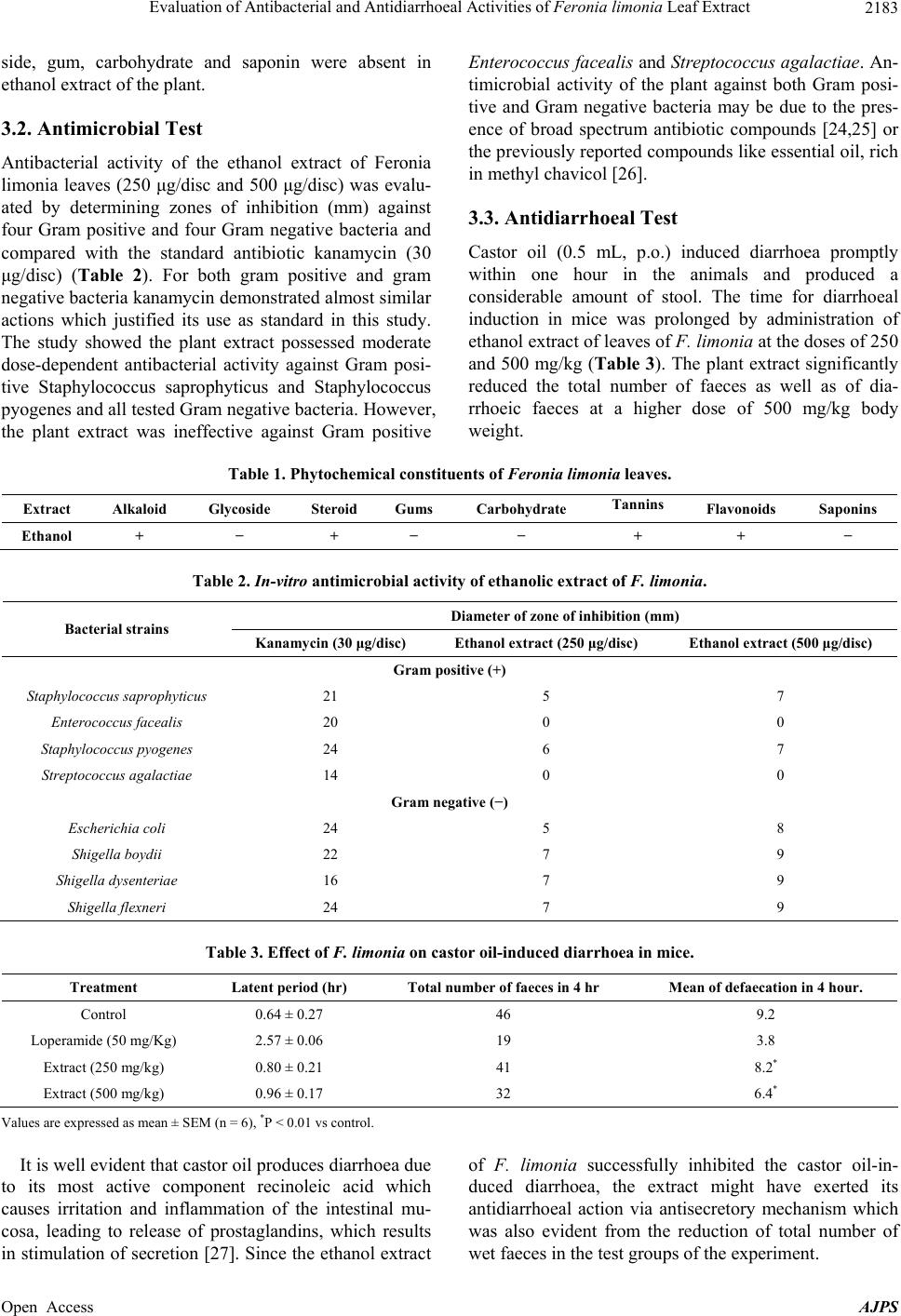 Evaluation of Antibacterial and Antidiarrhoeal Activities of Feronia limonia Leaf Extract Open Access AJPS 2183 Enterococcus facealis and Streptococcus agalactiae. An- timicrobial activity of the plant against both Gram posi- tive and Gram negative bacteria may be due to the pres- ence of broad spectrum antibiotic compounds [24,25] or the previously reported compounds like essential oil, rich in methyl chavicol [26]. side, gum, carbohydrate and saponin were absent in ethanol extract of the plant. 3.2. Antimicrobial Test Antibacterial activity of the ethanol extract of Feronia limonia leaves (250 μg/disc and 500 μg/disc) was evalu- ated by determining zones of inhibition (mm) against four Gram positive and four Gram negative bacteria and compared with the standard antibiotic kanamycin (30 μg/disc) (Table 2). For both gram positive and gram negative bacteria kanamycin demonstrated almost similar actions which justified its use as standard in this study. The study showed the plant extract possessed moderate dose-dependent antibacterial activity against Gram posi- tive Staphylococcus saprophyticus and Staphylococcus pyogenes and all tested Gram negative bacteria. However, the plant extract was ineffective against Gram positive 3.3. Antidiarrhoeal Test Castor oil (0.5 mL, p.o.) induced diarrhoea promptly within one hour in the animals and produced a considerable amount of stool. The time for diarrhoeal induction in mice was prolonged by administration of ethanol extract of leaves of F. limonia at the doses of 250 and 500 mg/kg (Table 3). The plant extract significantly reduced the total number of faeces as well as of dia- rrhoeic faeces at a higher dose of 500 mg/kg body weight. Table 1. Phytochemical constituents of Feronia limonia leaves. Extract Alkaloid Glycoside Steroid Gums Carbohydrate Tannins Flavonoids Saponins Ethanol + − + − − + + − Table 2. In-vitro antimicrobial activity of ethanolic extract of F. limonia. Diameter of zone of inhibition (mm) Bacterial strains Kanamycin (30 μg/disc) Ethanol extract (250 μg/disc) Ethanol extract (500 μg/disc) Gram positive (+) Staphylococcus saprophyticus 21 5 7 Enterococcus facealis 20 0 0 Staphylococcus pyogenes 24 6 7 Streptococcus agalactiae 14 0 0 Gram negative (−) Escherichia coli 24 5 8 Shigella boydii 22 7 9 Shigella dysenteriae 16 7 9 Shigella flexneri 24 7 9 Table 3. Effect of F. limonia on castor oil-induced diarrhoea in mice. Treatment Latent period (hr) Total number of faeces in 4 hr Mean of defaecation in 4 hour. Control 0.64 ± 0.27 46 9.2 Loperamide (50 mg/Kg) 2.57 ± 0.06 19 3.8 Extract (250 mg/kg) 0.80 ± 0.21 41 8.2* Extract (500 mg/kg) 0.96 ± 0.17 32 6.4* Values are expressed as mean ± SEM (n = 6), *P < 0.01 vs control. It is well evident that castor oil produces diarrhoea due to its most active component recinoleic acid which causes irritation and inflammation of the intestinal mu- cosa, leading to release of prostaglandins, which results in stimulation of secretion [27]. Since the ethanol extract of F. limonia successfully inhibited the castor oil-in- duced diarrhoea, the extract might have exerted its antidiarrhoeal action via antisecretory mechanism which was also evident from the reduction of total number of wet faeces in the test groups of the experiment.  Evaluation of Antibacterial and Antidiarrhoeal Activities of Feronia limonia Leaf Extract 2184 Furthermore, the standard chemical tests performed in this study showed that the leaves of the plant species contain tannins, steroids and flavonoids. Tannins have been reported in several studies to have antidiarrhoeal effect [28,29]. In fact, tannins denature proteins and form protein tannate, which makes the intestinal mucosa more resistant and reduces intestinal secretion [30]. The antidiarrhoeal activity of flavonoids has been ascribed to their ability to inhibit intestinal motility and hydro-elec- trolytic secretion [31,32]. Hence, the antidiarrhoeal ac- tivity of the plant may be due to its content of tannins and/or flavonoids. In addition, the antidiarrhoeal activity of the plant may be associated with its antimicrobial ef- fect. 4. Conclusion The results of the present study indicate that the ethanol extracts of F. limonia leaves possess significant antibac- terial and antidiarrhoeal potentials in dose dependant manner. The present data justify the traditional uses of this plant for the treatment of various diseases. However, further studies are required for isolation and purification of the active principles of the plant responsible for these effects and to better understand the mechanism of such actions. As the leaves extracts possess tannin and flavon- oids, which indicates the presence of antioxidant capacity, we have further plan to conduct study to investigate an- tioxidant property. REFERENCES [1] A. J. Alanis, “Resistance to Antibiotics: Are We in the Post-Antibiotics Era?” Archives of Medical Research, Vol. 36, No. 6, 2005, pp. 697-705. http://dx.doi.org/10.1016/j.arcmed.2005.06.009 [2] J. D. Snyder and M. H. Merson, “The Magnitude of the Global Problem of Acute Diarrhea Disease: A Review of Active Surveillance of Data,” Bulletin of the WHO, Vol. 60, No. 4, 1982, pp. 605-613. [3] K. Park, “Park’s Text Book of Preventive and Social Medicine,” Banarsidas Bharat Publishers, Jabalpur, 2000, pp. 122-175. [4] Anonymous, “Diarrhoeal Disease Control Program,” Weekly Epidemic Record, Vol. 16, 1979, p. 121. [5] L. Zhu, Y. J. Tian, L. Yang and J. G. Jiang, “Chemical Composition and Antimicrobial Activities of Essential Oil of Blumea megacephala,” EXCLI Journal, Vol. 10, 2011, pp. 62-68. [6] D. L. Dreyer, M. V. Pickering and P. Cohan, “Distribu- tion of Limonoids in the Rutaceae,” Phytochemistry, Vol. 11, No. 2, 1972, pp. 705-713. http://dx.doi.org/10.1016/0031-9422(72)80036-0 [7] J. D. Hooker, “The Flora of British India,” L. Reeve & Co, London, 1875, p. 178. [8] K. R. Kirtikar and B. D. Basu, “Indian Medicinal Plants,” Vol. I, 2nd Edition, Bishen Sigh Mahinder Pal Singh, Dehra Dun, 1998, pp. 496-498. [9] D. N. G. Bakshi, P. Sensarma and D. C. Pai, “A Lexicon of Medicinal Plants in India,” Naya Prokash, Calcutta, 2001, pp. 186-187. [10] S. M. Ahamed, K. N. Jayaveera, J. V. Rao and T. Nagar- jan, “Hepatoprotective and Antioxidant Activity of Me- thanolic Extract of Feronia limonia Leaves on Paraceta- mol-Induced Hepatic Injury in Rats,” Advances in Phar- macology and Toxicology, Vol. 11, No. 1, 2010, pp. 47- 53. [11] A. A. Rahuman, G. Gopalarkrishnan, G. Saleem, S. Aru- mugam and B. Himalayan, “Effect of Feronia limonia on Mosquito Larvae,” Fitoterapia, Vol. 71, No. 5, 2000, pp. 553-555. http://www.sciencedirect.com/science/article/pii/S036732 6X00001647 http://dx.doi.org/10.1016/S0367-326X(00)00164-7 [12] Y. Saima, A. K. Das, K. K. Sarkar, A. K. Sen and P. Sur, “An Antitumor Pectic Polysaccharide from Feronia limo- nia,” International Journal of Biological Macromolecules, Vol. 27, No. 5, 2000, pp. 333-335. http://www.ncbi.nlm.nih.gov/pubmed/10998491 http://dx.doi.org/10.1016/S0141-8130(00)00134-3 [13] R. K. Joshi, P. A. Patil, M. H. K. Mujawar, D. Kumar and S. D. Kholkute, “Hypoglycemic Activity of Aqueous Leaf Extract of Feronia elephantum in Normal and Strep- tozotocin-Induced Diabetic Rats,” Pharmacologyonline, Vol. 3, 2009, pp. 815-821. http://pharmacologyonline.silae.it/front/archives_2009_3 [14] B. D. Patel, R. Shrivastava and R. K. Uppadhyay, “Phy- tochemical and Pharmacological Studies of Root and Root Bark of Feronia limonia (L.) Swingle,” Indian Journal of Forestry, Vol. 5, No. 1, 1982, pp. 14-17. [15] Md. R. Ali, M. Hossain, J. F. Runa and Md. Hasanuz- zaman, “Preliminary Cytotoxic Activity of Different Ex- tracts of Averrhoa bilimbi (Fruits)”, International Current Pharmaceutical Journal, Vol. 2, No. 3, 2013, pp. 83-84. http://www.icpjonline.com/documents/Vol2Issue3/09.pdf [16] S. C. Das, S. Sultana, S. Roy and S. S. Hasan, “Antibac- terial and Cytotoxic Activities of Methanolic Extracts of Leaf and Fruit Parts of the Plant Averrhoa bilimbi (Ox- alidaceae),” American Journal of Scientific and Industrial Research, Vol. 2, No. 4, 2011, pp. 531-536. http://dx.doi.org/10.5251/ajsir.2011.2.4.531.536 [17] Md. A. A. Sikder, A. K. M. N. Hossian, Md. M. Parvez, Md. A. Kaisar, I. Nimmi and M. A. Rashid, “Antioxidant Behavior of Two Bangladeshi Medicinal Plants: Kigelia pinnata and Mesua nagassarium,” Bangladesh Pharma- ceutical Journal, Vol. 14, No. 1, 2011, pp. 27-30. [18] A. Ghani, “Medicinal Plants of Bangladesh: Chemical Constituents & Uses,” 2nd Edition, Asiatic Society of Bangladesh, Dhaka, 2003, pp. 1-16. [19] M. T. Trease and S. E. Evans, “The Phytochemical Analysis and Antibacterial Screening of Extracts of Tet- racarpetum conophorum,” Journal—Chemical Society of Nigeria, Vol. 26, 1978, pp. 57-58. [20] A. L. Barry, “Procedures for Testing Antimicrobial Agents in Agar Media,” In: V. Lorian, Ed., Antibiotics in Labo- Open Access AJPS  Evaluation of Antibacterial and Antidiarrhoeal Activities of Feronia limonia Leaf Extract Open Access AJPS 2185 ratory Medicine, Willams and Wilkins Company, Balti- more, 1980, pp. 1-23. [21] A. W. Bauer, W. M. M. Kirby, J. C. Sherries and M. Truck, “Antibiotic Susceptibility Testing by Standardized Single Disc Method,” American Journal of Clinical Pa- thology, Vol. 45, No. 4, 1966, pp. 493-496. [22] M. S. Rahman and M. A. Rashid, “Antimicrobial Activity and Cytotoxicity of Eclipta prostrate,” Oriental Phar- macy and Experimental Medicine, Vol. 8, No. 1, 2008, pp. 47-52. http://dx.doi.org/10.3742/OPEM.2008.8.1.047 [23] R. Yegnanarayan and D. S. Shostri, “Comparison of Antidiarrhoeal Activity of Sons Drugs in Experimental Diarrhea,” Indian Journal of Pharmacology, Vol. 14, No. 4, 1982, pp. 293-299. [24] R. H. Cichewicz and P. A. Thorpe, “The Antimicrobial Properties of Chile Peppers (Capsicum Species) and Their Uses in Mayan Medicine,” Journal of Ethnopharmacol- ogy, Vol. 52, No. 2, 1996, pp. 61-70. http://dx.doi.org/10.1016/0378-8741(96)01384-0 [25] D. Srinivasan, L. P. Perumalsamy, S. Nathan and T. Sures, “Antimicrobial Activity of Certain Indian Medicinal Plants Used in Folkloric Medicine,” Journal of Ethno- pharmacology, Vol. 74, No. 3, 2001, pp. 217-222. http://dx.doi.org/10.1016/S0378-8741(00)00345-7 [26] S. C. Garg, “Antimicrobial Activity of the Essential Oil of Feronia elephantum Correa,” Indian Journal of Phar- maceutical Sciences, Vol. 63, No. 2, 2001, pp. 155-157. http://www.ijpsonline.com/showBackIssue.asp?issn=025 0-474X;year=2001;volume=63;issue=2;month=March-A pril [27] T. S. Gaginella, J. J. Stewart, W. A. Olsen and P. Bass, “Action of Recinoleic Acid and Structurally Related Fatty Acid on the Gastrointestinal Tract. II. Effect on Water and Electrolyte Absorption in Vitro,” Journal of Phar- macology and Experimental Therapeutics, Vol. 195, No. 2, 1975, pp. 355-356. http://www.ncbi.nlm.nih.gov/pubmed/1185605 [28] J. Bruneton, “Pharmacognosy, Phytochemistry, Medicinal Plants,” 3rd Edition, Intercept Ltd., Hampshire, 1999, pp. 385-386. [29] M. J. G. Farthing, “Diarrhoea: A Significant Worldwide Problem,” International Journal of Antimicrobial Agents, Vol. 14, No. 1, 2000, pp. 65-69. http://www.ijaaonline.com/article/S0924-8579%2899%2 900149-1 http://dx.doi.org/10.1016/S0924-8579(99)00149-1 [30] K. D. Tripathy, “Essential of Medical Pharmacology,” Medical Publishers, Jaypee Brothers, New Delhi, 1994, p. 187. [31] J. Galvez, A. Zarzuelo, M. E. Crespo, M. D. Lorente, M. A. Ocete and J. Jimenez, “Antidiarrhoeic Activity of Eu- phorbia hirta Extract and Isolation of an Active Flavon- oid Constituent,” Plant a Me dic a, Vol. 59, No. 4, 1993, pp. 333-336. http://dx.doi.org/10.1055/s-2006-959694 [32] V. S. N. Rao, F. A. Santos, T. T. Sobreika, M. F. Souza, L. L. Melo and E. R. Silveira, “Investigations on the Gas- troprotective and Antidiarrhoeal Properties of Ternatin, a Tetramethoxyflavone from Egletes viscose,” Planta Me- dica, Vol. 63, No. 2, 1997, pp. 146-149. http://dx.doi.org/10.1055/s-2006-957632 |