

Paper Menu >>
Journal Menu >>
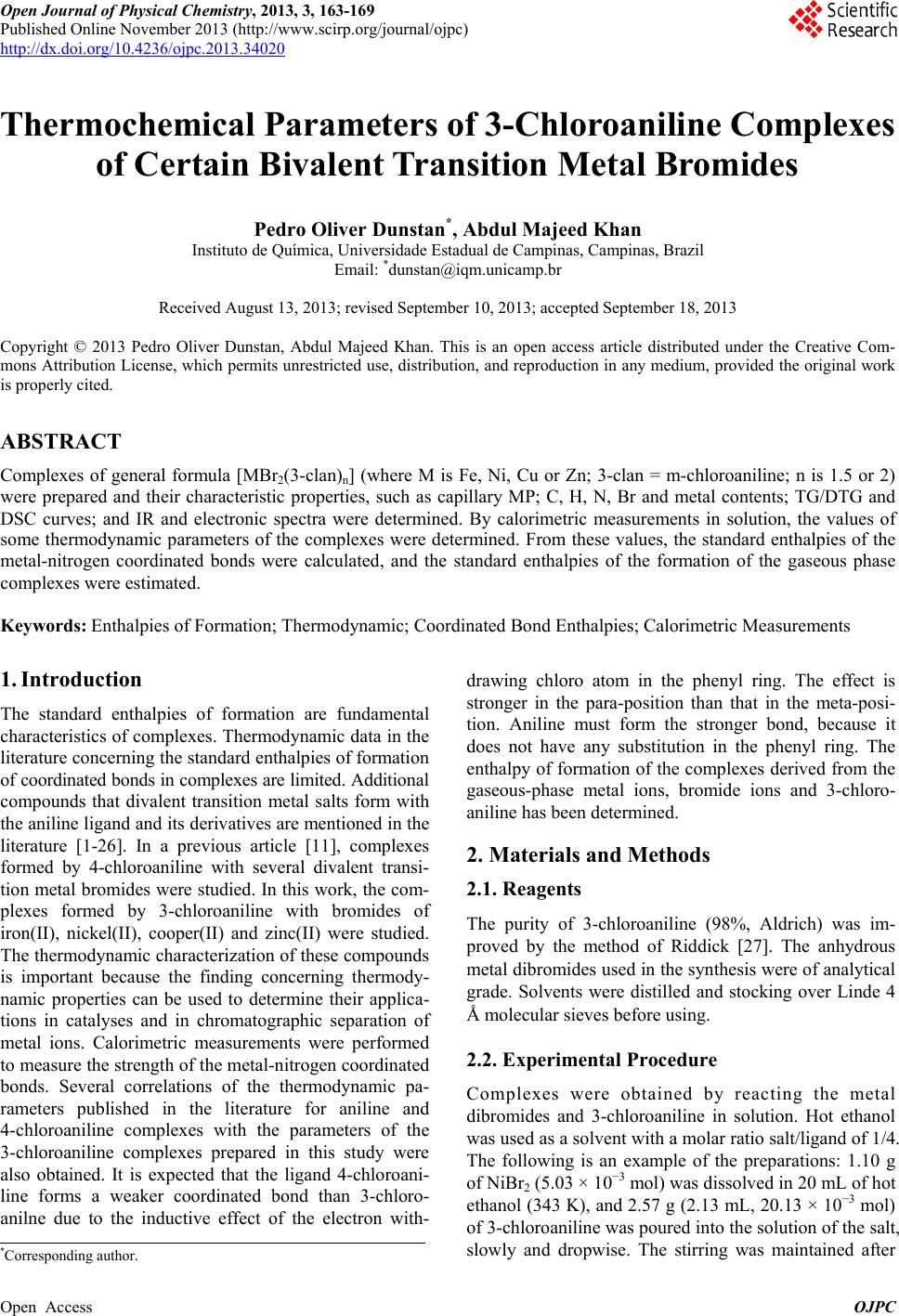 Open Journal of Physical Chemistry, 2013, 3, 163-169 Published Online November 2013 (http://www.scirp.org/journal/ojpc) http://dx.doi.org/10.4236/ojpc.2013.34020 Open Access OJPC Thermochemical Parameters of 3-Chloroaniline Complexes of Certain Bivalent Transition Metal Bromides Pedro Oliver Dunstan*, Abdul Majeed Khan Instituto de Química, Universidade Estadual de Campinas, Campinas, Brazil Email: *[email protected] Received August 13, 2013; revised September 10, 2013; accepted September 18, 2013 Copyright © 2013 Pedro Oliver Dunstan, Abdul Majeed Khan. This is an open access article distributed under the Creative Com- mons Attribution License, which permits unrestricted use, distribution, and reproduction in any medium, provided the original work is properly cited. ABSTRACT Complexes of general formula [MBr2(3-clan)n] (where M is Fe, Ni, Cu or Zn; 3-clan = m-chloroaniline; n is 1.5 or 2) were prepared and their characteristic properties, such as capillary MP; C, H, N, Br and metal contents; TG/DTG and DSC curves; and IR and electronic spectra were determined. By calorimetric measurements in solution, the values of some thermodynamic parameters of the complexes were determined. From these values, the standard enthalpies of the metal-nitrogen coordinated bonds were calculated, and the standard enthalpies of the formation of the gaseous phase complexes were estimated. Keywords: Enthalpies of Formation; Thermodynamic; Coordinated Bond Enthalpies; Calorimetric Measurements 1. Introduction The standard enthalpies of formation are fundamental characteristics of complexes. Thermodynamic data in the literature concerning the standard enthalpies of formation of coordinated bonds in complexes are limited. Additional compounds that divalent transition metal salts form with the aniline ligand and its derivatives are mentioned in the literature [1-26]. In a previous article [11], complexes formed by 4-chloroaniline with several divalent transi- tion metal bromides were studied. In this work, the com- plexes formed by 3-chloroaniline with bromides of iron(II), nickel(II), cooper(II) and zinc(II) were studied. The thermodynamic characterization of these compounds is important because the finding concerning thermody- namic properties can be used to determine their applica- tions in catalyses and in chromatographic separation of metal ions. Calorimetric measurements were performed to measure the strength of the metal-nitrogen coordinated bonds. Several correlations of the thermodynamic pa- rameters published in the literature for aniline and 4-chloroaniline complexes with the parameters of the 3-chloroaniline complexes prepared in this study were also obtained. It is expected that the ligand 4-chloroani- line forms a weaker coordinated bond than 3-chloro- anilne due to the inductive effect of the electron with- drawing chloro atom in the phenyl ring. The effect is stronger in the para-position than that in the meta-posi- tion. Aniline must form the stronger bond, because it does not have any substitution in the phenyl ring. The enthalpy of formation of the complexes derived from the gaseous-phase metal ions, bromide ions and 3-chloro- aniline has been determined. 2. Materials and Methods 2.1. Reagents The purity of 3-chloroaniline (98%, Aldrich) was im- proved by the method of Riddick [27]. The anhydrous metal dibromides used in the synthesis were of analytical grade. Solvents were distilled and stocking over Linde 4 Å molecular sieves before using. 2.2. Experimental Procedure Complexes were obtained by reacting the metal dibromides and 3-chloroaniline in solution. Hot ethanol was used as a solvent with a molar ratio salt/ligand of 1/4. The following is an example of the preparations: 1.10 g of NiBr2 (5.03 × 10⁻³ mol) was dissolved in 20 mL of hot ethanol (343 K), and 2.57 g (2.13 mL, 20.13 × 10⁻³ mol) of 3-chloroaniline was poured into the solution of the salt, slowly and dropwise. The stirring was maintained after *Corresponding author. 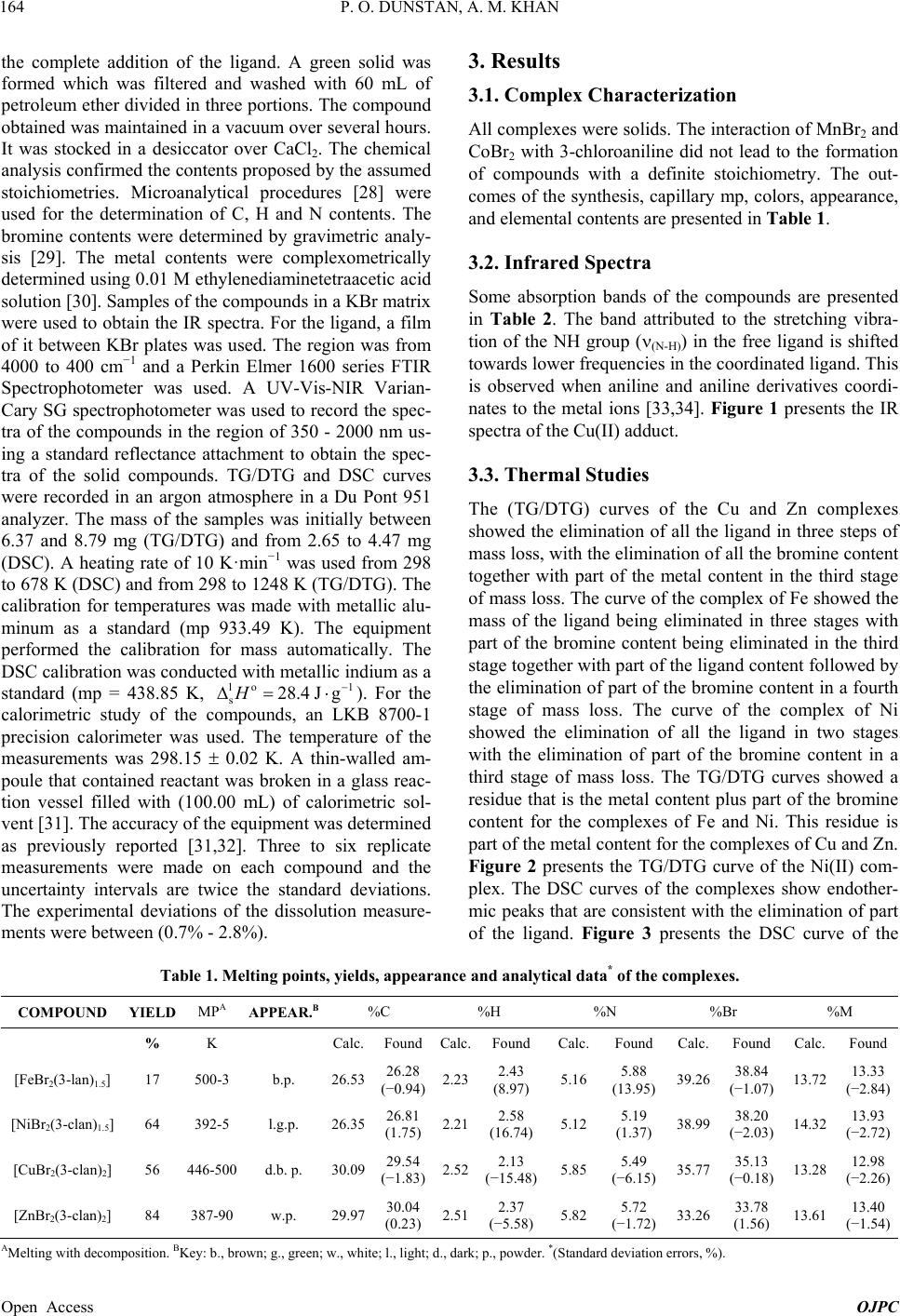 P. O. DUNSTAN, A. M. KHAN 164 the complete addition of the ligand. A green solid was formed which was filtered and washed with 60 mL of petroleum ether divided in three portions. The compound obtained was maintained in a vacuum over several hours. It was stocked in a desiccator over CaCl2. The chemical analysis confirmed the contents proposed by the assumed stoichiometries. Microanalytical procedures [28] were used for the determination of C, H and N contents. The bromine contents were determined by gravimetric analy- sis [29]. The metal contents were complexometrically determined using 0.01 M ethylenediaminetetraacetic acid solution [30]. Samples of the compounds in a KBr matrix were used to obtain the IR spectra. For the ligand, a film of it between KBr plates was used. The region was from 4000 to 400 cm−1 and a Perkin Elmer 1600 series FTIR Spectrophotometer was used. A UV-Vis-NIR Varian- Cary SG spectrophotometer was used to record the spec- tra of the compounds in the region of 350 - 2000 nm us- ing a standard reflectance attachment to obtain the spec- tra of the solid compounds. TG/DTG and DSC curves were recorded in an argon atmosphere in a Du Pont 951 analyzer. The mass of the samples was initially between 6.37 and 8.79 mg (TG/DTG) and from 2.65 to 4.47 mg (DSC). A heating rate of 10 K·min−1 was used from 298 to 678 K (DSC) and from 298 to 1248 K (TG/DTG). The calibration for temperatures was made with metallic alu- minum as a standard (mp 933.49 K). The equipment performed the calibration for mass automatically. The DSC calibration was conducted with metallic indium as a standard (mp = 438.85 K, ). For the calorimetric study of the compounds, an LKB 8700-1 precision calorimeter was used. The temperature of the measurements was 298.15 0.02 K. A thin-walled am- poule that contained reactant was broken in a glass reac- tion vessel filled with (100.00 mL) of calorimetric sol- vent [31]. The accuracy of the equipment was determined as previously reported [31,32]. Three to six replicate measurements were made on each compound and the uncertainty intervals are twice the standard deviations. The experimental deviations of the dissolution measure- ments were between (0.7% - 2.8%). lo 1 s28.4 JgH 3. Results 3.1. Complex Characterization All complexes were solids. The interaction of MnBr2 and CoBr2 with 3-chloroaniline did not lead to the formation of compounds with a definite stoichiometry. The out- comes of the synthesis, capillary mp, colors, appearance, and elemental contents are presented in Table 1. 3.2. Infrared Spectra Some absorption bands of the compounds are presented in Table 2. The band attributed to the stretching vibra- tion of the NH group ((N-H)) in the free ligand is shifted towards lower frequencies in the coordinated ligand. This is observed when aniline and aniline derivatives coordi- nates to the metal ions [33,34]. Figure 1 presents the IR spectra of the Cu(II) adduct. 3.3. Thermal Studies The (TG/DTG) curves of the Cu and Zn complexes showed the elimination of all the ligand in three steps of mass loss, with the elimination of all the bromine content together with part of the metal content in the third stage of mass loss. The curve of the complex of Fe showed the mass of the ligand being eliminated in three stages with part of the bromine content being eliminated in the third stage together with part of the ligand content followed by the elimination of part of the bromine content in a fourth stage of mass loss. The curve of the complex of Ni showed the elimination of all the ligand in two stages with the elimination of part of the bromine content in a third stage of mass loss. The TG/DTG curves showed a residue that is the metal content plus part of the bromine content for the complexes of Fe and Ni. This residue is part of the metal content for the complexes of Cu and Zn. Figure 2 presents the TG/DTG curve of the Ni(II) com- plex. The DSC curves of the complexes show endother- mic peaks that are consistent with the elimination of part of the ligand. Figure 3 presents the DSC curve of the Table 1. Melting points, yields, appearance and analytical data* of the complexes. COMPOUND YIELD MPA APPEAR.B %C %H %N %Br %M % K Calc. Found Calc. Found Calc. Found Calc. Found Calc. Found [FeBr2(3-lan)1.5] 17 500-3 b.p. 26.53 26.28 (−0.94) 2.23 2.43 (8.97) 5.16 5.88 (13.95)39.26 38.84 (−1.07) 13.72 13.33 (−2.84) [NiBr2(3-clan)1.5] 64 392-5 l.g.p. 26.3526.81 (1.75) 2.21 2.58 (16.74) 5.12 5.19 (1.37)38.99 38.20 (−2.03) 14.32 13.93 (−2.72) [CuBr2(3-clan)2] 56 446-500 d.b. p. 30.09 29.54 (−1.83) 2.52 2.13 (−15.48) 5.85 5.49 (−6.15) 35.77 35.13 (−0.18) 13.28 12.98 (−2.26) [ZnBr2(3-clan)2] 84 387-90 w.p. 29.9730.04 (0.23) 2.51 2.37 (−5.58)5.82 5.72 (−1.72) 33.26 33.78 (1.56) 13.61 13.40 (−1.54) A Melting with decomposition. BKey: b., brown; g., green; w., white; l., light; d., dark; p., powder. *(Standard deviation errors, %). Open Access OJPC 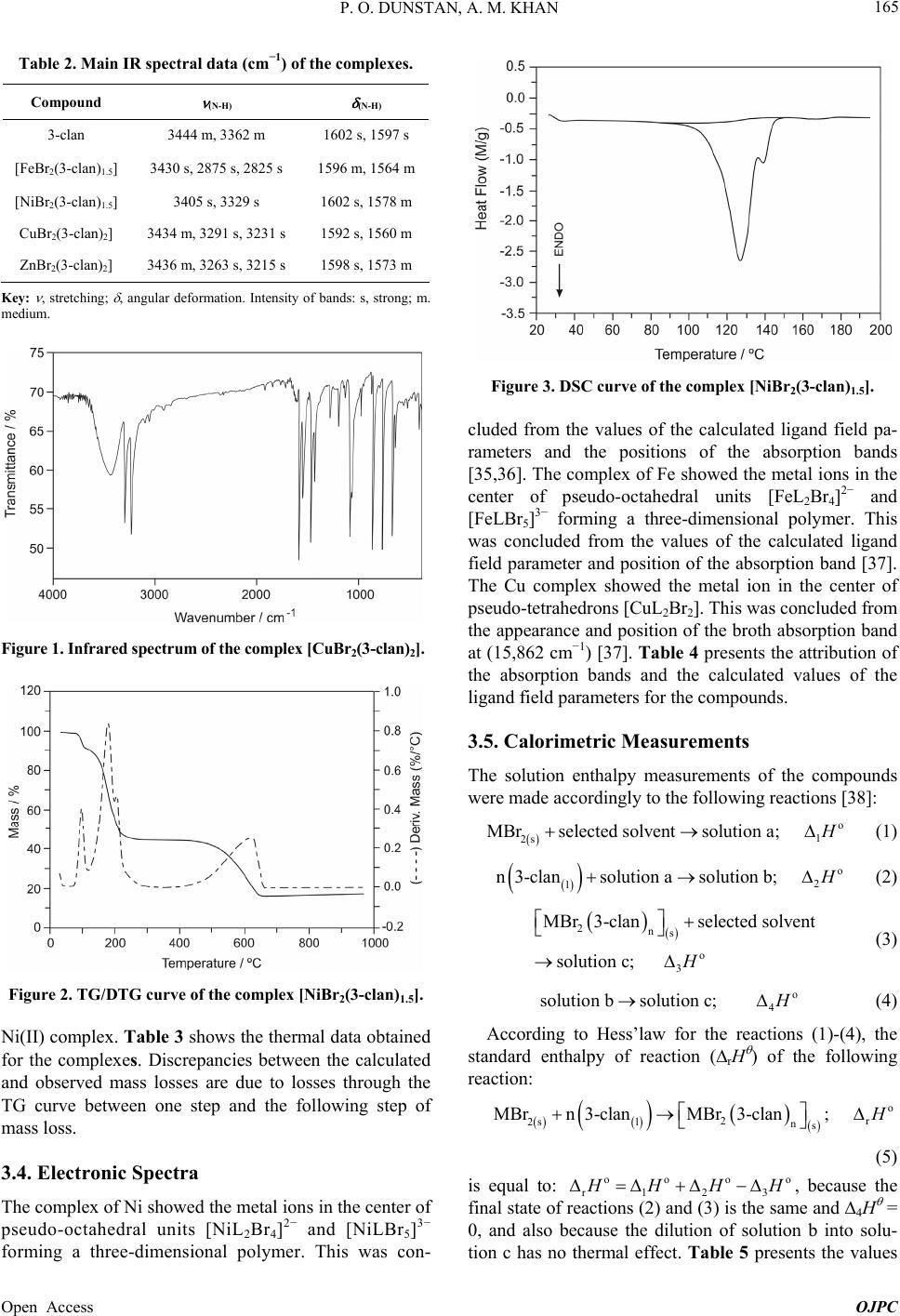 P. O. DUNSTAN, A. M. KHAN 165 Table 2. Main IR spectral data (cm−1) of the complexes. Compound (N-H) (N-H) 3-clan 3444 m, 3362 m 1602 s, 1597 s [FeBr2(3-clan)1.5] 3430 s, 2875 s, 2825 s 1596 m, 1564 m [NiBr2(3-clan)1.5] 3405 s, 3329 s 1602 s, 1578 m CuBr2(3-clan)2] 3434 m, 3291 s, 3231 s 1592 s, 1560 m ZnBr2(3-clan)2] 3436 m, 3263 s, 3215 s 1598 s, 1573 m Key: , stretching; , angular deformation. Intensity of bands: s, strong; m. medium. Figure 1. Infrared spectrum of the complex [CuBr2(3-clan)2]. Figure 2. TG/DTG curve of the complex [NiBr2(3-clan)1.5]. Ni(II) complex. Table 3 shows the thermal data obtained for the complexes. Discrepancies between the calculated and observed mass losses are due to losses through the TG curve between one step and the following step of mass loss. 3.4. Electronic Spectra The complex of Ni showed the metal ions in the center of pseudo-octahedral units [NiL2Br4]2− and [NiLBr5]3− forming a three-dimensional polymer. This was con- Figure 3. DSC curve of the complex [NiBr2(3-clan)1.5]. cluded from the values of the calculated ligand field pa- rameters and the positions of the absorption bands [35,36]. The complex of Fe showed the metal ions in the center of pseudo-octahedral units [FeL2Br4]2− and [FeLBr5]3− forming a three-dimensional polymer. This was concluded from the values of the calculated ligand field parameter and position of the absorption band [37]. The Cu complex showed the metal ion in the center of pseudo-tetrahedrons [CuL2Br2]. This was concluded from the appearance and position of the broth absorption band at (15,862 cm−1) [37]. Table 4 presents the attribution of the absorption bands and the calculated values of the ligand field parameters for the compounds. 3.5. Calorimetric Measurements The solution enthalpy measurements of the compounds were made accordingly to the following reactions [38]: o 1 2s MBrselected solventsolution a; H (1) o 2 1 n3-clansolution asolution b; H (2) 2ns o 3 MBr3-clanselected solvent solution c;H (3) o 4 solution bsolution c; H (4) According to Hess’law for the reactions (1)-(4), the standard enthalpy of reaction (rH ) of the following reaction: o 2r 2s lns MBrn 3-clanMBr3-clan; H o (5) is equal to: ooo r123 H HHH, because the final state of reactions (2) and (3) is the same and 4H = 0, and also because the dilution of solution b into solu- tion c has no thermal effect. Table 5 presents the values Open Access OJPC 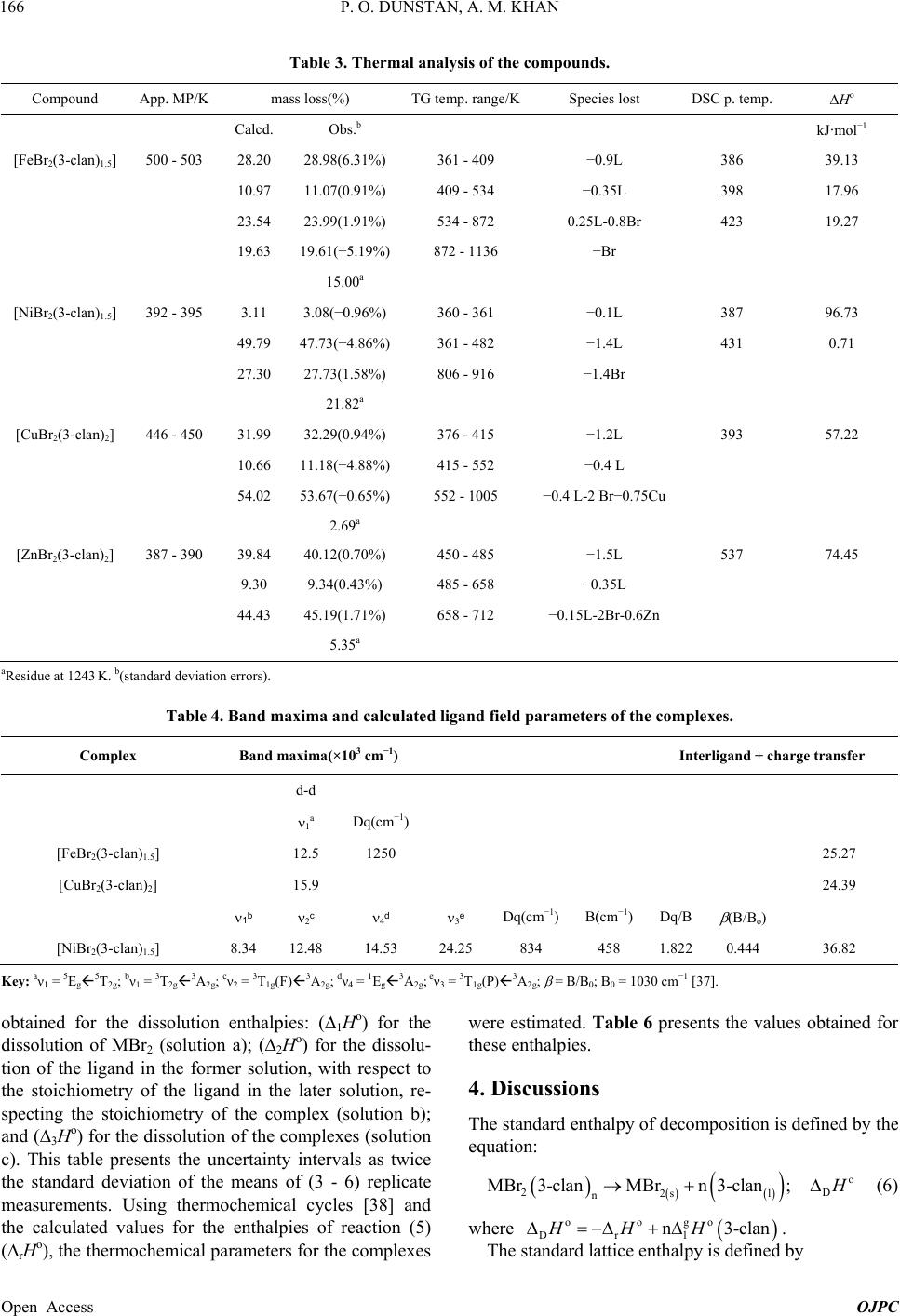 P. O. DUNSTAN, A. M. KHAN 166 Table 3. Thermal analysis of the compounds. Compound App. MP/K mass loss(%) TG temp. range/KSpecies lost DSC p. temp. Ho Calcd. Obs.b kJ·mol−1 [FeBr2(3-clan)1.5] 500 - 503 28.20 28.98(6.31%) 361 - 409 −0.9L 386 39.13 10.97 11.07(0.91%) 409 - 534 −0.35L 398 17.96 23.54 23.99(1.91%) 534 - 872 0.25L-0.8Br 423 19.27 19.63 19.61(−5.19%)872 - 1136 −Br 15.00a [NiBr2(3-clan)1.5] 392 - 395 3.11 3.08(−0.96%) 360 - 361 −0.1L 387 96.73 49.79 47.73(−4.86%)361 - 482 −1.4L 431 0.71 27.30 27.73(1.58%) 806 - 916 −1.4Br 21.82a [CuBr2(3-clan)2] 446 - 450 31.99 32.29(0.94%) 376 - 415 −1.2L 393 57.22 10.66 11.18(−4.88%)415 - 552 −0.4 L 54.02 53.67(−0.65%)552 - 1005 −0.4 L-2 Br−0.75Cu 2.69a [ZnBr2(3-clan)2] 387 - 390 39.84 40.12(0.70%) 450 - 485 −1.5L 537 74.45 9.30 9.34(0.43%) 485 - 658 −0.35L 44.43 45.19(1.71%) 658 - 712 −0.15L-2Br-0.6Zn 5.35a aResidue at 1243 K. b(standard deviation errors). Table 4. Band maxima and calculated ligand field parameters of the complexes. Complex Band maxima(×103 cm−1) Interligand + charge transfer d-d 1a Dq(cm−1) [FeBr2(3-clan)1.5] 12.5 1250 25.27 [CuBr2(3-clan)2] 15.9 24.39 1b 2c 4d 3e Dq(cm−1) B(cm−1)Dq/B (B/Bo) [NiBr2(3-clan)1.5] 8.34 12.48 14.53 24.25 834 458 1.822 0.444 36.82 Key: aν1 = 5Eg5T2g; bν1 = 3T2g3A2g; cν2 = 3T1g(F)3A2g; dν4 = 1Eg3A2g; eν3 = 3T1g(P)3A2g; = B/B0; B0 = 1030 cm−1 [37]. obtained for the dissolution enthalpies: (1Ho) for the dissolution of MBr2 (solution a); (2Ho) for the dissolu- tion of the ligand in the former solution, with respect to the stoichiometry of the ligand in the later solution, re- specting the stoichiometry of the complex (solution b); and (3Ho) for the dissolution of the complexes (solution c). This table presents the uncertainty intervals as twice the standard deviation of the means of (3 - 6) replicate measurements. Using thermochemical cycles [38] and the calculated values for the enthalpies of reaction (5) (rHo), the thermochemical parameters for the complexes were estimated. Table 6 presents the values obtained for these enthalpies. 4. Discussions The standard enthalpy of decomposition is defined by the equation: o 2D 2s l n MBr3-clanMBrn 3-clan; H (6) where . oogo Drl n3-claHHHn T he standard lattice enthalpy is defined by Open Access OJPC 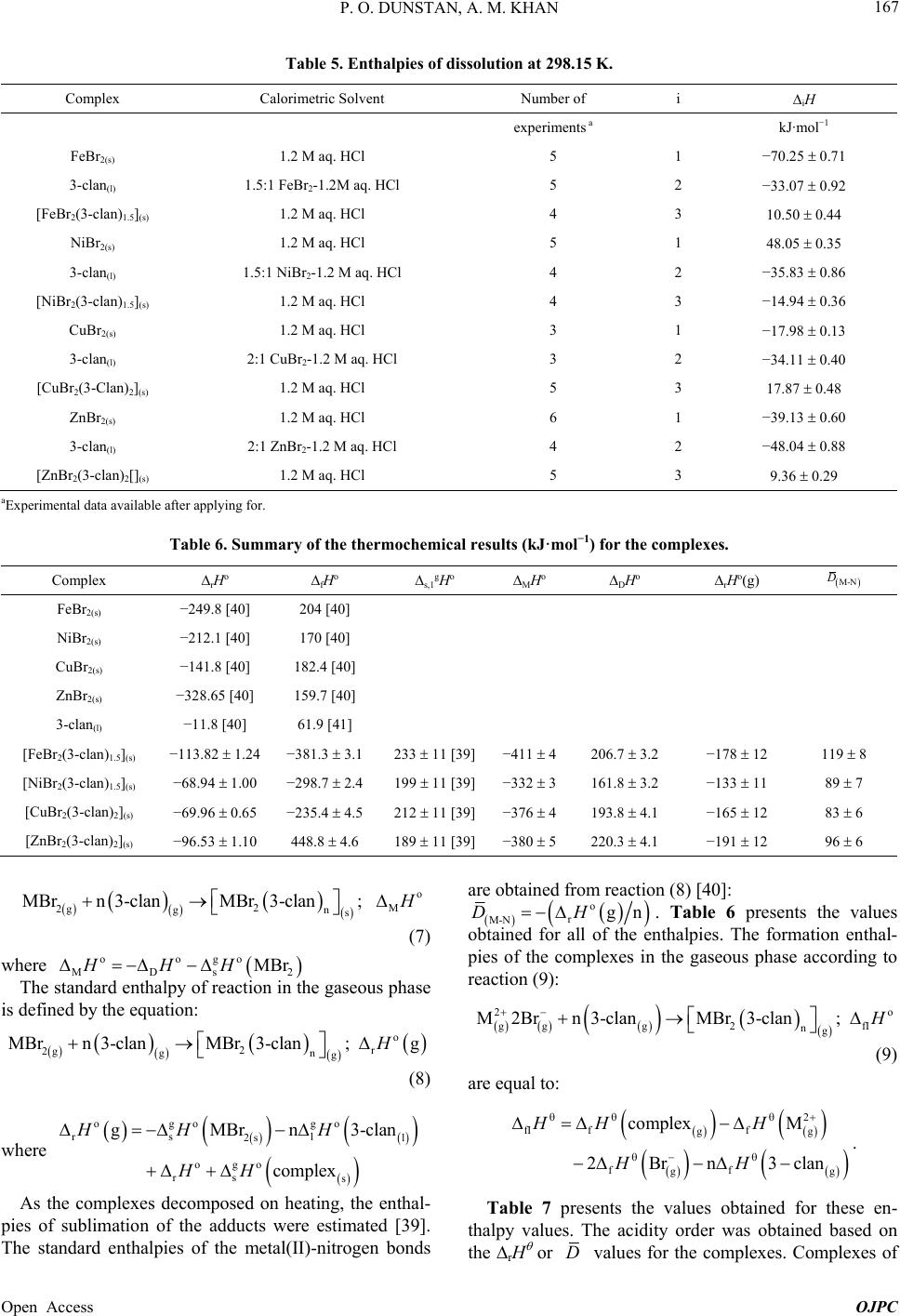 P. O. DUNSTAN, A. M. KHAN 167 Table 5. Enthalpies of dissolution at 298.15 K. Complex Calorimetric Solvent Number of i iH experiments a kJ·mol−1 FeBr2(s) 1.2 M aq. HCl 5 1 −70.25 0.71 3-clan(l) 1.5:1 FeBr2-1.2M aq. HCl 5 2 −33.07 0.92 [FeBr2(3-clan)1.5](s) 1.2 M aq. HCl 4 3 10.50 0.44 NiBr2(s) 1.2 M aq. HCl 5 1 48.05 0.35 3-clan(l) 1.5:1 NiBr2-1.2 M aq. HCl 4 2 −35.83 0.86 [NiBr2(3-clan)1.5](s) 1.2 M aq. HCl 4 3 −14.94 0.36 CuBr2(s) 1.2 M aq. HCl 3 1 −17.98 0.13 3-clan(l) 2:1 CuBr2-1.2 M aq. HCl 3 2 −34.11 0.40 [CuBr2(3-Clan)2](s) 1.2 M aq. HCl 5 3 17.87 0.48 ZnBr2(s) 1.2 M aq. HCl 6 1 −39.13 0.60 3-clan(l) 2:1 ZnBr2-1.2 M aq. HCl 4 2 −48.04 0.88 [ZnBr2(3-clan)2[](s) 1.2 M aq. HCl 5 3 9.36 0.29 aExperimental data available after applying for. Table 6. Summary of the thermochemical results (kJ·mol−1) for the complexes. Complex rHo fHo s,1gHo MHo DHo rHo(g) M-N D FeBr2(s) −249.8 [40] 204 [40] NiBr2(s) −212.1 [40] 170 [40] CuBr2(s) −141.8 [40] 182.4 [40] ZnBr2(s) −328.65 [40] 159.7 [40] 3-clan(l) −11.8 [40] 61.9 [41] [FeBr2(3-clan)1.5](s) −113.82 1.24 −381.3 3.1233 11 [39] −411 4206.7 3.2 −178 12 119 8 [NiBr2(3-clan)1.5](s) −68.94 1.00 −298.7 2.4199 11 [39] −332 3161.8 3.2 −133 11 89 7 [CuBr2(3-clan)2](s) −69.96 0.65 −235.4 4.5212 11 [39] −376 4193.8 4.1 −165 12 83 6 [ZnBr2(3-clan)2](s) −96.53 1.10 448.8 4.6 189 11 [39] −380 5220.3 4.1 −191 12 96 6 o 2M 2g gn s MBrn 3-clanMBr3-clan; H (7) where oogo MDs MBrHHH 2 The standard enthalpy of reaction in the gaseous phase is defined by the equation: o 2r 2g gn g MBrn 3-clanMBr3-clan;gH (8) where ogo go rs l 2s l ogo rs s gMBrn3-cl complex HH H HH an As the complexes decomposed on heating, the enthal- pies of sublimation of the adducts were estimated [39]. The standard enthalpies of the metal(II)-nitrogen bonds are obtained from reaction (8) [40]: o r M-N . Table 6 presents the values obtained for all of the enthalpies. The formation enthal- pies of the complexes in the gaseous phase according to reaction (9): gnDH 2 o 2f gg gng M2Brn 3-clanMBr3-clan;I H (9) are equal to: 2 fI ff gg ff gg complex M 2Brn3clan HH H HH . Table 7 presents the values obtained for these en- thalpy values. The acidity order was obtained based on the rH or D values for the complexes. Complexes of Open Access OJPC 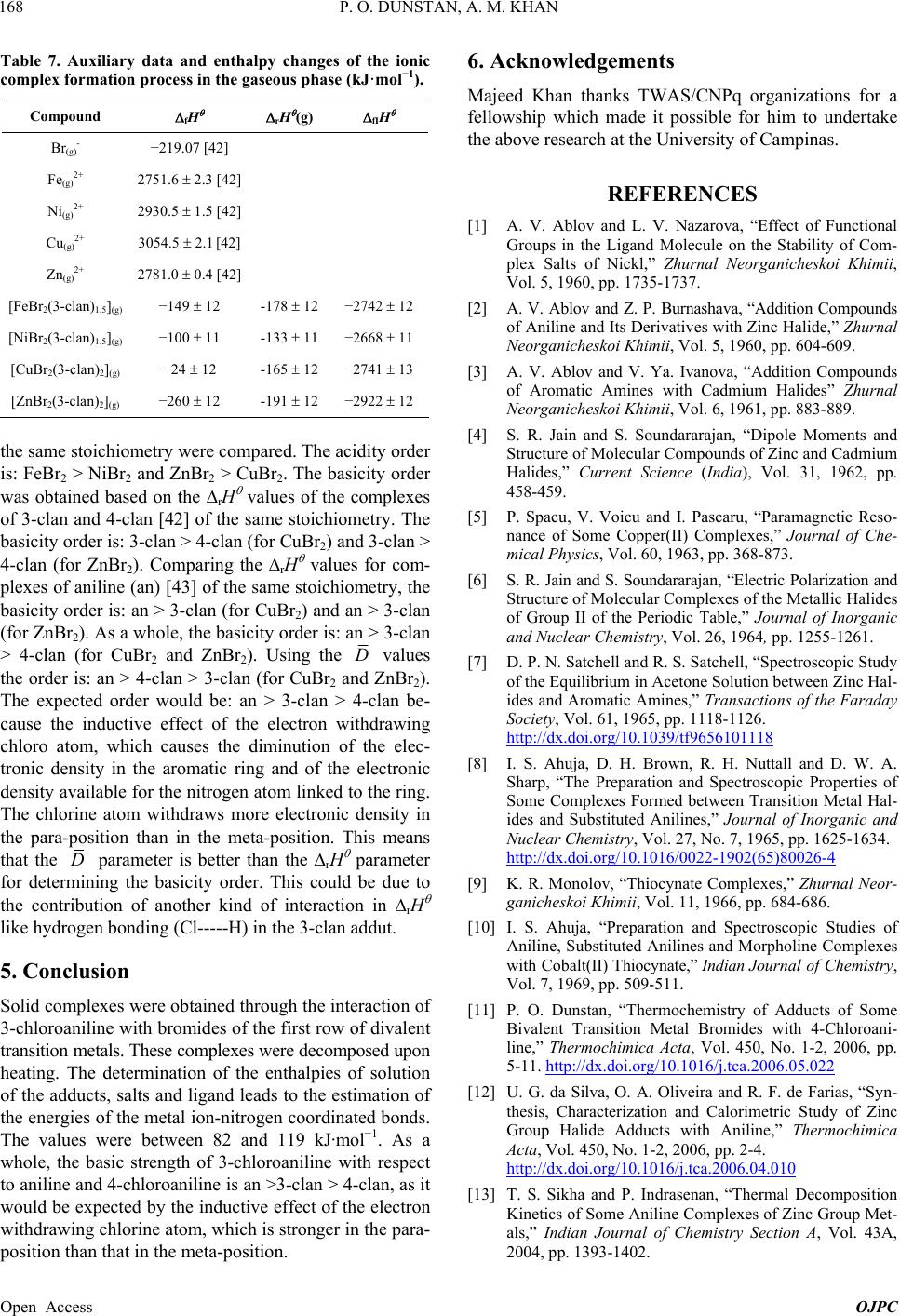 P. O. DUNSTAN, A. M. KHAN 168 Table 7. Auxiliary data and enthalpy changes of the ionic complex formation process in the gaseous phase (kJ·mol−1). Compound fH rH (g) fIH Br(g)- −219.07 [42] Fe(g)2+ 2751.6 2.3 [42] Ni(g)2+ 2930.5 1.5 [42] Cu(g)2+ 3054.5 2.1 [42] Zn(g)2+ 2781.0 0.4 [42] [FeBr2(3-clan)1.5](g) −149 12 -178 12 −2742 12 [NiBr2(3-clan)1.5](g) −100 11 -133 11 −2668 11 [CuBr2(3-clan)2](g) −24 12 -165 12 −2741 13 [ZnBr2(3-clan)2](g) −260 12 -191 12 −2922 12 the same stoichiometry were compared. The acidity order is: FeBr2 > NiBr2 and ZnBr2 > CuBr2. The basicity order was obtained based on the rH values of the complexes of 3-clan and 4-clan [42] of the same stoichiometry. The basicity order is: 3-clan > 4-clan (for CuBr2) and 3-clan > 4-clan (for ZnBr2). Comparing the rH values for com- plexes of aniline (an) [43] of the same stoichiometry, the basicity order is: an > 3-clan (for CuBr2) and an > 3-clan (for ZnBr2). As a whole, the basicity order is: an > 3-clan > 4-clan (for CuBr2 and ZnBr2). Using t heD values the order is: an > 4-clan > 3-clan (for CuBr2 and ZnBr2). The expected order would be: an > 3-clan > 4-clan be- cause the inductive effect of the electron withdrawing chloro atom, which causes the diminution of the elec- tronic density in the aromatic ring and of the electronic density available for the nitrogen atom linked to the ring. The chlorine atom withdraws more electronic density in the para-position than in the meta-position. This means that the D parameter is better than the rH parameter for determining the basicity order. This could be due to the contribution of another kind of interaction in rH like hydrogen bonding (Cl-----H) in the 3-clan addut. 5. Conclusion Solid complexes were obtained through the interaction of 3-chloroaniline with bromides of the first row of divalent transition metals. These complexes were decomposed upon heating. The determination of the enthalpies of solution of the adducts, salts and ligand leads to the estimation of the energies of the metal ion-nitrogen coordinated bonds. The values were between 82 and 119 kJ·mol−1. As a whole, the basic strength of 3-chloroaniline with respect to aniline and 4-chloroaniline is an >3-clan > 4-clan, as it would be expected by the inductive effect of the electron withdrawing chlorine atom, which is stronger in the para- position than that in the meta-position. 6. Acknowledgements Majeed Khan thanks TWAS/CNPq organizations for a fellowship which made it possible for him to undertake the above research at the University of Campinas. REFERENCES [1] A. V. Ablov and L. V. Nazarova, “Effect of Functional Groups in the Ligand Molecule on the Stability of Com- plex Salts of Nickl,” Zhurnal Neorganicheskoi Khimii, Vol. 5, 1960, pp. 1735-1737. [2] A. V. Ablov and Z. P. Burnashava, “Addition Compounds of Aniline and Its Derivatives with Zinc Halide,” Zhurnal Neorganicheskoi Khimii, Vol. 5, 1960, pp. 604-609. [3] A. V. Ablov and V. Ya. Ivanova, “Addition Compounds of Aromatic Amines with Cadmium Halides” Zhurnal Neorganicheskoi Khimii, Vol. 6, 1961, pp. 883-889. [4] S. R. Jain and S. Soundararajan, “Dipole Moments and Structure of Molecular Compounds of Zinc and Cadmium Halides,” Current Science (India), Vol. 31, 1962, pp. 458-459. [5] P. Spacu, V. Voicu and I. Pascaru, “Paramagnetic Reso- nance of Some Copper(II) Complexes,” Journal of Che- mical Physics, Vol. 60, 1963, pp. 368-873. [6] S. R. Jain and S. Soundararajan, “Electric Polarization and Structure of Molecular Complexes of the Metallic Halides of Group II of the Periodic Table,” Journal of Inorganic and Nuclear Chemistry, Vol. 26, 1964, pp. 1255-1261. [7] D. P. N. Satchell and R. S. Satchell, “Spectroscopic Study of the Equilibrium in Acetone Solution between Zinc Hal- ides and Aromatic Amines,” Transactions of the Faraday Society, Vol. 61, 1965, pp. 1118-1126. http://dx.doi.org/10.1039/tf9656101118 [8] I. S. Ahuja, D. H. Brown, R. H. Nuttall and D. W. A. Sharp, “The Preparation and Spectroscopic Properties of Some Complexes Formed between Transition Metal Hal- ides and Substituted Anilines,” Journal of Inorganic and Nuclear Chemistry, Vol. 27, No. 7, 1965, pp. 1625-1634. http://dx.doi.org/10.1016/0022-1902(65)80026-4 [9] K. R. Monolov, “Thiocynate Complexes,” Zhurnal Neor- ganicheskoi Khimii, Vol. 11, 1966, pp. 684-686. [10] I. S. Ahuja, “Preparation and Spectroscopic Studies of Aniline, Substituted Anilines and Morpholine Complexes with Cobalt(II) Thiocynate,” Indian Journ al of Che mist ry, Vol. 7, 1969, pp. 509-511. [11] P. O. Dunstan, “Thermochemistry of Adducts of Some Bivalent Transition Metal Bromides with 4-Chloroani- line,” Thermochimica Acta, Vol. 450, No. 1-2, 2006, pp. 5-11. http://dx.doi.org/10.1016/j.tca.2006.05.022 [12] U. G. da Silva, O. A. Oliveira and R. F. de Farias, “Syn- thesis, Characterization and Calorimetric Study of Zinc Group Halide Adducts with Aniline,” Thermochimica Acta, Vol. 450, No. 1-2, 2006, pp. 2-4. http://dx.doi.org/10.1016/j.tca.2006.04.010 [13] T. S. Sikha and P. Indrasenan, “Thermal Decomposition Kinetics of Some Aniline Complexes of Zinc Group Met- als,” Indian Journal of Chemistry Section A, Vol. 43A, 2004, pp. 1393-1402. Open Access OJPC 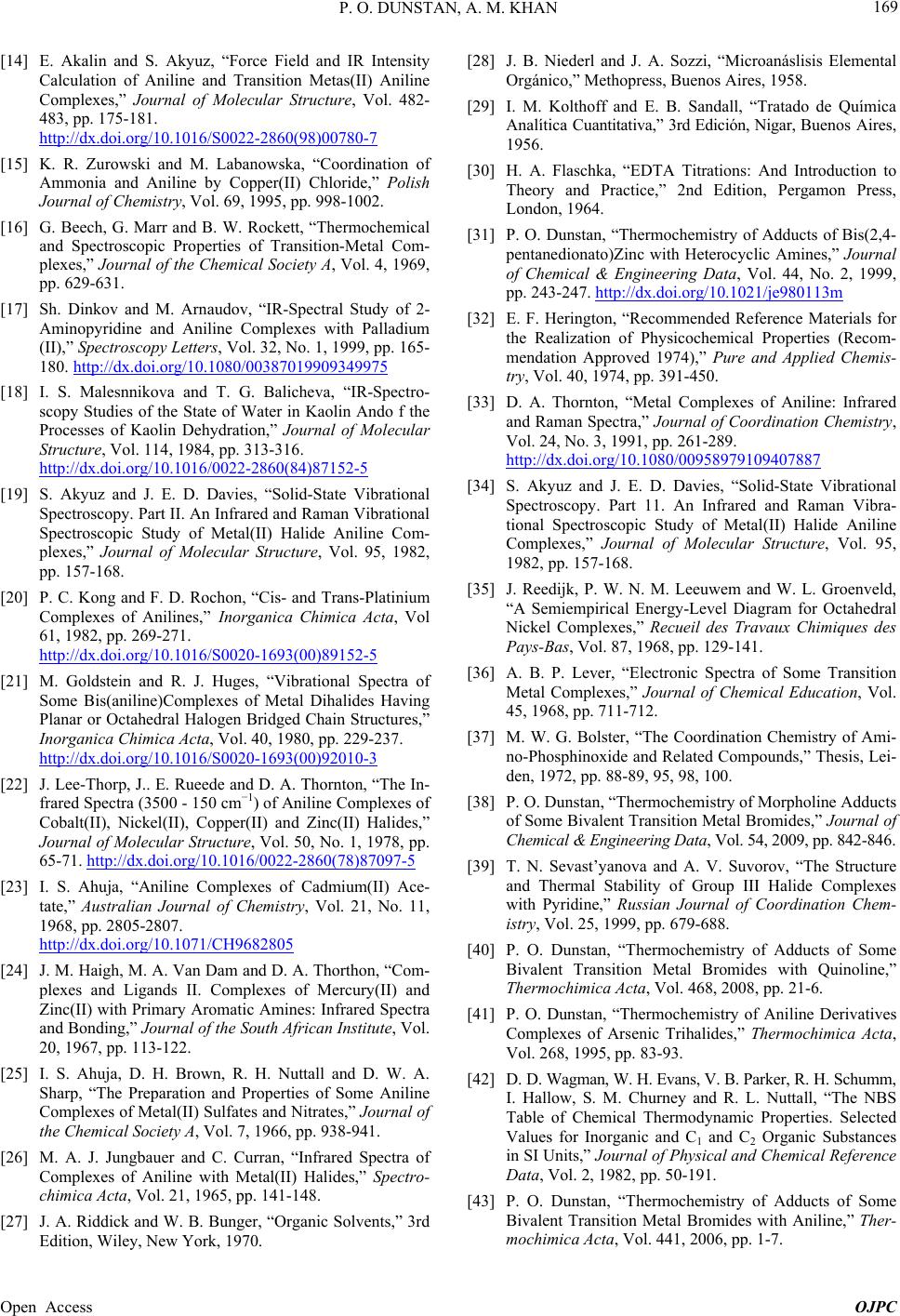 P. O. DUNSTAN, A. M. KHAN Open Access OJPC 169 [14] E. Akalin and S. Akyuz, “Force Field and IR Intensity Calculation of Aniline and Transition Metas(II) Aniline Complexes,” Journal of Molecular Structure, Vol. 482- 483, pp. 175-181. http://dx.doi.org/10.1016/S0022-2860(98)00780-7 [15] K. R. Zurowski and M. Labanowska, “Coordination of Ammonia and Aniline by Copper(II) Chloride,” Polish Journal of Chemistry, Vol. 69, 1995, pp. 998-1002. [16] G. Beech, G. Marr and B. W. Rockett, “Thermochemical and Spectroscopic Properties of Transition-Metal Com- plexes,” Journal of the Chemical Society A, Vol. 4, 1969, pp. 629-631. [17] Sh. Dinkov and M. Arnaudov, “IR-Spectral Study of 2- Aminopyridine and Aniline Complexes with Palladium (II),” Spectroscopy Letters, Vol. 32, No. 1, 1999, pp. 165- 180. http://dx.doi.org/10.1080/00387019909349975 [18] I. S. Malesnnikova and T. G. Balicheva, “IR-Spectro- scopy Studies of the State of Water in Kaolin Ando f the Processes of Kaolin Dehydration,” Journal of Molecular Structure, Vol. 114, 1984, pp. 313-316. http://dx.doi.org/10.1016/0022-2860(84)87152-5 [19] S. Akyuz and J. E. D. Davies, “Solid-State Vibrational Spectroscopy. Part II. An Infrared and Raman Vibrational Spectroscopic Study of Metal(II) Halide Aniline Com- plexes,” Journal of Molecular Structure, Vol. 95, 1982, pp. 157-168. [20] P. C. Kong and F. D. Rochon, “Cis- and Trans-Platinium Complexes of Anilines,” Inorganica Chimica Acta, Vol 61, 1982, pp. 269-271. http://dx.doi.org/10.1016/S0020-1693(00)89152-5 [21] M. Goldstein and R. J. Huges, “Vibrational Spectra of Some Bis(aniline)Complexes of Metal Dihalides Having Planar or Octahedral Halogen Bridged Chain Structures,” Inorganica Chimica Acta, Vol. 40, 1980, pp. 229-237. http://dx.doi.org/10.1016/S0020-1693(00)92010-3 [22] J. Lee-Thorp, J.. E. Rueede and D. A. Thornton, “The In- frared Spectra (3500 - 150 cm−1) of Aniline Complexes of Cobalt(II), Nickel(II), Copper(II) and Zinc(II) Halides,” Journal of Molecular Structure, Vol. 50, No. 1, 1978, pp. 65-71. http://dx.doi.org/10.1016/0022-2860(78)87097-5 [23] I. S. Ahuja, “Aniline Complexes of Cadmium(II) Ace- tate,” Australian Journal of Chemistry, Vol. 21, No. 11, 1968, pp. 2805-2807. http://dx.doi.org/10.1071/CH9682805 [24] J. M. Haigh, M. A. Van Dam and D. A. Thorthon, “Com- plexes and Ligands II. Complexes of Mercury(II) and Zinc(II) with Primary Aromatic Amines: Infrared Spectra and Bonding,” Journal of the South African Institute, Vol. 20, 1967, pp. 113-122. [25] I. S. Ahuja, D. H. Brown, R. H. Nuttall and D. W. A. Sharp, “The Preparation and Properties of Some Aniline Complexes of Metal(II) Sulfates and Nitrates,” Journal of the Chemical Society A, Vol. 7, 1966, pp. 938-941. [26] M. A. J. Jungbauer and C. Curran, “Infrared Spectra of Complexes of Aniline with Metal(II) Halides,” Spectro- chimica Acta, Vol. 21, 1965, pp. 141-148. [27] J. A. Riddick and W. B. Bunger, “Organic Solvents,” 3rd Edition, Wiley, New York, 1970. [28] J. B. Niederl and J. A. Sozzi, “Microanáslisis Elemental Orgánico,” Methopress, Buenos Aires, 1958. [29] I. M. Kolthoff and E. B. Sandall, “Tratado de Química Analítica Cuantitativa,” 3rd Edición, Nigar, Buenos Aires, 1956. [30] H. A. Flaschka, “EDTA Titrations: And Introduction to Theory and Practice,” 2nd Edition, Pergamon Press, London, 1964. [31] P. O. Dunstan, “Thermochemistry of Adducts of Bis(2,4- pentanedionato)Zinc with Heterocyclic Amines,” Journal of Chemical & Engineering Data, Vol. 44, No. 2, 1999, pp. 243-247. http://dx.doi.org/10.1021/je980113m [32] E. F. Herington, “Recommended Reference Materials for the Realization of Physicochemical Properties (Recom- mendation Approved 1974),” Pure and Applied Chemis- try, Vol. 40, 1974, pp. 391-450. [33] D. A. Thornton, “Metal Complexes of Aniline: Infrared and Raman Spectra,” Journal of Coordination Chemistry, Vol. 24, No. 3, 1991, pp. 261-289. http://dx.doi.org/10.1080/00958979109407887 [34] S. Akyuz and J. E. D. Davies, “Solid-State Vibrational Spectroscopy. Part 11. An Infrared and Raman Vibra- tional Spectroscopic Study of Metal(II) Halide Aniline Complexes,” Journal of Molecular Structure, Vol. 95, 1982, pp. 157-168. [35] J. Reedijk, P. W. N. M. Leeuwem and W. L. Groenveld, “A Semiempirical Energy-Level Diagram for Octahedral Nickel Complexes,” Recueil des Travaux Chimiques des Pays-Bas, Vol. 87, 1968, pp. 129-141. [36] A. B. P. Lever, “Electronic Spectra of Some Transition Metal Complexes,” Journal of Chemical Education, Vol. 45, 1968, pp. 711-712. [37] M. W. G. Bolster, “The Coordination Chemistry of Ami- no-Phosphinoxide and Related Compounds,” Thesis, Lei- den, 1972, pp. 88-89, 95, 98, 100. [38] P. O. Dunstan, “Thermochemistry of Morpholine Adducts of Some Bivalent Transition Metal Bromides,” Journal of Chemical & Engineering Data, Vol. 54, 2009, pp. 842-846. [39] T. N. Sevast’yanova and A. V. Suvorov, “The Structure and Thermal Stability of Group III Halide Complexes with Pyridine,” Russian Journal of Coordination Chem- istry, Vol. 25, 1999, pp. 679-688. [40] P. O. Dunstan, “Thermochemistry of Adducts of Some Bivalent Transition Metal Bromides with Quinoline,” Thermochimica Acta, Vol. 468, 2008, pp. 21-6. [41] P. O. Dunstan, “Thermochemistry of Aniline Derivatives Complexes of Arsenic Trihalides,” Thermochimica Acta, Vol. 268, 1995, pp. 83-93. [42] D. D. Wagman, W. H. Evans, V. B. Parker, R. H. Schumm, I. Hallow, S. M. Churney and R. L. Nuttall, “The NBS Table of Chemical Thermodynamic Properties. Selected Values for Inorganic and C1 and C2 Organic Substances in SI Units,” Journal of Physical and Chemical Reference Data, Vol. 2, 1982, pp. 50-191. [43] P. O. Dunstan, “Thermochemistry of Adducts of Some Bivalent Transition Metal Bromides with Aniline,” Ther- mochimica Acta, Vol. 441, 2006, pp. 1-7. |