

Paper Menu >>
Journal Menu >>
 Psychology 2013. Vol.4, No.11, 787-791 Published Online November 2013 in SciRes (http://www.scirp.org/journal/psych) http://dx.doi.org/10.4236/psych.2013.411112 Open Access 787 The Impact of Preschool Social-Emotional Development on Academic Success of Elementary School Students Merita Shala Psychology Department, FAMA College, Pristine, Kosovo Email: [email protected] Received July 27th, 2013; revised August 26th, 2013; accepted September 25th, 2013 Copyright © 2013 Merita Shala. This is an open access article distributed under the Creative Commons Attribu- tion License, which permits unrestricted use, distribution, and reproduction in any medium, provided the original work is properly cited. Social and emotional development is considered as an important factor in child development, especially considering its importance in child school readiness. Social and emotional development consists of the relationships an individual has with others, the level of self-control, and the motivation and perseverance a person has during an activity. This study examined the relationship between children’s preschool social and emotional development and their academic success in primary school. There were 96 children from Pristine participating in the study, 28 of them in the first grade, 32 in the second grade, 15 in the third grade and 21 in the fourth grade. To determine the relationship between children’s social and emotional development, during their preschool years, the ELDS assessment form was used, while for their academic achievements in each grade, the ELDS assessment form was used for their grades in two subjects. Several hierarchical regressions were used to determine the relationship between children’s social and emotional development, during their preschool years and their academic success. The results of this study revealed that the social and emotional development showed significant predictive value for the first, second and third grade criterion variables. While for the fourth grade, there was no significant predictive value. Keywords: Social-Emotional Development; Academic Success; School Readiness Introduction Children entering school now are expected to come with the prerequisite skills for early literacy and math and the social maturity to comply with school routines. Some of them enter school with all of these skills and the disposition to use them. Others do not. One important reason for these variations in social competence rests in the quality of children’s preschool experiences. Decades of research show that high-quality early childhood programs are linked to greater social-emotional competence (Campbell, Ramey, Pungello, Sparling, & Miller-Johnson, 2002; Schweinhart & Weikart, 1997). High-quality programs are identified as those in which children learn many of the social skills that help them participate in a group as a cooperative member and learn to use adults to gain information and assis- tance. Most preschool curricula focus primarily on building the child’s cognitive skills. However, social-emotional skill deficits impact a student’s academic performance, and remain a some- times-overlooked characteristic of young children’s transition to grade school (Child Trends, 2002; LaParo & Pianta, 2000). In fact, school readiness is typically defined in terms of a child’s cognitive skills, but also includes the child’s capacity to regulate emotions and be able to show positive social interac- tions and cooperation in the classroom. Despite the quality of children’s earlier experiences, they come to school together and the teacher must develop this group of diverse learners into a community of respectful, moti- vated learners. Social-Em o tional Development Social and emotional development in children has to do with how children feel about themselves (such as confidence, always scared, eager to learn, proud of their culture, afraid of being wrong), how they behave (such as constantly fighting, easily upset, able to deal with conflict), and how they relate to others, especially people who matter to them (for example, parents, teachers, and friends). Social-emotional development includes the emergence of emotional self-regulation, empathy, effective communication, positive social interaction, and social independence. Typically social-emotional development is divided into three main areas: attachment, initiative and self-control, also known as self-re- gulation. Initiative is defined as a psychological feature that entices a person to achieve a desired goal (LeBuffe & Naglieri, 1998). Self-regulation is the process in which a person controls his or her own behavior through internal executive functions. Atta- chment is defined as a deep and enduring emotional bond that connects one person to another across time and space (Ains- worth, 1973; Bowlby, 1969). While a child’s innate temperament matters, much of social behavior is learned. Children learn social behaviours and norms from interactions with parents, caregivers, siblings and peers (Emde, 1998; Harris, 1995). Studies of “prosocial” behaviours in childhood show that when such behavior is modeled by  M. SHALA adults, it is learned at an earlier age (Eisenberg & Mussen, 1989). A two-year-old child can be socialised to display em- pathy towards others, adjust their responses to others’ emotio- nal expressions (social referencing), and try to make others feel better following a negative event (Shonkoff & Phillips, 2000; Thompson, 1998). Children in preschool (four or five years old) must acquire understanding of emotions, and become more ca- pable for managing their feelings. Social-Emotional Development and School Readiness School readiness is typically defined in terms of a child’s cognitive skills, but also includes the child’s capacity to regu- late emotions and be able to show positive social interactions and cooperation in the classroom. The current emphasis on chil- dren’s academic preparedness continues to overshadow the im- portance of children’s social and emotional development for school readiness (Raver & Zigler, 1997). Over the past 20 years, researches have demonstrated that children’s emotional and so- cial skills are linked to their early academic standing (Wentzel & Asher, 1995). Children with difficulties paying attention, fol- lowing directions, getting along with others, and controlling ne- gative emotions of anger and distress do less well in school (McClelland et al., 2000). For many children, academic achieve- ment in their first few years of schooling appears to be built on a firm foundation of children’s emotional and social skills (Ladd, Kochenderfer, & Coleman, 1997; O’Neil et al., 1997). Science has established a compelling link between social- emotional development and behavior and school success (Raver, 2002; Zins, Bloodworth, Weissberg, & Walberg, 2004). Young children cannot learn to read if they have problems that distract them from educational activities, problems following directions, problems getting along with others and controlling negative emotions, and problems that interfere with relationships with peers, teachers, and parents. Social-Emo t i o n al Deve lopment and Academic Achievement According to Howes, Hamilton, & Philipsen (1998), norma- tively, first friendships are established during the preschool years. The acquisition of prosocial friendship skills (such as helping, sharing, and taking turns) during preschool predict kin- dergarten and later elementary school engagement and aca- demic success (Howes et al., 1998). Also, prosocial behavior may foster positive relationships with teachers and peers, thereby motivating school bonding and creating feelings of social-emotional security and comfort in the classroom that support exploration and thereby enhance learn- ing (Coolahan et al., 2000; Konold & Pianta, 2005). Social-emotional skills include: emotional regulation; de- veloping skills to communicate about emotions and resolve/ avoid conflicts, showing empathy, demonstrating positive inte- ractions and classroom cooperation, and the ability to take di- rections and conform to behavior norms expected in the class- room. Children learn self-monitoring and deliberate inhibition of undesired behaviours (Saarni, Mumme, & Campos, 1998; Sroufe, 1996). Those children who are delayed in the develop- ment of social-emotional skills exhibit academic and behavi- oural problems (Blair, 2002; Connell & Prinz, 2002; Denham, 2006; Shonkoff & Phillips, 2000). Methodology This is a correlational study, with the main aim to determine the relationships between the students’ pre-kindergarten social and emotional development and their academic success in first, second, third and fourth grade of elementary school. Participants A total of 96 primary school students participated in this study. During the last four years they attended a public pre- school program. In 2012, 28 of them have completed first grade, 32 have completed second grade, 15 students have completed third grade and 21 students have completed fourth grade. For children’s participation in the study parent’s agreement was ob- tained. Instruments ELDS Assessment F orm At the end of each school year, preschool teachers completed an evaluation form for the achievement of each child during the year. The content of that evaluation form, for social-emotional development, was compared and adopted with the content of the field of social-emotional development of ELDS, recently developed and published. We estimate children social-emotio- nal development with grades of E (excellent = 3), S (satisfacto- ry = 2), or N (needs improvement = 1) of 24 observed behav- iors, divided into five factors: 1-differentiations between known and unknown people (DKNP-Cronbach a = .72), 2-interaction with the persons around (IPA-Cronbach a = .85), 3-experience, recognise and properly express emotions (ER-PEE-Cronbach a = .65), 4-demonstrate that she/he knows the concept of her/him self (DKCHS-Cronbach a = .67), 5-ability of self-regulation of emotions (ASRE-Cronbach a = .70). Academic Grades The students’ grades at the end of each academic year, from first to fourth grade, were also used to assess their academic success. Academic grades consisted in student’s performance during the whole school year. Students received grades in ma- thematics and Albanian language (reading and writing). Procedures The method of linear regression analysis was used, in order to evaluate how well social and emotional development in pre- kindergarten predicts academic success from kindergarten until fourth grade. A specific child code for the identification of in- formation was used. The statistical package used in the present study is SPSS Ver. 19.0. Results There were a series of multiple regressions used in this study to determine the relationship between the social and emotional factors and student academic success from preschool through grade four. Several hierarchical regressions were performed be- tween the five social-emotional factors, measured in preschool, as the predictor variables and academic grades, (scores) as the criterion variables. We used separate regressions for each academic grade in Al- banian language (reading and writing) and mathematics from Open Access 788 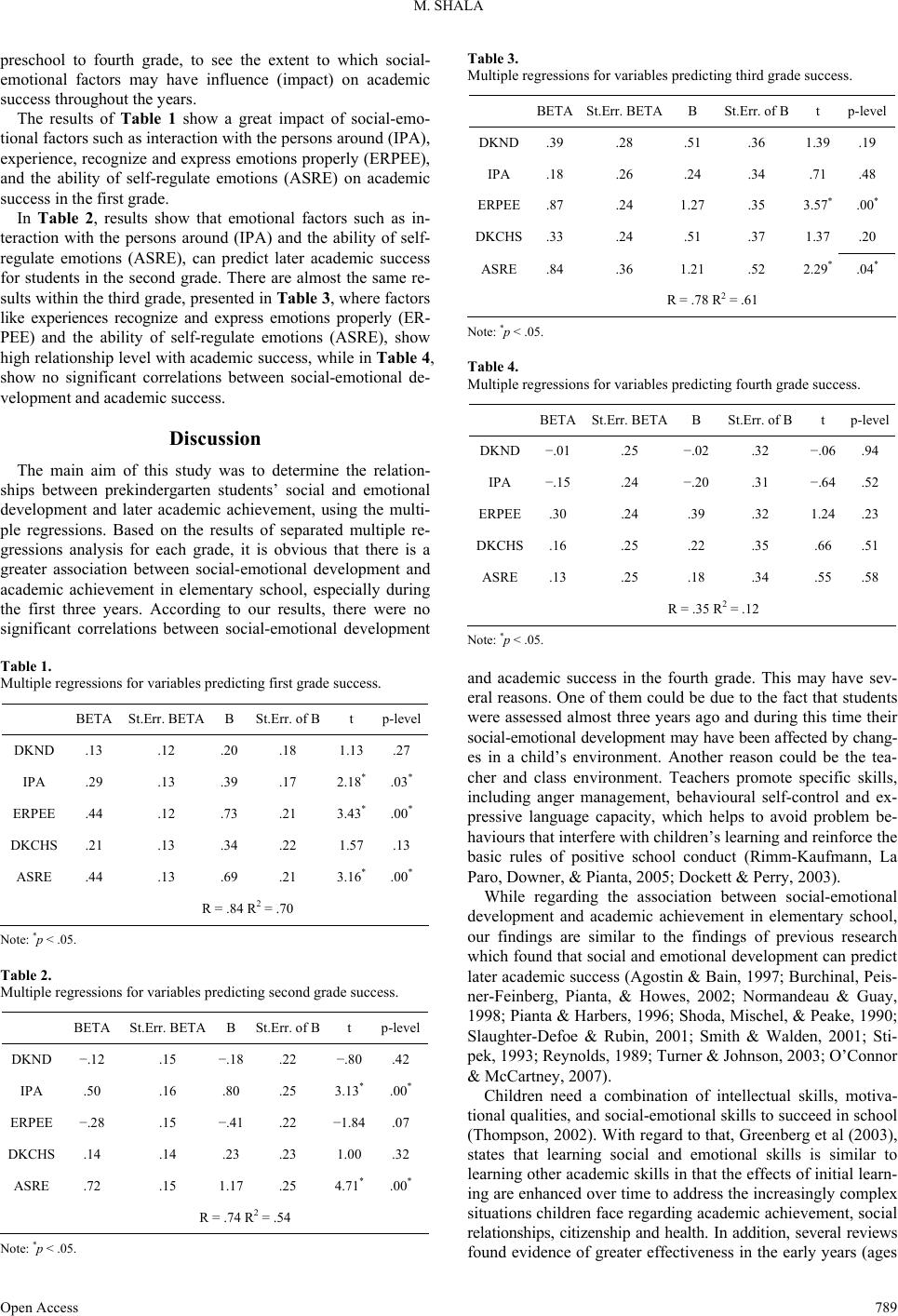 M. SHALA preschool to fourth grade, to see the extent to which social- emotional factors may have influence (impact) on academic success throughout the years. The results of Table 1 show a great impact of social-emo- tional factors such as interaction with the persons around (IPA), experience, recognize and express emotions properly (ERPEE), and the ability of self-regulate emotions (ASRE) on academic success in the first grade. In Table 2, results show that emotional factors such as in- teraction with the persons around (IPA) and the ability of self- regulate emotions (ASRE), can predict later academic success for students in the second grade. There are almost the same re- sults within the third grade, presented in Table 3, where factors like experiences recognize and express emotions properly (ER- PEE) and the ability of self-regulate emotions (ASRE), show high relationship level with academic success, while in Table 4, show no significant correlations between social-emotional de- velopment and academic success. Discussion The main aim of this study was to determine the relation- ships between prekindergarten students’ social and emotional development and later academic achievement, using the multi- ple regressions. Based on the results of separated multiple re- gressions analysis for each grade, it is obvious that there is a greater association between social-emotional development and academic achievement in elementary school, especially during the first three years. According to our results, there were no significant correlations between social-emotional development Table 1. Multiple regressions for variables predicting first grade success. BETA St.Err. BETA BSt.Err. of B t p-level DKND .13 .12 .20 .18 1.13.27 IPA .29 .13 .39 .17 2.18*.03* ERPEE .44 .12 .73 .21 3.43*.00* DKCHS .21 .13 .34 .22 1.57.13 ASRE .44 .13 .69 .21 3.16*.00* R = .84 R2 = .70 Note: *p < .05. Table 2. Multiple regressions for variables predicting second grade success. BETA St.Err. BETA B St.Err. of B t p-level DKND −.12 .15 −.18 .22 −.80.42 IPA .50 .16 .80 .25 3.13*.00* ERPEE −.28 .15 −.41 .22 −1.84.07 DKCHS .14 .14 .23 .23 1.00.32 ASRE .72 .15 1.17 .25 4.71*.00* R = .74 R2 = .54 Note: *p < .05. Table 3. Multiple regressions for variables predicting third grade success. BETASt.Err. BETAB St.Err. of B t p-level DKND.39 .28 .51 .36 1.39.19 IPA .18 .26 .24 .34 .71.48 ERPEE.87 .24 1.27 .35 3.57*.00* DKCHS.33 .24 .51 .37 1.37.20 ASRE.84 .36 1.21 .52 2.29*.04* R = .78 R2 = .61 Note: *p < .05. Table 4. Multiple regressions for variables predicting fourth grade success. BETASt.Err. BETAB St.Err. of B t p-level DKND −.01 .25 −.02 .32 −.06.94 IPA −.15 .24 −.20 .31 −.64.52 ERPEE.30 .24 .39 .32 1.24.23 DKCHS.16 .25 .22 .35 .66.51 ASRE.13 .25 .18 .34 .55.58 R = .35 R2 = .12 Note: *p < .05. and academic success in the fourth grade. This may have sev- eral reasons. One of them could be due to the fact that students were assessed almost three years ago and during this time their social-emotional development may have been affected by chang- es in a child’s environment. Another reason could be the tea- cher and class environment. Teachers promote specific skills, including anger management, behavioural self-control and ex- pressive language capacity, which helps to avoid problem be- haviours that interfere with children’s learning and reinforce the basic rules of positive school conduct (Rimm-Kaufmann, La Paro, Downer, & Pianta, 2005; Dockett & Perry, 2003). While regarding the association between social-emotional development and academic achievement in elementary school, our findings are similar to the findings of previous research which found that social and emotional development can predict later academic success (Agostin & Bain, 1997; Burchinal, Peis- ner-Feinberg, Pianta, & Howes, 2002; Normandeau & Guay, 1998; Pianta & Harbers, 1996; Shoda, Mischel, & Peake, 1990; Slaughter-Defoe & Rubin, 2001; Smith & Walden, 2001; Sti- pek, 1993; Reynolds, 1989; Turner & Johnson, 2003; O’Connor & McCartney, 2007). Children need a combination of intellectual skills, motiva- tional qualities, and social-emotional skills to succeed in school (Thompson, 2002). With regard to that, Greenberg et al (2003), states that learning social and emotional skills is similar to learning other academic skills in that the effects of initial learn- ing are enhanced over time to address the increasingly complex situations children face regarding academic achievement, social relationships, citizenship and health. In addition, several reviews found evidence of greater effectiveness in the early years (ages Open Access 789  M. SHALA 2 - 7) than in older children (Tennant et al., 2007; Browne et al., 2004). “Learning is a social process” (Zins et al., 2004), and if we expect children to enter school “ready to learn” they must have the underlying security and emotional foundation for that learning. Social-emotional development is too important to be left to chance. REFERENCES Ainsworth, M. D. (1973). The development of infant mother attachment. In B. M. Caldwell, & H. N. Ricciuti (Eds.), Review of child develop- ment research (Vol. 3). Chicago, IL: University of Chicago Press. Agostin, R. M., & Bain, S. K. (1997). Predicting early school success with development and social skills screeners. Psychology in the Schools, 34, 219-228. http://dx.doi.org/10.1002/(SICI)1520-6807(199707)34:3<219::AID- PITS4>3.0.CO;2-J Blair, C. (2002). School readiness: Integrating cognition and emotion in a neurobiological conceptualization of children’s functioning at school entry. American Psychologist, 57, 111-127 http://dx.doi.org/10.1037/0003-066X.57.2.111 Bowlby, J. (1969). Attachment and loss. Vol. 1: Attachment. New York: Basic Books. Browne, G., Gafni, A., Roberts, J., Byrne, C., & Majumdar, B. (2004). Effective/efficient mental health programs for school-age children: A synthesis of reviews. Social Science & Medicine, 58, 1367-1384. http://dx.doi.org/10.1016/S0277-9536(03)00332-0 Burchinal, M. R., Peisner-Feinberg, E., Pianta, R., & Howes, C. (2002). Development of academic skills from preschool through second grade: Family and classroom predictors of developmental trajectories. Journal of School Psychology, 40, 415-436. http://dx.doi.org/10.1016/S0022-4405(02)00107-3 Campbell, F.A., Ramey, C.T., Pungello, E., Sparling, J., & Miller-John- son, S. (2002). Early childhood education: Young adult outcomes from the Abecedarian Project. Applied Developmental Science, 6, 42-57. http://dx.doi.org/10.1207/S1532480XADS0601_05 Caldwell, H. N., Arnold, D. H., Ortiz, C., Curry, J. C., Stowe, R. M., Goldstein, N. E., Fisher, P. H., Zeljo, A., & Blair, C. (2002). School readiness: Integrating cognition and emotion in a neurobiological conceptualization of children’s functioning at school entry. American Psychologist, 57, 111-127. http://dx.doi.org/10.1037/0003-066X.57.2.111 Child Trends (2002). Facts at a glance. Washington DC: Child Trends. Coolahan, K., Fantuzzo, J., Mendez, J., & McDermott, P. (2000). Pre- school peer interactions and readiness to learn: Relationships be- tween classroom peer play and learning behaviors and conduct. Jour- nal of Educational Psycho logy, 92, 458-465. http://dx.doi.org/10.1037/0022-0663.92.3.458 Connell, C. M., & Prinz, R. J. (2002). The impact of childcare and parent-child interactions on school readiness and social skills devel- opment for low income African American children. Journal of Schoo l Psychology, 40, 177-193. http://dx.doi.org/10.1016/S0022-4405(02)00090-0 Denham, S. A. (2006). Social-emotional competence as support for school readiness: What is it and how do we assess it? Early Educa- tion and Development, Special Issue: Measurement of school Readi- ness, 17, 57-89. Dockett, S., & Perry, B. (2003). Children starting school: What should children, parents and school teachers do? Australian Research in Early childhood Education, 10, 1-12. Eisenberg, N., & Mussen, P. H. (1989). The roots of prosocial behavior in children. New York: Wiley. http://dx.doi.org/10.1017/CBO9780511571121 Emde, R. N. (1998). Early emotional development: New modes of thin- king for research and intervention. In J. G. Warhol (Ed.), New per- spectives in early emotional development (pp. 29-45). Johnson & Johnson Pediatric Institute. Greenberg, M., Weissberg, R., O Brien, M., Zins, J., Fredericks, L., Resnik, H., et al. (2003). Enhancing school-based prevention and youth development through coordinated social, emotional, and aca- demic learning. A mer ica n Psychologist, 58, 466-474. http://dx.doi.org/10.1037/0003-066X.58.6-7.466 Harris, J. R. (1995). Where is the child’s environment? A group sociali- zation theory of development. Psychological Review, 1 02, 458-489. http://dx.doi.org/10.1037/0033-295X.102.3.458 Howes, C., Hamilton, C. E., & Philipsen, L. C. (1998). Stability and- continuity of caregiver and child-peer relationships. Child Develop- ment, 69, 418-426. Howes, C., Burchinal, M., Pianta, R., Bryant, D., Early, D., Clifford, R., & Barbarin, O. (2008). Ready to learn? Children’s preacademic achievement in prekindergarten programs. Early Child hood Research Quarterly, 23, 27-50. http://dx.doi.org/10.1016/j.ecresq.2007.05.002 Konold, T. R., & Pianta, R. C. (2005). Empirically-derived, per son- oriented patterns of school readiness in typically-developing children: Description and prediction to first grade achievement. Applied De- velopmental Science, 9, 174-187. http://dx.doi.org/10.1207/s1532480xads0904_1 La Paro, K. M., & Pianta, R. C. (2000). Predicting children’s compe- tence in the early school years: A meta-analytic review. Review of Educational Research, 70, 443-484. http://dx.doi.org/10.3102/00346543070004443 Ladd, G. W., Kochenderfer, B. J., & Coleman, C. C. (1997). Classroom peer acceptance, friendship, and victimization: Distinct relational sys- tems that contribute uniquely to children’s school adjustment? Child Development, 68, 1181-1197. http://dx.doi.org/10.2307/1132300 LeBuffe, P. A., & Naglieri, J. A. (1998). The Devereux Early Child- hood Assessment (DECA). Villanova, PA: Devereux Foundation. McClelland, M. M., Morrison, F. J., & Holmes, D. L. (2000). Children at risk for early academic problems: The role of learning related so- cial skills. Early Childhood Research Quarterly, 15, 307-329. http://dx.doi.org/10.1016/S0885-2006(00)00069-7 Normandeau, S., & Guay, F. (1998). Preschool behavior and first grade school achievement: The meditational role of cognitive self-control. Journal of Educational Psycholo gy, 90, 111-121. http://dx.doi.org/10.1037/0022-0663.90.1.111 O’Neil, R., Welsh, M., Parke, R. D., Wang, S., & Strand, C. (1997). A longitudinal assessment of the academic correlates of early peer ac- ceptance and rejection. Journal of clinical child psychology, 26, 290- 303. http://dx.doi.org/10.1207/s15374424jccp2603_8 O’Connor, E., & McCartney, K. (2007). Examining teacher-child rela- tionships and achievement as part of an ecological model of devel- opment. American Educational Research Journal, 44, 340-369. http://dx.doi.org/10.3102/0002831207302172 Pianta, R. C., & Harbers, K. L. (1996). Observing mother and child be- havior in a problem solving situation at school entry: Relations with academic achievement. Journal of School Psychology, 34, 307-322. http://dx.doi.org/10.1016/0022-4405(96)00017-9 Raver, C. C., & Zigler, E. F. (1997). Social competence: An untapped dimension of Head Start’s success. Early Childhood Research Quar- terly. In Ricciuti (Eds.), Review of child development research (Vol. 3, pp. 363-385). Chicago, IL: University of Chicago Press. Raver, C. (2002). Emotions matter: Making the case for the role of young children’s emotional development for early school readiness. Social Policy Report of the Society for Research in Child Development, 16, 1-20. Rimm-Kaufman Sara, E., La Paro Karen, M., Downer Jason, T., & Pia- nta Robert, C. (2005). The contribution of classroom setting and qua- lity of instruction to children’s behavior in kindergarten classrooms. The Elementary School Journal, 105, 377-394. http://dx.doi.org/10.1086/429948 Saarni, C., Mumme, D. L., & Campos, J. J. (1998). Emotional devel- opment: Action, communication and understanding. In W. Damon (Ed.), Handbook of child psychology (5th ed., pp. 237-309). New York: Wiley. Slaughter-Defoe, D. T., & Rubin, H. H. (2001). A longitudinal case study of Head Start eligible children: Implications for urban educa- tion. Educational Psychologist, 36, 31-44. http://dx.doi.org/10.1207/S15326985EP3601_4 Schweinhart, L. J., & Weikart, D. P. (1997). The high/scope preschool Open Access 790  M. SHALA Open Access 791 curriculum comparison study through age 23. Early Childhood Re- search Quarterly, 12, 117-143. http://dx.doi.org/10.1016/S0885-2006(97)90009-0 Smith, M., & Walden, T. (2001). An exploration of African American preschool-aged children’s behavioral regulation in emotionally arousing situations. Child Study Journal, 31, 13-43. Sroufe, L. A. (1996). Emotional development: The organization of emo- tional life in the early years. New York: Cambridge University Press. http://dx.doi.org/10.1017/CBO9780511527661 Shonkoff. J. P., & Phillips, D. A. (eds.) (2000). From neurons to neigh- borhoods: The science of early childhood development. Committee on integrating the Science of Early Childhood Development, Na- tional Research Council and Institute of Medicine. Washington DC: National Academy Press. Tennant, R., Goens, C., Barlow, J., Day, C., & Stewart-Brown, S. (2007). A systematic review of reviews of interventions to promote mental health and prevent mental health problems in children and young people. Journal of Public Mental Health, 6, 25-32. http://dx.doi.org/10.1108/17465729200700005 Turner, L. A., & Johnson, B. (2003). A model of mastery motivation for at-risk preschoolers. Journal of Educational Psychology, 95, 495- 505. http://dx.doi.org/10.1037/0022-0663.95.3.495 Thompson, R. A. (1998). Emotional competence and the development of self. Psychological Inquiry, 9, 308-309 http://dx.doi.org/10.1207/s15327965pli0904_14 Thompson, R. A. (2002). The roots of school readiness in social and emotional development. Set for success: Building a strong founda- tion for school readiness based on the social-emotional development of young children. 1(1), pp. 8-29. Kansas City, MO: The Ewing Marion Kauffman Foundation. Wentzel, K. R., & Asher, S. R. (1995). The academic lives of neglected, rejected, popular, and controversial children. Child Development, 66, 754-763. http://dx.doi.org/10.2307/1131948 Zins, J., Bloodworth, M., Weissberg, R., & Walberg, H. (2004). The scientific base linking social and emotional learning to school suc- cess. In J. Zins, R. Weissberg, M. Wang, & H. J. Walberg (Eds.), Building academic success on social and emotional learning: What does the research say? (pp. 1-22). New York: Teachers Press, Co- lumbia University. |