

Paper Menu >>
Journal Menu >>
 Psychology 2011. Vol. 2, No. 1, 18-23 Copyright © 2011 SciRes. DOI:10.4236/psych.2011.21003 Deaf Individuals’ Bilingual Abilities: American Sign Language Proficiency, Reading Skills, and Family Characteristics Brittany L. Freel1,3, M. Diane Clark1,2, Melissa L. Anderson1,2, Gizelle L. Gilbert1,2, Millicent M. Musyoka1,2, Peter C. Hauser1,3 1Science of Learning Center on Visual Language and Visual Learning, Washington, DC, USA; 2Gallaudet University, Washington, DC, USA; 3National Technical Institute of the Deaf / Rochester Institute of Technology, Rochester, NY, USA. Email: [email protected] Received October 11th, 2010; revised November 2nd, 2010; accepted December 10th, 2010. The current study investigated the bilingual abilities of 55 Deaf individuals, examining both American Sign Language (ASL) competency and English reading skills. Results revealed a positive relationship between ASL competency and English skills, with highly competent signers scoring higher on a measure of reading compre- hension. Additionally, family characteristics (e.g., parental education level, family hearing status) were entered into the analysis to ascertain their effect on Deaf individuals’ bilingual abilities. The findings support the theory that competency in ASL may serve as a bridge to the acquisition of English print. Moreover, the findings pro- vide support for the critical period hypothesis for first language acquisition and its later impact on other cogni- tive and academi c skills. Keywords: Deaf, American Sign Language, Reading, Bilingual, Family Introduction Deaf readers tend to lag behind their hearing peers, with the average reading level commonly pinpointed at the fourth grade (Allen, 2002; Conrad, 1979; Marschark & Harris, 1996; Mus- selman, 2000). Mayer and Wells’ (1996) rationale for this delay is that American Sign Language (ASL) cannot serve as the bridge to English literacy. They posit that deaf students cannot use ASL grammatical knowledge to transition between ASL and written English, because there is no written form of ASL (Mayer & Akamatsu, 1999). Consequently, for deaf individuals who use ASL, written English cannot be directly mapped back to ASL. Others disagree, with Evans (2004) proposing that one cannot be taught English without a bridge, implicating the im- portance of ASL as that bridge in the instruction of English. Due to the lack of direct mapping between visual ASL and written English, deaf individuals often utilize their knowledge of ASL structure as a guide for entry to text (Evans, 1998). With this contradictory knowledge base, there is controversy about how to teach literacy to deaf children. In contrast to the deficit model, which uses strategies deve loped for hearing c hil- dren to teach deaf children (Perfetti & Sandak, 2000), beginning in the late 1980’s bilingual education programs were suggested as appropriate s trategies fo r i n c reasing deaf individuals’ re ading levels (Johnson, Liddell, & Erting, 1998). Since that time, the number of bi lingual prog rams has increased in acad emic settings (Bailes, 2001; Benedict & Sass-Lehrer, 2007; Hermans, Knoors, Ormel, & Verhoeven, 2008; Singleton, Supalla, Litchfield, & Schley, 1998; Wilbur, 2000). Current research that focuses on bilingualism with deaf individuals highlights the use of ASL for general communication, as well as for teachi ng English, r eading, and writing (All en, 2002) . In fact , fluen t ASL-Englis h bilingual s possess grammatically-structured ASL that serves as a bridge to the acquisition of written English (Grosjean, 2001). However, teachers of the deaf often do not take advantage of ASL skills as a bridge to English literacy. Many do not clearly distinguish grammatical differences between ASL and English for their students, therefore missing the opportunity to teach their students how to map the grammar of one language to the grammar of a second language (Chamberlain, Morford, & May- berry, 2000). While hearing schoolchildren are required to take courses in English and English grammar, deaf children are not required to take ASL grammar courses and often these courses are not even offered (S. Nover, personal communication, Sep- tember 28, 2009). A national formal curriculum for ASL has not been developed, even though local schools may have de- veloped one in-house. But all too often, these in-house ASL curricula are not developed by curriculum specialists and are not research based. Often, the deaf child is attempting to learn both basic inter- personal communicative skills (BICS) and cognitive academic language proficiency (CALP) (Cummins,1979) when they arr- ive at school, resulting from incomplete access to a visual lan- guage for social interactions at home and with peers during the traditional period for language acquisition. Hence, first and second language acquisition, as well as education in general, is extremely inconsistent between hearing and deaf individuals because hearing children in the United States tend to arrive at school with fully developed social language or BICS and then use this base as a scaffold into academic language or CALP. Authors’ Note: The first author of this paper was an Undergraduate Summer Research Fellow at the NSF supported Science of Learning Center on Visual Language and Visual Learning in the summer of 2009 supported by grant number SBE-0541953. Other authors were faculty and graduate assistants involved with this Summer Research Institute. We would like to thank the participants for their help with this project.  B. L. FREEL ET AL. 19 However, for deaf children, who often arrive at school with no (L1), no social language instruction is provided before formal academic English instruction (S. Baker, personal communica- tion, Sept 22, 2009). While the proponents of bilingualism for deaf individuals emphasize the bilingual use and equal value of ASL and English, the equality of ASL is not always upheld, as shown by the aforementioned imbalances in language education (Evans, 1998). Rather, the comprehensive development of ASL as a first language is often not a priority in the education of deaf children. A great deal of research supports an educational method of utilizing a well-developed first language to support and facili- tate the acquisition of a second language. Native language pro- ficiency is a strong predictor of second language skill (Hakuta, 1990). Cummins (2000; 2006) proposed the Linguistic Interde- pendence Theory, which proposes that competence in a second language is a function of proficiency in one’s first language. When applied to deaf individuals, this research suggests that individuals who have full command of ASL as a first language are better disposed to learn English as a second language. Therefore, deaf individuals’ below-average reading skills may likely stem from inadequate instruction of ASL in the educa- tional environment, rather than the insufficient aptitude of deaf students (DeLana, Gentry, & Andrews, 2007). Indeed, research has shown that failing to completely develop a first language results in severely negative consequences, including major challenges in academic and vocational successes (Niemann, Greenstein, & David, 2004; Strong & Prinz, 1997). Family Influe n ce s on D eaf Individuals Parental communication skill significantly predicts deaf children’s positive language and academic development (Cal- deron, 2000). Often, deaf children do not have clear or direct access to their parents’ language. In order to provide sufficient communication, parents must be attuned and responsive to their child’s needs. By recognizing the importance of communication and the child’s communication needs, parents can foster more positive educational outcomes. When comparing deaf children of deaf parents (DoD) and deaf children of hearing parents (DoH), research has found that DoD generally outperform DoH children in future linguistic and academic success related to their ASL abilities (Meadow, 1968; Quigley & Frisini, 1961; Stevenson, 1964; Strong & Prinz, 1997; Stuckless & Birch, 1966). Additionally, parental hearing status has been found to have an effect on ASL and English abilities, indicating that deaf parents are more likely to aid in the development of ASL (Mounty, Nover, & Pucci, 2008). In an interview study of par- ents and teachers of successful deaf readers, all respondents focused on the importance of ASL as a bridge to written liter- acy. They emphasized the importance of adult involvement in connecting the visual language of ASL to the written language of English through shared book reading and connecting finger- spelling to corresponding written letters. Each individual em- phasized the sociocultural context of educated deaf adults lead- ing young deaf children towards literacy by exposing them to a print culture in the hom e. An additional familial characteristic that may be predictive of deaf children’s literacy is the family’s social economic status (SES), which is often measured by maternal educa tion level. In studies with hearing children, maternal education level has been found to be a strong predictor of children’s academic success (Stevenson & Baker, 1987). However, Calderon (2000) found that maternal education level alone did not predict deaf chil- dren’s ASL and reading skills. Instead, Calderon reported that while a mother’s education level was important, the quantity and quality of mother-child communication had a stronger im- pact on the child’s academic outcome. Research Question and Hypotheses The goal of the current study was to investigate ASL profi- ciency and reading skills within a sample of deaf individuals, as well as to ascertain the impact of familial characteristics on lan- guage and literacy development. Two hypotheses were developed: Hypothesis 1: Signing skills will correlate positively with English literacy skills. Hypothesis 2: Family characteristics will impact bilingual skills, including parental involvement, parental communication, and maternal level of education. Method Participants The current study utilized a convenience sample of 55 deaf individuals from Gallaudet University and the Washington, DC metropolitan area. Participants were recruited in two ways: the National Science Foundation’s Science of Learning Center on Visual Language and Visual Learning (VL2) Volunteer Data- base and flyers posted on the Gallaudet University campus. Individuals recruited through the VL2 Volunteer Database were sent an invitation to participate via email, with information on how to contact the investigators. All participants from this da- tabase are current undergraduate students. Individuals recruited through flyers were provided with contact information on the advertisement, through which they could obtain scheduling information. All participants who responded to the flyer were either students, both graduate and undergraduate in a summer session, or college graduates living in the Washington, DC area. Demographic characteristics of the sample are listed in Table 1. To be classified as a native signer, participants had to have deaf parents and report their acquisition of ASL began prior to age three. The criterion of having deaf signing parents creates the sociocultural experience of full access to a visual language by adults who understand how to guide visual attention and scaffold visual language during the critical period of language acquisition (Corina & Singleton, 2009; Mayberry, 2007). Measures Data were collected using the following three measures: the VL2 Background Questionnaire, the American Sign Language – Sentence Reproduction Test (ASL-SRT) (Hauser, Palud- neviciene, Supalla, & Bavelier, 2008), and the Passage Com- prehension subtest from Woodcock Johnson III Tests of Achievement (WJ III ACH) (Woodcock, McGrew, & Mather, 2001). The VL2 Background Questionnaire consists of 101 ques- tions related to participants’ demographic and background cha- racteristics, including ethnicity, age, education placements, family hearing st atu s, and level o f hearin g loss. Thi s questionna ire was administered online via http://www. surveymonkey.com. 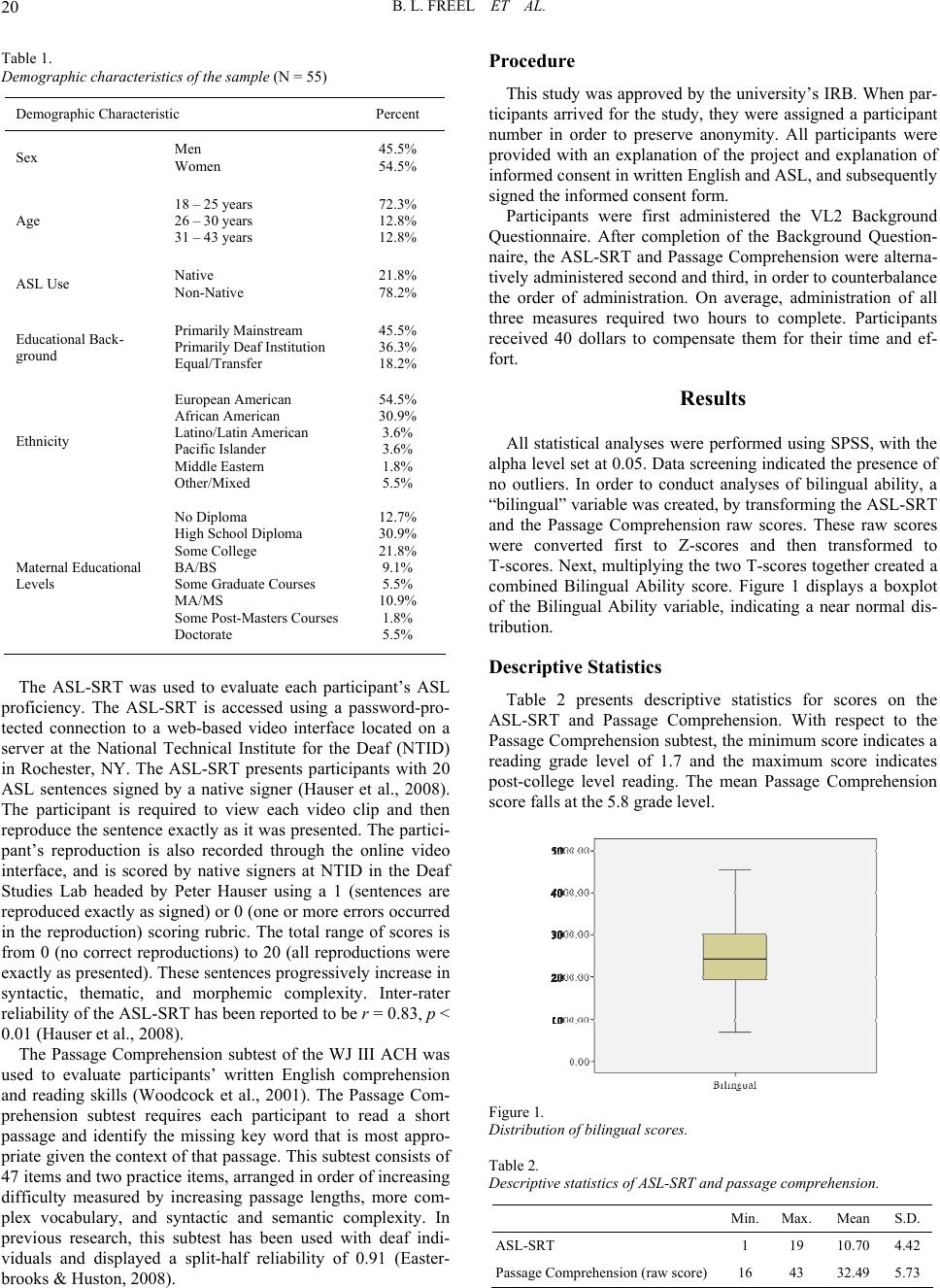 B. L. FREEL ET AL. 20 Table 1. Demographic characteristics of the sample (N = 55) Demographic Characteristic Percent Sex Men Women 45.5% 54.5% Age 18 – 25 yea r s 26 – 30 yea r s 31 – 43 yea r s 72.3% 12.8% 12.8% ASL Use Native Non-Native 21.8% 78.2% Educational Back- ground Primarily M ainstream Primarily Deaf Institution Equal/Transfer 45.5% 36.3% 18.2% Ethnicity European American African American Latino/Latin American Pacific Islander Middle East ern Other/Mixed 54.5% 30.9% 3.6% 3.6% 1.8% 5.5% Maternal Educational Levels No Diploma High School Diploma Some College BA/BS Some Graduate Courses MA/MS Some Post-Maste rs Courses Doctorate 12.7% 30.9% 21.8% 9.1% 5.5% 10.9% 1.8% 5.5% The ASL-SRT was used to evaluate each participant’s ASL proficiency. The ASL-SRT is accessed using a password-pro- tected connection to a web-based video interface located on a server at the National Technical Institute for the Deaf (NTID) in Rochester, NY. The ASL-SRT presents participants with 20 ASL sentences signed by a native signer (Hauser et al., 2008). The participant is required to view each video clip and then reproduce the sentence exactly as it was presented. The partici- pant’s reproduction is also recorded through the online video interface, and is scored by native signers at NTID in the Deaf Studies Lab headed by Peter Hauser using a 1 (sentences are reproduced exactly as signed) or 0 (one or more errors occurred in the reproduction) scoring rubric. The total range of scores is from 0 (no correct reproductions) to 20 (all reproductions were exactly as presented). These sentences progressively increase in syntactic, thematic, and morphemic complexity. Inter-rater reliability of the ASL-SRT has been reported to be r = 0.83, p < 0.01 (Hauser et al., 2008). The Passage Comprehension subtest of the WJ III ACH was used to evaluate participants’ written English comprehension and reading skills (Woodcock et al., 2001). The Passage Com- prehension subtest requires each participant to read a short passage and identify the missing key word that is most appro- priate given the context of that passage. This subtest consists of 47 items and two practice items, arranged in order of increasing difficulty measured by increasing passage lengths, more com- plex vocabulary, and syntactic and semantic complexity. In previous research, this subtest has been used with deaf indi- viduals and displayed a split-half reliability of 0.91 (Easter- brooks & Huston, 2008). Procedure This study was approved by the university’s IRB. When par- ticipants arrived for the study, they were assigned a participant number in order to preserve anonymity. All participants were provided with an explanation of the project and explanation of informed consent in written English and ASL, and subsequently signed the informed consent form. Participants were first administered the VL2 Background Questionnaire. After completion of the Background Question- naire, the ASL-SRT and Passage Comprehension were alterna- tively administered second and third, in order to counterbalance the order of administration. On average, administration of all three measures required two hours to complete. Participants received 40 dollars to compensate them for their time and ef- fort. Results All statistical analyses were performed using SPSS, with the alpha level set at 0.05. Data screening indicated the presence of no outliers. In order to conduct analyses of bilingual ability, a “bilingual” variable was created, by transforming the ASL-SRT and the Passage Comprehension raw scores. These raw scores were converted first to Z-scores and then transformed to T-scores. Next, multiplying the two T-scores together created a combined Bilingual Ability score. Figure 1 displays a boxplot of the Bilingual Ability variable, indicating a near normal dis- tribution. Descriptive Statistics Table 2 presents descriptive statistics for scores on the ASL-SRT and Passage Comprehension. With respect to the Passage Comprehension subtest, the minimum score indicates a reading grade level of 1.7 and the maximum score indicates post-college level reading. The mean Passage Comprehension score falls at the 5.8 grade level. Figure 1. Distribution of bilingual sc or e s. Table 2. Descriptive statistic s of ASL-SRT and passage c o mp re hension. Min. Max. Mean S.D. ASL-SRT 1 19 10.70 4.42 Passage C omprehension (raw score)16 43 32.49 5.73 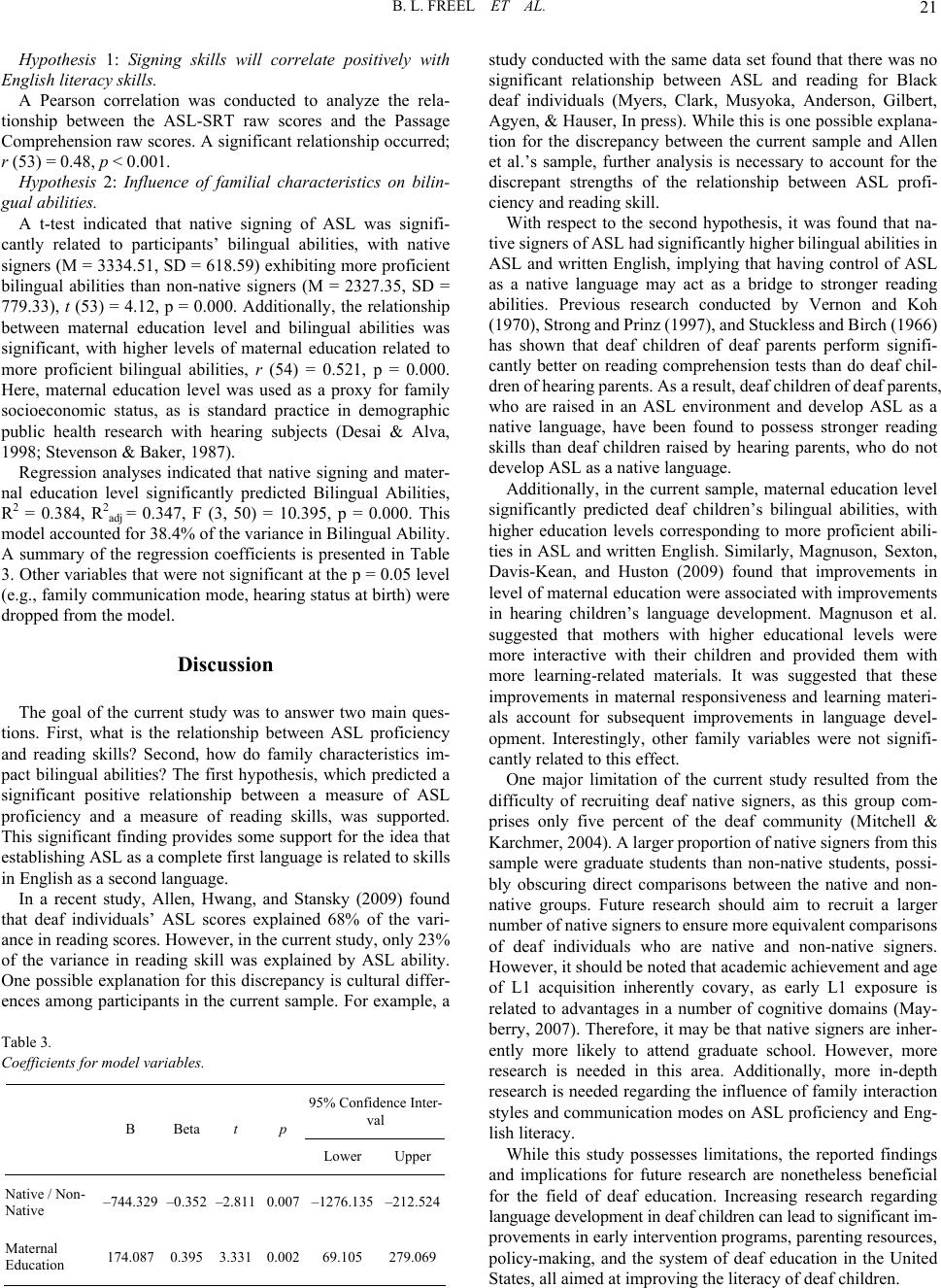 B. L. FREEL ET AL. 21 Hypothesis 1: Signing skills will correlate positively with English literacy skills. A Pearson correlation was conducted to analyze the rela- tionship between the ASL-SRT raw scores and the Passage Comprehension raw scores. A significant relationship occurred; r (53) = 0.48, p < 0.001. Hypothesis 2: Influence of familial characteristics on bilin- gual abilities. A t-test indicated that native signing of ASL was signifi- cantly related to participants’ bilingual abilities, with native signers (M = 3334.51, SD = 618.59) exhibiting more proficient bilingual abilities than non-native signers (M = 2327.35, SD = 779.33), t (53) = 4.12, p = 0.000. Additionally, the relationship between maternal education level and bilingual abilities was significant, with higher levels of maternal education related to more proficient bilingual abilities, r (54) = 0.521, p = 0.000. Here, maternal education level was used as a proxy for family socioeconomic status, as is standard practice in demographic public health research with hearing subjects (Desai & Alva, 1998; Stevenson & Baker, 1987). Regression analyses indicated that native signing and mater- nal education level significantly predicted Bilingual Abilities, R2 = 0.384, R2adj = 0.347, F (3, 50) = 10.395, p = 0.000. This model accounted for 38.4% of the variance in Bilingual Ability. A summary of the regression coefficients is presented in Table 3. Other variables that were not significant at the p = 0.05 level (e.g., family communication mode, hearing status at birth) were dropped from the model. Discussion The goal of the current study was to answer two main ques- tions. First, what is the relationship between ASL proficiency and reading skills? Second, how do family characteristics im- pact bilingual abilities? The first hypothesis, which predicted a significant positive relationship between a measure of ASL proficiency and a measure of reading skills, was supported. This significant finding provides some support for the idea that establishing ASL as a complete first language is related to skills in English as a second language. In a recent study, Allen, Hwang, and Stansky (2009) found that deaf individuals’ ASL scores explained 68% of the vari- ance in reading scores. However, in the current study, only 23% of the variance in reading skill was explained by ASL ability. One possible explanation for this discrepancy is cultural differ- ences among participants in the current sample. For example, a Table 3. Coefficients for model variables. 95% Confidence Inter- val B Beta t p Lower Upper Native / Non- Native –744.329 –0.352 –2.811 0.007 –1276.135 –212.524 Maternal Education 174.087 0.395 3.331 0.002 69.105 279.069 study conducted with the same data set found that there was no significant relationship between ASL and reading for Black deaf individuals (Myers, Clark, Musyoka, Anderson, Gilbert, Agyen, & Hauser, In press). While this is one possible explana- tion for the discrepancy between the current sample and Allen et al.’s sample, further analysis is necessary to account for the discrepant strengths of the relationship between ASL profi- ciency and reading skill. With respect to the second hypothesis, it was found that na- tive signers of ASL had signif icantly h igher bi lin gual abi lit ies in ASL and written English, implying that having control of ASL as a native language may act as a bridge to stronger reading abilities. Previous research conducted by Vernon and Koh (1970), Stron g and P rinz (1 997) , and Stu ckles s a nd B irch (1966) has shown that deaf children of deaf parents perform signifi- cantly better on reading comprehension tests than do deaf chil- dren of hea ring p arents. As a result, d eaf children of deaf par ents, who are raised in an ASL environment and develop ASL as a native language, have been found to possess stronger reading skills than deaf children raised by hearing parents, who do not develop ASL as a native language. Additionally, in the current sample, maternal education level significantly predicted deaf children’s bilingual abilities, with higher education levels corresponding to more proficient abili- ties in ASL and written English. Similarly, Magnuson, Sexton, Davis-Kean, and Huston (2009) found that improvements in level of maternal education were associated with improvements in hearing children’s language development. Magnuson et al. suggested that mothers with higher educational levels were more interactive with their children and provided them with more learning-related materials. It was suggested that these improvements in maternal responsiveness and learning materi- als account for subsequent improvements in language devel- opment. Interestingly, other family variables were not signifi- cantly related to this effect. One major limitation of the current study resulted from the difficulty of recruiting deaf native signers, as this group com- prises only five percent of the deaf community (Mitchell & Karchmer, 2004 ). A la rger pro port ion of n ativ e sig ners fr om th is sample were graduate students than non-native students, possi- bly obscuring direct comparisons between the native and non- native groups. Future research should aim to recruit a larger number of native signers to ensure more equ ivale nt com parison s of deaf individuals who are native and non-native signers. However, it should be noted that acade mic achievement and age of L1 acquisition inherently covary, as early L1 exposure is related to advantages in a number of cognitive domains (May- berry, 2007). Therefore, it may be that native signers are inher- ently more likely to attend graduate school. However, more research is needed in this area. Additionally, more in-depth research is needed regarding the influence of family interaction styles and communication modes on ASL proficiency and Eng- lish literacy. While this study possesses limitations, the reported findings and implications for future research are nonetheless beneficial for the field of deaf education. Increasing research regarding language development in deaf c h ildren can lead to significant im- provements in early intervention programs, parenting resources, policy-making, and the system of deaf education in the United States, all aimed at improving the literacy of deaf children.  B. L. FREEL ET AL. 22 References Allen, B. (2002). ASL-English bilingual classroom: The families’ per- spectives. Bilingual Research Journal, 26, 149-168. Allen, T. E., Hwang, Y., & Stansky, A. (2009). Measuring factors that predict deaf students’ reading abilities: The VL2 Toolkit-Project De- sign and Early Findings. Paper Presented at the 2009 Annual Meet- ing of the Association of College Educators of the Deaf and Hard of Hearing, New Orleans. Bailes, C. N. (2001). Integrative ASL-English language arts: Bridging paths to literacy. Sign Language Studies, 1, 147-174. doi:10.1353/sls.2001.0002 Benedict, B. S., & Sass-Lehrer, M. (2007). The ASL and English bi- lingual approach: A professional perspective. In S. Schwartz (Ed.), Choices in Deafness: A Parent’s Guide to Communication Options (3rd ed., pp. 185-221). Bethesda, MD: Woodbine House. Calderon, R. (2000). Parental involvement in deaf children’s education programs as a predictor of child’s language, early reading, and social emotional development. Journal of Deaf Studies and Deaf Education, 5, 140-155. doi:10.1093/deafed/5.2.140 Chamberlain, C., Morford, J. P., & Mayberry, R. I. (2000). Language acquisition by eye. Mahwah, NJ: Lawrence Erlbaum Associates. Conrad, R. (1979). The deaf school child: Language and function. London: Harper & Row. Corina, D., & Singleton, J. (2009). Developmental social cognitive neuroscience: Insights from deafness. Child Development, 80, 952- 967. doi:10.1111/j.1467-8624.2009.01310.x Cummins, J. (1979). Cognitive / academic language proficiency, lin- guistic interdependence, the optimum age question and some other matters. Working Papers on Bilingualism, 19, 121-129. Cummins, J. (2000). Language, power, and pedagogy: Bilingual chil- dren in the crossfire. Buffalo, NY: Multilingual Matters. Cummins, J. (2006,). The relationship between ASL proficiency and English academic development: A review of the research. Paper Pre- sented at the Workshop Challenges, Opportunities, and Choices in Education Minority Group Students, Hamar University College, Norway. DeLana, M., Gentry, M. A., & Andrews, J. (2007). The efficacy of ASL / English bilingual education: Considering public schools. American Annals of the Deaf, 152, 73-87. doi:10.1353/aad.2007.0010 Desai, S., & Alva, S. (1998). Maternal education and child health: Is there a strong casua l relationship? Demography, 35, 71-81. doi:10.2307/3004028 Easterbrooks, S., & Huston, S. (2008). Signed Reading fluency of stu- dents who are deaf/hard of hearing. Journal of Deaf Studies and Deaf Education, 13, 37-54. doi:10.1093/deafed/enm030 Evans, C. J. (1998). Literacy acquisition in deaf children. Paper Pre- sented at Annual Meeting of the Teachers of English to Speakers of Other Language, Seattle, WA. Evans, C. J. (2004). Literacy development in deaf students: Case stud- ies in bilingual teaching and learning. American Annals of the Deaf, 149, 17-27. doi:10.1353/aad.2004.0011 Grosjean, F. (2001). The right of the deaf child to grow up bilingual. Washington, DC: Gallaudet University Press. Hakuta, K. (1990). Bilingualism and bilingual education: A research perspective. Occasional Papers Series, No. 1. Washington, DC: Na- tional Clearinghous e for Bilingual Education. Hauser, P., Palu dneviciene, R., Supalla, T., & B avelier, D. (2 008). Ame- rican Sign Language – Sen tence Reproduction T est: Development & implications. In R. M. de Quadros (Ed.), Sign languages: spinning and unraveling the past, present, and future. Petrópolis, Brazil: Edi- tora Arara Azul. Hermans, D., Knoors, H., Ormel, E., & Verhoeven, L. (2008). The relationship between the reading and signing skills of deaf children in bilingual education programs. Journal of Deaf Studies and Deaf Education, 13, 518-530. doi:10.1093/deafed/enn009 Johnson, R. E., Liddell, S. K., & Erting, C. J. (1998). Unlocking the curriculum: Principles for achieving access in deaf education. Gal- laudet Research Institute Working Paper, 89, Washington, DC: Gallaudet University Press. Magnuson, K., Sexton, H., Davis-Kean, P., & Huston, A. (2009). In- creases in maternal education and young children’s language skills. Merrill – Palmer Quarterly, 55, 319-350. Marschark, M., & Harris, M. (1996). Success and failure in learning to read: The special case of deaf children. In C. Coronoldi, & J. Oakhill (Eds.), Reading Comprehension Difficulties: Process and Interven- tion. Hillsdale, NJ: Lawrence Erlbaum. Mayberry, R. I. (2007). When timing is everything: Age of first-lan- guage acquisition effects on second-language learning. Applied Psy- cholinguistics, 28, 537-54 9. doi:10.1017/S0142716407070294 Mayer, C., & Akamatsu, C. (1999). Bilingual-bicultural models of literacy education for deaf students: considering the claims. Journal of Deaf Studies and Deaf Education, 4, 1-8. doi:10.1093/deafed/4.1.1 Mayer, C., & Wells, G. (1996). Can the linguistic interdependence theory support a bilingual-bicultural model of literacy education for deaf students? Journal of Deaf Studies and Deaf Education, 1, 93-107. Meadow, K. (1968). Early manual communication in relation to the deaf child’s intellectual, social, and communicative functioning. Am- erican Annals of the Deaf, 113, 29-41. Mitchell, R. E., & Karchmer, M. A. (2004). When parents are deaf versus hard of hearing: patterns of sign use and school placement of deaf and hard-of-hearing children. Journal of Deaf Studies and Deaf Education, 9, 133-152. doi:10.1093/deafed/enh017 Mounty, J., Nover, S. M., & Pucci, C. (2008). How deaf children be- come proficient readers: A sociocultural perspective. Presented at the Association of College Educators – Deaf and Hard of Hearing, New Orleans, LA. Musselman, C. (2000). How do children who can’t hear learn to read an alphabetic script? A review of the literature on reading and deafness. Journal of Deaf Studies and Deaf E duc ation, 5, 9-31. doi:10.1093/deafed/5.1.9 Myers, C., Clark, M. D., Musyo ka, M. M., Anderso n, M. L., Gilbert, G. L., Agyen, S., & Hauser, P. C. (in press). The interaction of culture, family characteristics, reading experiences, language, and educa- tional level: Impacts on Black Deaf individuals’ reading skills. American Annals of the D eaf. Niemann, S., Greenstein, D., & David, D. (2004). Helping children who are deaf: Family and community support for children who do not hear well (Early assistance series for children with disabilities). Pa- laestra, 21, 52-53. Perfetti, C. A., & Sandak, R. (2000). Reading optimally builds on spo- ken language: Implications for deaf readers. Journal of Deaf Studies and Deaf Education, 5, 32-50. doi:10.1093/deafed/5.1.32 Quigley, S., & Frisina, R. (1961). Institutionalization and Psycho- Educational Development of Deaf Children. CEC Research Mono- graph. Washington, D.C.: Council on Exceptional Children . Singleton, J. L., Supalla, S., Litchfield, S., & Schley, S. (1998). From sign to word: Considering modality constraints in ASL / English bi- lingual education. Topics in Lan guage Disorders, 18, 16-29. Stevenson, D. L., & Baker, D. P. (1987). The family-school relation and the child’s school performance. Child Development: Special Is- sue: Schools and Development, 58, 1348-1357. Stevenson, E. (1964). A study of the educational achievement of deaf children of deaf parents. California News, 80, 143. Strong, M., & Prinz, P. (1997). A study of the relationship between American Sign Language and English literacy. Journal of Deaf Stu- dies and Deaf Education, 2, 37-46. Stuckless, R., & Birch, J. (1966). The influence of early manual com- munication on the linguistic development of deaf children. American Annals of the Deaf, 106, 436-480. Vernon, M., & Koh, S. D. (1970). Early manual communication and deaf children’s achievements. American Annals of the Deaf, 115, 527-536. Wilbur, R. B. (2000). The use of ASL to support the development of English and literacy. Journal of Deaf Studies and Deaf Education, 5, |
