

Paper Menu >>
Journal Menu >>
 Energy and Power Engineering, 2013, 5, 975-979 doi:10.4236/epe.2013.54B187 Published Online July 2013 (http://www.scirp.org/journal/epe) Distribution Network Expansion Planning Based on Multi-objective PSO Algorithm Chunyu Zhang, Yi Ding, Qiuwei Wu, Qi Wang, Jacob Østergaard Center for Electric Power and Energy, Technical University of Denmark, Copenhagen, Denmark Email: [email protected] Received January, 2013 ABSTRACT This paper presents a novel approach for electrical distribution network expansion planning using multi-objective parti- cle swarm optimization (PSO). The optimization objectives are: investment and operation cost, energy losses cost, and power congestion cost. A two-phase multi-objective PSO algorithm was proposed to solve this optimization problem, which can accelerate the convergence and guarantee the diversity of Pareto-optimal front set as well. The feasibility and effectiveness of both the proposed multi-objective planning approach and the improved multi-objective PSO have been verified by the 18-node typical system. Keywords: Distribution Network Expansion Planning; Two-phase; Multi-objective PSO 1. Introduction The restructure and deregulation of the global power industry have introduced fundamental changes to the practices of power system planning. Conventional single optimization objective approach such as the minimiza- tion of the investment cost is no longer suitable for the new market operation environment. The multi-objective planning approach has become necessary in order to take into account new problems caused by the competitive power market environment [1,2]. Over the past decade, a large amount of researches and literatures have been accomplished in multi-objective distribution network expansion planning approach. A detailed review of different methods can be found in [3,4]. The distribution system planning problem dimension increases with number of nodes. Normally, numerical optimization tools such as nonlinear programming (NLP) [5] and dynamic programming [6] have been used to solve this problem with lower node systems. In multi- objective problems, there are some specific disadvan- tages in using these analytical solution strategies, i.e., curse of dimensionality, non-differentiability, discon- tinuous objective space etc [7]. Moreover, to get a set of solutions (as with Pareto-optimality principle), any nu- merical method requires several trial runs. Considering the complex solution space, non-convex and nonlinear mixed integer objective functions, the so- lution of multi-objective distribution network planning problem is difficult to gain by many traditional optimiza- tion methods. Therefore, several intelligent algorithms have been used to enhance the performance of distribu- tion expansion planning process, including greedy algo- rithms, genetic algorithms, particle swarm optimization, and evolutionary optimization. Particle swarm optimiza- tion (PSO) is one of the most widely used multi-point search algorithms using stochastic behavior. PSO is de- veloped by inspiring with social behavior that is ob- served in nature such as flocks of birds and schools of fish [8]. Recently, PSO has been gained more and more attention, due to its powerful search ability in function optimization. PSO is adopted to the multi-objective op- timization widely. The main differences from single- objective PSO are the proper introduction of archive to reserve Pareto-optimal candidates and the appropriate selection of guide particles for multi-objective optimiza- tion [9]. For example, Mostaghim and Teich [10] pro- posed a Sigma method. This method selected the best local guides for each particle, which mainly improved the convergence to the Pareto front. But, the method could not gain good convergence rate and uniform diversity simultaneously. Coello and Lechgua [11] introduced the global guide selection method based on Pareto optimality and hypercube in the objective function space to main- tain the diversity of the particles. However, its conver- gence rate was low [12]. The performance of multi-ob- jective PSO optimization algorithm needs to be im- proved. In this paper, a distribution network expansion plan- ning approach is proposed to optimize three objectives: the investment and operation cost, energy losses cost, Copyright © 2013 SciRes. EPE  C. Y. ZHANG ET AL. 976 and power congestion cost. Accordingly, a two- phase multi-objective PSO is also proposed, which accelerates the convergence and guarantees the diversity of Pareto- optimal front set as well. Case study based on the 18- node system is conducted to demonstrate the feasibility and effectiveness of both the proposed planning approach and the improved multi-objective PSO algorithm. 2. Problem Formulation 2.1. Multi-Objective Planning Model The power system restructuring forces a change in duties and objectives of traditional planning and it compels to consider several objectives that are in mutual conflict. The proposed planning model minimizes different cost functions related to the cost of investment and operation s1(x), cost of energy losses s2(x) and cost of power con- gestion s3(x) in the form of multi-objective optimization (1). 123 m,i .. 00 n , Ssss st gh XXXX XX , (1) where g(x) and h(x) are equality and inequality con- straints of the problem. 2.2. Investment and Operation Cost The total cost function (s1) for investment and operation of DG units is given in (2). The costs of installing DGs in candidate buses of a distribution network are considered as follow. It is assumed that DG units can be installed in all load buses; however, the best sites are determined according to the optimization process. Yearly investment cost of each technology is determined based on discount rate and payment period according to (3). As an incentive program for renewable sources, this parameter is calcu- lated using a low discount value. Besides, feed-in tariffs increase the capacity factor o of DG technologies. 1, , 11 NN Cj DGijCj DGijjj ij ij s IPOP AaT (2) 1 1 t Cj ICj t dd I d T (3) where ICj and OCj are the yearly investment and hourly operating costs of jth technology of DG-unit, respec- tively, TICj is the total investment cost of jth DG tech- nology, d and t are, respectively, discount rate and pay- ment period, N is the number of load buses in the distri- bution system; PDG,i j is the capacity of jth technology of DG-unit at bus i, T is yearly operating hours, Aj is the availability factor related to jth technology; and aj is the average capacity factor of jth DG technology considering incentive effects of feed-in tariff policy. 2.3. Energy Losses Cost This objective function (s2) attempts to minimize the total cost of the energy losses in the distribution network due to installation of DG units. This function is strongly related to the locations of DG units in the distribution system. The power flow in the feeder connecting buses i and j is used to formulate the energy loss function as fol- lows: 2 2 11 NN ij ff iji ij VV s PLkT Z (4) ij ij if ij VV PV P Z (5) where N is the total number of buses in the distribution system; V is the bus voltage, Zij and Pij are the impedance and power flow of branch i–j, respectively; Pf is the sys- tem power factor and k is the expected price of electric- ity. 2.4. Power Congestion Cost The congestion cost (s3) is given by 3 () ij jif i, j s =PllP W (6) where li , lj is the locational marginal price at bus i, j, which are the Lagrange multipliers or shadow prices of the power flow constraints. Pf is the large penalty factor. W is the total artificial generator (shed load) in normal operation conditions. 3. Two-phase Multi-objective PSO 3.1. Classical PSO Particle swarm optimization is a relatively new technique for optimization of continuous non-linear functions. The individuals in a PSO have their own positions and ve- locities. Each particle moves in the search space with velocity, which is dynamically adjusted and balanced based on its own best movement (pb) and the best movement of the group (gb). If the best previous position of the i-th particle is recorded and represented as pi=( pb1, pb2, pb3, …, pbd) and the global best position is recorded and represented as gi= (gb1, gb2, gb3, …, gbd), the modifi- cation of velocity (vid) and position (xid) of the i-th parti- cle can be calculated by the current velocity and the dis- tance from pi to gi as shown in the following formulas, 112 2idii idi id vwvcrpx crgx (7) idid i x xv (8) where w is known as the inertia weight, c1 and c2 are two Copyright © 2013 SciRes. EPE  C. Y. ZHANG ET AL. 977 positive constants, r1 and r2 are random numbers in the range of [0, 1]. The important part in multi-objective PSO is to deter- mine the global best particle gi for each particle i of the population. In single objective PSO, the global best par- ticle is determined easily by selecting the particle in the best position. In multi-objective optimization problems, each particle of the population should select its global best particle from the set of Pareto-optimal solution. 3.2. Two-phase Multi-objective PSO Algorithm 1) The steps of two-phase multi-objective PSO. Step 1: Initialize the parameters of two-phase multi- objective PSO, including size of the swarm P, capacity of the archive A, PSO coefficients w, c1 and c2, and maxi- mum iterations Z, t=0; Step 2: Randomly initialize the position and velocity of each particle in set P and set A. Set the initial position as the individual best position pi of each particle; Step 3: For t=1 to Z, a) Update archive, b) Select the global bests (gi) from A for each particle in the set P based on the strategy of two-phase guided, c) Update position and velocity of every particle ac- cording to the (7)−(8), d) If t < 0.85Z, the particle is mutated according to the proposed strategy, e) Each particle in set P has a new location, if the cur- rent location is dominated by its personal best location (pi), then the previous location is kept, otherwise, the current location is set as the personal best location. If the particles are mutually non-dominated, one particle is selected randomly, f) End. 2) Strategy of two-phase guided. The selection of gi is the key of PSO algorithm. For multi-objective problems, gi is related to the convergence speed of the algorithm and the diversity of solution. A two-phase guide gi selection strategy is proposed in this paper. Sigma method is adopted to the first half of the evolution because of its fast convergence rate, and an approximated front of Pareto is found. And then, a pro- posed ideal optimal particle method is adopted to the remaining half of the evolution, which will promote the diversity of solution. a) Sigma method The Sigma method involves choosing the guide parti- cle based on the similarity of the angular position in ob- jective space. This method was proposed by Mostaghim and Teich [10], which was proved to have good conver- gence speed. For two-dimensional objective space, δ is defined as 22 12 2 12 The guide particle of particles in set P is the particle that has the closest δ in set A. b) Optimal particle method Defined fj ’ is regarded as the optimal value of the jth objective, and the point (f1, f2, …, fn) is called ideal point. The optimal particle xI of the following equation is the ideal optimal particle 2 ' 1 min n IjI j j f xfx f (10) For a complex multi-objective optimization problem, the optimal value of the each objective and the corre- sponding optimal point tends to be unknown advance. In this paper, the previous optimal value of each objective in iterative process is regarded as fj ’. The process in which the guide particles are selected from set A is described as the following steps: Step 1: Calculate the optimal value fj ’ and the corre- sponding optimal particle x’ in set A; Step 2: According to (10), obtain the ideal optimal particle xI; Step 3: Compute the average of the optimal particle x’ and the ideal optimal particle xI, and regard and average value as gi. The value gi represents the optimal information of the each objective, achieves the global optimization of the algorithm, and is helpful to achieve the local depth search. c) Selecting guided particle strategy Sigma method which has faster convergence rate is adopted to the first n1-th generation of the evolution, and the ideal optimal particle method is adopted to the re- maining (Z−n1)-th generation. 3) Strategy of mutation. The use of mutation operator in this Multi-objective PSO is needed because the algorithm may converge to local optimal fronts. Mutation probability (Pm) is reduced with the iteration of the algorithm according to 1 g m C p Z (11) where Cg is the number of current generation. For each particle, the variable mr is a random number in the range of [0, 1]. If mr<Pg, the particle is randomly selected for mutation according to 1 1 irii x mvx (12) where μ points out the direction in mutation and θ con- trols the distance covered by a jump. In this paper, μ=3 and θ is set as ±1 randomly. If the solution is beyond its boundary by mutation, it is moved to the corresponding boundary. 2 f f f f (9) Copyright © 2013 SciRes. EPE 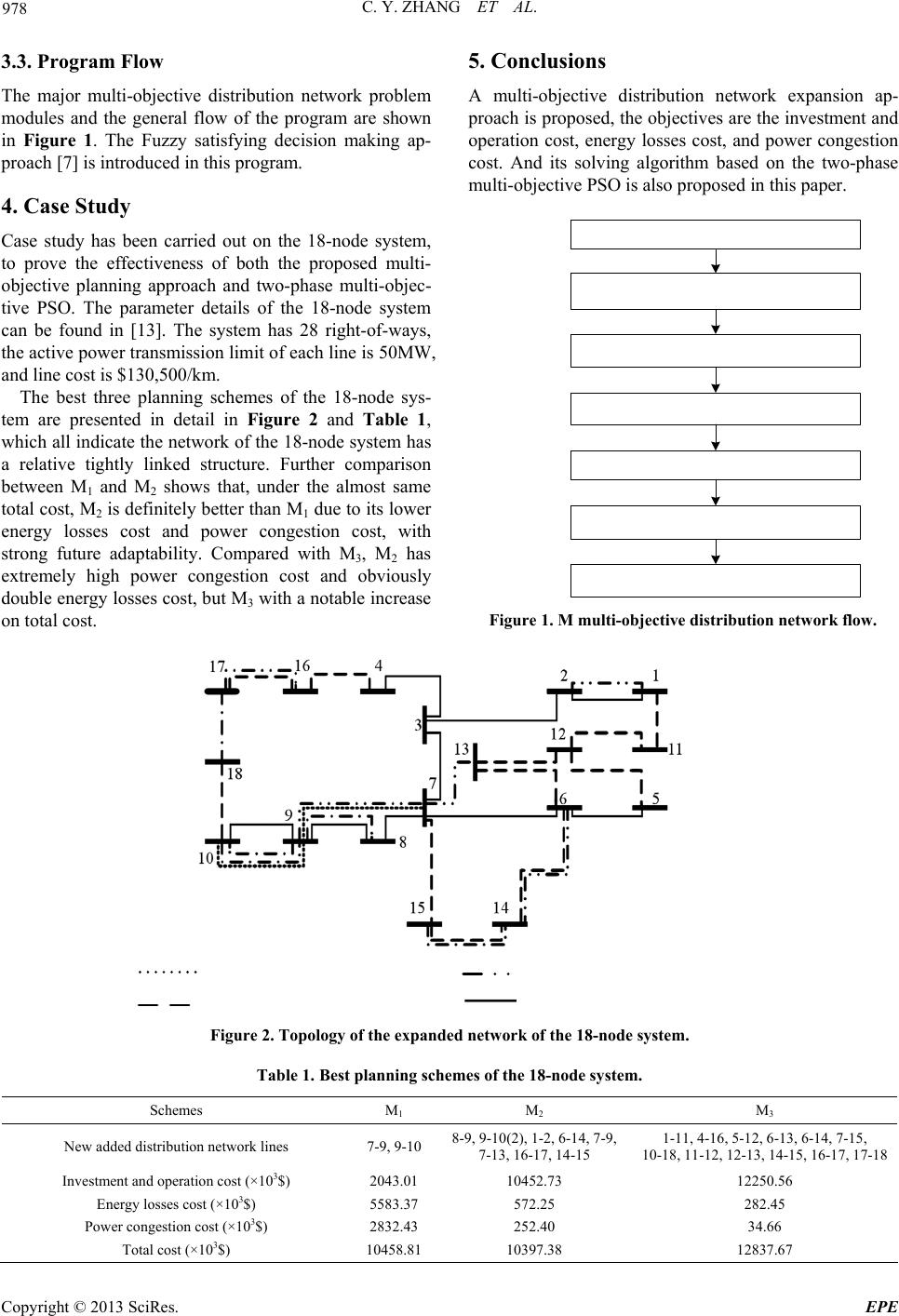 C. Y. ZHANG ET AL. Copyright © 2013 SciRes. EPE 978 5. Conclusions 3.3. Program Flow The major multi-objective distribution network problem modules and the general flow of the program are shown in Figure 1. The Fuzzy satisfying decision making ap- proach [7] is introduced in this program. A multi-objective distribution network expansion ap- proach is proposed, the objectives are the investment and operation cost, energy losses cost, and power congestion cost. And its solving algorithm based on the two-phase multi-objective PSO is also proposed in this paper. 4. Case Study Case study has been carried out on the 18-node system, to prove the effectiveness of both the proposed multi- objective planning approach and two-phase multi-objec- tive PSO. The parameter details of the 18-node system can be found in [13]. The system has 28 right-of-ways, the active power transmission limit of each line is 50MW, and line cost is $130,500/km. The best three planning schemes of the 18-node sys- tem are presented in detail in Figure 2 and Table 1, which all indicate the network of the 18-node system has a relative tightly linked structure. Further comparison between M1 and M2 shows that, under the almost same total cost, M2 is definitely better than M1 due to its lower energy losses cost and power congestion cost, with strong future adaptability. Compared with M3, M2 has extremely high power congestion cost and obviously double energy losses cost, but M3 with a notable increase on total cost. Figure 1. M multi-objective distribution network flow. Figure 2. Topology of the expanded network of the 18-node system. Table 1. Best planning schemes of the 18-node system. Schemes M1 M 2 M 3 New added distribution network lines 7-9, 9-10 8-9, 9-10(2), 1-2, 6-14, 7-9, 7-13, 16-17, 14-15 1-11, 4-16, 5-12, 6-13, 6-14, 7-15, 10-18, 11-12, 12-13, 14-15, 16-17, 17-18 Investment and operation cost (×103$) 2043.01 10452.73 12250.56 Energy losses cost (×103$) 5583.37 572.25 282.45 Power congestion cost (×103$) 2832.43 252.40 34.66 Total cost (×103$) 10458.81 10397.38 12837.67  C. Y. ZHANG ET AL. 979 The planning results of the 18-node system show that, for a practical system, the proposed multi-objective dis- tribution network expansion method can effectively en- hance the distribution capacity by adding specific new lines under the variety conditions of future uncertainties. Considering efficiency, reliability, and economic, the best planning schemes can be put forward by the pro- posed two-phase multi-objective PSO, which shows its superiority as well. Further research can focus on the multi-stage and mul- ti-objective model, which should consider the uncertainty of the bidding parameters and other uncertain factors in distribution expansion problem. 6. Acknowledgements The authors gratefully acknowledge the financial sup- ports and the strategic platform for innovation & research provided by Danish national project iPower. REFERENCES [1] A. Barin, L. F. Pozzatti, L. N. Canha, et al., “Mul- ti-objective Analysis of Impacts of Distributed Generation Placement on the Operational Characteristics of Networks for Distribution System Planning,” International Journal of Electrical Power & Energy Systems, Vol. 32, 2010, pp. 1157-1164. doi:10.1016/j.ijepes.2010.06.015 [2] Z. Kai, A. P. Agalgaonkar, K. M. Muttaqi and S. Perera, “Multi-objective Optimization for Distribution System Planning with Renewable Energy Resources,” in Proc. 2010 IEEE International Energy Conference, pp. 670-675. [3] A. H. Mantway and M. M. Al-Muhaini, “Multi-objective BPSO Algorithm for Distribution System Expansion Planning Including Distributed Generation,” in Proc. 2008 IEEE International Transmission & Distribution, pp. 134-141. [4] R. Rosado and D. Navarro, “Possibilistic Model Based on Fuzzy Sets for the Multiobjective Optimal Planning of Electric Power Distribution Networks,” IEEE Trans. Power Systems, Vol. 19, 2004, pp. 1801-1810. doi:10.1109/TPWRS.2004.835678 [5] A. Soroudi and M. Ehsan, “A Distribution Network Ex- pansion Planning Model Considering Distributed Genera- tion Options and Techo-Economical Issues,” Interna- tional Journal of Energy, Vol. 35, 2010, pp. 3364-3374. [6] E. G. Carrano, F. G. Guimaraes, R. H. C. Takahashi, et al., “Electric Distribution Network Expansion Under Load-Evolution Uncertainty Using an Immune System Inspired Algorithm,” IEEE Trans. Power Systems, Vol. 22, 2007, pp. 851-861. [7] T. S. Chung, K. K. Lee, G. J. Chen, J. D. Xie and G. Q. Tang, “Multi-Objective Transmission Network Planning by a Hybrid GA Approach with Fuzzy Decision Analy- sis,” International Journal of Electrical Power & Energy Systems, Vol. 25, 2003, pp. 187-192. [8] R. Poli, J. Kennedy and T. Blackwell, Particle swarm optimization an overview, Vol. I. MIT: Wiley, 2010, p. 2. [9] A. M. R. Sierra and C. A. Coello, “Multi-objective Parti- cle Swarm Optimizers: A Survey of the State-of-the-art,” International Journal of Computational Intelligence Re- search, Vol. 3, 2006, pp. 287-308. [10] S. Mostaghim and J. Teich, “Strategies for finding good local guides in multi-objective particle swarm optimiza- tion (MOPSO),” in Proc. 2003 IEEE Swarm Intelligence Symposium, pp. 26-33. [11] M. S. Lechuga, and C. A. Coello, “Handling Multiple Objectives with Particle Swarm Optimization,” IEEE Trans. Evolutionary Computation, Vol. 3, 2006, pp. 256-279. [12] N. C. Sahoo, S. Ganguly and D. Das, “Fuzzy-Pareto-dominance Driven Possibilistic Model Based Planning of Electrical Distribution Systems Using Multi-objective Particle Swarm Optimization,” Expert Systems with Applications, Vol. 39, 2012, pp. 881-893. doi:10.1016/j.eswa.2011.07.086 [13] X. Wang and J. R. McDonald, Modern Power System Planning, McGraw-Hill Book Company, London, 1993. Copyright © 2013 SciRes. EPE |