

Paper Menu >>
Journal Menu >>
 Materials Sciences and Applicatio ns, 2011, 2, 111-115 doi:10.4236/msa.2011.22015 Published Online February 2011 (http://www.SciRP.org/journal/msa) Copyright © 2011 SciRes. MSA 111 Facile Synthesis of Polypyrrole/Titanate Core-Shell Nanorods and Their Electrorheological Characteristics Jiexu Zhang1, Ying He2, Lijun Ji1 1College of Chemical Engineering, East China University of Science and Technology, Shanghai, China; 2Key Laboratory for Ul- trafine Materials of Ministry of Education, School of Materials Science and Engineering, East China University of Science and Technology, Shanghai, China. Email: [email protected] Received November 9th, 2010; revised January 14th, 2011; accepted January 24th, 2011. ABSTRACT In this work, polypyrrole (PPy)/titanate (TN) composite nanorods were successfully synthesized using cetyl trimethyl- ammonium bromide (CTAB) as a structure-directing agent by in situ chemical oxidative polymerization. The structural characterization indicated that the new composite rods were core (TN)-shell (PPy) nanostructure with the average di- ameter in the range of 250-300 nm. Further, this semiconducting composite can be used as a dispersed phase in sili- cone oil for a new electrorheological (ER) fluid, and its ER behavior was investigated under steady and oscillatory shear. It was found that the PPy/TN fluid showed typical ER characteristics under an external electric field. Keywords: Polypyrrole, Titanate Nanorods, Conducting Composite, Electrorheological Fluid, Viscoelastic Properties 1. Introduction In recent years, considerable efforts have been made to- wards the design and synthesis of one-dimensional (1D) nanostructured materials (e.g. nanotube, nanowire and nanorod) due to their potential applications in nanoscale electronic and photonic devices, as well as in biotech- nology. More recently, interesting ER properties induced by 1D materials -based fluids have also attracted wide attention [1-3]. As one of the important smart materials, ER fluids have been intensively investigated over the past decades. ER fluids are commonly known as suspensions consist- ing of polarizable particles dispersed in an insulating liquid medium [4]. Their rheological properties can rap- idly and reversibly change upon application of an electric field. This rapid and reversible electric-controlled me- chanical response makes ER fluids to be used in the automotive industry for clutch, brake and damping sys- tems [5]. To facilitate the practical application of ER technology, current research has focused on the devel- opment of optimal anhydrous ER materials with high- performance. Among these materials, 1D nanomaterials have had the advantage of the ER materials with a good ER efficiency due to their large aspect ratio (large in- duced dipole moments) and good suspended stability. In particular, 1D conducting nanocomposites, containing inorganic nanotubes/nanowires coated with conducting polymer, provide an exciting system exhibiting improved chemical and physical properties over those of core or shell materials [6]. Since conducting polymers (e.g. polyaniline and polypyrrole) have been developed for ER application in the past years because of their high po- larizability, good thermal stability and controllable con- ductivities and dielectric properties. Therefore, it is ex- pected that 1D conducting nanocomposites with core- shell structure could be used as advanced ER fluids. In this paper, we present a facile way to prepare a new conducting nanocomposite in which titanate (TN) rods are encapsulated in the shell of polypyrrole (PPy). TiO2- derived TN nanorods with wide band-gaps have also recently received increasing interest due to their impor- tant photocatalytic, photovoltaic, and semiconducting properties [7]. Hydrothermal treatment of TiO2 precur- sors in a highly alkaline medium is an effective way to the synthesis of 1D TN nanostructures. The PPy/TN composite nanorods were obtained by chemical oxidative polymerization directed by CTAB in the presence of TN. 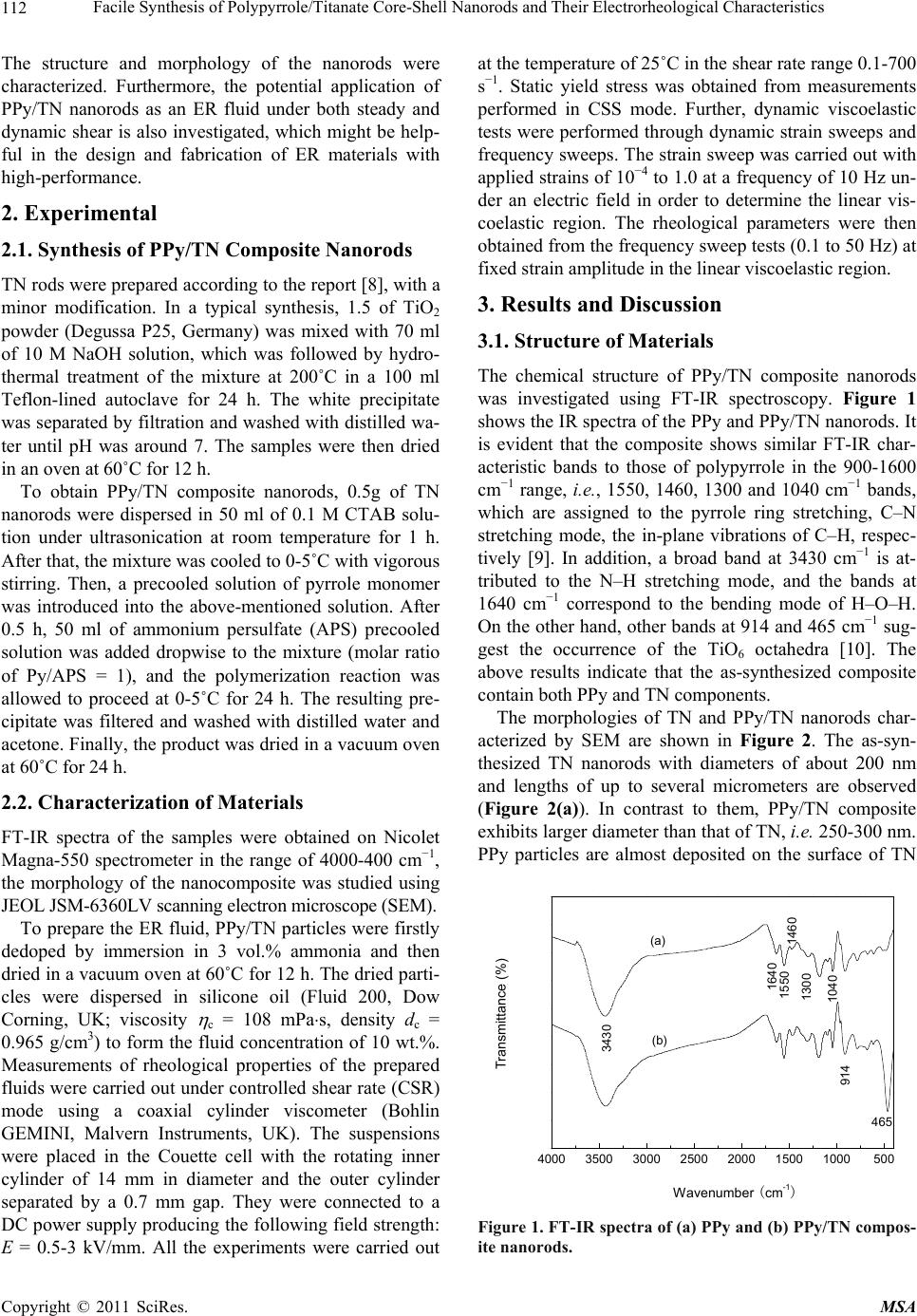 Facile Synthesis of Polypyrrole/Titanate Core-Shell Nanorods and Their Electrorheological Characteristics 112 The structure and morphology of the nanorods were characterized. Furthermore, the potential application of PPy/TN nanorods as an ER fluid under both steady and dynamic shear is also investigated, which might be help- ful in the design and fabrication of ER materials with high-performance. 2. Experimental 2.1. Synthesis of PPy/TN Composite Nanorods TN rods were prepared according to the report [8], with a minor modification. In a typical synthesis, 1.5 of TiO2 powder (Degussa P25, Germany) was mixed with 70 ml of 10 M NaOH solution, which was followed by hydro- thermal treatment of the mixture at 200˚C in a 100 ml Teflon-lined autoclave for 24 h. The white precipitate was separated by filtration and washed with distilled wa- ter until pH was around 7. The samples were then dried in an oven at 60˚C for 12 h. To obtain PPy/TN composite nanorods, 0.5g of TN nanorods were dispersed in 50 ml of 0.1 M CTAB solu- tion under ultrasonication at room temperature for 1 h. After that, the mixture was cooled to 0-5˚C with vigorous stirring. Then, a precooled solution of pyrrole monomer was introduced into the above-mentioned solution. After 0.5 h, 50 ml of ammonium persulfate (APS) precooled solution was added dropwise to the mixture (molar ratio of Py/APS = 1), and the polymerization reaction was allowed to proceed at 0-5˚C for 24 h. The resulting pre- cipitate was filtered and washed with distilled water and acetone. Finally, the product was dried in a vacuum oven at 60˚C for 24 h. 2.2. Characterization of Materials FT-IR spectra of the samples were obtained on Nicolet Magna-550 spectrometer in the range of 4000-400 cm−1, the morphology of the nanocomposite was studied using JEOL JSM-6360LV scanning electron microscope (SEM). To prepare the ER fluid, PPy/TN particles were firstly dedoped by immersion in 3 vol.% ammonia and then dried in a vacuum oven at 60˚C for 12 h. The dried parti- cles were dispersed in silicone oil (Fluid 200, Dow Corning, UK; viscosity η c = 108 mPa⋅s, density dc = 0.965 g/cm3) to form the fluid concentration of 10 wt.%. Measurements of rheological properties of the prepared fluids were carried out under controlled shear rate (CSR) mode using a coaxial cylinder viscometer (Bohlin GEMINI, Malvern Instruments, UK). The suspensions were placed in the Couette cell with the rotating inner cylinder of 14 mm in diameter and the outer cylinder separated by a 0.7 mm gap. They were connected to a DC power supply producing the following field strength: E = 0.5-3 kV/mm. All the experiments were carried out at the temperature of 25˚C in the shear rate range 0.1-700 s−1. Static yield stress was obtained from measurements performed in CSS mode. Further, dynamic viscoelastic tests were performed through dynamic strain sweeps and frequency sweeps. The strain sweep was carried out with applied strains of 10−4 to 1.0 at a frequency of 10 Hz un- der an electric field in order to determine the linear vis- coelastic region. The rheological parameters were then obtained from the frequency sweep tests (0.1 to 50 Hz) at fixed strain amplitude in the linear viscoelastic region. 3. Results and Discussion 3.1. Structure of Materials The chemical structure of PPy/TN composite nanorods was investigated using FT-IR spectroscopy. Figure 1 shows the IR spectra of the PPy and PPy/TN nanorods. It is evident that the composite shows similar FT-IR char- acteristic bands to those of polypyrrole in the 900-1600 cm−1 range, i.e., 1550, 1460, 1300 and 1040 cm−1 bands, which are assigned to the pyrrole ring stretching, C–N stretching mode, the in-plane vibrations of C–H, respec- tively [9]. In addition, a broad band at 3430 cm−1 is at- tributed to the N–H stretching mode, and the bands at 1640 cm−1 correspond to the bending mode of H–O–H. On the other hand, other bands at 914 and 465 cm−1 sug- gest the occurrence of the TiO6 octahedra [10]. The above results indicate that the as-synthesized composite contain both PPy and TN components. The morphologies of TN and PPy/TN nanorods char- acterized by SEM are shown in Figure 2. The as-syn- thesized TN nanorods with diameters of about 200 nm and lengths of up to several micrometers are observed (Figure 2(a)). In contrast to them, PPy/TN composite exhibits larger diameter than that of TN, i.e. 250-300 nm. PPy particles are almost deposited on the surface of TN 4000 3500 3000 2500 2000 1500 1000500 Transmitt ance ( %) Wavenumber (cm-1) (a) (b) 3430 1640 1550 1460 1300 1040 465 914 Figure 1. FT-IR spectra of (a) PPy and (b) PPy/TN compos- ite nanorods. Copyright © 2011 SciRes. MSA 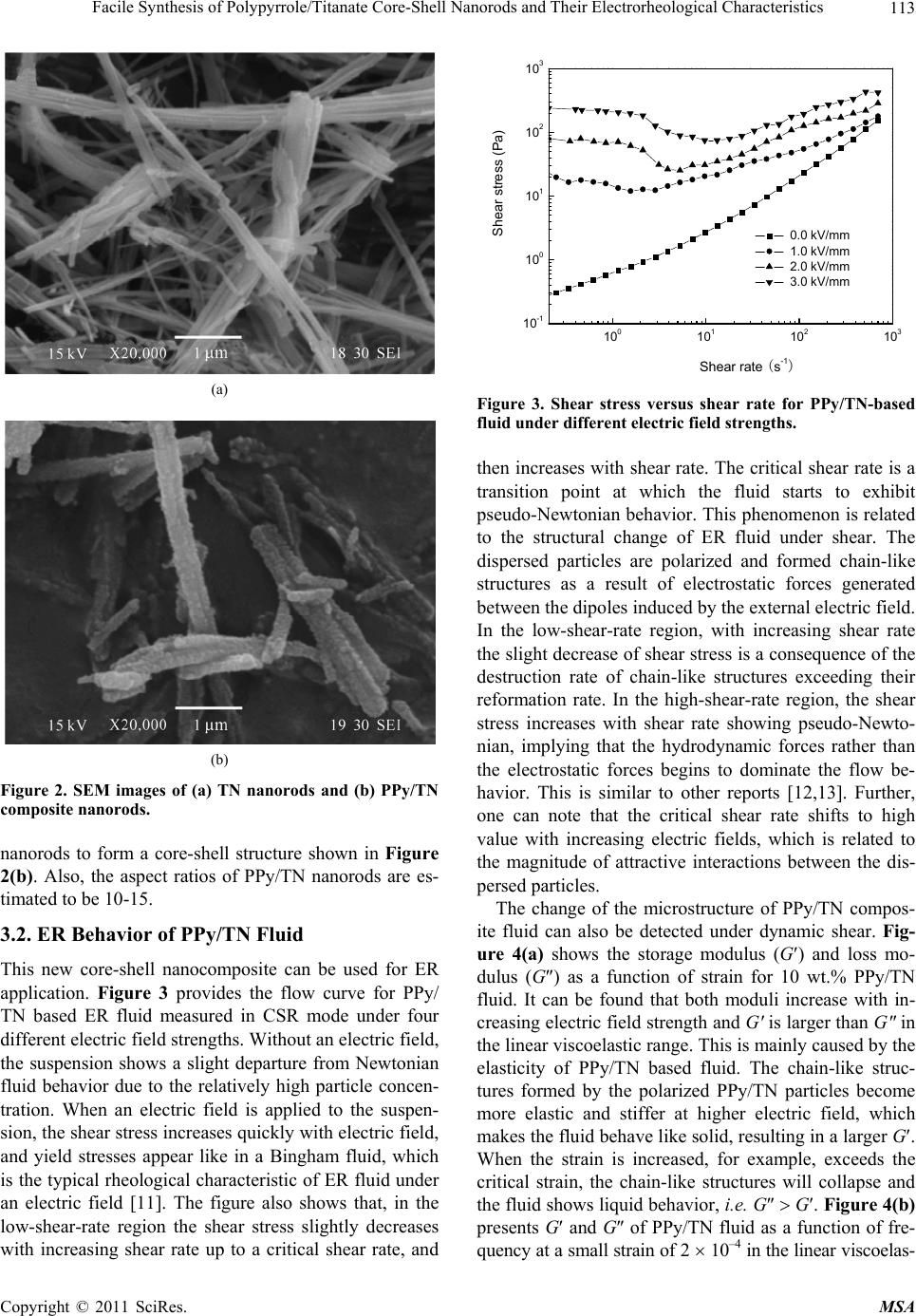 Facile Synthesis of Polypyrrole/Titanate Core-Shell Nanorods and Their Electrorheological Characteristics 113 (a) (b) Figure 2. SEM images of (a) TN nanorods and (b) PPy/TN composite nanorods. nanorods to form a core-shell structure shown in Figure 2(b). Also, the aspect ratios of PPy/TN nanorods are es- timated to be 10-15. 3.2. ER Behavior of PPy/TN Fluid This new core-shell nanocomposite can be used for ER application. Figure 3 provides the flow curve for PPy/ TN based ER fluid measured in CSR mode under four different electric field strengths. Without an electric field, the suspension shows a slight departure from Newtonian fluid behavior due to the relatively high particle concen- tration. When an electric field is applied to the suspen- sion, the shear stress increases quickly with electric field, and yield stresses appear like in a Bingham fluid, which is the typical rheological characteristic of ER fluid under an electric field [11]. The figure also shows that, in the low-shear-rate region the shear stress slightly decreases with increasing shear rate up to a critical shear rate, and 100101102103 10-1 100 101 102 103 Shear stress (Pa) Shear rate (s-1) 0.0 kV/mm 1.0 kV/mm 2.0 kV/mm 3.0 kV/mm Figure 3. Shear stress versus shear rate for PPy/TN-based fluid under different electric field strengths. then increases with shear rate. The critical shear rate is a transition point at which the fluid starts to exhibit pseudo-Newtonian behavior. This phenomenon is related to the structural change of ER fluid under shear. The dispersed particles are polarized and formed chain-like structures as a result of electrostatic forces generated between the dipoles induced by the external electric field. In the low-shear-rate region, with increasing shear rate the slight decrease of shear stress is a consequence of the destruction rate of chain-like structures exceeding their reformation rate. In the high-shear-rate region, the shear stress increases with shear rate showing pseudo-Newto- nian, implying that the hydrodynamic forces rather than the electrostatic forces begins to dominate the flow be- havior. This is similar to other reports [12,13]. Further, one can note that the critical shear rate shifts to high value with increasing electric fields, which is related to the magnitude of attractive interactions between the dis- persed particles. The change of the microstructure of PPy/TN compos- ite fluid can also be detected under dynamic shear. Fig- ure 4(a) shows the storage modulus (G′) and loss mo- dulus (G″) as a function of strain for 10 wt.% PPy/TN fluid. It can be found that both moduli increase with in- creasing electric field strength and G′ is larger than G″ in the linear viscoelastic range. This is mainly caused by the elasticity of PPy/TN based fluid. The chain-like struc- tures formed by the polarized PPy/TN particles become more elastic and stiffer at higher electric field, which makes the fluid behave like solid, resulting in a larger G′. When the strain is increased, for example, exceeds the critical strain, the chain-like structures will collapse and the fluid shows liquid behavior, i.e. G″ > G′. Figure 4(b) presents G′ and G″ of PPy/TN fluid as a function of fre- quency at a small strain of 2 ×10⁻⁴ in the linear viscoelas- Copyright © 2011 SciRes. MSA 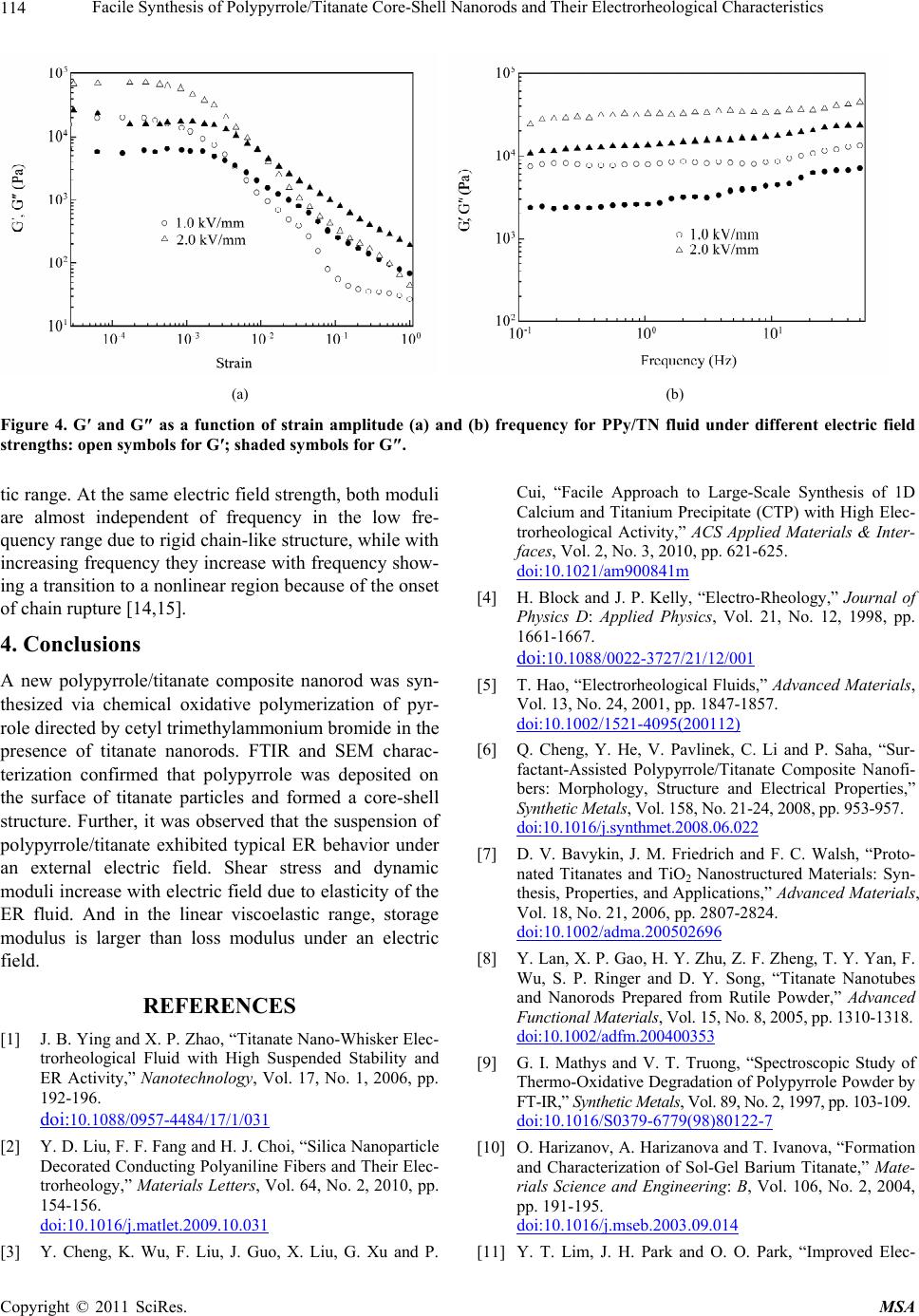 Facile Synthesis of Polypyrrole/Titanate Core-Shell Nanorods and Their Electrorheological Characteristics Copyright © 2011 SciRes. MSA 114 (a) (b) Figure 4. G′ and G″ as a function of strain amplitude (a) and (b) frequency for PPy/TN fluid under different electric field strengths: open symbols for G′; shaded symbols for G″. tic range. At the same electric field strength, both moduli are almost independent of frequency in the low fre- quency range due to rigid chain-like structure, while with increasing frequency they increase with frequency show- ing a transition to a nonlinear region because of the onset of chain rupture [14,15]. 4. Conclusions A new polypyrrole/titanate composite nanorod was syn- thesized via chemical oxidative polymerization of pyr- role directed by cetyl trimethylammonium bromide in the presence of titanate nanorods. FTIR and SEM charac- terization confirmed that polypyrrole was deposited on the surface of titanate particles and formed a core-shell structure. Further, it was observed that the suspension of polypyrrole/titanate exhibited typical ER behavior under an external electric field. Shear stress and dynamic moduli increase with electric field due to elasticity of the ER fluid. And in the linear viscoelastic range, storage modulus is larger than loss modulus under an electric field. REFERENCES [1] J. B. Ying and X. P. Zhao, “Titanate Nano-Whisker Elec- trorheological Fluid with High Suspended Stability and ER Activity,” Nanotechnology, Vol. 17, No. 1, 2006, pp. 192-196. doi:10.1088/0957-4484/17/1/031 [2] Y. D. Liu, F. F. Fang and H. J. Choi, “Silica Nanoparticle Decorated Conducting Polyaniline Fibers and Their Elec- trorheology,” Materials Letters, Vol. 64, No. 2, 2010, pp. 154-156. doi:10.1016/j.matlet.2009.10.031 [3] Y. Cheng, K. Wu, F. Liu, J. Guo, X. Liu, G. Xu and P. Cui, “Facile Approach to Large-Scale Synthesis of 1D Calcium and Titanium Precipitate (CTP) with High Elec- trorheological Activity,” ACS Applied Materials & Inter- faces, Vol. 2, No. 3, 2010, pp. 621-625. doi:10.1021/am900841m [4] H. Block and J. P. Kelly, “Electro-Rheology,” Journal of Physics D: Applied Physics, Vol. 21, No. 12, 1998, pp. 1661-1667. doi:10.1088/0022-3727/21/12/001 [5] T. Hao, “Electrorheological Fluids,” Advanced Materials, Vol. 13, No. 24, 2001, pp. 1847-1857. doi:10.1002/1521-4095(200112) [6] Q. Cheng, Y. He, V. Pavlinek, C. Li and P. Saha, “Sur- factant-Assisted Polypyrrole/Titanate Composite Nanofi- bers: Morphology, Structure and Electrical Properties,” Synthetic Metals, Vol. 158, No. 21-24, 2008, pp. 953-957. doi:10.1016/j.synthmet.2008.06.022 [7] D. V. Bavykin, J. M. Friedrich and F. C. Walsh, “Proto- nated Titanates and TiO2 Nanostructured Materials: Syn- thesis, Properties, and Applications,” Advanced Materials, Vol. 18, No. 21, 2006, pp. 2807-2824. doi:10.1002/adma.200502696 [8] Y. Lan, X. P. Gao, H. Y. Zhu, Z. F. Zheng, T. Y. Yan, F. Wu, S. P. Ringer and D. Y. Song, “Titanate Nanotubes and Nanorods Prepared from Rutile Powder,” Advanced Functional Materials, Vol. 15, No. 8, 2005, pp. 1310-1318. doi:10.1002/adfm.200400353 [9] G. I. Mathys and V. T. Truong, “Spectroscopic Study of Thermo-Oxidative Degradation of Polypyrrole Powder by FT-IR,” Synthetic Metals, Vol. 89, No. 2, 1997, pp. 103-109. doi:10.1016/S0379-6779(98)80122-7 [10] O. Harizanov, A. Harizanova and T. Ivanova, “Formation and Characterization of Sol-Gel Barium Titanate,” Mate- rials Science and Engineering: B, Vol. 106, No. 2, 2004, pp. 191-195. doi:10.1016/j.mseb.2003.09.014 [11] Y. T. Lim, J. H. Park and O. O. Park, “Improved Elec-  Facile Synthesis of Polypyrrole/Titanate Core-Shell Nanorods and Their Electrorheological Characteristics 115 trorheological Effect in Polyaniline Nanocomposite Sus- pensions,” Journal of Colloid and Interface Science, Vol. 245, No. 1, 2002, pp. 198-203. doi:10.1006/jcis.2001.7983 [12] H.-J. Choi, M.-S. Cho and K. To, “Electrorheological and Dielectric Characteristics of Semiconductive Polyaniline- Silicone Oil Suspensions,” Physica A: Statistical Me- chanics and Its Applications, Vol. 254, No. 1-2, 1998, pp. 272-279. doi:10.1016/S0378-4371(98)00005-3 [13] Q. Cheng, V. Pavlinek, A. Lengalova, C. Li, T. Belza and P. Saha, “Electrorheological Properties of New Mesopor- ous Material with Conducting Polypyrrole in Mesoporous silica,” Microporous and Mesoporous Materials, Vol. 94, No. 1-3, 2006, pp. 193-199. doi:10.1016/j.micromeso.2006.03.039 [14] S.-G. Kim, J.-W. Kim, M.-S. Cho, H.-J. Choi and M.-S. Jhon, “Viscoelastic Characterization of Semiconducting Dodecylbenzenesulfonic Acid Doped Polyaniline Elec- trorheological Suspensions,” Journal of Applied Polymer Science, Vol. 79, No. 1, 2001, pp. 108-114. doi:10.1002/1097-4628(20010103) [15] M.-S. Cho, H.-J. Choi and W.-S. Ahn, “Enhanced Elec- trorheology of Conducting Polyaniline Confined in MCM- 41 Channels,” Langmuir, Vol. 20, No. 1, 2004, pp. 202-207. doi:10.1021/la035051z Copyright © 2011 SciRes. MSA |