

Paper Menu >>
Journal Menu >>
 Communications and Network, 2013, 5, 390-393 http://dx.doi.org/10.4236/cn.2013.53B2071 Published Online September 2013 (http://www.scirp.org/journal/cn) Performance Comparison between OQAM and N-continuous OFDM Guobing Cheng, Huilei Li, Shaoqian Li, Lisha Gong, Binhong Dong, Peng Wei National Key Laboratory of Science and Technology on Communications, University of Electronic Science and Technology of China, Chengdu, China Email: [email protected] Received August, 2013 ABSTRACT Orthogonal frequency division multiplex/offset QAM (OFDM/OQAM) and N-continuous OFDM are both improved multi-carrier modulation (MCM) techniques for the transmission of signals over multipath fading channels. In this pa- per, we aim to compare these two techniques with respect to out-of-band radiation , bit error ratio (BER) and calcu lation complexity. Analysis and simulation results show that, compared to the N-continuous OFDM, the OFDM/OQAM has lower out-of-band radiation, calculation consumption and similar BER performance. Keywords: OFDM/OQAM; N-continuous OFDM; Out-of-band Radiation 1. Introduction Orthogonal frequency division multiplexing (OFDM) is an efficient scheme and it has been some practical appli- cations. However, the trad itional OFDM has some intrin- sic drawbacks that the discontinuous phase between ad- jacent symbols leads to high out-of-band radiations and its robustness to multi-path propagation effect is acquired by the insertion of a cyclic prefix (CP). To alleviate these drawbacks, another MCM schemes such as N-continuous OFDM and OFDM/offset QAM (OFDM/OQAM) are proposed in [1,2] respectively. Compared to traditional CP-OFDM, OFDM/OQAM may provide a higher useful bit rate since it operates without CP and N-continuous OFDM has less out-of-band radiation since it has several continuous order of derivatives at the edge of adjacent OFDM symbols. For OFDM/OQAM system, pulse shapes with good time-frequency localization (TFL) can be introduced. Among these, a pulse shape named extended Gaussian functions (EGF) is widely used and its TFL can be ad- justed by the time and frequency real parameters [3]. Through selecting a suitable parameter, an OFDM/ OQAM signal with very low out-of-band radiation can be acquired [4]. On the other hand, in the traditional OFDM system, each OFDM symbol is independently and the transmitted signals are no t continuous, leading to high out-of-band radiation. In order to overcome the dis- continuities between consecutive OFDM symbols, N- continuous OFDM scheme is proposed at the price of increasing calculation complexity and/or system per- formance. Therefore, we have to comprise between these aspects for practical application. In this paper, we compare the performance of OFDM/ OQAM and N-continuous OFDM. Firstly, the system models of them are given in section II. And then we ana- lyze the out-of-band radiation, bit error ratio (BER) and calculation complexity of these two schemes in section III. The simulation results are shown in section IV. Brief conclusion is given in section V. The analysis and simu- lation results show that, compared to the N-continuous OFDM, the OFDM/OQAM system has similar system performance, lower out-of-band radiation and less calcu- lation consumption. 2. System Model 2.1. System Model of OFDM/OQAM System The baseband version of a continuous-time OFDM/ OQAM transmitting signal can be written as [2] ,0 12 ,0 0, mn Mjjmt mn nm staeegt n (1) with M an even number of sub-carriers, ,mn the real- valued symbol conveyed by the sub-carrier of index m during the symbol time of index n0 a the subcarrier spacing and 0 the time offset between the adjacent real part and imaginary part of an OFDM/OQAM symbol. 00 0 1 2T1 , with 0 the duration of the complex- valued symbols. T ,mn is an additional phase term given by C opyright © 2013 SciRes. CN  G. B. CHENG ET AL. 391 ,0()mod 2 mn mn , (2) where 0 can be arbitrarily chosen. g t is the pulse shape that can be different from the rectangle shape of conditional OFDM system. The EGF shape is often used in OFDM/OQAM system and its out-of-band character- istic can be adjusted by the Gaussian parameter . In the following, the adaption and compromise between BER performance and out-of-band radiation are dis- cussed. For a distortion-free channel, perfect reconstruction of real symbols is obtained owing to the following real or- thogonal condition * ,,, ,, | mnpqmnpqmpnq gggtgt, (3) where is the taking real part operator. ,1 mp if and mp,0 mp if mp . 2.2. System model of N-continuous OFDM System The baseband equivalent OF DM symbol can be given as 0isg i sts tiTT (4) where s T is the OFDM symbol duration and g T is the CP length. In order to make the transmitted signal s t and its first N derivatives continuous, the following equation should be satisfied that 1, gg nn itTi tT nn dd sts t dt dt (5) for all and n=0, 1,…, N [1 ,5 ] . 1i The realization of N-continuous OFDM symbol is to pre-coder the set of information symbols (taken from some complex-valued symbol constellation ) in each OFDM symbol such that ,ki d s t becomes N-continuous. Concretely, the OFDM symbol i s t can be expressed as [1] 2 ,, s k jt T iki g ks s tde TtT (6) where and the complex numbers 01 1 ,,..., K kk k ,ki d are the result of pre-coding information symbols ,ki. For OFDM symbols, the characterization (5) be- comes d ,, njk n ki ki kk ke dkd ,1 (7) where 2 g s TT . An equivalent form of vector is that , ii Ad Ad -1 (8) where 01 1 ,, , , ,...,, K T ki kiki dd d i d (9) 01 , ,...,, K jk jk jk diag eee 1 (10) and 01 1 01 1 11...1 ... . ... ...... ... K NN N K kk k kk k A (11) Finally, we can get 1 () i H ii dIPdPΦd, where . The deducing detail can be referred to [1]. 1 HH H PΦAAA AΦ 3. Comparison of the OFDM/OQAM and N-continuous OFDM System 3.1. Comparison of the Out-of-band Radiation Because the pulse shape with lower side lobe such as the EGF shape is used in the OFDM/OQAM system, the final transmitting signal has very low out-of-band radia- tion naturally. The EGF shape is defined as [6] 00 0 0 ,, ,, 000 ,1 , 00 1 2 cos2 aka k l l kk ztdgt gt t dl (12) where g t is the Gaussian function defined by 2 14 20 t gte a . 0 is the frequency paramr, 0 ete is the time parameter and 00 12 . For ifferent a, we can get different transmitting signal and the larger the value of a is, the lower out-of-band radiation d will be. For N-continuous OFDM system, the out-of-band radiation is determined by the number of orders that having continuous derivatives. And the larger is, the lower out-of-band radiation will be. N N In contrast to OFDM/OQAM, increasing of leads to not only the decrease of BER performance but also the rapid increasing of calculation complexity. Therefore, the compromise should be made between calculation con- sumption and system performance. N 3.2. Comparison of the BER Performance In OFDM/OQAM system, since the pulse shape that having immunity to the inter-symbol interference (ISI) is introduced, the CP is not necessary. Then it can provide higher bit rate or equivalently higher bit energy. While for the N-continuous OFDM, the using of CP cannot be avoided. Furthermore, since the maximum- likelihood detector of N-continuous is prohibitively Copyright © 2013 SciRes. CN 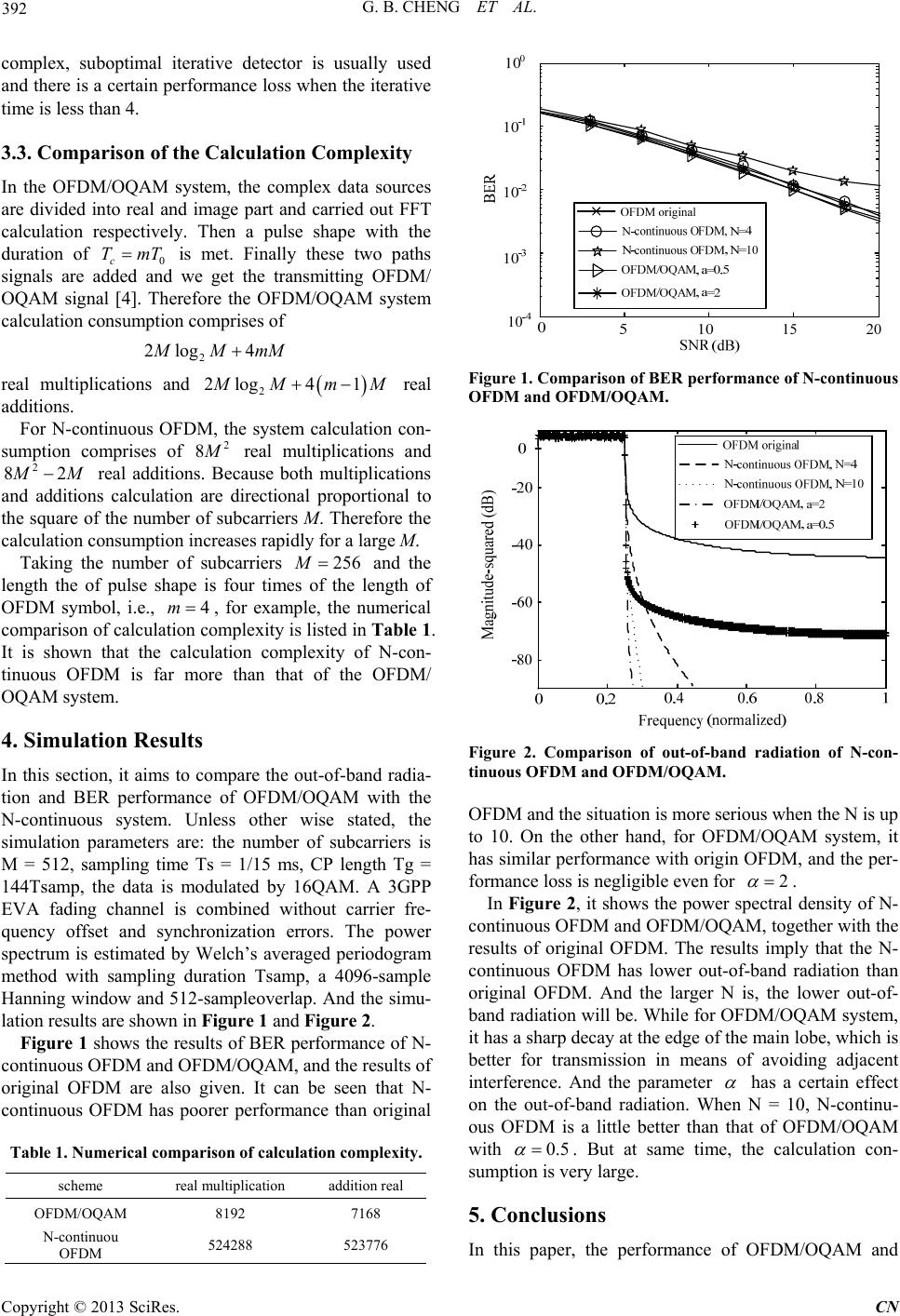 G. B. CHENG ET AL. 392 complex, suboptimal iterative detector is usually used and there is a certain performance loss when the iterative time is less than 4. 3.3. Comparison of the Calculation Complexity In the OFDM/OQAM system, the complex data sources are divided into real and image part and carried out FFT calculation respectively. Then a pulse shape with the duration of 0c is met. Finally these two paths signals are added and we get the transmitting OFDM/ OQAM signal [4]. Therefore the OFDM/OQAM system calculation consumption comprises of TmT 2 2log 4 M MmM real multiplications and 2 2log4 1 M MmM real additions. For N-continuous OFDM, the system calculation con- sumption comprises of 2 8 M real multiplications and 2 82 M M real additions. Because both multiplications and additions calculation are directional proportional to the square of the number of subcarriers M. Therefore the calculation consumption increases rapidly for a large M. Taking the number of subcarriers and the length the of pulse shape is four times of the length of OFDM symbol, i.e., , for example, the numerical comparison of calculation complexity is listed in Table 1. It is shown that the calculation complexity of N-con- tinuous OFDM is far more than that of the OFDM/ OQAM system. 256M 4m 4. Simulation Results In this section, it aims to compare the out-of-band radia- tion and BER performance of OFDM/OQAM with the N-continuous system. Unless other wise stated, the simulation parameters are: the number of subcarriers is M = 512, sampling time Ts = 1/15 ms, CP length Tg = 144Tsamp, the data is modulated by 16QAM. A 3GPP EVA fading channel is combined without carrier fre- quency offset and synchronization errors. The power spectrum is estimated by Welch’s averaged periodogram method with sampling duration Tsamp, a 4096-sample Hanning window and 512-sampleoverlap. And the simu- lation results are shown in Figure 1 and Figure 2. Figure 1 shows the results of BER performance of N- continuous OFDM and OFDM/OQAM, and the results of original OFDM are also given. It can be seen that N- continuous OFDM has poorer performance than original Table 1. Numerical comparison of calculation complexity. scheme real multiplication addition real OQAM/OFDM 8192 7168 N-continuou Figure 1. Comparison of BER performance of N-continuous OFDM and OFDM/OQAM. Figure 2. Comparison of out-of-band radiation of N-con- tinuous OFDM and OFDM/OQAM. OFDM and the situation is more serious when the N is up to 10. On the other hand, for OFDM/OQAM system, it has similar performance with origin OFDM, and the per- formance loss is negligible even for 2 . In Figure 2, it sh ows the power spectral density of N- continuous OFDM and OFDM/OQAM, together with the results of original OFDM. The results imply that the N- continuous OFDM has lower out-of-band radiation than original OFDM. And the larger N is, the lower out-of- band radiation will be. While for OFDM/OQAM system, it has a sharp decay at the edge of the main lobe, which is better for transmission in means of avoiding adjacent interference. And the parameter has a certain effect on the out-of-band radiation. When N = 10, N-continu- ous OFDM is a little better than that of OFDM/OQAM with 0.5 . But at same time, the calculation con- sumption is very large. 5. Conclusions 524288 OFDM 523776 In this paper, the performance of OFDM/OQAM and Copyright © 2013 SciRes. CN  G. B. CHENG ET AL. Copyright © 2013 SciRes. CN 393 N-continuous OFDM are compared with respect to out- of-band radiation, BER performance and calculation complexity with different system parameters. We show that N-continuous OFDM is only designed to suppress the out-of-band radiation, but this benefit is acquired with large calculation consumption increase. The advan- tages of OFDM/OQAM lie in that it has not only the na- ture advantage of low out-of-band radiation, but also the strong immunity to ISI and inter-carrier interference si- multaneously. When the length of pulse shape is suitable selected, while with moderate complexity increase. In whole, OFDM/OQAM system outperforms the N-con- tinuous OFDM system. 6. Acknowledgements This work is supported in part by the National Science Foundation of China under Grant number 61101101, National Grand Special Science and Technology Project of China under Grant No. 2010ZX03006-002-02,, Pro- gram for New Century Excellent Talents in University of China ((NCET110058), the Foundation Project of Na- tional Key Laboratory of Science and Technology on Communications under Grant 9140C020404120C0201, and Key Laboratory of Universal Wireless Communica- tions, Beijing university of Posts and Telecommunica- tions, Ministry of Education, P.R.China (No. KFKT- 2012102). REFERENCES [1] J. van de Beek and F. Berggren, “N-continuous OFDM,” IEEE Communications Letters, Vol. 13, No. 1, 2009, pp. 1-3. doi:10.1109/LCOMM.2009.081446 [2] B. Le Floch, M. Alard and C. Berrou, “Coded Orthogonal Frequency Division Multiplex,” Proceedings of IEEE, Vol. 83, 1995, pp. 982-996. doi:10.1109/5.387096 [3] P. Siohan and C. Roche. “Cosine-Modulated Filter- banks Based on Extended Gaussian Function,” IEEE Transactions on Signal Processing, Vol. 48, No. 11, 2000, pp. 3052-3061. doi:10.1109/78.875463 [4] J. F. Du, S. Signell, “Time Frequency Localization of Pulse Shaping Filters in OFD/OQAM Systems,” 6th In- ternational Conference on Information, Communications & Signal Processing, Dec. 2007. [5] J. van de Beek and F. Berggren, “Out-of-band Power Suppression in OFDM,” IEEE Communications Letters, Vol. 12, No. 9, 2008, pp. 609-611. doi:10.1109/LCOMM.2008.080587 [6] C. Roche and P. Siohan, “A Family of E xtende d Gaussia n Functions with An Early Optimal Localization Property,” First International Workshop Multi-Carrier Spread-Spectrum, 1997, pp. 179-186. doi:10.1007/978-1-4615-6231-3_21 |