

Paper Menu >>
Journal Menu >>
 Communications and Network, 2013, 5, 338-343 http://dx.doi.org/10.4236/cn.2013.53B2062 Published Online September 2013 (http://www.scirp.org/journal/cn) Resource Allocation Method of Device-to-Device Communication Wenji Feng, Yafeng Wang, Lei Yang Wireless Theory & Technology lab (WT&T), Beijing University of Posts and Telecommunications, Beijing, China Email: [email protected], wangyf@bupt.edu.cn, [email protected] Received July, 2013 ABSTRACT In this paper, we study D2D (Device-to-Device) communication underlying LTE-Advanced uplink system. Since D2D communication reuses uplink resources with cellular communication in this scenario, it’s hard to avoid the inference between D2D users and cellular users. If there is no restriction for D2D communication on using the whole uplink fre- quency band, it will have a strong negative impact on cellular communication. In order to overcome this shortage, we propose a resource allocation method that D2D users and cellular users use orthogonal frequency resources. This method will effectively reduce the inference between both kinds of communication. However, an obvious disadvantage of this method is no effective use of uplink resources. Based on this, we propose an optimized resource allocation method that a specific cellular user will be chosen to reuse the RBs (Resource Block) of D2D users. These ideas will be taken into system-level simulation, and from the results of simulation we can see that the optimized method has the ability to improve overall syste m performance and limit inference for cell-edge users. Keywords: Device-to-device Communication; LTE-Advanced System; Resource Allocation Method; up Link; Cell-edge Users 1. Introduction 3GPP Long Term Evolution (LTE) technology has been proved to have outstanding performance, especially in the measures of spectral efficiency and the average throughput, cell-edge and peak values in a cellular, fre- quency reuse one network [1,2]. Hence, major efforts have been spent on the development of LTE. Currently the further evolution of such systems has been started under the scope of LTE-Advanced [3-5]. The device-to-device communication (D2D) technol- ogy, also known as proximity-based services (ProSe), is introduced into LTE-Advanced system [6-7]. However, D2D communication is sharing authorized frequency band with cellular communication by the way of or- thogonal method or multiplexing method. The introduc- tion of D2D communication is to improve the throughput of overall cellular system. It contributes to higher fre- quency resource utilization as well. When D2D users reuse cellular frequency resources, it is hard to avoid the interference of other cellular users in cell. It may affect the D2D user's communication quality to some extent. If there are no restrictions for D2D communication on us- ing the whole frequency band, it will have a strong n ega- tive impact on cellular communication. As mentioned above, appropriative resource allocation methods of D2D communication may improve this situa- tion. Because of frequency reusing with cellular commu- nication, D2D communication should choose a better resource allocation method to avoid inference against each other. Hence, we hope to find out simulation sce- narios of different resource allocation methods so that we can choose an appropriative allocation method for D2D communication. This paper is organized as follows: Section 2 describes the simulation platform. Section 3 shows different kinds of D2D communication resource allocation methods, and the performance will be analyzed in this section. Ac- cording to section 3, we propose some optimization method of D2D resource allocation method in section 4. Finally concluding remarks are made in Section 5. 2. Simulation Platform Assume that the D2D communication underlying LTE- Advanced network only reuse uplink frequency resource. The simulation platform consists of 7 eNB (21 sectors). We distribute one pair of D2D UEs into one cell amount to 21 pairs of D2D UEs. In our simulation platform, we consider that there is one transmitter and one receiver in a pair of D2D UEs, which are working only during up- link slot. The distribution of eNB (evolved node B) and D2D UEs is shown in Figure 1. C opyright © 2013 SciRes. CN 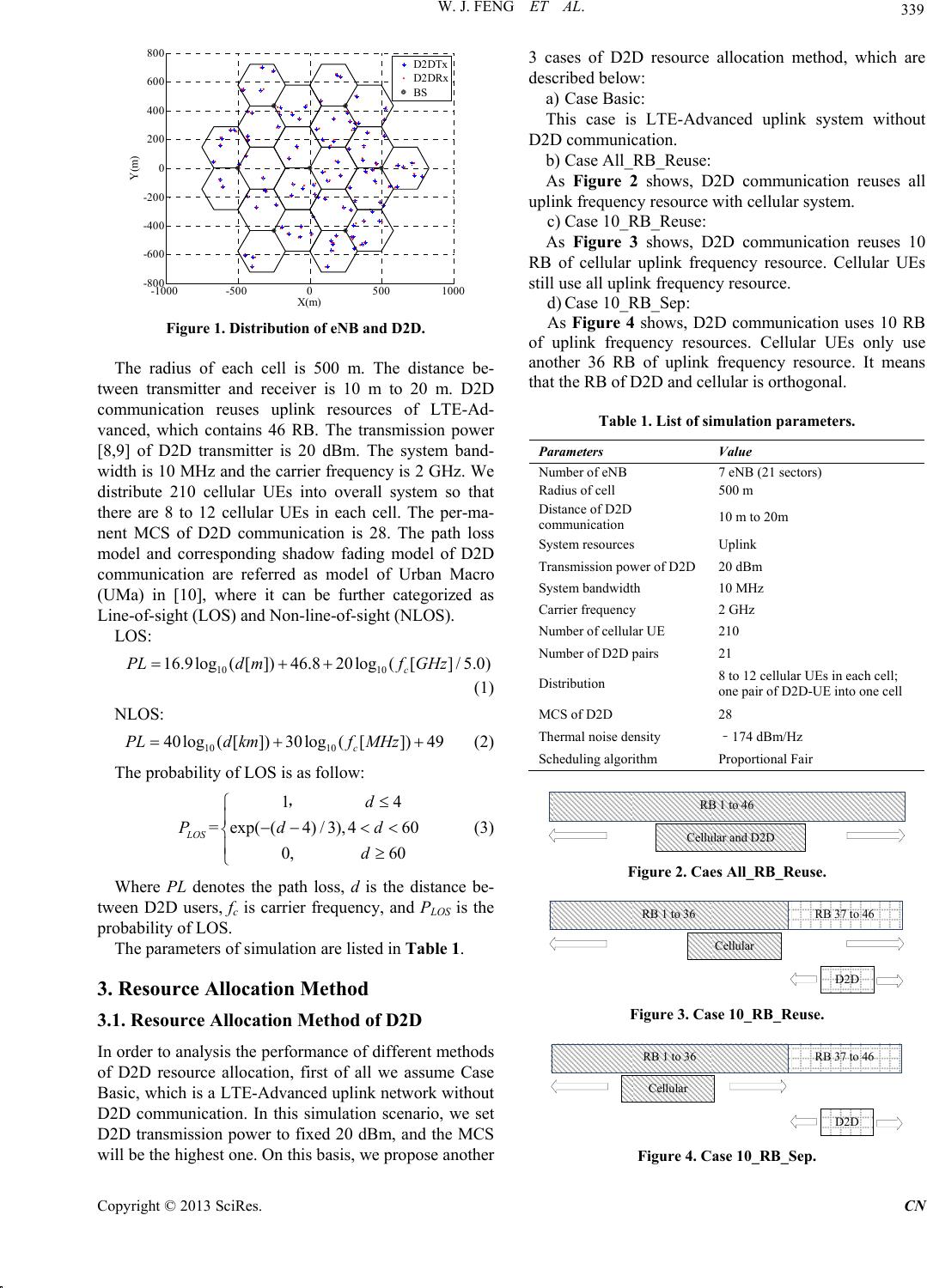 W. J. FENG ET AL. 339 -1000 -500 0500 1000 -800 -600 -400 -200 0 200 400 600 800 X(m) Y(m) D2DTx D2DRx BS Figure 1. Distribution of eNB and D2D. The radius of each cell is 500 m. The distance be- tween transmitter and receiver is 10 m to 20 m. D2D communication reuses uplink resources of LTE-Ad- vanced, which contains 46 RB. The transmission power [8,9] of D2D transmitter is 20 dBm. The system band- width is 10 MHz and the carrier frequency is 2 GHz. We distribute 210 cellular UEs into overall system so that there are 8 to 12 cellular UEs in each cell. The per-ma- nent MCS of D2D communication is 28. The path loss model and corresponding shadow fading model of D2D communication are referred as model of Urban Macro (UMa) in [10], where it can be further categorized as Line-of-sigh t (LOS) and Non-line-of-sight (NLOS). LOS: 10 10 16.9log ([])46.820log ([]/5.0) c PLd mfGHz (1) NLOS: 10 10 40log ([])30log ([])49 c PLd kmfMHz (2) The probability of LOS is as follow: 14 =exp((4) /3),460 0, 60 LOS d Pdd d , (3) Where PL denotes the path loss, d is the distance be- tween D2D users, fc is carrier frequency, and PLOS is the probability of LOS. The parameters of simulation are listed in Table 1. 3. Resource Allocation Method 3.1. Resource Allocation Method of D2D In order to analysis the performance of different methods of D2D resource allocation, first of all we assume Case Basic, which is a LTE-Advanced uplink network without D2D communication. In this simulation scenario, we set D2D transmission power to fixed 20 dBm, and the MCS will be the highest one. On this basis, we propose another 3 cases of D2D resource allocation method, which are described below: a) Case Basic: This case is LTE-Advanced uplink system without D2D communication. b) Case All_RB_Reuse: As Figure 2 shows, D2D communication reuses all uplink frequency resource with cellular system. c) Case 10_RB_Reuse: As Figure 3 shows, D2D communication reuses 10 RB of cellular uplink frequency resource. Cellular UEs still use all uplink frequency resource. d) Case 10_RB_Sep: As Figure 4 shows, D2D communication uses 10 RB of uplink frequency resources. Cellular UEs only use another 36 RB of uplink frequency resource. It means that the RB of D2D and cellular is orthogonal. Table 1. List of simulation parameters. Parameters Value Number of eNB 7 eNB (21 sectors) Radius of cell 500 m Distance of D2D communication 10 m to 20m System resources Uplink Transmission power of D2D 20 dBm System bandwidth 10 MHz Carrier freque nc y 2 GHz Number of cellular U E 210 Number of D2D pairs 21 Distribution 8 to 12 cellular UEs in each cell; one pair of D2D-U E into one cell MCS of D2D 28 Thermal noise density ﹣174 dBm/Hz Scheduling algorithm Proportional Fai r RB 1 to 46 Cellular and D2D Figure 2. Caes All_RB_Reuse. RB 1 to 36 RB 37 to 46 Cellular D2D Figure 3. Case 10_RB_Reuse. RB 1 to 36 RB 37 to 46 Cellular D2D Figure 4. Case 10_RB_Sep. Copyright © 2013 SciRes. CN  W. J. FENG ET AL. Copyright © 2013 SciRes. CN 340 3.2. Performance Analysis We compare the simulation results of previous 4 cases including average throughput of eNB, throughput of cell-edge users, throughput of D2D communication, throughput of overall system and BLER (Block Error Rate) of D2D communication. Figure 5 illustrates the simulation results of 4 cases. From Figure 5, we recognize that if D2D communica- tion reuses all resource with cellular communication, the throughput of overall system gets a very large increase. However, on the other hand, D2D communication brings a lot of interference against cellular communication so that cell-edge users almost unable to transmit data cor- rectly. At the same time, because of interference from D2D communication, the throughput of cell centre users drop sharply. Therefore, if there are no restrictions for D2D communication on using the whole frequency band, it will have a strong negative impact on cellular commu- nication [11,12], which is not appropriate in the practical communication system. In the view of this, D2D communication only use part of uplink frequency resource. In Case 10_RB_Reuse, D2D communication only reuses 10 RB with cellular system, and the all 46 RB is still used by cellular. In this simulation case, comparing with Case All_RB_Reuse, cellular system throughput gets a large increase, but the throughput of cell-edge UEs is still very low so that cell- edge users cannot communicate normally. At the same time, we consider Case 10_RB_Sep, which D2D commun icatio n uses 10 RB of cellular up link frequency resource, and cellular UEs only use the other 36 RB of uplink frequency resource. From the results of simulation, the performance of Case 10_RB_Sep is the most equilibrium. What’s more, comparing with Case Basic the throughpu t gets a lot of gain, and the BLER of D2D is the lowest. AverageThroughputofeNB 5887.64 1281.07 4680.12 4607.12 0 1000 2000 3000 4000 5000 6000 7000 BasicAll_RB_Reuse10_RB_Reuse10_RB_Sep Throughput(kbps) ThroughputofCell‐edgeUEs 259.01 0.09 4.42 206.67 0 50 100 150 200 250 300 BasicAll_RB_Reuse 10_RB_Reuse10_RB_Sep Throughput(kbps) ThroughputofD2D 8863.94 2350.36 2460.53 0 1000 2000 3000 4000 5000 6000 7000 8000 9000 10000 BasicAll_RB_Reuse10_RB_Reuse10_RB_Sep Throughput(kbps) Thro ughputofoveral lsystem 5887.64 10145.01 7030.48 7067.65 0 2000 4000 6000 8000 10000 12000 BasicAll_RB_Reuse 10_RB_Reuse10_RB_Sep Throughput(kbps) BLE RofD2DCommunication 34.92% 21.54% 17.87% 0 0.05 0.1 0.15 0.2 0.25 0.3 0.35 0.4 BasicAll_RB_Reuse 10_RB_Reuse10_RB_Sep BLER Figure 5. Results of four simulation cases.  W. J. FENG ET AL. 341 Figure 6 shows the cellular users SINR of 4 cases. From Figure 6, we can still have the conclusions as above. In Case All_RB_Reuse, the SINR of cellular UEs is sharply decreased. It causes the exacerbation of overall system. In Case 10_RB_Reuse, the effects of SINR are more embodied at cell-edge users. The throughput of cell-edge UEs is still very low so that cell-edge users cannot communicate normally in this case. In Case 10_RB_Sep, the performance of SINR is almost the same as Case Basic. 4. Optimization Scheme 4.1. Optimization Simulation Scenarios We describe Case 10_RB_Sep in section 3, which has the best performance of all 4 cases. However, in Case 10_RB_Sep, cellular communication gives up 10 RB to assure the excellent performance of both cell-edge users and D2D communication. The 10 RB, which are given up by cellular communication and only used by D2D communication, still negatively affect the performance of overall system. Hence, we hope to find a possible way to overcome the shortage. On the basis of Case 10_RB_Sep, we consider choosing one cellular UE to reuse 10 RB with D2D UEs. The simulation scenarios are described as follow: a) Case 10_RB_Sep: This case is described in section 3. b) Case Random_UE: We choose a random cellular UE from current cell to reuse 10 RB with D2D communication. The rest of cel- lular users still use the other 36 RB. c) Case Worst_UE: We choose a cellular UE from current cell, which has the slowest transmission rate currently, to reuse 10 RB with D2D communication. The rest of cellular users still use the other 36 RB. d) Case Best_UE: We choose a cellular UE from current cell, which has the highest transmission rate currently, to reuse 10 RB with D2D communication. The rest of cellular users still use the other 36 RB. 4.2. Performance Analysis We propose 3 cases to compare with Case 10_RB_Sep, the results of performance are shown in Figure 7. -40 -30 -20 -10010 20 30 40 0 0.1 0.2 0.3 0.4 0.5 0.6 0.7 0.8 0.9 1 SINR(dB) C D F Basic AllRBResue 10RBResue 10RBSep Figure 6. Cellular UEs SINR. AverageThroughputofeNB 4607.12 4528.54 4795.63 4571.52 4350 4400 4450 4500 4550 4600 4650 4700 4750 4800 4850 10_RB_Sep Random_UEWorst_UEBest_UE Throughput(kbps) ThroughputofCell‐edgeUEs 206.67 187.18 3.97 221.21 0 50 100 150 200 250 10_RB_Sep Random_UEWorst_UEBest_UE Throughput(kbps) ThroughputofD2D 2576.15 2537.96 2450.88 2532.05 2380 2400 2420 2440 2460 2480 2500 2520 2540 2560 2580 2600 10_RB_Sep Random_UEWorst_UEBest_UE Throughput(kbps) Throughputofoverallsystem 7066.51 7246.51 7103.58 7183.27 6950 7000 7050 7100 7150 7200 7250 7300 10_RB_Sep Random_UEWorst_UEBest_UE Throughput(kbps) Figure 7. Results of optimized simulation cases. Copyright © 2013 SciRes. CN  W. J. FENG ET AL. 342 From Figure 7, we can draw the following conclu- sions: In Case Random_UE, the throughput of eNB, D2D and overall system is all lower than Case 10_RB_Sep, and the throughput of cell-edge users also lower than Case 10_RB_Sep. So Case Random_UE is not an appro- priate case to further optimize the performance. In Case Worst_UE, th e throughput of eNB and over all system increases a lot, but the throughput of D2D com- munication fall sharply. And worst yet, the throughput of cell-edge UEs is the lowest so that cell-edge users canno t communicate normally. So Case Worst_UE is still not an appropriate case to further optimize the performance. In Case Best_UE, comparing with Case 10_RB_Sep, the average throughput of eNB is reduced by 0.8%, and the overall system throughput is reduced by 1.1%. At the same time, the throughput o f cell-edge users is increased by 7.1%. So in this case, we giv e up a little th roughp ut of eNB and overall system, for the purpose of cell-edge users’ throughput improvement. Case Best_UE is an ap- propriate case to further optimize the performance. Figure 8 shows the cellular UEs SINR of 4 optimized cases. From this figure, we can obviously see that the cellular UEs of Case Worst_UE has the worst SINR. In Case Best_UE, due to choosing the highest transmission rate in current slot, the SINR is not as good as Case 10_ RB_Sep. But the improvement of cell-edge users’ throughput is what we want. 5. Conclusions Based on the simulation and analysis above, we can rec- ognize that after introducing D2D communication into LTE-Advanced uplink system, the performance of over- all system gains dramatically increase and it also im- prove the system spectrum efficiency. At the same time, when D2D communication reuses frequency resource -40 -30 -20 -10010 2030 0 0.1 0.2 0.3 0.4 0.5 0.6 0.7 0.8 0.9 1 SINR(dB) CDF Last10Sep OneBestMS OneRanMS OneWorstMS Figure 8. Cellular UEs SINR of optimized cases. with cellular users, cellular UEs will be interfered strongly. It leads to the unable transmission of cell-edge users. Therefore, proposing an appropriate resource allo- cation method for D2D communication is a key factor to improve the performance of the overall system. This pa- per firstly consider different kinds of D2D communica- tion resource allocation methods and choose the case that D2D communication uses 10 RB of uplink frequency resource and the cellular UEs only use another 36 RB of uplink frequency resource, which has the best perform- ance. On the basis of Case 10_RB_Sep, we consider choosing one cellular UE, which has the highest trans- mission rate in current slot, to reuse 10 RB with D2D UEs. This optimized simulation case sacrifice a little throughput of overall system in order to improve the performance of cell-edge users. After verification and analysis, Case Best_UE has the ability to improve overall system performance and limit inference for cellular communication, especially for cell-edge cellular users. 6. Acknowledgements This paper is supported by National Key Technology R&D Program of China under grant No. 2012ZX03003011. REFERENCES [1] H. Ekstrom, A. Furusk¨ar, J. Karlsson, M. Meyer, S. Parkvall, J. Torsner and M. Wahlqvist, “Solutions for the 3G Long-term Evolution,” IEEE Communications Maga- zine, Vol. 44, No. 3, 2006, pp. 2432-2455. doi:10.1109/MCOM.2006.1607864 [2] ITU, “ITU-R; Recommendation M. 1645 Framework and Overall Objectives of the Future Development of IMT-2000 and Systems Beyond IMT-2000,” 2003. [3] “Estimated Spectrum Bandwidth Requirements for the Future Development of IMT-2000 and IMT-Advanced,” ITU. [4] D. C. Lee and Y. H. Kwon, “Performance Benefits of Uplink Packet Relay Protocols for Cellular-Like Systems: Quantitative Analysis,” IEEE Transactions Wireless Communications, Vol. 5, No. 7, 2006, pp. 1569-1574. doi:10.1109/TWC.2006.1673062 [5] S. Haykin, “Cognitive Radio: Brain-empowered Wireless Communications,” IEEE Journal on Selected Areas in Communications, Vol. 23, No. 2, 2005, pp. 201-220. doi:10.1109/JSAC.2004.839380 [6] H.-Y. Hsieh and R. Sivakumar, “On Using Peer-to-peer Communication in Cellular Wireless Data Networks,” IEEE Transactions on Mobile Computing, Vol. 3, No. 1, 2004, pp. 57-72. doi:10.1109/TMC.2004.1261817 [7] P. J¨anis, Y. Chia-Hao, K. Doppler, C. Ribeiro, C. Wi- jting, K. Hugl, O. Tirkkonen and V. Koivunen, “De- vice-to-device Communication Underlaying Cellular Communications Systems,” Submitted to: International Copyright © 2013 SciRes. CN  W. J. FENG ET AL. 343 Journal of Communications, Network and System Sci- ences (IJCNS). [8] V. Chandrasekhar and Z. Shen, “Optimal Uplink Power Control in Twocell Systems with Rise-over-thermal Con- straints,” IEEE communications letters, Vol. 12, No. 3, 2008, pp. 173-175. doi:10.1109/LCOMM.2008.071697 [9] C.-H. Yu, K. Doppler, C. Ribeiro and O. Tirkkonen, “Power Optimization of Device-to-device Communica- tion Underlaying Cellular Communication Systems,” in Proc. of IEEE International Conference on Communica- tions, June 2009. [10] Rep. ITU-R M.2135, “Guidelines for Evaluation of Radio Interface Technologies for IMT-Advanced,” Revision 1 to Document 5D/TEMP/90-E, 1st July 2008. [11] C.-H. Yu, K. Doppler, C. B. Ribeiro and O. Tirkkonen, “Resource Sharing Optimization for Device-to-Device Communication Underlaying Cellular Networks. Wireless Communications,” IEEE Transactions on. 8. 2011, pp. 2752-2763. [12] M. Zulhasnine, C. C. Huang and A. Srinivasan, “Efficient Resource Allocation for Device-to-Device Communica- tion Underlaying Lte Network,” in Wireless and Mobile Computing, Networking and Communications (WiMob), 2010 IEEE 6th International Conference on, 2010), pp. 368-75. Copyright © 2013 SciRes. CN |