

Paper Menu >>
Journal Menu >>
 Communications and Network, 2013, 5, 333-337 http://dx.doi.org/10.4236/cn.2013.53B2061 Published Online September 2013 (http://www.scirp.org/journal/cn) Performance of HARQ in Device-to-Device Communication Wenji Feng, Yafeng Wang, Lei Yang Wireless Theory & Technology lab (WT&T), Beijing University of Posts and Telecommunications, Beijing, China Email: [email protected], wangyf@bupt.edu.cn, [email protected] Received July, 2013 ABSTRACT In this paper, we study D2D (Device-to-Device) communication underlying LTE-Advanced uplink system. Since D2D communication reuses uplink resources with cellular communication in this scenario, it’s hard for D2D users to avoid the interference from cellular users while cellular users are communication with eNB (evolved Node B). HARQ (Hy- brid Automatic Repeat reQuest) is widely used in LTE-Advanced system in order to improve the accurate rate of cellu- lar communication. Hence, we consider studying the integration of D2D with HARQ, so as to achieve the purpose of improving the throughput of D2D communication and the performance of overall system. Synchronous HARQ is con- sidered to introduce into D2D communicatio n procedures. What’s more, this idea will be taken into system-level simu- lation. From the simulation results, we can see that the throughput of D2D communication gets a lot of gain and the performance of overall system is improved as well. In addition, Synchronous HARQ technique can significantly de- crease the BLER (Block Error Rate) of D2D communication, especially for which in a bad channel condition. Keywords: D2D Communication; Synchronous HARQ; LTE-Advanced System; Uplink; BLER 1. Introduction 3GPP Long Term Evolution (LTE) technology has been proved to have outstanding performance, especially in the measures of spectral efficiency and throughput, cell edge and peak values in a cellular, frequency reuse one network [1,2]. Hence, major efforts have been spent on the development of LTE. Currently the further evolu-tion of such systems has been started under the scope of IMT-Advanced [3-5]. The device-to-device communication (D2D) tech- nol-ogy, also known as proximity-based services (ProSe), is introduced to the LTE-Advanced system [6-7]. How- ever, the D2D communication is sharing authorized fre- quency band with cellular communication by the way of or-thogonal method or multiplexing method. The intro- duc-tion of D2D communication is to improve the throughput of the whole cellular system. It contributes to higher sys-tem spectrum efficiency as well. When D2D users reuse cellular frequency resources, it is hard to avoid the inter-ference from other cellular users in the same cell. It may affect the performance of D2D com- munication to some extent. Hybrid automatic repeat request technology (HARQ) is widely used in LTE-Advanced. HARQ can be divided into synchronous HARQ and asynchronous HARQ in accordance with the time of occurrence of the re- trans-mission [8]. Synchronous HARQ means the trans- mission of a HARQ process (retransmission) occurs at a fixed moment. Asynchronous HARQ refers to a retrans- mission that the HARQ process can occur at any time. Synchro-nous HARQ is considered to introduce into D2D com-munication procedures. This paper focuses on studying the integration of D2D with synchronous HARQ, and analysis the overall sys- tem performance after joining the mechanism. This paper is organized as follows: Section 2 describes the simulation platform. Section 3 compares and analysis the overall system performance with or without D2D communication. Finally concluding remarks are made in Section 4. 2. Procedures and Simulation Platform We usually use HARQ to guarantee the accuracy of data communication in LTE-Advanced system. Thus, we as well consider adding HARQ into D2D communication to guarantee the accuracy, and improve the performance of overall system. D2D communication reuses uplink resources of LTE-Advanced in our simulation. It means that D2D users only communicate during uplink slot. Figure 1 shows the procedures of the integration of D2D with HARQ. C opyright © 2013 SciRes. CN 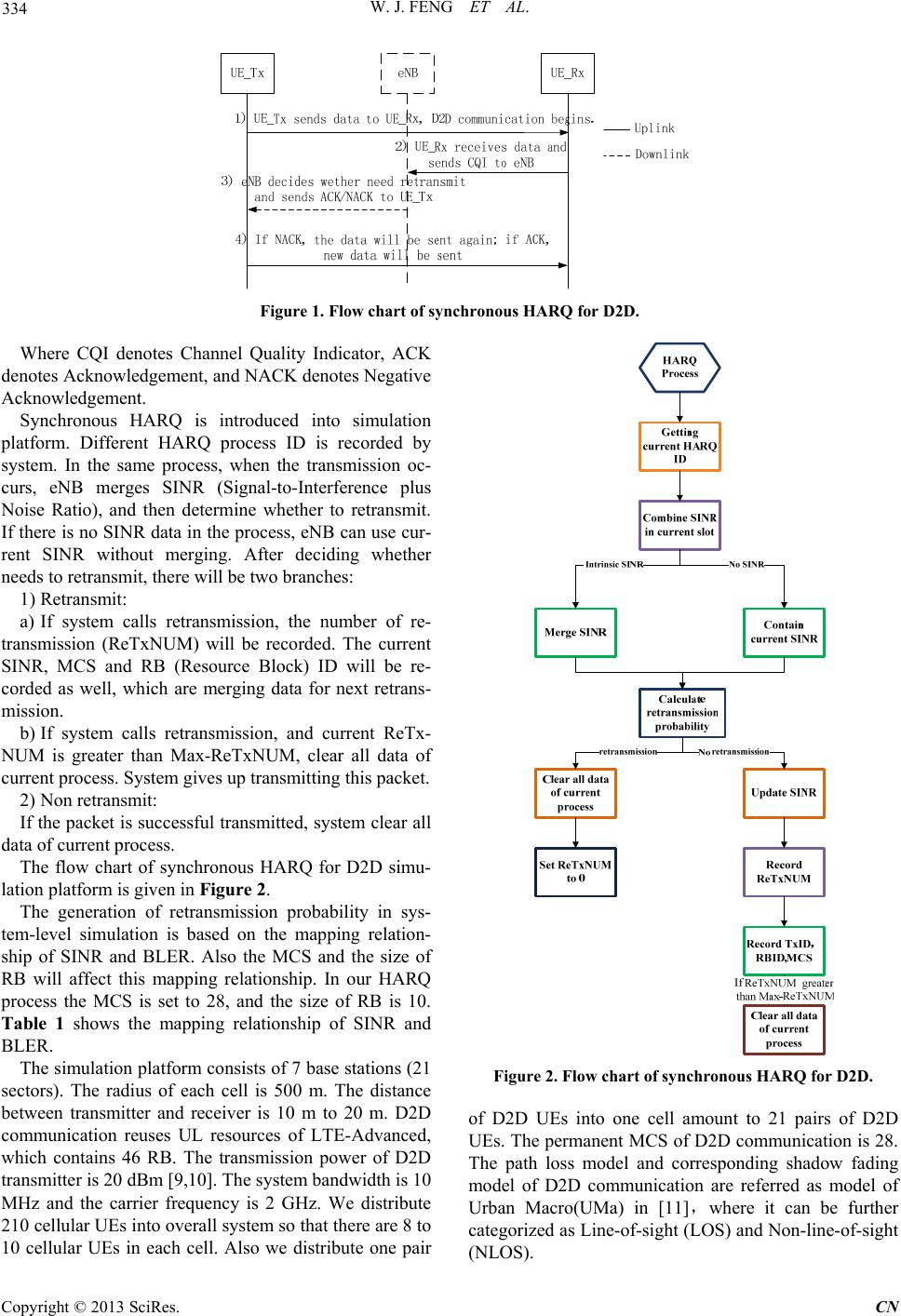 W. J. FENG ET AL. 334 Figure 1. Flow chart of synchronous HARQ for D2D. Where CQI denotes Channel Quality Indicator, ACK denotes Acknow ledgement, and NA CK denotes Negative Acknowledgement. Synchronous HARQ is introduced into simulation platform. Different HARQ process ID is recorded by system. In the same process, when the transmission oc- curs, eNB merges SINR (Signal-to-Interference plus Noise Ratio), and then determine whether to retransmit. If there is no SINR data in the process, eNB can use cur- rent SINR without merging. After deciding whether needs to retransmit, there will be two branches: 1) Retransmit: a) If system calls retransmission, the number of re- transmission (ReTxNUM) will be recorded. The current SINR, MCS and RB (Resource Block) ID will be re- corded as well, which are merging data for next retrans- mission. b) If system calls retransmission, and current ReTx- NUM is greater than Max-ReTxNUM, clear all data of current process. System gives up transmitting this packet. 2) Non retransmit: If the packet is successful transmitted, system clear all data of current process. The flow chart of synchronous HARQ for D2D simu- lation platform is given in Figure 2. The generation of retransmission probability in sys- tem-level simulation is based on the mapping relation- ship of SINR and BLER. Also the MCS and the size of RB will affect this mapping relationship. In our HARQ process the MCS is set to 28, and the size of RB is 10. Table 1 shows the mapping relationship of SINR and BLER. The simulation platform consists of 7 base stations (21 sectors). The radius of each cell is 500 m. The distance between transmitter and receiver is 10 m to 20 m. D2D communication reuses UL resources of LTE-Advanced, which contains 46 RB. The transmission power of D2D transmitter is 20 dBm [9,10]. The system bandwidth is 10 MHz and the carrier frequency is 2 GHz. We distribute 210 cellular UEs into overall system so that there are 8 to 10 cellular UEs in each cell. Also we distribute one pair Figure 2. Flow chart of synchronous HARQ for D2D. of D2D UEs into one cell amount to 21 pairs of D2D UEs. The permanent MCS of D2D communication is 28. The path loss model and corresponding shadow fading model of D2D communication are referred as model of Urban Macro(UMa) in [11],where it can be further categorized as Line-of-sight (LOS) and Non-line-of-sight (NLOS). Copyright © 2013 SciRes. CN 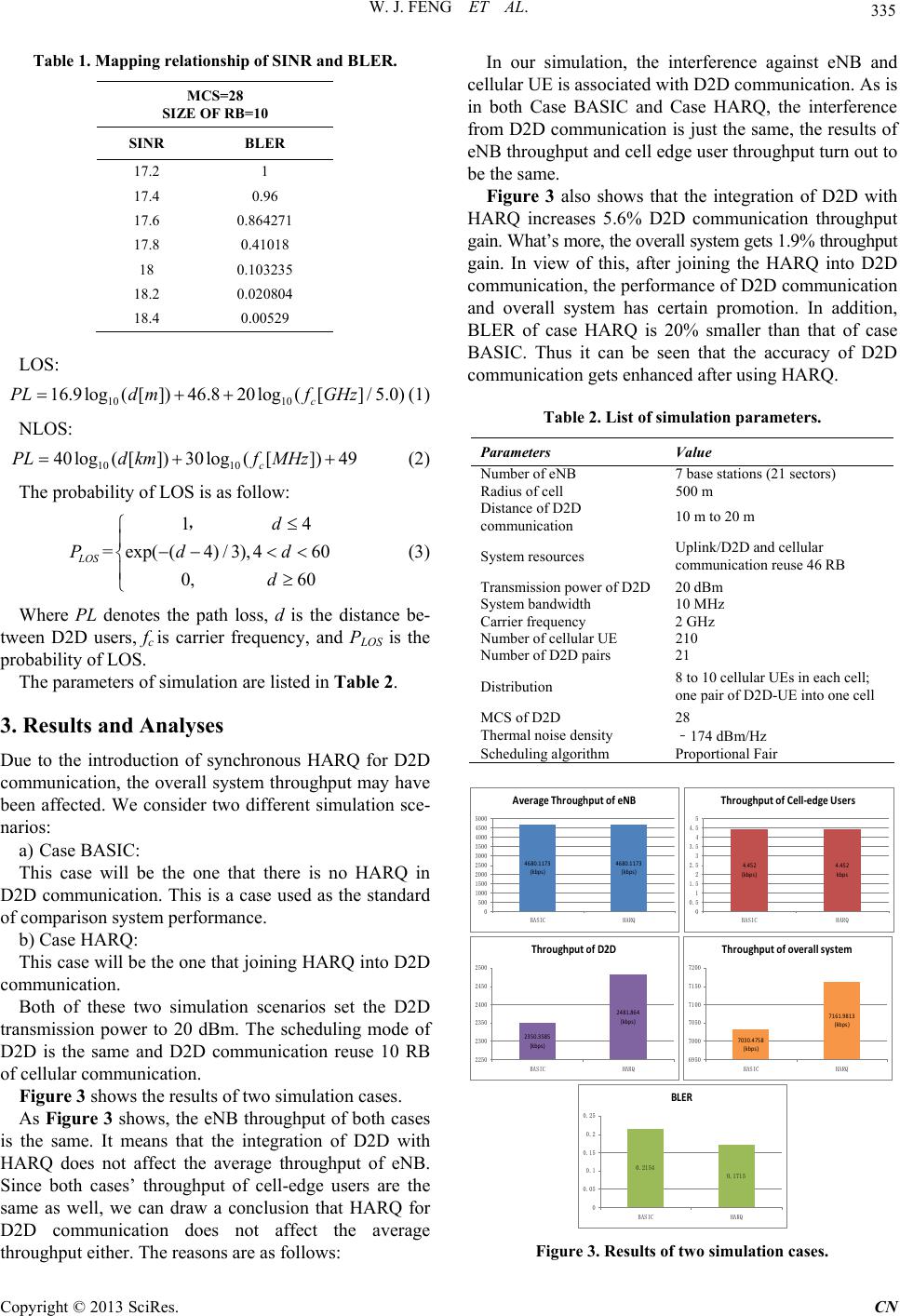 W. J. FENG ET AL. 335 Table 1. Mapping relationship of SINR and B LER. MCS=28 SIZE OF RB=10 SINR BLER 17.2 1 17.4 0.96 17.6 0.864271 17.8 0.41018 18 0.103235 18.2 0.020804 18.4 0.00529 LOS: 10 10 16.9log ([])46.820log ([]/5.0) c PLd mfGHz (1) NLOS: 10 10 40log([ ])30log([])49 c PLd kmfMHz (2) The probability of LOS is as follow: 14 =exp((4) / 3),460 0, 60 LOS d Pdd d , (3) Where PL denotes the path loss, d is the distance be- tween D2D users, fc is carrier frequency, and PLOS is the probability of LOS. The parameters of simulation are listed in Table 2. 3. Results and Analyses Due to the introduction of synchronous HARQ for D2D communication, the overall system throughput may have been affected. We consider two different simulation sce- narios: a) Case BASIC: This case will be the one that there is no HARQ in D2D communication. This is a case used as the standard of comparison system performance. b) Case HARQ: This case will be the one that joining HARQ into D2D communication. Both of these two simulation scenarios set the D2D transmission power to 20 dBm. The scheduling mode of D2D is the same and D2D communication reuse 10 RB of cellular communication. Figure 3 shows the results of two simulation cases. As Figure 3 shows, the eNB throughput of both cases is the same. It means that the integration of D2D with HARQ does not affect the average throughput of eNB. Since both cases’ throughput of cell-edge users are the same as well, we can draw a conclusion that HARQ for D2D communication does not affect the average throughput either. Th e reasons are as follows: In our simulation, the interference against eNB and cellular UE is associated with D2D communication. As is in both Case BASIC and Case HARQ, the interference from D2D communication is just the same, th e results of eNB throughput and cell edge user throughpu t turn ou t to be the same. Figure 3 also shows that the integration of D2D with HARQ increases 5.6% D2D communication throughput gain. What’s more, the overall system gets 1.9% throughput gain. In view of this, after joining the HARQ into D2D communication, the performance of D2D communication and overall system has certain promotion. In addition, BLER of case HARQ is 20% smaller than that of case BASIC. Thus it can be seen that the accuracy of D2D communication gets e nhanced after using HARQ. Table 2. List of simulation parameters. Parameters Value Number of eNB 7 base stations (21 sectors) Radius of cell 500 m Distance of D2D communication 10 m to 20 m System resources Uplink/D2D and cellular communication reuse 46 RB Transmission power of D2D 20 dBm System bandwidth 10 MHz Carrier freque nc y 2 GHz Number of cellular U E 210 Number of D2D pairs 21 Distribution 8 to 10 cellular UEs in each cell; one pair of D2D-U E into one cell MCS of D2D 28 Thermal noise density ﹣174 dBm/Hz Scheduling algorithm Proportional Fai r AverageThroughputofeNB 4680.1173 (kbps) 4680.1173 (kbps) 0 500 1000 1500 2000 2500 3000 3500 4000 4500 5000 BASIC HARQ ThroughputofCell‐edgeUsers 4.452 (kbps ) 4.452 kbps 0 0.5 1 1.5 2 2.5 3 3.5 4 4.5 5 BASIC HARQ ThroughputofD2D 2350.3585 (kbps) 2481.864 (kbps) 2250 2300 2350 2400 2450 2500 BASIC HARQ Throughputofoverallsystem 7030.4758 (kbps) 7161.9813 (kbps) 6950 7000 7050 7100 7150 7200 BASIC HARQ BLER 0.2154 0.1715 0 0.05 0.1 0.15 0.2 0.25 BASIC HARQ Figure 3. Results of two simulation case s. Copyright © 2013 SciRes. CN 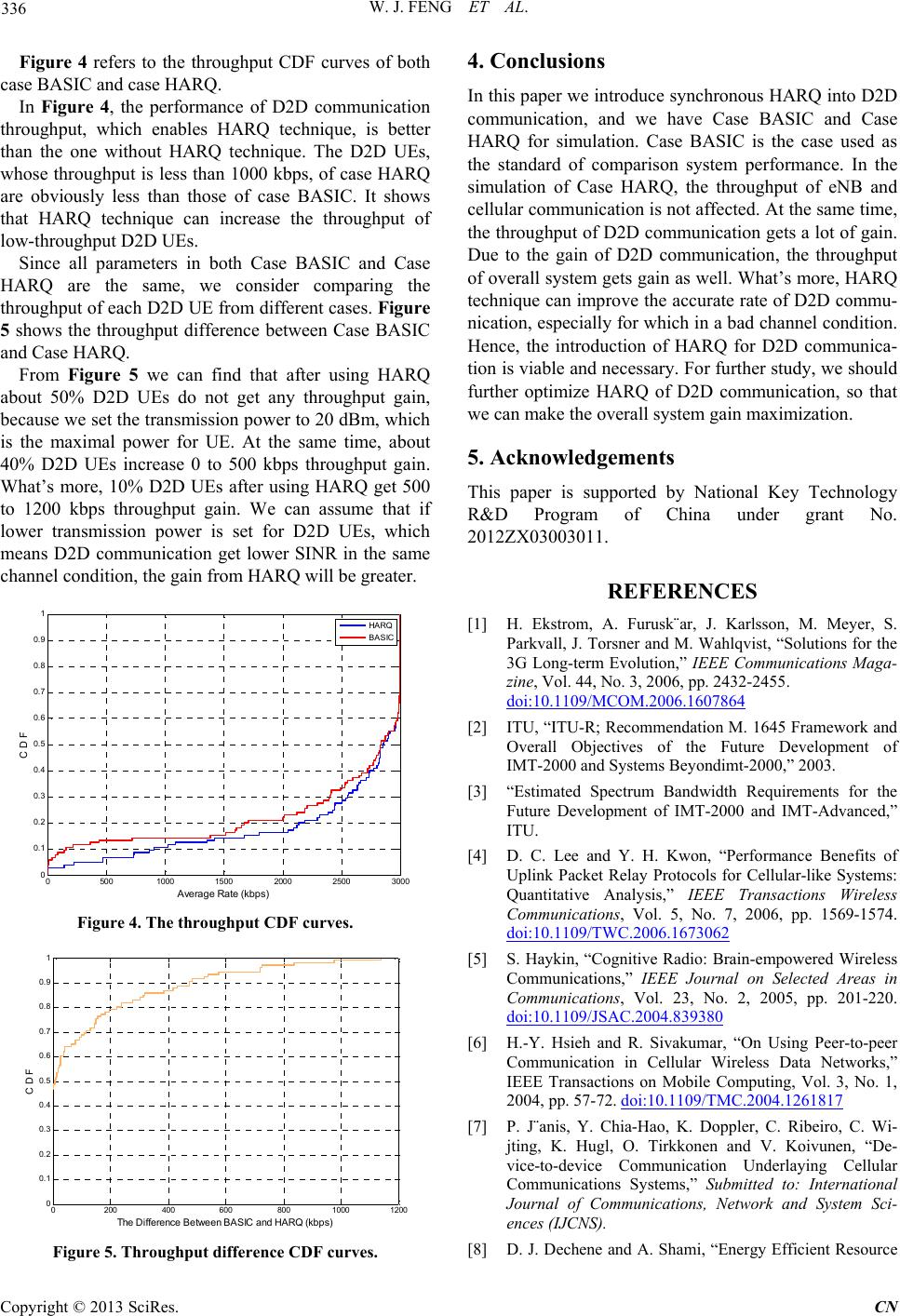 W. J. FENG ET AL. 336 Figure 4 refers to the throughput CDF curves of both case BASIC and case HARQ. In Figure 4, the performance of D2D communication throughput, which enables HARQ technique, is better than the one without HARQ technique. The D2D UEs, whose throughput is less than 1000 kbps, of case HARQ are obviously less than those of case BASIC. It shows that HARQ technique can increase the throughput of low-throughput D2D UEs. Since all parameters in both Case BASIC and Case HARQ are the same, we consider comparing the throughput of each D2D UE from different cases. Figure 5 shows the throughput difference between Case BASIC and Case HARQ. From Figure 5 we can find that after using HARQ about 50% D2D UEs do not get any throughput gain, because we set the transmission power to 20 dBm, which is the maximal power for UE. At the same time, about 40% D2D UEs increase 0 to 500 kbps throughput gain. What’s more, 10% D2D UEs after using HARQ get 500 to 1200 kbps throughput gain. We can assume that if lower transmission power is set for D2D UEs, which means D2D communication get lower SINR in the same channel conditio n, the gain from HARQ will be greater. 0500 1000 15002000 25003000 0 0.1 0.2 0.3 0.4 0.5 0.6 0.7 0.8 0.9 1 Av er age R a t e ( kbps ) C D F HARQ BASIC Figure 4. The throughput CDF curves. 0200 4006008001000 1200 0 0. 1 0. 2 0. 3 0. 4 0. 5 0. 6 0. 7 0. 8 0. 9 1 T he Differ ence Bet w een BASI C an d H AR Q ( kbps) C D F Figure 5. Throughput difference CDF curves. 4. Conclusions In this paper we introduce synchronous HARQ into D2D communication, and we have Case BASIC and Case HARQ for simulation. Case BASIC is the case used as the standard of comparison system performance. In the simulation of Case HARQ, the throughput of eNB and cellular communication is not affected. At the same time, the throughput of D2D communication g ets a lot of gain. Due to the gain of D2D communication, the throughput of overall system gets gain as well. What’s more, HARQ technique can improve the accurate rate of D2D commu- nication, espe cially for which in a bad channel condition . Hence, the introduction of HARQ for D2D communica- tion is viable and necessary. For further study, we should further optimize HARQ of D2D communication, so that we can make the overall system gain maximization. 5. Acknowledgements This paper is supported by National Key Technology R&D Program of China under grant No. 2012ZX03003011. REFERENCES [1] H. Ekstrom, A. Furusk¨ar, J. Karlsson, M. Meyer, S. Parkvall, J. Torsner and M. Wahlqvist, “Solutions for the 3G Long-term Evolution,” IEEE Communications Maga- zine, Vol. 44, No. 3, 2006, pp. 2432-2455. doi:10.1109/MCOM.2006.1607864 [2] ITU, “ITU-R; Recommendation M. 1645 Framework and Overall Objectives of the Future Development of IMT-2000 and Systems Beyondimt-2000,” 2003. [3] “Estimated Spectrum Bandwidth Requirements for the Future Development of IMT-2000 and IMT-Advanced,” ITU. [4] D. C. Lee and Y. H. Kwon, “Performance Benefits of Uplink Packet Relay Protocols for Cellular-like Systems: Quantitative Analysis,” IEEE Transactions Wireless Communications, Vol. 5, No. 7, 2006, pp. 1569-1574. doi:10.1109/TWC.2006.1673062 [5] S. Haykin, “Cognitive Radio: Brain-empowered Wireless Communications,” IEEE Journal on Selected Areas in Communications, Vol. 23, No. 2, 2005, pp. 201-220. doi:10.1109/JSAC.2004.839380 [6] H.-Y. Hsieh and R. Sivakumar, “On Using Peer-to-peer Communication in Cellular Wireless Data Networks,” IEEE Transactions on Mobile Computing, Vol. 3, No. 1, 2004, pp. 57-72. doi:10.1109/TMC.2004.1261817 [7] P. J¨anis, Y. Chia-Hao, K. Doppler, C. Ribeiro, C. Wi- jting, K. Hugl, O. Tirkkonen and V. Koivunen, “De- vice-to-device Communication Underlaying Cellular Communications Systems,” Submitted to: International Journal of Communications, Network and System Sci- ences (IJCNS). [8] D. J. Dechene and A. Shami, “Energy Efficient Resource Copyright © 2013 SciRes. CN  W. J. FENG ET AL. Copyright © 2013 SciRes. CN 337 Allocation in Sc-Fdma Uplink with Synchronous Harq Constraints,” in Communications (ICC), 2011 IEEE In- ternational Conference on, 2011, pp. 1-5. [9] V. Chandrasekhar and Z. Shen, “Optimal Uplink Power Control in Twocell Systems with Rise-over-thermal Con- straints,” IEEE communications letters, Vol. 12, No. 3, 2008, pp. 173-175. doi:10.1109/LCOMM.2008.071697 [10] H. M. Wang and D. J. Jiang, “A Novel Bidirectional Re- source Allocation to Decrease Signaling for Retransmis- sion in LTE System,” in Vehicular Technology Confer- ence, 2008. VTC Spring 2008. IEEE, 2008), pp. 2269-2271. [11] Rep. ITU-R M.2135, “Guidelines for Evaluation of Radio Interface Technologies for IMT-Advanced,” Revision 1 to Document 5D/TEMP/90-E, 1st July 2008. |