

Paper Menu >>
Journal Menu >>
 Energy and Power Engineering, 2013, 5, 869-872 doi:10.4236/epe.2013.54B166 Published Online July 2013 (http://www.scirp.org/journal/epe) A Research on Emergency DC Power Support Based on DCOI Fan Fan, Yingmin Zhang, Xingyuan Li, Wei Ma School of Electrical Engineering and Information, Key laboratory of Smart Grid Sichuan University, Chengdu, China Email: [email protected] Received October, 2012 ABSTRACT An integrated scheme of emergency DC power support which is based on dominant center of Inertia DCOI is proposed to improve power system transient stability. The inter-area speed differences equivalent by dominant center of inertia alleviates the main weakness o f the traditional signal which is made of the freq uencies at both sides and is represen t of abnormal information of the nonlinear dynamic behavior of the power system based on a model in which two AC sys- tems are connected by a HVDC Link. Sichuan Power Grid connected with Southwest Power Grid by Deyang-Baoji HVDC project is used to testify the method. The simulation results show that the control strategy can significantly ad- vance the transient stab ility of AC/DC system through extended equal area criterion (EEAC). Keywords: DCOI; Speed Differences; EEAC 1. Introduction The main appeal of HVDC (High Voltage Direct Current) with long-distance and large capacity competence for power transmission is the prominent ability to regulate reactive and active power. HVDC improves an efficient and robust approach to transient stability by modulating DC power into AC grid rapidly, which will remedy power imbalance between sending-grid and receiving- grid in order to advance transient angle stability and improve last-low-voltage level or voltage vibrating conditions [1]. Emergency control is a most significant measure against large disturbances which are the gravest threat to the stability to transient security of power systems. Thus, it becomes necessary to choose the most useful DC modulation signal from the huge amount of in- formation for the system stability control services [2]. This paper identifies and selects the “dangerous generators” to make the dominant center of inertia while discarding all “harm- less” ones by appraising the kinetic energy as the index in the during-fault period respectively. The inter-area speed differences equivalent by dominant center of iner- tia can effectively reflect the abnormal information of the nonlinear dynamic behavior of the power system based on a model in which two AC systems are connected by a HVDC link. Accordingly it is as the controller input sig- nal [3-6]. DC power lift / drop-back can provide certain transfers of power for the AC system to ensure the stability of the system by modifying the instructions of the DC system power to increase or reduce the DC transmission power. For instance, when there happens a generator loss in the sending-grid system, DC power drop-b ack can reduce th e DC power to balance the system's active power shortfall [7]. In this paper, an emergency DC power support com- prehensive strategy is devised by combining DC power lift / drop-back with the dominant center of inertia speed deviation signal to modify the power set value jointly. Taking Sichuan power grid for background, it indicates that the signal deriving from the dominant center of iner- tia is more efficient than the traditional signal made of the frequencies at both sides after comparative analysis of the system characteristics of various operating condi- tions under typical faults. 2. Mechanism of Edcps Comprhensive Strategy In the transient process, the separation of the system is not decided by the energy of the whole system. The un- stable situation of the system is caused by a small num- ber of out-of-step generators seriously deviating from the system and most of the generators with each other can still maintain synchronous operation. If all seriously dis- turbed crew in the system is stabilized, the system is sta- ble; Otherwise, the system is unstable. Thus, th e stability of the system is converted to determine the stability of the severely disturbed generators. During a failure, tran- sient energy injected into the system is converted into the Copyright © 2013 SciRes. EPE 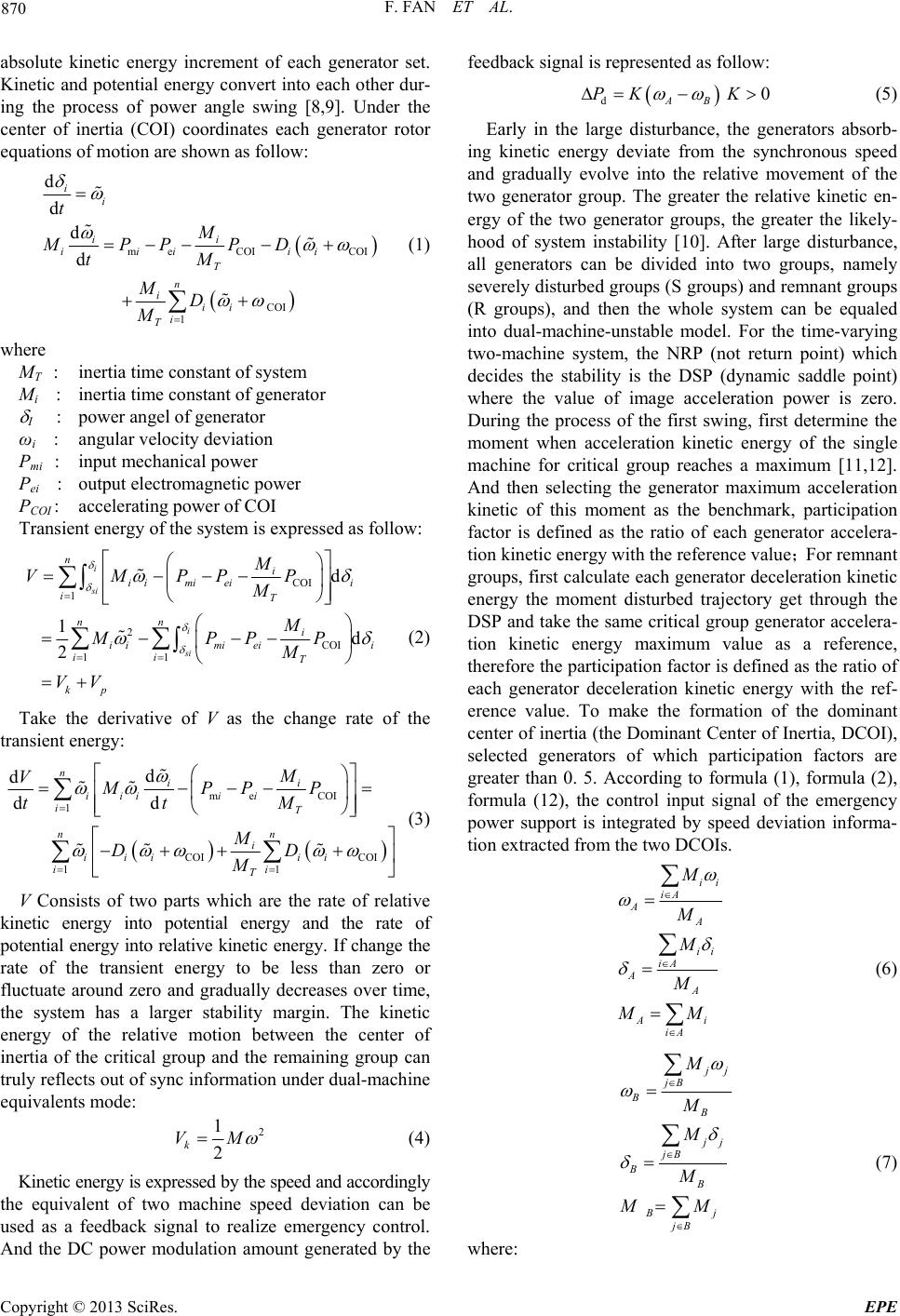 F. FAN ET AL. 870 absolute kinetic energy increment of each generator set. Kinetic and potential energ y convert into each other dur- ing the process of power angle swing [8,9]. Under the center of inertia (COI) coordinates each generator rotor equations of motion are shown as follow: me COICOI COI 1 d dd d i i ii iii ii T n i ii i T t M MPPPD tM MD M (1) where MT : inertia time constant of system Mi : inertia time constant of generator I : power angel of generator ωi : angular velocity deviation Pmi : input mechanical power Pei : output electromagnetic power PCOI : accelerating power of COI Transient energy of the system is expressed as follow: COI 1 2COI 11 d 1 d 2 i si i si n i iimi eii iT nn i iimi eii ii T kp M VMPPP M M MPPP M VV (2) Take the derivative of V as the change rate of the transient energy: me COI 1 COI COI 11 d d dd n ii iiii i iT nn i iiiii ii T M VMPPP ttM M DD M (3) V Consists of two parts which are the rate of relative kinetic energy into potential energy and the rate of potential energ y into relative kinetic energy. If change the rate of the transient energy to be less than zero or fluctuate around zero and gradually decreases over time, the system has a larger stability margin. The kinetic energy of the relative motion between the center of inertia of the critical group and the remaining group can truly reflects out of sync information under dual-machine equivalents mode: 2 1 2 k VM (4) Kinetic ene rgy is expres sed by th e speed and according ly the equivalent of two machine speed deviation can be used as a feedback signal to realize emergency control. And the DC power modulation amount generated by the feedback signal is represented as follow: d AB PK K 0 (5) Early in the large disturbance, the generators absorb- ing kinetic energy deviate from the synchronous speed and gradually evolve into the relative movement of the two generator group. The greater the relative kinetic en- ergy of the two generator groups, the greater the likely- hood of system instability [10]. After large disturbance, all generators can be divided into two groups, namely severely disturbed groups (S groups) and remnant groups (R groups), and then the whole system can be equaled into dual-machine-unstable model. For the time-varying two-machine system, the NRP (not return point) which decides the stability is the DSP (dynamic saddle point) where the value of image acceleration power is zero. During the process of the first swing, first determine the moment when acceleration kinetic energy of the single machine for critical group reaches a maximum [11,12]. And then selecting the generator maximum acceleration kinetic of this moment as the benchmark, participation factor is defined as the ratio of each generator accelera- tion kinetic energy with the reference value;For remnant groups, first calculate each generator deceleration kinetic energy the moment disturbed trajectory get through the DSP and take the same critical group generator accelera- tion kinetic energy maximum value as a reference, therefore the participation factor is defined as the ratio of each generator deceleration kinetic energy with the ref- erence value. To make the formation of the dominant center of inertia (the Dominant Center of Inertia, DCOI), selected generators of which participation factors are greater than 0. 5. According to formula (1), formula (2), formula (12), the control input signal of the emergency power support is integrated by speed deviation informa- tion extracted from the two DCOIs. ii iA A A ii iA A A Ai iA M M M M MM (6) j j jB B B j j jB B B Bj jB M M M M MM (7) where: Copyright © 2013 SciRes. EPE 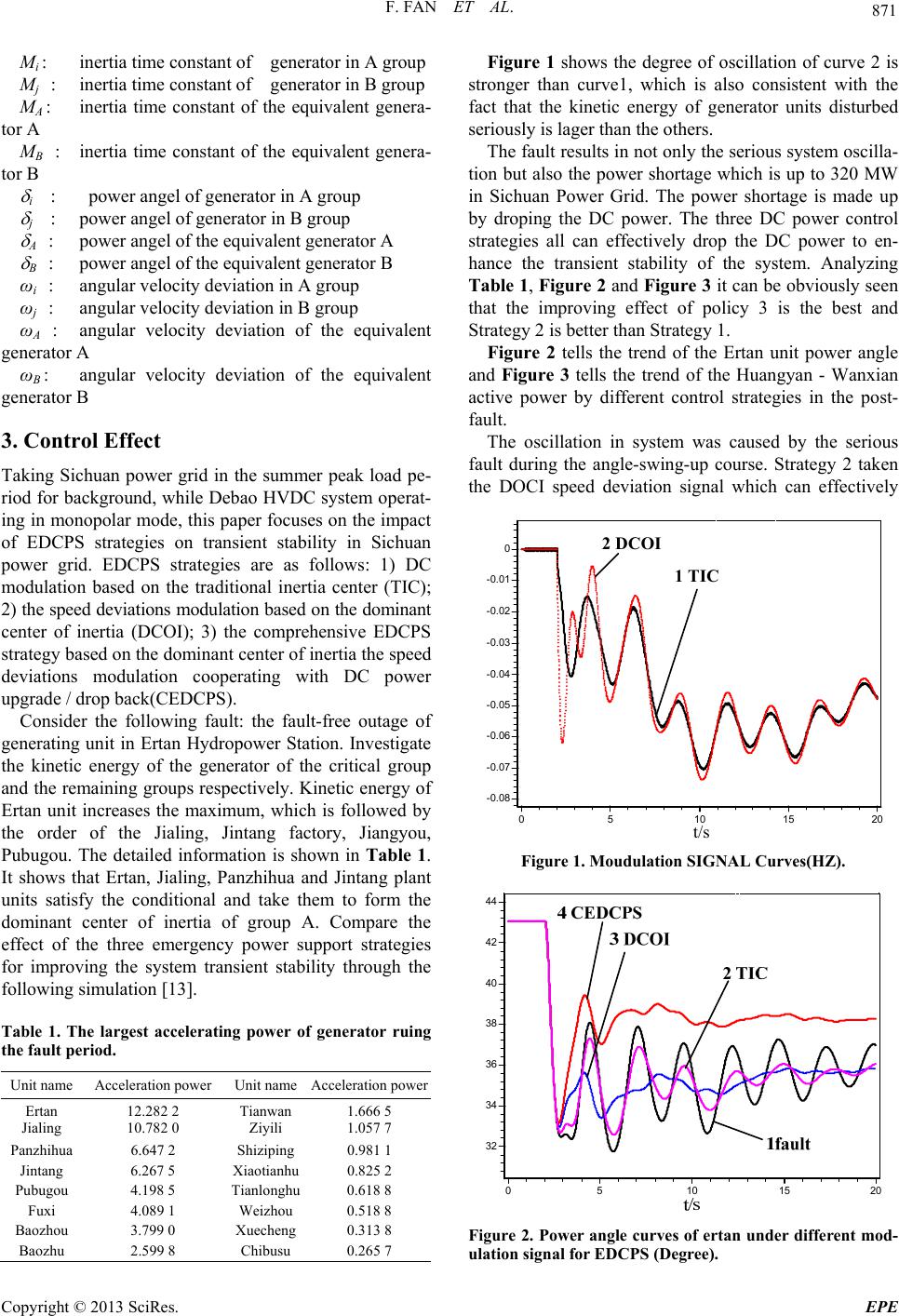 F. FAN ET AL. 871 Mi : inertia time constant of generator in A group Mj : inertia time constant of generator in B group MA : inertia time constant of the equivalent genera- tor A MB : inertia time constant of the equivalent genera- tor B i : power angel of generator in A group j : power angel of generator in B group A : power angel of the equivalent generator A B : power angel of the equivalent generator B ωi : angular velocity deviation in A group ωj : angular velocity deviation in B group ωA : angular velocity deviation of the equivalent generator A ωB : angular velocity deviation of the equivalent generator B 3. Control Effect Taking Sichuan power grid in the summer peak load pe- riod for background, while Debao HVDC system operat- ing in monopolar mode, this pap er focuses on the impact of EDCPS strategies on transient stability in Sichuan power grid. EDCPS strategies are as follows: 1) DC modulation based on the traditional inertia center (TIC); 2) the speed deviations modulation based on the dominant center of inertia (DCOI); 3) the comprehensive EDCPS strategy based on the dominant center of inertia the speed deviations modulation cooperating with DC power upgrade / drop back(CEDCPS). Consider the following fault: the fault-free outage of generating unit in Ertan Hydropower Station. Investigate the kinetic energy of the generator of the critical group and the remaining gr oups respectively. Kinetic energy of Ertan unit increases the maximum, which is followed by the order of the Jialing, Jintang factory, Jiangyou, Pubugou. The detailed information is shown in Table 1. It shows that Ertan, Jialing, Panzhihua and Jintang plant units satisfy the conditional and take them to form the dominant center of inertia of group A. Compare the effect of the three emergency power support strategies for improving the system transient stability through the following simulation [13]. Table 1. The largest accelerating power of generator ruing the fault period. Unit name Acceleration power Unit name Acceleration power Ertan Jialing 12.282 2 10.782 0 Tianwan Ziyili 1.666 5 1.057 7 Panzhihua 6.647 2 Shiziping 0.981 1 Jintang 6.267 5 Xiaotianhu 0.825 2 Pubugou 4.198 5 Tianlonghu 0.618 8 Fuxi 4.089 1 Weizhou 0.518 8 Baozhou 3.799 0 Xuecheng 0.313 8 Baozhu 2.599 8 C hib usu 0.265 7 Figure 1 shows the degree of oscillation of curve 2 is stronger than curve1, which is also consistent with the fact that the kinetic energy of generator units disturbed seriously is lager than the other s . The fault results in not on ly the serious system oscilla- tion but also the power shortage which is up to 320 MW in Sichuan Power Grid. The power shortage is made up by droping the DC power. The three DC power control strategies all can effectively drop the DC power to en- hance the transient stability of the system. Analyzing Table 1, Figure 2 and Figure 3 it can be obviously seen that the improving effect of policy 3 is the best and Strategy 2 is better than Strategy 1. Figure 2 tells the trend of the Ertan unit power angle and Figure 3 tells the trend of the Huangyan - Wanxian active power by different control strategies in the post- fault. The oscillation in system was caused by the serious fault during the angle-swing-up course. Strategy 2 taken the DOCI speed deviation signal which can effectively 20151050 0 -0.01 -0.02 -0.03 -0.04 -0.05 -0.06 -0.07 -0.08 t / s 2 DCOI 1 TIC Figure 1. Moudulation SIGNAL Curve s(HZ). 20151050 44 42 40 38 36 34 32 Figure 2. Power angle curves of ertan under different mod- ulation signal for EDCPS (Degree). Copyright © 2013 SciRes. EPE 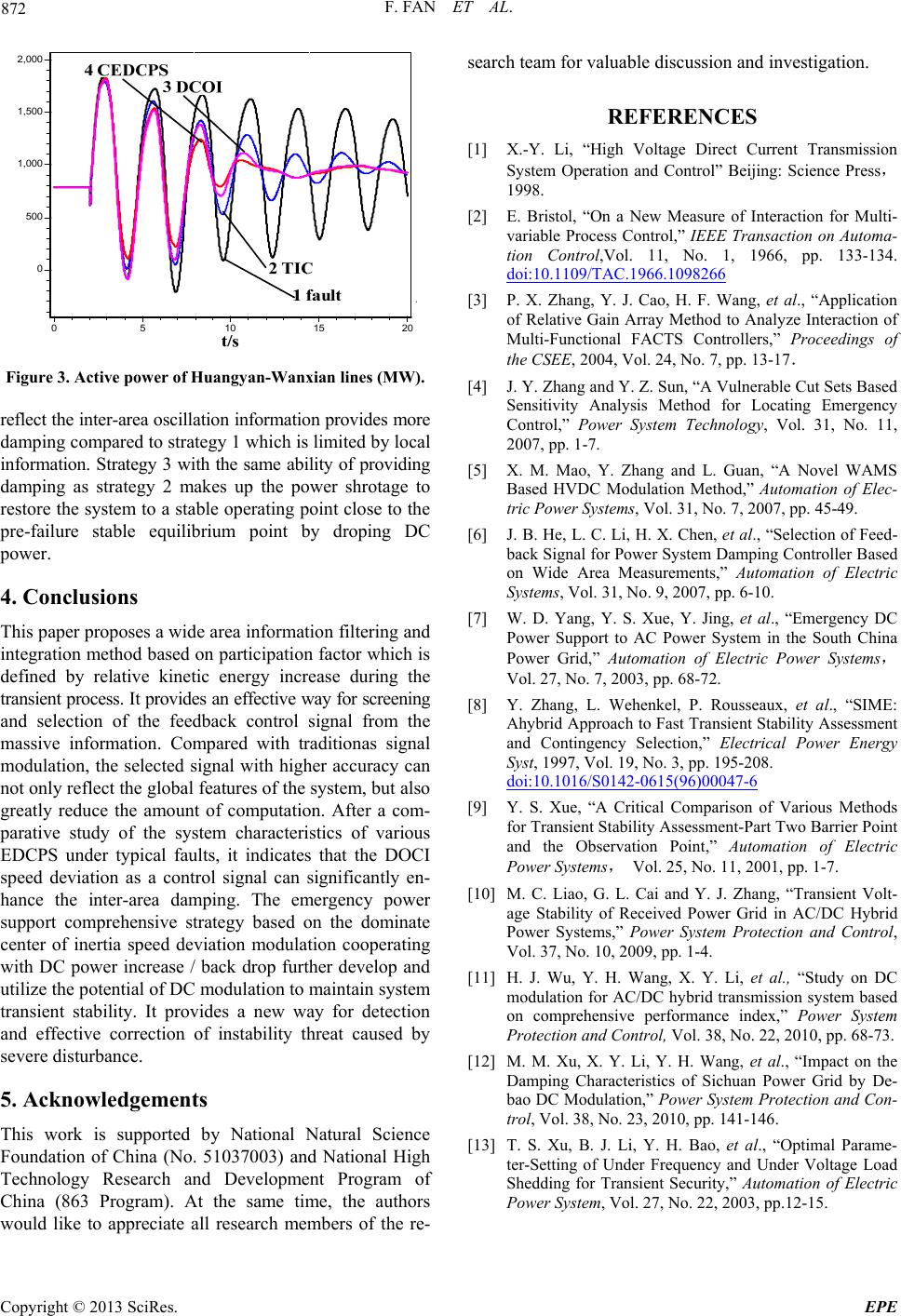 F. FAN ET AL. Copyright © 2013 SciRes. EPE 872 20151050 2,000 1,500 1,000 500 0 Figure 3. Active power of Huangyan-Wanxian lines (MW). reflect the inter -area oscillatio n information provides more damping compared to strategy 1 which is limited by lo cal information. Strategy 3 with the same ability of providing damping as strategy 2 makes up the power shrotage to restore the system to a stable operating point close to the pre-failure stable equilibrium point by droping DC power. 4. Conclusions This paper proposes a wide area information filtering and integration method ba sed on participation factor which is defined by relative kinetic energy increase during the transient pro cess. It provides an effective wa y for screening and selection of the feedback control signal from the massive information. Compared with traditionas signal modulation, the selected signal with higher accuracy can not only reflect the global features of the system, but also greatly reduce the amount of computation. After a com- parative study of the system characteristics of various EDCPS under typical faults, it indicates that the DOCI speed deviation as a control signal can significantly en- hance the inter-area damping. The emergency power support comprehensive strategy based on the dominate center of inertia speed deviation modulation cooperating with DC power increase / back drop further develop and utilize the potential of DC modulation to maintain system transient stability. It provides a new way for detection and effective correction of instability threat caused by severe disturbance. 5. Acknowledgements This work is supported by National Natural Science Foundation of China (No. 51037003) and National High Technology Research and Development Program of China (863 Program). At the same time, the authors ould like to appreciate all research members of the re- search team for valuable discussion and investigation. REFERENCES [1] X.-Y. Li, “High Voltage Direct Current Transmission System Operation and Control” Beijing: Science Press, 1998. [2] E. Bristol, “On a New Measure of Interaction for Multi- variable Process Control,” IEEE Transaction on Automa- tion Control,Vol. 11, No. 1, 1966, pp. 133-134. doi:10.1109/TAC.1966.1098266 [3] P. X. Zhang, Y. J. Cao, H. F. Wang, et al., “Application of Relative Gain Array Method to Analyze Interaction of Multi-Functional FACTS Controllers,” Proceedings of the CSEE, 2004, Vol. 24, No. 7, pp. 13-17. [4] J. Y. Zhang and Y. Z. Sun, “A Vulnerable Cut Sets Based Sensitivity Analysis Method for Locating Emergency Control,” Power System Technology, Vol. 31, No. 11, 2007, pp. 1-7. [5] X. M. Mao, Y. Zhang and L. Guan, “A Novel WAMS Based HVDC Modulation Method,” Automation of Elec- tric Power Systems, Vol. 31, No. 7, 2007, pp. 45-49. [6] J. B. He, L. C. Li, H. X. Chen, et al., “Selection of Feed- back Signal for Power System Damping Controller Based on Wide Area Measurements,” Automation of Electric Systems, Vol. 31, No. 9, 2007, pp. 6-10. [7] W. D. Yang, Y. S. Xue, Y. Jing, et al., “Emergency DC Power Support to AC Power System in the South China Power Grid,” Automation of Electric Power Systems, Vol. 27, No. 7, 2003, pp. 68-72. [8] Y. Zhang, L. Wehenkel, P. Rousseaux, et al., “SIME: Ahybrid Approach to Fast Transient Stability Assessme nt and Contingency Selection,” Electrical Power Energy Syst, 1997, Vol. 19, No. 3, pp. 195-208. doi:10.1016/S0142-0615(96)00047-6 [9] Y. S. Xue, “A Critical Comparison of Various Methods for Transient Stability Assessment-Part Two Barrier Point and the Observation Point,” Automation of Electric Power Systems, Vol. 25, No. 11, 2001, pp. 1-7. [10] M. C. Liao, G. L. Cai and Y. J. Zhang, “Transient Volt- age Stability of Received Power Grid in AC/DC Hybrid Power Systems,” Power System Protection and Control, Vol. 37, No. 10, 2009, pp. 1-4. [11] H. J. Wu, Y. H. Wang, X. Y. Li, et al., “Study on DC modulation for AC/DC hybrid transmission system based on comprehensive performance index,” Power System Protection and Control, Vol. 38, No. 22, 2010, pp. 68-73. [12] M. M. Xu, X. Y. Li, Y. H. Wang, et al., “Impact on the Damping Characteristics of Sichuan Power Grid by De- bao DC Modulation,” Power System Protection and Con- trol, Vol. 38, No. 23, 2010, pp. 141-146. [13] T. S. Xu, B. J. Li, Y. H. Bao, et al., “Optimal Parame- ter-Setting of Under Frequency and Under Voltage Load Shedding for Transient Security,” Automation of Electric Power System, Vol. 27, No. 22, 2003, pp.12-15. w |