

Paper Menu >>
Journal Menu >>
 Energy and Power Engineering, 2013, 5, 811-815 doi:10.4236/epe.2013.54B156 Published Online July 2013 (http://www.scirp.org/journal/epe) Pricing Mechanism of China’s Trans-regional and Trans-provincial Electricity Trading Tian Xia1,2, ZhiYan Liu1 , Wei Xiong1, YongXiu He1 1School of Economics and Management, North China Electric Power University, Beijing, China 2Gansu Electric Power Corporation, Lanzhou, China Email: [email protected] Received March, 2013 ABSTRACT With the large-scale development of Chinese electric power, the contradiction of China’s energy supply and demand that reverse distributed is very prominent, therefore, promoting electricity trading is one of the important measures to get optimized configuration of energy resources in nationwide. For the two kinds of trading method, the “power point to the grid” trading and the “grid to grid” trading, this paper designed pricing mechanism model, and took one area as an example, we analyzed the impact of the participants by using differen t pricing mechanism, and put forward reasonable policy proposals for China’s pricing mechanism of trans-regional and tran s-provincial electricity trading. Keywords: Trans-regional and Trans-provincial; Electricity Trading; Pricing Mechanism 1. Introduction China’s trans-regional and trans-provincial electricity trading has increased year by year. While with the scale enlargement of the trading, some problems happened: the low level of marketization, the imperfect price mecha- nism, and the unified pricing mechanism which is diffi- cult to meet the interests and the needs of different trad- ing regions and different trading participants, etc. The formation of scientific price mechanism has important significance to promote the development of power trad- ing. Literature [1] researches the pricing problems of Con- tract for Diff erences (CFDs) in th e No rdi c po w er tr ad ing . Through integrating the power market in South Asia Re- gional, examining the opportunities, benefits, and chal- lenges, Literature [2] promoted a trans-regional power trading scenario model of South Asia, in this model, the trans-regional power trading price is determined by b id ing . The studies in Literature [3] show that the convergence of power price can be induced by cross-border and trans-regional electricity trading, and the re-allocation of resources in various countries can be promoted by the optimization of exchange volume and exchange price. Based on the Markal model, Literature [4] assess the effectiveness of the trans-re gional power trading between Thailand and Laos, and pointed out that Thailand is ex- pected to gain benefit from the increased level of power imported from Laos in terms of the lower energy system cost, better environmental quality and, greater diversify- cation of energy sources. On the basis of an analysis on the price mechanism and methods for power trading be- tween trans-region or trans-provincial grids in China, Literature [5] puts forward some policy recommenda- tions for innovation of power trading price systems and mechanisms in China from different aspects. The char- acteristics of Chinese cross regional transmission trading price framework are summarized in Literature [6], based on that, the targets of Chinese cross regional trading pricing are proposed, and suggestions on related price framework and mechanism are put forward. Based on the different power supply and demand situation, and the power purchase cost, the price model in trans-regional power consensual dealings, as well as price compliance mechanism are established in Literature [7]. The feed-in tariff, the transmission price, the line loss as well as the sales price are discussed in Literature [8] on the basis of different costs: long-term, medium-term, short-term, accident support as well as spare power to each other. Literature [9] considers that, ration al transmission pr icing mechanism is a key issue for the development of cross regional electricity trading. The application of the Nash bargaining principle in trans-regional and trans-provin- cial power trading is studied in Literature [10], aim for maximize the overall effectiveness of the trade subject, the Nash negotiation price model in trans-regional and trans-provincial power trading have been established perceptively. Copyright © 2013 SciRes. EPE 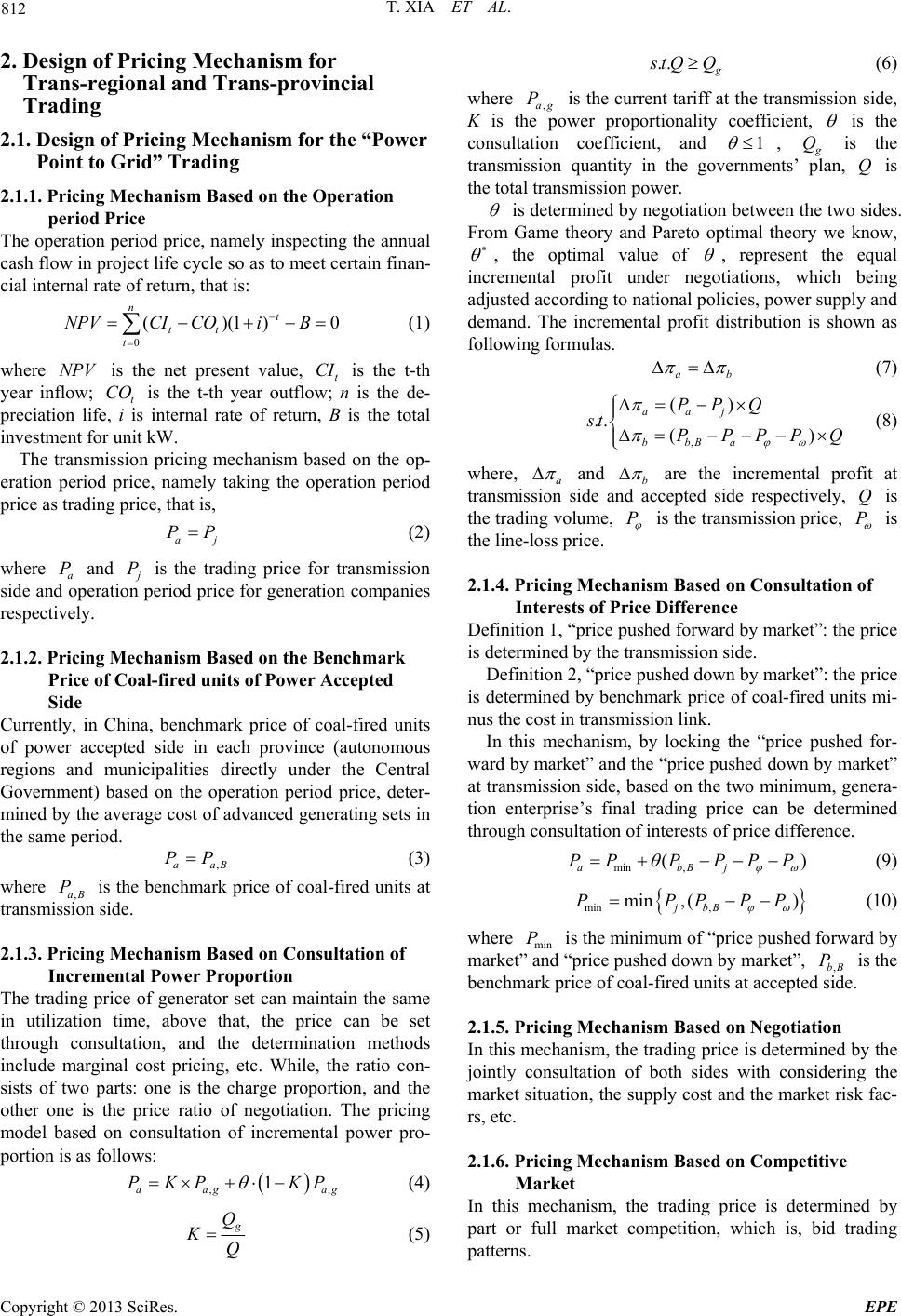 T. XIA ET AL. 812 2. Design of Pricing Mechanism for Trans-regional and Trans-provincial Trading 2.1. Design of Pricing Mechanism for the “Power Point to Grid” Trading 2.1.1. Pr i cing Mech an ism Based on the Operat ion period Price The operation period price, namely inspecting the annual cash flow in project life cycle so as to meet certain finan- cial internal rate of return, that is: 0 ()(1) nt tt t NPVCI COiB 0 j (1) where is the net present value, t is the t-th year inflow; t is the t-th year outflow; n is the de- preciation life, i is internal rate of return, B is the total investm e nt for uni t kW. NPV CI CO The transmission pricing mechanism based on the op- eration period price, namely taking the operation period price as trading price, that is, a PP (2) where a and P j P is the trading price for transmission side and operation period price for generation companies respectively. 2.1.2. P ricing Mechanism Base d on the Benc hm ark Price of Coal-fired units of Power Accepted Side Currently, in China, benchmark price of coal-fired units of power accepted side in each province (autonomous regions and municipalities directly under the Central Government) based on the operation period price, deter- mined by the average cost of advanced generating sets in the same period. ,aa PPB ag (3) where ,aB is the benchmark price of coal-fired units at transmission side. P 2.1.3. Pricing Mechanism Based on Consultation of Incremental Power Proportion The trading price of generator set can maintain the same in utilization time, above that, the price can be set through consultation, and the determination methods include marginal cost pricing, etc. While, the ratio con- sists of two parts: one is the charge proportion, and the other one is the price ratio of negotiation. The pricing model based on consultation of incremental power pro- portion is as follows: ,, 1 aag PKP KP (4) g Q KQ .. g s tQ Q (6) where is the current tariff at the transmission side, Kproportionality ,ag P is the power coefficient, is the 1 consultation coef (5) ficient, and , g Q is the transmi quantity in the governments’ plan, Q is the total transmission power. ssion is determined by negotiation en the two sides. From Game theory and Pareto optimal theory we know, betwe , the optimal value of , represent the equal dem incremental profit under negotiations, which being adjusted according to national policies, power supply and and. The incremental profit distribution is shown as following formulas. ab (7) ..st , () () aaj bbBa PP Q PP PPQ (8) where, and b a are the incremental p transmde apted side respectively the trading volume rofit at , Q is ission sind acce , P is the transmission price, P is ani of rice Difference Definition 1, “price pushed forward by market”: the price Defy market”: the price two minimum, genera- tio the line-rice. 2.1.4. Pri c ing Mechsm Based on C onsulta tion Interests of P loss p is determined by the transmission side. inition 2, “price pushed down b is determined by benchmark price of coal-fired units mi- nus the cost in transmission link. In this mechanism, by locking the “price pushed for- ward by market” and the “price pushed down by market” at transmission side, based on the n enterprise’s final trading price can be determined through consultation of interests of price difference. min , () abBj PPP PPP (9) min , min ,() jbB PPPPP (10) where is the minimum of “price pushed market” aprice pushed down by market”, benchmprice of coal-fired units at accepte ion the jointly consultation of both sides with considering the k fac- rket In this mechanism, the trading price is determined by ing patter min P nd “ ark forward by ,bB P is the d side. 2.1.5. Pricing Mechanism Based on Negoti a t In this mechanism, the trading price is determined by market situation, the supply cost and the market ris rs, etc. 2.1.6. Pr icing Mechanism Base d on Comp et itive Ma part or full market competition, which is, bid trad ns. Copyright © 2013 SciRes. EPE 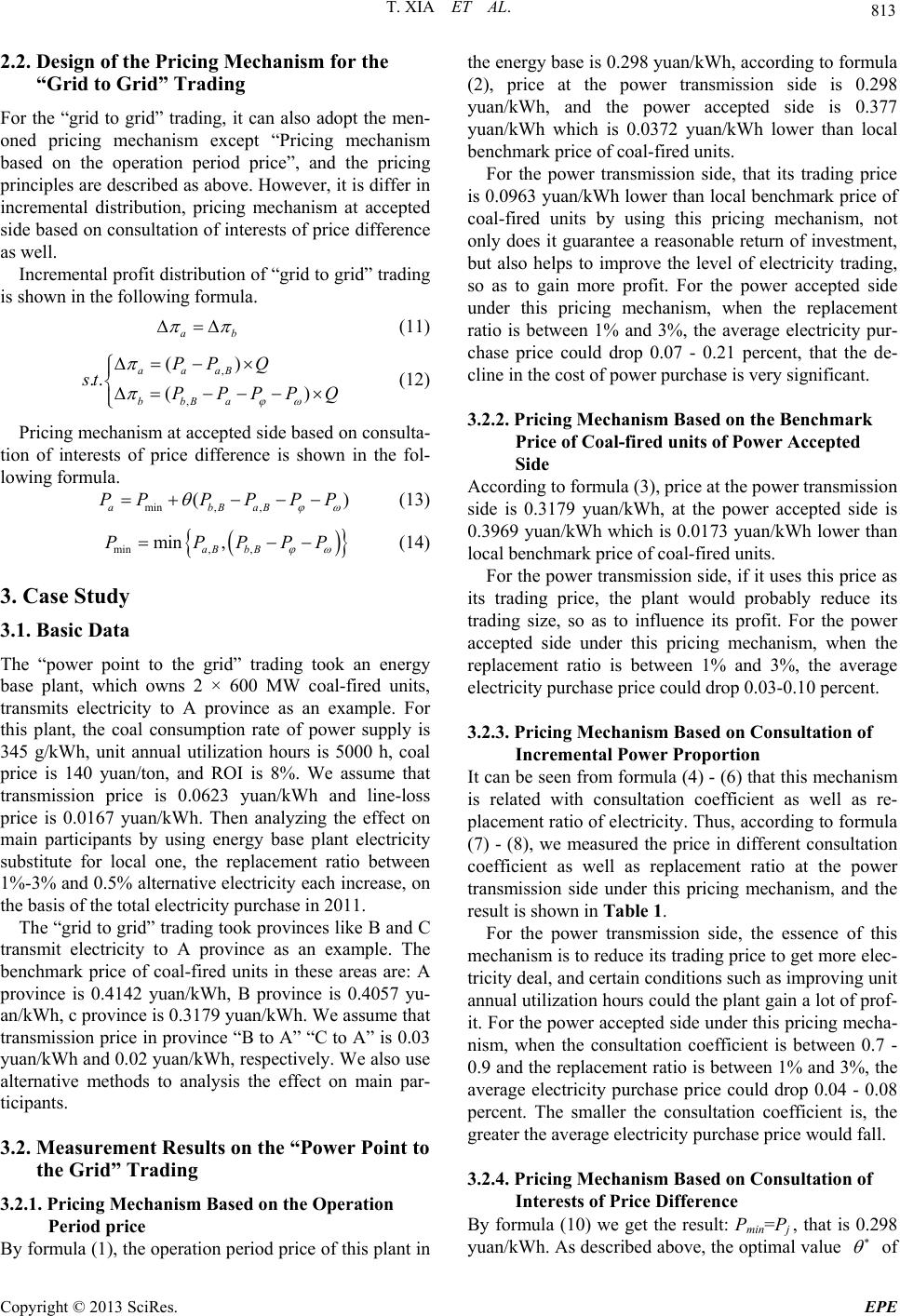 T. XIA ET AL. 813 2.2. Design of the Pricing Mechanism for the “Grid to Grid” Trading For the “grid to grid” trading, it can also adopt the men- ism cing princHowever, it is differ in oned pricing mechanism except “Pricing mechan based on the operation period price”, and the pri iples are described as above. incremental distribution, pricing mechanism at accepted side based on consultation of interests of price difference as well. Incremental profit distribution of “grid to grid” trading is shown in the following formula. ab (11) , , () .. ( aaaB bbBa PP Q st PPP (12) ) Pricing mechanism at accepted side based on consulta- tion of interests of price difference is shown in t lowing formula. PQ he fol- min, , () abBaB PPP PPP (13) min, , min , aB bB PPPPP (14) 3. Case Study 3.1. Basic Data The “power point to the grid” trading took an energy owns 2 × 600 MW coal-fired units, y to A province as an example. For consumption rate of power supply is 57 yu- an ing Mecha nism Based on the Operat ion the en/kWh, according to formula 298 377 on is an local b - n base plant, which transmits electricit this plant, the coal 345 g/kWh, unit annual utilization hours is 5000 h, coal price is 140 yuan/ton, and ROI is 8%. We assume that transmission price is 0.0623 yuan/kWh and line-loss price is 0.0167 yuan/kWh. Then analyzing the effect on main participants by using energy base plant electricity substitute for local one, the replacement ratio between 1%-3% and 0.5% alternative electricity each increase, on the basis of the total electricity purchase in 2011. The “grid to grid” trading took provinces like B and C transmit electricity to A province as an example. The benchmark price of coal-fired units in these areas are: A province is 0.4142 yuan/kWh, B province is 0.40 /kWh, c province is 0.3179 yu an/kWh. We assume that transmission price in province “B to A” “C to A” is 0.03 yuan/kWh and 0.02 yuan /kWh, respectiv ely. We also use alternative methods to analysis the effect on main par- ticipants. 3.2. Measurement Results on the “Power Point to the Grid” Trading 3.2.1. Pr i c Period price By formula (1), the operation period price of this plant in nergy base is 0.298 yua (2), price at the power transmission side is 0. yuan/kWh, and the power accepted side is 0. yuan/kWh which is 0.0372 yuan/kWh lower than local benchmark price of coal-fired units. For the power transmission side, that its trading price is 0.0963 yuan/kWh lower than local benchmark price of coal-fired units by using this pricing mechanism, not only does it guarantee a reasonable return of investment, but also helps to improve the level of electricity trading, so as to gain more profit. For the power accepted side under this pricing mechanism, when the replacement ratio is between 1% and 3%, the average electricity pur- chase price could drop 0.07 - 0.21 percent, that the de- cline in the cost of power purchase is very significant. 3.2.2. P ricing Mechanism Base d on the Benc hm ark Price of Coal-fired units of Power Accepted Side According to formula (3), price at the power transmissi side is 0.3179 yuan/kWh, at the power accepted side 0.3969 yuan/kWh which is 0.0173 yuan/kWh lower th enchmark price of coal-fired units. For the power transmission side, if it uses this price as its trading price, the plant would probably reduce its trading size, so as to influence its profit. For the power accepted side under this pricing mechanism, when the replacement ratio is between 1% and 3%, the average electricity purchase price could dro p 0.03 -0 . 10 pe rce nt. 3.2.3. Pricing Mechanism Based on Consultation of Incremental Power Proportion It can be seen from formula (4) - (6) that this mechanism is related with consultation coefficient as well as re placement ratio of electricity. Thus, according to formula (7) - (8), we measured the price in different consultatio coefficient as well as replacement ratio at the power transmission side under this pricing mechanism, and the result is shown in Table 1. For the power transmission side, the essence of this mechanism is to reduce its trading price to get more elec- tricity deal, and certain conditions such as improving unit annual utilization hours could th e plant gain a lot of prof- it. For the power accepted side under this pricing mecha- nism, when the consultation coefficient is between 0.7 - 0.9 and the replacement ratio is between 1% and 3%, the average electricity purchase price could drop 0.04 - 0.08 percent. The smaller the consultation coefficient is, the greater the average electricity purchase price would fall. 3.2.4. Pricing Mechanism Based on Consultation of Interests of Price Difference By formula (10) we get the result: Pmin=Pj , that is 0.298 yuan/kWh. As described above, the optimal value of Copyright © 2013 SciRes. EPE 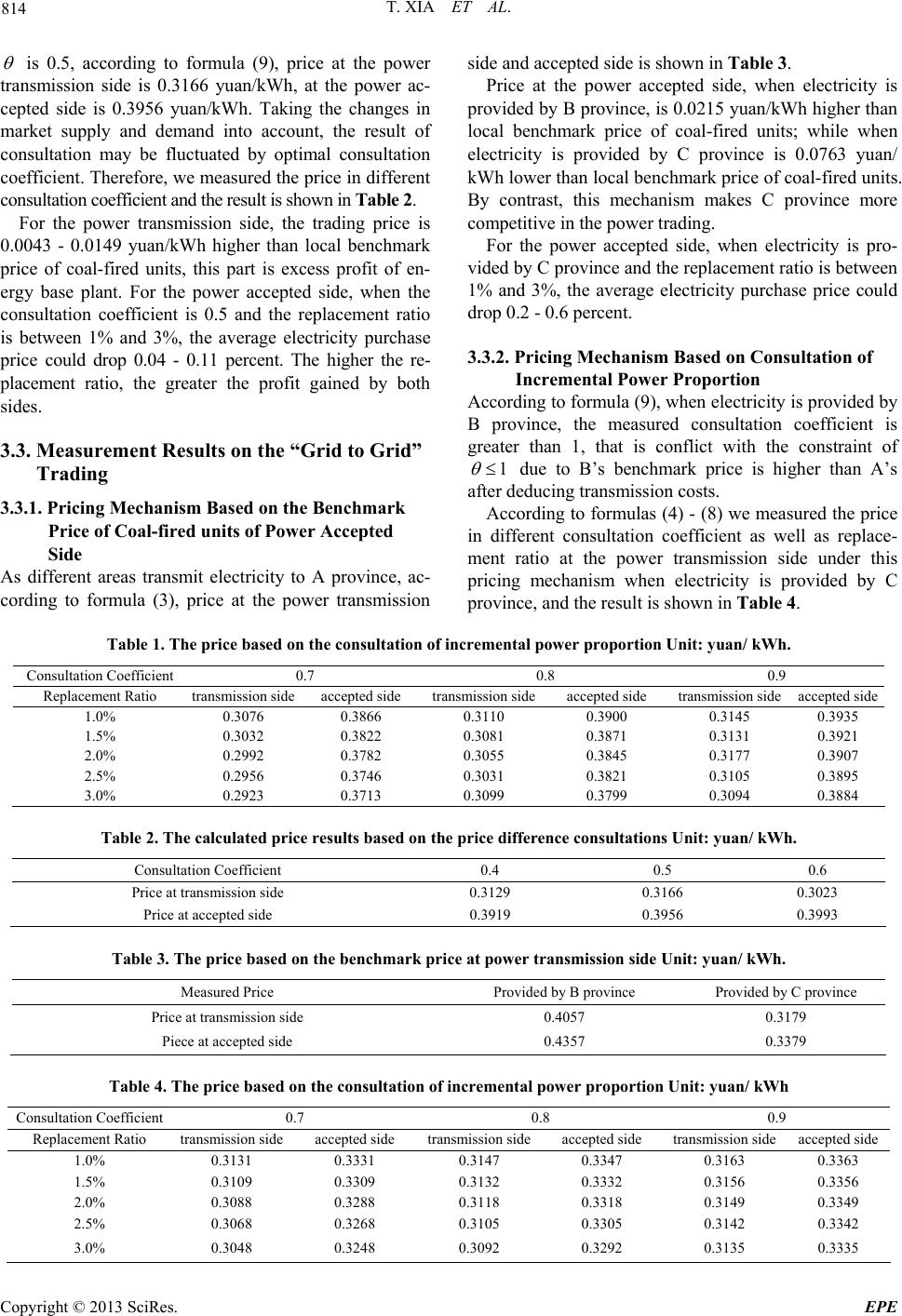 T. XIA ET AL. Copyright © 2013 SciRes. EPE 814 side and accepted side is shown in Table 3. is 0.5, according to formula (9), price at the pow ission side is 0.3166 yuan/kWer transmh, at the power ac- ricing Mechanism B ase d o n the Bench mark das transmit electricity to A province, ac- n Price at the power accepted side, when electricity is provided by B province, is 0.0215 yuan /kWh higher than local benchmark price of coal-fired units; while when electricity is provided by C province is 0.0763 yuan/ kWh lower than local benchmark price of coal-fired units. By contrast, this mechanism makes C province more competitive in the power trading. cepted side is 0.3956 yuan/kWh. Taking the changes in market supply and demand into account, the result of nsultation may be fluctuated by optimal consultation coefficient. Therefore, we measured the price in different consultation coefficient and the result is shown in Table 2. For the power transmission side, the trading price is 0.0043 - 0.0149 yuan/kWh higher than local benchmark price of coal-fired units, this part is excess profit of en- ergy base plant. For the power accepted side, when the co co As For the power accepted side, when electricity is pro- vided by C province and the replacement ratio is between 1% and 3%, the average electricity purchase price could drop 0.2 - 0.6 percent. nsultation coefficient is 0.5 and the replacement ratio is between 1% and 3%, the average electricity purchase price could drop 0.04 - 0.11 percent. The higher the re- placement ratio, the greater the profit gained by both sides. 3.3. Measurement Results on the “Grid to Grid” Trading 3.3.1. P 3.3.2. Pricing Mechanism Based on Consultation of Incremental Power Proportion According to formula (9 ), when electricity is provided by B province, the measured consultation coefficient is greater than 1, that is conflict with the constraint of 1 due to B’s benchmark price is higher than A’s after deducing transmission costs. According to formulas (4) - (8) we measured the price in different consultation coefficient as well as replace- ment ratio at the power transmission side under this pricing mechanism when electricity is provided by C province, and the result is shown in Table 4. Price of Coal-fired units of Power Accepted Side ifferent are cording to formula (3), price at the power transmissio Table 1. The price based on the consultation of incremental power proportion Unit: yuan/ kWh. 0.8 0.9 Consultation Coefficient 0.7 Replacement Ratio transmission side accepted side transmission sideaccepted side transmission side accepted side 1.0% 0.3076 0.3866 0.3110 0.3900 0.3145 0.3935 1.50.3921 0.2992 0.3782 0.3055 0.3845 0.3177 0.3907 % 0.3032 0.3822 0.3081 0.3871 0.3131 2.0% 2.5% 0.2956 0.3746 0.3031 0.3821 0.3105 0.3895 3.0% 0.2923 0.3713 0.3099 0.3799 0.3094 0.3884 le 2. The calce results based on the fference cions UnitkWh. Consultation Ct 0.5 0. Tabulated pricprice dionsultat: yuan/ oefficien0.4 6 Price at transme 0.3166 0.3ission sid0.3129 023 Price at accepted side 0.3919 0.3956 0.3993 Taon the benchmark price at power transmission sidit: yuan/ kWh. ided by B province Provided by e ble 3. The price based e Un Measured Price ProvC provinc Price at transmission side 0.4057 0.3179 Piece at accepted side 0.4357 0.3379 Table 4. T on the consultation of incremion Unit: Consultation Coefficient 0. he price basedental power proportyuan/ kWh 0.7 8 0.9 Replacement Ratio accepted side transmission sidetransmission side transmission side accepted side accepted side 1.0% 0.3363 0.3131 0.3331 0.3147 0.3347 0.3163 1.5%0.3356 0.3088 0.3288 0.3118 0.3318 0.3149 0.3349 0.3109 0.3309 0.3132 0.3332 0.3156 2.0% 2.5% 0.3068 0.3268 0.3105 0.3305 0.3142 0.3342 3.0% 0.3048 0.3248 0.3092 0.3292 0.3135 0.3335  T. XIA ET AL. 815 For ther accepted sr this pricing mecha- nism, whnsultatiocient is between 0.7 - 0.9 and thlacement ratio is between 1%, the ge e purchasecould dro0.17 e u- ed l and trans-provincial electricity trading. For the “power point to the grid” id to grid” trading, in this paper anism can be used as a useful transition. cknowlents ork descin this papeppor the (Grant No. 71273089) and Beijing Natural Science Foundation of olicy, Vol. 32, No. 9, 2004, pp. 1075-1085. doi:10.1016/S0301-4215(03)00065-X poweide unde en the con coeffi e rep and 3% avera plectricity price p 0.15 - rcent. The smaller the consultation coefficient is, the greater the average electricity purchase price would fall. 3.3.3. Pricing Mechanism Based on Consultation of Interests of Price Difference As the price difference between C province and A prov- ince is larger, we measured that price at the power trans- mission side is 0.3560 yuan/kWh which is 0.0382 y an/kWh lower than local benchmark price of coal-fir units, at the power accepted side is 0.3760 yuan/kWh which is 0.0382 yuan/kWh lower than local benchmark price of coal-fired units. For the power accepted side, when the consultation coefficient is 0.5 and the replacement ratio is between 1% and 3%, the average electricity purchase price could drop 0.10 - 0.30 percent. The higher the replacement ratio is the greater profit it gained. 4. Conclusions Establish a reasonable pricing mechanism is one of the core issues in China’s trans-regiona trading and the “grwe draw the conclusions as follows: 1) The pricing mechanism based on operation period price ensures the power generation companies’ recovery of the cost, is the most competitive trading price com- pared to other pricing mechanism of “power point to the grid” trading, thus, it is suitable for energy base power trading. 2) The pricing mechanism based on consultation of incremental power proportion considers the fairness of the planned trading and the flexibility of the unplanned trading benefit both sides at the same time. It is suitable for the “grid to grid” trading. 3) As for the pricing mechanism based on consultation of interests of price difference, its essence is the reason- able distribution of the price difference and suitable for the “grid to grid” trading. 4) The pricing mechanism based on negotiation as well as the pricing mechanism based on competitive market could reflect the actual market situation better, thus they apply to the electricity trading at the mature stage of the market. Before that, the above pricing National Natural Science Foundation of China mech 5. Aedgem The wribed r was suted by China (Grant No.9122022) REFERENCES [1] T. Kristiansen, “Pricing of Contracts for Difference in the Nordic market,” Energy P [2] S. Saroha ander Power Trading Model for South Asian R Pool,” Interna- R. Verma, “Cross-bord egional Power tional Journal of Electrical Power & Energy Systems, Vol. 44, No. 1, 2013, pp. 146-152. doi:/10.1016/j.ijepes.2012.07.007 [3] L. Parisio and B. Bosco, “Electricity Prices and Cross-border Trade: Volume and Strategy Effects,” En- ergy Economics, Vol. 30, No. 4, 2012, pp. 1760-1775. doi:10.1016/j.eneco.2008.01.002 [4] M. Watcharejyothin and R. M. Shrestha, “Effects of Thailand: Energy Security and Environmental Implica- tions,” Energy Policy, Vol. 37, No. 5, 2009, pp. 1782-1792. doi:10.1016/j.enpol.2008.12.021 [5] H. Q. Zheng, Price System and Mechanism Innovation for Electricity Trading between Trans-region or Trans-province Grids in China,” Electric Power Tech nologic Economics, Vol. 23, No. 12, 2011- , pp. 74-77. and G. H. Xie, “A Transmission l. 12, No. 2, 2011, pp. 103-106. [6] M. Zeng, J. C. Chu, P. J. Yang, et al., Research on Price Framework and Mechanism for Chinese Cross-regional Transmission Trading,” East China Electric Power, Vol. 37, No. 11, 2009, pp. 1795-1798. [7] H. Q. Zheng, “Study on Pricing Model of Power Negoti- ated Electricity Trading between Trans-region or Trans-province Grids in China,” China Price, Vol. 10, No. 3, 2010, pp. 48-50. [8] L. H. Wang, J. H. Wang and C. S. Xie, “Research on Trans-regional Power Transmission Prices,” North China Electric Power, Vol. 10, 2003, pp. 17-20. [9] Q. R. Wang, L. Z. Zhang Pricing Mechanism for Cross-regional Electricity Trad- ing,” Automation of Electric Power Systems, Vol. 34, No. 13, 2010, pp. 11-15. [10] H. Xia and G. H. Zeng, “Pricing Mechanism of Electric- ity Trading between Trans-region or Trans-province Based on Nash Equilibrium Consultation,” China Electric Power Education, Vo Copyright © 2013 SciRes. EPE |