

Paper Menu >>
Journal Menu >>
 Energy and Power Engineering, 2013, 5, 785-791 doi:10.4236/epe.2013.54B151 Published Online July 2013 (http://www.scirp.org/journal/epe) Research on Security Assessment Index System for Operating Reserve in Large Interc onnected Power Grid Mingsong Liu1, Huadong Sun1, Jian He1, Hengxu Zhang2, Jun Yi1, Jian Zhang1 1China Electric Power Researc h I n s t itute, Beij i n g, China 2Shandong University, Jinan, China Email: [email protected] Received April, 2013 ABSTRACT Optimization and placement of spinning reserve is an important issue in power system planning and operation. System- atic way for security assessment of operating reserve needs to study. A security assessment index system for operating reserve in large interconnected power grids is presented in th is paper. Firstly, classification and determination methods of operating reserve at home and abroad are investigated, and operating reserve is divided into transient state operating reserve and quasi-steady state operating reserve from the view of security assessment. Secondly, assessment indexes and optimization methods for transient state operating reserve are studied. Thirdly, optimization model, deterministic and probabilistic optimization methods for quasi-steady state operating reserve are explored. Finally, some principles for determination of operating reserve are suggested, and a security assessment index system is put forward. The pro- posed index system, considering both transient and quasi-steady state, both deterministic and probabilistic methods, provides a systematic way to assessment and arrangement of operating reserve. Keywords: Security Assessment Index System; Operating Reserve; Spinning Reserve; Large Interconnected Power Grid 1. Introduction Several major blackouts occurred in the world recent years, causing great economic losses and severe social influence [1-5]. Insufficient reserve capacity and im- proper placement of operating reserve are among several main reasons. Optimization and placement of spinning reserve is an important issue in power system planning and operation [6-10]. In China, power load grows rapidly with the development of economy, while power supply is far behind demand. Spinning reserve is often insufficient in period of peak load in many provinces, which is a great threat to security and stability of power system op- eration. How to arrange spinning reserve reasonably and effectively in a large interconnected power grid becomes a technical problem urgent to be solved. The arrangement of spinning reserve in China is mainly according to a certain proportion of overall gen- eration load [11], which is relatively rough. As regional interconnected power grids, intermittent renewable en- ergy and power electronic devices increase, system characteristics and operation modes of power grids be- come more and more complicated. Higher requirements have been put forward to spinning reserve. Much work has been done on optimization and place- ment of operating reserve, which is very helpful to power system planning and operation. However, systematic way for security assessment of operating reserve needs to study. A security assessment index system for operating reserve in large interconnected power grids is presented in this paper. Firstly, classification and determination methods of operating reserve at home and abroad are investigated, and operating reserve is divided into tran- sient state operating reserve and quasi-steady state oper- ating reserve from the view of security assessment. Sec- ondly, assessment indexes for transient state operating reserve are studied, and optimization methods are intro- duced. Thirdly, optimization model, deterministic and probabilistic optimization methods for quasi-steady state operating reserve are explored. Finally, some principles for determination of operating reserve are suggested , and a security assessment index system is put forward. The proposed index system, considering transient and quasi- steady state, deterministic and probabilistic methods, provide a systematic way to assessment and arrangement of operating reserve. 2. Classification and Determination Methods of Operating Reserve 2.1. Classification and Determination of Operating Reserve in China Copyright © 2013 SciRes. EPE  M. S. LIU ET AL. 786 Classification of operating reserve In China, according to its function, operating reserve is divided into load reserve, contingency reserve and main- tenance reserve [11]. Load reserve is used to balance instantaneous load fluctuation and load forecasting errors, which should be spinning reserve. Contingency reserve, activated in a certain period after disturbance, is used to compensate large active power imbalance caused by con- tingencies, part of which should be put into operation automatically when system frequency decreases. Main- tenance reserve meets the requirements of maintaining all generato rs per iodicall y. Spinning reserve usually consists of the following generators: 1) Generators that are already put into operation, without reaching their operating limits, including thermal power generators, hy dro power gen erators, et c . 2) Hydro power generators that can be put into opera- tion quickly, usually within several minutes. Determination of operating reserve In China, operating reserve is arranged according to a certain proportion of maximum generation load [11]. Load reserve is 2%-5% of maximum generation load. Lower proportion is suitable for large systems, while higher proportion is for small systems. Contingency re- serve is about 10% of maximum generation load, which should be greater than the largest generator of a system. Maintenance reserve is about 8%-10% of maximum gen- eration load. 2.2. Classification and Determination of Operating Reserve in America Classification of operating reserve In America, according to its function, operating re- serve is divided into regulating reserve, contingency re- serve, additional reserve for interruptible imports, and additional reserve for on-demand obligations [12]. Regulating reserve is similar to load reserve in China, and the same is contingency reserve. Additional reserve for interruptible imports and on-demand obligations should be made effective within ten minutes, which meet interruptible imports and on-demand obligations to other entities or balancing authorities. Operating reserve consists of spinning reserve and nonspinning reserve. Spinning reserve means unloaded generation which is synchronized and ready to serve ad- ditional demand. Nonspinning reserve means that oper- ating reserve not connected to the system but capable of serving demand within a specified time, or interruptible load that can be removed from the system in a specified time. Determination of operating reserve In America, operating reserve is arranged in a deter- ministic way [13]. Regulating reserve is to provide suffi- cient regulating margin to meet NERC's control per- formance criteria, while contingency reserve is to meet NERC disturbance control standard, considering the most severe single contingency and a certain proportion of hydro, thermal generation load. The combined unit ramp rate of each balancing authority's on-line, unloaded gen- erating capacity must be capable of responding within ten minutes. 2.3. Classification and Determination of Operating Reserve in Europe Classification of operating reserve In Europe, according to its function, operating reserve is divided into primary control reserve, secondary control reserve, and tertiary control reserve, as shown in Figure 1 [13]. Primary control reserve is activated within sec- onds, while secondary control reserve is activated within minutes. Tertiary control reserve implies changes in gen- eration or load on a contractual, market or regulatory basis, activated for a period of time, e.g. 15 minutes. Determination of operating reserve In Europe, operating reserve is determined as follows [13]. Primary control reserve, proportionally distributed among each control area, is agreed to be 3000 MW, which is the maximum instantaneous power deviation for the UCTE synchronous area, based on operational char- acteristics concerning system reliability and size of load s and generation units. Secondary control reserve must be available to cover expected demand and generation fluc- tuations. A total tertiary control reserve must be available to cover the largest expected loss of power in the control area. Figure 1. Principle frequency deviation and subsequent activation of reserves. Copyright © 2013 SciRes. EPE  M. S. LIU ET AL. 787 2.4. Classification of Operating Reserve According to Response Rate There are some other kinds of classification of operating reserve. In [14], reserve is divided into 10-minute spin- ning reserve, 10-minute nonspinning reserve, 30-minute reserve, 60-minute reserve and cold reserve. In [15], re- serve is divided into instantaneous reserve, fast reserve, slow reserve and cold reserve. It is obvious that response rate is the fundamental characteristics of operating re- serve. Therefore in power market, it is prone to divide operating reserve into instantaneous reserve, 10-minute spinning reserve, 10-minute nonspinning reserve, 30- minute reserve, 60-minute reserve and cold reserve, as shown in Table 1. 2.5. Classification of Operating Reserve from the View of Security Assessment Instantaneous reserve takes effect during transient state process immediately after a contingency, which affects system frequency deviation much. While other kinds of operating reserve take effect during quasi-steady state process, usually at least several minutes after a distur- bance, which mai nl y affect power flow regu l a t ion. From the view of security assessment for power sys- tem operation, operating reserve can be divided into transient state operating reserve and quasi-steady state operating reserve. Transient state operating reserve con- sists of instantaneous reserve, while quasi-steady state operating reserve consists of other kinds of operating reserve. 3. Transient State Operating Reserve 3.1. System Frequency Response after Loss of Generation System frequency response after loss of generation is introduced in [16]. When a large generator trips, the dis- turbance spreads to each generator immediately. Due to dead zone and delay block, generator governors do not Table 1. Classification of reserve according to response rate. Reserve Response Time Synchronous instantaneous reserve several seconds Yes 10-minu te spinning reserve <10min Yes 10-minut e nonspinning reserve <10min No 30-minute reserve (10min, 30min) No 60-minute reserve (30min, 60min) No cold reserve >60min No take effect at once. System frequency decreases sharply. Several seconds later, governors start regulating, and active power of each generator is adjusted according to its moment of inertia and system frequency deviation. Ten or more seconds later, primary frequency control is over, but system frequency does not recover to normal value. Several minutes later, AGC takes effect, restoring system frequency to normal value. 3.2. Assessment Index for Transient State Operating Reserve Dynamic characteristics of system frequency and assess- ment index for system frequency and spinning reserve have been studied [17-23]. There are mainly three kinds of index shown as follows. Transient frequency deviation index Overall spinning reserve capacity affects system frequency response after loss of active power. On the other hand, transient frequency deviation reflects overall spinning reserve capacity. If overall spinning reserve capacity is small, transient frequency deviation becomes large. If overall spinning reserve capacity is large, transient fr equency deviati on becom e s small. There are several indexes for transient frequency deviation shown as follows. 1) Maximum transient frequency deviation. This index, intuitive and easy, is widely adopted in power system analysis. 2) Transient frequency deviation index using two- element table [18]. A set of two-element tables, made up of transient frequency deviation and its duration, is used to describe transien t frequ ency dev iatio n accep tab ility for individual bus or gener ator. 3) Transient frequency deviation index considering cumulative effect [19]. The index, defined by integration of frequency deviation and its duration, is used to quantitatively assess transient frequency deviation security by taking into account the frequency deviation cumulative effect. Transient frequency time-space distribution index After a disturbance causing large active power imbalance, transient frequency presents time-space distribution features. Since network structure, load level, generation capacity, spinning reserve capacity, dynamic model parameters are different among areas, transient frequency deviation may be different at different locations. Some transient frequency time-space distribution indexes are used in [21], shown as follows. 1) Mean changing rate of frequency. Shortly after a disturbance, the frequency response curve is usually linear. The index reflects type and severity of the disturbance and information of network and generators. Copyright © 2013 SciRes. EPE  M. S. LIU ET AL. 788 2) Maximum transient frequency deviation at different locations. The index is used to assess influence degree on different locations by the disturbance. 3) Transient frequency response delay at different locations. This index reflects frequency spreading process. Response rate of generators in primary frequency control After a large disturbance of active power, different generators may response in different rates. Generators of different types, years and capacity have different re- sponse rate. Generally speaking, thermal generators of new type, with large capacity response fast. The faster the generators with reserve capacity response, the less the maximum transient frequency deviation is, and the shorter the duration to maximum deviation is. Response rates of generators in primary frequency control are re- lated to difference coefficients and dead blocks of their governors [17, 24]. 3.3. Optimization of Transient State Operating Reserve In [22], an optimization method for spinning reserve, considering transient frequency security, is proposed. The algorithm is separated into two steps. Critical spinning reserve capacity is calculated based on sensitivity analysis. Then critical spinning reserve capacity is put into optimization model as a constraint, and th e model is solved using priority list method. In [23], an optimization meth od in which the transient frequency deviation of power system is taken into account is proposed. The maximum active power of each generation unit that is allowed to undertake during primary frequency regulation is calculated. Then both spinning reserve cost and moment of inertia of each generation are comprehensively considered to give the optimization configuration scheme of spinning reserve. 4. Quasi-Steady State Operating Reserve 4.1. Optimization Model of Quasi-steady State Operating Reserve When quasi-steady state operating reserve takes effect, a system is usually in a quasi-steady state. Transient state process can be ignored, and it becomes a problem of power flow. Optimization of quasi-steady state operating reserve is a problem of optimal power flow with several constraints, as shown in (1). min =0 .. FX GX st A XB (1) The objective function F X represents network loss, generation cost, reserve procurement cost, social cost, or some other kinds of cost. The objective is to minimize give n ki n d of cost. The equality constraint represents power flow equations. =0GX The inequality constraint A XB represents a set of constraints, shown as follows. 1) Constraints of generator operation limits. 2) Constraints of generator reserve capacity. 3) Constraints of generator ramp rates. 4) Constraints of line curren t limits. 5) Constrains of section transfer capab ility. 6) Constrains of overall reserve capacity. 7) Constrains of area reserve capacity limits. 8) Constrains of system stability. These inequality constraints can be used as security assessment indexes for quasi-state operating reserve. 4.2. Deterministic Optimization Methods In traditional power industry, generation, transmission and distribution belong to one power company. Reserve capacity is provided and used by the same company. Therefore economic affairs are easy to be coordinated within the compan y. Power supply reliability and system operation security are the most important issues. Spinning reserve capacity is usually determined according to a certain proportion of maximum generation load, or the largest generator of a system. These methods are easy and widely used. However, they are not economically optimal. Some optimization methods are studied to minimize reserve capacity, reserve procurement cost, etc. In [25], optimal reserve model of interconnected regional power systems is built up. The adaptive immune genetic algorithm is used to calculate the optimal reserve capacity, taking into account offset frequency, load fluctuation and security reliability constraints of the regional inter- connected power system. In [26], two approaches are adopted, the independent modeling of multi-step optimization and unified modeling of joint optimization for daily spinning reserve and generation scheduling. Different energy- saving generation dispatching models are established. 4.3. Probabilistic Optimization Methods Power supply reliability is a most important issue for both traditional power industry and power markets. Security and adequacy are two aspects of reliability. Probabilistic indexes, such as loss of load probability and value of lost load, are often used to evaluate system reli- ability. Much has been done on probabilistic optimization methods of spinning reserve. In [27], a stochastic variable called spinning reserve's gain or loss is defined, to Copyright © 2013 SciRes. EPE 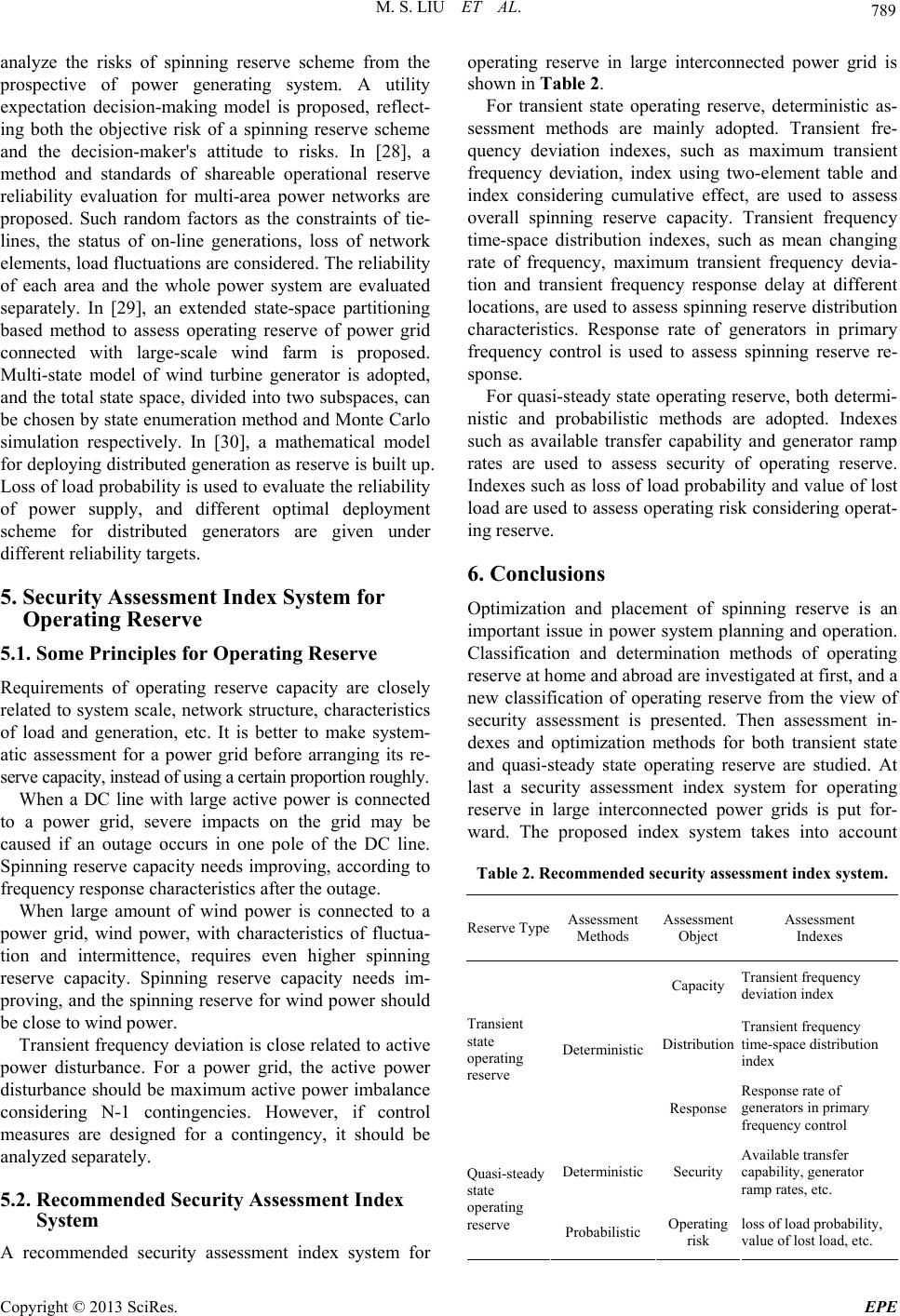 M. S. LIU ET AL. 789 analyze the risks of spinning reserve scheme from the prospective of power generating system. A utility expectation decision-making model is proposed, reflect- ing both the objective risk of a spinning reserve scheme and the decision-maker's attitude to risks. In [28], a method and standards of shareable operational reserve reliability evaluation for multi-area power networks are proposed. Such random factors as the constraints of tie- lines, the status of on-line generations, loss of network elements, load fluctuations are cons idered. The reliability of each area and the whole power system are evaluated separately. In [29], an extended state-space partitioning based method to assess operating reserve of power grid connected with large-scale wind farm is proposed. Multi-state model of wind turbine generator is adopted, and the total state space, divided into two subspaces, can be chosen by state enumeration method and Monte Carlo simulation respectively. In [30], a mathematical model for deploying distributed generation as reserve is built u p. Loss of load prob ability is used to evaluate the reliab ility of power supply, and different optimal deployment scheme for distributed generators are given under different reliability targets. 5. Security Assessment Index System for Operating Reserve 5.1. Some Principles for Operating Reserve Requirements of operating reserve capacity are closely related to system scale, network structure, characteristics of load and generation, etc. It is better to make system- atic assessment for a power grid before arranging its re- serve capacity, instead of using a certain proportion roughly. When a DC line with large active power is connected to a power grid, severe impacts on the grid may be caused if an outage occurs in one pole of the DC line. Spinning reserve capacity needs improving, according to frequency response characteristics after the outage. When large amount of wind power is connected to a power grid, wind power, with characteristics of fluctua- tion and intermittence, requires even higher spinning reserve capacity. Spinning reserve capacity needs im- proving, and the spinning reserve for wind power should be close to wind power. Transient frequency deviation is close related to active power disturbance. For a power grid, the active power disturbance should be maximum active power imbalance considering N-1 contingencies. However, if control measures are designed for a contingency, it should be analyzed separately. 5.2. Recommended Security Assessment Index System A recommended security assessment index system for operating reserve in large interconnected power grid is shown in Table 2. For transient state operating reserve, deterministic as- sessment methods are mainly adopted. Transient fre- quency deviation indexes, such as maximum transient frequency deviation, index using two-element table and index considering cumulative effect, are used to assess overall spinning reserve capacity. Transient frequency time-space distribution indexes, such as mean changing rate of frequency, maximum transient frequency devia- tion and transient frequency response delay at different locations, are used to assess spinning reserve distribution characteristics. Response rate of generators in primary frequency control is used to assess spinning reserve re- sponse. For quasi-steady state operating reserve, both determi- nistic and probabilistic methods are adopted. Indexes such as available transfer capability and generator ramp rates are used to assess security of operating reserve. Indexes such as loss of load probab ility and value of lost load are used to assess operating risk considering operat- ing reserve. 6. Conclusions Optimization and placement of spinning reserve is an important issue in power system planning and operation. Classification and determination methods of operating reserve at home and abroad are investigated at first, and a new classification of operating reserve from the view of security assessment is presented. Then assessment in- dexes and optimization methods for both transient state and quasi-steady state operating reserve are studied. At last a security assessment index system for operating reserve in large interconnected power grids is put for- ward. The proposed index system takes into account Table 2. Recommended security assessment index system. Reserve TypeAssessment Methods Assessment Object Assessment Indexes Capacity Transient frequency deviation index Distribution Transient frequency time-space di s tribution index Transient state operating reserve Deterministic Response Response rate of generators in primary frequency control DeterministicSecurity Available transfer capability, generator ramp rates, etc. Quasi-steady state operating reserve Probabilistic Operating risk loss of load probability, value of lost load, etc. Copyright © 2013 SciRes. EPE 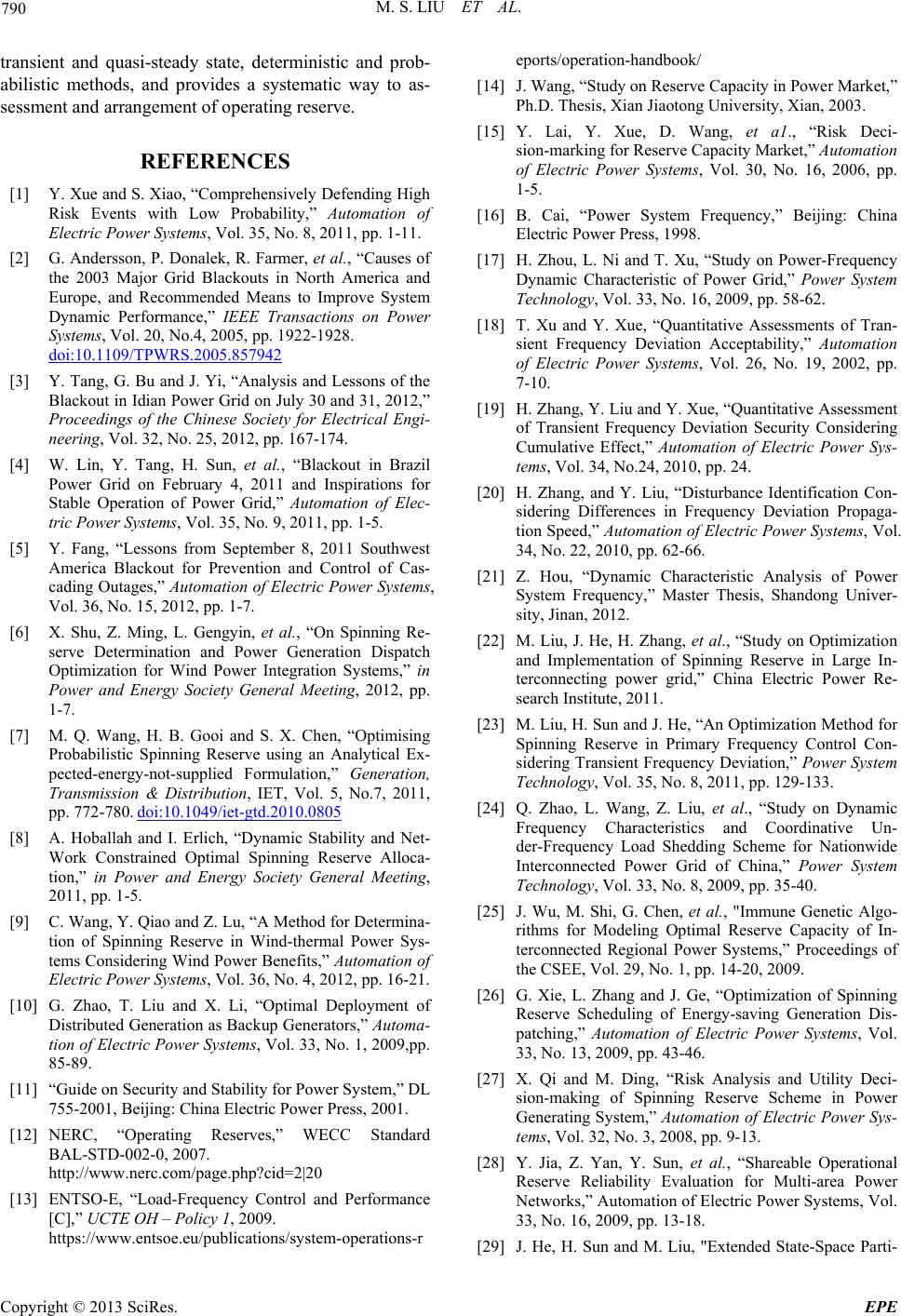 M. S. LIU ET AL. 790 transient and quasi-steady state, deterministic and prob- abilistic methods, and provides a systematic way to as- sessment and arrangement of operating reserve. REFERENCES [1] Y. Xue and S. Xiao, “Comprehensively Defending High Risk Events with Low Probability,” Automation of Electric Power Systems, Vol. 35, No. 8, 2011, pp. 1-11. [2] G. Andersson, P. Donalek, R. Farmer, et al., “Causes of the 2003 Major Grid Blackouts in North America and Europe, and Recommended Means to Improve System Dynamic Performance,” IEEE Transactions on Power Systems, Vol. 20, No.4, 2005, pp. 1922-1928. doi:10.1109/TPWRS.2005.857942 [3] Y. Tang, G. Bu and J. Yi, “Analysis and Lessons of the Blackout in Idian Power Grid on July 30 and 31, 2012,” Proceedings of the Chinese Society for Electrical Engi- neering, Vol. 32, No. 25, 2012, pp. 167-174. [4] W. Lin, Y. Tang, H. Sun, et al., “Blackout in Brazil Power Grid on February 4, 2011 and Inspirations for Stable Operation of Power Grid,” Automation of Elec- tric Power Systems, Vol. 35, No. 9, 2011, pp. 1-5. [5] Y. Fang, “Lessons from September 8, 2011 Southwest America Blackout for Prevention and Control of Cas- cading Outages,” Automation of Electric Power Systems, Vol. 36, No. 15, 2012, pp. 1-7. [6] X. Shu, Z. Ming, L. Gengyin, et al., “On Spinning Re- serve Determination and Power Generation Dispatch Optimization for Wind Power Integration Systems,” in Power and Energy Society General Meeting, 2012, pp. 1-7. [7] M. Q. Wang, H. B. Gooi and S. X. Chen, “Optimising Probabilistic Spinning Reserve using an Analytical Ex- pected-energy-not-supplied Formulation,” Generation, Transmission & Distribution, IET, Vol. 5, No.7, 2011, pp. 772-780. doi:10.1049/iet-gtd.2010.0805 [8] A. Hoballah and I. Erlich, “Dynamic Stability and Net- Work Constrained Optimal Spinning Reserve Alloca- tion,” in Power and Energy Society General Meeting, 2011, pp. 1-5. [9] C. Wang, Y. Qiao and Z. Lu, “A Method for Determina- tion of Spinning Reserve in Wind-thermal Power Sys- tems Considering Wind Power Benefits,” Automation of Electric Power Systems, Vol. 36, No. 4, 2012, pp. 16-21. [10] G. Zhao, T. Liu and X. Li, “Optimal Deployment of Distributed Generation as Backup Generators,” Automa- tion of Electric Power Systems, Vol. 33, No. 1, 2009,pp. 85-89. [11] “Guide on Security and Stability for Power System,” DL 755-2001, Beijing: China Electric Power Press, 2001. [12] NERC, “Operating Reserves,” WECC Standard BAL-STD-002-0, 2007. http://www.nerc.com/page.php?cid=2|20 [13] ENTSO-E, “Load-Frequency Control and Performance [C],” UCTE OH – Policy 1, 2009. https://www.entsoe.eu/publications/system-operations-r eports/operation-handbook/ [14] J. Wang, “Study on Reserve Capacity in Power Market,” Ph.D. Thesis, Xian Jiaotong University, Xian, 2003. [15] Y. Lai, Y. Xue, D. Wang, et a1., “Risk Deci- sion-marking for Reserve Capacity Market,” Automation of Electric Power Systems, Vol. 30, No. 16, 2006, pp. 1-5. [16] B. Cai, “Power System Frequency,” Beijing: China Electric Power Press, 1998. [17] H. Zhou, L. Ni and T. Xu, “Study on Power-Frequency Dynamic Characteristic of Power Grid,” Power System Technology, Vol. 33, No. 16, 2009, pp. 58-62. [18] T. Xu and Y. Xue, “Quantitative Assessments of Tran- sient Frequency Deviation Acceptability,” Automation of Electric Power Systems, Vol. 26, No. 19, 2002, pp. 7-10. [19] H. Zhang, Y. Liu and Y. Xue, “Quantitative Assessment of Transient Frequency Deviation Security Considering Cumulative Effect,” Automation of Electric Power Sys- tems, Vol. 34, No.24, 2010, pp. 24. [20] H. Zhang, and Y. Liu, “Disturbance Identification Con- sidering Differences in Frequency Deviation Propaga- tion Speed,” Automation of Electric Power Systems, Vol. 34, No. 22, 2010, pp. 62-66. [21] Z. Hou, “Dynamic Characteristic Analysis of Power System Frequency,” Master Thesis, Shandong Univer- sity, Jinan, 2012. [22] M. Liu, J. He, H. Zhang, et al., “Study on Optimization and Implementation of Spinning Reserve in Large In- terconnecting power grid,” China Electric Power Re- search Ins titute, 2011. [23] M. Liu, H. Sun and J. He, “An Optimization Method for Spinning Reserve in Primary Frequency Control Con- sidering Transient Frequency Deviation,” Power System Technology, Vol. 35, No. 8, 2011, pp. 129-133. [24] Q. Zhao, L. Wang, Z. Liu, et al., “Study on Dynamic Frequency Characteristics and Coordinative Un- der-Frequency Load Shedding Scheme for Nationwide Interconnected Power Grid of China,” Power System Technology, Vol. 33, No. 8, 2009, pp. 35-40. [25] J. Wu, M. Shi, G. Chen, et al., "Immune Genetic Algo- rithms for Modeling Optimal Reserve Capacity of In- terconnected Regional Power Systems,” Proceedings of the CSEE, Vol. 29, No. 1, pp. 14-20, 2009. [26] G. Xie, L. Zhang and J. Ge, “Optimization of Spinning Reserve Scheduling of Energy-saving Generation Dis- patching,” Automation of Electric Power Systems, Vol. 33, No. 13, 2009, pp. 43-46. [27] X. Qi and M. Ding, “Risk Analysis and Utility Deci- sion-making of Spinning Reserve Scheme in Power Generating System,” Automation of Electric Power Sys- tems, Vol. 32, No. 3, 2008, pp. 9-13. [28] Y. Jia, Z. Yan, Y. Sun, et al., “Shareable Operational Reserve Reliability Evaluation for Multi-area Power Networks,” Automation of Electric Power Systems, Vol. 33, No. 16, 2009, pp. 13-18. [29] J. He, H. Sun and M. Liu, "Extended State-Space Parti- Copyright © 2013 SciRes. EPE  M. S. LIU ET AL. Copyright © 2013 SciRes. EPE 791 tioning Based Operating Reserve Risk Assessment for Power Grid Connected With Wind Farms,” Vol. 36, No. 3, 2012, pp. 257-263. [30] G. Zhao, T. Liu and X. Li, “Optimal Deployment of Distributed Generation as Backup Generators,” Automa- tion of Electric Power Systems, Vol. 33, No. 1, 2009, pp. 85-89. |