

Paper Menu >>
Journal Menu >>
 Open Journal of Pediatrics, 2013, 3, 294-299 OJPed http://dx.doi.org/10.4236/ojped.2013.34053 Published Online December 2013 (http://www.scirp.org/journal/ojped/) Teenage pregnancy and implications on child survival amongst mothers attending a clinic in the East-End, Freetown, Sierra Leone* Tamramat I. Runsewe-Abiodun#, Sahr F. Bondi Ola during Children’s Hospital, Freetown, Sierra Leone Email: #[email protected] Received 22 August 2013; revised 16 September 2013; accepted 23 September 2013 Copyright © 2013 Tamramat I. Runsewe-Abiodun, Sahr F. Bondi. This is an open access article distributed under the Creative Com- mons Attribution License, which permits unrestricted use, distribution, and reproduction in any medium, provided the original work is properly cited. ABSTRACT Introduction: Every year it is estimated that about 14 million adolescent girls give birth globally with the highest rat e (143 per 1000 girls aged 15 - 19 years) in the sub-Saharan Africa. Babies born to adolescent mothers are at greater risk and are far more likely to die than those born to older women. This study therefore sets out to describe the health care seeking behaviors in a cohort of teenage mothers attending an Under-Five Clinic in a densely populated section of Freetown, Sierra Leone with a view of determining the impact of their behavior on the survival of their children. Methodology: This is a descriptively cross sectional and prospective study that involved four hundred and six mothers attending the Under-Five Clinic in the Eastern end of Freetown using semi- closed ended questionnaire which were interviewers administered between 1st and 29th July 2011. Result: The age of the study population ranged between 12 and 45 years, with a mean of 24.8 ± 6.3 years. Of the four hundred and six, eighty nine (21%) were teen- agers (less than 20 years) with a majority (60.6%) of them being between 18 and 19 years old. Concern- ing the 89 teenage mothers in the study population, the majority (95.5%) did not possess the secondary school education, 42.7% were petty traders and more than a half of them (61.8%) were married. The mothers were rated low in all the activities geared towards child survival except immunization. In addi- tion there was a delay in the initiation of complemen- tary feeds which were also of poor quality. Fewer percentages of the mothers who had antenatal care in the hospitals delivered there. Conclusion: This study has revealed that early marriage is still common in Sierra Leone. Also the teenage mothers did not en- gage fully in a majority of activities that have been proven to contribute to the survival of babies in the Tropics thereby making their children vulnerable to malnutrition, measles and diarrhoeal diseases. It was recommended that the country should use recognised teenage programs aimed at urgently addressing a reduction in teenage pregnancy especially by im- proving the provision of education/vocational studies for the girl child. Keywords: Teenage Pregnancy; Under-Five Mortality; Freetown 1. INTRODUCTION The definition of a teenager is as varied as who is an adolescent. Generally, teenage pregnancy is considered as that occurring between thirteen and eighteen years of age. Occasionally girls as young as ten who are sexually active could become pregnant. Every year it is estimated that about 14 million ado- lescent girls give birth globally [1] with the highest rate (143 per 1000 girls aged 15 - 19 years) in the sub-Saha- ran Africa [2]. It is also believed that women in Africa generally get married at earlier ages than elsewhere leading to early pregnancies [3]. Teenage pregnancy is beginning to attract significant interest among researchers, political and religiou s leaders, social scientists and co mmentators as a result of its com- plexity, health and social implications. *Disclosure: the authors declare no special interest. Authors’ contribution: TIR conceived the study and wrote the initial draft. SF read through for intellectual content and clarity. Both authors p repared and agreed on the fina l c ontent of the manuscript. #Corres p ondin g author. The association between teenage pregnancy and social disadvantage is global [4-7] and the continuing appre- OPEN ACCESS  T. I. Runsewe-Abiodun, S. F. Bondi / Open Journal of Pediatrics 3 (2013) 294-299 295 hension about teenage pregnancy is based on the pro- found impact that teenage pregnancy can have on the health of the girls and their children. Africa faces some of the most daunting pub lic health problems in the world and to meet the Millennium Development Goals, African countries therefore need to reduce teenage pregnancy [8]. In Sierra Leone, the 2008 DHS Survey revealed that 16 percent of pregnant women between 15 and 49 years were married befor e the age of 15 years and abou t a half before 18 years. A majority of them are in the poorest wealth quintile [9]. It is agreed that babies born to adolescent mothers are at greater risk. A review found that adolescent pregnan- cies are associated with premature delivery, still birth, fetal distress, birth asphyxia, low birth weight and mis- carriages. Also, babies born to teen mothers are also far more likely to die than those born to older women [10]. This study therefore sets out to describe the health care seeking behaviors in a cohort of teenage mothers attend- ing an Under-Five Clinic in a densely populated region of Freetown, Sierra Leone with a view to determining the impact of their behavior on the survival of their children. 2. METHODOLOGY This is a descriptive cross sectional prospective study that involved a cohort of mothers (four hundred and six) attending the under-five clinic in the Eastern end of Freetown. Freetown is the socio and economic nerve centre of Sierra-Leone. It is the capital and largest city. The city of Freetown is politically divided into three “ends”; eight municipalities or wards. The East End of Freetown has three wards: East I, East II, and East III; the Central Freetown includes two wards: Central I and Central II and the West End of Freetown co ntain the wards West I, West II, and West III. The wards in the East End of Freetown are the most densely populated and are inhab- ited by the poorest in the city. The estimated population of Freetown is 773,000 [9]. Mothers attending the clinic were consecutively re- cruited into the study between 1st July and 29th July 2011. Semi-closed ended questionnaire were interviewer ad- ministered. Permission for the study was obtained from the medi- cal superintendent of the Ola during Children’s Hospital to which the under-five clinic is affiliated and a written informed consent also obtained from the prospective study subjects. Data included in the questionnaire were information on the bio data, socio-economic status of mother, sexual- ity issues and other maternal information that may affect the health of the child e.g. family planning choices, number of children, child health care seeking and prac- tices, family planning, pattern of breastfeeding, atten- dance at Antenatal clinic, growth monitoring for the in- dex child, knowledg e abou t ORS etc. Th e index ch ild bio data, immunization status, anthropometric parameter, and 24-hour dietary were recalled. The nutritional status was determined based on the Gomez classification [11]. Data entry, validation and analysis were done using Epi-info 3.5.3 software. Frequency tables were generated for all the categorical variables and association between them was tested using the chi-square test. Means and standard deviations and other descriptive measures were determined for quantitative variables such as age, parity, etc. Level of significance was set at p value < 0.05. 3. RESULT A total of 406 mothers attending the clinic were con- secutively recruited into the study. The age of the study population ranged between 12 and 45 years, with a mean of 24.8 ± 6.3 years. Over 40.5% of the study population had their first child as teenager. Age of first sexual contact in the study population ranged between 10 - 18 years. There was a significant posi- tive correlation between the time of first sexual con- tact and first child correlation coefficient was 0.99 and p value of 0.0000. Socio-demographic characteristics of the teenage moth e r s Of the four hundred and six, eighty nine (21%) were teenagers (less than 20 years) with a majority (60.6%) of them being between 18 and 19 years old. The age range of the teenage mothers ranged between 12 and 19 years. The mean age of the teenage mothers was 17.5 ± 1.6 years. They reside mainly in the eastern end of Freetown (85.4%). Over two-thirds of the mothers (77.5%) were Moslems, 19.1%, Christians and 3.3% were traditional believers. Concerning the 89 teenage mothers in the study popu- lation, the majority (95.5%) did not possess the sec- ondary school certificate; 44(49.4%) did not go be- yond secondary education, 34(38.2%) had no formal education and 8(9.0%) had primary education. Ma- jority of them were petty traders (42.7%), the others were students, artisans or unemployed. More than a half of them (61.8%) were married. This was the first pregnancy in a majority, 72(80.9%), of the teenage mothers. Table 1 depicts the socio-demographic char- acteristics of the teenage mothers in the study popu la- tion. Child survival activities among the teenage mothers As shown in Table 2, slightly more than a half (65.9%) of the teenage mothers take their children for growth monitoring and about a quarter (25.3%) of them can cor- rectly prepare ORS. This activity is significantly differ- Copyright © 2013 SciRes. OPEN ACCESS 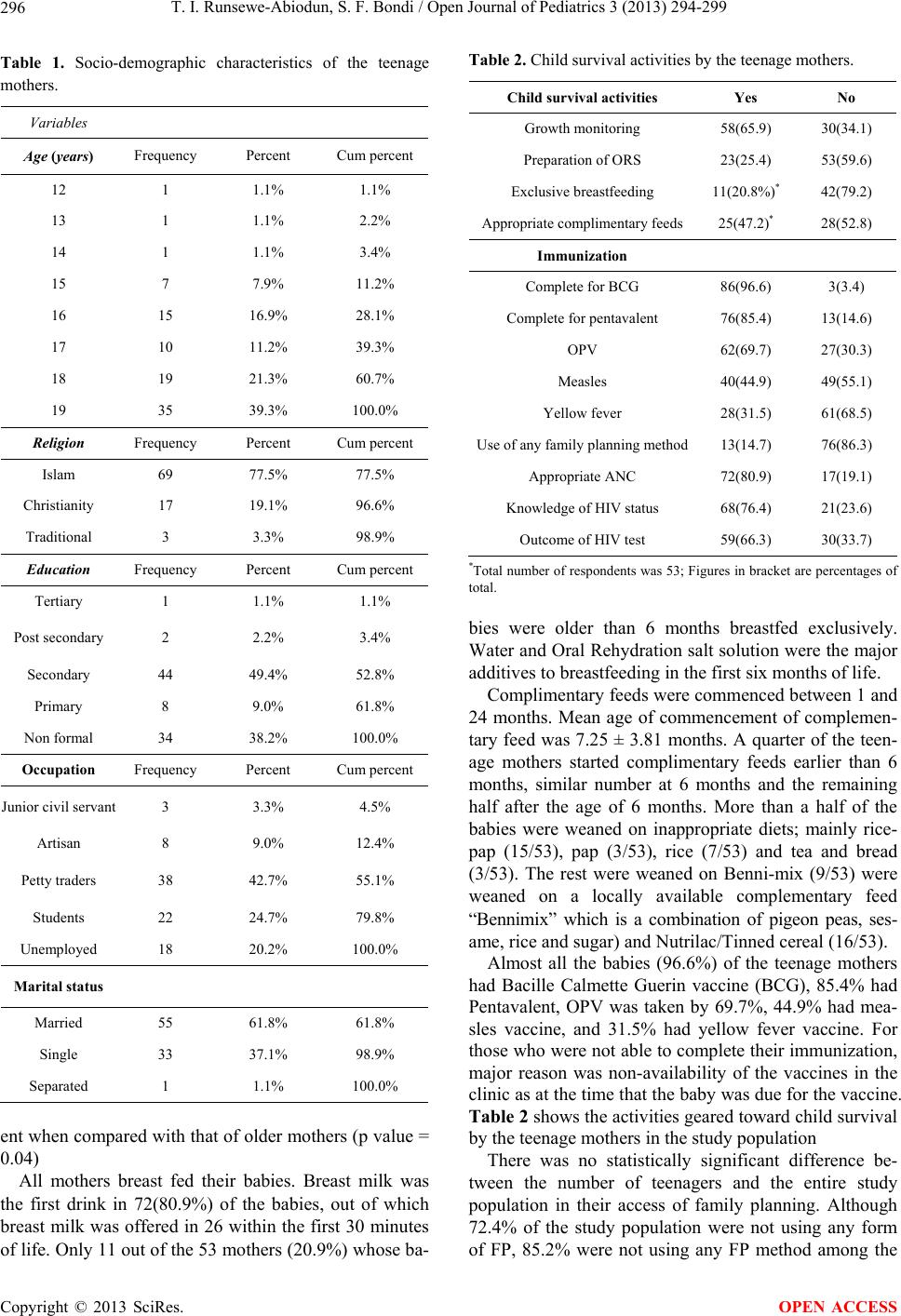 T. I. Runsewe-Abiodun, S. F. Bondi / Open Journal of Pediatrics 3 (2013) 294-299 296 Table 1. Socio-demographic characteristics of the teenage mothers. Variables Age (years) Frequency Percent Cum percent 12 1 1.1% 1.1% 13 1 1.1% 2.2% 14 1 1.1% 3.4% 15 7 7.9% 11.2% 16 15 16.9% 28.1% 17 10 11.2% 39.3% 18 19 21.3% 60.7% 19 35 39.3% 100.0% Religion Frequency Percent Cum percent Islam 69 77.5% 77.5% Christianity 17 19.1% 96.6% Traditional 3 3.3% 98.9% Education Frequency Percent Cum percent Tertiary 1 1.1% 1.1% Post secondary 2 2.2% 3.4% Secondary 44 49.4% 52.8% Primary 8 9.0% 61.8% Non formal 34 38.2% 100.0% Occupation Frequency Percent Cum percent Junior civil servant 3 3.3% 4.5% Artisan 8 9.0% 12.4% Petty traders 38 42.7% 55.1% Students 22 24.7% 79.8% Unemployed 18 20.2% 100.0% Marital status Married 55 61.8% 61.8% Single 33 37.1% 98.9% Separated 1 1.1% 100.0% ent when compared with that of older mothers (p value = 0.04) All mothers breast fed their babies. Breast milk was the first drink in 72(80.9%) of the babies, out of which breast milk was offered in 26 within the first 30 minutes of life. On ly 11 out of the 53 mothers (2 0.9%) whose ba- Table 2. Child survival activities by the teenage mothers. Child survival activities Yes No Growth monitoring 58(65.9) 30(34.1) Preparation of ORS 23(25.4) 53(59.6) Exclusive breastfeeding 11(20.8%)* 42(79.2) Appropriate complimentary feeds 25(47.2)* 28(52.8) Immunization Complete for BCG 86(96.6) 3(3.4) Complete for pentavalent 76(85.4) 13(14.6) OPV 62(69.7) 27(30.3) Measles 40(44.9) 49(55.1) Yellow fever 28(31.5) 61(68.5) Use of any family planning method 13(14.7) 76(86.3) Appropriate ANC 72(80.9) 17(19.1) Knowledge of HIV status 68(76. 4) 21(23.6) Outcome of HIV test 59(66.3) 30(33.7) *Total number of respondents was 53; Figures in bracket are percentages of total. bies were older than 6 months breastfed exclusively. Water and Oral Rehydration salt solution were the major additives to breastfeeding in the first six months of life. Complimentary feeds were commenced between 1 and 24 months. Mean age of commencement of complemen- tary feed was 7.25 ± 3.81 months. A quarter of the teen- age mothers started complimentary feeds earlier than 6 months, similar number at 6 months and the remaining half after the age of 6 months. More than a half of the babies were weaned on inappropriate diets; mainly rice- pap (15/53), pap (3/53), rice (7/53) and tea and bread (3/53). The rest were weaned on Benni-mix (9/53) were weaned on a locally available complementary feed “Bennimix” which is a combination of pigeon peas, ses- ame, rice and sugar) and Nutrilac/Tinned cereal (16/53). Almost all the babies (96.6%) of the teenage mothers had Bacille Calmette Guerin vaccine (BCG), 85.4% had Pentavalent, OPV was taken by 69.7%, 44.9% had mea- sles vaccine, and 31.5% had yellow fever vaccine. For those who were not ab le to complete their immunization , major reason was non-availability of the vaccines in the clinic as at the time that the baby was due for the vaccine. Table 2 shows the activities geared toward child su rvival by the teenage mothers in the study popu lation There was no statistically significant difference be- tween the number of teenagers and the entire study population in their access of family planning. Although 72.4% of the study population were not using any form of FP, 85.2% were not using any FP method among the Copyright © 2013 SciRes. OPEN ACCESS 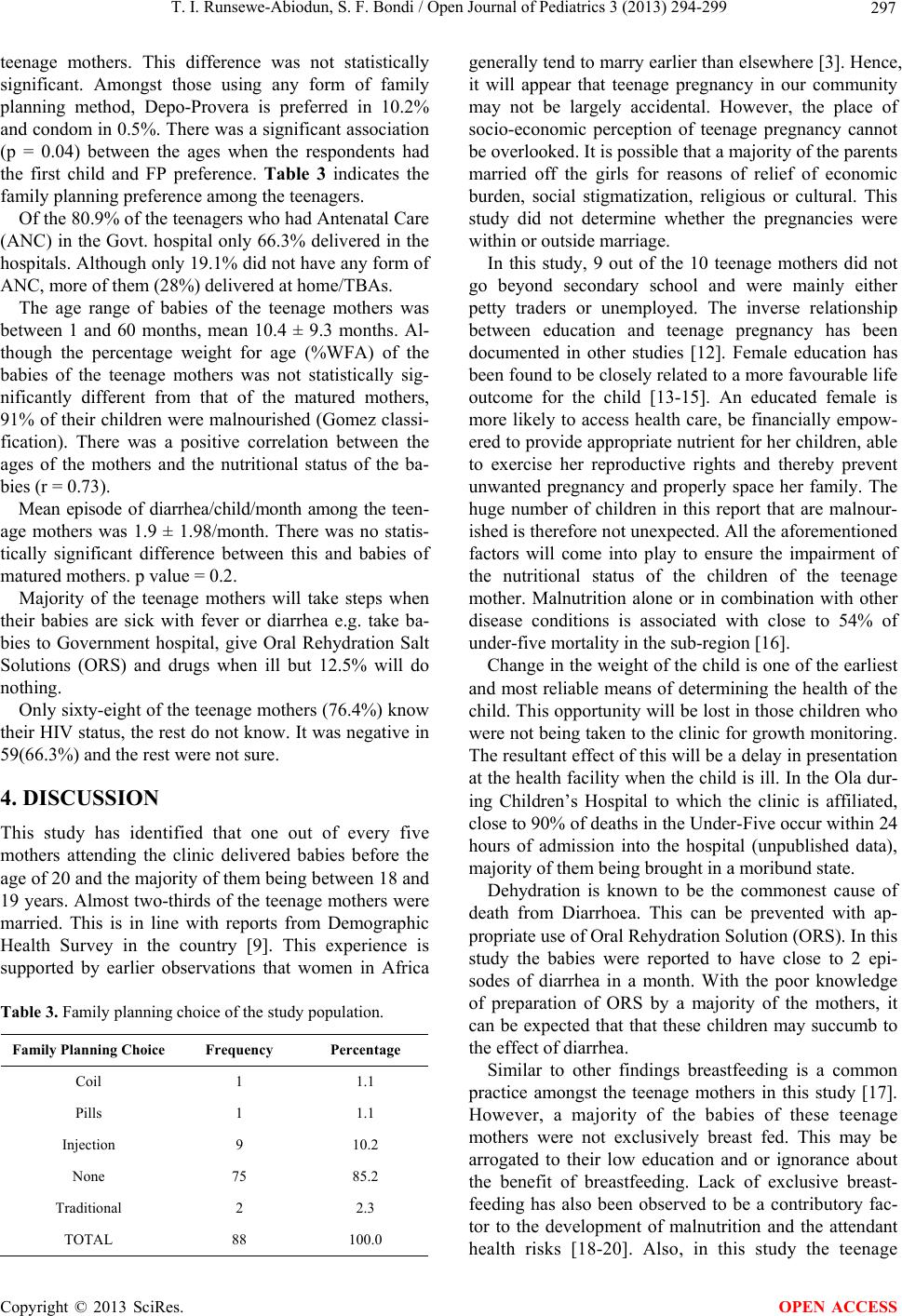 T. I. Runsewe-Abiodun, S. F. Bondi / Open Journal of Pediatrics 3 (2013) 294-299 297 teenage mothers. This difference was not statistically significant. Amongst those using any form of family planning method, Depo-Provera is preferred in 10.2% and condom in 0.5%. There was a significant association (p = 0.04) between the ages when the respondents had the first child and FP preference. Table 3 indicates the family planning preference among the teenagers. Of the 80.9% of the teen agers who had Anten atal Care (ANC) in the Govt. hospital only 66.3% delivered in the hospitals. Although only 19.1% did not have any form of ANC, more of them (28%) delivered at home/TBAs. The age range of babies of the teenage mothers was between 1 and 60 months, mean 10.4 ± 9.3 months. Al- though the percentage weight for age (%WFA) of the babies of the teenage mothers was not statistically sig- nificantly different from that of the matured mothers, 91% of their children were malnourished (Gomez classi- fication). There was a positive correlation between the ages of the mothers and the nutritional status of the ba- bies (r = 0.73). Mean episode of diarrhea/child/month among the teen- age mothers was 1.9 ± 1.98/month. There was no statis- tically significant difference between this and babies of matured mothe rs. p val ue = 0.2. Majority of the teenage mothers will take steps when their babies are sick with fever or diarrhea e.g. take ba- bies to Government hospital, give Oral Rehydration Salt Solutions (ORS) and drugs when ill but 12.5% will do nothing. Only sixty-eight of the teenage mothers (76.4 %) know their HIV status, the rest do not know. It was negative in 59(66.3%) and the rest were not sure. 4. DISCUSSION This study has identified that one out of every five mothers attending the clinic delivered babies before the age of 20 and the majority of them being between 18 and 19 years. Almost two-thirds of the teenage mothers were married. This is in line with reports from Demographic Health Survey in the country [9]. This experience is supported by earlier observations that women in Africa Table 3. Family planning choice of the study population. Family Planning Choice Frequency Percentage Coil 1 1.1 Pills 1 1.1 Injection 9 10.2 None 75 85.2 Traditional 2 2.3 TOTAL 88 100.0 generally tend to marry earlier than elsewhere [3]. Hence, it will appear that teenage pregnancy in our community may not be largely accidental. However, the place of socio-economic perception of teenage pregnancy cannot be overlooked. It is possible that a majority of the parents married off the girls for reasons of relief of economic burden, social stigmatization, religious or cultural. This study did not determine whether the pregnancies were within or outside marriage. In this study, 9 out of the 10 teenage mothers did not go beyond secondary school and were mainly either petty traders or unemployed. The inverse relationship between education and teenage pregnancy has been documented in other studies [12]. Female education has been found to be closely related to a more favourable life outcome for the child [13-15]. An educated female is more likely to access health care, be financially empow- ered to provide appropriate nutrient for her children, able to exercise her reproductive rights and thereby prevent unwanted pregnancy and properly space her family. The huge number of children in this report that are malnour- ished is therefore not unexpected. All the aforementioned factors will come into play to ensure the impairment of the nutritional status of the children of the teenage mother. Malnutrition alone or in combination with other disease conditions is associated with close to 54% of under-five mortality in the sub-region [16]. Change in the weight of the child is one of the earliest and most reliable means of determining the health of the child. This opportunity will be lost in tho se children who were not being taken to the clin ic for growth monitoring. The resultant effect of this will be a delay in presentatio n at the health facility when the child is ill. In the Ola dur- ing Children’s Hospital to which the clinic is affiliated, close to 90% of deaths in the Under-Five occur within 24 hours of admission into the hospital (unpublished data), majority of them being brought in a moribund state. Dehydration is known to be the commonest cause of death from Diarrhoea. This can be prevented with ap- propriate use of Oral Rehydration Solution (ORS). In this study the babies were reported to have close to 2 epi- sodes of diarrhea in a month. With the poor knowledge of preparation of ORS by a majority of the mothers, it can be expected that that these children may succumb to the effect of diarrhea. Similar to other findings breastfeeding is a common practice amongst the teenage mothers in this study [17]. However, a majority of the babies of these teenage mothers were not exclusively breast fed. This may be arrogated to their low education and or ignorance about the benefit of breastfeeding. Lack of exclusive breast- feeding has also been observed to be a contributory fac- tor to the development of malnutrition and the attendant health risks [18-20]. Also, in this study the teenage Copyright © 2013 SciRes. OPEN ACCESS  T. I. Runsewe-Abiodun, S. F. Bondi / Open Journal of Pediatrics 3 (2013) 294-299 298 mothers commenced complimentary feeds much earlier and even at that the feed s were of poor quality. Although breastfeeding for a long period has been associated with better cognitive and language development in children [21], a delay in adding complementary feeds as being practiced by some of the teenage mothers have been as- sociated with m a l nut r i t i on [22]. The nutritional status of some of these children must have been evidently compromised by the recurring epi- sodes of diarrhea and lack of exclusive breastfeeding. This study has found a strong positive correlation be- tween the nutritional status of the children and the ages of the mothers. The implication is that with maturity in the age of the mothers a more favorable outcome can be expected in the child. Malnutrition is known to be a major contributor (54%) to chil dhood deat hs in the tropics [16] . A majority of the teenage mothers were not using any form of family planning; hence, there is a tendency for repeat pregnancy not adequately spaced with complica- tions for the moth er and implication for the health of the child. 5. CONCLUSION This study has revealed that the teenage mothers that do not engage in a majority of activities hav e been proved to ensure the survival of their babies probably because of their low education. Therefore, it can be expected that their children will have a less favorable outcome with malnutrition, measles and diarrhoeal diseases, which are three of the major disease conditions associated with un- der-five mortality in the sub-region. 6. RECOMMENDATIONS 1) Teen pregnancy prevention programs e.g. use of mass media campaigns to promote safe sex. 2) A rise in school leaving age has been predicted to cut number of teenage pregnancies. This can be advo- cated in the country. 3) In as much as traditional and religious leaders preach abstinence, it may be more realistic that more effective birth control practice be advocated in teenagers as they are sexually active. 4) This study has rev ealed that the average age of first sexual contact is about 10 years in the country, hence primary school students must be educated about sex and sexuality and the consequences of pregn a ncy. 5) Bye laws and others to discourage child marriage. Cooperation of religious and traditional leaders will be needed in achieving this. 6) Support must be given to organizations aimed at provision of holistic approa ch to management of teenage pregnancy related issues; counselling, training, etc. 7. ACKNOWLEDGEMENTS The Authors appreciate the assistance of Miss Martins and… in admin- istering the questionnaires and the cooperation of the entire staff of Jen- ner-Wright Clinic , Freetown. REFERENCES [1] UNFPA (2013) State of world population 2004. www.unfpa.org/public/cache/offonce/home/publications/ pid/2104 [2] World Health Organization (2012) Adolescent pregnancy fact sheet No. 364. www.who.int/mediacentre/factsheets/fs364/en/ [3] Bayisenge, J. (2013) Early marriage as a barrier to girl’s education: A developmental challenge in Africa. www.ifuw.org/fuwa/docs/Early-marriage.pdf [4] Holgate, H., Evans, R. and Yuen, F.K.O. (2006) Teenage pregnancy and parenthood: Global perspectives, issues and interventions. Routledge, New York. [5] Harden, A., Brunton, G., Fletcher, A. and Oakley, A. (2009) Teenage pregnancy and social disadvantage: Sys- tematic review integrating controlled trials and qualitative studies. Britis h Me d i c al Journal, 339, 1182-1185. http://dx.doi.org/10.1136/bmj.b4254 [6] Cherry, A.L., Byers, L. and Dillon, M.E. (2009) A global perspective on teen pregnancy. In: Ehiri, J., Ed., Maternal and Child Health: Global Challenges, Programs, and Policies, Springer, New York, 375-397. http://dx.doi.org/10.1007/b106524_21 [7] Jiang, N., Kolbe, L.J., Seo, D. -C., Kay, N.S. and Brindis, C.D. (2011) Health of adolescents and young adults: Trends in achieving the 21 critical national health objec- tives by 2010. Journal of Adolescent Health, 49, 124-132. http://dx.doi.org/10.1016/j.jadohealth.2011.04.026 [8] (2013) The linkages between the MDGs and young wo- men’s health. http://www.youthcoalition.org/attachs/MH_MDG_factsh eet_webversion.pdf [9] Sierra Leone demographic and health survey report 2008. www.meaasuredhs.com/pubs [10] Reichman, N.E. and Pagnini, D.L. (1998) Maternal age and birth outcomes: Data from New Jersey. Family Plan- ning Perspectives, 30, 127. http://dx.doi.org/10.2307/2991626 [11] Gomez, F. and Galvan, R.R. (2000) Mortality in 2nd and 3rd degree malnutrition. Bulletin of the World Health Or- ganization, 78, 1275-1280. [12] Gakidou, E., Cowling, K., Lozano, R. and Murray, C.J.L. (2010) Increased educational attainment and its effect on child mortality in 175 countries between 1970 and 2009: A systematic analysis. Lancet, 376, 959-974. http://dx.doi.org/10.1016/S0140-6736(10)61257-3 [13] Cleland, J.G. and van Ginneken, J.K. (1998) Maternal education and child survival in developing countries: The search for pathways of influence. Social Science and Medicine, 29, 1357-1368. [14] Hobcarft, J. (1993) Women’s education, child welfare Copyright © 2013 SciRes. OPEN ACCESS  T. I. Runsewe-Abiodun, S. F. Bondi / Open Journal of Pediatrics 3 (2013) 294-299 Copyright © 2013 SciRes. 299 OPEN ACCESS and child survival: A review of evidence. Health Transi- tion Review, 3, 159-175. [15] UNICEF State of the World Children (2007) The link between child survival and women’s empowerment. www.unicef.org/media [16] UNICEF (2012) Nutrition report. [17] Batal, M., Boulghourjian, C., Abdallah, A. and Afifi, R. (2006) Breast-feeding and feeding practices of infants in a developing country: A national survey in Lebanon. Public Health Nutrition, 9, 313-319. http://dx.doi.org/10.1079/PHN2006860 [18] Lamberti, L.M., Walker, C.L.F., Noiman, A., Victora, C. and Black, R.E. (2011) Breastfeeding and the risk for di- arrhea morbidity and mortality. BMC Public Health, 11, S15-S27. http://dx.doi.org/10.1186/1471-2458-11-S3-S15 [19] Imdad, A., Yakoob, M.Y. and Bhutta, Z.A. (2011) Effect of breastfeeding promotion interventions on breastfeeding rates, with special focus on developing countries. BMC Public Health, 11, S24-S32. http://dx.doi.org/10.1186/1471-2458-11-S3-S24 [20] Black, R.E., Allen, L.H., Bhutta, Z.A, Caulfield, L.E., de Onis, M., Ezzati, M., et al. (2008) Maternal and child undernutrition: Global and regional exposures and health consequences. The Lancet, 371, 243-260. http://dx.doi.org/10.1016/S0140-6736(07)61690-0 [21] Belfort, M.B., Rifas-Shiman, S.L., Kleinman, K.P., Guth- rie, L.B., Bellinger, D.C., Taveras, E.M., Gillman, M.W. and Oken, E. (2013) Infant feeding and childhood cogni- tion at ages 3 and 7 years: Effects of breastfeeding dura- tion and exclusivity. JAMA Pediatrics, 167, Epub ahead of print. [22] Agarwal, K.N. (2011) Weaning practices in other parts of the world: Case study India. Nestle Nutrition Workshop Series. Paediatric Programme, 68, 107-115. http://dx.doi.org/10.1159/000325670 |