

Paper Menu >>
Journal Menu >>
 Journal of Computer and Communications, 2013, 1, 9-13 http://dx.doi.org/10.4236/jcc.2013.15002 Published Online October 2013 (http://www.scirp.org/journal/jcc) Copyright © 2013 SciRes. JCC 9 Protein-Protein Interac ti on Extraction Based on Convex Combination Kernel Function Peng Chen, Jianyi Guo, Zhengtao Yu, Sichao Wei, Feng Zhou, Xin Yan 1The School of Information Engineering and Automation, Kunming University of Science and Technology, Kunming, China; 2Key Laboratory of Intelligent Information Processing, Kunming University of Science and Technology, Kunming, China. Email: [email protected] Received August 2013 ABSTRACT Owing to the effect of classified models was different in Protein-Protein Interaction (PPI) extraction, which was made by different single kernel functions, and only using single kernel function hardly trained the optimal clas sif ied model to extract PPI, this paper presents a strategy to find the optimal kernel function from a kernel function set. The strategy is that in the kernel function set which consists of different single kernel functions, endlessly finding the last two kernel functions on the performance in PPI extraction, using their optimal kernel function to replace them, until there is only one kernel function and it’s the final opti mal kernel f unction . Finall y, ex tracting PPI using th e classif ied model made by this kernel function. This paper conducted the PPI extraction experiment on AIMed corpus, the experimental result shows that the optimal convex combination kernel function this paper presents can effectively improve the extraction performance than single kernel function, and it gets the best precision wh ich reach es 65.0 among the similar PPI extra c- tion systems. Keywords: Protein-Protein Interaction; Support Vector Machine; Convex Combination Kernel Function 1. Introduction That the presented protein entities exist interaction rela- tion of the article in biomedical field is called Protein- Protein Interaction. PPI is vital for knowing the single proteins and the organization of the entire biological process. Recently, PPI becomes an important and hot task in biomedical field. There is a surge of research in- terest in PPI. Early studies on PPI ex traction mostly employ the ma- chine learning method, it includes the convolution kernel based method [1-3] and feature based method [4-7]. The main difference of these two methods is the way they get their high dimension matrixes. The convolution kernel-ba- sed method expresses the sentence as string [2], tree [1], graph [3] or other structured ways, and determine the high dimension matrix by counting the number of same substructure in two sentences. The feature based method needs select features firstly, Miyao, Y. et al. [5] employ- ed three syntactic analysis methods and made syntactic information as the feature, Liu B et al. [6] used depen- dent information as features, Bui Q-C et al. [7 ] used key- words as the feature. When features have been determin- ed, the method expresses the sentence as feature vector, then gets the high dimension matrix mapping by com- mon kernel functions. For the high computation comple- xity, the convolution kernel based method or the compo- site method which includes the convolution kernel-based method is not adaptive in the practical PPI extraction system. The feature based method which can get the high dimension matrix at a high rate of speed becomes the mainstream. What calls for special atten tion is that in the feature-based method, the high dimension matrix is the only information in getting the classified model by train- ing, so the selection of the kernel function is crucial in PPI extraction. Niu Y et al. [4] and Bui Q -C et a l. [7] re- spectively used a linear kernel function and radial basis function (RBF Kernel) as the kernel function. The effect of classified models was different in PPI extraction, which was made by different single different kernel functions, and only using single kernel function hardly trained the optimal classified model to extract PPI. For the above problem, this paper presents a strategy that finds the optimal kernel function from a single ker- nel function set consists of some single kernel functions. On the basis of corpus pretreatment, selection features and getting high dimension matrixes by mapping from different single kernel functions, then achieving their classified models by training. The next step is that en- dlessly finding the last two kernel functions on the per- formance in PPI extraction, using their optimal kernel 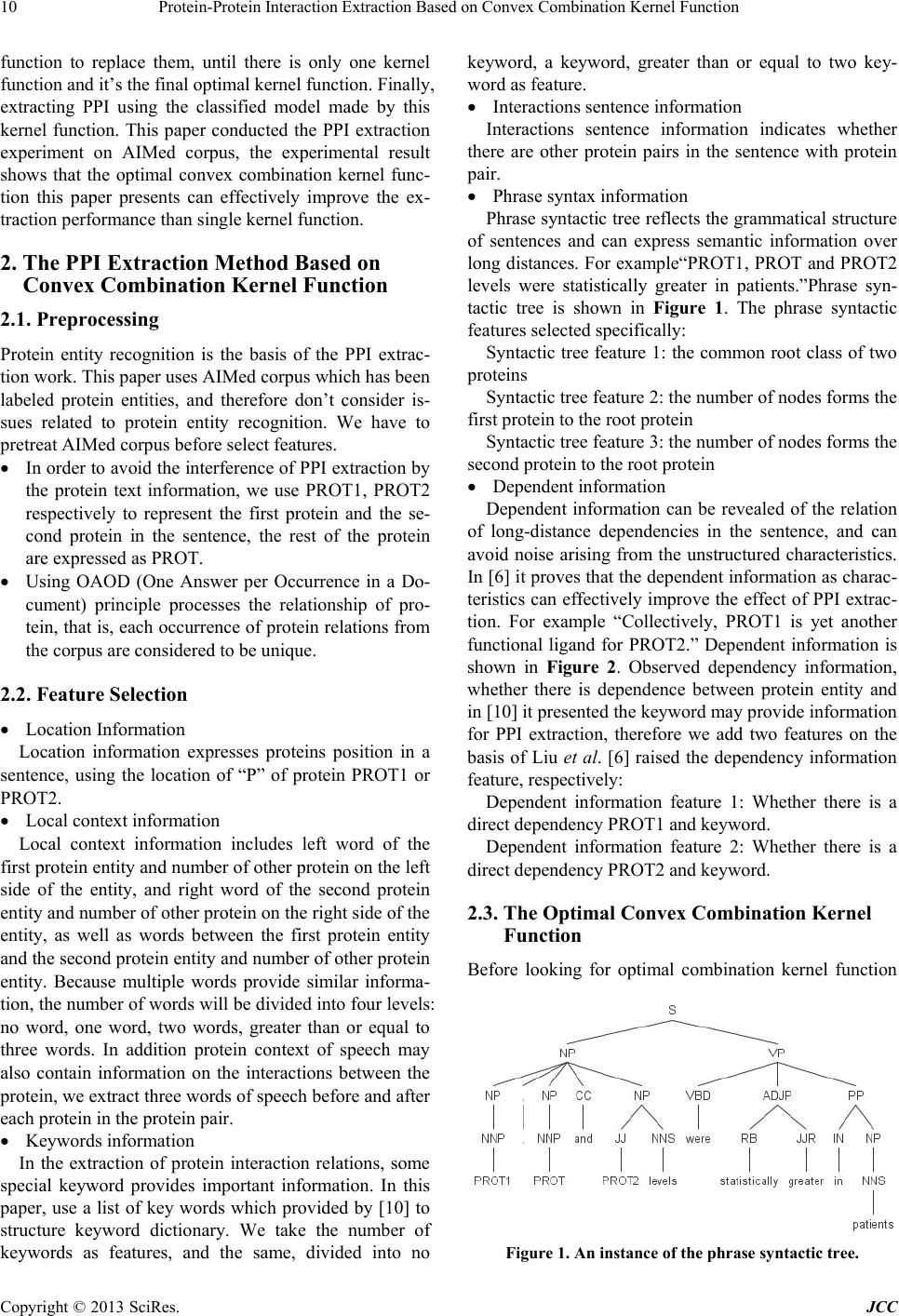 Protein-Protein Interaction Extraction Based on Convex Combination Kernel Function Copyright © 2013 SciRes. JCC 10 function to replace them, until there is only one kernel function and it’s the final op timal kernel function. Finally, extracting PPI using the classified model made by this kernel function. This paper conducted the PPI extraction experiment on AIMed corpus, the experimental result shows that the optimal convex combination kernel func- tion this paper presents can effectively improve the ex- traction performance than single kernel function. 2. The PPI Extraction Method Based on Convex Combination Kernel Function 2.1. Preprocessing Protein entity recognition is the basis of the PPI extrac- tion work. This paper uses AIMed corpus which has been labeled protein entities, and therefore don’t consider is- sues related to protein entity recognition. We have to pretreat AIMed corpus before select features. • In order to avoid the interference of PPI extraction by the protein text information, we use PROT1, PROT2 respectively to represent the first protein and the se- cond protein in the sentence, the rest of the protein are expressed as PROT. • Using OAOD (One Answer per Occurrence in a Do- cument) principle processes the relationship of pro- tein, that is, each occurrence of protein relations from the corpus are considered to be unique. 2.2. Feature Selection • Location Information Location information expresses proteins position in a sentence, using the location of “P” of protein PROT1 or PROT2. • Local context information Local context information includes left word of the first protein entity and number of other protein on the left side of the entity, and right word of the second protein entity and number of other protein on the right side of the entity, as well as words between the first protein entity and the second protein entity and number of other protein entity. Because multiple words provide similar informa- tion, the number of words will be divided into four levels: no word, one word, two words, greater than or equal to three words. In addition protein context of speech may also contain information on the interactions between the protein, we extract three words of speech before and after each prot e i n in the protein pair. • Keywords information In the extraction of protein interaction relations, some special keyword provides important information. In this paper, use a list of key words which provided by [10] to structure keyword dictionary. We take the number of keywords as features, and the same, divided into no keyword, a keyword, greater than or equal to two key- word as feature. • Interactions sentence information Interactions sentence information indicates whether there are other protein pairs in the sentence with protein pair. • Phrase syntax information Phrase syntactic tree reflects the grammatical structure of sentences and can express semantic information over long distances. For example“PROT1, PROT and PROT2 levels were statistically greater in patients.”Phrase syn- tactic tree is shown in Fig ure 1. The phrase syntactic features selected specifically: Syntactic tree feature 1: the common root class of two proteins Syntactic tree feature 2: the number of nodes forms the first protein to the root protein Syntactic tree feature 3: the number of nodes forms the second pr ot e in to the root prot e in • Dependent information Dependent information can be revealed of the relation of long-distance dependencies in the sentence, and can avoid noise arising from the unstructured characteristics. In [6] it proves that the dependent information as charac- teristics can effectively improve the effect of PPI extrac- tion. For example “Collectively, PROT1 is yet another functional ligand for PROT2.” Dependent information is shown in Figure 2. Observed dependency information, whether there is dependence between protein entity and in [10] it presented the keyword may provide information for PPI extraction, therefore we add two features on the basis of Liu et al. [6] raised the dependency information feature, respectively: Dependent information feature 1: Whether there is a direct de pendenc y PR OT1 and key word. Dependent information feature 2: Whether there is a direct de pendenc y PR OT2 and key word. 2.3. The Optimal Convex Combination Kernel Function Before looking for optimal combination kernel function Figure 1. An instance of the phrase syntactic tree. 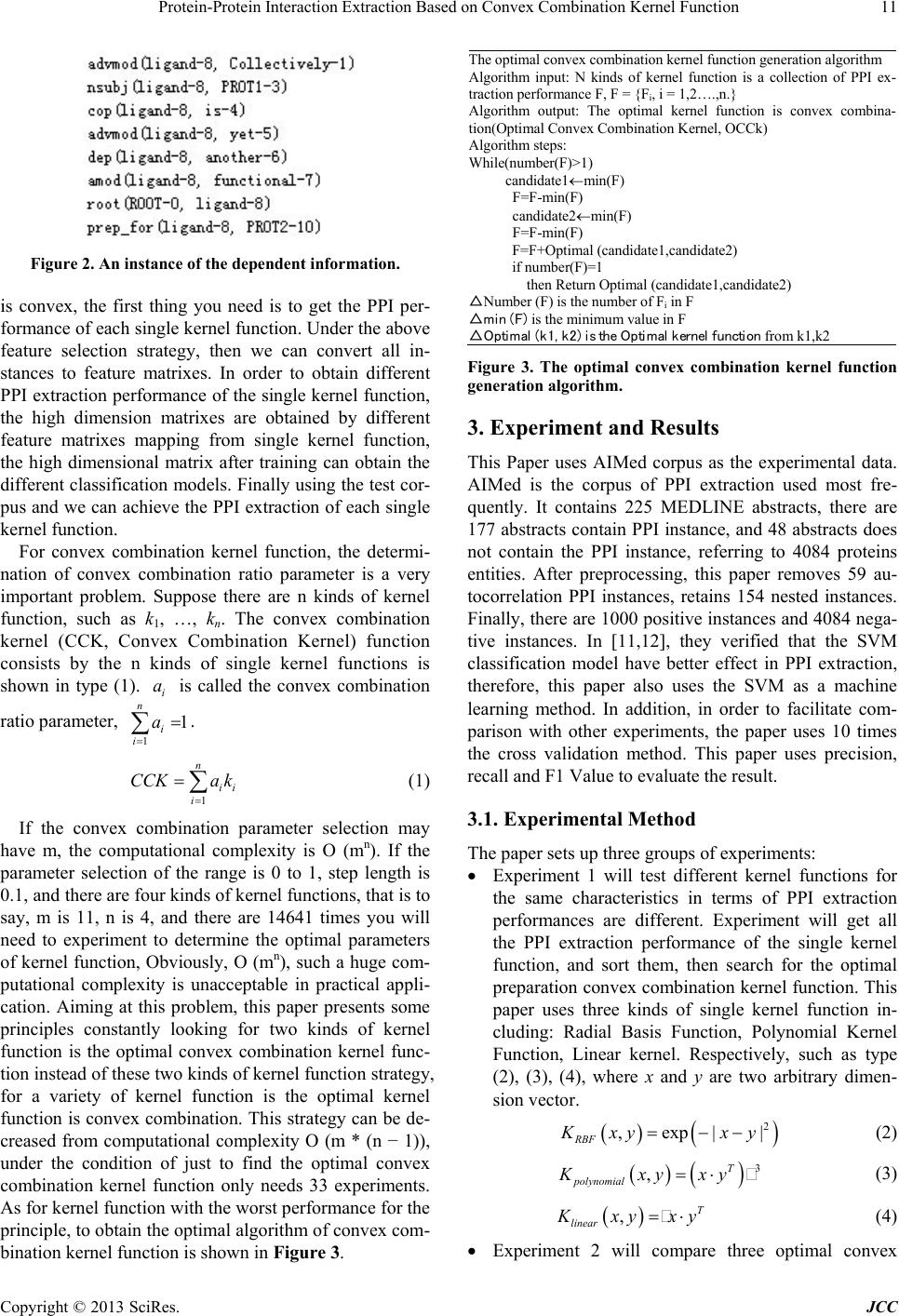 Protein-Protein Interaction Extraction Based on Convex Combination Kernel Function Copyright © 2013 SciRes. JCC 11 Figure 2. An instance of the dependent information. is convex, the first thing you need is to get the PPI per- formance of each single kernel function. Under the above feature selection strategy, then we can convert all in- stances to feature matrixes. In order to obtain different PPI extraction performance of the single kernel function, the high dimension matrixes are obtained by different feature matrixes mapping from single kernel function, the high dimensional matrix after training can obtain the different classification models. Finally using the test cor- pus and we can achieve the PPI extraction of each single kernel function. For convex combination kernel function, the determi- nation of convex combination ratio parameter is a very important problem. Suppose there are n kinds of kernel function, such as k1, …, kn. The convex combination kernel (CCK, Convex Combination Kernel) function consists by the n kinds of single kernel functions is shown in type (1). i a is called the convex combination ratio parameter, 1 1 n i i a = = ∑ . 1 n ii i CCKa k = = ∑ (1) If the convex combination parameter selection may have m, the computational complexity is O (mn). If the parameter selection of the range is 0 to 1, step length is 0.1, and there ar e four kinds of kernel functions, that is to say, m is 11, n is 4, and there are 14641 times you will need to experiment to determine the optimal parameters of kernel function, Obviously, O (mn), such a huge com- putational complexity is unacceptable in practical appli- cation. Aiming at this problem, this paper presents some principles constantly looking for two kinds of kernel function is the optimal convex combination kernel func- tion instead of these two kinds of kernel function strategy, for a variety of kernel function is the optimal kernel function is convex combination. This strategy can be de- creased from computational complexity O (m * (n − 1)), under the condition of just to find the optimal convex combination kernel function only needs 33 experiments. As for kernel function with the worst performance for the principle, to obtain the optimal algorithm of convex com- bination kernel function is shown in Figure 3. The optimal convex combinati on kernel functi on generation algor it hm Algorithm input: N kinds of kernel function is a collection of PPI ex- traction performance F, F = {Fi, i = 1,2….,n.} Algorithm output: The optimal kernel function is convex combina- tion(Optimal Convex Combination Kernel, OCCk) Algorithm steps: While(number(F)>1) candidate1←mi n(F ) F=F-min (F ) candidate2←min(F) F=F-min (F ) F=F+Optima l (cand idate1,candidat e2) if number(F)=1 then Return Optima l (candidate1,candidate2) △Number (F) is the numbe r o f F i in F △min (F) is the minimum value in F △Optimal (k1, k2) is the Optimal kernel function from k1,k2 Figure 3. The optimal convex combination kernel function generation algorithm. 3. Experiment and Results This Paper uses AIMed corpus as the experimental data. AIMed is the corpus of PPI extraction used most fre- quently. It contains 225 MEDLINE abstracts, there are 177 abstracts contain PPI instance, and 48 abstracts does not contain the PPI instance, referring to 4084 proteins entities. After preprocessing, this paper removes 59 au- tocorrelation PPI instances, retains 154 nested instances. Finally, there are 1000 positive instances and 4084 nega- tive instances. In [11,12], they verified that the SVM classification model have better effect in PPI extraction, therefore, this paper also uses the SVM as a machine learning method. In addition, in order to facilitate com- parison with other experiments, the paper uses 10 times the cross validation method. This paper uses precision, recall and F1 Value to evaluate the r e sult. 3.1. Experimental Method The paper sets up three groups of experiments: • Experiment 1 will test different kernel functions for the same characteristics in terms of PPI extraction performances are different. Experiment will get all the PPI extraction performance of the single kernel function, and sort them, then search for the optimal preparation convex combination kernel function. This paper uses three kinds of single kernel function in- cluding: Radial Basis Function, Polynomial Kernel Function, Linear kernel. Respectively, such as type (2), (3), (4), where x and y are two arbitrary dimen- sion vector. ( ) ( ) 2 ,exp || RBF Kxyx y= −− (2) ( ) ( ) 3 , T polynomial Kxyxy= ⋅ (3) ( ) ,T linear Kx yxy= ⋅ (4) • Experiment 2 will compare three optimal convex 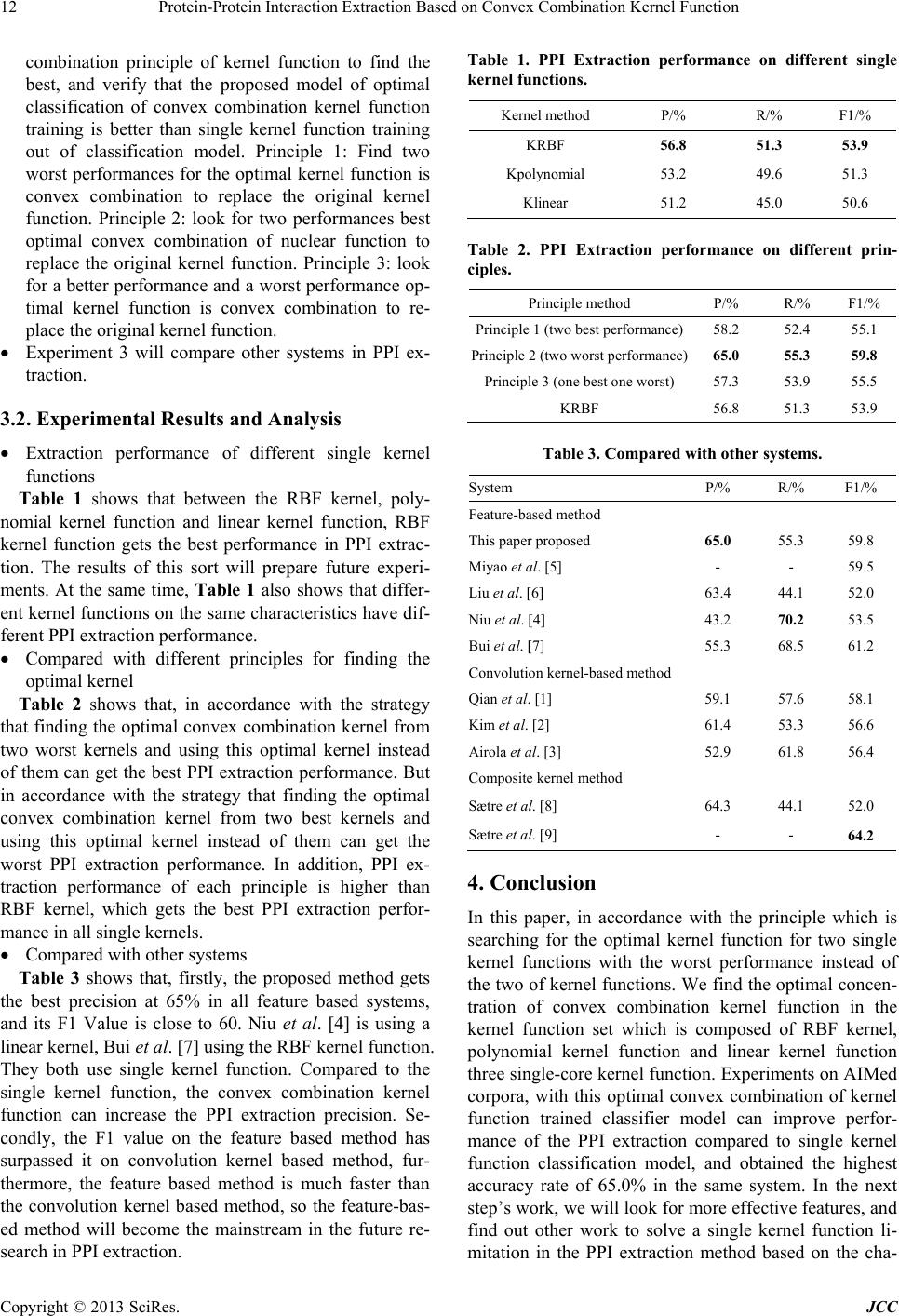 Protein-Protein Interaction Extraction Based on Convex Combination Kernel Function Copyright © 2013 SciRes. JCC 12 combination principle of kernel function to find the best, and verify that the proposed model of optimal classification of convex combination kernel function training is better than single kernel function training out of classification model. Principle 1: Find two worst performances for the optimal kernel function is convex combination to replace the original kernel function. Principle 2: look for two performances best optimal convex combination of nuclear function to replace the original kernel function. Principle 3: look for a better performance and a worst performance op- timal kernel function is convex combination to re- place the original kernel function. • Experiment 3 will compare other systems in PPI ex- traction. 3.2. Experimental Results and Analysis • Extraction performance of different single kernel functions Table 1 shows that between the RBF kernel, poly- nomial kernel function and linear kernel function, RBF kernel function gets the best performance in PPI extrac- tion. The results of this sort will prepare future experi- ments. At the same time, Table 1 also shows that differ- ent kernel functions on the same characteristics have d if- ferent PPI extraction performance. • Compared with different principles for finding the optimal kernel Table 2 shows that, in accordance with the strategy that finding the optimal convex combination kernel from two worst kernels and using this optimal kernel instead of them can get the best PPI extraction performance. But in accordance with the strategy that finding the optimal convex combination kernel from two best kernels and using this optimal kernel instead of them can get the worst PPI extraction performance. In addition, PPI ex- traction performance of each principle is higher than RBF kernel, which gets the best PPI extraction perfor- mance in all single kernels. • Compa re d with othe r sy s t e ms Table 3 shows that, first ly, the proposed method gets the best precision at 65% in all feature based systems, and its F1 Value is close to 60. Niu et al. [4] is using a linear kernel, Bui et al. [7] using the RBF kernel function. They both use single kernel function. Compared to the single kernel function, the convex combination kernel function can increase the PPI extraction precision. Se- condly, the F1 value on the feature based method has surpassed it on convolution kernel based method, fur- thermore, the feature based method is much faster than the convolution kernel based method, so the feature-bas- ed method will become the mainstream in the future re- search in PPI extraction. Table 1. PPI Extraction performance on different single kernel functions. Kernel method P/% R/% F1/% KRBF 56.8 51.3 53.9 Kpolynomial 53.2 49.6 51.3 Klinear 51.2 45.0 50.6 Table 2. PPI Extraction performance on different prin- ciples. Principle method P/% R/% F1/% Principle 1 (two best performance) 58.2 52.4 55.1 Principle 2 (two worst performance) 65.0 55.3 59.8 Principle 3 (one best one worst) 57.3 53.9 55.5 KRBF 56.8 51.3 53.9 Table 3. Compared with other systems. System P/% R/% F1/% Feature-based method This paper proposed 65.0 55.3 59.8 Miyao et al. [5] - - 59.5 Liu et al. [6] 63.4 44.1 52.0 Niu et al. [4] 43.2 70.2 53.5 Bui et al. [7] 55.3 68.5 61.2 Convolution kernel-based method Qian et al. [1] 59.1 57.6 58.1 Kim et al. [2] 61.4 53.3 56.6 Airola et al. [3] 52.9 61.8 56.4 Composite kernel method Sætre et al. [8] 64.3 44.1 52.0 Sætre et al. [9] - - 64.2 4. Conclusion In this paper, in accordance with the principle which is searching for the optimal kernel function for two single kernel functions with the worst performance instead of the two of kernel functions. We find the optimal concen- tration of convex combination kernel function in the kernel function set which is composed of RBF kernel, polynomial kernel function and linear kernel function three single-core kernel function. Experiments on AIMed corpora, with this optimal convex combination of kernel function trained classifier model can improve perfor- mance of the PPI extraction compared to single kernel function classification model, and obtained the highest accuracy rate of 65.0% in the same system. In the next step’s work, we will look for more effective features, and find out other work to solve a single kernel function li- mitation in the PPI extraction method based on the cha-  Protein-Protein Interaction Extraction Based on Convex Combination Kernel Function Copyright © 2013 SciRes. JCC 13 racteristic method. 5. Acknowledgements This research was supported by the National Natural Science Foundation of China (NSFC) under Grant Nos. 61175068, No.6126041. REFERENCES [1] L. H. Qian and G. D. Zhou, “Tree Kernel-Based Protein- Protein Interaction Extraction from Biomedical Literature [J],” Journal of Biomedical Informatics, Vol. 45, No. 3, 2012, pp. 535-543. http://dx.doi.org/10.1016/j.jbi.2012.02.004 [2] S. Kim, J. Yoon, J. Yang and S. Park, “Walk-Weighted Subsequence Kernels for Protein-Protein Interaction Ex- traction [J],” MBC Bioinformatics, Vol. 11, 2010, p. 107. [3] A. Airola, S. Pyys alo, J. Bjrne, T. Pahikkala, F. Ginter and T. Salakoski, “All-Paths Graphkernel for Protein-Protein Interaction Extraction with Evaluation of Crosscorpus Learning [J],” BMC Bioinformatics, Vol. 9, No. S1, 2008. [4] Y. Niu, D. Otasek and I. Jurisica, “Evaluation of Linguis- tic Features Useful in Extraction of Interactions from Pub- Med; Application to Annotating Known, High-Through- put and Predicted Interactions in I2D [J],” Bioinformatics, Vol. 26, No. 1, 2020, pp. 111-119. [5] Y. Miyao, et al., “Evaluating Contributions of Natural Language Parsers to Protein-Protein Interaction Extrac- tion [J],” Bioinformatics, Vol. 25, 2009, pp. 394-400. http://dx.doi.org/10.1093/bioinformatics/btn631 [6] B. Liu, L. H. Qian, H. L. Wang and G. D. Zhou, “Depen- dency-Driven Feature-Based Learning for Extracting Pro- tein-Protein Interactions from Biomedical Text,” Procee- dings of COLING’, Poster, 2010, pp. 757-765. [7] Q.-C. Bui, S. Katrenko and P. M. A. Sloot, “A Hybrid Approach to Extract Protein-Protein Interactions [J],” Bi- oinformatics, Vol. 27, No. 2, 2011, pp. 259-265. http://dx.doi.org/10.1093/bioinformatics/btq620 [8] R. Sætre, K. Sagae and J. Tsujii, “Syntactic Features for Protein-Protein Interaction Extraction,” Proceedings of LBM’07, Vol. 319, 2007, pp. 6. 1-6.14. [9] R. Sætre, K. Yoshida, M. Miwa, T. Matsuzaki, Y. Kano and J. Tsujii, “Extracting Protein Interactions from Text with the Unified AkaneRE Event Extraction System [J],” IEEE/ACM Transactions on Computing Biological Bioin- formatics, Vol. 7, No. 3, 2010, pp. 442-453. http://dx.doi.org/10.1109/TCBB.2010.46 [10] C. Plake, et al., “Optimizing Syntax Patterns for Disco- vering Protein-Protein Interactions,” Proceedings of the ACM Symposium on Applied Computing, 2005, ACM Press, New York, pp. 195-201. [11] S. Kim, et al ., “Wal k -Weighted Subsequence Kernels for Protein-Protein Interaction Extraction [J],” BMC Bioin- formatics, Vol. 11, 2010, p. 107. http://dx.doi.org/10.1186/1471-2105-11-107 [12] R. Sæt re, et al., “Extracting Protein-Interactions fro m Text with the Unified AkaneRE Event Extraction System [J],” IEEE/ACM Transactions on Computational Biology and Bioinformatics, Vol. 99, 2010, pp. 442-453. http://dx.doi.org/10.1109/TCBB.2010.46 |