

Paper Menu >>
Journal Menu >>
 iBusiness, 2013, 5, 205-208 http://dx.doi.org/10.4236/ib.2013.53B041 Published Online September 2013 (http://www.scirp.org/journal/ib) 205 E-Commerce Business Models and Search Engine Dependency Tobias Klatt Department of Business Administration and Economics, European-University Viadrina, Frankfurt Oder, Germany. Email: [email protected] Received 2013 ABSTRACT E-Commerce business models attracted a great deal of attention in the last years. An increasing number of bargains are realized via online transactions. However, some business models suffer distinctly under changes of search engine algo- rithms while others experience continuous stable traffic. This paper sheds light on the drivers of the unpunished e-commerce businesses based on a case-by-case analysis of 43 business models in the German Internet market. The analysis reveals that more stable business models are characterized by diversified customer arrivals which are obtained by a focused product management, multiple marketing ch anneling, freemium registration strategies and a subtle way to attract customer trust. Keywords: E-Commerce; Digital Business Models; Search Engine Optimization; Transaction Costs 1. Introduction The digitalization of markets sets the stage for the evolu- tion of new e-commerce platforms, sales channels, and services. Academic research accompanied this evolution with plentiful insights on advices for th e best practices of business models[1]. However, the multitude of proposi- tions and the increasing environmental dynamism awak- ened a certain degree of uncertainty about the design and management of those businesses [2]. Frequently, the success of digital businesses depends on their listings in search engine result pages (SERP) [3]. These result pages represent more than pure information and frequently build awareness and push brand strength [4]. Unfortunately, SERP are frequently affected by changes in the particular search algorithms, such as the mysterious Panda updates by Google. In the consequence to these updates, some businesses suffer immediately while others experience stable traffic or even benefit from these changes. This article addresses the uncertainty associated with changes in SERP listings. Evidence on the effects of changing search algorithms and strategies to reduce the dependency on SERP are revealed within an initial inter- view round with SEO experts and a follow-up case analysis of 43 business models in the German Internet market. The following section outlines the research back ground which focuses on SERP importance and changes in transaction costs caused by adjustments in search al-go- rithms. Section three is dedicated to the case analysis and discusses the implications. Section four gives conclusions, limitations and goals for further research. 2. Theoretical Background 2.1. SERP Importance and Control Search engines have developed from a disregarded medi- ating role into one of the most prominent pages in the web. Today, they represent the gate to the Internet in the presence of multitudinous forums, platforms and shops [5]. More than half of all visitors to websites arrive there from search engines rather than through a direct link [6]. Consequently, search engine advertising (SEA) becomes increasingly important. This channel will soon capture a lion’s share of the online advertisi ng pi e [7] . The importance of search engines increases, further- more, with the spill-over of branding effects and cus- tomer trust in the ranking of SERP. The rank of web pages in the search results influences directly consumer click behavior [8]. Studies have shown that users have even more trust in organic listings with higher conversion rates than in SEA campaigns [9]. Consequently, compa- nies push the rankings of their websites higher in organic search results through different techniques of search en- gine optimi zat ion (S EO ). However, these SEO activities are frequently equ alized by adjustments in search algorithms. These changes are made for ambiguous purposes, such as technological im- Copyright © 2013 SciRes. IB  E-Commerce Business Models and Search Engine Dependency 206 provements or for suspending low utility pages. Never- theless, each adjustment changes the SERP and the re- lated branding and transaction cost effects. 2.2. A Transaction Cost Problem Search engines grew to support the access to the enor- mous information on the Internet by crawling, retrieving, and presenting relevant information for users based upon their search algorithms [10]. These engines thereby di- rectly impact on the user’s search costs which represent one aspect of the costs involved in online transactions of e-commerce business models. Transaction costs are one if not the critical factor that companies doing business over the Internet try to reduce [11]. Besides information costs, search engines also af- fect agency costs and transaction uncertainty. Agency costs emerge in the presence of various ven- dors that seem to offer nearly the same product or infor- mation. Unknown brands benefit in the presence of as- similation effects that stipulate users to reshape their perceptions and elevate unknown brands along the primed brand attributes [12]. In these cases, changes in the ordering of search results can simply change transac- tion partners . This randomness of customer choices creates a certain level of transaction uncertainty for digital companies. Online businesses can not rely on certain click-through and subsequent conversion rates of customer arrivals from SERP. Therefore, adjustments in search algorithms represent a substantial risk to those business models that mainly rely on conversion from SERP. 3. Case Analysis 3.1. Consequences of Search Algorithm Changes Preliminary interviews with SEO experts confirmed the significance of search algorithm changes. Search engines use continuous as well as drastic updates of their search algorithms, such as the most prominent Jagger, Panda or Penguin updates. Generally, experts assume more than 500 incremental algorithm changes per year and only the striking ones are reported in the community [13]. The impact of these updates on website traffic is un- certain. Some SEO experts reported traffic drops of more than 50 percent in their company while other businesses were not affected. Similarly, the rebuilding of the af- fected websites is an art in itself. Even experienced SEO specialists have to find new ways in the presence of un- certainty about the direction of algorithm changes. Bing’s webmaster comes straight to the point of this uncertainty and emphasizes the necessity for a broader understanding of website construction: “You cannot control when a search engine makes an update, or what that update will impact. That much is obvious. But wha t many websites fail to take ac tion on is forecasting change, preventative work and exercises in the obvious.” [14] The following case analysis reveals evidence about strategies of digital businesses that perform such a pre- ventative work better than businesses which are more affected by changes in SERP. 3.2. Research Design The analysis is based on a longitudinal case research de- sign of different e-commerce business models. E-com- merce companies are defined as firms that derive a sig- nificant proportion of their revenues by participating in transactions over the Internet [15]. This study tightens this definition and considers only pure plays, i.e. digital businesses in terms of delivering either physical or virtual goods and services to the customer purely based on transactions facilitated by the In ternet. Furthermore, the selection is restricted to e-commerce firms founded in Germany. This regional focus should avoid biases from institutional differences and time lags owing to the regional focus of search algorithm updates which are launched at different times over the world. Initially, a set of the ten most affected companies from the prominent Pand a 2011 update were chosen according to the analysis of searchmetrics [16], see Table 1. Their business models are contrasted against the 33 most prominent German digital businesses judged by the Ger- man entrepreneurship community [17], see Table 2. Data about the 43 companies were acquired from public sources and analyzed using standard within-case and cross-case analysis [18]. Notes were taken on the business focus, the segment and the used marketing channels during the initial within-case analysis. In the cross-case analysis the results of the 10 affected companies were contrasted with the results of the 33 successful companies. Table 1. 10 most affected companies by Panda updatea. Company Business Segment Marketing Channelsb Ciao Price checkRetail A, B Cosmiq CommunityNetwork A, B Dooyoo Price checkRetail A, B Gutefrage CommunityNetwork A, B, C Helpster CommunityNetwork A, B Ladenzeile Price checkRetail A, B, C Suite101 Magazine Media A, B Wer-weiss-wasCommunityNetwork A, B Wikio Price checkRetail A, B Yopi Price checkRetail A, B aAccording to Searchmetics [16]. bUsing SEO (A), SEA (B), other forms of massive online advertising (C), print advertising (D) and radio and TV cam- paigns (E). Copyright © 2013 SciRes. IB 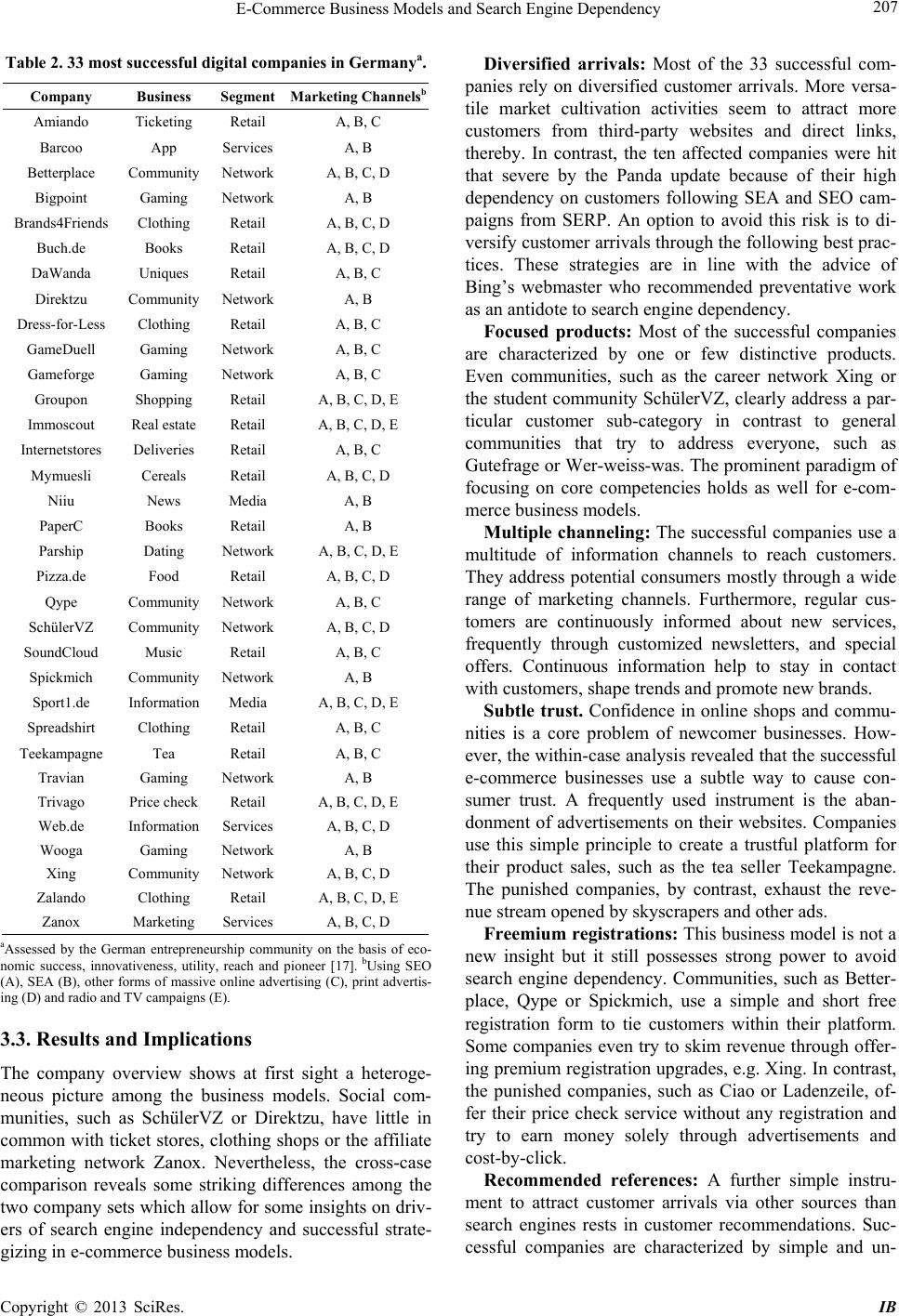 E-Commerce Business Models and Search Engine Dependency 207 Table 2. 33 most successful digital companies in Germanya. Company Business Segment Marketing Channelsb Amiando Ticketing Retail A, B, C Barcoo App Services A, B Betterplace Community Network A, B, C, D Bigpoint Gaming Network A, B Brands4Friends Clothing Retail A, B, C, D Buch.de Books Retail A, B, C, D DaWanda Uniques Retail A, B, C Direktzu Community Network A, B Dress-for-Less Clothing Retail A, B, C GameDuell Gaming Network A, B, C Gameforge G aming Network A, B, C Groupon Shopping Retail A, B, C, D, E Immoscout Real estate Retail A, B, C, D, E Internetstores Deliveries Retail A, B, C Mymuesli Cereals Retail A, B, C, D Niiu News Media A, B PaperC Books Retail A, B Parship Dating Network A, B, C, D, E Pizza.de Food Retail A, B, C, D Qype Community Network A, B, C SchülerVZ Community Network A, B, C, D SoundCloud Music Retail A, B, C Spickmich Community Network A, B Sport1.de Information Media A, B, C, D, E Spreadshirt Clothing Retail A, B, C Teekampagne Tea Retail A, B, C Travian Gaming Network A, B Trivago Price check Retail A, B, C, D, E Web.de Information Services A, B, C, D Wooga Gaming Network A, B Xing Community Network A, B, C, D Zalando C loth ing Retail A, B, C, D, E Zanox Marketing Services A, B, C, D aAssessed by the German entrepreneurship community on the basis of eco- nomic success, innovativeness, utility, reach and pioneer [17]. bUsing SEO (A), SEA (B), other forms of massive online advertising (C), print advertis- ing (D) and ra dio and TV campaigns (E). 3.3. Results and Implications The company overview shows at first sight a heteroge- neous picture among the business models. Social com- munities, such as SchülerVZ or Direktzu, have little in common with ticket stores, cloth ing shops or the affiliate marketing network Zanox. Nevertheless, the cross-case comparison reveals some striking differences among the two company sets which allow fo r some insights on driv- ers of search engine independency and successful strate- gizing in e-commerce business models. Diversified arrivals: Most of the 33 successful com- panies rely on diversified customer arrivals. More versa- tile market cultivation activities seem to attract more customers from third-party websites and direct links, thereby. In contrast, the ten affected companies were hit that severe by the Panda update because of their high dependency on customers following SEA and SEO cam- paigns from SERP. An option to avoid this risk is to di- versify customer arrivals through the following best prac- tices. These strategies are in line with the advice of Bing’s webmaster who recommended preventative work as an antidote to search engine dependency. Focused products: Most of the successful companies are characterized by one or few distinctive products. Even communities, such as the career network Xing or the student community SchülerVZ, clearly address a par- ticular customer sub-category in contrast to general communities that try to address everyone, such as Gutefrage or Wer-weiss-was. The prominent paradigm of focusing on core competencies holds as well for e-com- merce business models. Multiple channeling: The successful companies use a multitude of information channels to reach customers. They address potential consumers mostly through a wide range of marketing channels. Furthermore, regular cus- tomers are continuously informed about new services, frequently through customized newsletters, and special offers. Continuous information help to stay in contact with customers, shape trends and promote new brands. Subtle trust. Confidence in online shops and commu- nities is a core problem of newcomer businesses. How- ever, the within-case analysis revealed that the successful e-commerce businesses use a subtle way to cause con- sumer trust. A frequently used instrument is the aban- donment of advertisements on their websites. Companies use this simple principle to create a trustful platform for their product sales, such as the tea seller Teekampagne. The punished companies, by contrast, exhaust the reve- nue stream opened by skyscrapers and other ads. Freemium registrations: This business model is not a new insight but it still possesses strong power to avoid search engine dependency. Communities, such as Better- place, Qype or Spickmich, use a simple and short free registration form to tie customers within their platform. Some companies even try to skim revenue through offer- ing premium registratio n upgrades, e.g. Xing. In contra st, the punished companies, such as Ciao or Ladenzeile, of- fer their price check service without any registration and try to earn money solely through advertisements and cost-by-click. Recommended references: A further simple instru- ment to attract customer arrivals via other sources than search engines rests in customer recommendations. Suc- cessful companies are characterized by simple and un- Copyright © 2013 SciRes. IB  E-Commerce Business Models and Search Engine Dependency Copyright © 2013 SciRes. IB 208 disturbing hints for posting and sending recommenda- tions or inviting friends. The punished companies skip the recommendation opportunity for the price of ad- dressing the whole Internet community openly which seems an inadequate strategy in times of increasing com- petition and specialization of e-commerce business mod- els. 4. Conclusions This case analysis reveals evidence on strategies to avoid a strong dependency on search engine arrivals and the consequent risk of traffic losses due to changes in search algorithms. Based on SEO expert interviews and a longi- tudinal case study in the German e-commerce market insights on best practices of successful digital companies are presented. Besides the general strategy of customer arrival diversification, the case analysis shows that suc- cessful e-commerce companies use multiple instruments to comprehensively attract customers through direct links and third-party websites. These strategies help to reduce transaction and agency costs and transaction uncertainty. Of course, stronger effort and even higher marketing costs are necessary to grow businesses following these strategies. And of course, there are still examples for other e-commerce models that remain unaffected by search algorithms changes despite ignoring the strategies. However, they may be affected by the next search engine updates. Further research should concentrate on detailed dis- tinctions of new e-commerce business models and asso- ciated competitive strategies. We can expect that the digital market will further differentiate and create new sales channels. Moreover, a new research stream is at the starting blocks to reveal insights on e-commerce via smartphones and special offers for tablets which require different marketing channels and business models. 5. Acknowledgements The au thor than ks Ale xande r Drees, Benjamin Feldmann, Philipp Appelt and Martin Loske for substantive insights into new e-commerce businesses and helpful comments. REFERENCES [1] A. Osterwalder and Y. Pigneur, “An Ontology for E- Business Models,” In W. Currie, Ed., Value Creation from E-Business Models, Butterworth-Heinemann, Ox- ford, 2004, pp. 65-97. [2] J. Johannson, M. Malmström, D. Chroneer, M. E. Styven, A. Engström and B. Bergvall-Kareborn, “Business Mod- els at Work in the Mobile Service Sector,” Journal of iBusiness, Vol. 4, No. 1, 2012, pp. 84-92. [3] M. P. Evans, “Analyzing Google Rankings through Search Engine Optimization Data,” Internet Research, Vol. 17, No. 1, 2007, pp. 21-37. doi:10.1108/10662240710730470 [4] W. Dou, K. H. Lim, C. Su, N. Zhou and N. Cui, “Brand Positioning Strategy Using Search Engine Marketing,” MIS Quarterly, Vol. 34, No. 2, 2010, pp. 261-279. [5] D. Laffey, “Paid Search: The Innovation that Changed the Web,” Business Horizons, Vol. 50, No. 3, 2007, pp. 211-218. doi:10.1016/j.bushor.2006.09.003 [6] R. Telang, U. Rajan and T. Mukhopadhayay, “The Market Structure for Internet Search Engines”, Journal of Man- agement Information Systems, Vol. 21, No. 2, 2004, pp. 137-160. [7] J. Garside, “Google Phobia (Noun): A Rational Fear of a Search Engine Seeking to Dominate Internet Advertis- ing,” The Sunday Telegraph, April 12, London, 2007. [8] B. Pan, Z. Xiang, R. Law and D.R. Fesenmaier, “The Dynamics of Search Engine Marketing for Tourist Desti- nations,” Journal of Travel Research, Vol. 50, No. 4, 2010, p. 365-377. [9] B. J. Jansen and M. Resnick, “An examination of Searcher’s Perceptions of Nonsponsored and Sponsored Links During Ecommerce Web Searching,” Journal of the American Society for Information Science and Technology, Vol. 57, No. 14, 2006, pp. 1949-1961. doi:10.1002/asi.20425 [10] M. R. Henzinger, “Search Technologies for the Internet,” Science, Vol. 317, No. 5837, pp. 468-471. doi:10.1126/science.1126557 [11] J. H. Dyer, “Effective Interfirm Collaboration: How Firms Minimize Transaction Costs and Maximize Transaction Volume,” Strategic Management Journal, Vol. 18, No. 7, 1997, pp. 466-467. doi:10.1002/(SICI)1097-0266(199708)18:7<535::AID-S MJ885>3.0.CO;2-Z [12] W. Dou, K. H. Lim, C. Su, N. Zhou and N. Cui, “Brand Positioning Strategy Using Search Engine Marketing,” MIS Quarterly, Vol. 34, No. 2, 2010, pp. 261-279. [13] See for an Example of Updates in Google’s Search Algo- rithm: Seomoz, “Google Algorithm Change History,“ 2013. http://www.seomoz.org/google-algorithm-change [14] Bing Webmaster Blog, “Penguins & Pandas Poetry,” 2012. http://www.bing.com/blogs/site_blogs/b/webmaster /archive/2012/05/18/are-you-the-hunter-or-the-prey.aspx [15] R. Amit and C. Zott, “Value Creation in E-business,” Strategic Management Journal, Vol. 22, No. 6-7, 2001, pp. 493-520. doi:10.1002/smj.187 [16] Searchmetrics, “Google Panda Update in Germany,” 2011. http://blog.searchmetrics.com/de/2011/08/13/goog le-panda-update-in-deutschland-gewinner-und-verlierer/ [17] Gründerszene, “Success Made in Germany,” 2011. http://www.gruenderszene.de/allgemein/internetunterneh men- deutschland. [18] K. M. Eisenhardt, “Building Theories from Case Study Research,” Academy of Management Review, Vol. 14, No. 4, 1989, pp. 532-550. |