

Paper Menu >>
Journal Menu >>
 iBusiness, 2013, 5, 52-54 http://dx.doi.org/10.4236/ib.2013.53B011 Published Online September 2013 (http://www.scirp.org/journal/ib) The Effect of Pull Power of Karaoke Television-set Service on the Inner Need of Consumer Jiun-Hung Lin Department of Marketing and Logistics Management, China University of Technology, No. 530, Sec. 3, Jhong-Shan Road, Hukou Township, Hsin Chu County, 3. Email: [email protected].tw, [email protected] Received June, 2013 ABSTRACT KTV is an important recreation activity in Taiwan. Since the recreation activities are more diversified because of the progress of information technology and the leisure policy of government lead to many free recreation places and activi- ties existed, KTV service as a kind of recreation activities but not free and face a keener competition. This study tries to explore how to strengthen the th rust for consumer to choose KTV as their recreation activity through understanding the motivations for KTV consumption with empirical data and provides suggestions to help improve the KTV service. Keywords: Motivation; Karaoke TV (KTV) 1. Introduction Karaoke television-set (KTV) is a form of interactive musical entertainment service provides independent pri- vate room and interactive musical facilities for consumer to sing song with friends or family [1]. Since 1990, KTV is an important recreation activity in Taiwan [2]. However, the recreation activities are more and more diversified because of the arise of internet and handy smart phone and local government constructs many green and free public parks and places with hold- ing many festival and activities to attract people to par- ticipate and consume. KTV service as a kind of recrea- tion activities but is not free and face a keener competi- tion. How to strengthen the thrust for consumer to choose KTV for their recreation through understanding the inner motivations for KTV consumption and strengthen those inner motivations by improving the KTV service factors become important issues to be studied. 2. Theoretical Backgrounds 2.1. Karaok TV (KTV) Sha [1] indicate KTV is originated from Karaoke came from Japan. Karaoke which means singing in a public stage with the accompaniment of an orchestra without anybody is introduced to Taiwan in the early 1980. However, it need consumer with courage and dare to sing in the public but not the case for everyone. Hence, the popularity of Karaoke is limited [3]. In the early 1990, business in Taiwan developed a new type of recreation service to combine Karaoke with an independent and private room and is called as Karaoke television-set (KTV) [1]. KTV is a singing place provides an inde- pendent and private room for consumer to sing with a vocal accompaniment video tape broadcasted on a larger television and stereo facility. Beverage and meal is also provided for consumer [4]. 2.2. Motivation of Leisure Activity Psychologists interpret motivation with different view- points and indicate motivation is highly related to what people talk and behave. Motivation is the drive of an individual behavior [5]. “Push factor” and “pull factor” are two factors that can induce individual behavior reac- tion [5-7]. “Push factor” means an inner drive that would guide individual behavior. While a motivation of indi- vidual is satisfied, this motivation would be eliminated. Inner needs or socio-psychological motives such as so- cial with others or escape routine are commonly push based motivations for recreations activities [5, 6]. “Pull factor” is induced by the service itself. The characteris- tics of the service itself that would attract consumer such as having special atmosphere, exciting facilities, or con- venient location are commonly pull based motives for recreations activities [5,6]. Previous researches proposed the motives drive con- sumer to KTV includes organizing a social party for family or friends, having flow across each other with family or friends, seeking for entertainment and ex citing, Copyright © 2013 SciRes. IB 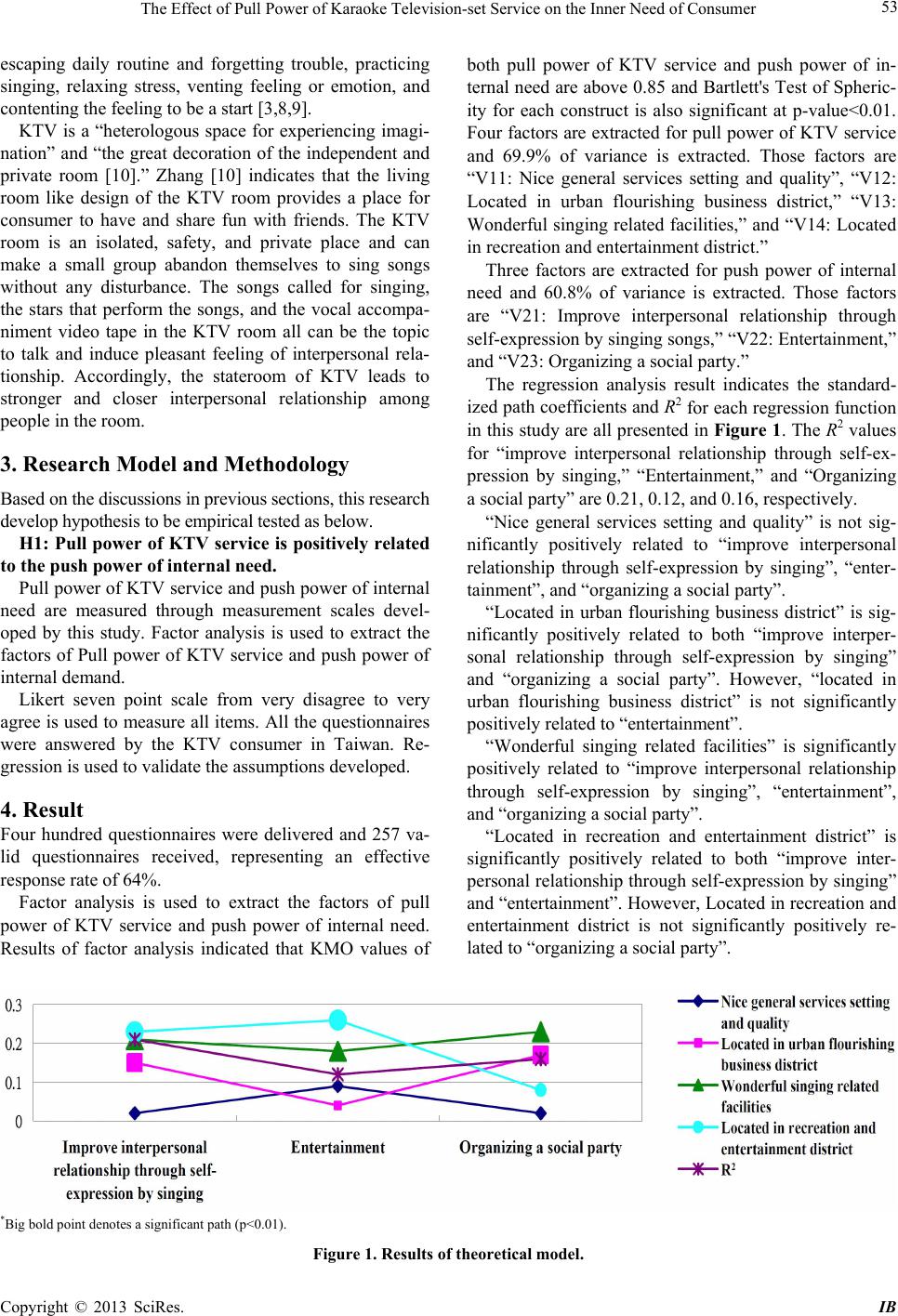 The Effect of Pull Power of Karaoke Television-set Service on the Inner Need of Consumer 53 escaping daily routine and forgetting trouble, practicing singing, relaxing stress, venting feeling or emotion, and contenting the feeling to be a start [3,8,9 ]. KTV is a “heterologous space for experiencing imagi- nation” and “the great decoration of the independent and private room [10].” Zhang [10] indicates that the living room like design of the KTV room provides a place for consumer to have and share fun with friends. The KTV room is an isolated, safety, and private place and can make a small group abandon themselves to sing songs without any disturbance. The songs called for singing, the stars that perform the songs, and the vocal accompa- niment video tape in the KTV room all can be the topic to talk and induce pleasant feeling of interpersonal rela- tionship. Accordingly, the stateroom of KTV leads to stronger and closer interpersonal relationship among people in the roo m. 3. Research Model and Methodology Based on the discussions in previous sections, t his research develop hypothesis to be empiri cal tested as below. H1: Pull power of KTV service is positively related to the push power of internal need. Pull power of KTV serv ice and push power of intern al need are measured through measurement scales devel- oped by this study. Factor analysis is used to extract the factors of Pull power of KTV service and push power of internal dem and. Likert seven point scale from very disagree to very agree is used to measure all items. All the questionnaires were answered by the KTV consumer in Taiwan. Re- gression is used to validate the assumptions developed. 4. Result Four hundred questionnaires were delivered and 257 va- lid questionnaires received, representing an effective response rate of 64%. Factor analysis is used to extract the factors of pull power of KTV service and push power of internal need. Results of factor analysis indicated that KMO values of both pull power of KTV service and push power of in- ternal need are above 0.85 and Bartlett's Test of Spheric- ity for each construct is also significant at p-value<0.01. Four factors are extracted for pull power of KTV service and 69.9% of variance is extracted. Those factors are “V11: Nice general services setting and quality”, “V12: Located in urban flourishing business district,” “V13: Wonderful singing related facilities,” and “V14: Located in recreation and entertain men t district.” Three factors are extracted for push power of internal need and 60.8% of variance is extracted. Those factors are “V21: Improve interpersonal relationship through self-expression by singing songs,” “V22: Entertainment,” and “V23: Organizing a social party.” The regression analysis result indicates the standard- ized path coefficients and R2 for each regression function in this study are all presented in Figure 1. The R2 values for “improve interpersonal relationship through self-ex- pression by singing,” “Entertainment,” and “Organizing a social party” are 0.21, 0.12, and 0.16, resp ectively. “Nice general services setting and quality” is not sig- nificantly positively related to “improve interpersonal relationship through self-expression by singing”, “enter- tainment”, and “organizing a social party”. “Located in urban flourishing business district” is sig- nificantly positively related to both “improve interper- sonal relationship through self-expression by singing” and “organizing a social party”. However, “located in urban flourishing business district” is not significantly positively related to “entertain ment”. “Wonderful singing related facilities” is significantly positively related to “improve interpersonal relationship through self-expression by singing”, “entertainment”, and “organizing a social party”. “Located in recreation and entertainment district” is significantly positively related to both “improve inter- personal relationship through self-expression by singing” and “entertainment”. However, Located in recreation and entertainment district is not significantly positively re- lated to “organizin g a social party”. *Big bold point denotes a significant path (p<0.01). Figure 1. Results of theoretical model. Copyright © 2013 SciRes. IB  The Effect of Pull Power of Karaoke Television-set Service on the Inner Need of Consumer 54 5. Conclusions Based on the research result of this research, the motives for consumer to KTV can classified in to push based mo- tives which are the inner drives that would guide indi- vidual behavior and pull based motives induced by the service itself that would strengthen the push based mo- tives. The three main push power of internal need for consumer to KTV are ‘improve interpersonal relationship through self-expression by singing songs,’ ‘entertain- ment,’ and ‘organizing a social party.’ The four main pull power induced by the characteristics of the KTV service itself are ‘nice general services setting and quality,’ ‘lo- cated in urban flourishing business district,’ ‘wonderful singing related facilities,’ and ‘located in recreation and entertainment district.’ In order to attract consumer to consume KTV service, KTV stores should provide wonderful singing related facilities in each KTV room and are recommended to set their KTV stores located in both ‘urban flourish ing busi- ness district’ and ‘famous recreation and entertainment district’. The general hardware and service outside the KTV room such as the lobby setting is suggested to be set in an acceptable level as the average industry stan- dard. REFERENCES [1] G. G. Sha, “The Politic Economic of Recreation- the First Analysis to the KTV in Taiwan,” Journal of Outdoor Recreation Study, Vol. 5, No. 2, 1992, pp. 145-163. [2] Y. Z. Chiang, “One Million Lonely Heart Wait for Hap- piness in the Three Metro City,” Global Views Magazine, Vol. 238, 2006, pp. 166-174. [3] F. S. Su, “The Study of Motivations, Obstructions, and Health Effects of Teenage Students to Sing at KTV Stores,” Unpublished Master Thesis of Department of Leisure and Recreation, Asia University, Taichung Tai- wan, 2006. [4] DCAMEA (Dept of commercial affairs of Ministry of Economic Affairs), “The Change and Future Trend of Audio-visual Entertainment Industry,” Annual Report of Service Business in Taiwan, 2000, pp. 21-46. [5] D. Fodness, “Measuring Tourist Motivation,” Annals of Tourism Research, Vol. 21, No. 4, 1994, pp. 555-581. doi:10.1016/0160-7383(94)90120-1 [6] J. Gnoth, “Tourism Motivation and Expectation Forma- tion,” Annals of Tourism Research, Vol. 24, No. 2, 1997, pp. 283-304. doi:10.1016/S0160-7383(97)80002-3 [7] Z. S. Chang, “Chang’s Psychology Dictionary,” Taipei: Tunghua. Publish Ltd., 1990. [8] T. L. Cheng, “The Study of "KTV" Consumer’s Motives and Behaviors,” Unpublished Master Thesis of Depart- ment of News, Chinese Cultural University, Taipei, Tai- wan, 1993. [9] Y. F. Chen, “A Study of Key Determinants of Hedonic Experience in KTV Industry,” Unpublished Master The- sis of Department of Marketing and Logistics, National Kaohsiung First University of Technology, Kaohsiung, Taiwan, 2006. [10] S. M. Zhang, “Leisure, Pleasure, and Power-a Sociologi- cal Analysis of KTV in Taiwan,” Unpublished Master Thesis of Graduate Institute of Building and Planning, National Taiwan University, Taipei, Taiwan, 1993. Copyright © 2013 SciRes. IB |