

Paper Menu >>
Journal Menu >>
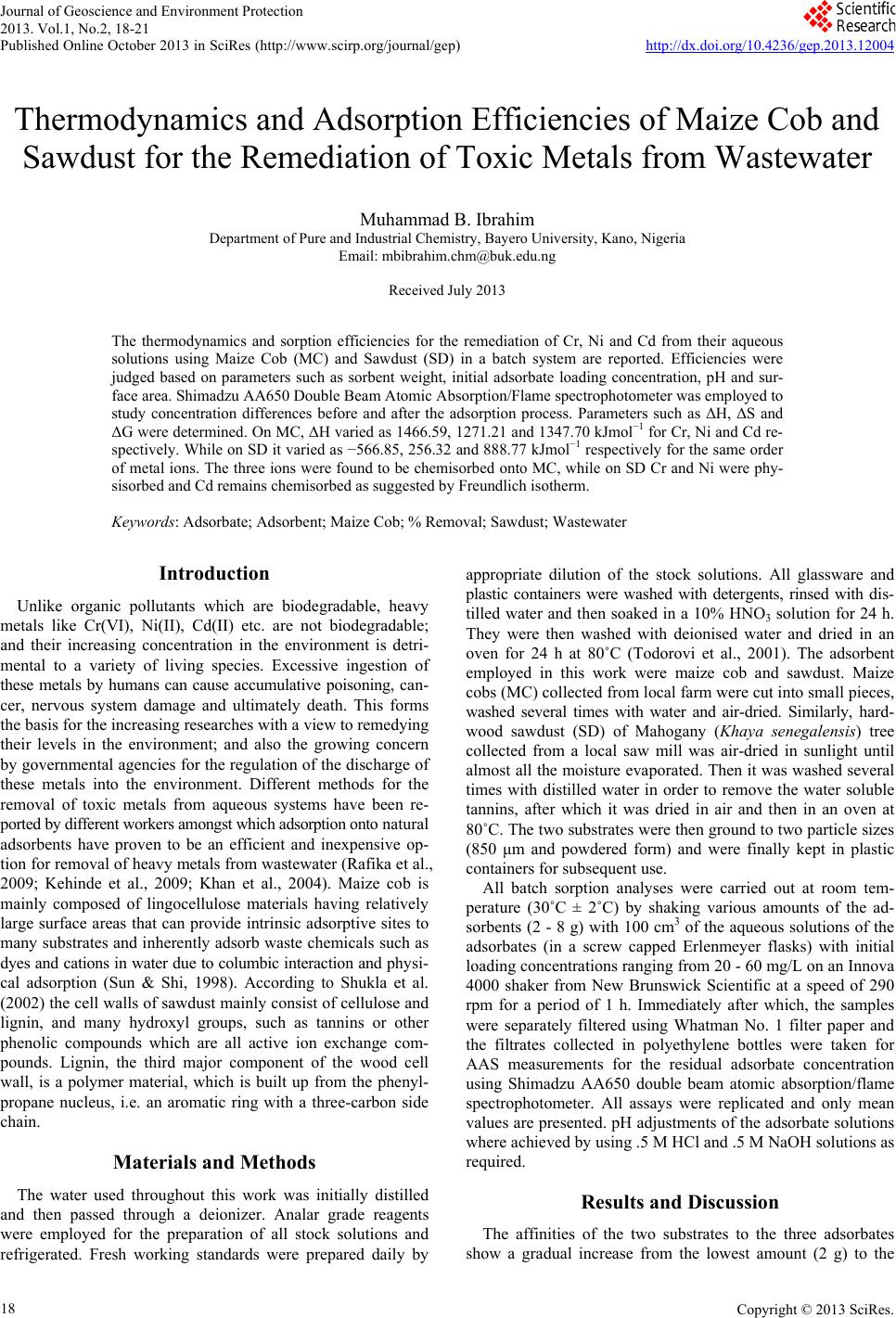 Journal of Geoscience and Environment Protection 2013. Vol.1, No.2, 18-21 Published Online October 201 3 in SciRes (http://www.scirp.org/journal/gep) http://dx.doi.org/10.4236/gep.2013.12004 Copyright © 2013 SciRes. 18 Thermodynamics and Adsorption Efficiencies of Maize Cob and Sawdust for the Remediation of Toxic Metals from Wastewater Muhammad B. Ibrahim Department of Pure and Industrial Chemistry, Bayero University, Kano, Nigeria Email: [email protected] Received July 2013 The thermodynamics and sorption efficiencies for the remediation of Cr, Ni and Cd from their aqueous solutions using Maize Cob (MC) and Sawdust (SD) in a batch system are reported. Efficiencies were judged based on parameters such as sorbent weight, initial adsorbate loading concentration, pH and sur- face area. Shimadzu AA650 Double Beam Atomic Absorption/Flame spectrophotometer was employed to study concentration differences before and after the adsorption process. Parameters such as ΔH, ΔS and ΔG were determined. On MC, ΔH varied as 1466.59, 1271.21 and 1347.70 kJmol−1 for Cr, Ni and Cd re- spectively. While on SD it varied as −566.85, 256.32 and 888.77 kJmol−1 respectively for the same order of metal ions. The three ions were found to be chemisorbed onto MC, while on SD Cr and Ni were phy- sisorbed and Cd remains chemisorbed as suggested by Freundlich isotherm. Keywords: Adsorbate; Adsorbent; Maize Cob; % Removal; Sawdust; Wastewater Introduction Unlike organic pollutants which are biodegradable, heavy metals like Cr(VI), Ni(II), Cd(II) etc. are not biodegradable; and their increasing concentration in the environment is detri- mental to a variety of living species. Excessive ingestion of these metals by humans can cause accumulative poisoning, can- cer, nervous system damage and ultimately death. This forms the basis for the increasing researches with a view to remedying their levels in the environment; and also the growing concern by governmental agencies for the regulation of the discharge of these metals into the environment. Different methods for the removal of toxic metals from aqueous systems have been re- ported by different workers amongst which adsorption onto natural adsorbents have proven to be an efficient and inexpensive op- tion for removal of heavy metals from wastewater (Rafika et al., 2009; Kehinde et al., 2009; Khan et al., 2004). Maize cob is mainly composed of lingocellulose materials having relatively large surface areas that can provide intrinsic adsorptive sites to many substrates and inherently adsorb waste chemicals such as dyes and cations in water due t o columbic interaction and phy si- cal adsorption (Sun & Shi, 1998). According to Shukla et al. (2002) the cell walls of sawdust mainly consist of cellulose and lignin, and many hydroxyl groups, such as tannins or other phenolic compounds which are all active ion exchange com- pounds. Lignin, the third major component of the wood cell wall, is a polymer material, which is built up from the phenyl- propane nucleus, i.e. an aromatic ring with a three-carbon side chain. Materials and Methods The water used throughout this work was initially distilled and then passed through a deionizer. Analar grade reagents were employed for the preparation of all stock solutions and refrigerated. Fresh working standards were prepared daily by appropriate dilution of the stock solutions. All glassware and plastic containers were washed with detergents, rinsed with dis- tilled water and then soaked in a 10% HNO3 solution for 24 h. They were then washed with deionised water and dried in an oven for 24 h at 80˚C (Todorovi et al., 2001). The adsorbent employed in this work were maize cob and sawdust. Maize cobs (MC) collected from local farm were cut into small pieces, washed several times with water and air-dried. Similarly, hard- wood sawdust (SD) of Mahogany (Khaya senegalensis) tree collected from a local saw mill was air-dried in sunlight until almost all the moisture evaporated. Then it was washed several times with distilled water in order to remove the water soluble tannins, after which it was dried in air and then in an oven at 80˚C. The two substrates were then ground to two particle sizes (850 μm and powdered form) and were finally kept in plastic containers for subsequent use. All batch sorption analyses were carried out at room tem- perature (30˚C ± 2˚C) by shaking various amounts of the ad- sorbents (2 - 8 g) with 100 cm3 of the aqueous solutions of the adsorbates (in a screw capped Erlenmeyer flasks) with initial loading concentrations ranging from 20 - 60 mg/L on an Innova 4000 shaker from New Brunswick Scientific at a speed of 290 rpm for a period of 1 h. Immediately after which, the samples were separately filtered using Whatman No. 1 filter paper and the filtrates collected in polyethylene bottles were taken for AAS measurements for the residual adsorbate concentration using Shimadzu AA650 double beam atomic absorption/flame spectrophotometer. All assays were replicated and only mean values are presented. pH adjustments of the adsorbate solutions where achieved by using .5 M HCl and .5 M NaOH solutions as required. Results and Discu ssion The affinities of the two substrates to the three adsorbates show a gradual increase from the lowest amount (2 g) to the 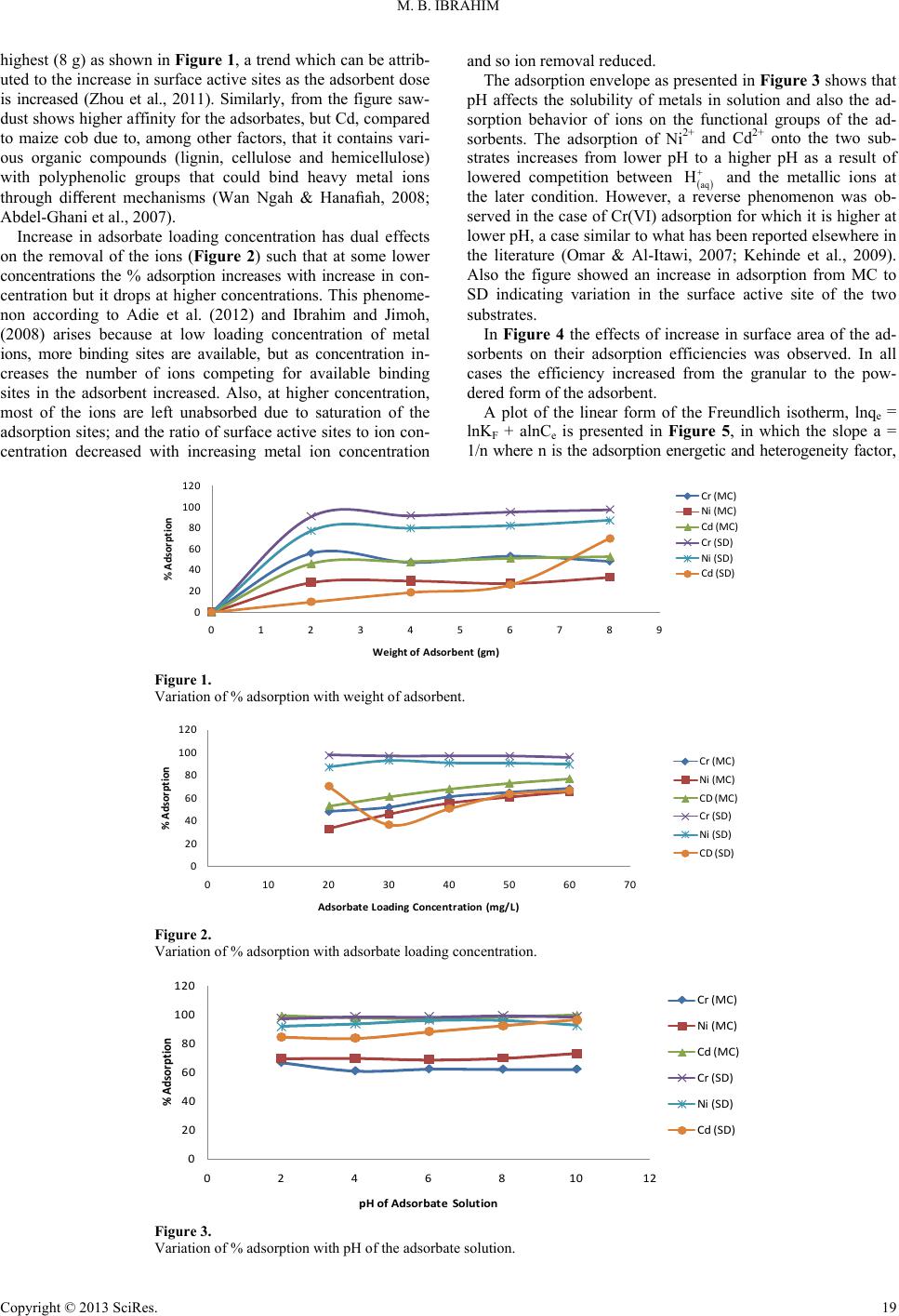 M. B. IBRAHIM Copyright © 2013 SciRes. 19 highest (8 g) as shown in Figure 1, a trend which can be attrib- uted to the increase in surface active sites as the adsorbent dose is increased (Zhou et al., 2011). Similarly, from the figure saw- dust shows higher affinity for the adsorbates, but Cd, compared to maize cob due to, among other factors, that it contains vari- ous organic compounds (lignin, cellulose and hemicellulose) with polyphenolic groups that could bind heavy metal ions through different mechanisms (Wan Ngah & Hana fiah, 2008; Abdel-Ghani et al., 2007). Increase in adsorbate loading concentration has dual effects on the removal of the ions (Figure 2) such that at some lower concentrations the % adsorption increases with increase in con- centration but it drops at higher concentrations. This phenome- non according to Adie et al. (2012) and Ibrahim and Jimoh, (2008) arises because at low loading concentration of metal ions, more binding sites are available, but as concentration in- creases the number of ions competing for available binding sites in the adsorbent increased. Also, at higher concentration, most of the ions are left unabsorbed due to saturation of the adsorption sites; and the ratio of surface active sites to ion con- centration decreased with increasing metal ion concentration and so ion removal reduced. The adsorption envelope as presented in Figure 3 shows that pH affects the solubility of metals in solution and also the ad- sorption behavior of ions on the functional groups of the ad- sorbents. The adsorption of Ni2+ and Cd2+ onto the two sub- strates increases from lower pH to a higher pH as a result of lowered competition between ( ) aq H + and the metallic ions at the later condition. However, a reverse phenomenon was ob- served in the case of Cr(VI) adsorption for which it is higher at lower pH, a case similar to what has been reported elsewhere in the literature (Omar & Al-Itawi, 2007; Kehinde et al., 2009). Also the figure showed an increase in adsorption from MC to SD indicating variation in the surface active site of the two substrates. In Figure 4 the effects of increase in surface area of the ad- sorbents on their adsorption efficiencies was observed. In all cases the efficiency increased from the granular to the pow- dered form of the adsorbent. A plot of the linear form of the Freundlich isotherm, lnqe = lnKF + alnCe is presented in Figure 5, in which the slope a = 1/n where n is the adsorption energetic and heterogeneity factor , Figure 1. Variation of % adsorption with weight of adsorbent. Figure 2. Variation of % adsorption with adsorbate loading concentration. Figure 3. Variation of % adsorption with pH of the adsorbate solution. 0 20 40 60 80 100 120 0 1 2 3 4 5 6 7 8 9 % Adsorption Weight of Adsorbent (gm) Cr (MC) Ni (MC) Cd (MC) Cr (SD) Ni (SD) Cd (SD) 0 20 40 60 80 100 120 010 20 30 40 50 60 70 % Adsorption Adsorbate Loading Concentration (mg/L) Cr (MC) Ni (MC) CD (MC) Cr (SD) Ni (SD) CD (SD) 0 20 40 60 80 100 120 0246810 12 % Adsorption pH of Adsorbate Solution Cr (MC) Ni (MC) Cd (MC) Cr (SD) Ni (SD) Cd (SD) 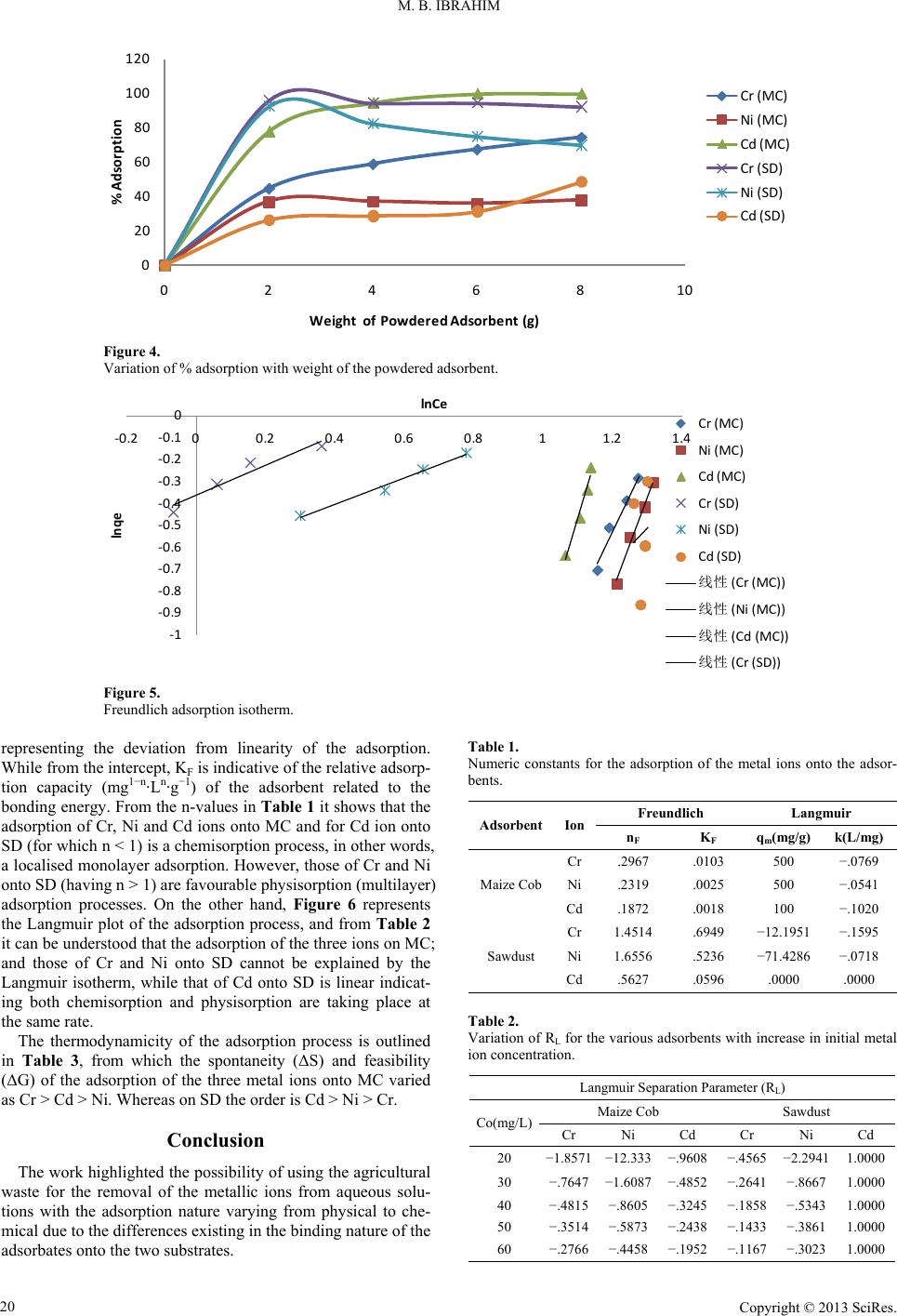 M. B. IBRAHIM Copyright © 2013 SciRes. 20 Figure 4. Variation of % adsorption with weight of the powdered adsorbent. Figure 5. Freundlich adsorption isotherm. representing the deviation from linearity of the adsorption. While from the intercept, KF is indicative of the relative adsorp- tion capacity (mg1−n∙Ln∙g−1) of the adsorbent related to the bonding energy. From the n-values in Table 1 it shows that the adsorption of Cr, Ni and Cd ions onto MC and for Cd ion onto SD (for which n < 1) is a chemisorption process, in other words, a localised monolayer adsorption. However, those of Cr and Ni onto SD (having n > 1) are favourable physisorption (multilayer) adsorption processes. On the other hand, Figure 6 represents the Langmuir plot of the adsorption process, and from Table 2 it can be understood that the adsorption of the three ions on MC; and those of Cr and Ni onto SD cannot be explained by the Langmuir isotherm, while that of Cd onto SD is linear indicat- ing both chemisorption and physisorption are taking place at the same rate. The thermodynamicity of the adsorption process is outlined in Table 3, from which the spontaneity (ΔS) and feasibility (ΔG) of the adsorption of the three metal ions onto MC varied as Cr > Cd > Ni. Whereas on SD the order is Cd > Ni > Cr. Conclusion The work highlighted the possibility of using the agricultural waste for the removal of the metallic ions from aqueous solu- tions with the adsorption nature varying from physical to che- mical due to the differences existing in the binding nature of the adsorbates onto the two substrates. Table 1. Numeric constants for the adsorption of the metal ions onto the adsor- bents. Adsorbent Ion Freundlich Langmuir nF KF qm(mg/g) k(L/ mg ) Maize Cob Cr .2967 .0103 500 −.0769 Ni .2319 .0025 500 −.0541 Cd .1872 .0018 100 −.1020 Sawdust Cr 1.4514 .6949 −12.1951 −.1595 Ni 1.6556 .5236 −71.4286 −.0718 Cd .5627 .0596 .0000 .0000 Table 2. Variation of RL for the various adsorb ents with increase in initial metal ion concentration. Langmuir Separation Parameter (RL) Co(mg/L) Maize Cob Sawdust Cr Ni Cd Cr Ni Cd 20 −1.8571 −12.333 −.9608 −.4565 −2.2941 1.0000 30 −.7647 −1.6087 −.4852 −.2641 −.8667 1.0000 40 −.4815 −.8605 −.3245 −.1858 −.5343 1.0000 50 −.3514 −.5873 −.2438 −.1433 −.3861 1.0000 60 −.2766 −.4458 −.1952 −.1167 −.3023 1.0000 0 20 40 60 80 100 120 02 4 68 10 % Adsorption Weight of Powdered Adsorbent (g) Cr (MC) Ni (MC) Cd (MC) Cr (SD) Ni (SD) Cd (SD) -1 -0 .9 -0 .8 -0 .7 -0 .6 -0 .5 -0 .4 -0 .3 -0 .2 -0 .1 0 -0.2 00.2 0.4 0.6 0.8 11.2 1.4 lnqe lnC e Cr (MC) Ni (MC) Cd (MC) Cr (SD) Ni (SD) Cd (SD) 线性 (Cr (MC)) 线性 (Ni (MC)) 线性 (Cd (MC)) 线性 (Cr (SD)) 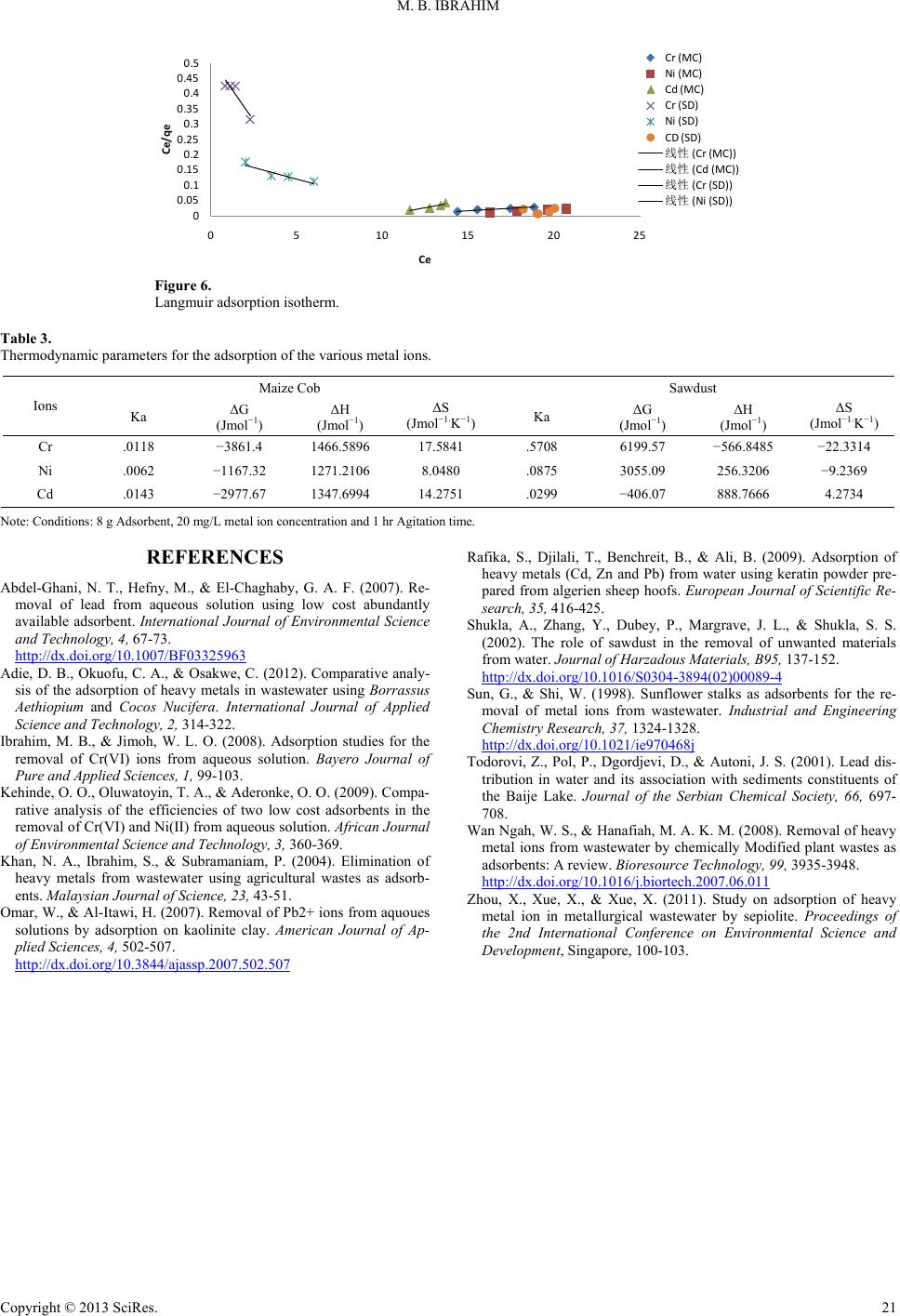 M. B. IBRAHIM Copyright © 2013 SciRes. 21 Figure 6. Langmuir adsorption isotherm. Table 3. Thermodynamic parameters for the adsorption of the various metal ions. Ions Maize Cob Sawdust Ka ΔG (Jmol−1) ΔH (Jmol−1) ΔS (Jmol−1∙K−1) Ka ΔG (Jmol−1) ΔH (Jmol−1) ΔS (Jmol−1∙K−1) Cr .0118 −3861.4 1466.5896 17.5841 .5708 6199.57 −566.8485 −22.3314 Ni .0062 −1167.32 1271.2106 8.0480 .0875 3055.09 256.3206 −9.2369 Cd .0143 −2977.67 1347.6994 14.2751 .0299 −406.07 888.7666 4.2734 Note: Conditions: 8 g Adsorbent, 20 mg/L metal ion concentration and 1 hr Agitation time. REFERENCES Abdel-Ghani, N. T., Hefny, M., & El-Chaghaby, G. A. F. (2007). Re- moval of lead from aqueous solution using low cost abundantly available adsorbent. International Journal of Environmental Science and Technology, 4, 67-73. http://dx.doi.org/10.1007/BF03325963 Adie, D. B. , Okuofu, C. A. , & Osakwe, C. (2012). Comparative analy- sis of the adsorpti on of heavy metals in wastewater us ing Borrassus Aethiopium and Cocos Nucifera. International Journal of Applied Science and Technology, 2, 314-322. Ibrahim, M. B., & Jimoh, W. L. O. (2008). Adsorption studies for the removal of Cr(VI) ions from aqueous solution. Bayero Journal of Pure and Applied Sciences, 1, 99-103. Kehinde, O. O., Olu watoyin, T. A., & Aderonke, O. O. (2009). Compa- rative analysis of the efficiencies of two low cost adsorbents in the removal of Cr(VI) and Ni(II) from aqueous solution. African Journal of Environmental Science and Technology, 3, 360-369. Khan, N. A., Ibrahim, S., & Subramaniam, P. (2004). Elimination of heavy metals from wastewater using agricultural wastes as adsorb- ents. Malaysian Journal of Science, 23, 43-51. Omar, W., & Al-It awi, H. (200 7). Removal of Pb2+ ions from aquoues solutions by adsorption on kaolinite clay. American Journal of Ap- plied Sciences, 4, 502-507. http://dx.doi.org/10.3844/ajassp.2007.502.507 Rafika, S., Djilali, T., Benchreit, B., & Ali, B. (2009). Adsorption of heavy metals (Cd, Zn and Pb) from water using keratin powder pre- pared from algerien sheep h oofs. European Journal of Scientific Re- search, 35, 416-425. Shukla, A., Zhang, Y., Dubey, P., Margrave, J. L., & Shukla, S. S. (2002). The role of sawdust in the removal of unwanted materials from water. Journal of Harzadous Materials, B95, 137-152. http://dx.doi.org/10.1016/S0304-3894(02)00089-4 Sun, G., & Shi, W. (1998). Sunflower stalks as adsorbents for the re- moval of metal ions from wastewater. Industrial and Engineering Chemistry Research, 37, 1324-1328. http://dx.doi.org/10.1021/ie970468j Todorovi, Z., Pol, P., Dgordjevi, D., & Autoni, J. S. (2001). Lead dis- tribution in water and its association with sediments constituents of the Baije Lake. Journal of the Serbian Chemical Society, 66, 697- 708. Wan Ngah, W. S., & Hanafiah, M. A. K. M. (2008). Re moval of heavy metal ions from wastewater by chemically Modified plant wastes as adsorbents: A review. Bioresource Technology, 99, 3935-3948. http://dx.doi.org/10.1016/j.biortech.2007.06.011 Zhou, X., Xue, X., & Xue, X. (2011). Study on adsorption of heavy metal ion in metallurgical wastewater by sepiolite. Proceedings of the 2nd International Conference on Environmental Science and Development, Singapore, 100-103. 0 0.05 0.1 0.15 0.2 0.25 0.3 0.35 0.4 0.45 0.5 0510 15 20 25 Ce /qe Ce Cr (MC) Ni (MC) Cd (MC) Cr (SD) Ni (SD) CD (SD) 线性 (Cr (MC)) 线性 (Cd (MC)) 线性 (Cr (SD)) 线性 (Ni (SD)) |