

Paper Menu >>
Journal Menu >>
 iBusiness, 2013, 5, 30-35 http: //dx.doi.org/10.4236/ib.2013.53B007 Published Online September 2013 (http://www.scirp.org/journal/ib) The Assessment of Ice-snow Tourism Resources Value and Its Realization Degree Weiwei Wu1, Yexin Zhu1, Chunyan Zhang2 1School of management, Harbin Institute of Technology, Harbin 150001, China; 2Heilongjiang Province Tourism Agency, Harbin 150001, China. Email: [email protected] Received May, 2013 ABSTRACT The development of the ice-snow tourism needs a scientific and effective method to assess the value of ice-snow tour- ism resource and its realization degree effectively and reasonability. Based on the analysis of expectation value and realization value of ice-snow tourism resource, this paper designs a three-dimension assessment index system and con- structs the method of assessing the value of ice-snow tourism resource and its realization degree. Finally using ISW scenic area in Heilongjiang Province as an example for empirical analysis, the results show that the method can be ef- fective in assessing the value of ice-snow tourism resource and its realization degree. Keywords: Ice-snow Tourist Resources; Value Assessment; Realization Degree 1. Introduction China’s tourism industry has made considerable devel- opment since the reform and opening up, and more and more tourists prefer specialized tourism such as sport tourism than simply sightseeing-type tourism. Especially after the “World Conference on Sport and Tourism” was held by World Tourism Organization and International Olympic Committee, sport tourism is becoming a new focus [1]. As an important part of sport tourism, ice-snow tourism is one of the most rapidly developing tourism. Now China has built up nearly 200 ski resorts and earned more than one billion per year. Experts expect that ice-snow tourists in China will reach 13 million and oc- cupy 1% of the total population [2]. Ice-snow tourism resource value refers to the sum of different values in the processes of the ice-snow tourism operators developing and managing ice-snow tourism resource, and attracting tourists to consume it. It is sig- nificant for ice-snow tourism resource value to measure whether ice-snow scenic spots have the potential to be developed [3]. In China at present, the scale of ice-snow tourism is enlarging rapidly, whereas developers lack effective and scientific method of evaluating ice-snow tourism resource value, and cannot fully understand the development degree of ice-snow tourism resource, which leads to the wasting, the predatory exploitation and re- peated development of ice-snow tourism resource. All these further lead to the low economic efficiency of ice-snow tourism, and become an obstacle to gain a fur- ther development of ice-snow tourism [4]. Therefore, in order to recognize the value of ice-snow tourism re- sources fully and develop ice-snow tourism resource reasonably, it is of great significance to establish a scien- tific and reasonable evaluation index system, making a macro analysis and evaluation towards ice-snow tourism resource value and its realized degree. 2. The Value of Ice-snow Tourism Resource All kind of resource value has multiple-functions, and tourism value is just an additional value produced by one of these functions. This kind of value is firstly reflected during people’s pursuing the comfortable life, and then is promoted gradually with the strengthening of the source’s scarcity and is known and selected by more people. When this resource value is selected, it also means it is being produced and realized. The tourism value of ice-snow resource is first reflected when people gain relaxation and an understanding of exotic through touring. From the economic point of view, the value of ice and snow tourism resource is more essentially re- flected as a willingness to pay when people want to gain a comfortable environment, spectacular enjoyment, or cultural influence. Thus, to understand the value of ice-snow resource, must emphasis not only the additional value of the resource, but also the essential attributes. From this perspective, tourism resource value is mostly reflected through expectation value (EX) and realization value (RX). Copyright © 2013 SciRes. IB 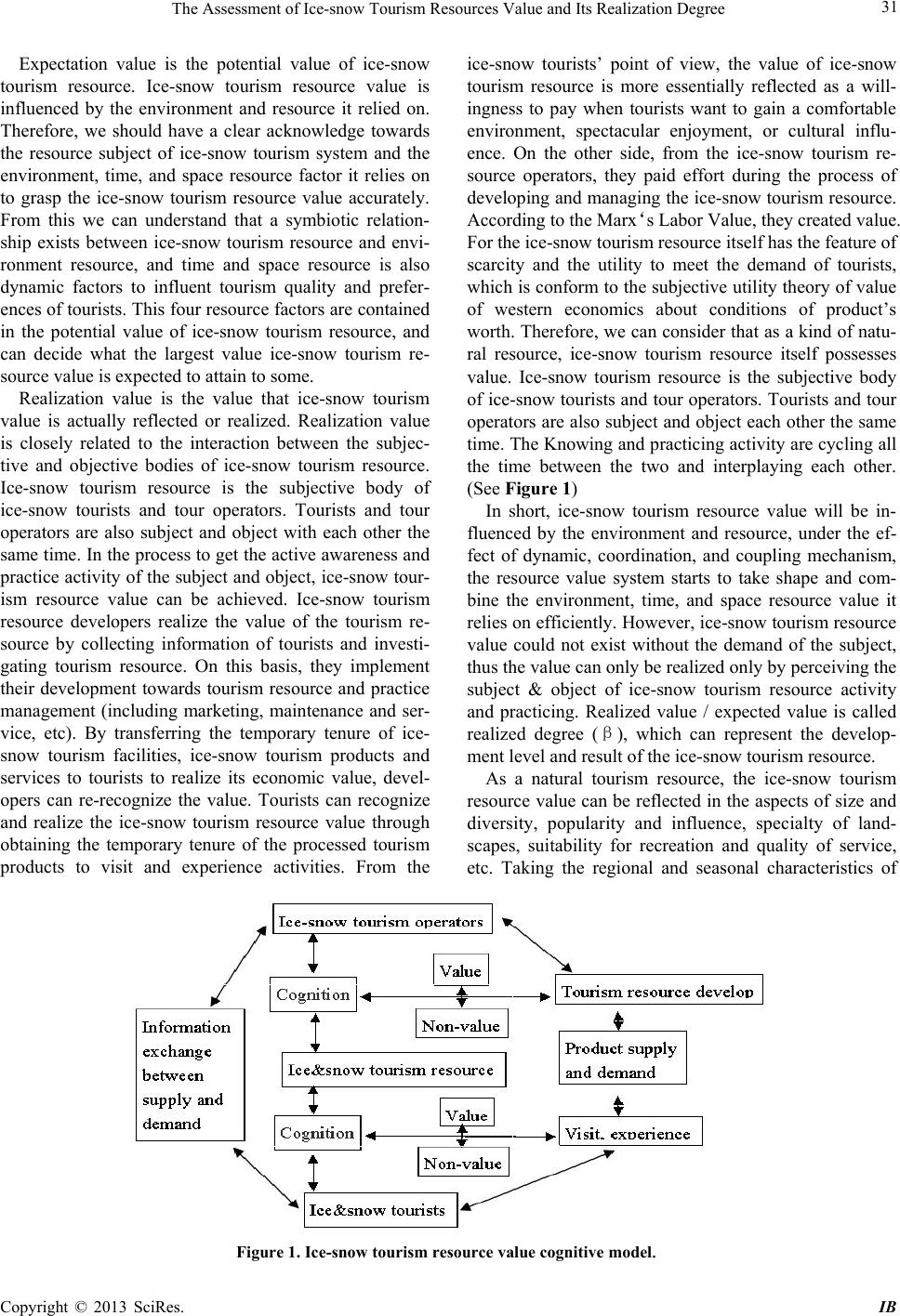 The Assessment of Ice-snow Tourism Resources Value and Its Realization Degree 31 Expectation value is the potential value of ice-snow tourism resource. Ice-snow tourism resource value is influenced by the environment and resource it relied on. Therefore, we should have a clear acknowledge towards the resource subject of ice-snow tourism system and the environment, time, and space resource factor it relies on to grasp the ice-snow tourism resource value accurately. From this we can understand that a symbiotic relation- ship exists between ice-snow tourism resource and envi- ronment resource, and time and space resource is also dynamic factors to influent tourism quality and prefer- ences of tourists. This four resource factors are contained in the potential value of ice-snow tourism resource, and can decide what the largest value ice-snow tourism re- source value is expected to attain to some. Realization value is the value that ice-snow tourism value is actually reflected or realized. Realization value is closely related to the interaction between the subjec- tive and objective bodies of ice-snow tourism resource. Ice-snow tourism resource is the subjective body of ice-snow tourists and tour operators. Tourists and tour operators are also subject and object with each other the same time. In the process to get the active awareness and practice activity of the subject and object, ice-snow tour- ism resource value can be achieved. Ice-snow tourism resource developers realize the value of the tourism re- source by collecting information of tourists and investi- gating tourism resource. On this basis, they implement their development towards tourism resource and practice management (including marketing, maintenance and ser- vice, etc). By transferring the temporary tenure of ice- snow tourism facilities, ice-snow tourism products and services to tourists to realize its economic value, devel- opers can re-recognize the value. Tourists can recognize and realize the ice-snow tourism resource value through obtaining the temporary tenure of the processed tourism products to visit and experience activities. From the ice-snow tourists’ point of view, the value of ice-snow tourism resource is more essentially reflected as a will- ingness to pay when tourists want to gain a comfortable environment, spectacular enjoyment, or cultural influ- ence. On the other side, from the ice-snow tourism re- source operators, they paid effort during the process of developing and managing the ice-snow tourism resource. According to the Marx‘s Labor Value, they created value. For the ice-snow tourism resource itself has the feature of scarcity and the utility to meet the demand of tourists, which is conform to the subjective utility theory of value of western economics about conditions of product’s worth. Therefore, we can consider that as a kind of natu- ral resource, ice-snow tourism resource itself possesses value. Ice-snow tourism resource is the subjective body of ice-snow tourists and tour operators. Tourists and tour operators are also subject and object each other the same time. The Knowing and practicing activity are cycling all the time between the two and interplaying each other. (See Figure 1) In short, ice-snow tourism resource value will be in- fluenced by the environment and resource, under the ef- fect of dynamic, coordination, and coupling mechanism, the resource value system starts to take shape and com- bine the environment, time, and space resource value it relies on efficiently. However, ice-snow tourism resource value could not exist without the demand of the subject, thus the value can only be realized only by perceiving the subject & object of ice-snow tourism resource activity and practicing. Realized value / expected value is called realized degree (β), which can represent the develop- ment level and result of the ice-snow tourism resource. As a natural tourism resource, the ice-snow tourism resource value can be reflected in the aspects of size and diversity, popularity and influence, specialty of land- scapes, suitability for recreation and quality of service, etc. Taking the regional and seasonal characteristics of Figure 1. Ice-snow tourism resource value cognitive model. Copyright © 2013 SciRes. IB 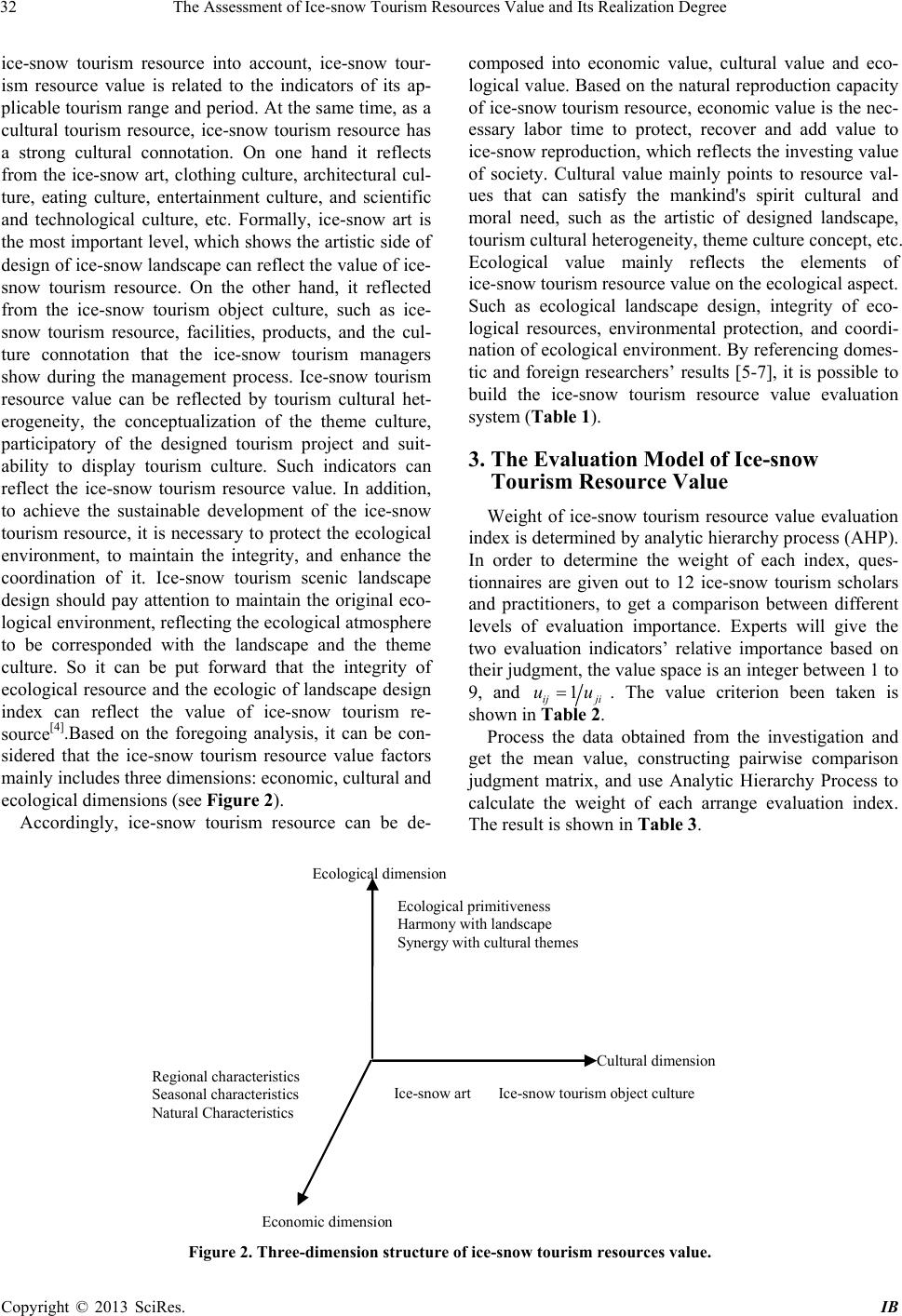 The Assessment of Ice-snow Tourism Resources Value and Its Realization Degree 32 ice-snow tourism resource into account, ice-snow tour- ism resource value is related to the indicators of its ap- plicable tourism range and period. At the same time, as a cultural tourism resource, ice-snow tourism resource has a strong cultural connotation. On one hand it reflects from the ice-snow art, clothing culture, architectural cul- ture, eating culture, entertainment culture, and scientific and technological culture, etc. Formally, ice-snow art is the most important level, which shows the artistic side of design of ice-snow landscape can reflect the value of ice- snow tourism resource. On the other hand, it reflected from the ice-snow tourism object culture, such as ice- snow tourism resource, facilities, products, and the cul- ture connotation that the ice-snow tourism managers show during the management process. Ice-snow tourism resource value can be reflected by tourism cultural het- erogeneity, the conceptualization of the theme culture, participatory of the designed tourism project and suit- ability to display tourism culture. Such indicators can reflect the ice-snow tourism resource value. In addition, to achieve the sustainable development of the ice-snow tourism resource, it is necessary to protect the ecological environment, to maintain the integrity, and enhance the coordination of it. Ice-snow tourism scenic landscape design should pay attention to maintain the original eco- logical environment, reflecting the ecological atmosphere to be corresponded with the landscape and the theme culture. So it can be put forward that the integrity of ecological resource and the ecologic of landscape design index can reflect the value of ice-snow tourism re- source[4].Based on the foregoing analysis, it can be con- sidered that the ice-snow tourism resource value factors mainly includes three dimensions: economic, cultural and ecological dimensions (see Figure 2). Accordingly, ice-snow tourism resource can be de- composed into economic value, cultural value and eco- logical value. Based on the natural reproduction capacity of ice-snow tourism resource, economic value is the nec- essary labor time to protect, recover and add value to ice-snow reproduction, which reflects the investing value of society. Cultural value mainly points to resource val- ues that can satisfy the mankind's spirit cultural and moral need, such as the artistic of designed landscape, tourism cultural heterogeneity, theme culture concept, etc. Ecological value mainly reflects the elements of ice-snow tourism resource value on the ecological aspect. Such as ecological landscape design, integrity of eco- logical resources, environmental protection, and coordi- nation of ecological environment. By referencing domes- tic and foreign researchers’ results [5-7], it is possible to build the ice-snow tourism resource value evaluation system (Table 1). 3. The Evaluation Model of Ice-snow Tourism Resource Value Weight of ice-snow tourism resource value evaluation index is determined by analytic hierarchy process (AHP). In order to determine the weight of each index, ques- tionnaires are given out to 12 ice-snow tourism scholars and practitioners, to get a comparison between different levels of evaluation importance. Experts will give the two evaluation indicators’ relative importance based on their judgment, the value space is an integer between 1 to 9, and 1 ij ji uu . The value criterion been taken is shown in Table 2. Process the data obtained from the investigation and get the mean value, constructing pairwise comparison judgment matrix, and use Analytic Hierarchy Process to calculate the weight of each arrange evaluation index. The result is shown in Table 3. Regional characteristics Seasonal characteristics Natural Characteristics Cultural dimension Economic dimension Ecological p rimitiveness Harmony with landscape Synergy with cultural themes Ice-snow art Ice-snow tourism object culture Ecological dimension Figure 2. Three-dimension structure of ice-snow tourism resources value. Copyright © 2013 SciRes. IB 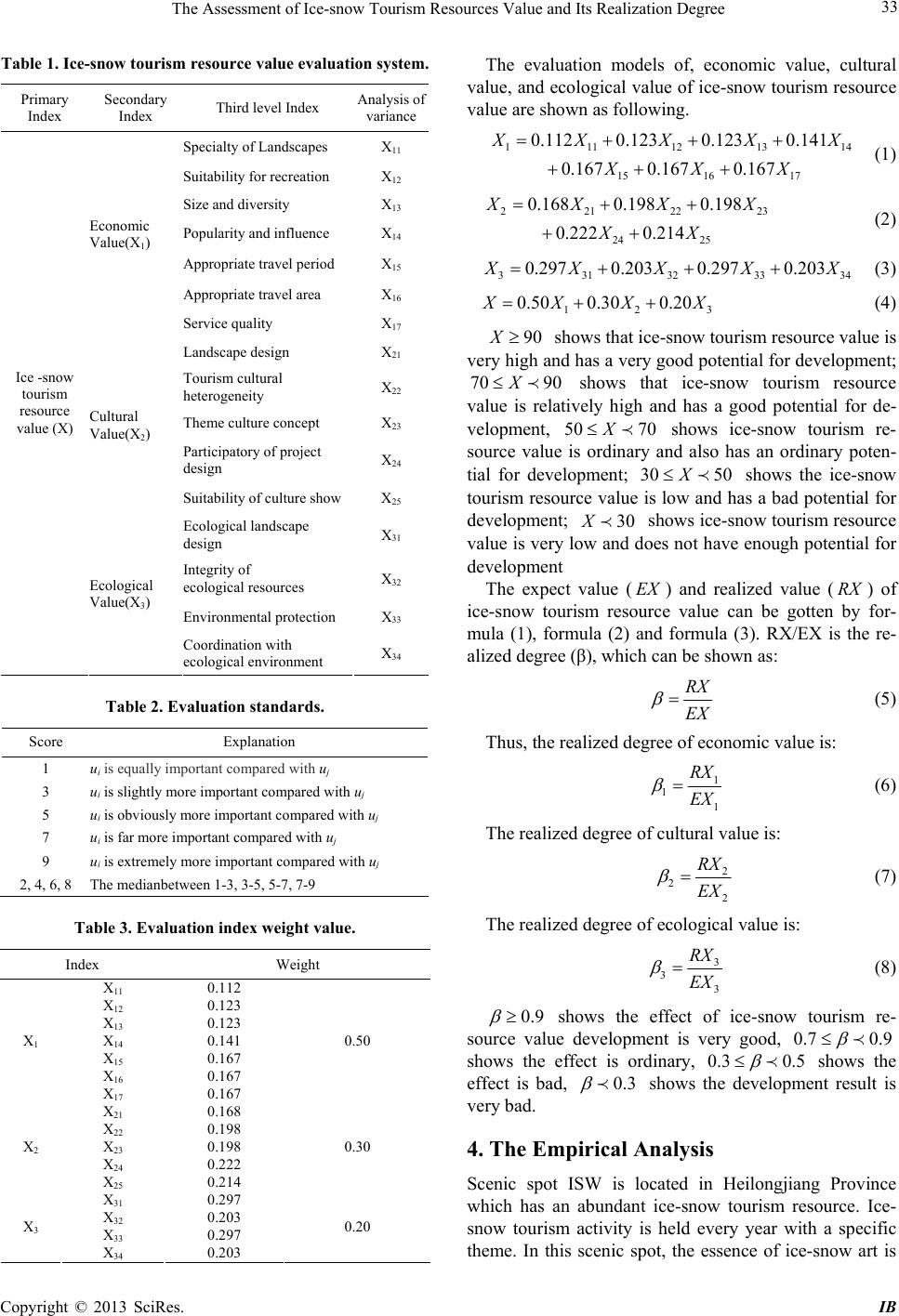 The Assessment of Ice-snow Tourism Resources Value and Its Realization Degree 33 Table 1. Ice-snow tourism resource value evaluation system. Primary Index Secondary Index Third level Index Analysis of variance Specialty of Landscapes X11 Suitability for recreation X12 Size and diversity X13 Popularity and influence X14 Appropriate travel period X15 Appropriate travel area X16 Economic Value(X1) Service quality X17 Landscape design X21 Tourism cultural heterogeneity X22 Theme culture concept X23 Participatory of project design X24 Cultural Value(X2) Suitability of culture show X25 Ecological landscape design X31 Integrity of ecological resources X32 Environmental protection X33 Ice -snow tourism resource value (X) Ecological Value(X3) Coordination with ecological environment X34 Table 2. Evaluation standards. Score Explanation 1 ui is equally important compared with uj 3 ui is slightly more important compared with uj 5 ui is obviously more important compared with uj 7 ui is far more important compared with uj 9 ui is extremely more important compared with uj 2, 4, 6, 8 The medianbetween 1-3, 3-5, 5-7, 7-9 Table 3. Evaluation index weight value. Index Weight X11 0.112 X12 0.123 X13 0.123 X14 0.141 X15 0.167 X16 0.167 X1 X17 0.167 0.50 X21 0.168 X22 0.198 X23 0.198 X24 0.222 X2 X25 0.214 0.30 X31 0.297 X32 0.203 X33 0.297 X3 X34 0.203 0.20 The evaluation models of, economic value, cultural value, and ecological value of ice-snow tourism resource value are shown as following. 1111213 15 16 17 0.112 0.1230.123 0.141 0.167 0.167 0.167 14 X XXX XXX X 23 (1) 22122 24 25 0.168 0.1980.198 0.222 0.214 X XX XX X 34 (2) 3313233 0.297 0.203 0.2970.203 X XXXX (3) 12 0.500.300.20 3 X XXX (4) 90X X shows that ice-snow tourism resource value is very high and has a very good potential for development; 70 90 shows that ice-snow tourism resource value is relatively high and has a good potential for de- velopment, 50 70X 30 shows ice-snow tourism re- source value is ordinary and also has an ordinary poten- tial for development; 50X shows the ice-snow tourism resource value is low and has a bad potential for development; shows ice-snow tourism resource value is very low and does not have enough potential for development 30X The expect value () and realized value () of ice-snow tourism resource value can be gotten by for- mula (1), formula (2) and formula (3). RX/EX is the re- alized degree (β), which can be shown as: EX RX RX EX (5) Thus, the realized degree of economic value is: 1 1 1 RX EX (6) The realized degree of cultural value is: 2 2 2 RX EX (7) The realized degree of ecological value is: 3 3 3 RX EX (8) 0.9 shows the effect of ice-snow tourism re- source value development is very good, 0.7 0.9 0.5 shows the effect is ordinary, 0.3 shows the effect is bad, 0.3 shows the development result is very bad. 4. The Empirical Analysis Scenic spot ISW is located in Heilongjiang Province which has an abundant ice-snow tourism resource. Ice- snow tourism activity is held every year with a specific theme. In this scenic spot, the essence of ice-snow art is Copyright © 2013 SciRes. IB 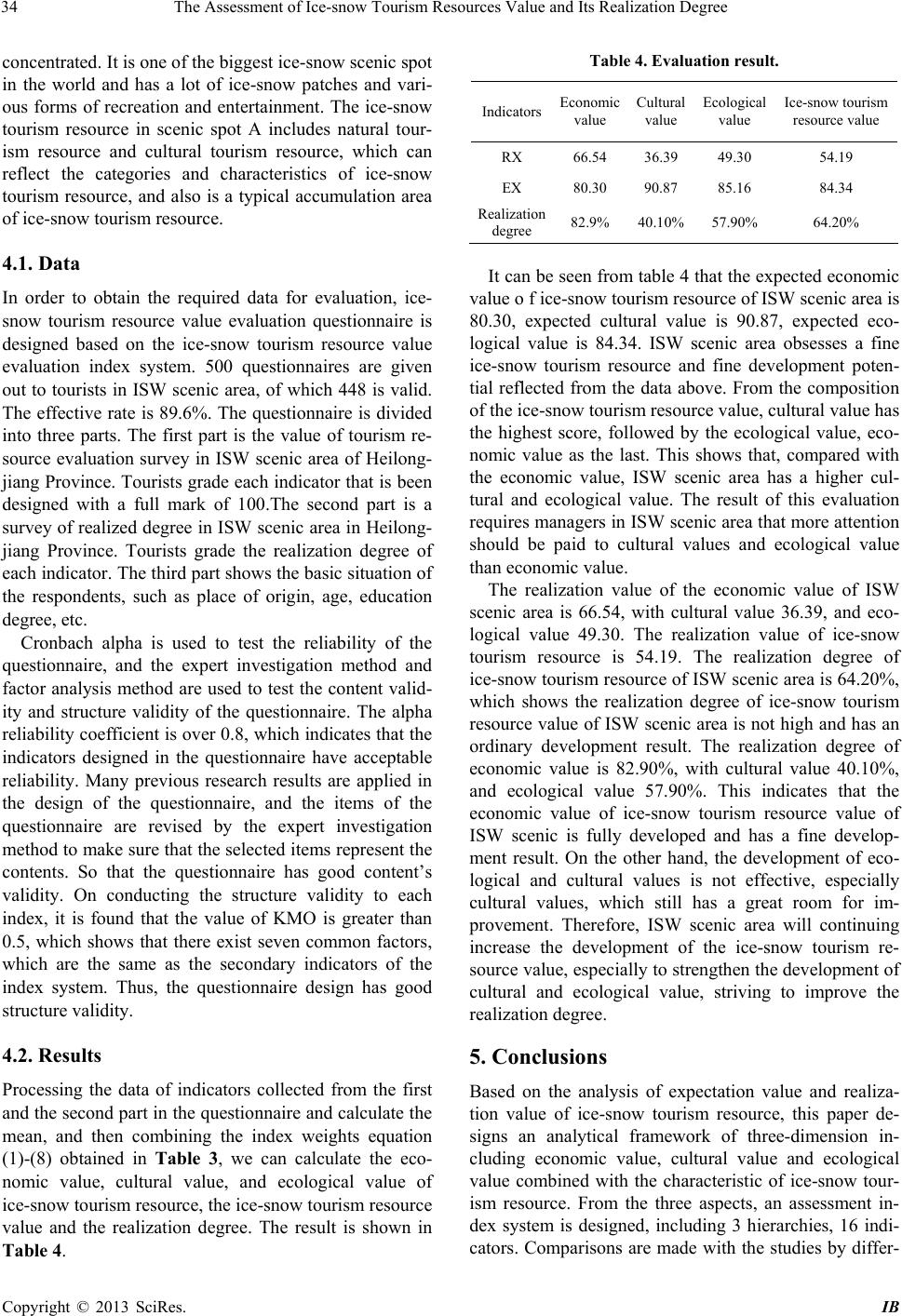 The Assessment of Ice-snow Tourism Resources Value and Its Realization Degree 34 concentrated. It is one of the biggest ice-snow scenic spot in the world and has a lot of ice-snow patches and vari- ous forms of recreation and entertainment. The ice-snow tourism resource in scenic spot A includes natural tour- ism resource and cultural tourism resource, which can reflect the categories and characteristics of ice-snow tourism resource, and also is a typical accumulation area of ice-snow tourism resource. 4.1. Data In order to obtain the required data for evaluation, ice- snow tourism resource value evaluation questionnaire is designed based on the ice-snow tourism resource value evaluation index system. 500 questionnaires are given out to tourists in ISW scenic area, of which 448 is valid. The effective rate is 89.6%. The questionnaire is divided into three parts. The first part is the value of tourism re- source evaluation survey in ISW scenic area of Heilong- jiang Province. Tourists grade each indicator that is been designed with a full mark of 100.The second part is a survey of realized degree in ISW scenic area in Heilong- jiang Province. Tourists grade the realization degree of each indicator. The third part shows the basic situation of the respondents, such as place of origin, age, education degree, etc. Cronbach alpha is used to test the reliability of the questionnaire, and the expert investigation method and factor analysis method are used to test the content valid- ity and structure validity of the questionnaire. The alpha reliability coefficient is over 0.8, which indicates that the indicators designed in the questionnaire have acceptable reliability. Many previous research results are applied in the design of the questionnaire, and the items of the questionnaire are revised by the expert investigation method to make sure that the selected items represent the contents. So that the questionnaire has good content’s validity. On conducting the structure validity to each index, it is found that the value of KMO is greater than 0.5, which shows that there exist seven common factors, which are the same as the secondary indicators of the index system. Thus, the questionnaire design has good structure validity. 4.2. Results Processing the data of indicators collected from the first and the second part in the questionnaire and calculate the mean, and then combining the index weights equation (1)-(8) obtained in Table 3, we can calculate the eco- nomic value, cultural value, and ecological value of ice-snow tourism resource, the ice-snow tourism resource value and the realization degree. The result is shown in Table 4. Table 4. Evaluation result. Indicators Economic value Cultural value Ecological value Ice-snow tourism resource value RX 66.54 36.39 49.30 54.19 EX 80.30 90.87 85.16 84.34 Realization degree 82.9% 40.10% 57.90% 64.20% It can be seen from table 4 that the expected economic value o f ice-snow tourism resource of ISW scenic area is 80.30, expected cultural value is 90.87, expected eco- logical value is 84.34. ISW scenic area obsesses a fine ice-snow tourism resource and fine development poten- tial reflected from the data above. From the composition of the ice-snow tourism resource value, cultural value has the highest score, followed by the ecological value, eco- nomic value as the last. This shows that, compared with the economic value, ISW scenic area has a higher cul- tural and ecological value. The result of this evaluation requires managers in ISW scenic area that more attention should be paid to cultural values and ecological value than economic value. The realization value of the economic value of ISW scenic area is 66.54, with cultural value 36.39, and eco- logical value 49.30. The realization value of ice-snow tourism resource is 54.19. The realization degree of ice-snow tourism resource of ISW scenic area is 64.20%, which shows the realization degree of ice-snow tourism resource value of ISW scenic area is not high and has an ordinary development result. The realization degree of economic value is 82.90%, with cultural value 40.10%, and ecological value 57.90%. This indicates that the economic value of ice-snow tourism resource value of ISW scenic is fully developed and has a fine develop- ment result. On the other hand, the development of eco- logical and cultural values is not effective, especially cultural values, which still has a great room for im- provement. Therefore, ISW scenic area will continuing increase the development of the ice-snow tourism re- source value, especially to strengthen the development of cultural and ecological value, striving to improve the realization degree. 5. Conclusions Based on the analysis of expectation value and realiza- tion value of ice-snow tourism resource, this paper de- signs an analytical framework of three-dimension in- cluding economic value, cultural value and ecological value combined with the characteristic of ice-snow tour- ism resource. From the three aspects, an assessment in- dex system is designed, including 3 hierarchies, 16 indi- cators. Comparisons are made with the studies by differ- Copyright © 2013 SciRes. IB  The Assessment of Ice-snow Tourism Resources Value and Its Realization Degree Copyright © 2013 SciRes. IB 35 ent scholars in the same field from home and abroad when choosing indicators to ensure that the selected in- dicators are comprehensive, scientific and rational [8,9]. Analytic Hierarchy Process is used to determine the index weight, and based on this, economic value, cultural value, ecological value, as well as ice-snow tourism re- source value and are analyzed, the model of ice-snow tourism resource value is constructed, and the develop- ment of ice-snow tourism resource value is assessed. It can be seen from the evaluation and analysis of ice-snow tourism resource value of ISW scenic area in Heilongji- ang province that the evaluation model and methods de- veloped in this paper can make scientific and reasonable evaluation towards ice-snow tourism resource value and are beneficial to improving the result of ice-snow tourism resource development. This paper only provides a preliminary exploration on the assessment of the ice-snow tourism resource value, and there are many other important issues need to be further studied. For example, the interaction and coupling relationships among the three dimensions have a certain influence on the ice-snow tourism resource value, and can be included into the index system in further research to achieve a more precise evaluation result. 6. Acknowledgements The work described in this paper is supported by the Philosophy and Social Science Project in Heilongjiang Province (08C059). REFERENCES [1] L. Wang, “A Summary on the Ice-Snow Tourism Devel- opment and Research at Home and Abroad,” Ecological Economy, Vol. 6, 2010, pp. 66-69. [2] Y. N. Tan, “A Primary Exploration of Ice-snow Tourism Experience Marketing Tactics in Changchun, Economic Vision, Vol. 11, 2006, pp. 39-40. [3] H. Elsasser and P. Messerli, “The Vulnerability of the Snow Industry in the Swiss Alps,” Mountain Research and Development, Vol. 21, No. 4, 2001, pp. 335-339. doi:10.1659/0276-4741(2001)021[0335:TVOTSI]2.0.CO; 2 [4] Y. S. Tang, “Development Circumstance Analysis and Innovation Strategy of Chinese Ski Industry,” China Win- ter Sports, Vol. 1, 2009, pp. 83-87 [5] W. W. Wu, Q. Deng and C. Y. Zhang, “Study on the Cou- pling Mechanism of the Ice-Snow Tourism Resource Value and External Environment,” Proceedings of Geol- ogy Resource Management and Sustainable Development, 2009, pp. 339-343. [6] H. Elsasser, P. Messerli, “The Vulnerability of the Snow Industry in the Swiss Alps. Mountain,” Research and Development, Vol. 4, 2001, pp. 335-339. doi:10.1659/0276-4741(2001)021[0335:TVOTSI]2.0.CO; 2 [7] C. Y. Zhang, Y. Q. Hu and M. Du, “Ice-snow Tourism Culture Shaping during Tourism Resource Development Evaluation,” Management World, Vol. 4, 2008, pp. 173-174. [8] C. Wolfsegger, S. Gössling and D. Scott, “Climate Change Risk Appraisal in the Austrian Ski Industry,” Tourism Review International, Vol. 12, No. 1, 2008, pp. 13-23. doi:10.3727/154427208785899948 [9] C. K. Lee and S. Y. Han, “Estimating the Use and Pres- ervation Values of National Parks’ Tourism Resources using a Contingent Valuation Method,” Tourism Man- agement, Vol. 23, No. 5, 2002, pp. 531-540. doi:10.1016/S0261-5177(02)00010-9 |