

Paper Menu >>
Journal Menu >>
 iBusiness, 2013, 5, 26-29 http: //dx.doi.org/10.4236/ib.201 3.53B006 Published Online September 2013 (http://www.scirp.org/journal/ib) A Public Value Based Framework for Evaluating the Performance of e-Government in China Wenlin Bai1,2 1Key Laboratory of Data Engineering and Knowledge Engineering of the Ministry of Education, Renmin University of China, Bei- jing, China; 2School of Information Resources Management, Renmin University of China, Beijing, China. Email: [email protected] Received May, 2013 ABSTRACT Much research has been done on evaluating the performance of e-government in China, but comprehensive pictures of research done on evaluation of performance of e-government can hardly be found in the Chinese literature. Besides, there are few theories to support the research and practice in evaluation. By analyzin g existed literature, the paper pro- poses a conceptual framework for evaluating performance of e-government based on public value perspective. Delivery of public services, effectiveness of public organization and development of trust are identified and selected as three ba- sic public values for analysis. Keywords: Evaluation of Performance of e-Government; Public Value; Conceptual Framework; China 1. Introduction “Electronic Government” (or in short “e-Government”) essentially refers to ‘The utilization of IT, ICTs, and oth- er web-based telecommunication technologies to im- prove and enhance on the efficiency and effectiveness of service delivery in the public sector.’ (Jeong, 2007)[1]. With the development of information and communica- tion technologies (or in short ICT), the concept of elec- tronic government becomes more and more popular all over the world. In the background of information and knowledge economy, the construction of E-government has become a necessity [2-3]. However, with the constant pressure of investment on e-government, evaluating the performance of e-government becomes urgent. To the government, it has provided an effective way to reduce the operating costs for government and at the same time, to enhance the administrative ability of government [4]. To the citizens, evaluation of performance of e-govern- ment has provided an opportunity for citizen to partici- pate in the e-government services and to increase the availability of government information and to improve their public services which will be beneficial to meet the citizens’ needs [5,6]. Many e-government projects and research have been done in China, however, e-government performance re- search in China are either from the perspective of gov- ernment agencies or from the perspective of citizens, no convergence of both as an integrated whole and lacks of theoretical support. This paper recommends adoption of concept of public value as theoretical support to the evaluation. In this paper, the concept of public value re- fers to a holistic approach to evaluate the effectiveness and efficiency of public services (Moore, 1995)[7]. Firstly, this paper has reviewed representative Chinese and English literature on “evaluation of performance of e-government” from CSSCI, ProQuest database, EI, SCI, SSCI, ISTP, ISSHP citied journals. Representative theo ry, strategies practices have been selected for study. Then based on literature review and meta-synthesis, a new conceptual framework for evaluation of e-government performance is put up. 2. Literature Review Literature shows there is little research on evaluation of performance of e-government under the perspective of public value in Chinese literature. However, the concept of public value has been aroused much attention and has been widely used in the designing of framework for e-government performance evaluation in English litera- ture. Figure 1 shows an overview of five representative papers: The five representative papers all share same concept of public value, but each has different advantages and limitations. The first paper focuses on high quality of services, outcomes and trust with limitations on trust not fully discussed. (Keams, 2004)[8].The second paper fo- cuses on the operating efficiency of government, the publicity and transparency of public agencies, the public Copyright © 2013 SciRes. IB 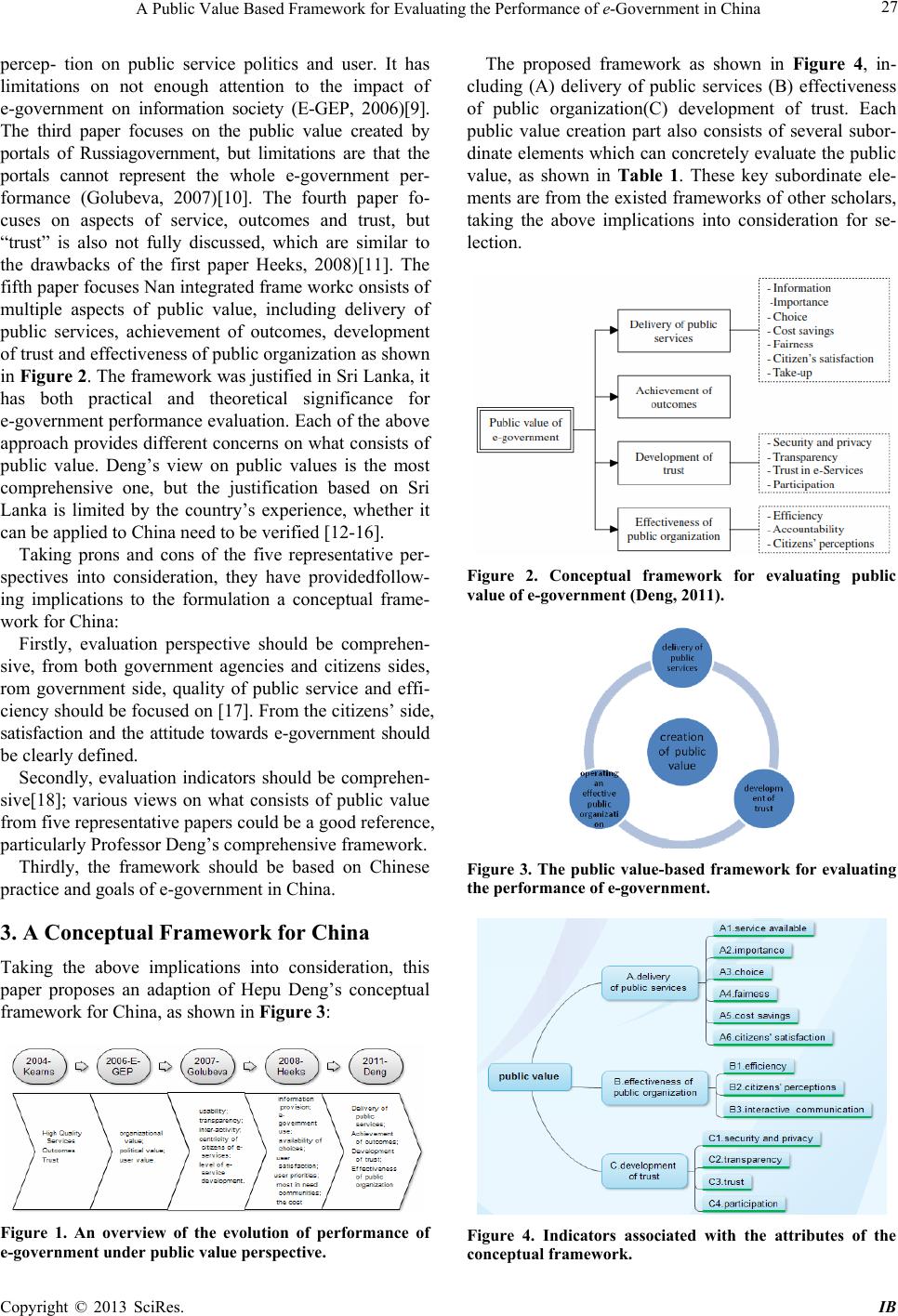 A Public Value Based Framework for Evaluating the Performance of e-Government in China 27 percep- tion on public service politics and user. It has limitations on not enough attention to the impact of e-government on information society (E-GEP, 2006)[9]. The third paper focuses on the public value created by portals of Russiagovernment, but limitations are that the portals cannot represent the whole e-government per- formance (Golubeva, 2007)[10]. The fourth paper fo- cuses on aspects of service, outcomes and trust, but “trust” is also not fully discussed, which are similar to the drawbacks of the first paper Heeks, 2008)[11]. The fifth paper focuses Nan integrated frame workc onsists of multiple aspects of public value, including delivery of public services, achievement of outcomes, development of trust and effectiveness of public organization as shown in Figure 2. The framework was justified in Sri Lanka, it has both practical and theoretical significance for e-government performance evaluation. Each of the abov e approach provides different concerns on what consists of public value. Deng’s view on public values is the most comprehensive one, but the justification based on Sri Lanka is limited by the country’s experience, whether it can be applied t o China need to be verified [12-16]. Taking prons and cons of the five representative per- spectives into consideration, they have providedfollow- ing implications to the formulation a conceptual frame- work for China: Firstly, evaluation perspective should be comprehen- sive, from both government agencies and citizens sides, rom government side, quality of public service and effi- ciency should be focused on [17]. From the citizens’ side, satisfaction and the attitude towards e-government should be clearly defined. Secondly, evaluation indicators should be comprehen- sive[18]; various views on what consists of public value from five representative papers could be a good reference, particularly Professor Deng’s comprehensive framework. Thirdly, the framework should be based on Chinese practice and goals of e-government in China. 3. A Conceptual Framework for China Taking the above implications into consideration, this paper proposes an adaption of Hepu Deng’s conceptual framework for China, as shown in Figure 3: Figure 1. An overview of the evolution of performance of e-government under public value perspective. The proposed framework as shown in Figure 4, in- cluding (A) delivery of public services (B) effectiveness of public organization(C) development of trust. Each public value creation part also consists of several subor- dinate elements which can con cretely evaluate the public value, as shown in Table 1. These key subordinate ele- ments are from the existed frameworks of other scholars, taking the above implications into consideration for se- lection. Figure 2. Conceptual framework for evaluating public value of e-government (Deng, 2011). Figure 3. The public value-based framework for evaluating the performance of e-government. Figure 4. Indicators associated with the attributes of the conceptual framework. Copyright © 2013 SciRes. IB 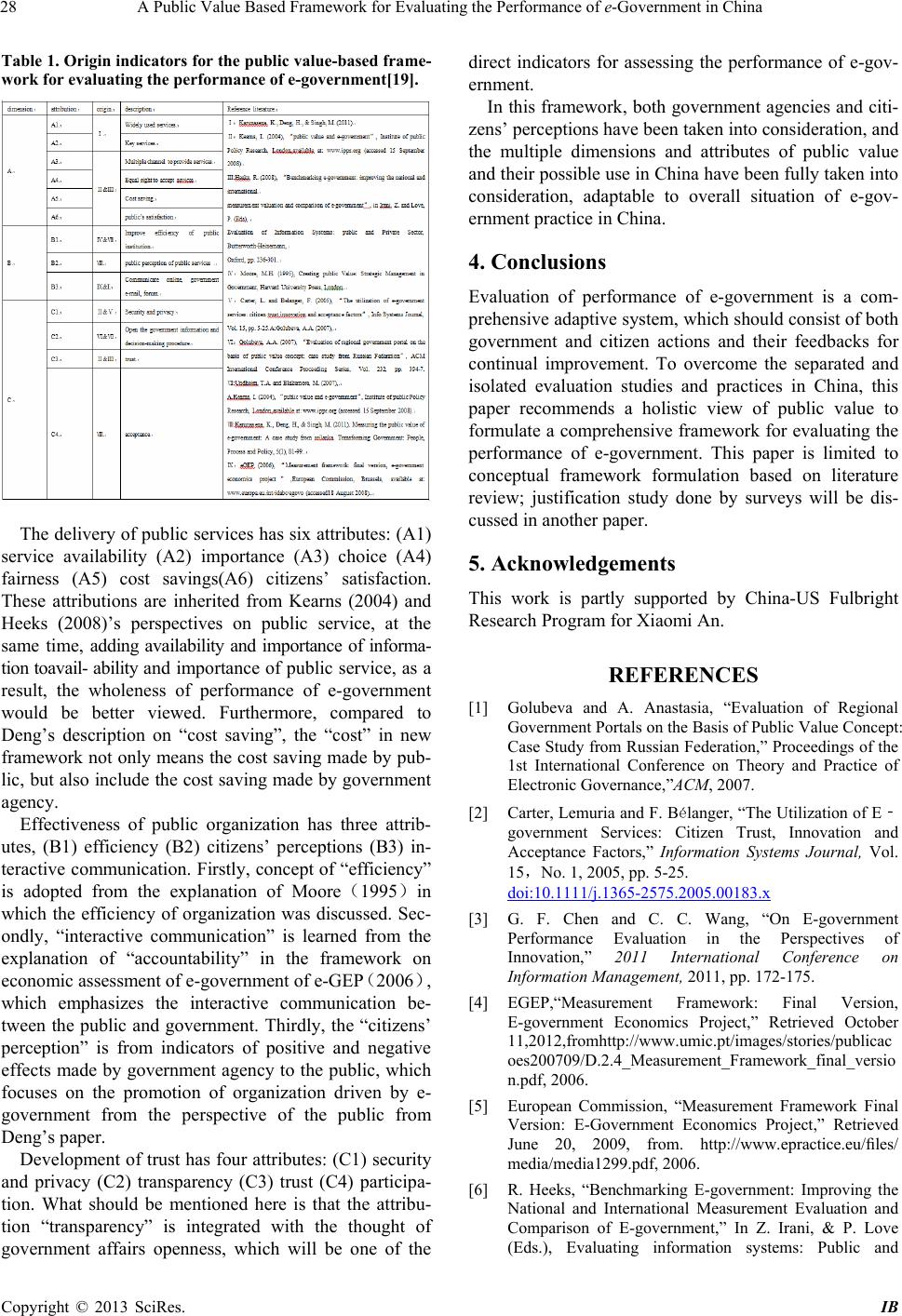 A Public Value Based Framework for Evaluating the Performance of e-Government in China 28 Table 1. Origin indicators for the public value-based frame- work for evaluating the performance of e-government[19]. The delivery of public services has six attributes: (A1) service availability (A2) importance (A3) choice (A4) fairness (A5) cost savings(A6) citizens’ satisfaction. These attributions are inherited from Kearns (2004) and Heeks (2008)’s perspectives on public service, at the same time, adding availability and importance of informa- tion toavail- ability an d imp orta nce o f pu blic servic e, a s a result, the wholeness of performance of e-government would be better viewed. Furthermore, compared to Deng’s description on “cost saving”, the “cost” in new framework not only means the cost saving made by pub- lic, but also include the cost saving made by government agency. Effectiveness of public organization has three attrib- utes, (B1) efficiency (B2) citizens’ perceptions (B3) in- teractive communication. Firstly, concept of “efficiency” is adopted from the explanation of Moore(1995)in which the efficiency of organization was discussed. Sec- ondly, “interactive communication” is learned from the explanation of “accountability” in the framework on economic assessment of e-government of e-GEP(2006), which emphasizes the interactive communication be- tween the public and government. Thirdly, the “citizens’ perception” is from indicators of positive and negative effects made by government agency to the public, which focuses on the promotion of organization driven by e- government from the perspective of the public from Deng’s paper. Development of trust has four attributes: (C1) security and privacy (C2) transparency (C3) trust (C4) participa- tion. What should be mentioned here is that the attribu- tion “transparency” is integrated with the thought of government affairs openness, which will be one of the direct indicators for assessing the performance of e-gov- ernment. In this framework, both government agencies and citi- zens’ perceptions have been taken into consideration, and the multiple dimensions and attributes of public value and their possible use in China have been fully taken into consideration, adaptable to overall situation of e-gov- ernment practice in China. 4. Conclusions Evaluation of performance of e-government is a com- prehensive adaptive system, which should consist of both government and citizen actions and their feedbacks for continual improvement. To overcome the separated and isolated evaluation studies and practices in China, this paper recommends a holistic view of public value to formulate a comprehensive framework for evaluating the performance of e-government. This paper is limited to conceptual framework formulation based on literature review; justification study done by surveys will be dis- cussed in another paper. 5. Acknowledgements This work is partly supported by China-US Fulbright Research Program for Xiaomi An. REFERENCES [1] Golubeva and A. Anastasia, “Evaluation of Regional Government Portals on the Basis of Public Value Concept: Case Study from Russian Fede ration,” Proceedings of the 1st International Conference on Theory and Practice of Electronic Governance,”ACM, 2007. [2] Carter, Lemuria and F. Bélanger, “The Utilization of E‐ government Services: Citizen Trust, Innovation and Acceptance Factors,” Information Systems Journal, Vol. 15,No. 1, 2005, pp. 5-25. doi:10.1111/j.1365-2575.2005.00183.x [3] G. F. Chen and C. C. Wang, “On E-government Performance Evaluation in the Perspectives of Innovation,” 2011 International Conference on Information Management, 2011, pp. 172-175. [4] EGEP,“Measurement Framework: Final Version, E-government Economics Project,” Retrieved October 11,2012,fromhttp://www.umic.pt/images/stories/publicac oes200709/D.2.4_Measurement_Framework_final_versio n.pdf, 2006. [5] European Commission, “Measurement Framework Final Version: E-Government Economics Project,” Retrieved June 20, 2009, from. http://www.epractice.eu/ files/ media/media1299.pdf, 2006. [6] R. Heeks, “Benchmarking E-government: Improving the National and International Measurement Evaluation and Comparison of E-government,” In Z. Irani, & P. Love (Eds.), Evaluating information systems: Public and Copyright © 2013 SciRes. IB 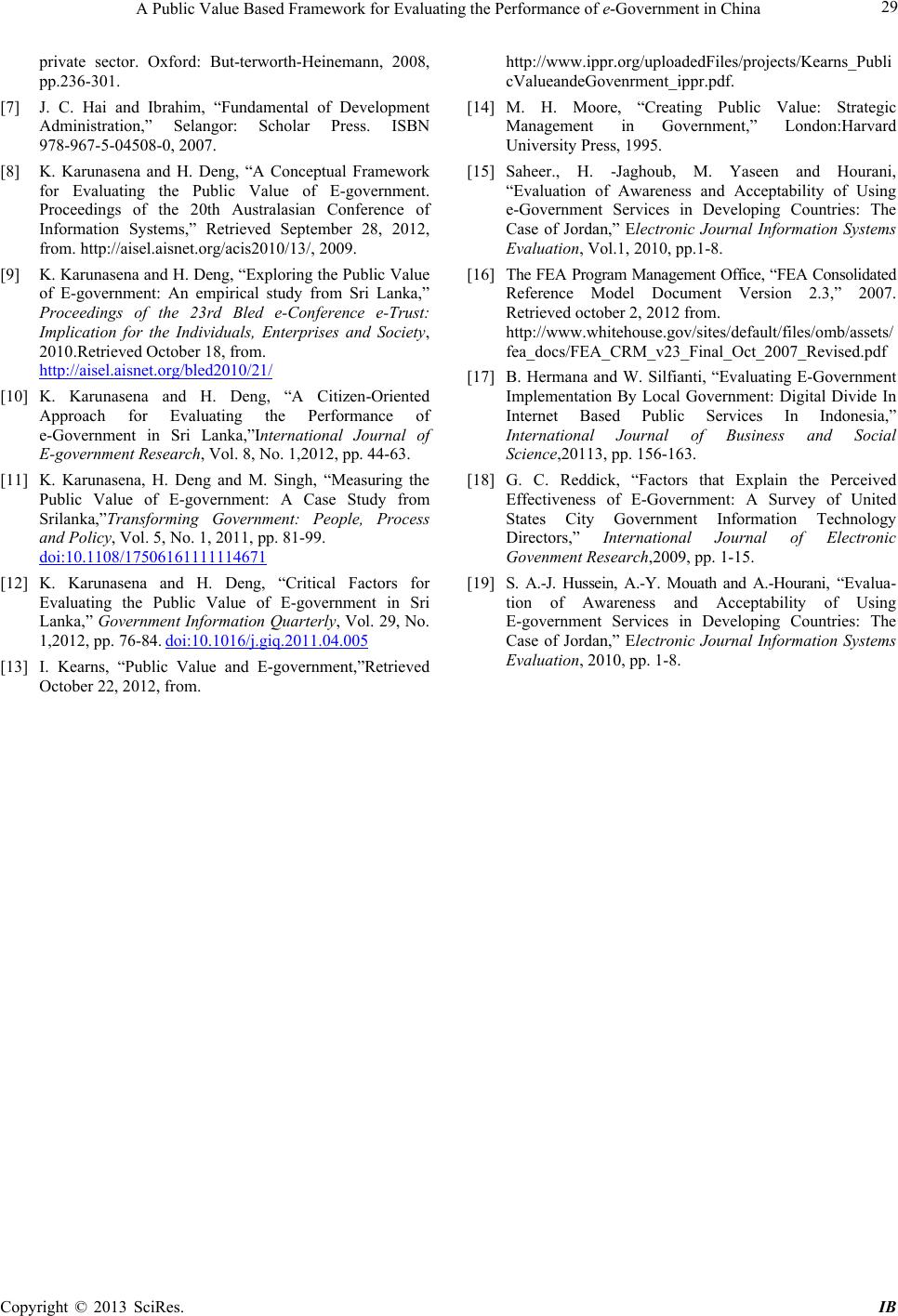 A Public Value Based Framework for Evaluating the Performance of e-Government in China Copyright © 2013 SciRes. IB 29 private sector. Oxford: But-terworth-Heinemann, 2008, pp.236-301. [7] J. C. Hai and Ibrahim, “Fundamental of Development Administration,” Selangor: Scholar Press. ISBN 978-967-5-04508-0, 2007. [8] K. Karunasena and H. Deng, “A Conceptual Framework for Evaluating the Public Value of E-government. Proceedings of the 20th Australasian Conference of Information Systems,” Retrieved September 28, 2012, from. http://aisel.aisnet.org/acis2010/13/, 2009. [9] K. Karunasena and H. Deng, “Exploring the Public Value of E-government: An empirical study from Sri Lanka,” Proceedings of the 23rd Bled e-Conference e-Trust: Implication for the Individuals, Enterprises and Society, 2010.Retrieved October 18, from. http://aisel.aisnet.org/bled2010/21/ [10] K. Karunasena and H. Deng, “A Citizen-Oriented Approach for Evaluating the Performance of e-Government in Sri Lanka,”International Journal of E-government Research, Vol. 8, No. 1,2012, pp. 44-63. [11] K. Karunasena, H. Deng and M. Singh, “Measuring the Public Value of E-government: A Case Study from Srilanka,”Transforming Government: People, Process and Policy, Vol. 5, No. 1, 2011, pp. 81-99. doi:10.1108/17506161111114671 [12] K. Karunasena and H. Deng, “Critical Factors for Evaluating the Public Value of E-government in Sri Lanka,” Government Information Quarterly, Vol. 29, No. 1,2012, pp. 76-84. doi:10.1016/j.giq.2011.04.005 [13] I. Kearns, “Public Value and E-government,”Retrieved October 22, 2012, from. http://www.ippr.org/uploadedFiles/projects/Kearns_Publi cValueandeGovenrment_ippr.pdf. [14] M. H. Moore, “Creating Public Value: Strategic Management in Government,” London:Harvard University Press, 1995. [15] Saheer., H. -Jaghoub, M. Yaseen and Hourani, “Evaluation of Awareness and Acceptability of Using e-Government Services in Developing Countries: The Case of Jordan,” Electronic Journal Information Systems Evaluation, Vol.1, 2010, pp.1-8. [16] The FEA Program Management Office, “FEA Consolidated Reference Model Document Version 2.3,” 2007. Retrieved october 2, 2012 from. http://www.whitehouse.gov/sites/default/files/omb/assets/ fea_docs/FEA_CRM_v23_Final_Oct_2007_Revised.pdf [17] B. Hermana and W. Silfianti, “Evaluating E-Government Implementation By Local Government: Digital Divide In Internet Based Public Services In Indonesia,” International Journal of Business and Social Science,20113, pp. 156-163. [18] G. C. Reddick, “Factors that Explain the Perceived Effectiveness of E-Government: A Survey of United States City Government Information Technology Directors,” International Journal of Electronic Govenment Resear c h,2009, pp. 1-15. [19] S. A.-J. Hussein, A.-Y. Mouath and A.-Hourani, “Evalua- tion of Awareness and Acceptability of Using E-government Services in Developing Countries: The Case of Jordan,” Electronic Journal Information Systems Evaluation, 2010, pp. 1-8. |