

Paper Menu >>
Journal Menu >>
 Journal of Materials Science and Chemical Engineering, 2013, 1, 61-65 http://dx.doi.org/10.4236/msce.2013.15013 Published Online October 2013 (http://www.scirp.org/journal/msce) Copyright © 2013 SciRes. MSCE Synthesis, Characterization and Perfo rmance of a New Type of Alkylene Triphenyl Double Quaternary Phosphonium Salt* Wei Wei, Bin Yuan#, Song Lv, Qifeng Liao, Jieyang Huang Faculty of Environmental Science & Engineering, Guangdong University of Technology, Guangdong, China Email: #[email protected] Received October 2013 ABSTRACT By Bimolecular Nucleophilic Substitution, four new types of alkylene triphenyl double quaternary phosphonium salt were synthesized respectively by using triphenylphosphine, 1,3-dibromopropane, 1,6-dibromohexane, 1,10-dibromo- decane, 1,12-dibromododecane as raw materials and using DMAC as the solvent, under a certain temperature and reac- tion time. The productivity is 58% - 83%. The molecular structures of the products were characterized by IR, NMR and elemental analysis. The sterilizing eff ect of 1,6-hexylidene triphenyl double phosphonium bromide (HTDPB) and 1,12 - dodecylidene triphenyl double phosphonium bromide (DoTDPB) was evaluated by using extinct dilution method. The experimental result shows that the sterilizin g effect of DoTDPB is better than the effect of HTDPB under the same drug concentration and contact time. When the concentration of DoTDPB was 20 mg/L and the contact time was 0.5 h, the sterilizing rate of DoTDPB used to kill saprophytic bacteria (TGB), sulfate-reducing bacteria (SRB) and iron bacteria (IB) was 95.56%, 84% and 99.58% respectively. Keywords: Alkylene Triphenyl Phosphonium; Double Quat e rna r y P h osphoni um Salt; Bactericide; Synthesis; Performance 1. Introduction One traditional way to prevent microbes from breeding in water is adding bactericide in water. If people use the same kind of bactericide frequently, microbes will get resistance to drugs. That will decreases the sterilizing ef- fect of bactericide, and increas es the application amount of bactericide and the cost of water treatment, so to make a new type of high-effeciency bactericide has been a re- search hotspot among domestic and overseas researchers. Quaernary phosphonium salt and double quaernary phos- phonium salt are one type of new, high-effeciency and broad-spectrum bactericide [1-3], which will not produce foam after being used in water and exist in the interface and water body. The sulfonated triphenyl phosphonium has the effect of resisting tumour [4], so it is evaluat ed hi ghl y. Four new types of alkylene triphenyl double quater- nary phosphonium salt were synthesized respectively by Bimolecular Nucleophilic Substitution and using triphenyl phosphine, 1,3-dibromo propane, 1,6-dibro mohexane, 1,10-dibromodecane and 1,12-dibromododecane as raw materials. Their synthetic route is in Figure 1. The molecular structures of products were characte- rized by using IR, NMR and element analysis. The steri- lizing effect of 1,6-hexylidene triphenyl double phos- phonium bromide (HTDPB) and 1,12-dodecylidene tri- phenyl double phosphonium bromide (DoTDPB) was tested by using extinct dilution method. 2. Experimental Part 2.1. Reagents and Instrument s Reagents: Triphenylphosphine, 1,3-dibromomopropane, 1,6-dibromohexane, 1,10-dibromodecane, 1,12-dibromodo- decane and N,N-dimethylacetamide are all analytical rea- gents. Industrial circulating cooling water samples are from a petrochemical corporation in Guangzhou. Instruments: PE-2400 CHNS elementalanalyser (Per - kinElmer of Shanghai); NICOLET-380 infrared spec- trometer (Thermo Electron Corporation); XT41-00B Figure 1. The synthetic route of alkylene triphenyl double quaternary phosphonium salt. * Supported by the Guangzhou science and technology plan projects (2010Y1-C781). #Corresponding author. 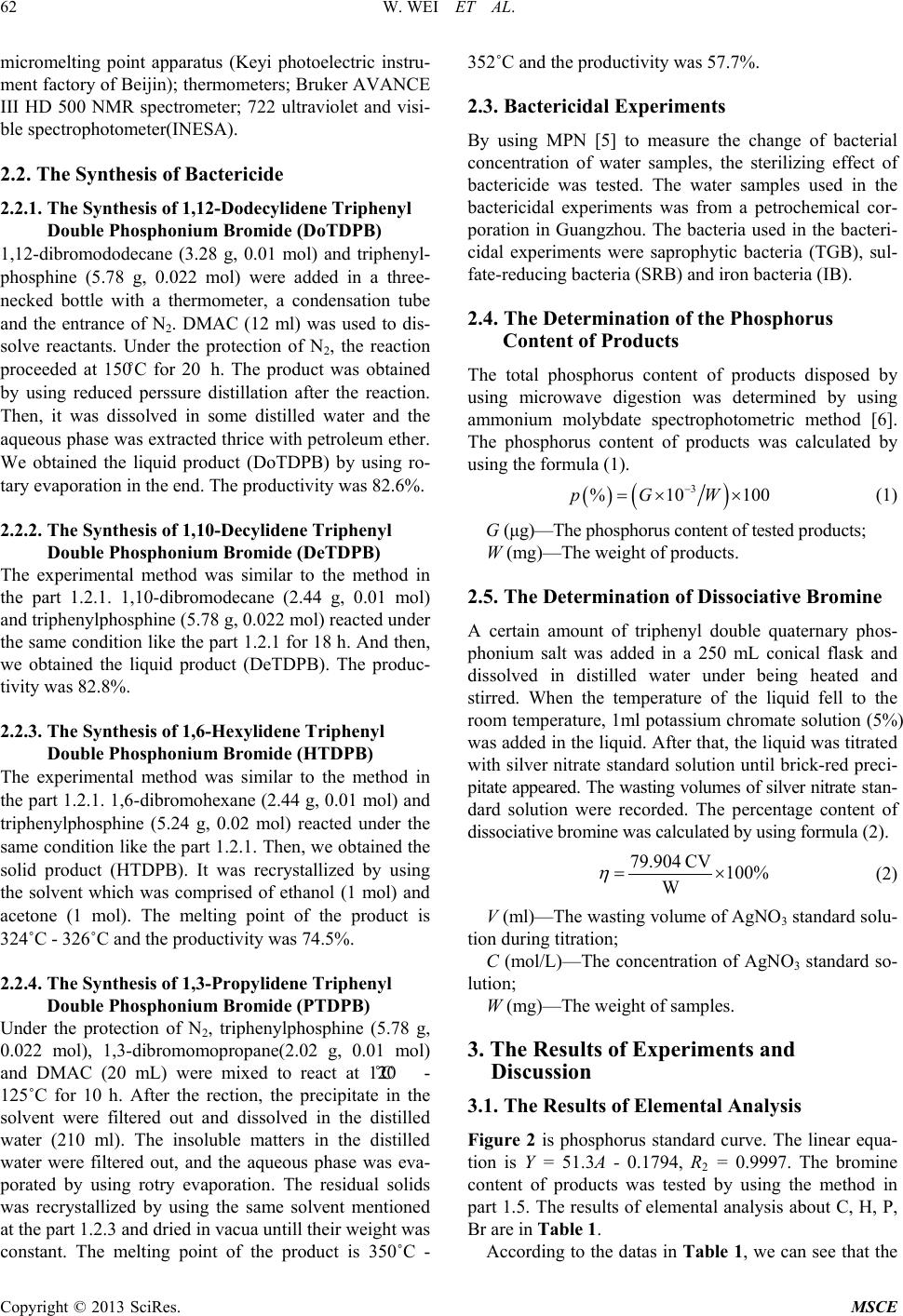 W. WEI ET AL. Copyright © 2013 SciRes. MSCE 62 micromelting point apparatus (Keyi photoelectric instru- ment factory of Beijin); thermometers; Bruker AVANCE III HD 500 NMR spectrometer; 722 ultraviolet and visi- ble spectrophotometer(INESA). 2.2. The Synthesis of Bac tericide 2.2.1. The Synthe sis of 1,12-Dodecylidene Tri phe nyl Double Phosphonium Bromide (DoTDPB) 1,12-dibromododecane (3.28 g, 0.01 mol) and triphenyl- phosphine (5.78 g, 0.022 mol) were added in a three- necked bottle with a thermometer, a condensation tube and the entrance of N2. DMAC (12 ml) was used to dis- solve reactants. Under the protection of N2, the reaction proceeded at 150˚C for 20 h. The product was obtained by using reduced perssure distillation after the reaction. Then, it was dissolved in some distilled water and the aqueous phase was extracted thrice w ith petroleum ether. We obtained the liquid product (DoTDPB) by using ro- tary evaporation in the end. The produc t i vity was 82.6%. 2.2.2. The Synthesis of 1,10-Decylidene Triphenyl Double Phosphonium Bromide (DeTDPB) The experimental method was similar to the method in the part 1.2.1. 1,10-dibromodecane (2.44 g, 0.01 mol) and triphenylphosphine (5.78 g, 0.022 mol) reacted under the same condition like the part 1.2.1 for 18 h. And then, we obtained the liquid product (DeTDPB). The produc- tivity was 82.8%. 2.2.3. The Synthesis of 1,6-Hexyliden e Triphe ny l Double Phosphonium Bromide (HTDPB) The experimental method was similar to the method in the part 1.2.1. 1,6-dibromohexane (2.44 g, 0.01 mol) and triphenylphosphine (5.24 g, 0.02 mol) reacted under the same condition like the part 1.2.1. Then, we obtained the solid product (HTDPB). It was recrystallized by using the solvent which was comprised of ethanol (1 mol) and acetone (1 mol). The melting point of the product is 324˚C - 326˚C and the productivity was 74.5%. 2.2.4. The Synthesis of 1,3-Propylidene Triphenyl Double Phosphonium Bromide (PTDPB) Under the protection of N2, triphenylphosphine (5.78 g, 0.022 mol), 1,3-dibromomopropane(2.02 g, 0.01 mol) and DMAC (20 mL) were mixed to react at 120˚C - 125˚C for 10 h. After the rection, the precipitate in the solvent were filtered out and dissolved in the distilled water (210 ml) . The insoluble matters in the distilled water were filtered out, and the aqueous phase was eva- porated by using rotry evaporation. The residual solids was recrystallized by using the same solvent mentioned at the part 1.2.3 and dried in vacua untill their weight was constant. The melting point of the product is 350˚C - 352˚C and the productivity was 57.7%. 2.3. Bactericidal Experiments By using MPN [5] to measure the change of bacterial concentration of water samples, the sterilizing effect of bactericide was tested. The water samples used in the bactericidal experiments was from a petrochemical cor- poration in Guangzhou. The bacteria used in the bacteri- cidal experiments were saprophytic bacteria (TGB), sul- fate-redu cing bacteria (SRB) and iron bacteria (IB). 2.4. The Determination of the Phosphorus Content of Products The total phosphorus content of products disposed by using microwave digestion was determined by using ammonium molybdate spectrophotometric method [6]. The phosphorus content of products was calculated by using the formula (1). ( ) ( ) 3 %10 100p GW − =×× (1 ) G (μg)—The p hosph orus content of tested products; W (mg ) —The weight of products. 2.5. The Determination of Di ssociative Bromine A certain amount of triphenyl double quaternary phos- phonium salt was added in a 250 mL conical flask and dissolved in distilled water under being heated and stirred. When the temperature of the liquid fell to the room temperature, 1ml potassium chromate solution (5%) was added in the liquid. After that, the liquid was titra ted with silver nitrate standard solution until brick-red preci- pitate appeared. The wasting volumes of silver nitrate stan- dard solution were recorded. The percentage content of dissociative bromine was calcul ated by usi ng formula (2). 79.904 CV100% W η = × (2 ) V ( ml) —The wasting volume of AgNO3 standard solu- tion during titration; C (mol/L)—The concentration of AgNO3 standard so- lution; W (mg ) —The weight of samples. 3. The Results of Experiments and Discussion 3.1. The Results of Elemental Analysis Figure 2 is phosphorus standard curve. The linear equa- tion is Y = 51.3A - 0.1794, R2 = 0.9997. The bromine content of products was tested by using the method in part 1.5. The results of elemental analysis about C, H, P, Br are in Table 1. According to the datas in Table 1, we can see that the 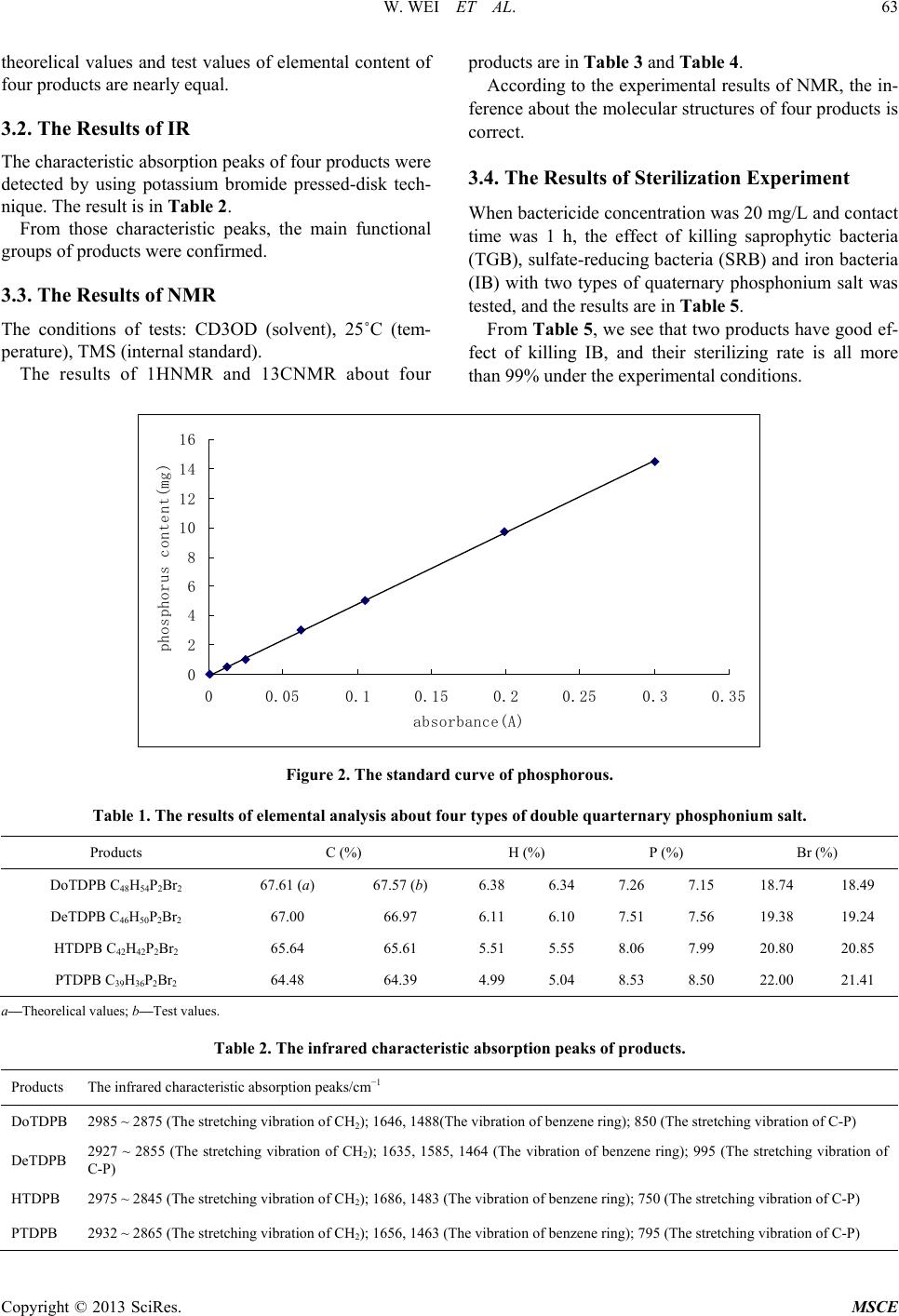 W. WEI ET AL. Copyright © 2013 SciRes. MSCE 63 theorelical values and test values of elemental content of four products are nearly equal. 3.2. The Results of IR The characteristic absorption peaks of fou r pr oduc ts w er e detected by using potassium bromide pressed-disk tech- nique. The result is in Table 2. From those characteristic peaks, the main functional groups of product s were confirmed. 3.3. The Results of NMR The conditions of tests: CD3OD (solvent), 25˚C (tem- perature), TMS (internal standard). The results of 1HNMR and 13CNMR about four products are in Table 3 and Table 4. According to the experimental results of NMR, the in- ference about the molecular structures of four products is correct. 3.4. The Results of Sterilization Experiment When bactericide concentration was 20 mg/L and contact time was 1 h, the effect of killing saprophytic bacteria (TGB), sulfate-reducing bacteria (SRB) and iron bacteria (IB) with two types of quaternary phosphonium salt was tested, and the results are in Table 5. From Table 5, we see that two products have good ef- fect of killing IB, and their sterilizing rate is all more than 99% u nder the ex perimental conditions. Figure 2. The standard c urve of phosphorous. Table 1. The results of elemental analysis about four types of double quarternary phosphonium salt. Products C (%) H (%) P (%) Br (%) DoTDPB C48H54P2Br2 67.61 (a) 67.57 (b) 6.38 6.34 7.26 7.15 18.74 18.49 DeTDPB C46H50P2Br2 67.00 66.97 6.11 6.10 7.51 7.56 19.38 19.24 HTDPB C42H42P2Br2 65.64 65.61 5.51 5.55 8.06 7.99 20.80 20.85 PTDPB C39H36P2Br2 64.48 64.39 4.99 5.04 8.53 8.50 22.00 21.41 a—Theorelical values; b—Test values. Table 2. The infrared characteristic absorption peaks of products. Products The infrared characteristic absorption peaks/cm−1 DoTDPB 2985 ~ 2875 (The stretching vibration of CH2); 1646, 1488(The vibration of benzene ring); 850 (The stretching vibration of C-P) DeTDPB 2927 ~ 2855 (The stretching vibration of CH2); 1635, 1585, 1464 (The vibration of benzene ring); 995 (The stretching vibration of C-P) HTDPB 2975 ~ 2845 (The stretching vibration of CH2); 1686, 1483 (The vibration of benzene ring); 750 (The stretching vibration of C-P) PTDPB 2932 ~ 2865 (The stretching vibration of CH2); 1656, 1463 (The vibrat ion of benzene ring); 795 (The stretching vibration of C-P) 0 2 4 6 8 10 12 14 16 00.050.1 0.150.2 0.250.3 0.35 absorbance(A) phosphorus content(mg) 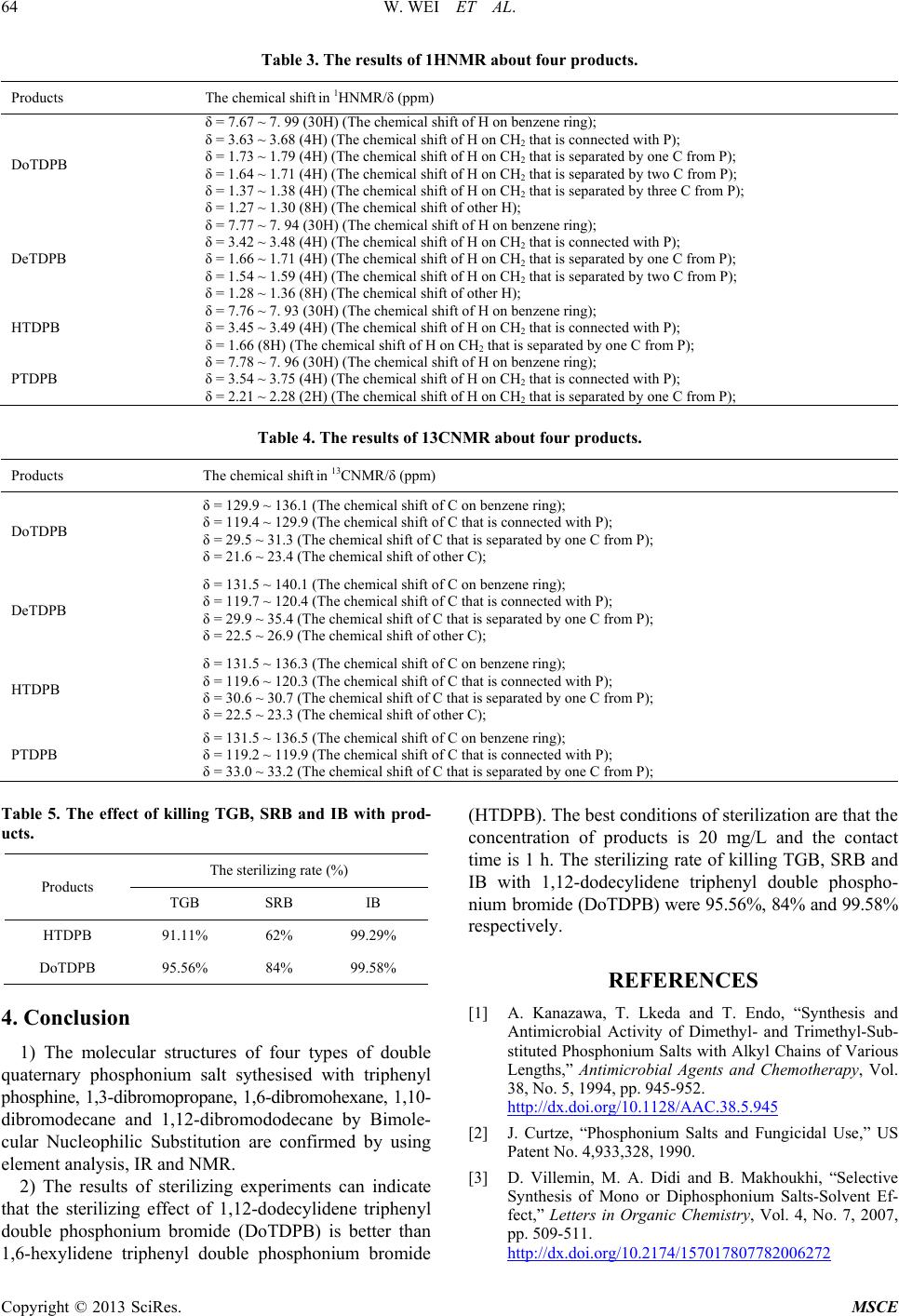 W. WEI ET AL. Copyright © 2013 SciRes. MSCE 64 Table 3. The results of 1HNMR about four products. Products The chemical shift in 1HNMR/δ (ppm) DoTDPB δ = 7.67 ~ 7. 99 (30H) (The chemical shift of H on benzene ring); δ = 3.63 ~ 3.68 (4H) (The chemical shift of H on CH2 that is connected with P); δ = 1.73 ~ 1.79 (4H) (The chemical shift of H on CH2 that is separated by one C from P); δ = 1.64 ~ 1.71 (4H) (The chemical shift of H on CH2 that is separated by two C from P); δ = 1.37 ~ 1.38 (4H) (The chemical shift of H on CH2 that is separated by three C from P); δ = 1.27 ~ 1.30 (8H) (The chemical shift of other H); DeTDPB δ = 7.77 ~ 7. 94 (30H) (The chemical shift of H on benzene ring); δ = 3.42 ~ 3.48 (4H) (The chemical shift of H on CH2 that is connected with P); δ = 1.66 ~ 1.71 (4H) (The chemical shift of H on CH2 that is separated by one C from P); δ = 1.54 ~ 1.59 (4H) (The chemical shift of H on CH2 that is separated by two C from P); δ = 1.28 ~ 1.36 (8H) (The chemical shift of other H); HTDPB δ = 7.76 ~ 7. 93 (30H) (The chemical shift of H on benzene ring); δ = 3.45 ~ 3.49 (4H) (The chemical shift of H on CH2 that is connected with P); δ = 1.66 (8H) (The c hemical shift of H on C H2 that is separated by one C from P); PTDPB δ = 7.78 ~ 7. 96 (30H) (The chemical shift of H on benzene ring); δ = 3.54 ~ 3.75 (4H) (The chemical shift of H on CH2 that is connected with P); δ = 2.21 ~ 2.28 (2H) (The chemical shift of H on CH2 that is separated by one C from P); Table 4. The results of 13CNMR about four products. Products The chemical shift in 13CNMR/δ (ppm) DoTDPB δ = 129.9 ~ 136.1 (The chemical shift of C on benzene ring); δ = 119.4 ~ 129.9 (The chemical shift of C that is connected with P); δ = 29.5 ~ 31.3 (The chemical shift of C that is separated by one C from P); δ = 21.6 ~ 23.4 (The chemical shift of other C); DeTDPB δ = 131.5 ~ 140.1 (The chemical shift of C on benzene ring); δ = 119.7 ~ 120.4 (The chemical shift of C that is connected with P); δ = 29.9 ~ 35.4 (The chemical shift of C that is separated by one C from P); δ = 22.5 ~ 26.9 (The chemical shift of other C); HTDPB δ = 131.5 ~ 136.3 (The chemical shift of C on benzene ring); δ = 119.6 ~ 120.3 (The chemical shift of C that is connected with P); δ = 30.6 ~ 30.7 (The chemical shift of C that is separated by one C from P); δ = 22.5 ~ 23.3 (The chemical shift of other C); PTDPB δ = 131.5 ~ 136.5 (The chemical shift of C on benzene ri ng); δ = 119.2 ~ 119.9 (The chemical shift of C that is connected with P); δ = 33.0 ~ 33.2 (The chemical shift of C that is separated by one C from P); Table 5. The effect of killing TGB, SRB and IB with prod- ucts. Products The sterilizing rate (%) TGB SRB IB HTDPB 91.11% 62% 99.29% DoTDPB 95.56% 84% 99.58% 4. Conclusion 1) The molecular structures of four types of double quaternary phosphonium salt sythesised with triphenyl phosphine, 1,3-dibromopropane, 1,6-dibromohexane, 1,10- dibromodecane and 1,12-dibromododecane by Bimole- cular Nucleophilic Substitution are confirmed by using element analysis, IR and NMR. 2) The results of sterilizing experiments can indicate that the sterilizing effect of 1,12-dodecylidene triphenyl double phosphonium bromide (DoTDPB) is better than 1,6-hexylidene triphenyl double phosphonium bromide (HTDPB). The best conditions of sterilization are that the concentration of products is 20 mg/L and the contact time is 1 h. The sterilizing rate of killing TGB, SRB and IB with 1,12-dodecylidene triphenyl double phospho- nium bromide (DoTDPB) were 95.56%, 84% and 99.58% respectively. REFERENCES [1] A. Kanazawa, T. Lkeda and T. Endo, “Synthesis and Antimicrobial Activity of Dimethyl- and Trimethyl-Sub- stituted Phosphonium Salts with A lkyl Chai ns of Various Lengths,” Antimicrobial Agents and Chemotherapy, Vol. 38, No. 5, 1994, pp. 945-952. http://dx.doi.org/10.1128/AAC.38.5.945 [2] J. Curtze, “Phosphonium Salts and Fungicidal Use,” US Patent No. 4,933,328, 1990. [3] D. Villemin, M. A. Didi and B. Makhoukhi, “Selective Synthesis of Mono or Diphosphonium Salts-Solvent Ef- fect,” Letters in Organic Chemistry, Vol. 4, No. 7, 2007, pp. 509-511. http://dx.doi.org/10.2174/157017807782006272  W. WEI ET AL. Copyright © 2013 SciRes. MSCE 65 [4] Z.-W. Lou and X.-M. Shang, “Synthesis and Antitumor Activities of Sulfonated Triphenylphosphoniums ,” Chi- nese Journal of Medicinal Chemistry, Vol. 10, No. 3, 2000, pp. 168-171. [5] SY/T 0532-2012, “Analysis Method of the Bacteria for Oilfield Injecting Water. Disappearing Dilution Method”. [6] GB 11893-1989, “Water Quality-Determination of Total Phosphorus-Ammonium Molybdate Spectrophotometric Method”. |