

Paper Menu >>
Journal Menu >>
 Energy and Power Engineering, 2013, 5, 740-745 doi:10.4236/epe.2013.54B143 Published Online July 2013 (http://www.scirp.org/journal/epe) A New Placement Scheme of Distributed Generation in Power Gr id * Zhipeng Jiang1, Tiande Guo2, Wei Pei3 1Academy of Mathematics and Systems Science, Chinese Academy of Sciences, Beijing, China 2University of Chinese Academy of Sciences, Beijing, China 3Institute of Electrical Engineering, Chinese Academy of Sciences, Beijing, China Email: [email protected] Received March, 2013 ABSTRACT Smart grid gets more and more popular today. Distributed generation is one of the key technologies, and especially, the integration problem of the distributed generation is an important issue. Especially, the location and capacity of the dis- tributed generation play an important role for the performance of the distribution network. In this paper, an optimization model to minimize the loss cost of the unsatisfied demand is given. Th is model is based on a reliability computing me- thod which avoiding power flow calculation in a previous work. Then the model is used on the IEEE-123 nodes ex- periment network and a result of five distributed generation placement is got. Keywords: Smart Grid; Distributed Generation; Optimal Integration ; Optimization Model 1. Introduction The smart grid being more and more popular today and distributed generation is one of the key technologies in it. The distributed generation device is an independent gen- eration, small modular and compatible with the environ- ment whose power is from several kilowatts to 50 me- gawatt. The power of the distributed generation is owned by the power department, users or the third party, which is used to meet the particular demand of the power sys- tem and users. For example, adjusts the peak, supplies the power for remote users and residents, decreases the cost of the power transmission and transformation and improves the reliability of the p ower supply. The distrib- uted generation is deployed near the users in a distributed way and it’s a system which can independently provide power. The distributed generation mainly includes the internal combustion engine micro gas turbine, wind power generation as well as photovoltaic cells which use liquid or gas as the fuel. The distributed generation is an important supplement of self-healing strategy, which plays an important role in peak averting, valley filling and load balancing. However, it also brings about new problems. For example, some types of distributed gen- eration are stochastic, and increase the volatility of the system voltage. There are many issues concerned in distributed gen- eration problem, among which the optimal integration is one of the important problems. It involves many aspects of factors. It has not only to find a proper optimization objective, but also to analyze various elements like the location, size and type of the distributed generation. Hence, it is a very complicated issue. The location of distributed generation is a location prob lem in the opera- tions research, and it’s an NP (Non-Deterministic Poly- nomial) problem which needs an appropriate algorithm to solve it. The constraints need to synthesize the influence of distributed generation on power grid when connecting the grid, the equilibrium conditions of power gird and voltage as well as the randomness of distributed genera- tion; while objective function requires comprehensive consideration of operation cost and power consumption. 2. Related Work The In recent years, a variety of methods on the optimal integration of distributed generation have been arisen. A main method is establishing an optimization model with multiple indicators as objective function and some char- acteristics and restrictions of power grid as constraints. The location and the access capacity of the distributed generation can be achieved by solving the optimization model. The most important object among these indicators is to minimize the lin e loss [1-3]. In [1], th e authors gave a method of line loss minimization based on analytical method. The mathematical programming method is used in [2] and in [3] the genetic algorithm is adopted. The *This paper is supported by the Important Knowledge Innovation Pro- j ect of Chinese Academy of Sciences No.Y225011E K 2 Copyright © 2013 SciRes. EPE 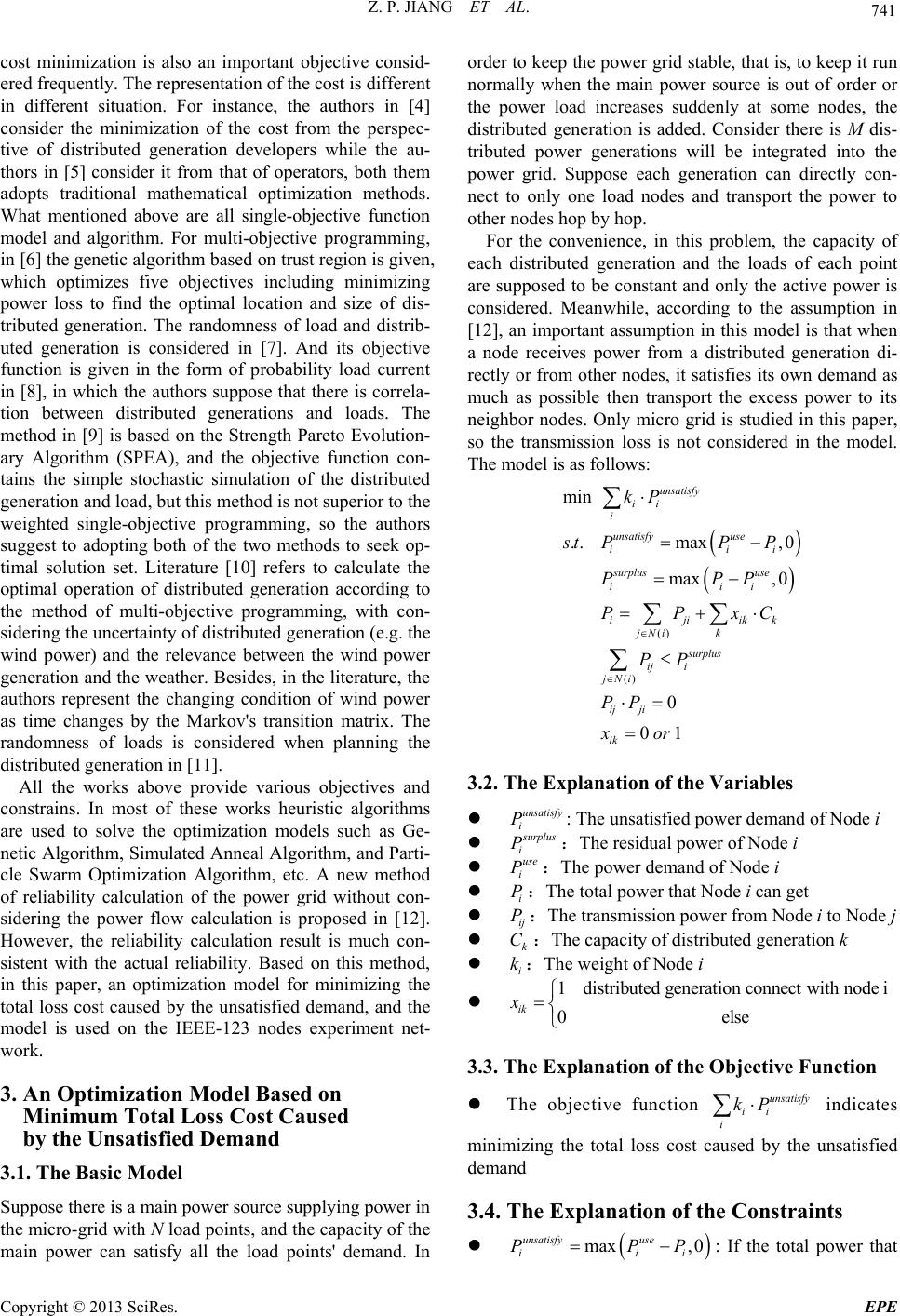 Z. P. JIANG ET AL. 741 cost minimization is also an important objective consid- ered frequently. The representation of the cost is different in different situation. For instance, the authors in [4] consider the minimization of the cost from the perspec- tive of distributed generation developers while the au- thors in [5] consider it from that of operators, both them adopts traditional mathematical optimization methods. What mentioned above are all single-objective function model and algorithm. For multi-objective programming, in [6] the genetic algorithm based on trust region is given, which optimizes five objectives including minimizing power loss to find the optimal location and size of dis- tributed generation. The randomness of load and distrib- uted generation is considered in [7]. And its objective function is given in the form of probability load current in [8], in which the authors suppose that there is correla- tion between distributed generations and loads. The method in [9] is based on the Strength Pareto Evolution- ary Algorithm (SPEA), and the objective function con- tains the simple stochastic simulation of the distributed generation and load, but this method is not superior to the weighted single-objective programming, so the authors suggest to adopting both of the two methods to seek op- timal solution set. Literature [10] refers to calculate the optimal operation of distributed generation according to the method of multi-objective programming, with con- sidering the uncertainty of distributed generation (e.g. the wind power) and the relevance between the wind power generation and the weather. Besides, in the literature, the authors represent the changing condition of wind power as time changes by the Markov's transition matrix. The randomness of loads is considered when planning the distribute d generation in [1 1] . All the works above provide various objectives and constrains. In most of these works heuristic algorithms are used to solve the optimization models such as Ge- netic Algorithm, Simulated Anneal Algorithm, and Parti- cle Swarm Optimization Algorithm, etc. A new method of reliability calculation of the power grid without con- sidering the power flow calculation is proposed in [12]. However, the reliability calculation result is much con- sistent with the actual reliability. Based on this method, in this paper, an optimization model for minimizing the total loss cost caused by the unsatisfied demand, and the model is used on the IEEE-123 nodes experiment net- work. 3. An Optimization Model Based on Minimum Total Loss Cost Caused by the Unsatisfied Demand 3.1. The Basic Model Suppose there is a main power source supplying power in the micro-grid with N load points, and the capacity of the main power can satisfy all the load points' demand. In order to keep the power grid stable, that is, to keep it ru n normally when the main power source is out of order or the power load increases suddenly at some nodes, the distributed generation is added. Consider there is M dis- tributed power generations will be integrated into the power grid. Suppose each generation can directly con- nect to only one load nodes and transport the power to other nodes h op by hop. For the convenience, in this problem, the capacity of each distributed generation and the loads of each point are supposed to be constant and only the active power is considered. Meanwhile, according to the assumption in [12], an important assumption in this model is that when a node receives power from a distributed generation di- rectly or from other nodes, it satisfies its own demand as much as possible then transport the excess power to its neighbor nodes. Only micro grid is studied in this paper, so the transmission loss is not considered in the model. The model is as follows: () () min ..max,0 max ,0 0 01 unsatisfy ii i unsatisfy use ii surplus use iii ijiikk jNi k surplus ij i jNi ij ji ik kP st PPP PPP PPxC PP PP xor i 3.2. The Explanation of the Variables unsatisfy i P: The unsatisfied power demand of N o d e i s urplus i P:The residual power of Node i use i P:The power demand of Node i i P:The total power that Node i can get ij P:The transmission power from Node i to Node j k C:The capacity of distributed generation k i k:The weight of Node i 1distributedgenerationconnectwithnodei 0e lse ik x 3.3. The Explanation of the Objective Function The objective function unsatisfy ii indicates i kP minimizing the total loss cost caused by the unsatisfied demand 3.4. The Explanation of the Constraints max ,0 unsatisfy use ii PP i P: If the total power that Copyright © 2013 SciRes. EPE  Z. P. JIANG ET AL. Copyright © 2013 SciRes. EPE 742 Node i gets is less than the demand of node i, the unsatis- fied demand of Node i will equal to use ii PP; Else, it will equal to 0; nodes is adopted to carry out the simulation test, the load and weight of the nodes are both constant and the units of the nodes’ load and the capacity of the distributed gen- eration are all kilowatt (kW). The network structure is shown in Figure 1, and the parameters of the nodes are shown in Table 1 i : If the total power that max ,0 surplus use ii PPP Node i gets is more than or equal to its demand, the re- sidual energy of Node i will equal to ; Else, it will equal to 0. use ii PPOn the test network of IEEE-123 nodes above, five distributed generations are set, whose capacities are: C1 = 700, C2 = 650, C3 = 500, C4 = 350, C5 = 600 respec- tively. k C: The total received power () ijiik jNik PPx of node i is equal to the total energy supplied by the dis- tributed generation directly connected with node i and the power transported from the neighbor nodes of node i. We establish a model according to the method pro- posed in this paper, and solve it by Lingo. The results of the distributed generation’s placement and power trans- mission are as follows. The place result of the distributed generation is shown in Figure 2 and the result of the power transmission (direction and size) between the nodes is shown in Table 2. The final value of the objec- tive function (that is the total loss cost) is: 6868.2. And () s urplus ij i jNi PP : The residual power of the node i can be transported to its neighbor nodes through any way of distribution, or keep it to itself. 0PP: The power can only be transported in ij ji one direction on each line Distributed generation P1 is placed on the node 36; Distributed generation P2 is placed on the node 30; 4. Solution and Simulation Distributed generation P3 is placed on the node 160; In this paper, the standard testing network of IEEE-123 33 32 31 27 26 25 28 29 30 250 1 3 4 56 2 78 12 11 14 10 20 19 22 21 18 35 37 40 135 48 47 49 50 45 41 51 44 46 42 43 36 38 39 66 65 64 63 62 60 160 67 57 58 59 5453 52 55 56 13 34 15 16 17 96 95 94 93 152 92 90 88 91 89 87 86 80 81 82 83 84 78 85 72 73 74 75 77 79 300 111 110 108 109 107 112113 114 105 106 101 102 103 104 450 100 97 99 68 69 70 71 197 151 150 61 610 9 24 23 251 195 451 149 350 98 76 76 Figure 1. The network structure of the IEEE-123 nodes.  Z. P. JIANG ET AL. 743 Table 1. The parameters of the nodes. idload weightidload weightidload weight 1358.4141 202.7780 409.97 2407.2542203.2681401.7 3203.8543 206.5482 354.98 7359.5544 405.2684 401.96 4201.3145 354.1683 209.66 5404.9547 208.4885 201.04 6204.4346 356.2787 407.97 8407.8948 205.9588 404.14 1235 8.164970 9.258940 8.36 9202.6850 703.5790 358.82 1340 5.415140 7.819140 1.76 1435 5.015220 7.7892354.6 3435 6.825340 4.429340 3.34 1840 7.385440 6.1194358.2 1135 7.795535 1.689540 4.88 1040 3.485720 1.4996209.2 1520 7.125635 5.789820 2.64 16356.95820 8.019940 3.37 1740 2.466020 9.4110040 2.31 1920 2.075920 2.1745040 2.22 2140 5.496120 6.1210135 8.82 2035 9.646235 5.2210235 6.22 2240 4.066340 1.1110520 5.95 2340 6.276440 4.03103352.3 2435 3.016575 2.4610440 8.68 2540 7.766670 8.15106406.6 2635 3.3 6775 3.8108404.16 2835 5.556835 5.7610735 5.62 2740 7.297220 2.4910940 4.62 3135 9.029735 6.4230040 1.68 3320 9.636935 3.3711035 3.16 2940 5.927040 6.8911135 2.11 3040 2.2571207.2 11220 2.66 25040 2.347340 7.7311320 3.16 3235 3.327640 5.0511440 4.76 35208.57741051.75 135201.45 3640 3.297540 3.0614935 9.12 4035 8.337740 9.22152359.5 3735 3.198640 2.3716035 5.42 3840 9.367820 8.43197355.4 3920 4.157935 5.85 Copyright © 2013 SciRes. EPE 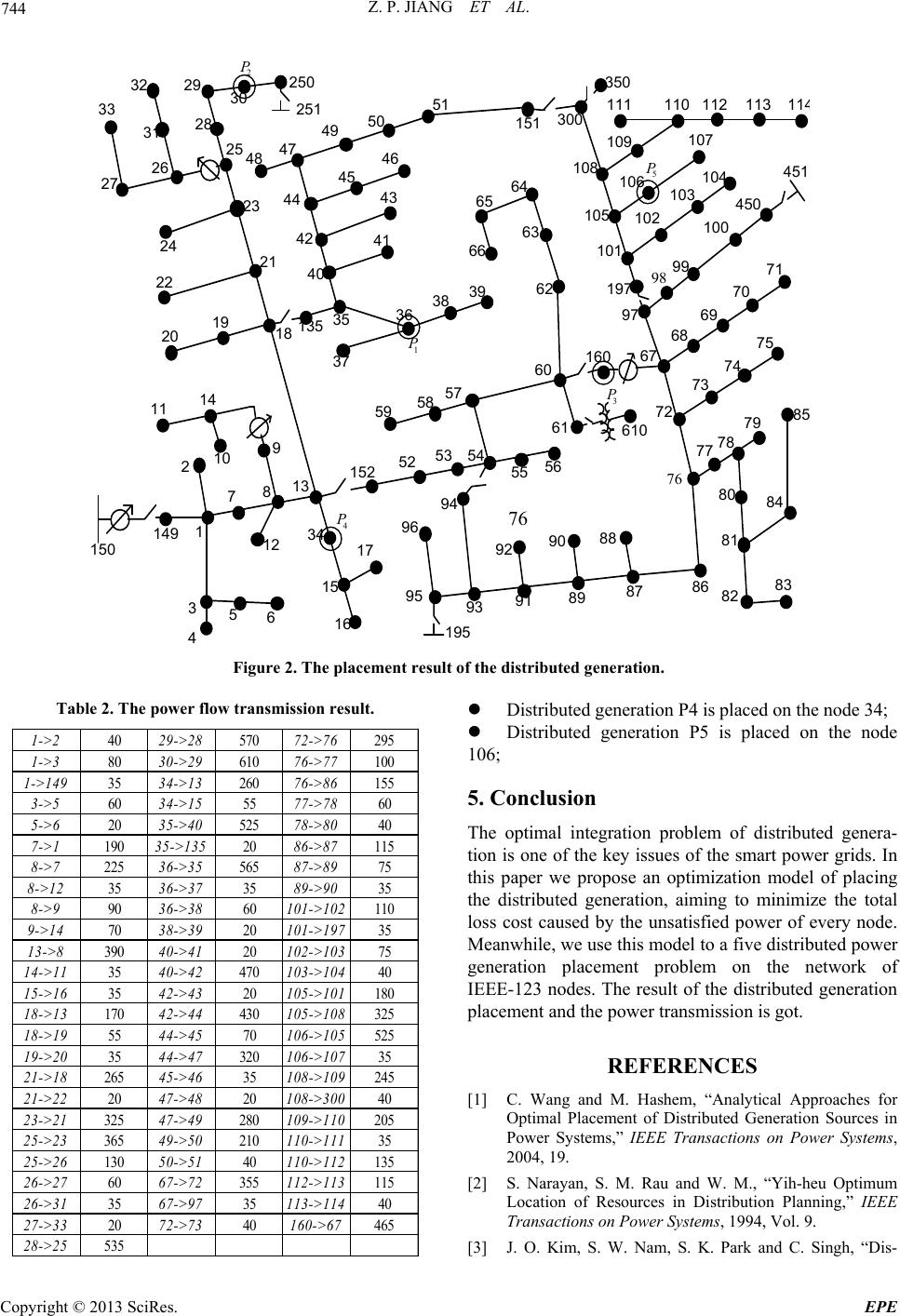 Z. P. JIANG ET AL. Copyright © 2013 SciRes. EPE 744 1 3 4 56 2 78 12 11 14 10 20 19 22 21 18 35 37 40 135 33 32 31 27 26 25 28 29 30 250 48 47 49 50 51 44 45 46 42 43 41 36 38 39 66 65 64 63 62 60 160 67 57 58 59 5453 52 55 56 13 34 15 16 17 96 95 94 93 152 92 90 88 91 89 87 86 80 81 82 83 84 78 85 72 73 74 75 77 79 300 111 110 108 109 107 112113 11 4 105 106 101 102 103 104 450 100 97 99 68 69 70 71 197 151 150 61 610 9 24 23 251 195 451 149 350 76 98 76 4 P 2 P 1 P 5 P 3 P Figure 2. The placement result of the distributed generation. Table 2. The power flow transmission result. Distributed generation P4 is placed on the node 34; Distributed generation P5 is placed on the node 106; 1->2 40 29->28 570 72->76 295 1->3 80 30->29 610 76->77 100 1->149 35 34->13 260 76->86 155 3->5 60 34->1555 77->78 60 5->6 20 35->40 525 78->80 40 7->1190 35->13520 86->87 115 8->7225 36->35 565 87->8975 8->12 35 36->3735 89->90 35 8->9 90 36->3860 101->102 110 9->14 70 38->3920 101->197 35 13->839040->4120 102->103 75 14->11 35 40->42 470 103->104 40 15->16 35 42->4320 105->101 180 18->13 170 42->44430 105->108 325 18->19 55 44->4570 106->105 525 19->20 35 44->47 320 106->107 35 21->18 265 45->4635 108->109 245 21->222047->4820 108->300 40 23->21 325 47->49280 109->110 205 25->23 365 49->50210 110->111 35 25->26 130 50->5140 110->112 135 26->27 60 67->72 355 112->113 115 26->31 35 67->9735 113->114 40 27->33 20 72->7340 160->67465 28->25 535 5. Conclusion The optimal integration problem of distributed genera- tion is one of the key issues of the smart power grids. In this paper we propose an optimization model of placing the distributed generation, aiming to minimize the total loss cost caused by the unsatisfied power of every node. Meanwhile, we use this model to a five distributed power generation placement problem on the network of IEEE-123 nodes. The result of the distributed generation placement and the power transmission is got. REFERENCES [1] C. Wang and M. Hashem, “Analytical Approaches for Optimal Placement of Distributed Generation Sources in Power Systems,” IEEE Transactions on Power Systems, 2004, 19. [2] S. Narayan, S. M. Rau and W. M., “Yih-heu Optimum Location of Resources in Distribution Planning,” IEEE Transactions on Power Systems, 1994, Vol. 9. [3] J. O. Kim, S. W. Nam, S. K. Park and C. Singh, “Dis- 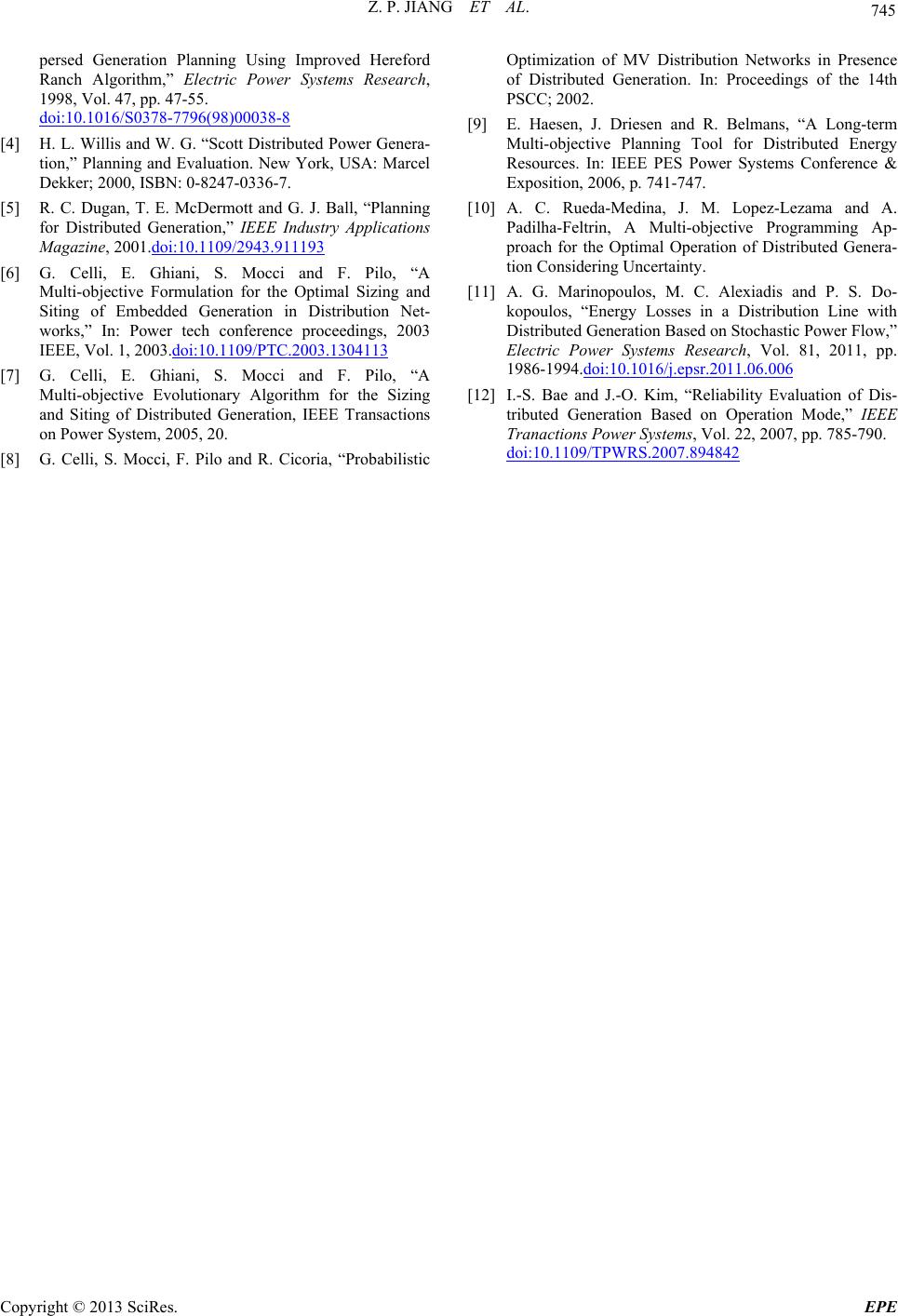 Z. P. JIANG ET AL. 745 persed Generation Planning Using Improved Hereford Ranch Algorithm,” Electric Power Systems Research, 1998, Vol. 47, pp. 47-55. doi:10.1016/S0378-7796(98)00038-8 [4] H. L. Willi s and W. G. “Scott Distributed Power Genera- tion,” Planning and Evaluation. New York, USA: Marcel Dekker; 2000, ISBN: 0-8247-0336-7. [5] R. C. Dugan, T. E. McDermott and G. J. Ball, “Planning for Distributed Generation,” IEEE Industry Applications Magazine, 2001.doi:10.1109/2943.911193 [6] G. Celli, E. Ghiani, S. Mocci and F. Pilo, “A Multi-objective Formulation for the Optimal Sizing and Siting of Embedded Generation in Distribution Net- works,” In: Power tech conference proceedings, 2003 IEEE, Vol. 1, 2003.doi:10.1109/PTC.2003.1304113 [7] G. Celli, E. Ghiani, S. Mocci and F. Pilo, “A Multi-objective Evolutionary Algorithm for the Sizing and Siting of Distributed Generation, IEEE Transactions on Power System, 2005, 20. [8] G. Celli, S. Mocci, F. Pilo and R. Cicoria, “Probabilistic Optimization of MV Distribution Networks in Presence of Distributed Generation. In: Proceedings of the 14th PSCC; 2002. [9] E. Haesen, J. Driesen and R. Belmans, “A Long-term Multi-objective Planning Tool for Distributed Energy Resources. In: IEEE PES Power Systems Conference & Exposition, 2006, p. 741-747. [10] A. C. Rueda-Medina, J. M. Lopez-Lezama and A. Padilha-Feltrin, A Multi-objective Programming Ap- proach for the Optimal Operation of Distributed Genera- tion Considering Uncertainty. [11] A. G. Marinopoulos, M. C. Alexiadis and P. S. Do- kopoulos, “Energy Losses in a Distribution Line with Distributed Generation Based on Stochastic Power Flow,” Electric Power Systems Research, Vol. 81, 2011, pp. 1986-1994.doi:10.1016/j.epsr.2011.06.006 [12] I.-S. Bae and J.-O. Kim, “Reliability Evaluation of Dis- tributed Generation Based on Operation Mode,” IEEE Tranactions Power Systems, Vol. 22, 2007, pp. 785-790. doi:10.1109/TPWRS.2007.894842 Copyright © 2013 SciRes. EPE |