

Paper Menu >>
Journal Menu >>
 Applied Mathematics, 2013, 4, 1-6 Published Online November 2013 (http://www.scirp.org/journal/am) http://dx.doi.org/10.4236/am.2013.411A2001 Open Access AM Controlling Unstable Discrete Chaos and Hyperchaos Systems* Xin Li, Suping Qian School of Mathematics and Statistics, Changshu Institute of Technology, Changshu, China Email: [email protected] Received July 23, 2013; revised August 23, 2013; accepted August 30, 2013 Copyright © 2013 Xin Li, Suping Qian. This is an open access article distributed under the Creative Commons Attribution License, which permits unrestricted use, distribution, and reproduction in any medium, provided the original work is properly cited. ABSTRACT A method is introduced to stabilize unstable discrete systems, which does not require any adjustable control parameters of the system. 2-dimension discrete Fold system and 3-dimension discrete hyperchaotic system are stabilized to fixed points respectively. Numerical simulations are then provided to show the effectiveness and feasibility of the proposed chaos and hyperchaos controlling scheme. Keywords: 2-Dimension Discrete Fold System; 3-Dimension Discrete Hyperchaotic System; Lyapunov Stability Theory; Controlling Chaos 1. Introduction In many engineering and other practical problems, chaos is undesirable and therefore needs to be controlled. Thus, a large number of control methods have been developed and are being applied to real systems [1-10]. The method given by Ott, Grebogi and Yorke (OGY) [1] is to stabi- lize an unstable orbit in the neighborhood of a hyperbolic fixed point by forcing the orbit onto the stable manifold. The method proposed by Romeiras, Grebogi, Ott and Dayawansa (RGOD) [2] is not yet suitable for control- ling hyperchaos since the method changes the stability property of the fixed point completely. However, the method proposed by Yang, Liu and Jian-min Mao [11] gives a new idea to stabilize unstable orbits even if there is no preexisting stable manifold nearby. For a finite- dimensional dynamical system, whose governing equa- tions may or may not be analytically available, Yang, Liu and Mao show how to stabilize an unstable orbit in a neighborhood of a “fully” unstable fixed point. The ad- vantage of this method is: only one of the unstable direc- tions is to be stabilized via time-dependent adjustments of control parameters. The parameter adjustments can be optimized. Recently, Bu [12] and Li [13] stabilized un- stable discrete systems by a method which does not re- quire any adjustable control parameters of the system. Consider an n-dimensional dynamical system defined by 1, kk x Fx (1) where n x Ris an n-dimensional vector, F is a nonlin- ear vector valued function. Let xf be the fixed point of the map (1). To stabilize a chaotic orbit to this fixed point, we take a variable feedback control described by 1kk kk x Fx MFx x , (2) Define an infinitesimal deviation of xk from xf as kkf x xx . Then from Equation (2), one has 1, kk k x JxMJ Ix (3) where kf kxx JFx is the Jacobian matrix of the original system F evaluated at the fixed point xf and I is the nn identity matrix. The goal of controlling here is to make li km 0 k x . For this aim, one requires 1, kk x Qx (4) where Q is an nn matrix and takes the form 1 2 0, 0 q Qq (5) where are constants. Substituting Equation (4) and Equa- tion (5) into Equation (3) and eliminating k x , choosing one special form of the matrix one have 1,1QqI ,q , *The work was supported by the Special Funds of the National Natural Science Foundation of China (Grant No. 11141003).  X. LI, S. P. QIAN 2 1.MqIJJI (6) This needs to use numeric computation to do. There- fore the above scheme based on the symbolic numeric computation is summarized as follows. Input: 1) The unstable system (1); 2) The system (2) with a variable feedback controller; 3) Choose the initial values of systems (2). Output: 1) ; kf kxx JFx 2) M in (6); 3) Deduce the system (2) according to the results (6); 4) Numerical simulations of the states xk when . k In this paper, we use the method to stabilize 2-dimen- sion discrete Fold system [14] and 3-dimension discrete hyperchaotic system due to Wang [15] to fixed points respectively. 2. Stabilizing 2-Dimensional Discrete Fold System Using the above method, we stabilize 2-dimension dis- crete Fold system presented as: 121 2 21 1, 1 x kxkxk xk xk (7) where , are the parameters, and we choose = −0.1, = −1.7. In the following based on the method mentioned above, we will make the Fold system stabilize at the fixed point. It is easy to get the two fixed points (1.965097170, 2.161606887), and (−0.8650971698, −0.9516068868) of Equation (7). The Jacobian matrix corresponding the fixed point 12 , f f x x is 1 1. 20 f Jx (8) From (6) one can have 1 1 11 11 21 12 12 , 212 12 12 f f ff ff qx q xx M1f x qxq xx q (9) here we choose 12 ,1.965097170, 2.161606887 ff xx as our re- search object. Choosing the parameter 0.5,q and 0.3q respectively, one gets 1 2 1.1766663130.1766663133 , 0.6943329445 1.194332944 1.2473328380.2473328387 . 0.9720661223 1.272066122 M M (10) From (2), respectively substitute (10) into (7), we can obtain 121 211 2 12 2 21 211 2 12 1( )1.76666313 0.1766663133 , 1 0.6943329445 1.194332944 , x k xkxkxkxkxk xk xk x kxkx kxkxk xk xk (11) and 121 211 2 12 2 21 211 2 12 1 1.247332838 0.2473328387 , 1 0.9720661223 1.272066122 . x kxkxk xkxkxk xk xk x kxkx kxkxk xk xk (12) In the following, we give the orbit of 2-dimension dis- crete Fold system before being stabilized in Figure 1(a). And in Figure 1(b), three orbits starting from different initial points are stabilized to the fixed point (1.965097170, 2.161606887). It is shown that the unsta- ble orbit is stabilized to the desired fixed point mono- tonically. Then the orbits stabilized of xk and yk versus tk are depicted contrasting with the ones before being stabi- lized in Figures 2 and 3, respectively. 3. Stabilizing 3-Dimension Discrete Hyperchaotic System In this section, we consider 3-dimension discrete hyper- haotic system c Open Access AM 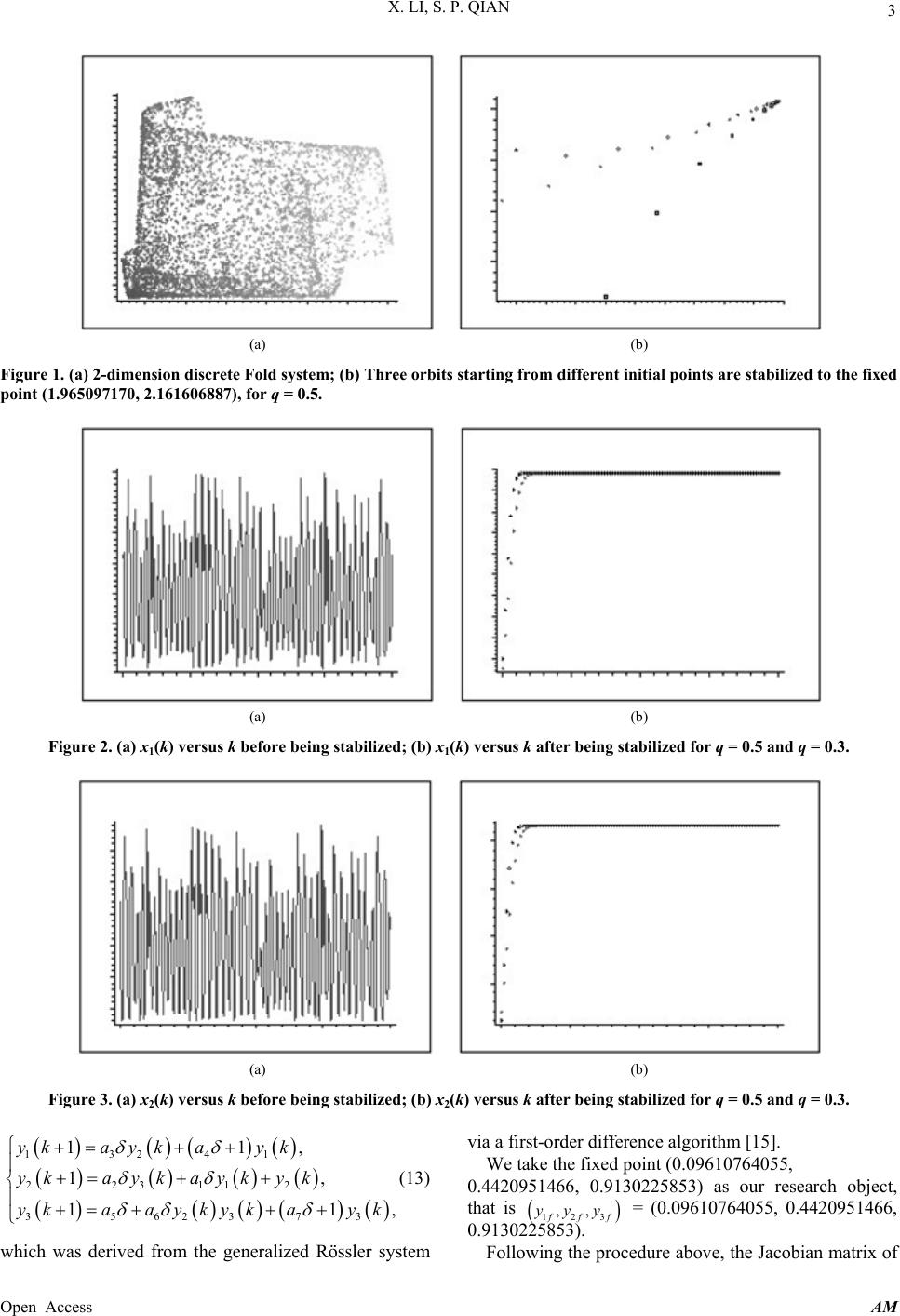 X. LI, S. P. QIAN 3 (a) (b) Figure 1. (a) 2-dimension discrete Fold system; (b) Three orbits starting from different initial points are stabilized to the fixed point (1.965097170, 2.161606887), for q = 0.5. (a) (b) Figure 2. (a) x1(k) versus k before being stabilized; (b) x1(k) versus k after being stabilized for q = 0.5 and q = 0.3. (a) (b) Figure 3. (a) x2(k) versus k before being stabilized; (b) x2(k) versus k after being stabilized for q = 0.5 and q = 0.3. 13241 223112 3562373 11, 1 11 ykaykayk ykaykaykyk ykaa ykykayk , , (13) which was derived from the generalized Rössler system via a first-order difference algorithm [15]. We take the fixed point (0.09610764055, 0.4420951466, 0.9130225853) as our research object, that is 123 ,, f ff yyy = (0.09610764055, 0.4420951466, 0.9130225853). Following the procedure above, the Jacobian matrix of Open Access AM  X. LI, S. P. QIAN 4 map (13) is 43 12 63 62 7 10 1 0 ff aa Ja a ayay a . (14) 1 Here we let a1 = −1.9, a2 = 0.2, a3 = 0.5, a4 = −2.3, a5 = 2, a6 = −0.6, a7 = −1.9 and 1. From (6), choosing 0.5q and respec- tively, the matrix M at the fixed point (0.09610764055, 0.4420951466, 0.9130225853) is correspondingly ob- tained as following 0.2q 0.9762747382 0.2344378413 0.02165450397 0.89086379700.07841407030.09961071835 , 0.22538998420.2728405070 0.7942822117 M (15) and 0.94305937220.5626508191 0.05197080956 2.1380731131.5881937680.2390657240 . 0.54093596150.6548172166 0.562773086 M (16) From (2), respectively substitute (15) and (16) into (13), one can obtain 1324111 2311562373 223112324 1 0.02372526180.97627473820.2344378412 0.02165450397 , 1 1.078414070.890863797 0.099610 yka ykaykykyk ayk aykaaykyk ayk ykaykayk ykaykayk 562 373 3562373 4123 113 71835 , 1 0.205717788310.2253899842 0.2728405070.7942822117 , aaykykayk 1 32 y kaaykykayka aykayk aykyk yk 41 32 (17) and 1324111 2311562373 22311232 1 0.05694062780.94305937220.5626508191 0.05197080956 , 1 2.5881937682.138073113 0.23906 yka ykaykykyk ayk aykaaykyk ayk ykayk aykykayk ayk 562373 3562373 4123 113 5724 , 1 0.493722691410.5409359615 0.65481721660.5062773086 , aaykykayk ykaa ykykaykayk aykayk aykyk (18) The numerical results are shown in the followed fig- ures. The orbit of 3-dimension discrete time hyperchaotic system is given by Figure 4(a). In Figure 4(b), three orbits starting from different initial points are stabilized to the fixed point (0.09610764055, 0.4420951466, 0.9130225853). We can also get the result that 3-dimension discrete time hyperchaotic system is stabilized. In Figures 5-7, the stabilized orbits of 123 ,, y kykyk versus tk are plotted contrasting with the ones before being stabi- lized, respectively. 4. Conclusion In summary, we have introduced a method to stabilize unstable discrete systems, which does not require any adjustable control parameters of the system. 2-dimension discrete Fold system and 3-dimension discrete hypercha- otic system are stabilized to fixed points respectively. From the process we finish, it is shown that stabilizing the unstable discrete systems neither requires a prior analytical knowledge of the underlying system nor any adjustable control parameters in advance. Numerical imulations are then provided to show the effectiveness s Open Access AM 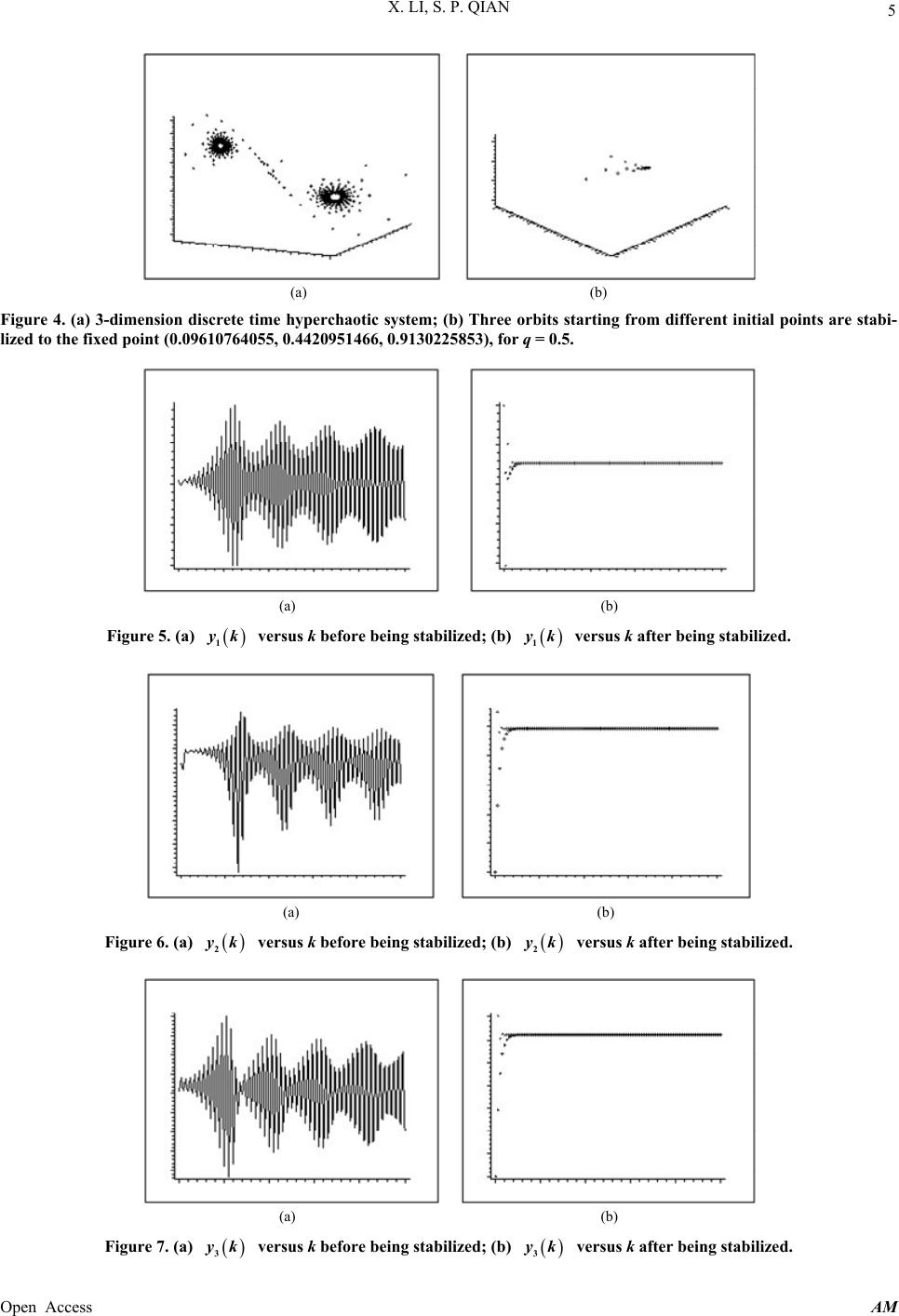 X. LI, S. P. QIAN 5 (a) (b) Figure 4. (a) 3-dimension discrete time hyperchaotic system; (b) Three orbits starting from different initial points are stabi- lized to the fixed point (0.09610764055, 0.4420951466, 0.9130225853), for q = 0.5. (a) (b) Figure 5. (a) y k 1 versus k before being stabilized; (b) y k 1 versus k after being stabilized. (a) (b) Figure 6. (a) 2 y k versus k before being stabilized; (b) 2 y k versus k after being stabilized. (a) (b) Figure 7. (a) 3 yk versus k before being stabilized; (b) 3 yk versus k after being stabilized. Open Access AM 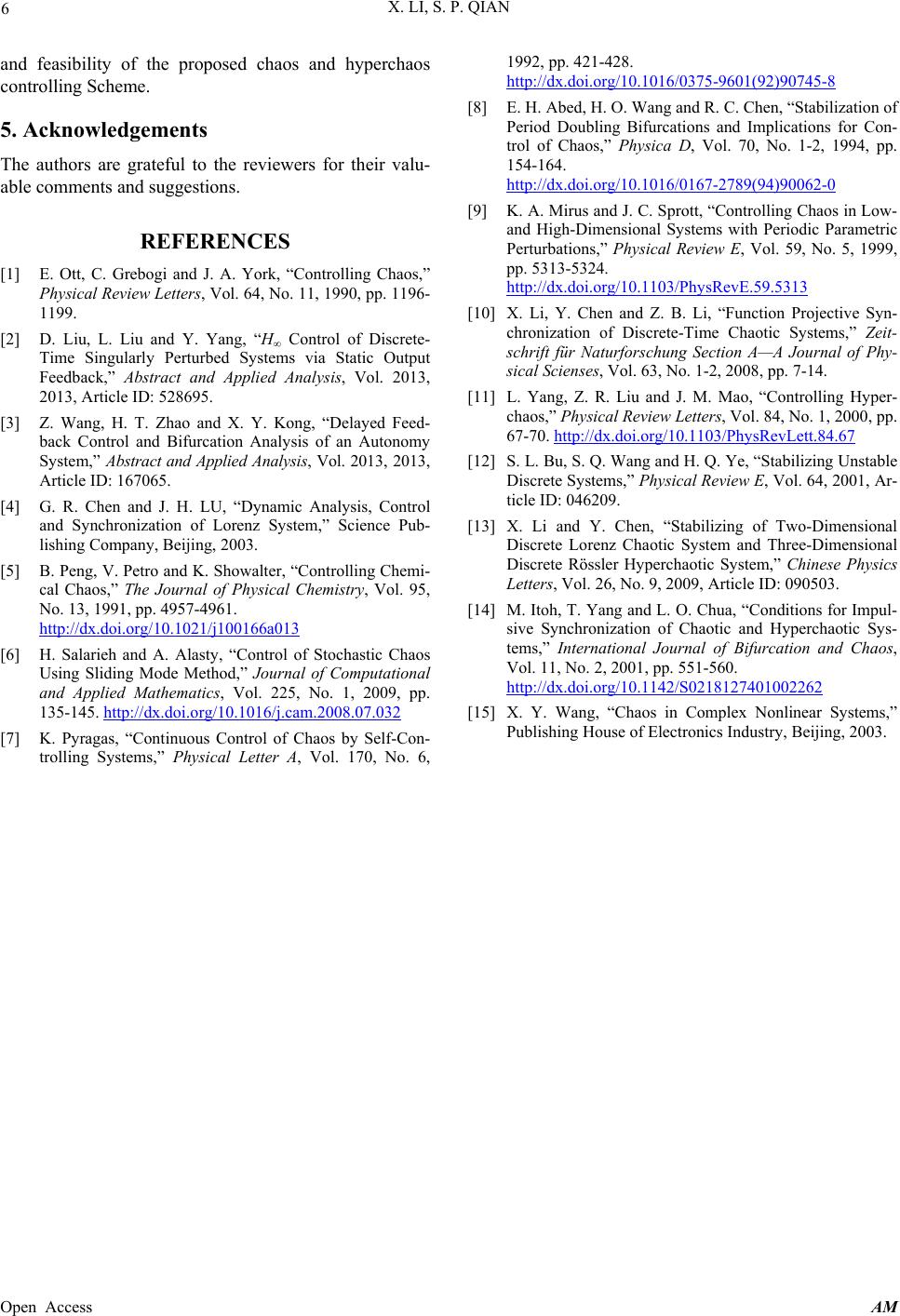 X. LI, S. P. QIAN 6 and feasibility of the proposed chaos and hyperchaos controlling Scheme. 5. Acknowledgements The authors are grateful to the reviewers for their valu- able comments and suggestions. REFERENCES [1] E. Ott, C. Grebogi and J. A. York, “Controlling Chaos,” Physical Review Letters, Vol. 64, No. 11, 1990, pp. 1196- 1199. [2] D. Liu, L. Liu and Y. Yang, “H∞ Control of Discrete- Time Singularly Perturbed Systems via Static Output Feedback,” Abstract and Applied Analysis, Vol. 2013, 2013, Article ID: 528695. [3] Z. Wang, H. T. Zhao and X. Y. Kong, “Delayed Feed- back Control and Bifurcation Analysis of an Autonomy System,” Abstract and Applied Analysis, Vol. 2013, 2013, Article ID: 167065. [4] G. R. Chen and J. H. LU, “Dynamic Analysis, Control and Synchronization of Lorenz System,” Science Pub- lishing Company, Beijing, 2003. [5] B. Peng, V. Petro and K. Showalter, “Controlling Chemi- cal Chaos,” The Journal of Physical Chemistry, Vol. 95, No. 13, 1991, pp. 4957-4961. http://dx.doi.org/10.1021/j100166a013 [6] H. Salarieh and A. Alasty, “Control of Stochastic Chaos Using Sliding Mode Method,” Journal of Computational and Applied Mathematics, Vol. 225, No. 1, 2009, pp. 135-145. http://dx.doi.org/10.1016/j.cam.2008.07.032 [7] K. Pyragas, “Continuous Control of Chaos by Self-Con- trolling Systems,” Physical Letter A, Vol. 170, No. 6, 1992, pp. 421-428. http://dx.doi.org/10.1016/0375-9601(92)90745-8 [8] E. H. Abed, H. O. Wang and R. C. Chen, “Stabilization of Period Doubling Bifurcations and Implications for Con- trol of Chaos,” Physica D, Vol. 70, No. 1-2, 1994, pp. 154-164. http://dx.doi.org/10.1016/0167-2789(94)90062-0 [9] K. A. Mirus and J. C. Sprott, “Controlling Chaos in Low- and High-Dimensional Systems with Periodic Parametric Perturbations,” Physical Review E, Vol. 59, No. 5, 1999, pp. 5313-5324. http://dx.doi.org/10.1103/PhysRevE.59.5313 [10] X. Li, Y. Chen and Z. B. Li, “Function Projective Syn- chronization of Discrete-Time Chaotic Systems,” Zeit- schrift für Naturforschung Section A—A Journal of Phy- sical Scienses, Vol. 63, No. 1-2, 2008, pp. 7-14. [11] L. Yang, Z. R. Liu and J. M. Mao, “Controlling Hyper- chaos,” Physical Review Letters, Vol. 84, No. 1, 2000, pp. 67-70. http://dx.doi.org/10.1103/PhysRevLett.84.67 [12] S. L. Bu, S. Q. Wang and H. Q. Ye, “Stabilizing Unstable Discrete Systems,” Physical Review E, Vol. 64, 2001, Ar- ticle ID: 046209. [13] X. Li and Y. Chen, “Stabilizing of Two-Dimensional Discrete Lorenz Chaotic System and Three-Dimensional Discrete Rössler Hyperchaotic System,” Chinese Physics Letters, Vol. 26, No. 9, 2009, Article ID: 090503. [14] M. Itoh, T. Yang and L. O. Chua, “Conditions for Impul- sive Synchronization of Chaotic and Hyperchaotic Sys- tems,” International Journal of Bifurcation and Chaos, Vol. 11, No. 2, 2001, pp. 551-560. http://dx.doi.org/10.1142/S0218127401002262 [15] X. Y. Wang, “Chaos in Complex Nonlinear Systems,” Publishing House of Electronics Industry, Beijing, 2003. Open Access AM |