

Paper Menu >>
Journal Menu >>
 Journal of Materials Science and Chemical Engineering, 2013, 1, 49-52 http://dx.doi.org/10.4236/msce.2013.15010 Published Online October 2013 (http://www.scirp.org/journal/msce) Copyright © 2013 SciRes. MSCE Homogeneous Isolation of Nanocellulos e from Cotton Cellulose by High Pressure Homogenization Yihong Wang1,2, Xiaoyi Wei1, Jihua Li1,3*, Fei Wang1, Qinghuang Wang1,3*, Lingxue Kong4 1Agriculture Products Processing Research Institute, Chinese Academy of Tropical Agricultural Sciences, Zhanjiang, China 2College of Food Science and Technology of Huazhong Agricultural University, Wuhan, China 3National Center of Important Tropical Crops Engineering and Technology Research, Haikou, China 4Institute for Frontier Materials, Deakin University, Waurn Ponds, Vic, Australia Email: *[email protected] Received July 2013 ABSTRACT Nano-cellulose materials are widely believed to have the potential to push polymer mechanical properties. The cotton cellulose was dissolved in ionic liquid (1-butyl-3-methylimidazolium chloride ([Bmim]Cl)), and then was isolated by high pressure homogenization in a homogeneous media. The nano-cellulose was obtained at 80 MPa for 30 cycles. The geometry and microstructure of the cellulose nano-fibres were observed by SEM and their particle size analysis. FTIR, XRD and TGA were used to characterize changes to chemical functionality. Particular emphasis is given to the physical and chemical characterization of these nano-fibres together w ith their thermal stability and crystallinity, in order to de- velop their suitability. Keywords: Ionic Liquid; Particle Size; High Pressure Homogenization; Thermal Stability; Crystallin ity 1. Introduction Science and technology continue to move toward re- newable raw materials and more env ironmentally friend- ly and sustainable resources and processes [2]. Cellulose, as a whole is of growing importance in the development and application of polymer materials, represents a pote n- tially sustainable source to create fuels, chemicals, com- posites, and a host of other products to replace fossil- based products [8]. The nanomaterial landscape is vast, which is widely believed to have the potential to push polymer mechanical properties to extreme values [6]. Production of nanocellulose has different methods, such as acid hydrolysis [9] alkali hydrolysis ball milling and so on. And the weakness of these methods limit the de- velopment. Homogeneous isolation of nanocellulose by high pres- sure homogenization is a new and comparatively green method due to without pretreatment by adding catalytic amount of sulfuric acid and cellulose solution under mild condition [5]. We report the structural and physicochemical proper- ties of the nanocellulose caused by the whole process, using Four ier transform infrared (FT-IR) spectroscopy, transmission electron microscopy, and XPS measure- ments. 2. Experimental 2.1. Materials Cotton cellulose was purchased by local factory in Zhan- jiang, China. The ionic liquid 1-butyl-3-methylimidazo- lium chloride ([Bmim]Cl) was synthesized according to the previous work [4]. All other chemicals were of ana- lytical grade, come from Guangzhou Chemical Reagent Factory (Guangzhou, China). 2.2. Preparation of Nanocellulose Cotton cellulose was pretreated by 1% (w/v) sodium hy- droxyl solution to remove hemicellulose and lignin, re- spectively. It was washed with distilled water until the solution was neutral, and then air dried. Pretreated cotton cellulose was dissolved in [Bmim]Cl by microwave (Qpro-M, Questron Inc., Canada) heating until it formed a clear and viscous solution after completely dissolved in ILs. Then it was homogenized by a high pressure homo- genizer (AH100D, ATS Engineering Inc., Canada) at pressure levels ranging from 40 to 120 MPa and for up to 50 HPH cycles. Fin a lly, the regenerated SBC was dried in a vacuum freeze drying equipment. *Corresponding a uthor. 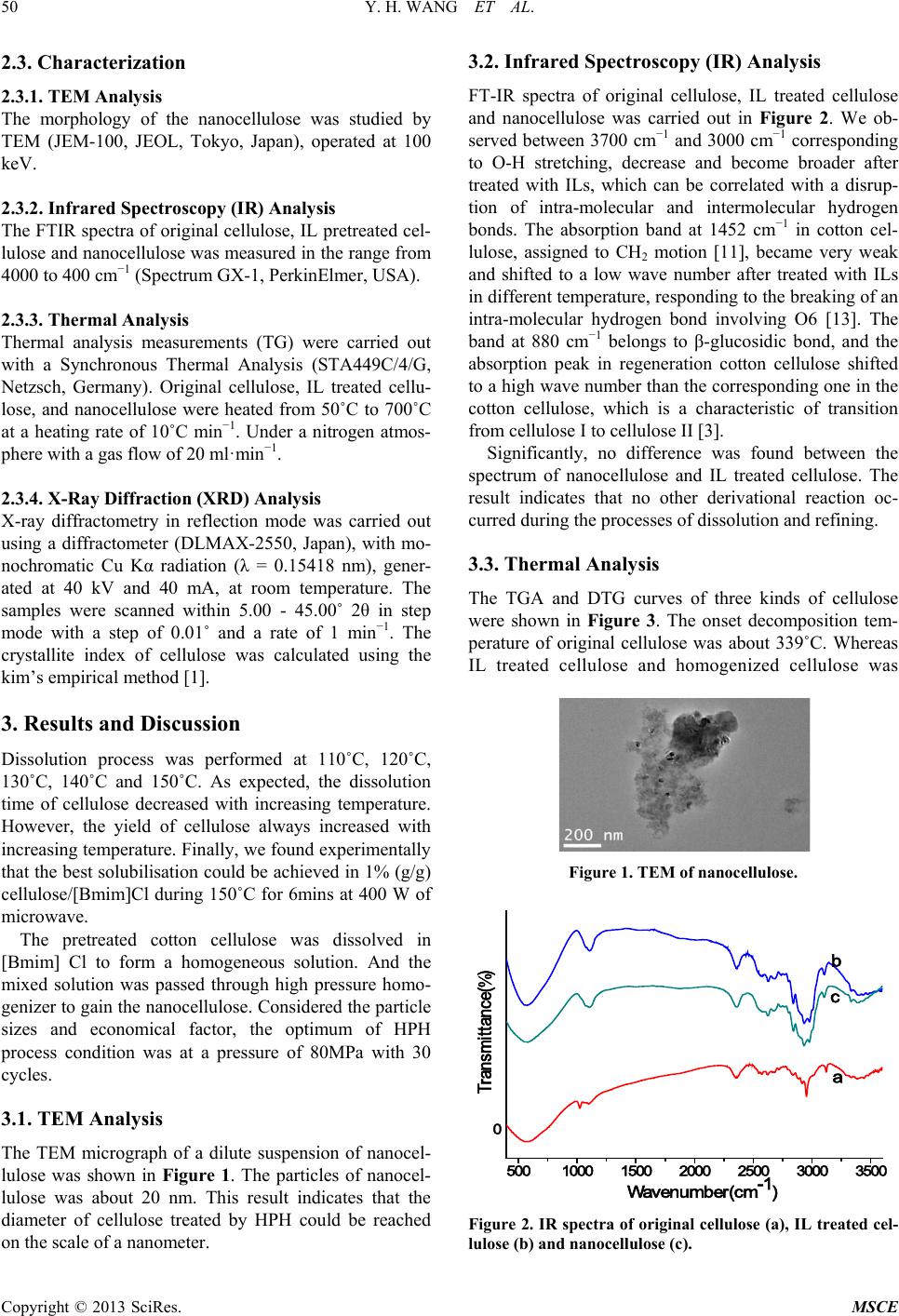 Y. H. WANG ET AL. Copyright © 2013 SciRes. MSCE 50 2.3. Characterization 2.3.1. TEM Analysis The morphology of the nanocellulose was studied by TEM (JEM-100, JEOL, Tokyo, Japan), operated at 100 keV. 2.3.2. Infrar ed Spectroscopy (IR) Analysis The FTIR spectra of original cellulose, IL pretreated cel- lulose and nanocellulose was measured in the range from 4000 to 400 cm−1 (Spectrum GX-1, PerkinElmer, USA). 2.3.3. Thermal Analysis Thermal analysis measurements (TG) were carried out with a Synchronous Thermal Analysis (STA449C/4/G, Netzsch, Germany). Original cellulose, IL treated cellu- lose, and nanocellulose were heated from 50˚C to 700˚C at a heating rate of 10˚C min−1. Under a nitrogen atmos- phere with a gas flow of 20 ml·min−1. 2.3.4. X-Ray Diffraction (XRD) Analysis X-ray diffractometry in reflection mode was carried out using a diffractometer (DLMAX-2550, Japan), with mo- nochromatic Cu Kα radiation (λ = 0.15418 nm), gener- ated at 40 kV and 40 mA , at room temperature. The samples were scanned within 5.00 - 45.00˚ 2θ in step mode with a step of 0.01˚ and a rate of 1 min−1. The crystallite index of cellulose was calculated using the kim’s empirical method [1]. 3. Results and Discussion Dissolution process was performed at 110˚C, 120˚C, 130˚C, 140˚C and 150˚C. As expected, the dissolution time of cellulose decreased with increasing temperature. However, the yield of cellulose always increased with increasing temperature. Finally, we found experimentally that the best solub ilisation could be achieved in 1% (g/g) cellulose/[Bmim]Cl during 150˚C for 6mins at 400 W of microwave. The pretreated cotton cellulose was dissolved in [Bmim] Cl to form a homogeneous solution. And the mixed solution was passed through high pressure homo- genizer to gain the nanocellulose. Considered the par ticle sizes and economical factor, the optimum of HPH process condition was at a pressure of 80MPa with 30 cycles. 3.1. TEM Analysis The TEM micrograph of a dilute suspension of nanocel- lulose was shown in Figure 1. The particles of nanocel- lulose was about 20 nm. This result indicates that the diameter of cellulose treated by HPH could be reached on the scale of a nanometer. 3.2. Infrared S pectroscopy (IR) Anal ysis FT-IR spectra of original cellulose, IL treated cellulose and nanocellulose was carried out in Figure 2. We ob- served between 3700 cm−1 and 3000 cm−1 corresponding to O-H stretching, decrease and become broader after treated with ILs, which can be correlated with a disrup- tion of int ra-molecular and intermolecular hydrogen bonds. The absorption band at 1452 cm−1 in cotton cel- lulose, assigned to CH2 motion [11], became very weak and shifted to a low wave number after treated with ILs in different temperature , resp onding to the breaking of an intra-molecular hydrogen bond involving O6 [13]. The band at 880 cm−1 belongs to β-glucosidic bond, and the absorption peak in regeneration cotton cellulose shifted to a high wave number than the corresponding one in the cotton cellulose, which is a characteristic of transition from cellulose I to cellulose II [3]. Significantly, no difference was found between the spectrum of nanocellulose and IL treated cellulose. The result indicates that no other derivational reaction oc- curred during the processes of dissolutio n and refining. 3.3. Thermal Analysis The TGA and DTG curves of three kinds of cellulose were shown in Figure 3. The onset decomposition tem- perature of original cellulose was about 339˚C. Whereas IL treated cellulose and homogenized cellulose was Figure 1. TEM of nanocellulose. 5001000 1500 2000 2500 3000 3500 0 c b Transmittan ce(%) Wavenumber(cm-1) a Figure 2. IR spectra of original cellulose (a), IL treated cel- lulose (b) an d nan ocellulose (c). 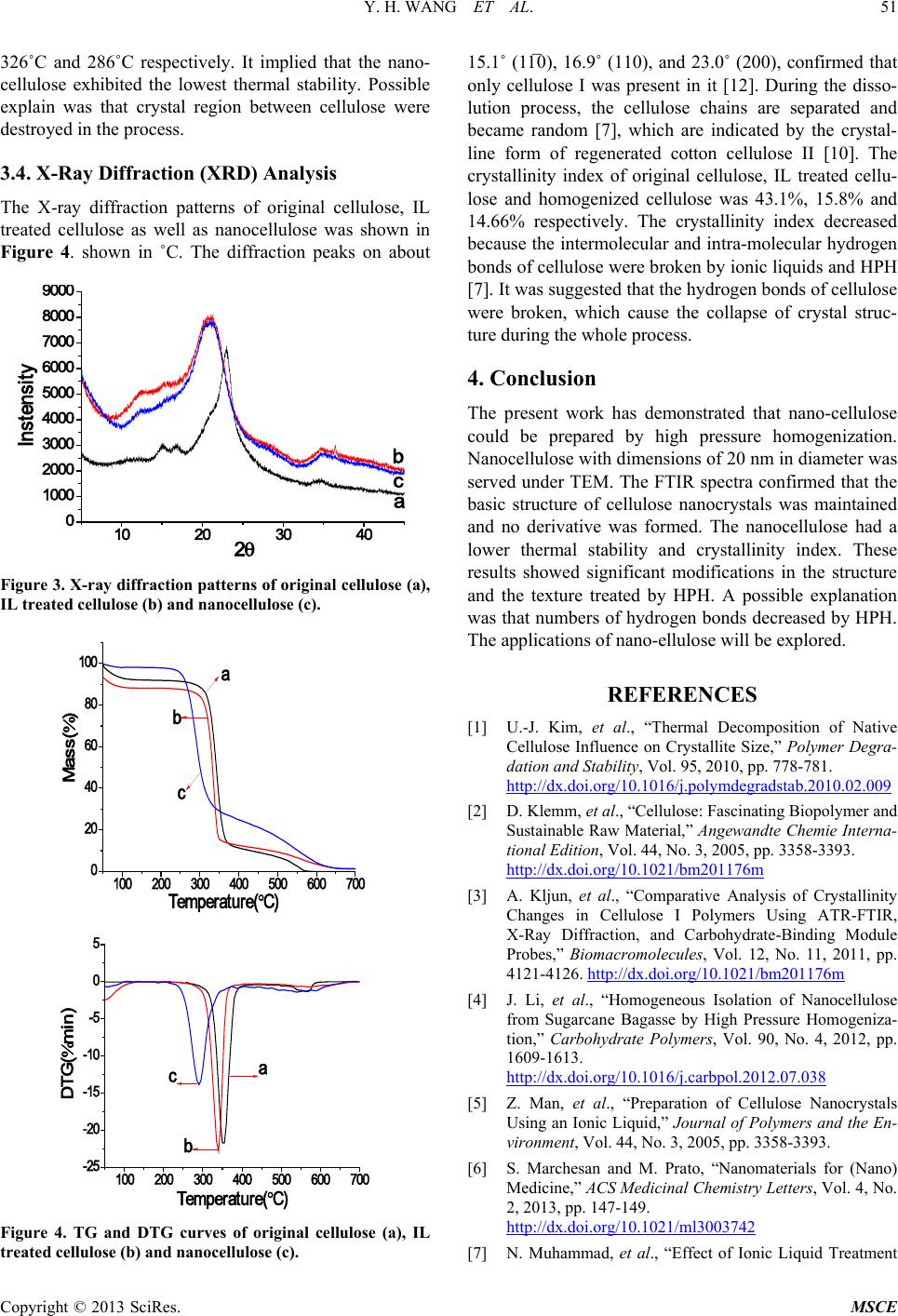 Y. H. WANG ET AL. Copyright © 2013 SciRes. MSCE 51 326˚C and 286˚C respectively. It implied that the nano- cellulose exhibited the lowest thermal stability. Possible explain was that crystal region between cellulose were destroyed in the process. 3.4. X-Ray Diffraction (XRD) Analysis The X-ray diffraction patterns of original cellulose, IL treated cellulose as well as nanocellulose was shown in Figure 4. shown in ˚C. The diffraction peaks on about 10 20 30 40 0 1000 2000 3000 4000 5000 6000 7000 8000 9000 c b Inst ensi ty 2θ a Figure 3. X-ray diffraction patterns of original cellulose (a), IL treated cellulose (b) and nanocellulose (c). 100 200 300 400 500 600 700 0 20 40 60 80 100 c b Ma ss(%) Temperature(°C) a 100 200 300 400 500 600 700 - 25 - 20 - 15 - 10 -5 0 5 c b DTG(%min ) Temperature(°C) a Figure 4. TG and DTG curves of original cellulose (a), IL treated cellulose (b) and nanocellulose (c). 15.1˚ (11̅0), 16.9˚ (110), and 23.0˚ (200), confirmed that only cellulose I was present in it [12]. During the disso- lution process, the cellulose chains are separated and became random [7], which are indicated by the crystal- line form of regenerated cotton cellulose II [10]. The crystallinity index of original cellulose, IL treated cellu- lose and homogenized cellulose was 4 3.1%, 15 .8% and 14.66% respectively. The crystallinity index decreased because the intermolecular and intra-molecular h ydrogen bonds of cellulose were broken by ionic liquids and HPH [7]. It was suggested that the hydrogen bonds of cellulose were broken, which cause the collapse of crystal struc- ture duri n g the whole process . 4. Conclusion The present work has demonstrated that nano-cellulose could be prepared by high pressure homogenization. Nanocellulose with dimension s o f 20 nm in diameter was served under TEM. The FTIR spectra confirmed that the basic structure of cellulose nanocrystals was maintained and no derivative was formed. The nanocellulose had a lower thermal stability and crystallinity index. These results showed significant modifications in the structure and the texture treated by HPH. A possible explanation was that numbers of hydrogen bonds decreased by HPH. The applications of n ano -ellulose will be explored . REFERENCES [1] U.-J. Kim, et al., “Thermal Decomposition of Native Cellulose Influence on Crystallite Size,” Polymer Degra- dation and Stability, Vol. 95, 2010, pp. 778-781. http://dx.doi.org/10.1016/j.polymdegradstab.2010.02.009 [2] D. Klemm, et al., “Cellulose: Fascinating Biopolymer and Sustainable Raw Material,” Angewandte Chemie Interna- tional Edition, Vol. 44, No. 3, 2005, pp. 3358-3393. http://dx.doi.org/10.1021/bm201176m [3] A. Kljun, et al., “Comparative Analysis of Crystallinity Changes in Cellulose I Polymers Using ATR-FTIR, X-Ray Diffraction, and Carbohydrate-Binding Module Probes,” Biomacromolecules, Vol. 12, No. 11, 2011, pp. 4121-4126. http://dx.doi.org/10.1021/bm201176m [4] J. Li, et al., “Homogeneous Isolation of Nanocellulose from Sugarcane Bagasse by High Pressure Homogeniza- tion,” Carbohydrate Polymers, Vol. 90, No. 4, 2012, pp. 1609-1613. http://dx.doi.org/10.1016/j.carbpol.2012.07.038 [5] Z. Man, et al., “Preparation of Cellulose Nanocrystals Using an Ionic Liquid,” Journal of Polymers and the En- vironment, Vol. 44, No. 3, 2005, pp. 3358-3393. [6] S. Marchesan and M. Prato, “Nanomaterials for (Nano) Medicine,” ACS Medicinal Chemistry Letters, Vol. 4, No. 2, 2013, pp. 147-149. http://dx.doi.org/10.1021/ml3003742 [7] N. Muhammad, et al., “Effect of Ionic Liquid Treatment  Y. H. WANG ET AL. Copyright © 2013 SciRes. MSCE 52 on Pyrolysis Products from Bamboo,” Industrial & Engi- neering Chemistry Research, Vol. 51, 2012, pp. 2280- 2289. http://dx.doi.org/10.1021/ie2014313 [8] K. Nakashima, et al., “Direct Bioethanol Production from Cellulose by the Combination of Cellulose-Displaying Yeast and Ionic Liquid Pretreatment,” Green Chemistry, Vol. 13, 2011, pp. 2948-2953. http://dx.doi.org/10.1039/c1gc15688h [9] E. H. Qua, et al., “Preparation and Characterization of Cellulose Nanofibres,” Journal of Materials Science, Vol. 46, No. 18, 2011, pp. 6029-6045. http://dx.doi.org/10.1007/s10853-011-5565-x [10] Y. Yue, et al., “Comparative Properties of Cellulose Na- no-Crystals from Native and Mercerized Cotton Fibers,” Cellulose, Vol. 19, 2012, pp. 1173-1187. http://dx.doi.org/10.1021/ma0505676 [11] H. Zhang, J. Wu, J. Zhang and J. S. He, “1-Allyl-3-Me- thylimidazolium Chloride Room Temperature Ionic Liq- uid: A New and Powerful Nonderivatizing Solvent for Cellulose,” Macromolecules, Vol. 38, 2005, pp. 8272- 8277. http://dx.doi.org/10.1021/ma0505676 [12] L. Zhang, D. Ruan and S. J. Gao, “Dissolution and Rege- neration of Cellulose in NaOH/Thiourea Aqueous Solu- tion,” Polymer Science, Vol. 4, 2002, pp. 1521-1529. http://dx.doi.org/10.1002/polb.10215 [13] L. Zhang, D. Ruan and J. P. Zhou, “Structure and Proper- ties of Regenerated Cellulose Films Prepared from Cotton Linters in NaOH/Urea Aqueous Solution,” Industrial & Engineering Chemistry Research, Vol. 40, 2001, pp. 5923-5928. http://dx.doi.org/10.1021/ie0010417 |