

Paper Menu >>
Journal Menu >>
 Journal of Materials Science and Chemical E ngineering, 2013, 1, 23-27 http://dx.doi.org/10.4236/msce.2013.15005 Published Online October 2013 (http://www.scirp.org/journal/msce) Copyright © 2013 SciRes. MSCE The Polymeric Heterogemeous Matrix for Ca rb o n and Glass Reinforced Plastic Galina Malysheva1, Lianhe Liu2, Xiao Ouyang3, Oleg Kulakov1 1Department of Special Machinery, Bauman Moscow State Technical University, Moscow, Russia 2Qingdao Advanced Marine Material Technology Co., Ltd, Qingdao, China 3Department of Material Science and Chemical Engineering, Harbin Engineering University, Harbin, China Email: [email protected] Received August 2013 Copyright © 2013 Galina Malysheva et al. This is an open access article distributed under the Creative Commons Attribution Li- cense, which permits unrestricted use, distribution, and reproduction in any medium, provided the original work is properly cited. ABSTRACT This article presents the results of deformation -strength properties measurement and microstructural analysis of hetero- geneous polymer matrix consisting of thermoset and thermoplastic polymers. Thermosetting material is a diamino-di- phenil sulfon -cured epoxy oligomer. Polysulfone was used as thermoplastic material. Two different technological proc- esses were used to obtain heterogeneous polymer matrix: the material was mixed in the block, or layered material was produced in which a layer of thermoplastic material alternated with a layer of epoxy oligomer. Keywords: Heterogeneous Matrix; Polysulfon; Epoxy Olygomer; Interphase Bou ndary; Microstructure; Polymer Composite Materials 1. Introduction Polymer composite material (PCM) matrix ensures the material solidity and uniform load distribution between the reinforcing elements, resulting in the growth of cracks deceleration, as well as stress transfer and distri- bution. The most widespread matrix used in production of PCM construction products is epoxy-based binding. The main advantages of epoxy bindings are high adhe- sive durability, good technological effectiveness, small swelling levels and very good technological properties. This allows creating materials which can be cured at the room temperature (cold-curing binding) and at increased temperatures (hot-curing binding). However, epoxy po- lymers are rather fragile, generally, their stretch ratio does not exceed 1%, so the search of effective ways of their modification for the deformation properties increase is needed. The purpose of this work is the development of the epoxy binding with improved deformation properties. To achieve this goal, thermoplastic polymers were used as plasticizers. 2. Experimental Process Traditional epoxy plasticizers, such as dibutylphthalate, active diluents or rubbers, ensure molecular plasticization and allow increasing the characteristics of impact strength and crack resistance, yet their input results in elastic modulus and gla s s-transition temperature decrease. One of modern methods of drastic increase of epoxy binding deformation characteristics that does not result in deterioration of their heat resistance and other operating specifications, is use of thermop lasts which relate to type of structural plasticization. Using the se polymer mixes as basis makes it possible to create new type of hybrid ma- trix with high deformation, strength, thermal and physi- cal properties, offering high chemical resistance and good fabricating characteristics. The most prevailing thermoplasts are polyetherketones, polyest e ri mides an d polysul fones. In this work the microstructure of the polymer mixes prepared by two different technologies was researched: first, epoxy oligomer and polysulfone mix was prepared, second, the multilayered material consisting of alternat- ing layers of epoxy oligomer and polysulfone was pre- pared. In accordance with the first technology, epoxy oli- gomer and polysulfon mixing were performed using a mechanical mixer at +180˚C. Afterwards this polymer mixture was cooled, injected with a curing solution and repeatedly mixed by the same mechanical mixer. Curing was held at +180˚C during 3 hours. The produced ma- 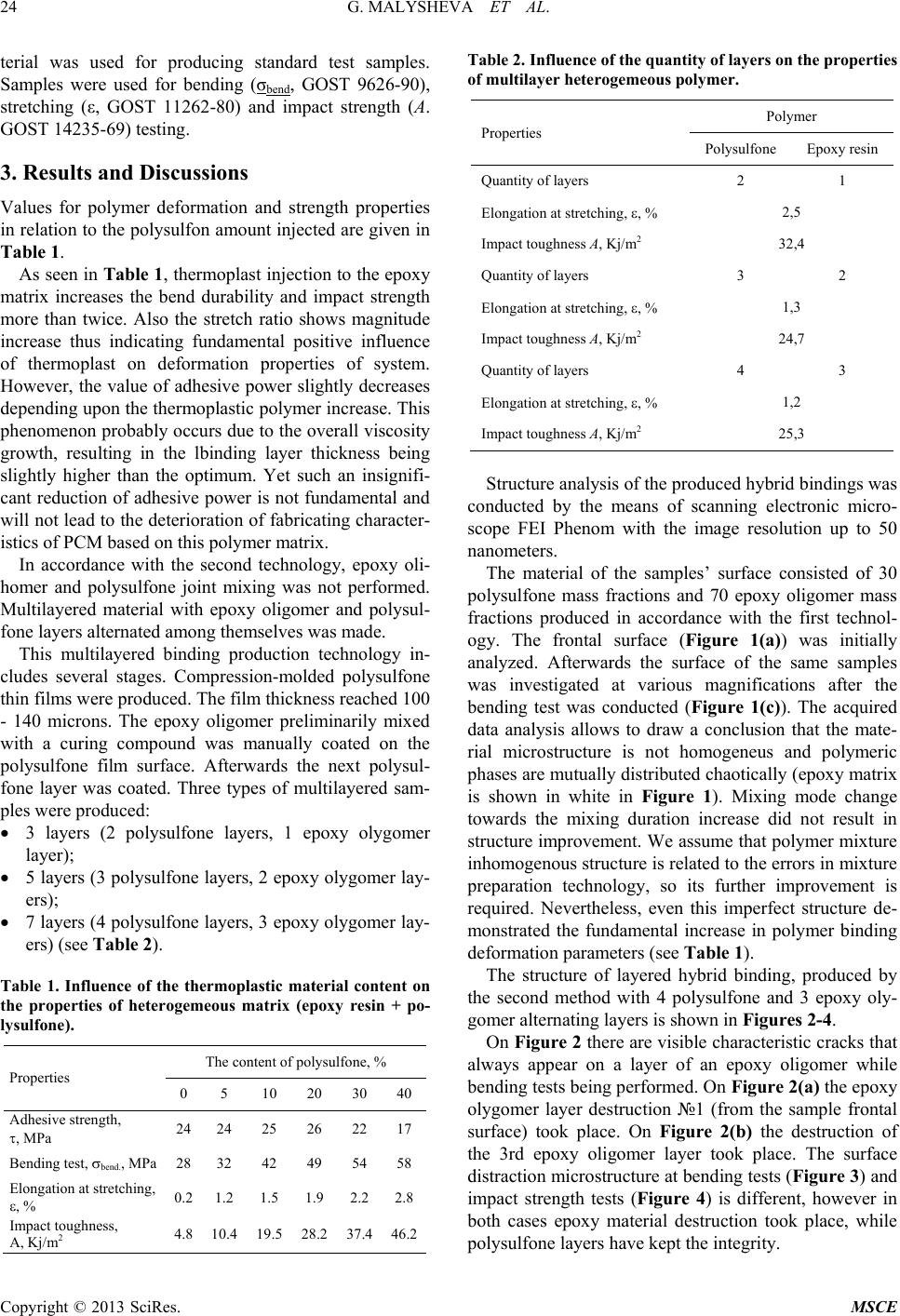 G. MALYSHEVA ET AL. Copyright © 2013 SciRes. MSCE 24 terial was used for producing standard test samples. Samples were used for bending (σbend • 3 layers (2 polysulfone layers, 1 epoxy olygomer layer); , GOST 9626-90), stretching (ε, GOST 11262-80) and impact strength (A. GOST 14235-69) testing. 3. Results and Discuss ions Values for polymer deformation and strength properties in relation to the polysulfon amount injected are given in Table 1. As seen in Table 1 , thermoplast injection to the epoxy matrix increases the bend durability and impact strength more than twice. Also the stretch ratio shows magnitude increase thus indicating fundamental positive influence of thermoplast on deformation properties of system. However, the value of adhesive power slightly decreases depending upon the thermoplastic polymer increase. This phenomenon probably occurs due to the overall viscosity growth, resulting in the lbinding layer thickness being slightly higher than the optimum. Yet such an insignifi- cant reduction of adhesive power is not fundamental and will not lead to the deterioration of fabricating chara cter- istics of PCM based on this polymer matrix. In accordance with the second technology, epoxy oli- homer and polysulfone joint mixing was not performed. Multilayered material with epoxy oligomer and polysul- fone layers alternated among themselves was made. This multilayered binding production technology in- cludes several stages. Compression-molded polysulfone thin films were produced. The film thickness reached 100 - 140 microns. The epoxy oligomer preliminarily mixed with a curing compound was manually coated on the polysulfone film surface. Afterwards the next polysul- fone layer was coated. Three types of multilayered sam- ples were produced: • 5 layers (3 polysulfon e layers, 2 epoxy olygomer lay- ers); • 7 layers (4 polysulfon e layers, 3 epoxy olygomer lay- ers) (see Table 2). Table 1. Influence of the thermoplastic material content on the properties of heterogemeous matrix (epoxy resin + po- lysulfone). Properties The content of polysulfone, % 0 5 10 20 30 40 Adhesive strength, τ, МPа 24 24 25 26 22 17 Bending test, σbend., МPа 28 32 42 49 54 58 Elongation at stretching, ε, % 0.2 1.2 1.5 1.9 2.2 2.8 Impact toughness, А, Kj/m2 4.8 10.4 19.5 28.2 37.4 46.2 Table 2. Influence of the quantity of layers on the properties of multilayer heterogemeous polymer. Properties Polymer Polysulfone Epoxy resi n Quantity of layers 2 1 Elongation at stretching, ε, % 2,5 Impact toughness А, Kj/m2 32,4 Quantity of layers 3 2 Elongation at stretching, ε, % 1,3 Impact toughness А, Kj/m2 24,7 Quantity of layers 4 3 Elongation at stretching, ε, % 1,2 Impact toughness А, Kj/m2 25,3 Structure analysis of the produced hybrid bindings was conducted by the means of scanning electronic micro- scope FEI Phenom with the image resolution up to 50 nanometers. The material of the samples’ surface consisted of 30 polysulfone mass fractions and 70 epoxy oligomer mass fractions produced in accordance with the first technol- ogy. The frontal surface (Figure 1(a)) was initially analyzed. Afterwards the surface of the same samples was investigated at various magnifications after the bending test was conducted (Figure 1(c)). The acquired data analysis allows to draw a conclusion that the mate- rial microstructure is not homogeneus and polymeric phases are mutually distributed chaotically (epoxy matrix is shown in white in Figure 1). Mixing mode change towards the mixing duration increase did not result in structure improvement. We assume that polymer mixture inhomogenous structure is related to the errors in mixture preparation technology, so its further improvement is required. Nevertheless, even this imperfect structure de- monstrated the fundamental increase in polymer binding deformation parameters (see Table 1). The structure of layered hybrid binding, produced by the second method with 4 polysulfone and 3 epoxy oly- gomer alternating layers is shown in Figur es 2-4. On Figure 2 there are visible characteristic cracks that always appear on a layer of an epoxy oligomer while bending tests being performed. On Figure 2(a) the epoxy olygomer layer destruction №1 (from the sample frontal surface) took place. On Figure 2( b) the destruction of the 3rd epoxy oligomer layer took place. The surface distraction microstructure at bending tests (Figure 3) and impact strength tests (Figure 4) is different, however in both cases epoxy material destruction took place, while polysulfone layers have kept the integrity. 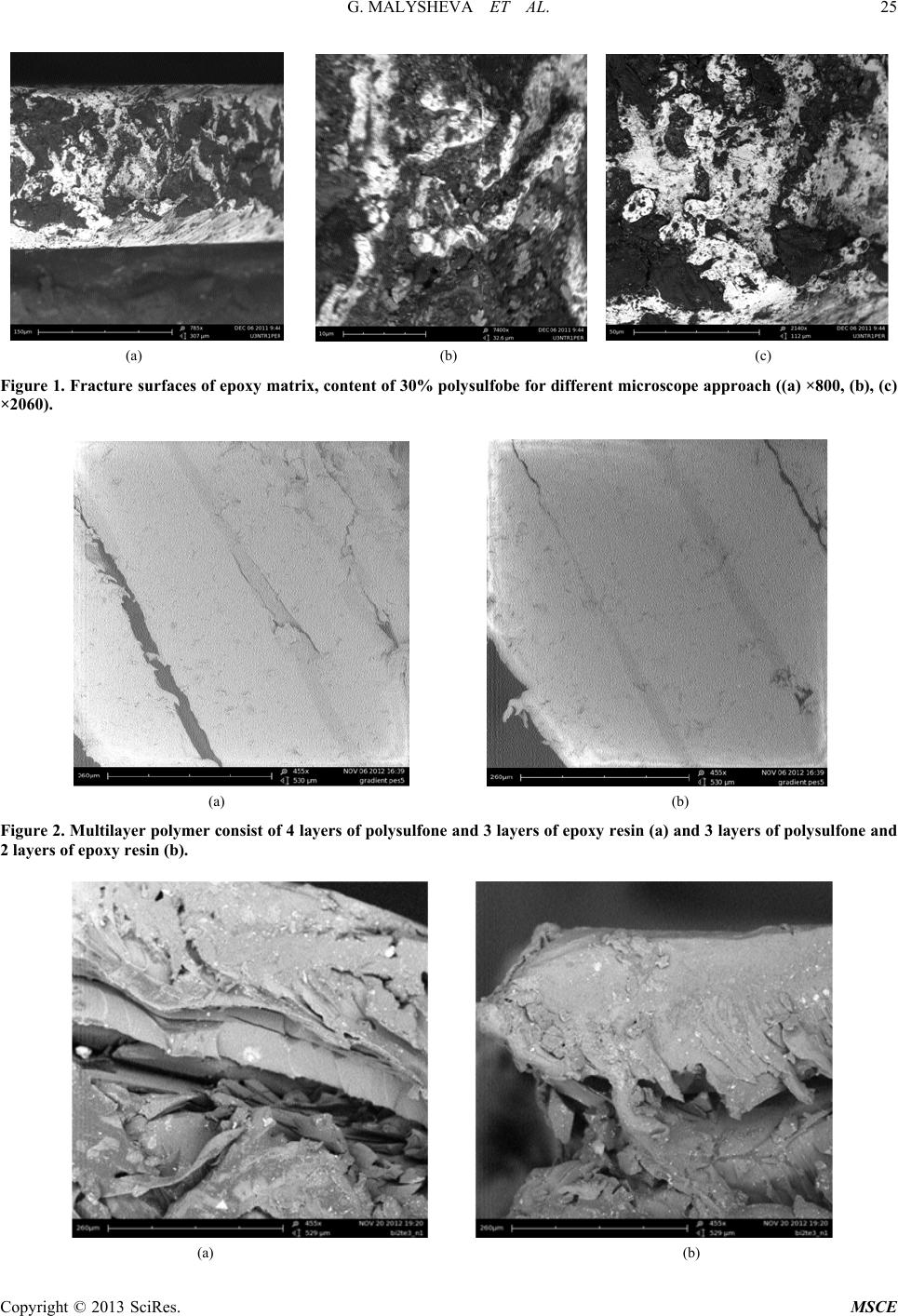 G. MALYSHEVA ET AL. Copyright © 2013 SciRes. MSCE 25 (a) (b) (c) Figure 1. Fracture surfaces of epoxy matrix, content of 30% polysulfobe for different microscope approach ((a) ×800, (b), (c) ×2060). (a) (b) Figure 2. Multilayer polymer consist of 4 layers of polysulfone and 3 layers of epoxy resin (a) and 3 layers of polysulfone and 2 layers of epoxy resin (b). (a) (b) 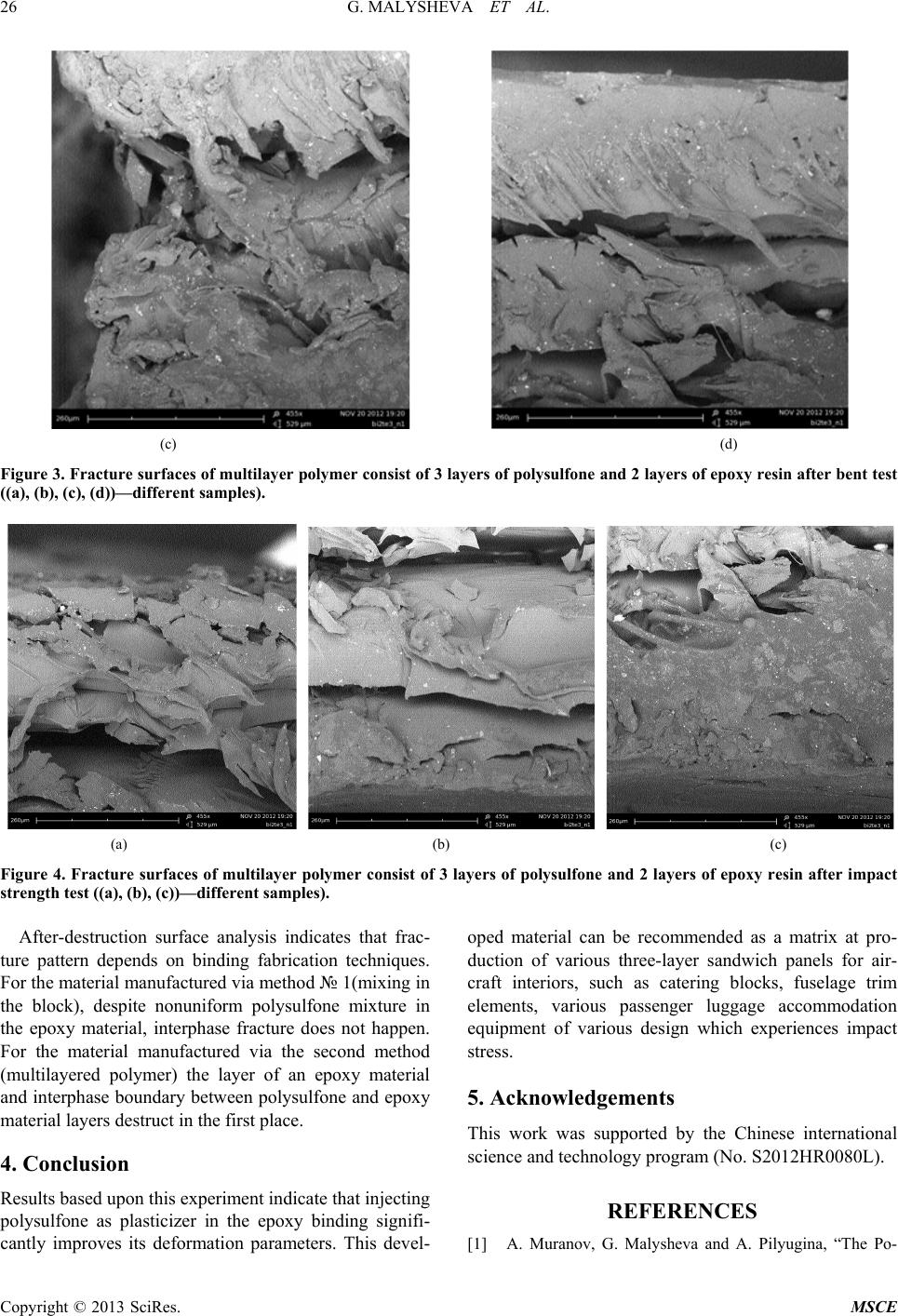 G. MALYSHEVA ET AL. Copyright © 2013 SciRes. MSCE 26 (c) (d) Figure 3. Fracture surfaces of multilayer polymer consist of 3 layers of polysulfone and 2 layers of epoxy resin after bent test ((a), (b), (c), (d))—different samples). (a) (b) (c) Figure 4. Fracture surfaces of multilayer polymer consist of 3 layers of polysulfone and 2 layers of epoxy resin after impact strength test ((a), (b), (c))—different samples). After-destruction surface analysis indicates that frac- ture pattern depends on binding fabrication techniques. For the material manufactured via method № 1(mixing in the block), despite nonuniform polysulfone mixture in the epoxy material, interphase fracture does not happen. For the material manufactured via the second method (multilayered polymer) the layer of an epoxy material and interphase boundary between polysulfone and epoxy material layers destruct in the first place. 4. Conclusion Results based upon this experiment indicate that injecting polysulfone as plasticizer in the epoxy binding signifi- cantly improves its deformation parameters. This devel- oped material can be recommended as a matrix at pro- duction of various three-layer sandwich panels for air- craft interiors, such as catering blocks, fuselage trim elements, various passenger luggage accommodation equipment of various design which experiences impact stress. 5. Acknowledgements This work was supported by the Chinese international science and technology program (No. S2012HR0080L). REFERENCES [1] A. Muranov, G. Malysheva and A. Pilyugina, “The Po-  G. MALYSHEVA ET AL. Copyright © 2013 SciRes. MSCE 27 lymeric Heterogeneous matrix for Composites,” ACM- TAA-2012, Werxham, 2012. [2] M. Kerber and I. Gorbunova, “Binders for Polymeric Composite Materials,” Plastics, No. 12, 2010, pp. 14-21. |