

Paper Menu >>
Journal Menu >>
 Journal of Materials Science and Chemical Engineering, 2013, 1, 7-10 http://dx.doi.org/10.4236/msce.2013.15002 Published Online October 2013 (http://www.scirp.org/journal/msce) Copyright © 2013 SciRes. MSCE Mechanical Properties of Micro- and Nanostructured Copper Films N. Kosarev, M. Khazin, R. Apakashev, N. Valiev The Ural State Mining University, Ekaterinburg, Russia Email: [email protected] Received June 2013 ABSTRACT Mechanical properties of electrodeposited and electroless copper with nano- and crystalline structure are considered. Grain diameters in films ranged from 0.06 to 8 μm. A model is described which takes into account the grain bou ndary hardeni ng and den sity of dislocation. Keywords: Nano- and Microcrystalline Materials; Hall-Petch Relation; Yield Point Stress; Grain Boundary Hardening Coefficient; Nonequilibrium Grain Boundaries 1. Introduction Structural features of nanomaterials determine their uni- que properties. Properties of nanomaterials strongly de- pend from type of distribution, form, size and chemical composition of crystallites. Nanomaterials are used in practice due to their mechanical properties: resilience, plasticity, strength etc. The identification of regularities of influence of size effects to forming of nanomaterials’ properties is one of the most important problems of na- nostructural materials science. In this paper copper films received by electroless and electrodeposit precipitation to metallic and dielectric substrates are researched. Thin structure of copper was studied by the method of transmission electron micros- copy on the electronic microscope TESLA BS 500. Cov- erings are thinned by two-sided electrodeposite etching with using the method of “window” in 50% water solu- tion of ort hophosphoric acid. 2. Experiment The studying of structure is conducted from the broad- ening of the lines on received polycrystalline X-ray pic- tures. The record of intensity distribution curves of mod- el and samples is conducted on diffract meter “DRON-3” with use of nickel-filtered characteristic Кα iron emis- sion. For calculation of characteristics of thin structure we us ed seven Fo urier co efficien ts (t = 0, 1, ···, 6). Stud- ying of elemental composition of the conductors is con- ducted by atomic adsorption method on the spectro- photometer “Perkin Elmer” model 403. For researching of mechanical properties the copper films is separated from the substrate. Mechanical properties of free copper films were determined at tensile tests on the breaking machine with record of strain diagrams. In polycrystalline metals the change in the flow stress (σт) from the grain diameters (d) is described by Hall- Petch relation: 1/2 σσ, ту okd − = + (1) σо: tension which characterizes plastic deformation re- sistance, kу: coefficient which characterizes the influ- ence of gra i n b oundaries on harde ning. Received experimental results of research of depend- ence of flow stress of electroless and electrodeposited precipitated copper from the grain diameters (according to d−1/2) averaged by linear dependence (Figure 1). Extrapolation of dependence oo σσ(ε)= to ε = 0 is allowed to estimate the value of shear stress σƒ. Results for electroless and electrodeposited precipitated copper are concordant with data for the copper which got by casting method and vacuum deposition method [1-3]. A Table 1 shows coefficients of the Equation (1) which adequate to samples received by various methods. Value σƒ or σo depends from the presence of obstacles for promotion of dislocations in sliding places: friction forces of Peierls, cluster of dislocations, impurity atoms and other defects). Coefficient ky characterizes a diffi- culty of transmission of strains from grain to grain [4]. Elemental composition of precipitated conductors deter- mined y atomic adsorption method similar to copper grade М2 (mass fraction of the copper 99.70%). At the same time the samples considered in works [2,3] similar 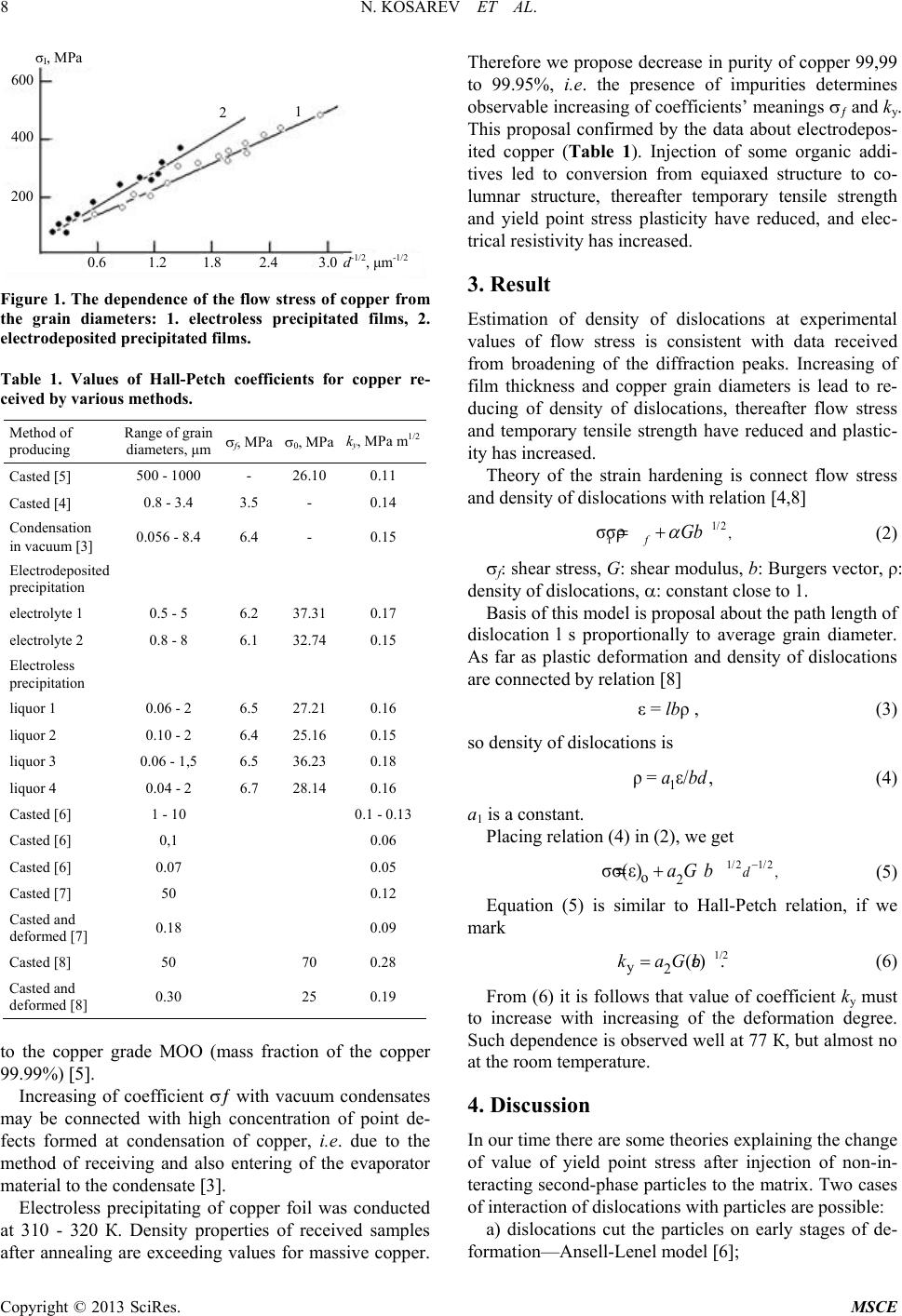 N. KOSAREV ET AL. Copyright © 2013 SciRes. MSCE 8 0.6 1.2 1.8 2.4 3.0 200 400 600 σ I , MPa d -1/2 , μm -1/2 2 1 Figure 1. The dependence of the flow stress of copper from the grain diameters: 1. electroless precipitated films, 2. electrodeposited precipitated films. Table 1. Values of Hall-Petch coefficients for copper re- ceived by various methods. Method of producing Range of grain diameters, μm σf, MPa σ0, MPa kу, MPa m1/2 Casted [5] 500 - 1000 - 26.10 0.11 Casted [4] 0.8 - 3.4 3.5 - 0.14 Condensation in vacuum [3] 0.056 - 8.4 6.4 - 0.15 Electrodeposited precipitation electrolyte 1 0.5 - 5 6.2 37.31 0.17 electrolyte 2 0.8 - 8 6.1 32.74 0.15 Electroless precipitation liquor 1 0.06 - 2 6.5 27.21 0.16 liquor 2 0.10 - 2 6.4 25.16 0.15 liquor 3 0.06 - 1,5 6.5 36.23 0.18 liquor 4 0.04 - 2 6.7 28.14 0.16 Casted [6] 1 - 10 0.1 - 0.13 Casted [6] 0,1 0.06 Casted [6] 0.07 0.05 Casted [7] 50 0.12 Casted and deformed [7] 0.18 0.09 Casted [8] 50 70 0.28 Casted and deformed [8] 0.30 25 0.19 to the copper grade МОО (mass fraction of the copper 99.99%) [5]. Increasing of coefficient σƒ with vacuum condensates may be connected with high concentration of point de- fects formed at condensation of copper, i.e. due to the method of receiving and also entering of the evaporator material to the condensate [3]. Electroless precipitating of copper foil was conducted at 310 - 320 К. Density properties of received samples after annealing are exceeding values for massive copper. Therefore we propose decrease in purity of copper 99,99 to 99.95%, i.e. the presence of impurities determines observable increasing of coefficients’ meanings σƒ and ky. This proposal confirmed by the data about electrodepos- ited copper (Table 1). Injection of some organic addi- tives led to conversion from equiaxed structure to co- lumnar structure, thereafter temporary tensile strength and yield point stress plasticity have reduced, and elec- trical resistivity has increased. 3. Result Estimation of density of dislocations at experimental values of flow stress is consistent with data received from broadening of the diffraction peaks. Increasing of film thickness and copper grain diameters is lead to re- ducing of density of dislocations, thereafter flow stress and temporary tensile strength have reduced and plastic- ity has increased. Theory of the strain hardening is connect flow stress and density of dislocations with relation [4,8] 1/2 т , σσρ fGb α = + (2) σf: shear stress, G: shear modulus, b: Burgers vector, ρ: density of dislocations, α: constant close to 1. Basis of this model is proposal about the path length of dislocation l s proportionally to average grain diameter. As far as plastic deformation and density of dislocations are connected by relation [8] ε = ρlb , (3) so density of dislocations is 1 ρ = ε/,a bd (4 ) а1 is a constant. Placing relation (4) in (2), we get 1/2 1/2 , 2 o σσ(ε) d aGb − = + (5) Equation (5) is similar to Hall-Petch relation, if we mark 1/2 у2 (ε).k aGb= (6) From (6) it is follows that value of coefficient ky must to increase with increasing of the deformation degree. Such dependence is observed well at 77 К, but almost no at the room temperature. 4. Discussion In our time there are some theories explain ing the change of value of yield point stress after injection of non-in- teracting second-phase particles to the matrix. Two cases of interaction of dislocations with particles are po ssi ble: а) dislocations cut the particles on early stages of de- formation—Ansell-Lenel model [6]; 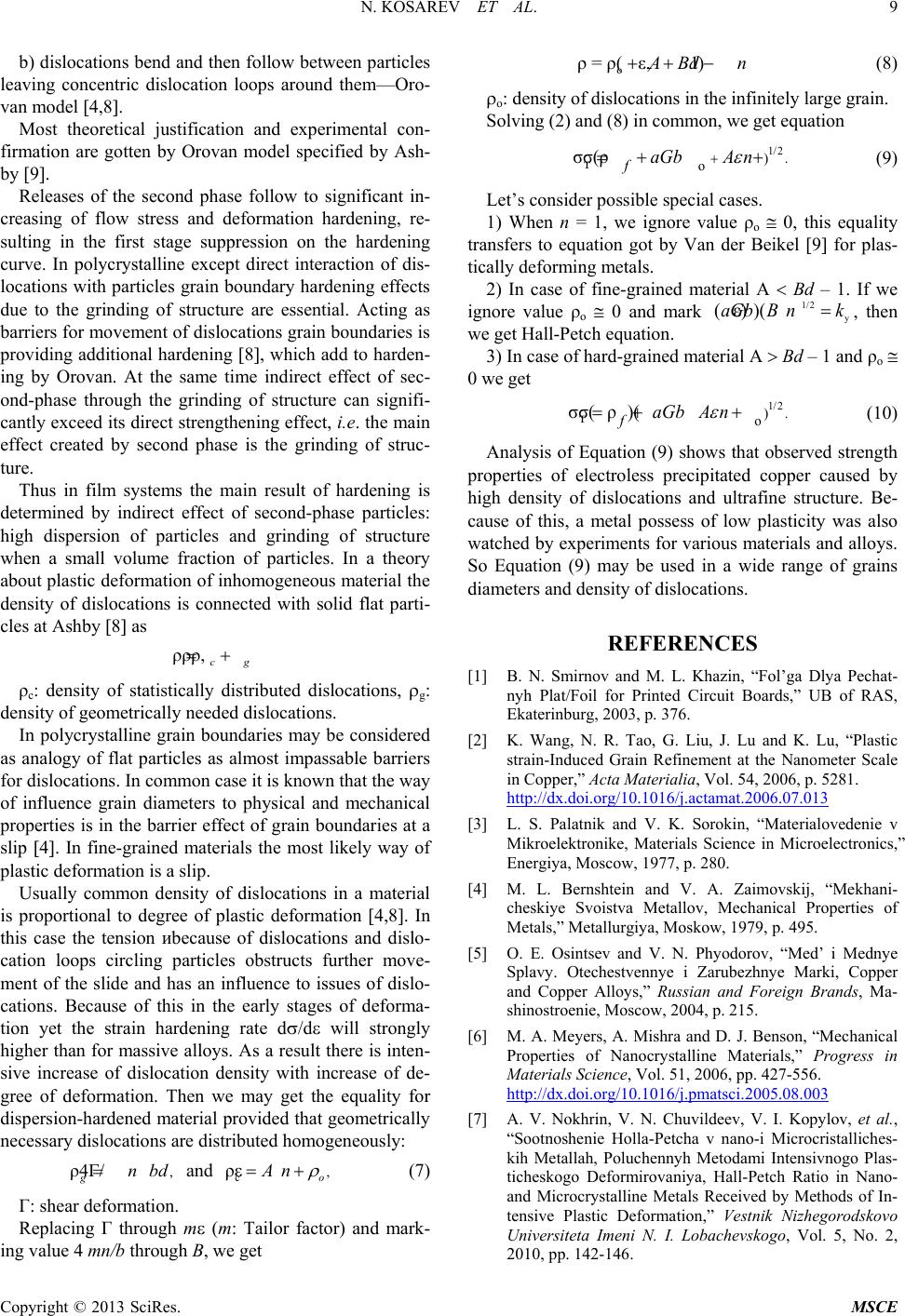 N. KOSAREV ET AL. Copyright © 2013 SciRes. MSCE 9 b) dislocations bend and then follow between particles leaving concentric dislocation loops around them—Oro- van model [4,8]. Most theoretical justification and experimental con- firmation are gotten by Orovan model specified by Ash- by [9]. Releases of the second phase follow to significant in- creasing of flow stress and deformation hardening, re- sulting in the first stage suppression on the hardening curve. In polycrystalline except direct interaction of dis- locations with par ticles grain boundary hardening effects due to the grinding of structure are essential. Acting as barriers for movement of dislocations grain boundaries is providing additional hardening [8], which add to harden- ing by Orovan. At the same time indirect effect of sec- ond-phase through the grinding of structure can signifi- cantly exceed its direct str engthening effect, i.e. the main effect created by second phase is the grinding of struc- ture. Thus in film systems the main result of hardening is determined by indirect effect of second-phase particles: high dispersion of particles and grinding of structure when a small volume fraction of particles. In a theory about plastic def ormation of inhomogeneous material the density of dislocations is connected with solid flat parti- cles at Ashby [8] as ρρρ, cg = + ρс: density of statistically distributed dislocations, ρg: density of geometrically needed dislocations. In polycrystalline grain boundaries may be considered as analogy of flat particles as almost impassable barriers for dislocations. In common case it is known that the way of influence grain diameters to physical and mechanical properties is in the barrier effect of grain boundaries at a slip [4]. In fine-grained materials the most likely way of plastic deformation is a slip. Usually common density of dislocations in a material is proportional to degree of plastic deformation [4,8]. In this case the tension иbecause of dislocations and dislo- cation loops circling particles obstructs further move- ment of the slide and has an influence to issues of dislo- cations. Because of this in the early stages of deforma- tion yet the strain hardening rate dσ/dε will strongly higher than for massive alloys. As a result there is inten- sive increase of dislocation density with increase of de- gree of deformation. Then we may get the equality for dispersion-hardened material provided that geometrically necessary dislocat i ons a re distrib ut e d h omogeneo us l y: , ρ4Г/ gn bd= and c,ρε o An ρ =+ (7 ) Г: shear deformation. Replacing Г through mε (m: Tailor factor) and mark- ing value 4 mn/b through В, we get o ρ = ρ( 1)ε,A Bdn++ − (8) ρо: density of dislocations in the infinitely large grain . Solving (2) and (8) in common, we get equation 1/2 ). o т σσ(ρfaGbA n ε + =++ (9) Let’s consider possible special cases. 1) When n = 1, we ignore value ρо ≅ 0, this equality transfers to equation got by Van der Beikel [9] for plas- tically deforming metals. 2) In case of fine-grained material А < Вd – 1. If we ignore value ρо ≅ 0 and mark 1/2 у ( )(ε)aGbB nk= , then we get Hall-Petch equation. 3) In case of hard-grained material А > Вd – 1 and ρо ≅ 0 we get 1/2 ). o т σσ( )(ρfaGbA n ε =++ (10) Analysis of Equation (9) shows that observed strength properties of electroless precipitated copper caused by high density of dislocations and ultrafine structure. Be- cause of this, a metal possess of low plasticity was also watched by experiments for various materials and alloys. So Equation (9) may be used in a wide range of grains diameters and density of dislocations. REFERENCES [1] B. N. Smirnov and M. L. Khazin, “Fol’ga Dlya Pechat- nyh Plat/Foil for Printed Circuit Boards,” UB of RAS, Ekaterinburg, 2003, p. 376. [2] K. Wang, N. R. Tao, G. Liu, J. Lu and K. Lu, “Plastic strain-Induced Grain Refinement at the Nanometer Scale in Copper,” Acta Materialia, Vol. 54, 2006, p. 5281. http://dx.doi.org/10.1016/j.actamat.2006.07.013 [3] L. S. Palatnik and V. K. Sorokin, “Materialovedenie v Mikroelektronike, Materials Science in Microelectronics,” Energiya, Moscow, 1977, p. 280. [4] M. L. Bernshtein and V. A. Zaimovskij, “Mekhani- cheskiye Svoistva Metallov, Mechanical Properties of Metals,” Metallurgiya, Moskow, 1979, p. 495. [5] O. E. Osintsev and V. N. Phyodorov, “Med’ i Mednye Splavy. Otechestvennye i Zarubezhnye Marki, Copper and Copper Alloys,” Russian and Foreign Brands, Ma- shinostroenie, Moscow, 2004, p. 215. [6] M. A. Meyers, A. Mishra and D. J. Benson, “Mechanical Properties of Nanocrystalline Materials,” Progress in Materials Science, Vol. 51, 2006, pp. 427-556. http://dx.doi.org/10.1016/j.pmatsci.2005.08.003 [7] A. V. Nokhrin, V. N. Chuvildeev, V. I. Kopylov, et al., “Sootnoshenie Holla-Petcha v nano-i Microcristalliches- kih Metallah, Poluchennyh Metodami Intensivnogo Plas- ticheskogo Deformirovaniya, Hall-Petch Ratio in Nano- and Microcrystalline Metals Received by Methods of In- tensive Plastic Deformation,” Vestnik Nizhegorodskovo Universiteta Imeni N. I. Lobachevskogo, Vol. 5, No. 2, 2010, pp. 142-146.  N. KOSAREV ET AL. Copyright © 2013 SciRes. MSCE 10 [8] R. B. Khonikomb, “Plasticheskaya Deformatsiya Metal- lov, Plastic Deformation of Metals,” Mir, Moscow, 1972, p. 408. [9] A. Van der Beukel, “Grain Size Dependence of the Dis- location in Cold-Wоrked,” Scr. Met., No. 9, 1978, pp. 809-817. |