

Paper Menu >>
Journal Menu >>
 Journal of Materials Science and Chemical Engineering, 2013, 1, 11-15 http://dx.doi.org/10.4236/msce.2013.15003 Published Online October 2013 (http://www.scirp.org/journal/msce) Copyright © 2013 SciRes. MSCE Influence of the Precipitating Reagents and Dispersants on the Formation Nano-Aluminum Hydroxide G. Sarsenbay1, L. A. Myltykbaeva2, R. A. Abdulwalyev1, B. M. Sukurov1 1Center of the Earth Sciences, Metallurgy and Benefication, JSC, Science and Education Ministry of the Republic of Kazakhstan, Almaty, Kazakhstan 2National Science and Technology Holding “Parasat”, JSC, Science and Education Ministry of the Republic of Kazakhstan, Astana, Kazakhstan Email: mer-[email protected] Received July 2013 ABSTRACT The influence of the precipitating reagents and dispersants on the formation of nano-aluminum hydroxide from sodium aluminate solution by chemical precipitation was investigated. The influence of the dispersed seeds on the d ecomposi- tion process was investigated too. The alkaline aluminate solutions were used as original solutions with a concentration of Al2O3 having 14.78 g/dm3, αk—1.6 and 127 g/dm3, αk—1.6. For the precipitation processes there were used follow- ing precipitating reagents—solutions HCl, NaHCO3 and NH4HCO3 with a concentration of 80 g/dm3, dispersants—PEG 6000, (NaPO3)6 and Tween 20. For the decomposition process the dispersed seeds and factories seeds were used. Struc- tural studies of the aluminum hydroxide particles were carried out by means of the electron-probe microanalysis and scanning electron microscopy, and phase composition of products was determined by means of X-ray diffraction analy- sis. Ammonium bicarbonate and Tween 20 were determined as the optimal precipitating reagent and dispersant, corre- spondingly, resulting in dispersed aluminum hydroxide, which is used as a seed in the decomposition process. It was established that this product in form of dispersed seed considerably reduces the duration of the decomposition process; the maximal decomposition of solution (73.9%) was observed after injection of dispersеd aluminum hydroxide into solution. The final aluminum hydroxide having 90% of particles less than 100 nanometers was obtained within 7 hours of steady decreasing temperature from 70˚C to 48˚C. Keywords: Nano-Aluminum Hydroxide; Precipitating Reagents; Dispersants; Alkaline Aluminate Solution; Precipitation; Particles; Decomposition; Particle Diameter 1. Introduction Nowadays more than 90% of produced alumina are di- rected to the production of aluminum, and the demand for special types of alumina permanently grows with the pace of development of the industry and the economy [1]. Usage of special aluminas such as nano-dispersed alu- mina enable the significantly improved properties of ma- terials with expansion of the area of applications. It can form the basis for the creation of fundamentally new de- vices on nanometric scale bringing the considerable eco- nomic benefit because of their special properties [2]. Ma- terials containing nano-alumina are widely used in the aerospace, nuclear, power, metallurgy, electronics, bio- chemical industry, etc [3]. Production of nanodispersed alumina around the world in recent years has become a major focus in the field of new materials based on alumina. Analysis of literature data and patent information show that the raw materials for nano-alumina are in general the expensive alkoxides or inorganic salts and the commercial products of alu- mina production. It leads to negative effect on the eco- nomical indexes of production [4-6]. Associated produc- tion of nano-alumina in alumina production can greatly raise the price of commercial products with resulting profit per ton higher to 10 - 100 times compared to in- dexes in case of metallurgical alumina. There are physical, chemical and combined methods to obtain nano-alumina. The easiest and cheapest way is the method of chemical precipitation from solution of alu- minum salt. This way the precipitating reagents and dis- persants cause variation in particle sizes and other prop- erties of the resulting aluminum hydroxide. Precipitation of solid aluminum hydroxide from the solution of alumi- nate may occur in alkaline, acid and neutral media. In this paper we investigate the process of chemical pre- cipitation of nanoparticles of aluminum hydroxide from alkali aluminate solution to identify production condi- 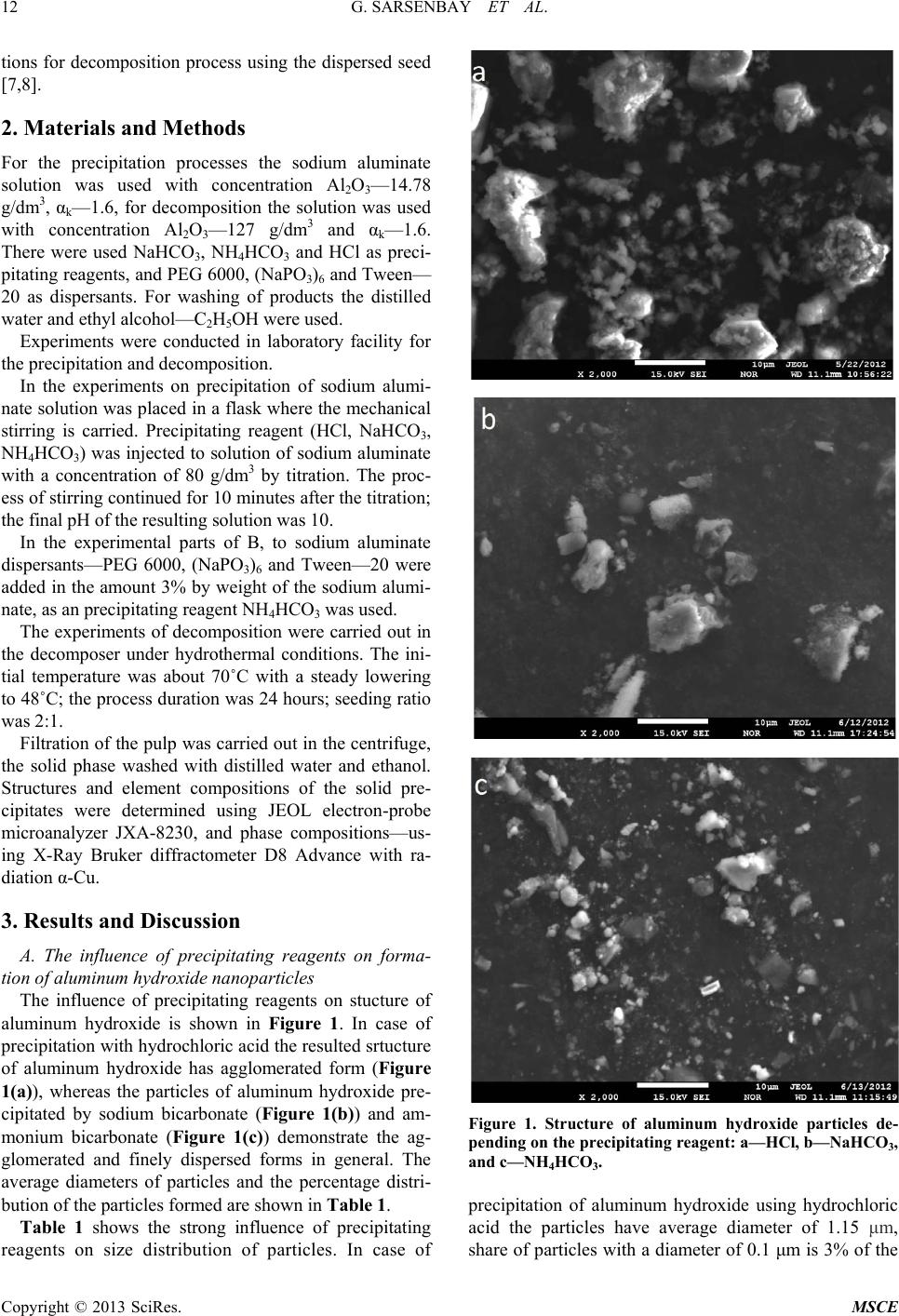 G. SARSENBAY ET AL. Copyright © 2013 SciRes. MSCE 12 tions for decomposition process using the dispersed seed [7,8]. 2. Materials and Methods For the precipitation processes the sodium aluminate solution was used with concentration Al2O3—14.78 g/dm3, αk—1.6, for decomposition the solution was used with concentration Al2O3—127 g/dm3 and αk—1.6. There were used NaHCO3, NH4HCO3 and HCl as preci- pitating r eagents, and PEG 6000, (NaPO3)6 and Tween— 20 as dispersants. For washing of products the distilled water and ethyl alcohol—C2H5OH were us e d. Experiments were conducted in laboratory facility for the precipitation and decomposition. In the experiments on precipitation of sodium alumi- nate solution was placed in a flask where the mechanical stirring is carried. Precipitating reagent (HCl, NaHCO3, NH4HCO3) was injected to solution of sodium aluminate with a concentration of 80 g/dm3 by titration. The proc- ess of stirring continued fo r 10 minutes after the titration ; the final pH of the resulting solution was 10. In the experimental parts of B, to sodium aluminate dispersants—PEG 6000, (NaPO3)6 and Tween—20 were added in the amount 3% by weight of the sodium alumi- nate, as an precipitating reagent NH4HCO3 was used. The experiments of decomposition were carried out in the decomposer under hydrothermal conditions. The ini- tial temperature was about 70˚C with a steady lowering to 48˚C; the process duration was 24 hours; seeding ratio was 2:1. Filtration of the pulp was carried out in the centrifuge, the solid phase washed with distilled water and ethanol. Structures and element compositions of the solid pre- cipitates were determined using JEOL electron-probe microanalyzer JXA-8230, and phase compositions—us- ing X-Ray Bruker diffractometer D8 Advance with ra- diation α-Cu. 3. Results and Discussion A. The influence of precipitating reagents on forma- tion of al uminum hydr ox ide nan oparticles The influence of precipitating reagents on stucture of aluminum hydroxide is shown in Figure 1. In case of precipitation with hydrochloric acid the resulted srtucture of aluminum hydroxide has agglomerated form (Figure 1(a)), whereas the particles of aluminum hydroxide pre- cipitated by sodium bicarbonate (Figure 1(b)) and am- monium bicarbonate (Figure 1(c)) demonstrate the ag- glomerated and finely dispersed forms in general. The average diameters of particles and the percentage distri- bution of the particles formed are shown in Table 1. Table 1 shows the strong influence of precipitating reagents on size distribution of particles. In case of Figure 1. Structure of aluminum hydroxide particles de- pending on the pre cipit ating reagent: a—HCl, b—NaHCO3, and c—NH4HCO3. precipitation of aluminum hydroxide using hydrochloric acid the particles have average diameter of 1.15 μm, share of particles with a diameter of 0.1 μm is 3% of the 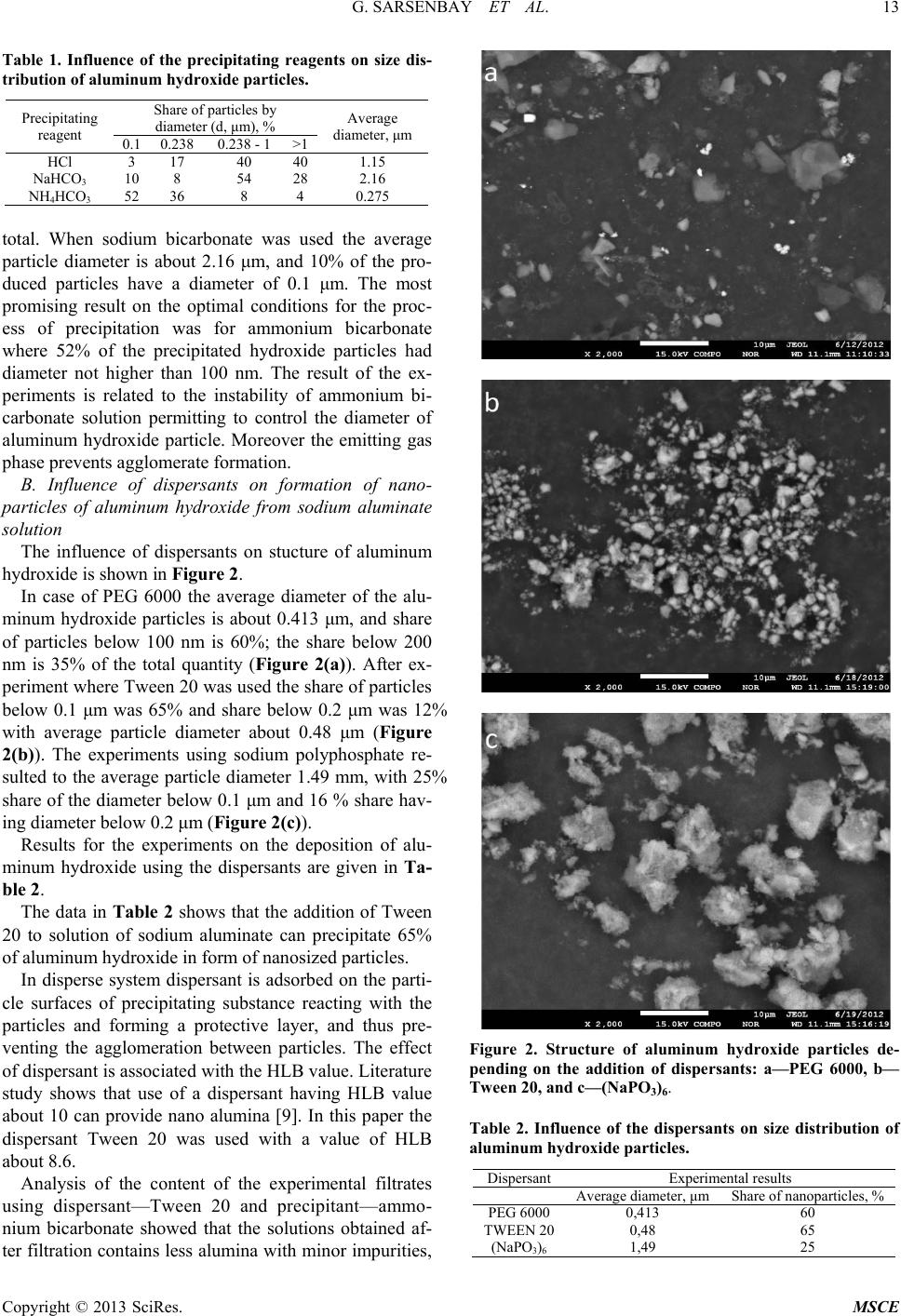 G. SARSENBAY ET AL. Copyright © 2013 SciRes. MSCE 13 Table 1. Influence of the precipitating reagents on size dis- tribution of aluminum hydroxide particles. Precipitating reagent Share of particles by diameter (d, μm), % Average diameter, μm 0.1 0.238 0.238 - 1 >1 HCl 3 17 40 40 1.15 NaHCO3 10 8 54 28 2.16 NH4HCO3 52 36 8 4 0.275 total. When sodium bicarbonate was used the average particle diameter is about 2.16 μm, and 10% of the pro- duced particles have a diameter of 0.1 μm. The most promising result on the optimal conditions for the proc- ess of precipitation was for ammonium bicarbonate where 52% of the precipitated hydroxide particles had diameter not higher than 100 nm. The result of the ex- periments is related to the instability of ammonium bi- carbonate solution permitting to control the diameter of aluminum hydroxide particle. Moreover the emitting gas phase prevents agglomerate formation. B. Influence of dispersants on formation of nano- particles of aluminum hydroxide from sodium aluminate solution The influence of dispersants on stucture of aluminum hydroxide is shown in Figure 2. In case of PEG 6000 the average diameter of the alu- minum hydroxide particles is about 0.413 μm, and share of particles below 100 nm is 60%; the share below 200 nm is 35% of the total quantity (Figure 2(a)). After ex- periment where Tween 20 was used the share of particles below 0.1 μm was 65% and share below 0.2 μm was 12% with average particle diameter about 0.48 μm (Figure 2(b)). The experiments using sodium polyphosphate re- sulted to the average particle diameter 1.49 mm, with 25% share of the diameter below 0.1 μm and 16 % share hav- ing diameter below 0.2 μm (Figure 2(c)). Results for the experiments on the deposition of alu- minum hydroxide using the dispersants are given in Ta- ble 2. The data in Table 2 shows that the addition of Tween 20 to solution of sodium aluminate can precipitate 65% of aluminum hydroxide in form of nanosized particles. In disperse system dispersant is adsorbed on the parti- cle surfaces of precipitating substance reacting with the particles and forming a protective layer, and thus pre- venting the agglomeration between particles. The effect of dispersant is associated with the HLB value. Literature study shows that use of a dispersant having HLB value about 10 can provide nano alumina [9]. In this paper the dispersant Tween 20 was used with a value of HLB about 8. 6. Analysis of the content of the experimental filtrates using dispersant—Tween 20 and precipitant—ammo- nium bicarbonate showed that the solutions obtained af- ter filtration contains les s alumina with minor impurities, Figure 2. Structure of aluminum hydroxide particles de- pending on the addition of dispersants: a—PEG 6000, b— Tween 20, and c—(NaPO3)6. Table 2. Influence of the dispersants on size distribution of aluminum hy droxide particles. Dispersant Experimental results Average diameter, μm Share of nanoparticles, % PEG 6000 0,413 60 TWEEN 20 0,48 65 (NaPO3)6 1,49 25 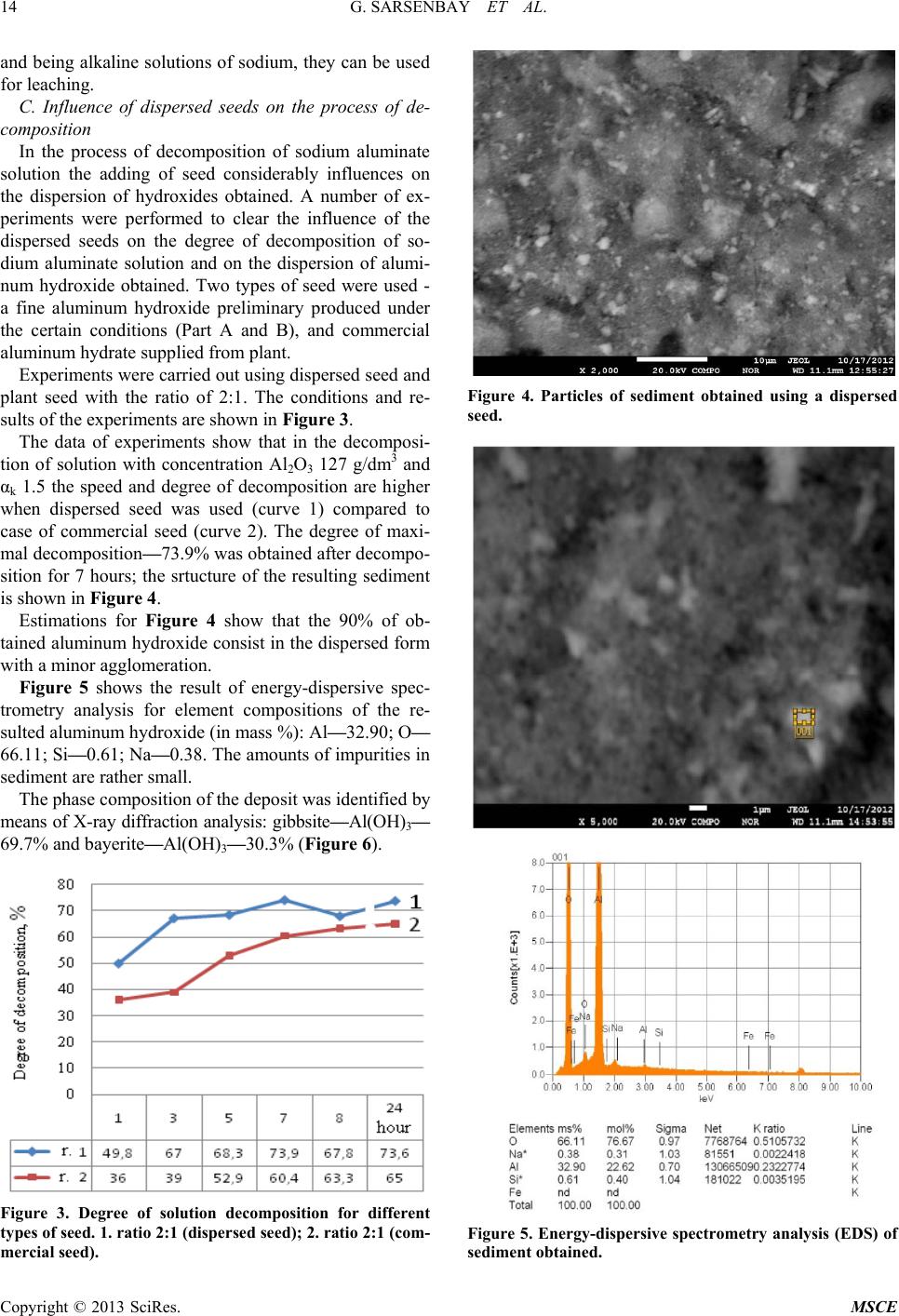 G. SARSENBAY ET AL. Copyright © 2013 SciRes. MSCE 14 and being alkaline solutions of sodium, they can be used for leaching. C. Influence of dispersed seeds on the process of de- composition In the process of decomposition of sodium aluminate solution the adding of seed considerably influences on the dispersion of hydroxides obtained. A number of ex- periments were performed to clear the influence of the dispersed seeds on the degree of decomposition of so- dium aluminate solution and on the dispersion of alumi- num hydroxide obtained. Two types of seed were used - a fine aluminum hydroxide preliminary produced under the certain conditions (Part A and B), and commercial aluminum hydrate supplied from plant. Experiments were carried out using dispersed seed and plant seed with the ratio of 2:1. The conditions and re- sults of the experiments are shown in Figure 3. The data of experiments show that in the decomposi- tion of solution with concentration Al2O3 127 g/dm3 and αk 1.5 the speed and degree of decomposition are higher when dispersed seed was used (curve 1) compared to case of commercial seed (curve 2). The degree of maxi- mal decomposition—73.9% was obtained after decompo- sition for 7 hours; the srtucture of the resulting sediment is shown in Figure 4. Estimations for Figure 4 show that the 90% of ob- tained aluminum hydroxide consist in the dispersed form with a minor agglomeration. Figure 5 shows the result of energy-dispersive spec- trometry analysis for element compositions of the re- sulted aluminum hydroxide (in mass %): Al—32.90; O— 66.11; Si—0.61; Na—0.38. The amounts of impurities in sediment are rather small. The phase composition of the deposit was identified by means of X-ray diffraction analysis: gibbsite—Аl(OH)3— 69.7% and bayerite—Аl(OH)3—30.3% (Figure 6). Figure 3. Degree of solution decomposition for different types of seed. 1. r atio 2:1 (dispersed seed); 2. ratio 2:1 (com- mercial seed). Figure 4. Particles of sediment obtained using a dispersed seed. Figure 5. Energy-dispersive spectrometry analysis (EDS) of sediment obt ained. 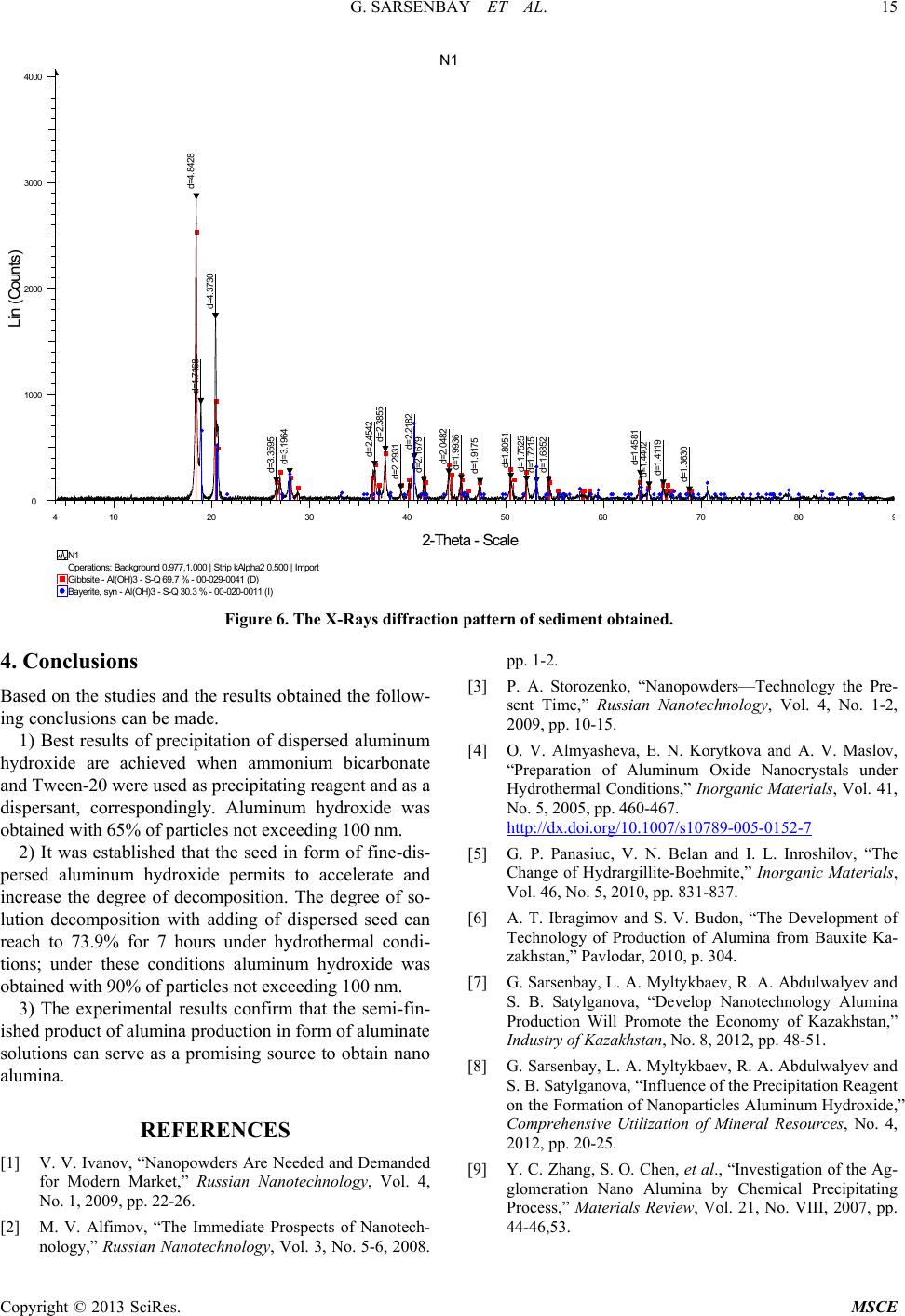 G. SARSENBAY ET AL. Copyright © 2013 SciRes. MSCE 15 N1 Bayerite, syn - Al(OH )3 - S-Q 30.3 % - 00-020-0011 (I) Gibbsite - Al(OH )3 - S-Q 69.7 % - 00-029-0041 (D) Operations: Background 0.977,1.000 | Strip kAlpha2 0.500 | Import N1 Lin (C ounts) 0 1000 2000 3000 4000 2-Theta - Scale 410 20 30 40 50 60 70 80 9 d=4.8428 d=4.7168 d=4.3730 d=3.3595 d=3.1964 d=2.4542 d=2.3855 d=2.2931 d=2.2182 d=2.1679 d=2.0482 d=1.9936 d=1.9175 d=1.8051 d=1.7525 d=1.7215 d=1.6852 d=1.4581 d=1.4402 d=1.4119 d=1.3630 Figure 6. The X-Rays diffraction pattern of sediment obtained. 4. Conclusions Based on the studies and the results obtained the follow- ing conclusions can be made. 1) Best results of precipitation of dispersed aluminum hydroxide are achieved when ammonium bicarbonate and Tween-20 were used as precipitating reagent and as a dispersant, correspondingly. Aluminum hydroxide was obtaine d with 65% of particles not exc e e ding 100 nm. 2) It was established that the seed in form of fine-dis- persed aluminum hydroxide permits to accelerate and increase the degree of decomposition. The degree of so- lution decomposition with adding of dispersed seed can reach to 73.9% for 7 hours under hydrothermal condi- tions; under these conditions aluminum hydroxide was obtaine d with 90% of particles not exc e e ding 100 nm. 3) The experimental results confirm that the semi-fin- ished product of alumina production in form of aluminate solutions can serve as a promising source to obtain nano alumina. REFERENCES [1] V. V. Ivanov, “Nanopowders Are Needed and Demanded for Modern Market,” Russian Nanotechnology, Vol. 4, No. 1, 2009, pp. 22-26. [2] M. V. Alfimov, “The Immediate Prospects of Nanotech- nology,” Russian Nanotechnology, Vol. 3, No. 5-6, 2008. pp. 1-2. [3] P. A. Storozenko, “Nanopowders—Technology the Pre- sent Time,” Russian Nanotechnology, Vol. 4, No. 1-2, 2009, pp. 10-15. [4] O. V. Almyasheva, E. N. Korytkova and A. V. Maslov, “Preparation of Aluminum Oxide Nanocrystals under Hydrothermal Conditions,” Inorganic Materials, Vol. 41, No. 5, 2005, pp. 460-467. http://dx.doi.org/10.1007/s10789-005-0152-7 [5] G. P. Panasiuc, V. N. Belan and I. L. Inroshilov, “The Change of Hydrargillite-Boehmite,” Inorganic Materials, Vol. 46, No. 5, 2010, pp. 831-837. [6] A. T. Ibragimov and S. V. Budon, “The Development of Technology of Production of Alumina from Bauxite Ka- zakhstan,” Pavlodar, 2010, p. 304. [7] G. Sarsenbay, L. A. Myltykbaev, R. A. Abdulwalyev and S. B. Satylganova, “Develop Nanotechnology Alumina Production Will Promote the Economy of Kazakhstan,” Industry of Kazakhstan, No. 8, 2012, pp. 48-51. [8] G. Sarsenbay, L. A. Myltykbaev, R. A. Abdulwalyev and S. B. Saty lganova, “Influence of the Precipitation Reagent on the Formation of Nanoparticles Aluminum Hydroxide,” Comprehensive Utilization of Mineral Resources, No. 4, 2012, pp. 20-25. [9] Y. C. Zhang, S. O. Chen, et al., “Investiga tion of the Ag- glomeration Nano Alumina by Chemical Precipitating Process,” Materials Review, Vol. 21, No. VΙΙΙ, 2007, pp. 44-46,53. |