

Paper Menu >>
Journal Menu >>
 Communications and Network, 2013, 5, 78-80 doi:10.4236/cn.2013.51B018 Published Online February 2013 (http://www.scirp.org/journal/cn) Sound Card Based ASK Communication System for Teaching Communication Principle Course Ming Jin, Yang Pu College of Information Science & Engineering, Ningbo University, Ningbo, China Email: mingjin141@gmail.com, [email protected] Received 2012 ABSTRACT This paper deals with the issue of using the MATLAB tool in teaching the course of communication principles via con- structing an Amplitude Shift Keying (ASK) communication system. Different from conventional MATLAB based si- mulations, the constructed system transmits modulated signals through a wire audio channel by exploiting sound card. Synchronization is required before the received signal being demodulated. Many practical problems should be consid- ered as in real system. The designed system can be extended easily, and not only stimulates students’ interest in com- munication course, but also helps them understanding the principles from system viewpoints. Keywords: Sound Card; Communication Principles; ASK; Communication System 1. Introduction Communication principles course is one of basic courses of electronic engineering (EE) related specialties. Com- munications technology is one of the most rapidly grow- ing technologies in the telecommunications industry. As a kernel course in EE, Communication principles course plays an important role. Many universities [1-7] have established hardware laboratory wh ich can implement all experiments involved in the course. However, to estab- lish such labs is very expensive. With the shortage of supplement, computer aided simulations is an option. Many Matlab/simulink based simulation program packages for communication principles course are avail- able online. However, some packages consist of many independent script files; it is difficult for students to op- erate it. And some program packages are designed based on GUI or simulink. We found that these kinds of pack- ages may not work in different computer platform or software versions. Moreover, most of available simula- tions are based on the ideal environment. Many practical problems, which may be encountered in hardware labo- ratory or real communication systems, are skipped. In [8], sound card is used in a demo of communication system. However, it is not shared for everyone. Following the idea of [8], in this paper, we present a MATLAB based Amplitude Shift Keying (ASK) com- munication system which is realized by transmitting the modulated signal through a wire audio channel by ex- ploiting sound card. Hence, it is different from the soft- ware only based simulations. And many practical prob- lems, such as synchronization, may be encountered. In addition, the simple ASK communication system can be extended easily, and will not only stimulate students’ interest in communication course, but also help them understanding the principles from system viewpoints. 2. Basic Principle of ASK This section describes the modulation and demodulation principles of ASK digital signals. Assumed that a binary digital data 0 n a or 1, , need to be trans- mitted through ASK modulation of car rier frequency 1, 2,n c f . Then, the transmission digital data sequence is given as ()( ) n n dtagtnT (1) where () g t and T are the pulse shape of each transmis- sion digital data and the bit duration, respectively. When () g t is trailing rectangular pulse, it is given that 1, () 2 0, otherwise TT t gt 2 (2) The digital data sequence is modulated by multiplying a carrier frequency signal and then transmitted. The transmitted signal is given by ()()cos 2c s tdt ft (3) The transmitted signal is contaminated by multi path fading and AWGN, and at the receiver it is received as Copyright © 2013 SciRes. CN 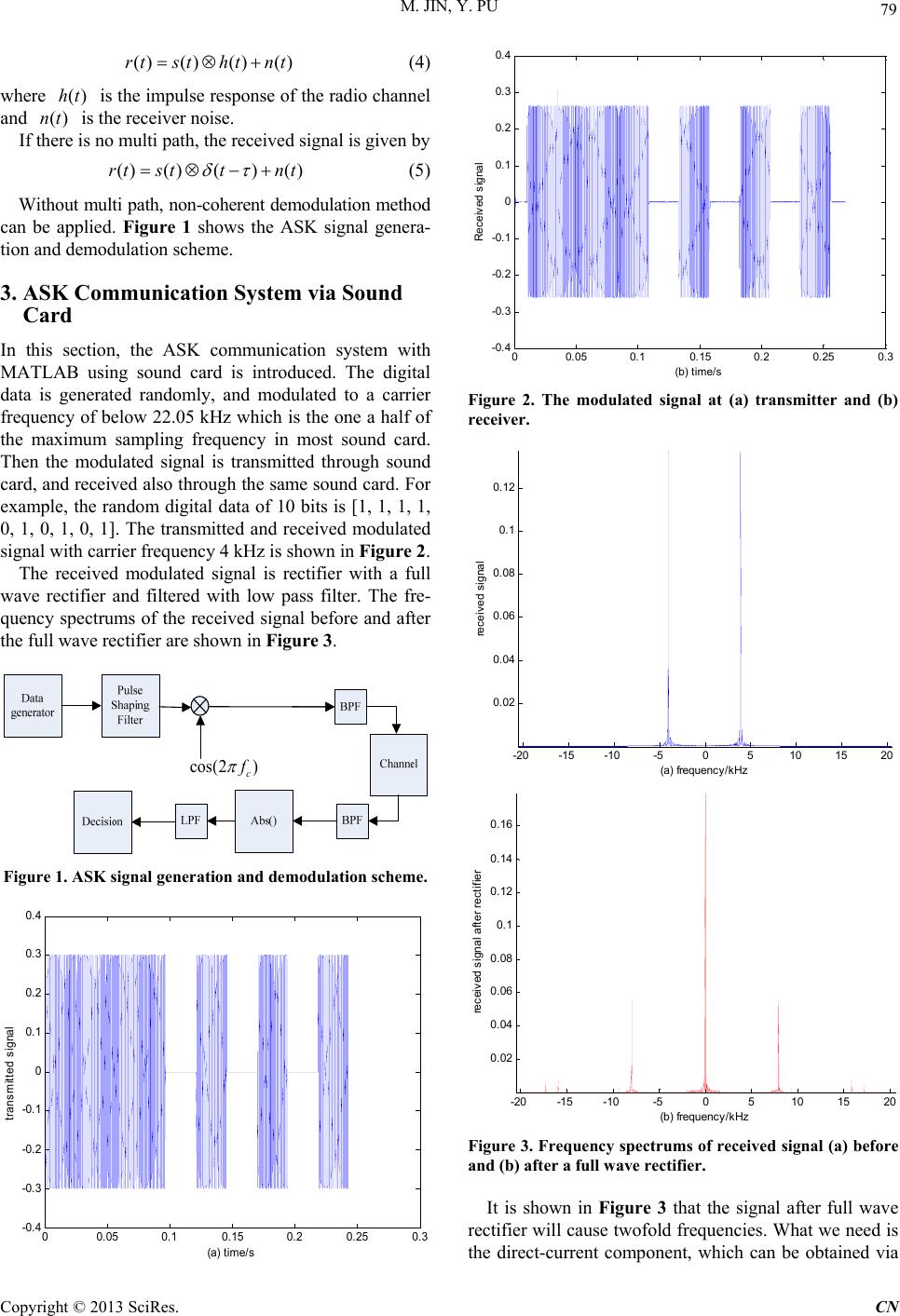 M. JIN, Y. PU 79 ()()()()rtstht nt (4) where is the impulse response of the radio chann el and is the receiver noise. ()ht ()nt If there is no multi path, the received signal is given by ()()() ()rt sttnt (5) Without multi path, non-coherent demodulation method can be applied. Figure 1 shows the ASK signal genera- tion and demodulation scheme. 3. ASK Communication System via Sound Card In this section, the ASK communication system with MATLAB using sound card is introduced. The digital data is generated randomly, and modulated to a carrier frequency of below 22.05 kHz which is the one a half of the maximum sampling frequency in most sound card. Then the modulated signal is transmitted through sound card, and received also through the same sound card. For example, the random digital data of 10 bits is [1, 1, 1, 1, 0, 1, 0, 1, 0, 1]. The transmitted and received modulated signal with carrier frequency 4 kHz is shown in Figure 2. The received modulated signal is rectifier with a full wave rectifier and filtered with low pass filter. The fre- quency spectrums of the received signal before and after the full wave rectifier are shown in Figure 3. cos(2 ) c f Figure 1. ASK signal generation and demodul ation scheme. 00.05 0.10.15 0.20.250.3 -0.4 -0.3 -0.2 -0.1 0 0.1 0.2 0.3 0.4 trans m it ted s i gnal (a) time/s 00.05 0.10.15 0.20.250. 3 -0.4 -0.3 -0.2 -0.1 0 0. 1 0. 2 0. 3 0. 4 Rec e i v e d s i gn al (b) time /s Figure 2. The modulated signal at (a) transmitter and (b) receiver. -20 -15 -10 -505 10 15 20 0. 02 0. 04 0. 06 0. 08 0. 1 0. 12 rec eived s ig nal (a) frequency/k Hz -20 -15 -10 -5 05 10 15 20 0. 02 0. 04 0. 06 0. 08 0.1 0. 12 0. 14 0. 16 rec eived s i gnal af t er rec t ifier (b) frequenc y/kHz Figure 3. Frequency spectrums of received signal (a) before and (b) after a full wave rectifier. It is shown in Figure 3 that the signal after full wave rectifier will cause twofold frequencies. What we need is the direct-current component, which can be obtained via Copyright © 2013 SciRes. CN 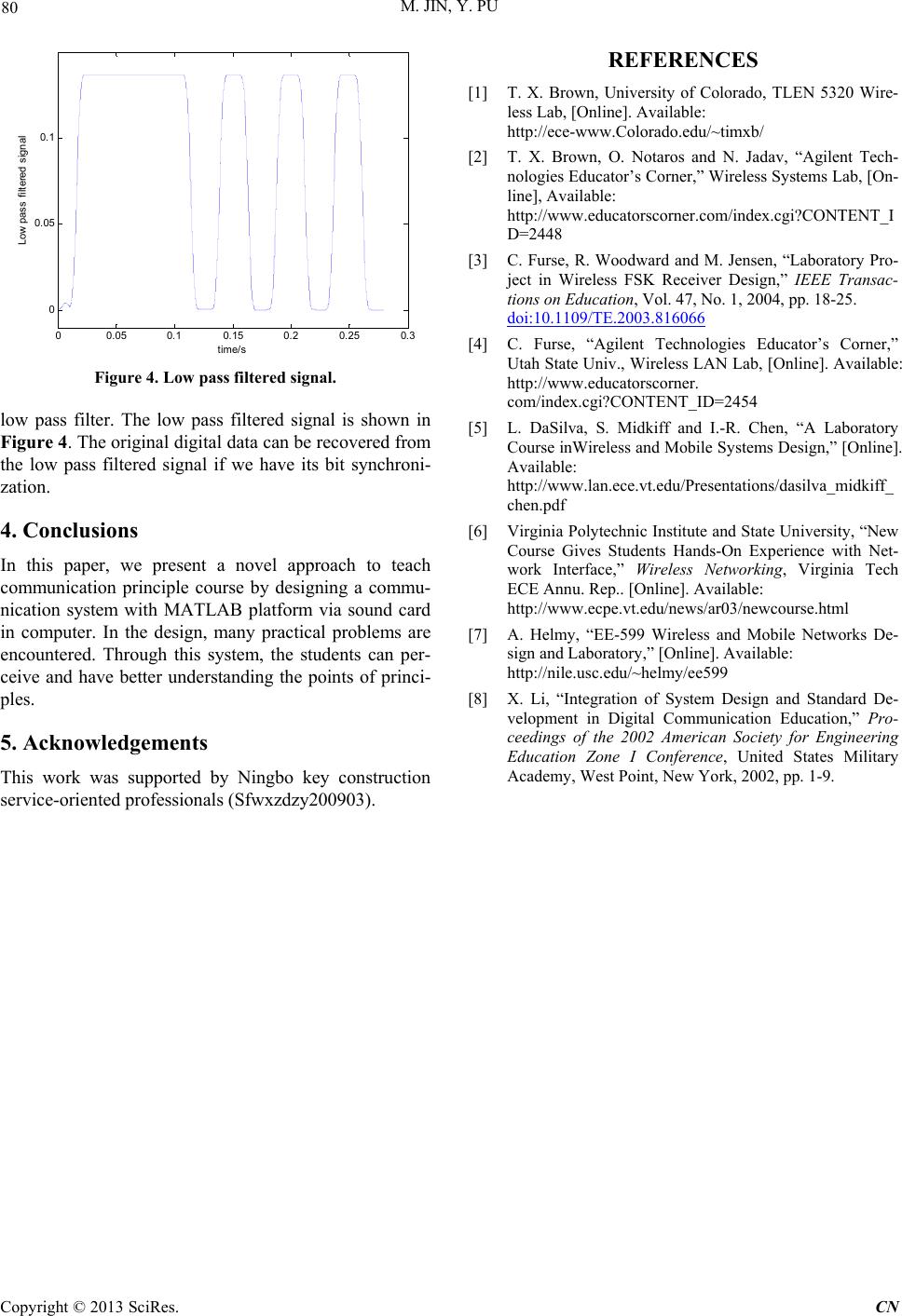 M. JIN, Y. PU Copyright © 2013 SciRes. CN 80 REFERENCES 00.05 0.10.15 0.2 0.25 0.3 0 0.05 0. 1 Low pas s fi l t ered signal time/s [1] T. X. Brown, University of Colorado, TLEN 5320 Wire- less Lab, [Online]. Available: http://ece-www.Colorado.edu/~timxb/ [2] T. X. Brown, O. Notaros and N. Jadav, “Agilent Tech- nologies Educator’s Corner,” Wireless Systems Lab, [On- line], Available: http://www.educatorscorner.com/index.cgi?CONTENT_I D=2448 [3] C. Furse, R. Woodward and M. Jensen, “Laboratory Pro- ject in Wireless FSK Receiver Design,” IEEE Transac- tions on Education, Vol. 47, No. 1, 2004, pp. 18-25. doi:10.1109/TE.2003.816066 [4] C. Furse, “Agilent Technologies Educator’s Corner,” Utah State Univ., Wireless LAN Lab, [Online]. Available: http://www.educatorscorner. com/index.cgi?CONTENT_ID=2454 Figure 4. Low pass filtered signal. low pass filter. The low pass filtered signal is shown in Figure 4. The original digital data can be recovered from the low pass filtered signal if we have its bit synchroni- zation. [5] L. DaSilva, S. Midkiff and I.-R. Chen, “A Laboratory Course inWireless and Mobile Systems Design,” [Online ]. Available: http://www.lan.ece.vt.edu/Presentations/dasilva_midkiff_ chen.pdf 4. Conclusions [6] Virginia Polytechnic Institute and State University, “New Course Gives Students Hands-On Experience with Net- work Interface,” Wireless Networking, Virginia Tech ECE Annu. Rep.. [Online]. Available: http://www.ecpe.vt.edu/news/ar03/newcourse.html In this paper, we present a novel approach to teach communication principle course by designing a commu- nication system with MATLAB platform via sound card in computer. In the design, many practical problems are encountered. Through this system, the students can per- ceive and have better understanding the points of princi- ples. [7] A. Helmy, “EE-599 Wireless and Mobile Networks De- sign and Labor a tory,” [Online]. Available: http://nile.usc.edu/~helmy/ee599 [8] X. Li, “Integration of System Design and Standard De- velopment in Digital Communication Education,” Pro- ceedings of the 2002 American Society for Engineering Education Zone I Conference, United States Military Academy, West Point, New York, 2002, pp. 1-9. 5. Acknowledgements This work was supported by Ningbo key construction service-oriented professionals (Sfwxzdzy200903). |