

Paper Menu >>
Journal Menu >>
 Communications and Network, 2013, 5, 34-38 doi:10.4236/cn.2013.51B009 Published Online February 2013 (http://www.scirp.org/journal/cn) A Communication Middleware with Unified Data Transmission Interface Yu Zhang, Yuanbing Zhang, Xiangyuan Bu, Chao Zhang School of Information and Electronics, Beijing Institute of Technology, Beijing, China Email: [email protected] Received 2012 ABSTRACT In a Modern communication network, data exchange become a complex problem because there usually exists a various data formats due to the diversity and complexity of communication devices. In this paper, a communication middleware with unified data transmission interface is introduced, which acts as the abstract communication layer in the heteroge- neous distributed private communication network. Devices within the network only need to interact with the middle- ware, instead of directly communicate with each other by various protocols and interfaces, which can reduce the com- plexity and diversity of the heterogeneous network. This article describes the structure and features of the middleware, and analyses the use of “buffer pool” in message sending and receiving process. The applications of this middleware can reduce the complexity of heterogeneous network interoperation, and improve communication efficiency. Keywords: Communication Middleware; Buffer Pool; UDP; XML 1. Introduction With explosive development of telecommunication tech- nology, a modern communication network is becoming more and more convenient and powerful. Meanwhile, it becomes more and more complex, which brings addi- tional technical difficulties. For a communication net- work in a local area which integrates multi abilities, in- cluding the telecommunication, localization and naviga- tion, we must make the data transmission and exchange between any two devices smoothly and reliably [1]. Since the network is composed of various devices with different protocols and physical layer specifications, to provide the direct connection between devices through the physical layer becomes very complicated and costly. Also, because of different data formats, the quick and correct data format translation is crucial for the network. To solve this problem, a communication middleware with unified data transmission interface is introduced in this article. Combined with the hardware adaptors, the middleware acts as an abstract communication layer, and provides an effective and flexible centralized message service. It can receive messages from source devices, and transfer them to the destinations accurately. As a result, multiple devices within the network only interact with the middleware through messages, and do not need con- sidering the format converting or data translating process [2]. The use of this middleware can greatly reduce the complexity of device interoperation, and furthermore improve communication efficiency. 2. Architecture of the Network In this article, the communication middleware with uni- fied data transmission interface makes the information exchange between various devices of the network based on a logical software bus, so the communication-related devices only need to establish a direct connection with the middleware, and can achieve communication with other ones. Thus, the coupling degree between devices within the network can be significantly reduced, and data can be transmitted in a unified way. The architecture and data flow of the entire communication network are shown in Figure 1. System data are preserved in XML format, and then transmitted through UDP protocol [3]. The information of various devices is saved in a system database, so the middleware can obtain message con- figuration information by querying the database, and then transmit messages. 3. Basic Function of the Middleware 3.1. Centralized Message Service *This work was supported in part by the Ministry of Science and Tech- nology of the People’s Republic of China under Grant 2011BA- H05B08. It is the key service of the middleware. As a transmission middleware of a large number of received messages, it Copyright © 2013 SciRes. CN 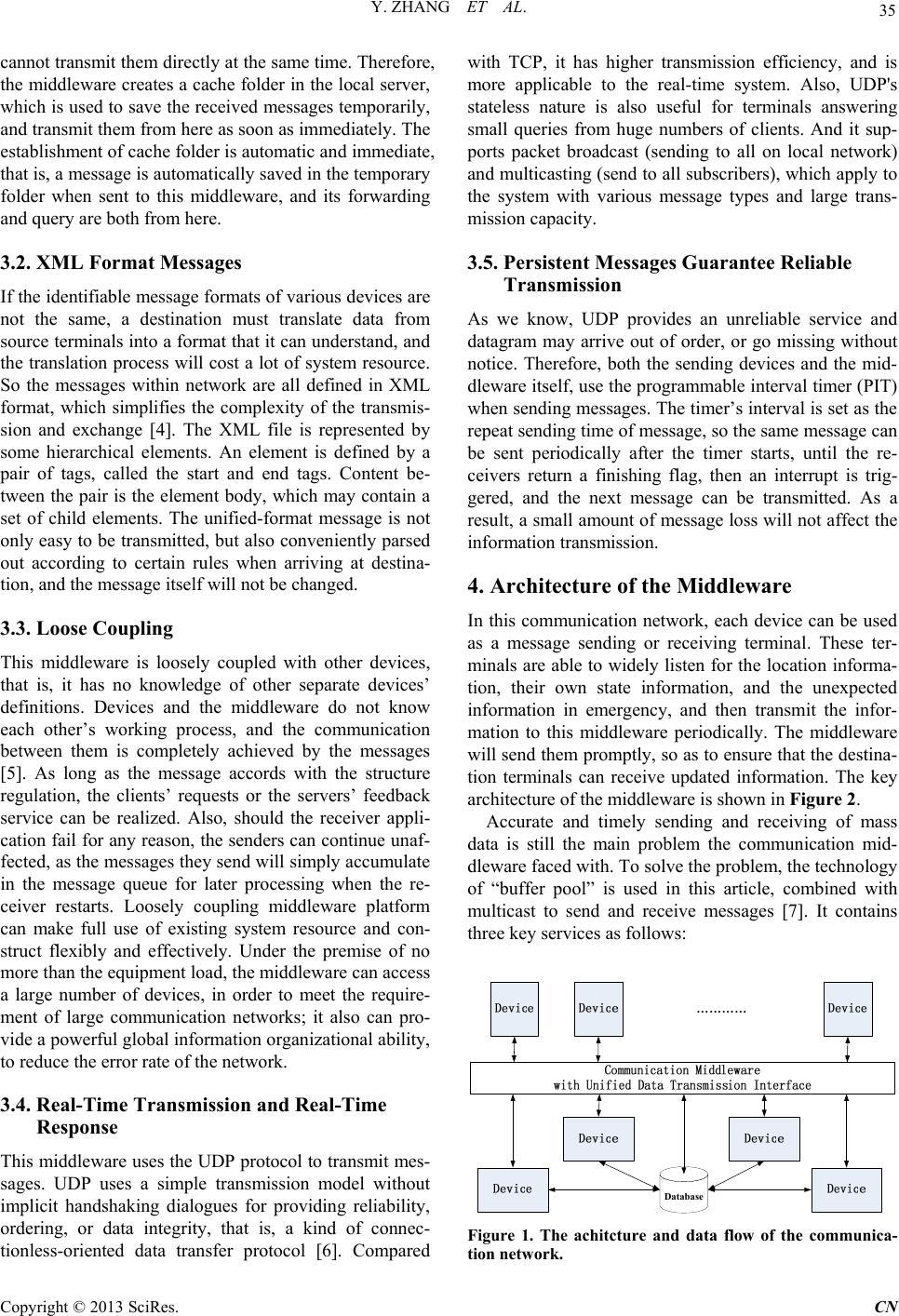 Y. ZHANG ET AL. 35 cannot transmit them directly at the same time. Therefore, the middleware creates a cache folder in the local server, which is used to save th e received messages temporarily, and transmit them from here as soon as immediately. The establishment of cache folder is automatic and immediate, that is, a message is automatically saved in the temporary folder when sent to this middleware, and its forwarding and query are both from here. 3.2. XML Format Messages If the identifiable message formats of various devices are not the same, a destination must translate data from source terminals into a format that it can understan d, and the translation process will cost a lot of system resource. So the messages within network are all defined in XML format, which simplifies the complexity of the transmis- sion and exchange [4]. The XML file is represented by some hierarchical elements. An element is defined by a pair of tags, called the start and end tags. Content be- tween the pair is the element body, which may contain a set of child elements. The unified-format message is not only easy to be transmitted, but also conveniently parsed out according to certain rules when arriving at destina- tion, and the message itself will not be changed. 3.3. Loose Coupling This middleware is loosely coupled with other devices, that is, it has no knowledge of other separate devices’ definitions. Devices and the middleware do not know each other’s working process, and the communication between them is completely achieved by the messages [5]. As long as the message accords with the structure regulation, the clients’ requests or the servers’ feedback service can be realized. Also, should the receiver appli- cation fail for any reason, the senders can continue unaf- fected, as the messages they send will simply accumulate in the message queue for later processing when the re- ceiver restarts. Loosely coupling middleware platform can make full use of existing system resource and con- struct flexibly and effectively. Under the premise of no more than the equipment load, the middleware can access a large number of devices, in order to meet the require- ment of large communication networks; it also can pro- vide a powerful global informatio n organization al ability, to reduce the error rate of the network. 3.4. Real-Time Transmission and Real-Time Response This middleware uses the UDP protocol to transmit mes- sages. UDP uses a simple transmission model without implicit handshaking dialogues for providing reliability, ordering, or data integrity, that is, a kind of connec- tionless-oriented data transfer protocol [6]. Compared with TCP, it has higher transmission efficiency, and is more applicable to the real-time system. Also, UDP's stateless nature is also useful for terminals answering small queries from huge numbers of clients. And it sup- ports packet broadcast (sending to all on local network) and multicasting (send to all subscribers), which app ly to the system with various message types and large trans- mission capacity. 3.5. Persistent Messages Guarantee Reliable Transmission As we know, UDP provides an unreliable service and datagram may arrive out of order, or go missing without notice. Therefore, both the sending devices and the mid- dleware itself, use the programmable interval timer (PIT) when sending messages. The timer’s interval is set as the repeat sending time of message, so the same message can be sent periodically after the timer starts, until the re- ceivers return a finishing flag, then an interrupt is trig- gered, and the next message can be transmitted. As a result, a small amount of message loss will not affect the information transmission. 4. Architecture of the Middleware In this communication network, each device can be used as a message sending or receiving terminal. These ter- minals are able to widely listen for the location informa- tion, their own state information, and the unexpected information in emergency, and then transmit the infor- mation to this middleware periodically. The middleware will send them promptly, so as to ensu re that the destina- tion terminals can receive updated information. The key architecture of the middleware is shown in Figure 2. Accurate and timely sending and receiving of mass data is still the main problem the communication mid- dleware faced with. To solve the problem, the technology of “buffer pool” is used in this article, combined with multicast to send and receive messages [7]. It contains three key services as follows: Database ………… Figure 1. The achitcture and data flow of the communica- tion network. Copyright © 2013 SciRes. CN 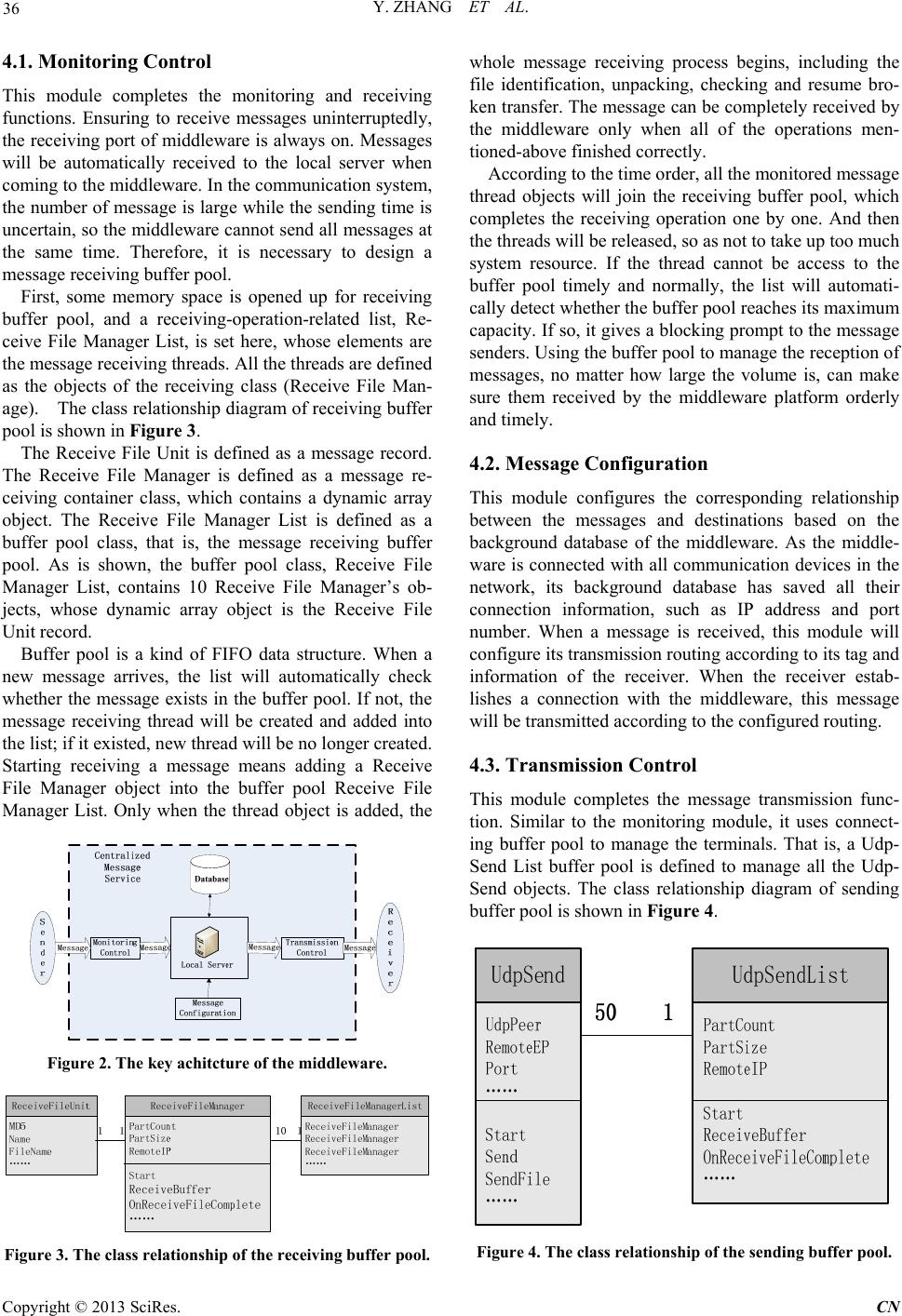 Y. ZHANG ET AL. 36 4.1. Monitoring Control This module completes the monitoring and receiving functions. Ensuring to receive messages uninterruptedly, the receiving port of middleware is always on. Messages will be automatically received to the local server when coming to the middleware. In the communication system, the number of message is large while the sen ding time is uncertain, so the middleware cannot send all messages at the same time. Therefore, it is necessary to design a message receiving buffer pool. First, some memory space is opened up for receiving buffer pool, and a receiving-operation-related list, Re- ceive File Manager List, is set here, whose elements are the message receiving threads. All the threads are defined as the objects of the receiving class (Receive File Man- age). The class relationship diagram of receiving buffer pool is shown in Figure 3. The Receive File Unit is defined as a message record. The Receive File Manager is defined as a message re- ceiving container class, which contains a dynamic array object. The Receive File Manager List is defined as a buffer pool class, that is, the message receiving buffer pool. As is shown, the buffer pool class, Receive File Manager List, contains 10 Receive File Manager’s ob- jects, whose dynamic array object is the Receive File Unit record. Buffer pool is a kind of FIFO data structure. When a new message arrives, the list will automatically check whether the message exists in the buffer pool. If not, the message receiving thread will be created and added into the list; if it existed, new thread will be no long er created. Starting receiving a message means adding a Receive File Manager object into the buffer pool Receive File Manager List. Only when the thread object is added, the Figure 2. The key achitcture of the middleware. Figure 3. The class relationship of the receiving buffer pool. whole message receiving process begins, including the file identification, unpacking, checking and resume bro- ken transfer. The message can be completely received by the middleware only when all of the operations men- tioned-above finished correctly. According to the time order, all the monitored message thread objects will join the receiving buffer pool, which completes the receiving operation one by one. And then the threads will be released, so as not to take up too much system resource. If the thread cannot be access to the buffer pool timely and normally, the list will automati- cally detect whether the buffer pool reach es its maximum capacity. If so, it gives a blocking prompt to the message senders. Using the buffer pool to manage the receptio n of messages, no matter how large the volume is, can make sure them received by the middleware platform orderly and timely. 4.2. Message Configuration This module configures the corresponding relationship between the messages and destinations based on the background database of the middleware. As the middle- ware is connected with all communication devices in the network, its background database has saved all their connection information, such as IP address and port number. When a message is received, this module will configure its transmission ro uting acco rding to its tag and information of the receiver. When the receiver estab- lishes a connection with the middleware, this message will be transmitted according to the configured routing. 4.3. Transmission Control This module completes the message transmission func- tion. Similar to the monitoring module, it uses connect- ing buffer pool to manage the terminals. That is, a Udp- Send List buffer pool is defined to manage all the Udp- Send objects. The class relationship diagram of sending buffer pool is shown in Figure 4. Figure 4. The class relationship of the sending buffer pool. Copyright © 2013 SciRes. CN 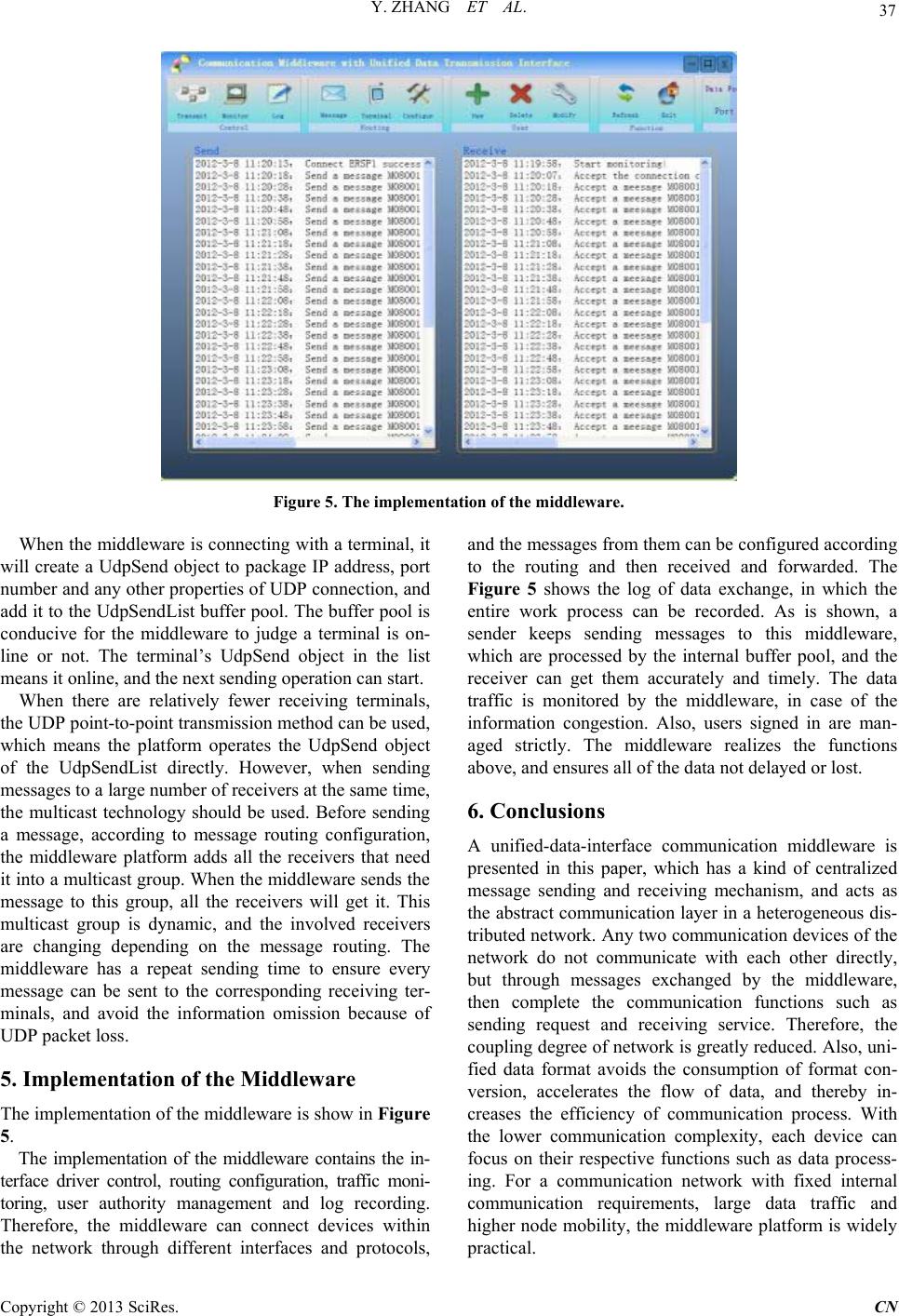 Y. ZHANG ET AL. Copyright © 2013 SciRes. CN 37 Figure 5. The implementation of the middleware. When the middleware is connecting with a terminal, it will create a UdpSend object to package IP address, port number and any other properties of UDP connection, and add it to th e UdpSendList buffer pool. The b uffer pool is conducive for the middleware to judge a terminal is on- line or not. The terminal’s UdpSend object in the list means it online, and the next sending operation can start. When there are relatively fewer receiving terminals, the UDP point-to-point transmission method can be used, which means the platform operates the UdpSend object of the UdpSendList directly. However, when sending messages to a large number of receivers at the same time, the multicast technology should be used. Before sending a message, according to message routing configuration, the middleware platform adds all the receivers that need it into a multicast group. When th e middleware sends the message to this group, all the receivers will get it. This multicast group is dynamic, and the involved receivers are changing depending on the message routing. The middleware has a repeat sending time to ensure every message can be sent to the corresponding receiving ter- minals, and avoid the information omission because of UDP packet loss. 5. Implementation of the Middleware The implementation of the middleware is show in Figure 5. The implementation of the middleware contains the in- terface driver control, routing configuration, traffic moni- toring, user authority management and log recording. Therefore, the middleware can connect devices within the network through different interfaces and protocols, and the messages from them can be configured according to the routing and then received and forwarded. The Figure 5 shows the log of data exchange, in which the entire work process can be recorded. As is shown, a sender keeps sending messages to this middleware, which are processed by the internal buffer pool, and the receiver can get them accurately and timely. The data traffic is monitored by the middleware, in case of the information congestion. Also, users signed in are man- aged strictly. The middleware realizes the functions above, and ensu res all of the data not delayed or lost. 6. Conclusions A unified-data-interface communication middleware is presented in this paper, which has a kind of centralized message sending and receiving mechanism, and acts as the abstract communication layer in a heterogeneous dis- tributed network. Any two communication devices of the network do not communicate with each other directly, but through messages exchanged by the middleware, then complete the communication functions such as sending request and receiving service. Therefore, the coupling degree of network is greatly reduced. Also, uni- fied data format avoids the consumption of format con- version, accelerates the flow of data, and thereby in- creases the efficiency of communication process. With the lower communication complexity, each device can focus on their respective functions such as data process- ing. For a communication network with fixed internal communication requirements, large data traffic and higher node mobility, the middleware platform is widely practical.  Y. ZHANG ET AL. 38 REFERENCES [1] A. Tsutsui, H. Maeomiti, R. Kawamura and K. Yata, “An Adaptive Communication Middleware for Network Ser- vice Coordination,” In Proceedings of 1st IEEE Consumer Communications and Network Conference, New York: IEEE, 2004, pp. 406-411. [2] J. AI-Jaroodi, N. Mohamed and J. Aziz, “Service Ori- ented Middleware: Trends and Challenges,” In Proceed- ings of ITNG2010-7th International Conference on Infor- mation Techonogy: New Generations, IEEE Computer Society, 2010, pp. 974-979. [3] L. Caviglione, G. Ciaccio and V. Gianuzzi, “Architecture of a Communication Midleware for VANET Applica- tions,” In Proceedings of the 10th IFIP Annual Mediter- ranean Ad Hoc Network Workshop, New York: IEEE, 2011, pp. 111-114. doi:10.1109/Med-Hoc-Net.2011.5970474 [4] V. Schuermann, A. Buda and J. F. Wollert, “XML-based Middleware Approach for Industral Wireless Communi- cation Systems,” In Proceedings of 13th IEEE Interna- tional Conference on Emerging Technologies and Fac- tory Automation, NJ, USA: IEEE, 2008, pp. 632-639. doi:10.1109/ETFA.2008.4638463 [5] G. Kitagata, J. Sekiba, T. Suganma, T. Kinoshita and N. Shiratori, “Communication Mechanism of Loose Coupled Agents in Fames,” In Proceedings of Seventh Iternational Comference on Parallel and Distributed System, Los Alamitos: IEEE Comput. Soc., 2000, pp. 467-472. [6] G. Gehlen, F. Aijaz and B. Walke, “Mobile Web Service Communication over UDP,” In Proceedings of IEEE 64th Vehicular Technology Conferrence, VTC-2006 Fall, IEEE, 2006, pp. 2876-2880. [7] J.-Y. Chwng, D. Ferguson, G. Wang, C. Nikolaou and J. Teng, “Goal-oriented Dynamic Buffer Pool Management for Data Base Systems,” In Proceedings of First IEEE International Conference on Engineering of Commplex Computer Systems, Los Alamitos: IEEE Comput. Soc. Press, 1995, pp. 191-198. Copyright © 2013 SciRes. CN |