

Paper Menu >>
Journal Menu >>
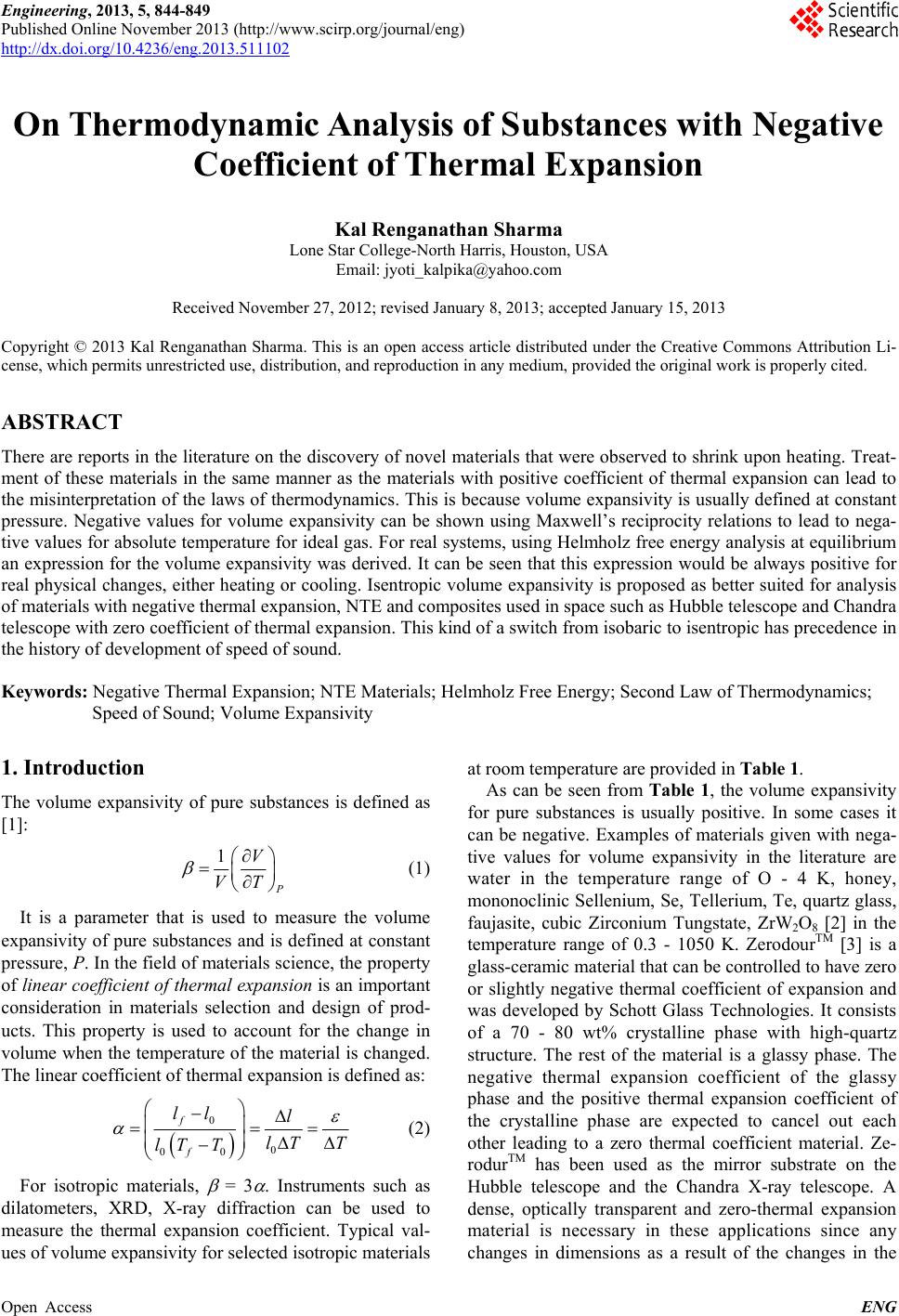 Engineering, 2013, 5, 844-849 Published Online November 2013 (http://www.scirp.org/journal/eng) http://dx.doi.org/10.4236/eng.2013.511102 Open Access ENG On Thermodynamic Analysis of Substances with Negative Coefficient of Thermal Expansion Kal Renganathan Sharma Lone Star College-North Harris, Houston, USA Email: [email protected] Received November 27, 2012; revised January 8, 2013; accepted January 15, 2013 Copyright © 2013 Kal Renganathan Sharma. This is an open access article distributed under the Creative Commons Attribution Li- cense, which permits unrestricted use, distribution, and reproduction in any medium, provided the original work is properly cited. ABSTRACT There are reports in the literature on the discovery of novel materials that were observed to shrink upon heating. Treat- ment of these materials in the same manner as the materials with positive coefficient of thermal expansion can lead to the misinterpretation of the laws of thermodynamics. This is because volume expansivity is usually defined at constant pressure. Negative values for volume expansivity can be shown using Maxwell’s reciprocity relations to lead to nega- tive values for absolute temperature for ideal gas. For real systems, using Helmholz free energy analysis at equilibrium an expression for the volume expansivity was derived. It can be seen that this expression would be always positive for real physical changes, either heating or cooling. Isentropic volume expansivity is proposed as better suited for analysis of materials with negative thermal expansion, NTE and composites used in space such as Hubble telescope and Chandra telescope with zero coefficient of thermal expansion. This kind of a switch from isobaric to isentropic has precedence in the history of development of speed of sound. Keywords: Negative Thermal Expansion; NTE Materials; Helmholz Free Energy; Second Law of Thermodynamics; Speed of Sound; Volume Expansivity 1. Introduction The volume expansivity of pure substances is defined as [1]: 1 P V VT (1) It is a parameter that is used to measure the volume expansivity of pure substances and is defined at constant pressure, P. In the field of materials science, the property of linear coefficient of thermal expansion is an important consideration in materials selection and design of prod- ucts. This property is used to account for the change in volume when the temperature of the material is changed. The linear coefficient of thermal expansion is defined as: 0 0 00 f f ll l lT T lT T (2) For isotropic materials, = 3 . Instruments such as dilatometers, XRD, X-ray diffraction can be used to measure the thermal expansion coefficient. Typical val- ues of volume expansivity for selected isotropic materials at room temperature are provided in Table 1. As can be seen from Table 1, the volume expansivity for pure substances is usually positive. In some cases it can be negative. Examples of materials given with nega- tive values for volume expansivity in the literature are water in the temperature range of O - 4 K, honey, mononoclinic Sellenium, Se, Tellerium, Te, quartz glass, faujasite, cubic Zirconium Tungstate, ZrW2O8 [2] in the temperature range of 0.3 - 1050 K. ZerodourTM [3] is a glass-ceramic material that can be controlled to have zero or slightly negative thermal coefficient of expansion and was developed by Schott Glass Technologies. It consists of a 70 - 80 wt% crystalline phase with high-quartz structure. The rest of the material is a glassy phase. The negative thermal expansion coefficient of the glassy phase and the positive thermal expansion coefficient of the crystalline phase are expected to cancel out each other leading to a zero thermal coefficient material. Ze- rodurTM has been used as the mirror substrate on the Hubble telescope and the Chandra X-ray telescope. A dense, optically transparent and zero-thermal expansion material is necessary in these applications since any changes in dimensions as a result of the changes in the 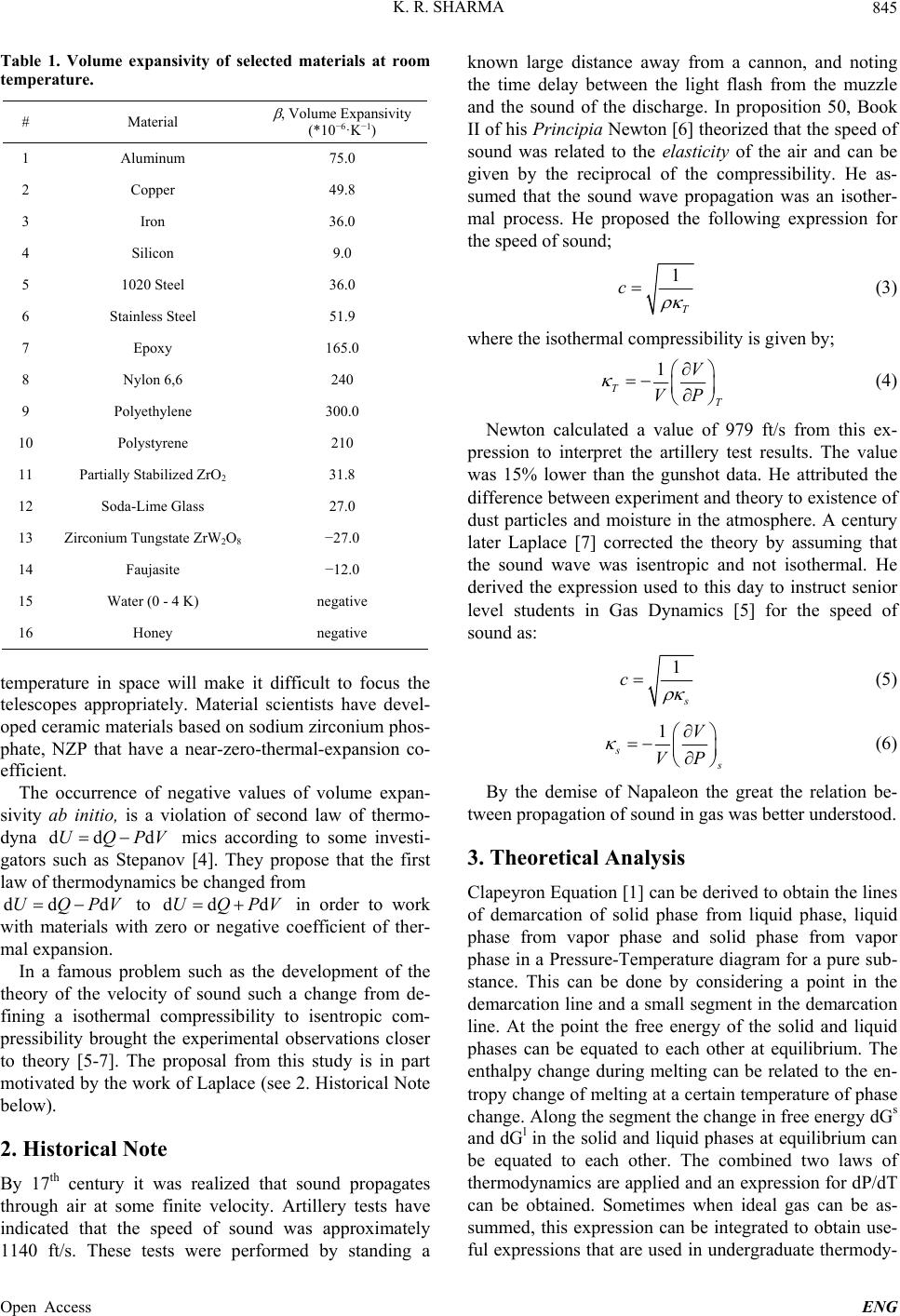 K. R. SHARMA 845 Table 1. Volume expansivity of selected materials at room temperature. # Material , Volume Expansivity (*10−6·K−1) 1 Aluminum 75.0 2 Copper 49.8 3 Iron 36.0 4 Silicon 9.0 5 1020 Steel 36.0 6 Stainless Steel 51.9 7 Epoxy 165.0 8 Nylon 6,6 240 9 Polyethylene 300.0 10 Polystyrene 210 11 Partially Stabilized ZrO2 31.8 12 Soda-Lime Glass 27.0 13 Zirconium Tungstate ZrW2O8 −27.0 14 Faujasite −12.0 15 Water (0 - 4 K) negative 16 Honey negative temperature in space will make it difficult to focus the telescopes appropriately. Material scientists have devel- oped ceramic materials based on sodium zirconium phos- phate, NZP that have a near-zero-thermal-expansion co- efficient. The occurrence of negative values of volume expan- sivity ab initio, is a violation of second law of thermo- dyna mics according to some investi- gators such as Stepanov [4]. They propose that the first law of thermodynamics be changed from to in order to work with materials with zero or negative coefficient of ther- mal expansion. dd dUQPV dd dUQ PV dd dUQPV In a famous problem such as the development of the theory of the velocity of sound such a change from de- fining a isothermal compressibility to isentropic com- pressibility brought the experimental observations closer to theory [5-7]. The proposal from this study is in part motivated by the work of Laplace (see 2. Historical Note below). 2. Historical Note By 17th century it was realized that sound propagates through air at some finite velocity. Artillery tests have indicated that the speed of sound was approximately 1140 ft/s. These tests were performed by standing a known large distance away from a cannon, and noting the time delay between the light flash from the muzzle and the sound of the discharge. In proposition 50, Book II of his Principia Newton [6] theorized that the speed of sound was related to the elasticity of the air and can be given by the reciprocal of the compressibility. He as- sumed that the sound wave propagation was an isother- mal process. He proposed the following expression for the speed of sound; 1 T c (3) where the isothermal compressibility is given by; 1 T T V VP (4) Newton calculated a value of 979 ft/s from this ex- pression to interpret the artillery test results. The value was 15% lower than the gunshot data. He attributed the difference between experiment and theory to existence of dust particles and moisture in the atmosphere. A century later Laplace [7] corrected the theory by assuming that the sound wave was isentropic and not isothermal. He derived the expression used to this day to instruct senior level students in Gas Dynamics [5] for the speed of sound as: 1 s c (5) 1 s s V VP (6) By the demise of Napaleon the great the relation be- tween propagation of sound in gas was better understood. 3. Theoretical Analysis Clapeyron Equation [1] can be derived to obtain the lines of demarcation of solid phase from liquid phase, liquid phase from vapor phase and solid phase from vapor phase in a Pressure-Temperature diagram for a pure sub- stance. This can be done by considering a point in the demarcation line and a small segment in the demarcation line. At the point the free energy of the solid and liquid phases can be equated to each other at equilibrium. The enthalpy change during melting can be related to the en- tropy change of melting at a certain temperature of phase change. Along the segment the change in free energy dGs and dGl in the solid and liquid phases at equilibrium can be equated to each other. The combined two laws of thermodynamics are applied and an expression for dP/dT can be obtained. Sometimes when ideal gas can be as- summed, this expression can be integrated to obtain use- ful expressions that are used in undergraduate thermody- Open Access ENG 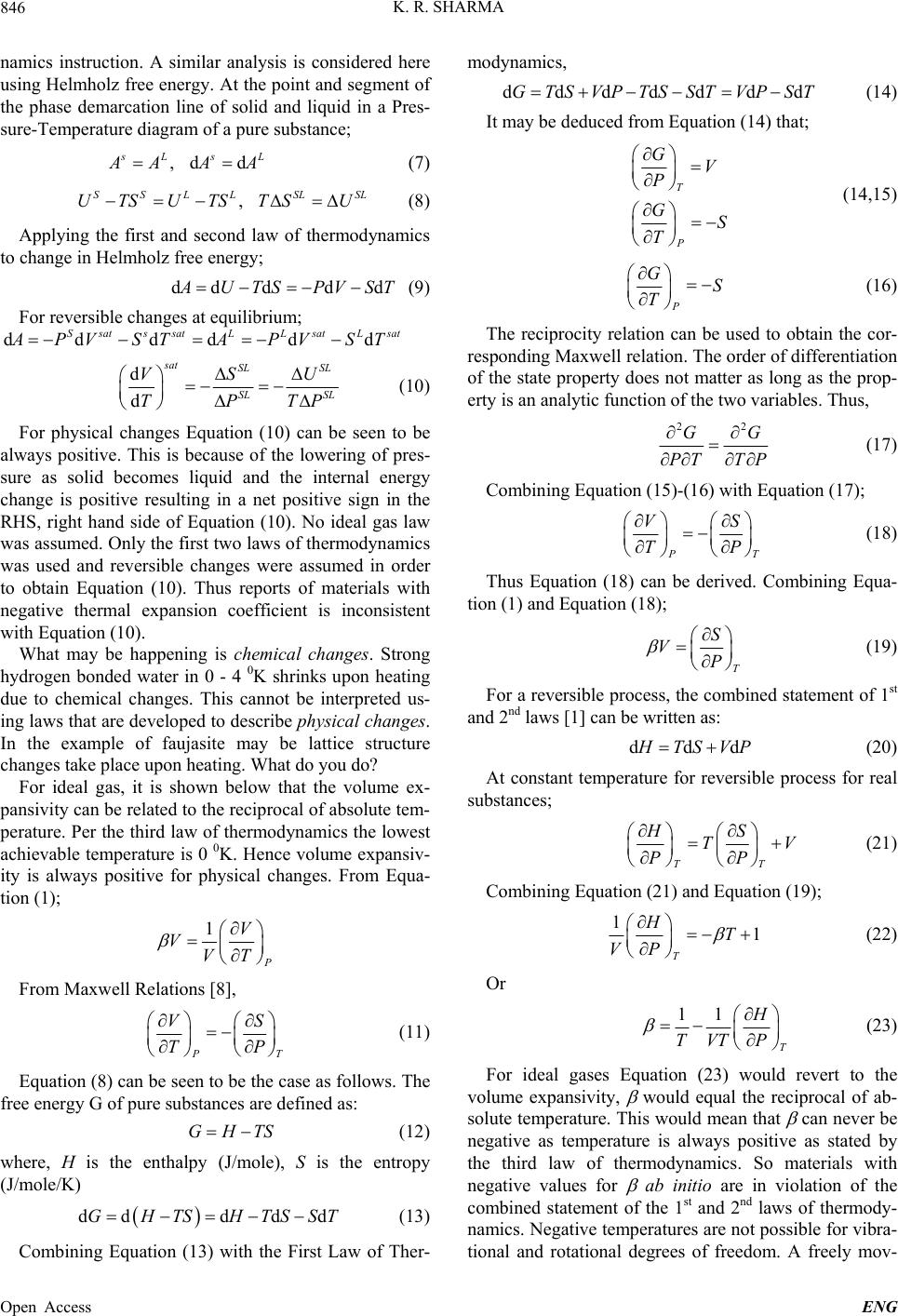 K. R. SHARMA 846 namics instruction. A similar analysis is considered here using Helmholz free energy. At the point and segment of the phase demarcation line of solid and liquid in a Pres- sure-Temperature diagram of a pure substance; ,d d s LsL A AAA (7) , SS LLSLSL UTSUTSTSU (8) Applying the first and second law of thermodynamics to change in Helmholz free energy; dddd d A UTS PVST (9) For reversible changes at equilibrium; dd dddd Ssats satLLsatLsat A PV STAPV ST d d sat SL SL SL SL VSU TPTP (10) For physical changes Equation (10) can be seen to be always positive. This is because of the lowering of pres- sure as solid becomes liquid and the internal energy change is positive resulting in a net positive sign in the RHS, right hand side of Equation (10). No ideal gas law was assumed. Only the first two laws of thermodynamics was used and reversible changes were assumed in order to obtain Equation (10). Thus reports of materials with negative thermal expansion coefficient is inconsistent with Equation (10). What may be happening is chemical changes. Strong hydrogen bonded water in 0 - 4 0K shrinks upon heating due to chemical changes. This cannot be interpreted us- ing laws that are developed to describe physical changes. In the example of faujasite may be lattice structure changes take place upon heating. What do you do? For ideal gas, it is shown below that the volume ex- pansivity can be related to the reciprocal of absolute tem- perature. Per the third law of thermodynamics the lowest achievable temperature is 0 0K. Hence volume expansiv- ity is always positive for physical changes. From Equa- tion (1); 1 P V VVT From Maxwell Relations [8], P T V TP S T (11) Equation (8) can be seen to be the case as follows. The free energy G of pure substances are defined as: GHTS (12) where, H is the enthalpy (J/mole), S is the entropy (J/mole/K) dddd dGHTSHTSS (13) Combining Equation (13) with the First Law of Ther- modynamics, dddddddGTSVPTSSTVPST (14) It may be deduced from Equation (14) that; T P GV P GS T (14,15) P GS T (16) The reciprocity relation can be used to obtain the cor- responding Maxwell relation. The order of differentiation of the state property does not matter as long as the prop- erty is an analytic function of the two variables. Thus, 22 G PT TP G (17) Combining Equation (15)-(16) with Equation (17); P T V TP S (18) Thus Equation (18) can be derived. Combining Equa- tion (1) and Equation (18); T S VP (19) For a reversible process, the combined statement of 1st and 2nd laws [1] can be written as: ddd H TS VP (20) At constant temperature for reversible process for real substances; TT HS T PP V (21) Combining Equation (21) and Equation (19); 11 T HT VP (22) Or 11 T H TVT P (23) For ideal gases Equation (23) would revert to the volume expansivity, would equal the reciprocal of ab- solute temperature. This would mean that can never be negative as temperature is always positive as stated by the third law of thermodynamics. So materials with negative values for ab initio are in violation of the combined statement of the 1st and 2nd laws of thermody- namics. Negative temperatures are not possible for vibra- tional and rotational degrees of freedom. A freely mov- Open Access ENG 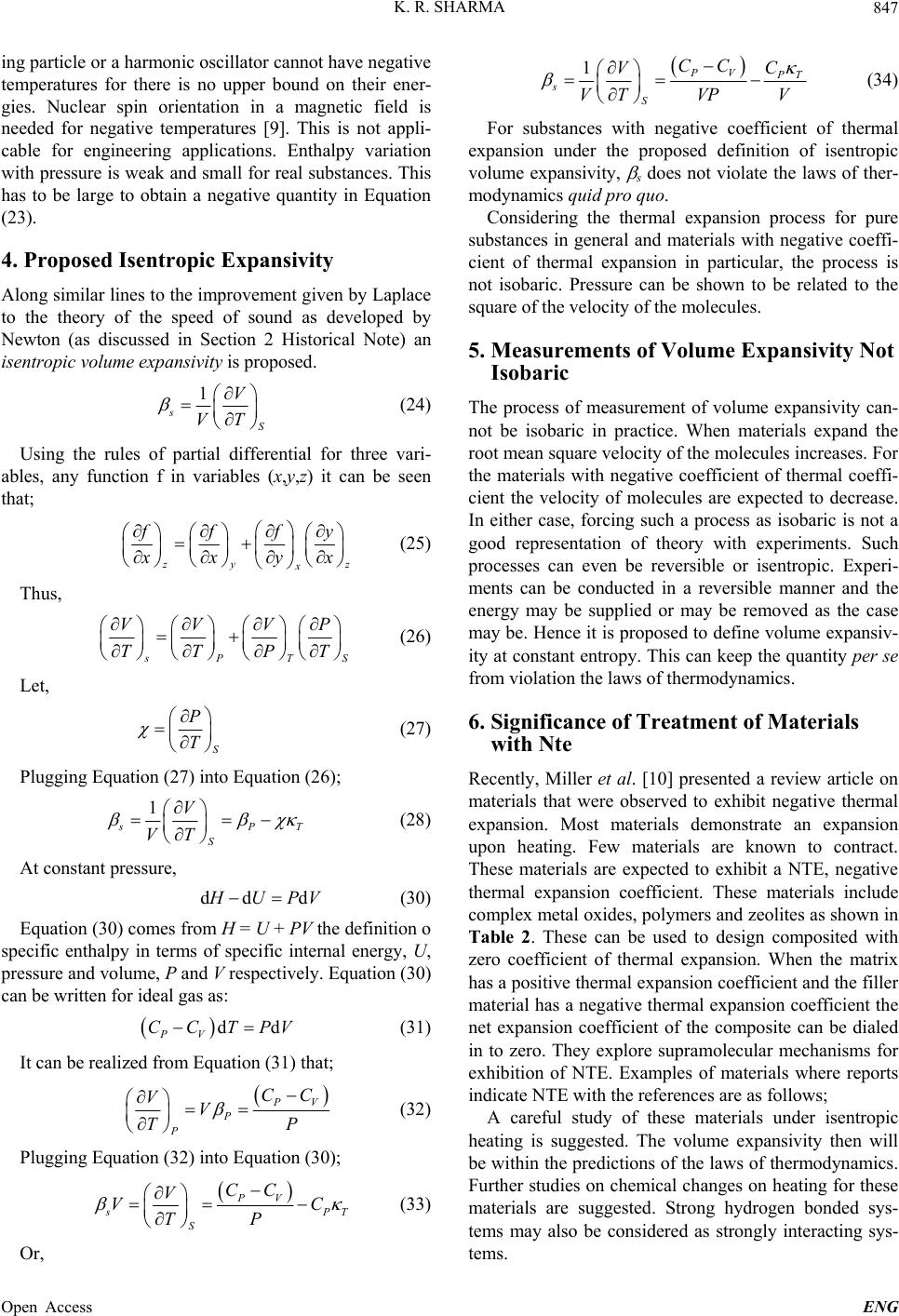 K. R. SHARMA 847 ing particle or a harmonic oscillator cannot have negative temperatures for there is no upper bound on their ener- gies. Nuclear spin orientation in a magnetic field is needed for negative temperatures [9]. This is not appli- cable for engineering applications. Enthalpy variation with pressure is weak and small for real substances. This has to be large to obtain a negative quantity in Equation (23). 4. Proposed Isentropic Expansivity Along similar lines to the improvement given by Laplace to the theory of the speed of sound as developed by Newton (as discussed in Section 2 Historical Note) an isentropic volume expansivity is proposed. 1 s S V VT (24) Using the rules of partial differential for three vari- ables, any function f in variables (x,y,z) it can be seen that; z yz x f ffy x xyx (25) Thus, s PT VVVP TT PT S (26) Let, S P T (27) Plugging Equation (27) into Equation (26); 1 s P S V VT T (28) At constant pressure, dd d H UPV (30) Equation (30) comes from H = U + PV the definition o specific enthalpy in terms of specific internal energy, U, pressure and volume, P and V respectively. Equation (30) can be written for ideal gas as: dd PV CC TPV (31) It can be realized from Equation (31) that; PV P P CC VV TP (32) Plugging Equation (32) into Equation (30); PV s PT S CC V V TP C (33) Or, 1PV P T s S CC C V VTVP V (34) For substances with negative coefficient of thermal expansion under the proposed definition of isentropic volume expansivity, s does not violate the laws of ther- modynamics quid pro quo. Considering the thermal expansion process for pure substances in general and materials with negative coeffi- cient of thermal expansion in particular, the process is not isobaric. Pressure can be shown to be related to the square of the velocity of the molecules. 5. Measurements of Volume Expansivity Not Isobaric The process of measurement of volume expansivity can- not be isobaric in practice. When materials expand the root mean square velocity of the molecules increases. For the materials with negative coefficient of thermal coeffi- cient the velocity of molecules are expected to decrease. In either case, forcing such a process as isobaric is not a good representation of theory with experiments. Such processes can even be reversible or isentropic. Experi- ments can be conducted in a reversible manner and the energy may be supplied or may be removed as the case may be. Hence it is proposed to define volume expansiv- ity at constant entropy. This can keep the quantity per se from violation the laws of thermodynamics. 6. Significance of Treatment of Materials with Nte Recently, Miller et al. [10] presented a review article on materials that were observed to exhibit negative thermal expansion. Most materials demonstrate an expansion upon heating. Few materials are known to contract. These materials are expected to exhibit a NTE, negative thermal expansion coefficient. These materials include complex metal oxides, polymers and zeolites as shown in Table 2. These can be used to design composited with zero coefficient of thermal expansion. When the matrix has a positive thermal expansion coefficient and the filler material has a negative thermal expansion coefficient the net expansion coefficient of the composite can be dialed in to zero. They explore supramolecular mechanisms for exhibition of NTE. Examples of materials where reports indicate NTE with the references are as follows; A careful study of these materials under isentropic heating is suggested. The volume expansivity then will be within the predictions of the laws of thermodynamics. Further studies on chemical changes on heating for these materials are suggested. Strong hydrogen bonded sys- tems may also be considered as strongly interacting sys- tems. Open Access ENG 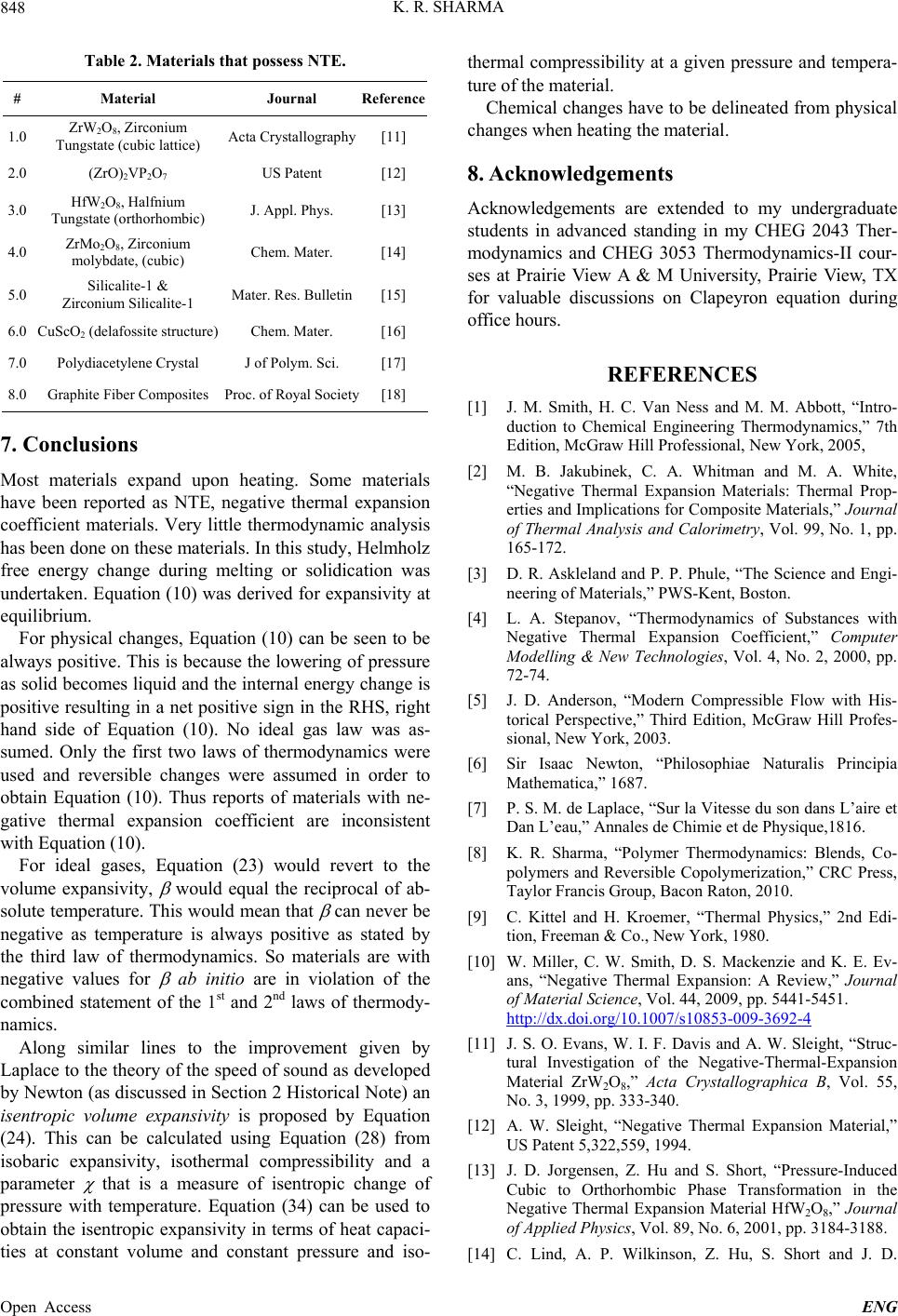 K. R. SHARMA 848 Table 2. Materials that possess NTE. # Material Journal Reference 1.0 ZrW2O8, Zirconium Tungstate (cubic lattice) Acta Crystallography[11] 2.0 (ZrO)2VP2O7 US Patent [12] 3.0 HfW2O8, Halfnium Tungstate (orthorhombic) J. Appl. Phys. [13] 4.0 ZrMo2O8, Zirconium molybdate, (cubic) Chem. Mater. [14] 5.0 Silicalite-1 & Zirconium Silicalite-1 Mater. Res. Bulletin[15] 6.0 CuScO2 (delafossite structure) Chem. Mater. [16] 7.0 Polydiacetylene Crystal J of Polym. Sci. [17] 8.0 Graphite Fiber Composites Proc. of Royal Society[18] 7. Conclusions Most materials expand upon heating. Some materials have been reported as NTE, negative thermal expansion coefficient materials. Very little thermodynamic analysis has been done on these materials. In this study, Helmholz free energy change during melting or solidication was undertaken. Equation (10) was derived for expansivity at equilibrium. For physical changes, Equation (10) can be seen to be always positive. This is because the lowering of pressure as solid becomes liquid and the internal energy change is positive resulting in a net positive sign in the RHS, right hand side of Equation (10). No ideal gas law was as- sumed. Only the first two laws of thermodynamics were used and reversible changes were assumed in order to obtain Equation (10). Thus reports of materials with ne- gative thermal expansion coefficient are inconsistent with Equation (10). For ideal gases, Equation (23) would revert to the volume expansivity, would equal the reciprocal of ab- solute temperature. This would mean that can never be negative as temperature is always positive as stated by the third law of thermodynamics. So materials are with negative values for ab initio are in violation of the combined statement of the 1st and 2nd laws of thermody- namics. Along similar lines to the improvement given by Laplace to the theory of the speed of sound as developed by Newton (as discussed in Section 2 Historical Note) an isentropic volume expansivity is proposed by Equation (24). This can be calculated using Equation (28) from isobaric expansivity, isothermal compressibility and a parameter that is a measure of isentropic change of pressure with temperature. Equation (34) can be used to obtain the isentropic expansivity in terms of heat capaci- ties at constant volume and constant pressure and iso- thermal compressibility at a given pressure and tempera- ture of the material. Chemical changes have to be delineated from physical changes when heating the material. 8. Acknowledgements Acknowledgements are extended to my undergraduate students in advanced standing in my CHEG 2043 Ther- modynamics and CHEG 3053 Thermodynamics-II cour- ses at Prairie View A & M University, Prairie View, TX for valuable discussions on Clapeyron equation during office hours. REFERENCES [1] J. M. Smith, H. C. Van Ness and M. M. Abbott, “Intro- duction to Chemical Engineering Thermodynamics,” 7th Edition, McGraw Hill Professional, New York, 2005, [2] M. B. Jakubinek, C. A. Whitman and M. A. White, “Negative Thermal Expansion Materials: Thermal Prop- erties and Implications for Composite Materials,” Journal of Thermal Analysis and Calorimetry, Vol. 99, No. 1, pp. 165-172. [3] D. R. Askleland and P. P. Phule, “The Science and Engi- neering of Materials,” PWS-Kent, Boston. [4] L. A. Stepanov, “Thermodynamics of Substances with Negative Thermal Expansion Coefficient,” Computer Modelling & New Technologies, Vol. 4, No. 2, 2000, pp. 72-74. [5] J. D. Anderson, “Modern Compressible Flow with His- torical Perspective,” Third Edition, McGraw Hill Profes- sional, New York, 2003. [6] Sir Isaac Newton, “Philosophiae Naturalis Principia Mathematica,” 1687. [7] P. S. M. de Laplace, “Sur la Vitesse du son dans L’aire et Dan L’eau,” Annales de Chimie et de Physique,1816. [8] K. R. Sharma, “Polymer Thermodynamics: Blends, Co- polymers and Reversible Copolymerization,” CRC Press, Taylor Francis Group, Bacon Raton, 2010. [9] C. Kittel and H. Kroemer, “Thermal Physics,” 2nd Edi- tion, Freeman & Co., New York, 1980. [10] W. Miller, C. W. Smith, D. S. Mackenzie and K. E. Ev- ans, “Negative Thermal Expansion: A Review,” Journal of Material Science, Vol. 44, 2009, pp. 5441-5451. http://dx.doi.org/10.1007/s10853-009-3692-4 [11] J. S. O. Evans, W. I. F. Davis and A. W. Sleight, “Struc- tural Investigation of the Negative-Thermal-Expansion Material ZrW2O8,” Acta Crystallographica B, Vol. 55, No. 3, 1999, pp. 333-340. [12] A. W. Sleight, “Negative Thermal Expansion Material,” US Patent 5,322,559, 1994. [13] J. D. Jorgensen, Z. Hu and S. Short, “Pressure-Induced Cubic to Orthorhombic Phase Transformation in the Negative Thermal Expansion Material HfW2O8,” Journal of Applied Physics, Vol. 89, No. 6, 2001, pp. 3184-3188. [14] C. Lind, A. P. Wilkinson, Z. Hu, S. Short and J. D. Open Access ENG  K. R. SHARMA Open Access ENG 849 Jorgensen, “Synthesis and Properties of the Negative Thernal Expansion Material Cubic ZrMo2O8,” Chemistry of Materials, Vol. 10, No. 9, 1998, pp. 2335-2337. http://dx.doi.org/10.1021/cm980438m [15] D. S. Bhange and Veda, “Negative Thermal Expansion in Silicalite-1 and Zirconium Silicalite-1 having MFI Struc- ture,” Materials Research Bulletin, Vol. 41, No. 7, pp. 1392-1402. http://dx.doi.org/10.1016/j.materresbull.2005.12.002 [16] J. Li, A. Yokochi, T. G. Amos and A. W. Sleight, “Strong Negative Thermal Expansion along the O-Cu-O Linkage in CuScO2”, Chemistry of Materials, Vol. 14, No. 6, 2002, pp. 2602-2606. http://dx.doi.org/10.1021/cm011633v [17] R. H. Baughman and E. A. Turi, “Negative Thermal Ex- pansion of a Polydiacetyelene Single Crystal”, Journal of Polymer Science Part B: Polymer Physics, Vol. 11, 1973, pp. 2453-2466. [18] P. Rupnowski, M. Gentz, J. K. Sutter and A. M. Kumosa, “An Evaluation of Elastic Properties and Coefficients of Thermal Expansion of Graphite Fibers from Macro- scopicc Composite Input Data,” Proceedings of Royal Society A, Vol. 461, 2005, pp. 347-369. Nomenclature A Helmholz free energy (J/mole) c Speed of Sound (m/s) CP Heat Capacity at Constant Pressure (J/kg/K) Cv Heat Capacity at Constant Volume (J/Kg/K) G Gibbs Free Energy (J/mole) H Specific Enthalpy (J/mole) l length of the box (m) m mass of molecule (kg) P Pressure (Nm−2) S Specific Entropy (J/mole/K) T Temperature (K) U Internal Energy (J/mole) v velocity of molecule (m/s) V Molar Volume (m3/mole) Greek α Linear coefficient of thermal expansion (K−1) P Isobaric Volume Expansivity (K−1) s Isentropic Volume Expansivity (K−1) ε Elongational Strain T Isothermal Compressibility (ms2/mole) s Isentropic Compressibility (ms2/mole) molar density (mole/m3) Subscripts 0 Intial state f Final state T isothermal P isobaric S isentropic |