

Paper Menu >>
Journal Menu >>
 Journal of Behavioral and Brain Science, 2011, 1, 1-5 doi:10.4236/jbbs.2011.11001 Published Online February 2011 (http://www.SciRP.org/journal/jbbs) Copyright © 2011 SciRes. JBBS Effect of Ethanol Deprivation and Re-Exposure on the Ethanol Drinking Behaviour of the High-Alcohol-Drinker (UChB) Rats Lutske Tampier, Maria Elena Quintanilla Molecular and Clinical Pharmacology Program, Institute of Biomedical Sciences, Faculty of Medicine, University of Chile, Santiago, Chile E-mail: [email protected] Received January 4, 2011; revised February 20, 2011; accepted February 22 , 20 11 Abstract Alcohol addiction constitutes a major health problem in the general population, it is a complex pathology characterized by the development of tolerance, physical dependence and compulsive ethanol-seeking behav- iour that often manifests as a chronic relapsing syndrome. 0ne of the major concerns in the treatment of al- cohol-dependent patients is the prevention of relapse during periods of abstinence. The alcohol deprivation effect (ADE) is defined as a temporary increase in the voluntary intake of ethanol when it is reinstated after a period of alcohol deprivation and has been used as an animal model of relapse-like drinking. ADE can be used to evaluate the efficacy of possible pharmacological agents to prevent relapse drinking. The current study was undertaken to examine whether the high-alcohol-drinker UChB rats would display an ADE. Rats were given either continuous or periodic concurrent access to 10%, 20% (vol/vol) of ethanol across depriva- tion cycles. UChB rats consuming ethanol voluntarily for two months, exhibit a robust ADE after a single deprivation period of two weeks. The increased alcohol intake during the early days of re-exposure, follow- ing a withdrawal phase, is attributed to a shift in preference towards the higher concentration of ethanol that might reflect an increase in craving for alcohol. Since an ADE is also observed in UChB rats, make this line of rats selectively bred for their high voluntary ethanol consumption, a useful model for study the efficacy of pharmacological agents for the treatment of relapse of alcohol consumption. Keywords: Alcohol Intake, Alcohol Deprivation, Alcohol Drinking Rats, UChB Rats 1. Introduction Addiction can be best defined as the loss of control over drug use. I t is caused by the action of a drug of abuse and generally requires repeated drug exposure. One of the drugs more abused is alcohol. Alcohol addiction (Alco- holism) constitutes a major health problem in th e general population, it is a complex pathology characterized by the development of tolerance, physical dependence and compulsive ethanol-seeking behaviour that often mani- fests as a chronic relapsing syndrome. As a matter of fact, one of the major concerns in the treatment of alco- hol-depe ndent patients is the pre vention of rela pse during periods of abstinence. According to Spanagel and Hölter (1999) [1], alcohol drinking over a long period of time can be separated into three stages. First, the initiation or acquisition of alcohol drinking, followed by a second stage of controlled alco- hol-drinking behaviour and eventually a third stage where uncontrolled alcohol-drinking behaviour occurs, leading to the development of dependence, which has been characterized as an progressive dysregulation of brain reward and stress circuits [2,3]. Although these various stages of alcohol drinking occur in humans, it is not clear whether those transitions in alcohol drinking from one stage to another can also be observed in all animals with a high preference an d a high daily intake of alcohol Various approaches have been used to evaluate the occurrence of addictive behaviour in laboratory ani- mals; most of them based on changes in the amount of alcohol intake following a period of abstinence and a shift of preference towards higher concentration of etha- nol solutions [1]. The alcohol deprivation effect (ADE) has been proposed as a model of “loss of control” and 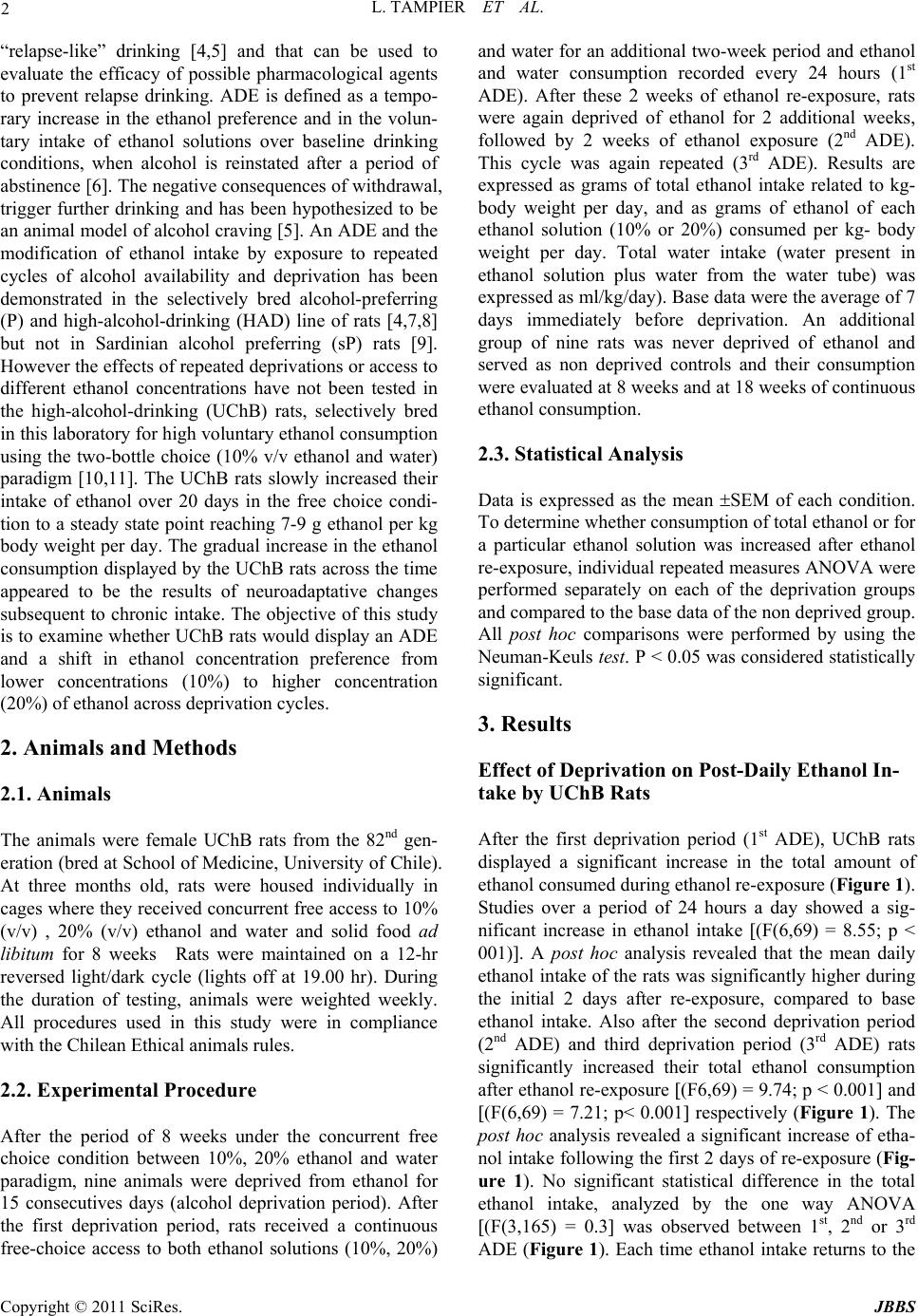 2 L. TAMPIER ET AL. “relapse-like” drinking [4,5] and that can be used to evaluate the efficacy of possible pharmacological agents to prevent relapse drinking. ADE is defined as a tempo- rary increase in the ethanol preference and in the volun- tary intake of ethanol solutions over baseline drinking conditions, when alcohol is reinstated after a period of abstinence [6]. The negative consequences of withdrawal, trigger further drinking and has been hypothesized to be an animal model of alcohol craving [5]. An ADE and the modification of ethanol intake by exposure to repeated cycles of alcohol availability and deprivation has been demonstrated in the selectively bred alcohol-preferring (P) and high-alcohol-drinking (HAD) line of rats [4,7,8] but not in Sardinian alcohol preferring (sP) rats [9]. However the effects of repeated deprivations or access to different ethanol concentrations have not been tested in the high-alcohol-drinking (UChB) rats, selectively bred in this laboratory for high volun tary ethano l consumption using the two-bottle choice (10% v/v ethanol and water) paradigm [10,11]. The UChB rats slowly increased their intake of ethanol over 20 days in the free choice condi- tion to a steady state point reaching 7-9 g ethanol per kg body weight per day. The gradual increase in the ethanol consumption displayed by the UChB rats across the time appeared to be the results of neuroadaptative changes subsequent to chronic intake. The objective of this study is to examine whether UChB rats would display an ADE and a shift in ethanol concentration preference from lower concentrations (10%) to higher concentration (20%) of ethanol across deprivation cycles. 2. Animals and Methods 2.1. Animals The animals were female UChB rats from the 82nd gen- eration (bred at Schoo l of Medicine, University of Chile). At three months old, rats were housed individually in cages where they received concurrent free access to 10% (v/v) , 20% (v/v) ethanol and water and solid food ad libitum for 8 weeks Rats were maintained on a 12-hr reversed light/dark cycle (lights off at 19.00 hr). During the duration of testing, animals were weighted weekly. All procedures used in this study were in compliance with the Chilean Ethical animals rules. 2.2. Experimental Procedure After the period of 8 weeks under the concurrent free choice condition between 10%, 20% ethanol and water paradigm, nine animals were deprived from ethanol for 15 consecutives days (alcohol deprivation period). After the first deprivation period, rats received a continuous free-choice access to both ethanol solutions (10%, 20%) and water for an additional two-week period and ethanol and water consumption recorded every 24 hours (1st ADE). After these 2 weeks of ethanol re-exposure, rats were again deprived of ethanol for 2 additional weeks, followed by 2 weeks of ethanol exposure (2nd ADE). This cycle was again repeated (3rd ADE). Results are expressed as grams of total ethanol intake related to kg- body weight per day, and as grams of ethanol of each ethanol solution (10% or 20%) consumed per kg- body weight per day. Total water intake (water present in ethanol solution plus water from the water tube) was expressed as ml/kg/day). Base data were the average of 7 days immediately before deprivation. An additional group of nine rats was never deprived of ethanol and served as non deprived controls and their consumption were evaluated at 8 weeks and at 18 weeks of continuous ethanol consumption. 2.3. Statistical Analysis Data is expressed as the mean SEM of each condition. To determine whether consumption of total ethanol or for a particular ethanol solution was increased after ethanol re-exposure, individual repeated measures ANOVA were performed separately on each of the deprivation groups and compared to the base data of the non deprived group. All post hoc comparisons were performed by using the Neuman-Keuls test. P < 0.05 was considered statistically significant. 3. Results Effect of Deprivation on Post-Daily Ethanol In- take by UChB Rats After the first deprivation period (1st ADE), UChB rats displayed a significant increase in the total amount of ethanol consumed during ethanol re-exposure (Figure 1). Studies over a period of 24 hours a day showed a sig- nificant increase in ethanol intake (F(6,69) = 8.55; p < 001). A post hoc analysis revealed that the mean daily ethanol intake of the rats was significantly higher during the initial 2 days after re-exposure, compared to base ethanol intake. Also after the second deprivation period (2nd ADE) and third deprivation period (3rd ADE) rats significantly increased their total ethanol consumption after ethanol re-exposure (F6,69) = 9.74; p < 0.001 and (F(6,69) = 7.21; p< 0.001 respectively (Figure 1). The post hoc analysis revealed a significant increase of etha- nol intake following the first 2 days of re-exposure (Fig- ure 1). No significant statistical difference in the total ethanol intake, analyzed by the one way ANOVA (F(3,165) = 0.3 was observed between 1st, 2nd or 3rd ADE (Figure 1). Each time ethanol intake returns to the Copyright © 2011 SciRes. JBBS  L. TAMPIER ET AL. 3 baseline around 7 .5 g/kg/day. Total water intake (su m of water from ethanol solution plus water from the water tube) about 100 to 120 ml/kg body weight/day, remains stable during the entire experimental period. The patterns of the two ethanol solutions, consumed dur- ing 24 hours of consumption are depicted in Figure 2. The intake of 20% ethanol increased after the ethanol re-exposure (F(6, 69) = 3.62; p < 0.005). The post hoc analysis revealed that the amount of 20% ethanol solu- tion increased during the initial 2 days of ethanol re-ex- posure. Whereas, the amount of the 10% ethanol solution did not show a significant difference (F6,69) = 2.8; n.s. The preference for the 10% ethanol solution remains stable. The increase in ethanol consumption after the 2nd ADE and 3rd ADE was also due to a shift in the prefer- ence for the more concentrated 20% ethanol solution (F6,69) = 6.94; p < 0.001 and (F6,69) = 4.64; p < 0.001) respectively. The post hoc analysis revealed that the intake of the 20% ethanol solution is significantly higher during the first two days of ethanol re-exposure (Figure 2). Rats show a preference for the more concen- trated ethanol solution. Overall there was a significant increase in ethanol intake and an effect of ethanol con- centrations. The total ethanol consumption and the relative intakes of the 10 and 20% ethanol solutions and water, in the non deprived UChB rats, under a 24-hr free-choice con- ditions appears in Table 1 . Each value is the mean of th e last seven consecutive days of the period of 8-weeks of *Significantly higher than base data. Figure 1. The mean (SEM) total amount of ethanol con- sumed (g/kg/day) by UChB rats under 24-hr free-choice condition, deprived of ethanol for 2 weeks and then sub- jected to one to three cycles of 2 weeks of ethanol drinking and 2 weeks of deprivation (1st, 2nd and 3rd ADE). *Significantly higher than the base data of the 20% ethanol solution. Figure 2. The mean (SEM) of ethanol 10% and 20% con- sumed (g/kg/day) by UChB rats under 24-hr free-choice condition, deprived of ethanol for 2 weeks and then sub- jected to one to three cycles of 2 weeks of ethanol drinking and 2 weeks of deprivation (1st, 2nd and 3rd ADE) Table 1. Ethanol, water and total water intake in non de- prived UChB controls rats at two periods of continuous access to a 10%, 20% v/v ethanol solution and water. After 8 weeks 18 weeks Ethanol intake g/kg/day g/kg/day Total ethanol 7.35 0.44 7.80 0.5 10% ethanol 6.36 0.42 6.00 0.31 20% ethanol 0.99 0.19 1.36 0.50 Water intake ml/kg/day ml/kg/day Water 25 5 20 8 Total water intake118.1 6.7 116.6 7.8 ethanol free choice consumption and the last seven con- secutive days after a period of 18 weeks of continuous ethanol consumption. The non deprived group that was allowed to have 24-hr continuous access to ethanol during all the 18 weeks of the experiments never approached intakes as seen after Copyright © 2011 SciRes. JBBS  4 L. TAMPIER ET AL. each deprivation. Also, the base ethanol intake (g/kg/ day), the average of the 7 days immediately before dep- rivation did not change as a result of the deprivation pe- riods. Data analyzed by one-way ANOVA indicate no significant difference in the total ethanol intake (F2,29) = 0.02; ns; 10% ethanol intake (F2,29)=0.27; ns and 20% ethanol intake (F2,29) = 0.19; ns between base data. 4. Discussion UChB rats consuming ethanol voluntarily for two months, exhibit a robust ADE after a single deprivation period of two weeks. The increased alcohol intake during the early days of re-exposure, following a withdrawal phase, is attributed to a shift in preference towards the higher concentration of ethanol that might reflect an in- crease in craving for alcohol, which returns to baseline after a period of two day s . Examining the effects of the second or third depriva- tion on ethanol intake, during the initial 24-hr period after the reinstatement of ethanol, the second and third deprivation cycle did not enhance the amount of ethanol intake above that was attained with the first deprivation. This could be the result of a ceiling effect (i.e. rats are drinking as much as possible under the experimental conditions). Repeated ADE evoked a drinking pattern in UChB rats very similar to that ob serv ed in P rats [8]. The increase in the amount of ethanol consumed was not the result of an indiscriminating polydipsia generated by the period of abstinence. The total fluid intake by rats (sum of water from ethanol solution plus water from the water tube) was not altered during all the period of the study. The effects observed after a single deprivation or re- peated deprivations were not observed in the non de- prived control group, suggesting that chronic exposure to ethanol alone is not sufficient to produce such a marked increase in ethanol intake or a shift in preference for higher concentrations of ethanol. Uncontrolled alcohol drinking behavior can be as- sessed after prolonged drug self-administration in some individuals, and similar to those humans, some rats se- lectively bred for their high voluntary ethanol consump- tion can also develop addiction-like behaviours, sug- gesting that specific genetic factors are involved in the transition between high ethanol intake and development of an alcohol deprivation effect [12,13]. Therefore, the results suggest that neurobiological alterations may be occurring during time and these alterations result in a marked increased of ethanol consumption and to the de- velopment of uncontrolled alcohol-drinking behavior. Another approach to evaluate the occurrence and the degree of addiction in laboratory animals are based on changes in alcohol intake by making drug seeking con- sistently resistant to interfering factors like concurrent choice of preferred flavours such as saccharin or sucrose [14]. This condition can also been ob served in UChB rats. The placement of a third bottle containing a highly pal- atable 0.2% saccharin solution, decreased the ethanol intake in UChB rats that were exposed for a period of 7 days to a 10% ethanol and water under free choice con- dition, but not in UChB rats exposed to the 10% ethanol solution for a period of 60 days [15]. Moreover, it is known that addicts lost the ability to stop drinking and continue seeking drugs in spite of adverse environmental conditions. As a matter of fact, it has been previously observed that under chronic ethanol intake UChB rats leads to marked tolerance to the aversive effects of disul- firam and cyanamide on ethanol intake despite the pres- ence of consistently high levels of blood acetaldehyde [16]. These results are in accord also to the notion that UChB rats develop uncontrolled alcohol-drinking be- haviour, because of its resistance to the aversive effects produced by an increase in blood acetaldehyde levels. There are several independent lines of evidence for genetic contributions to vulnerability to alcoholism [17]. Genetics is just beginning to illuminate the variations among individuals in their response to alcohol and one question is what are the changes in the brain that underlie the transition from contro lled to uncontro lled alcohol use. According to Nestler [18,19], repeated exposure to a drug of abuse alters the amounts, and even the types of genes expressed in specific brain regions resulting in alterations in molecular and cellular mechanisms that underlie long-term associative memories in several fore- brain circuits. Whereas some alcoholics can cease drink- ing, others cannot. Despite multiple episodes of treat- ment, and despite risk of significant life problems, re- lapses to alcohol drinking is very frequent. As a matter of fact, the alcohol deprivation effect (ADE) has been pro- posed as an animal model of “loss of control” and “re- lapse-like” drinking [4,5]. Since an alcohol deprivation effect (ADE) is also observed in UChB rats make this line of rats selectively bred for their high voluntary ethanol consumption, a useful model for study the effi- cacy of pharmacological agents for the treatment of re- lapse of ethanol consumption. 5. Conclusions Relapse to alcohol use after prolonged withdrawal peri- ods is the major problem in the treatment of alcohol de- pendence in humans. However, there are relatively few studies concentrated on elucidation of the neurochemical events underlying relapse to alcohol. The ADE is a use- ful model for studying alcohol relapse in both rats and Copyright © 2011 SciRes. JBBS  L. TAMPIER ET AL. Copyright © 2011 SciRes. JBBS 5 mice. Genetics, stress, and environmental cues are all important factors that influence relapse. Long-term al- terations in neuronal activity within the glutamatergic and dopaminergic/serotoninergic systems, appears to underlie alcohol relapse. 6. Acknowledgements We thank Mr. Juan Santibáñez for the expert care of the animals. 7. References [1] R. Spanagel and S. M. Hölter, “Long-term Alcohol Self-administration with Repeated Alcohol Deprivation Phases: An Animal Model of Alcoholism?” Alcohol and Alcoholism, Vol. 34, No. 2, 1999, pp. 231-243. doi:10.1093/alcalc/34.2.231 [2] G. F. Koob and M. Le Moal, “Drug Addiction, Dysregu- lation of Reward, and Allostasis,” Neuropsychopharma- cology, Vol. 24, No. 2, 2001, pp. 97-129. doi:10.1016/S0893-133X(00)00195-0 [3] G. F. Koob, “Alcoholism: Allostasis and Beyond,” Alco- holism: Clinical and Experimental Research, Vol. 27, No. 2, 2003, pp. 232-243. doi:10.1097/01.ALC.0000057122.36127.C2 [4] R. L. Bell, Z. A. Rodd, J. A. Schultz, C. L. Peper, L. Lu- meng, J. M. Murphy and W. J. McBride, “Effects of Short Deprivation and Re-exposure Intervals on the Etha- nol Drinking Behavior of Selectively Bred High Alco- hol-consuming Rats,” Alcohol, Vol. 42, No. 5, 2008, pp. 407-416. doi:10.1016/j.alcohol.2008.03.130 [5] J. D. Sinclair and T. K. Li, “Long and Short Alcohol Deprivation: Effects on AA and P Alcohol-preferring Rats,” Alcohol, Vol. 6, No. 6, 1989, pp. 505-509. doi:10.1016/0741-8329(89)90059-1 [6] J. D. Sinclair and R. J. Senter, “Increased Preference for Ethanol in Rats Following Deprivation,” Psychonomic Science, Vol. 8, 1967, pp. 11-12. [7] Z. A. Rodd-Henricks, D. L. McKinzie, S. A. Shaikh, J. M. Murphy, W. J. McBride, L. Lumeng and T. K. Li, “Al- cohol Deprivation Effect is Prolonged in the Alcohol Pre- ferring (P) Rat after Repeated Deprivations,” Alcoholism: Clinical and Experimental Research, Vol. 24, No. 1, 2000, pp. 8-16. doi:10.1111/j.1530-0277.2000.tb04546.x [8] Z. A. Rodd-Henricks, R. L. Bell, K. A. Kuc, J. M. Mur- phy, W. J. McBride, L. Lumeng and T. K. Li, “Effects of Concurrent Access to Multiple Ethanol Concentrations and Repeated Deprivations on Ethanol Intake of Alco- hol-preferring Rats,” Alcoholism: Clinical and Experi- mental Research, Vol. 25, No. 8, 2001, pp. 1140-1150. doi:10.1111/j.1530-0277.2001.tb02328.x [9] S. Serra, G. Brunetti, G. Vacca, C. Lobina, M. Carai, G. L. Gessa and G. C. Colombo, “Stable Preference for High Ethanol Concentrations Alter Alcohol Deprivation in Sar- dinian Alcohol-preferring (sP) Rats,” Alcohol, Vol. 29, No. 2, 2003, pp. 101-108. doi:10.1016/S0741-8329(03)00003-X [10] J. Mardones and N. Segovia-Riquelme, “Thirty-two Years of Selection of Rats by Ethanol Preference: UChA and UChB Strains,” Neurobehavioral Toxicology and Teratology, Vol. 5, 1984, pp. 171-178. [11] M. E. Quintanilla, Y. Israel, A. Sapag and L. Tampier, “The UChA and UChB Rat Lines: Metabolic and Genetic Differences Influencing Ethanol Intake,” Addiction Biol- ogy, Vol. 11, No. 3-4, 2006, pp. 310-323. doi:10.1111/j.1369-1600.2006.00030.x [12] J. C. Crabbe, “Genetic Contributions to Addiction,” An- nual Review of Psychology, Vol. 53, 2002, pp. 435-462. doi:10.1146/annurev.psych.53.100901.135142 [13] M. J. Kreek, D. A. Nielsen, E. R. Butelman and K. S. LaForge, “Genetic Influences on Impulsivity, Risk-taking, Stress Responsivity and Vulnerability to Drug Abuse and Addiction,” Nature Neuroscience, Vol. 8, No. 11, 2005, pp. 1450-1457. doi:10.1038/nn1583 [14] J. Wolffgramm and A. Heyne, “From Controlled Drug Intake to Loss of Control: The Irreversible Development of Drug Addiction in the Rat,” Behavioural Brain Re- search, Vol. 70, No. 1, 1995, pp. 77-94. doi:10.1016/0166-4328(95)00131-C [15] L. Tampier and M. E. Quintanilla, “Effect of Concurrent Saccharin Intake on Ethanol Consumption by High-al- cohol-drinking (UChB) Rats,” Addiction Biology, Vol. 14, No. 3, 2009, pp. 276-282. doi:10.1111/j.1369-1600.2009.00147.x [16] L. Tampier, M. E. Quintanilla and Y. Israel, “Tolerance to Disulfiram Induced by Chronic Alcohol Intake in the Rat,” Alcoholism: Clinical and Experimental Research, Vol. 32, No. 6, 2008, pp. 937-941. doi:10.1111/j.1530-0277.2008.00658.x [17] C. R. Cloninger, M. Bohman and S. Sigvardsson, “In- heritance of Alcohol Abuse. Cross-fostering Analysis of Adopted Men,” Archives of General Psychiatry, Vol. 38, No. 8, 1981, pp. 861-868. [18] E. J. Nestler, “Molecular Mechanisms of Drug Addic- tion,” Neuropharmacology, Vol. 47, No. 1001, 2004, pp. 24-32. doi:10.1016/j.neuropharm.2004.06.031 [19] E. J. Nestler, “Is There a Common Molecular Pathway for Addiction,” Nature Neuroscience, Vol. 8, No. 11, 2005, pp. 1445-1449. doi:10.1038/nn1578 |