

Paper Menu >>
Journal Menu >>
 Open Journal of Urology, 2013, 3, 269-271 Published Online November 2013 (http://www.scirp.org/journal/oju) http://dx.doi.org/10.4236/oju.2013.37050 Open Access OJU Tuberculosis of the Prostate Gland Masquerading Prostate Cancer: A Case Report Sani Ali Aji1*, Sani Usman Alhassan1, Sharfuddeen Abbas Mashi1, Muhammad Ibrahim Imam2 1Urology Unit, Bayero University/Aminu Kano Teaching Hospital, Kano, Nigeria 2Department of Pathology, Bayero University/Aminu Kano Teaching Hospital, Kano, Nigeria Email: *[email protected] Received September 25, 2013; revised October 21, 2013; accepted October 28, 2013 Copyright © 2013 Sani Ali Aji et al. This is an open access article distributed under the Creative Commons Attribution License, which permits unrestricted use, distribution, and reproduction in any medium, provided the original work is properly cited. ABSTRACT Tuberculosis is one of the most important infectious diseases, particularly in developing countries. Involvement of the prostate gland is very rare. We present a 70-year-old man who presented with low back pain and progressive weakness of the lower limbs associated with irritative lower urinary tract symptoms. Prostate glan d was enlarged, hard and nodu - lar. Prostate specific antigen was 6 ng/ml, Erythrocytes sedimentation rate was 130 mm/hr and Monteux was positive. Prostate biopsy revealed features of tuberculosis and lumbosacral radiograph revealed features of Pott’s disease. Diag- nosis of disseminated tuberculosis with prostate involvement was made and patient was placed on anti-tuberculosis drugs with good response. Keywords: Disseminated Tuberculosis; Prostate Gland; Diagnosis 1. Introduction Tuberculosis is one of the most important infectious dis- ease, particularly in developing countries like Nigeria. Approximately one third of the world population is in- fected with tuberculosis [1]. It has been estimated that the genus “mycobacteria” causes more suffering for the humans than all the other bacterial genera combined [2]. Pulmonary tuberculosis is the most common form of the disease and comprises of 68.4% of all cases, 20% to 25% of cases are extrapulmonary, while only 27% of the extrapulmonary tuberculosis involves the genitourinary system [3]. Tuberclosis of the prostate gland is seen in only 2.6% of genitourinary tuberculosis [1]. Tuberculosis involving the prostate gland, apart from being rare, can also mimic cancer of the prostate as well as BPH and therefore requires a high index of suspicion. Here we present a case of disseminated tuberculosis involving the spine and the prostate gland, thereby mas- querading as prostate cancer. 2. Case Report A 70-year-old man was referred to our clinic with a working diagnosis of prostate carcinoma from General outpatient department of our hospital. He presented with low back pain for 11 months and inability to walk for 1 month. He had associated irritative lower urinary tract symptoms but no obstructive symp- toms. No history of haematuria. No history of trauma. No history of fever, cough, contact with a person with chronic cough or excessive night sweats, however he had anorexia and progre ssi ve weight loss. On examination, he was found to be an elderly man on a wheelchair, he was not pale, afebrile, not dehydrated, no significant peripheral lymphadenopathy and no pedal oedema. Chest, cardiovascular and abdominal examina- tions were essentially normal, however on rectal exami- nation; the prostate was enlarged, hard and nodular. Power on both lower limbs was 3/5. There was no sensory im- pairment. Examination of the spines did not reveal any abnormality. His serum urea, electrolytes and creatinine were within normal limits. Prostate specific antigen was 6 ng/ml. Erythrocytes sedimentation rate was 130 mm/hr and Man - teux test was positive. Prostatic biopsy revealed poorly preserved prostatic tissue with few acini, the abundant fibromascular stroma shows predominantly caseous ne- crosis, occational “horse-shoe” shaped multinucleated g ia nt cells and lymphocytic infiltrates (Figures 1 and 2). Lumbo- sacral radiographs reveal reduction of space—L1/L2, *Corresponding author. 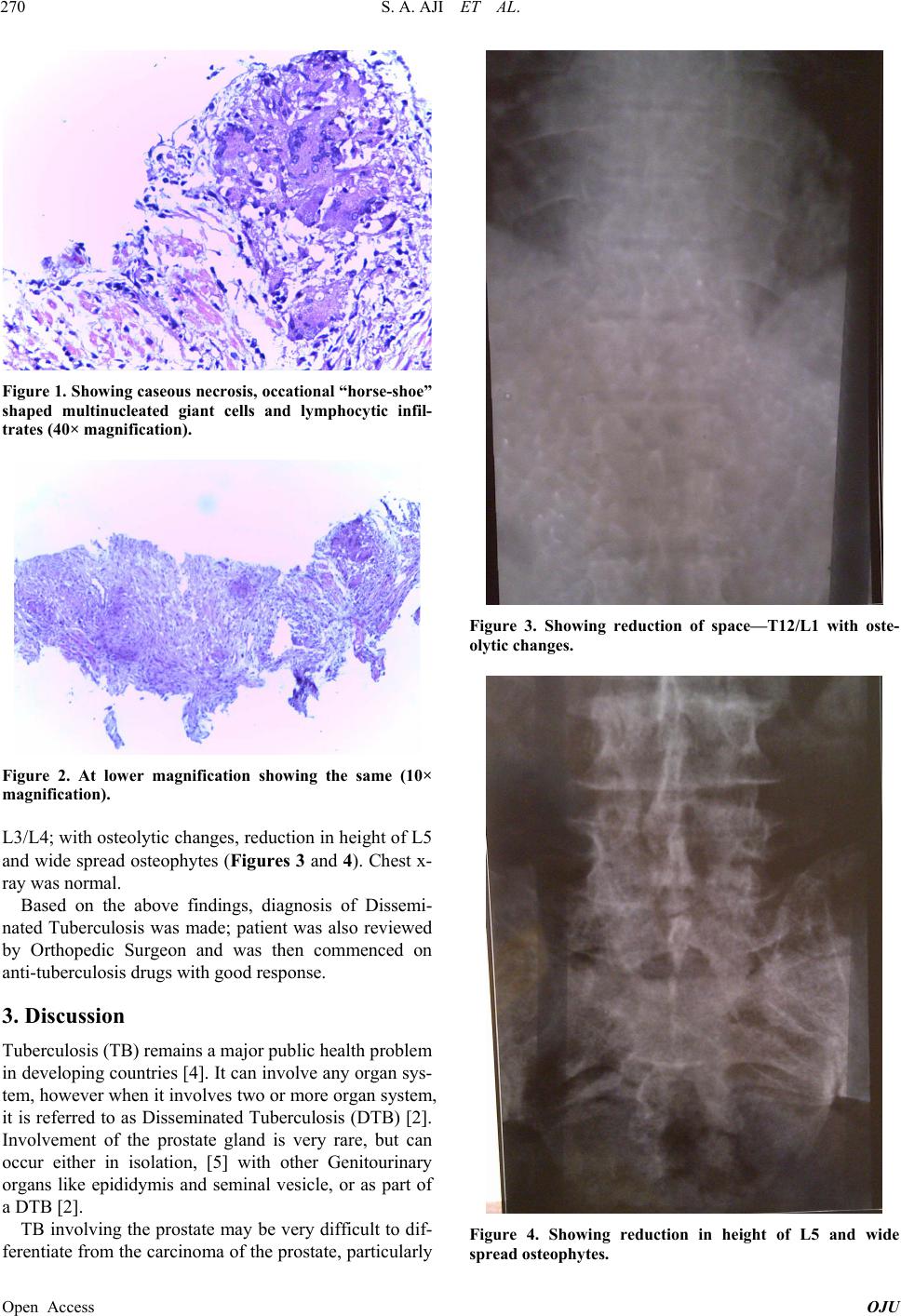 S. A. AJI ET AL. 270 Figure 1. Show ing caseous necrosis, occational “horse-shoe” shaped multinucleated giant cells and lymphocytic infil- trates (40× magnification). Figure 2. At lower magnification showing the same (10× magnification). L3/L4; with osteolytic changes, reduction in height of L5 and wide spr ead osteophytes (Figures 3 and 4). Chest x- ray was normal. Based on the above findings, diagnosis of Dissemi- nated Tuberculosis was made; patient was also reviewed by Orthopedic Surgeon and was then commenced on anti-tuberculosis drugs with good response. 3. Discussion Tuberculosis (TB) remains a major public health problem in developing countries [4]. It can involve any organ sys- tem, however when it involves two or more organ system, it is referred to as Disseminated Tuberculosis (DTB) [2]. Involvement of the prostate gland is very rare, but can occur either in isolation, [5] with other Genitourinary organs like epididymis and seminal vesicle, or as part of a DTB [2]. TB involving the prostate may be very difficult to dif- ferentiate from the carcinoma of the prostate, particularly Figure 3. Showing reduction of space—T12/L1 with oste- olytic changes. Figure 4. Showing reduction in height of L5 and wide spread osteophytes. Open Access OJU  S. A. AJI ET AL. Open Access OJU 271 when prostate is hard and nodular on digital rectal ex- amination [6]. Prostate TB is mainly diagnosed inciden- tally, either following trucut needle biopsy of the prostate for a suspected carcinoma of the prostate, [7] or after prostatectomy specimen for Benign Prostatic Hyperplasia is subjected to histology [8]. Very rarely prostate cancer can co-exist with TB of the Prostate [9]. In this case report, the patient was initially seen by a Family Physician, who made a diagnosis of metastatic carcinoma of the Prostate based on the Paraparesis, and the findings of a hard nodular prostate on rectal examina- tion. K. Huang et al. in Taiwan, conducted a study on 10 patients over a period of 10 years, who all presented with digital rectal examination findings suggestive of Prostate cancer, but needle biopsy of the prostate revealed tuber- culosis [6]. A. Kostakopoulos et al. also presented 5 cases of TB of the prostate, all of which were incidental histologic findings after Trans-urethral resecti on of the Prostate [10]. P. M. Karup et al. and M. A. Gafur et al. have all pre- sented a patient with lower urinary tract symptoms and prostate biopsy revealed granulomatous prostatitis [11, 12]. We presented this case because it masqueraded as a typical case of metastatic carcinoma of the prostate and was only revealed after prostatic biopsy was done. 4. Conclusion Tuberculosis of the prostate, though rare, can mimic p ros- tate cancer as well as BPH. A high index of suspicion is therefore needed in order to avoid misdiagnosis particu- larly those practicing in the develop ing countries. REFERENCES [1] K. Akhtar, “Tuberculous Granuloma with Langha n’s Gia nt Cells in the Prostate,” Kemcolian Journal of Medical Sciences, Vol. 1, No. 1, 2012. [2] R. Mittel, R. Sudha, M. Veeraraghavan, et al., “Dissemi- nated Tuberculosis with Involvement of the Prostate—A Case Report,” The Indian Journal of Tuberculosis, Vol. 57, No. 1, 2010, pp. 48-52. [3] S. Chandra, H. Chandra, N. Chauhan, et al., “Male Geni- tourinary Tuberculosis—13 Years’ Experience at a Terti- ary Centre in India,” Southeast Asian Journal of Tropical Medicine and Public Health, Vol. 43, No. 2, 2012, pp. 364-369. [4] N. Gupta, A. K. Mandal and S. K. Singh, “Tuberculosis of the Prostate and Urethra—A Review,” Indian Journal of Urology, Vol. 24, No. 3, 2008, pp. 388-391. http://dx.doi.org/10.4103/0970-1591.42623 [5] L. R. G. Cradon, “Tuberculosis of the Prostate,” The New England Journal of Medicine, Vol. 147, 1902, pp. 17-19. http://dx.doi.org/10.1056/NEJM190207031470106 [6] K. Huang, H. Wu, Y. Hsu, et al., “Tuberculosis of the Prostate,” Journal of Urology, Vol. 12, No. 3, 2001. [7] R. Klis, D. Mioczkowski and M. Sosnowski, “Tuberculo- sis of the Prostate—Rare case report,” Urologia Polska, 2006. [8] N. Bhargava and S. K. Bhargava, “Primary Tuberculosis of the Prostate,” Indian Journal of Radiology and Imag- ing, Vol. 13, 2003, pp. 236-237. [9] H. Zhang, Y. Xu and R. Liu, “A Rare Case of Prostatic Tuberculosis Accompanied by Prostate Cancer,” BJUI, 2010. [10] A. Kostokopoulos, G. Economou and D. Picramenos, “Tuberculosis of the Prostate,” International Urology and Nephrology, Vol. 30, No. 2, 1998, pp. 153-157. http://dx.doi.org/10.1007/BF02550570 [11] P. M. Krarup, Z. Kamper-Jorqensen and S. Oster, “Tu- berculous Prostatitis in a Previously Healthy Danish Ma n, ” Uqeskrift for Laeqer, Vol. 170, No. 1, 2008, p. 58. [12] M. A. Gafur, M. S. Talukder and S. S. Siddiqua, “Tuber- culous Prostatitis—A Case Report,” Mymensingh Medi- cal Journal, Vol. 11, No. 1, 2002, pp. 39-41. |