

Paper Menu >>
Journal Menu >>
 Vol.2, No.8, 437-438 (2013) Case Reports in Clinical Medicine http://dx.doi.org/10.4236/crcm.2013.28114 A case of mixed geno—Phenotype of generalized dystonia and strumpel disease* Vadim Belenky Yavorskiy Homeopathic Clinic, Saint Petersburg, Russia; [email protected] Received 3 September 2013; revised 30 September 2013; accepted 29 October 2013 Copyright © 2013 Vadim Belenky. This is an open access article distributed under the Creative Commons Attribution License, which permits unrestricted use, distribution, and reproduction in any medium, provided the original work is properly cited. ABSTRACT Background: St rumpel disease and dystonia are inherited disorders with the clinical picture of spastic paraparesis and hyperkinesis respec- tively. We present a case of a patient born from parents with these diseases who developed neurologic phenomena uncharacteristic for the classical clinical picture of his parents’ disor- ders. Case report: Patient V., 12, born from his father with generalized dystonia and mother with Strumpel disease, has flaccid lower para- plegia along with dystonic hyperkinesis in neck and arms. Discussion: The flaccid lower para- plegia could be caused by the anterior horn le- sion. This phenomenon is unclear because an- terior horn lesions were not diagnosed in the proband’s parents. Keywords: Dystonia; Strumpel Disease; DYT 1 1. INTRODUCTION Dystonia and Strumpel diseases, i.e. hereditory spastic paraparesis (HSP), are heterogenious conditions; muta- tions in more than 50 different genetic loci have been described to cause HSP and more than 20 different ge- netic forms of dystonia. Lesions of extrapyramidal sys- tem are responsible for clinical signs of dystonia with extrapyramidal rigidity in muscles. In case of Strumpel disease with lower spastic paraparesis, caused by lesions of corticospinal tract, spasticity in muscles grows by a pyramidal type. Flaccid paresis is not characteristic for either of these two disorders. Patient V., 12, born from his father with generalized non-DYT 1 dystonia and mother with Strumpel disease, has flaccid lower paraple- gia along with hands and neck dystonia. 2. CASE STORY I first met patient S. with generalized non-DYT 1 dystonia in 1987 on summer practice at neurologic de- partment, being a third year student of a medical school. He then was 21. He fell ill at the age of 9 and soon in- voluntary movements became generalized. None of his relatives was affected by this disease. Though classical research of Eldridge [1] established superior IQ of pa- tients with recessive forms of dystonia, we observed very clever and vivid mind in our patient. Later he married a woman with indolently progressive Strumpel disease, and their son inherited both parents’ diseases—from early childhood he developed flaccid lower paraplegia with complete absence of strength in legs and dystonic hyperkinesis in neck and arms, while having IQ as high as his father’s. The son underwent embryonal transplan- tation surgery into his brain with no significant effect. His father—patient S.—when hospitalized was given L-Dopa with no effect. I started tryhehyphenidyl therapy for patient S, which resulted in considerable improve- ment in his condition. Test for DYT 1 proved negative. Along with test results of my other primary dystonia pa- tients from the monitored group his serotonin exchange tended to be on the increase. His videoexamination was conducted befo re tryhehyph enidyl therap y (Figures 1-3). Unfortunately, the mother of the proband refused to videotype her son after brutal murder of her hus- band—patient S. on May 9th 2005—Russia’s national Victory Day holiday; patient S. ventured to leave the house in his wheelchair for the first time after the winter and never got back. Later he was found dead with tens of stab wounds and his neck cut. 3. DISCUSSION More than 20 genetic loci of dystonia have been dis- covered so far [2 ], but the clinical picture of the disorder of our proband’s father, i.e. non DYT-1 early onset gen- eralized autosomal dominant dystonia, differs from all *Financial disclosure: The study was not funded. Copyright © 2013 SciRes. OPEN ACCESS 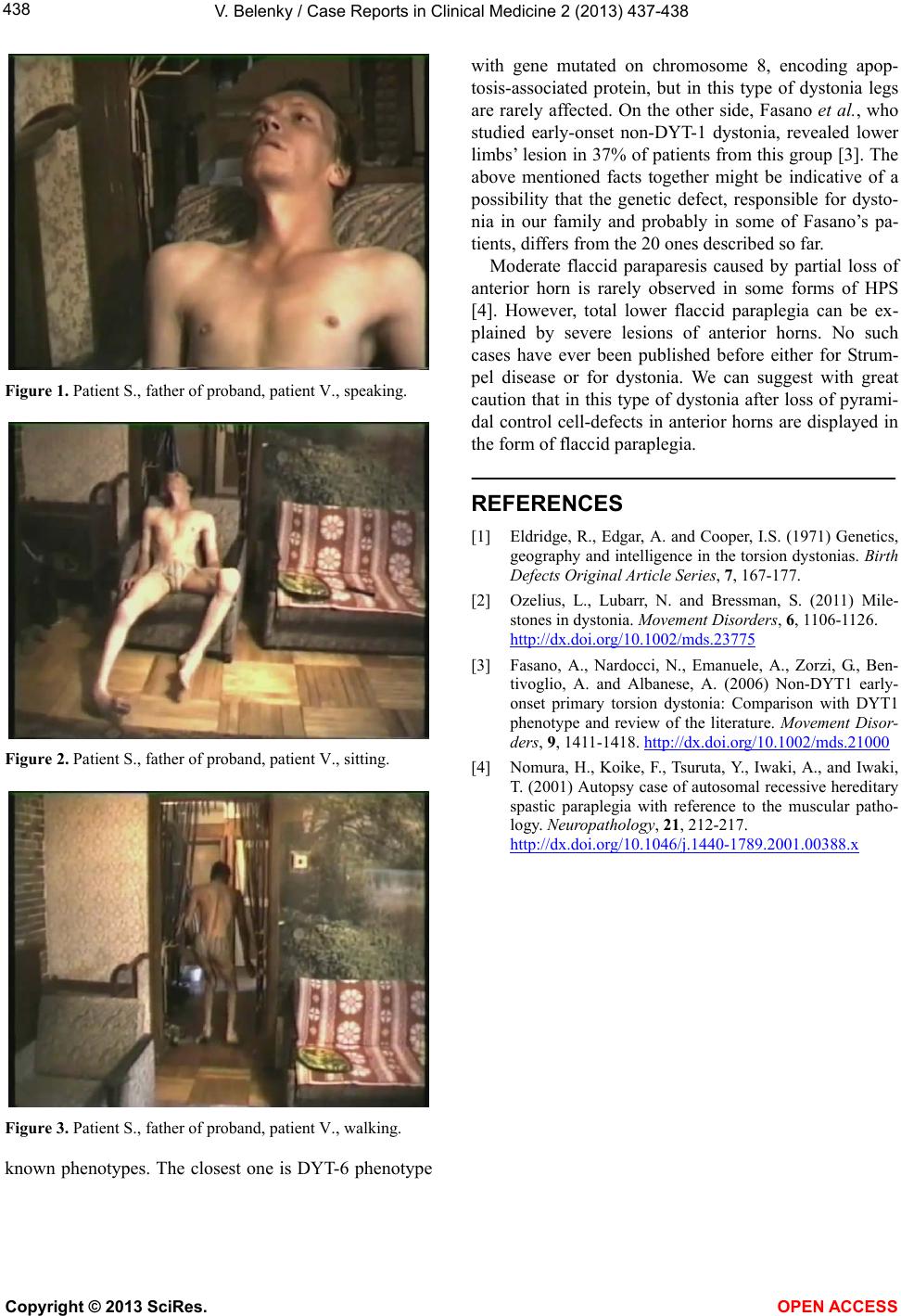 V. Belenky / Case Reports in Clinical Medicine 2 (2013) 437-438 438 Figure 1. Patient S., father of proband, patient V., speaking. Figure 2. Patient S., father of proband, patient V., sitting. Figure 3. Patient S., father of proband, patient V., walking. known phenotypes. The closest one is DYT-6 phenotype with gene mutated on chromosome 8, encoding apop- tosis-associated protein, but in this type of dystonia legs are rarely affected. On the other side, Fasano et al., who studied early-onset non-DYT-1 dystonia, revealed lower limbs’ lesion in 37% of patients fro m this group [3 ]. The above mentioned facts together might be indicative of a possibility that the genetic defect, responsible for dysto- nia in our family and probably in some of Fasano’s pa- tients, diff ers from the 20 ones described so far. Moderate flaccid paraparesis caused by partial loss of anterior horn is rarely observed in some forms of HPS [4]. However, total lower flaccid paraplegia can be ex- plained by severe lesions of anterior horns. No such cases have ever been published before either for Strum- pel disease or for dystonia. We can suggest with great caution that in this type of dystonia after loss of pyrami- dal control cell-defects in anterior horns are displayed in the form of flaccid paraplegia. REFERENCES [1] Eldridge, R., Edgar, A. and Cooper, I.S. (1971) Genetics, geography and intelligence in the torsion dystonias. Birth Defects Original Article Series, 7, 167-177. [2] Ozelius, L., Lubarr, N. and Bressman, S. (2011) Mile- stones in dystonia. Movement Disorders, 6, 1106-1126. http://dx.doi.org/10.1002/mds.23775 [3] Fasano, A., Nardocci, N., Emanuele, A., Zorzi, G., Ben- tivoglio, A. and Albanese, A. (2006) Non-DYT1 early- onset primary torsion dystonia: Comparison with DYT1 phenotype and review of the literature. Movement Disor- ders, 9, 1411-1418. http://dx.doi.org/10.1002/mds.21000 [4] Nomura, H., Koike, F., Tsuruta, Y., Iwaki, A., and Iwaki, T. (2001) Autopsy case of autosomal recessive hereditary spastic paraplegia with reference to the muscular patho- logy. Neuropathology, 21, 212-217. http://dx.doi.org/10.1046/j.1440-1789.2001.00388.x Copyright © 2013 SciRes. OPEN ACCESS |