

Paper Menu >>
Journal Menu >>
 Journal of Cosmetics, Dermatological Sciences and Applications, 2013, 3, 4-7 Published Online November 2013 (http://www.scirp.org/journal/jcdsa) http://dx.doi.org/10.4236/jcdsa.2013.33A2002 Open Access JCDSA Effectiveness of a Broad-Spectrum Sunscreen in the Prevention of Melasma in Asian Pregnant Women* Sophie Seité1#, Seok Beom Park2 1La Roche-Posay Pharmaceutical Laboratories, Asnières, France; 2Leaders Clinic, Seoul, Korea. Email: #[email protected] Received August 9th, 2013; revised September 7th, 2013; accepted September 15th, 2013 Copyright © 2013 Sophie Seité, Seok Beom Park. This is an open access article distributed under the Creative Commons Attribution License, which permits unrestricted use, distribution, and reproduction in any medium, provided the original work is properly cited. ABSTRACT Chloasma, or melasma, is a commonly acquired pigmentary disorder among Asian women. It may be considered as a physiological change during pregnancy. The incidence in Asian women is higher than that in other ethnic groups but further epidemiologic data are needed. There are very few studies related to the benefits of sunscreens to prevent this dermatosis. The aim of this study was to assess the effectiveness of a broad-spectrum sunscreen in the prevention of melasma in Korean pregnant women. We tested the effectiveness and tolerance of a sunscreen product (SPF 50+, UVA-PF 30) during a 12-month clinical trial including 220 Korean parturients with skin type III and IV. 217 women completed the study. Only 3 (1%) of the study population developed melasma, which was mild (MASI grade between 1.2 and 2.7). In addition, the clinical effectiveness of the evaluated sunscreen was judged “good to excellent” by the majority of study participants and by the research dermatologists. The “excellent” tolerance of the sunscreen under evaluation was confirmed “good” to “excellent” in 95% and 97% of cases. This study clearly demonstrates that this broad-spectrum sunscreen is well tolerated and effective in the prevention of melasma in Korean pregnant women. Al- though treatment remains elusive, prevention is possible. Keywords: Broad-Spectrum; Sunscreen; Chloasma; Melasma; Pregnancy; Photoprotection; SPF; UVA-PF 1. Introduction Melasma is a commonly acquired pigmentary disorder among Asian women [1-4] and the associated psycho- logical distress and altered quality of life [5,6] are of par- ticular concern for most pregnant women. During preg- nancy, melasma is not usually treated, aside from using an effective sunscreen and avoiding photosensitizing products or inappropriate skin care routines i.e. friction. However, in the literature, there are very few studies re- lated to the beneficial use of sunscreen to prevent this dermatosis. Consequently, pregnant women with a high risk of developing melasma (skin type IV to VI, with family history or increased outdoor sun exposure) do not use an effective and correctly applied photoprotection during their pregnancy. In 2007, a Moroccan study conducted with H. Lakhdar et al. [7], demonstrated that the regular use of a broad- spectrum sunscreen prevented the development of melasma during pregnancy. During this study, 200 preg- nant women applied a sunscreen with a Sun Protection Factor (SPF) of 50+ and UVA-Protection Factor (UVA- PF) evaluated with the persistent pigment darkening method (PPD) of 28. At the end of the pregnancy, new melasma occurrence was 2.7% as compared with 53% previously noted by H. Lakhdar et al. in the general population in 1999 [8]. Interestingly, during this study, we also observed an improvement of pre-existing melasma in 8 out of 12 women presenting with melasma at the beginning of their pregnancy [7]. 2. Materials and Methods Two hundred and seventeen pregnant women were re- cruited by the Leaders Clinic in collaboration with the Kwak Gynecology clinic in Seoul which includes 12 gy- necologists between October 2009 and July 2010. Each participant’s skin type was classified based on the Fitz- patrick’s classification of skin phototype [9] (Table 1) *Conflict of interest statement: Sophie Seité is an employee of La Roche- Posay Pharmaceutical Laboratories. Funding: this study was supported by a grant from La Roche-Posay Pharmaceutical Laboratories, France. #Corresponding author. 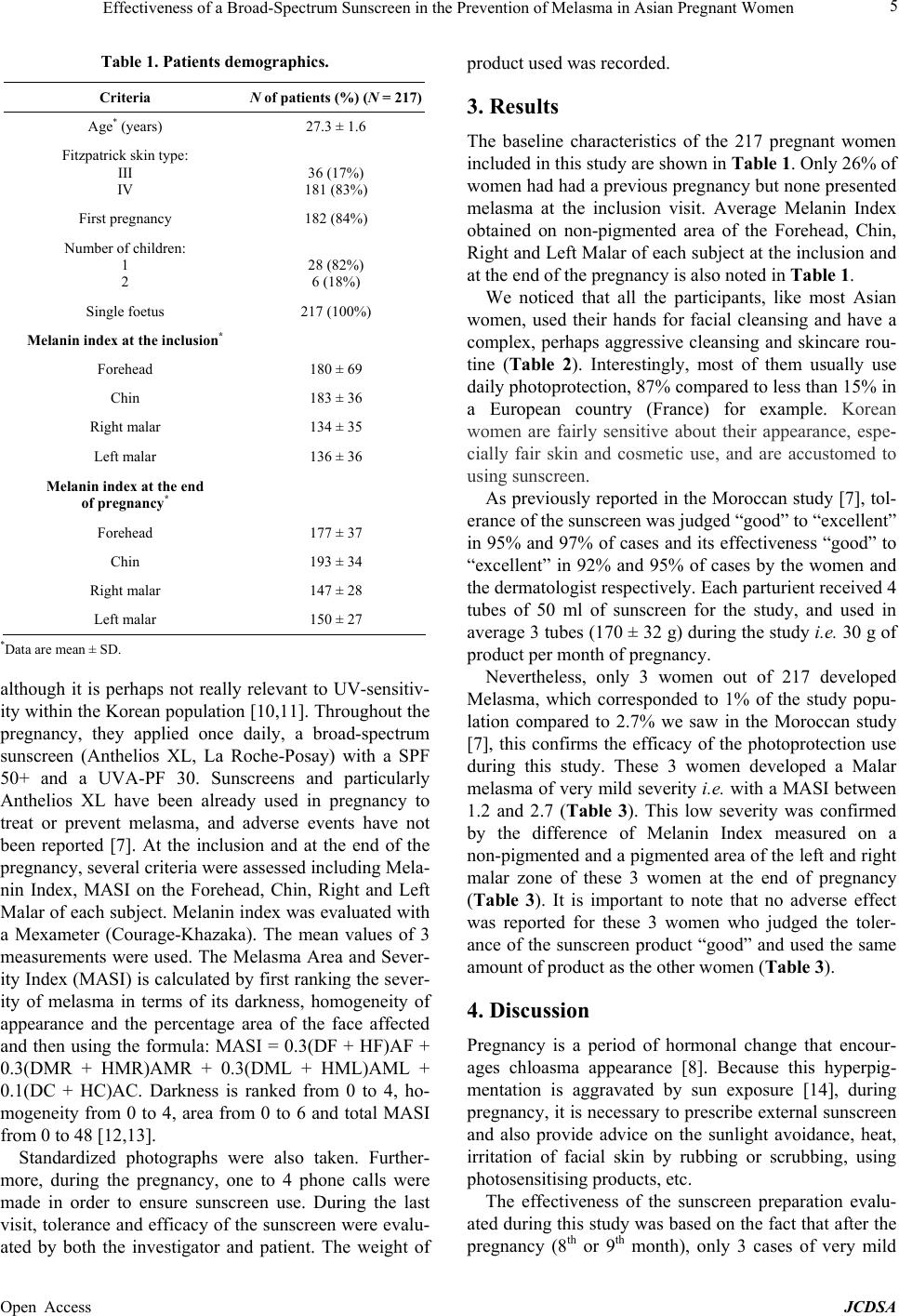 Effectiveness of a Broad-Spectrum Sunscreen in the Prevention of Melasma in Asian Pregnant Women 5 Table 1. Patients demographics. Criteria N of patients (%) (N = 217) Age* (years) 27.3 ± 1.6 Fitzpatrick skin type: III IV 36 (17%) 181 (83%) First pregnancy 182 (84%) Number of children: 1 2 28 (82%) 6 (18%) Single foetus 217 (100%) Melanin index at the inclusion* Forehead 180 ± 69 Chin 183 ± 36 Right malar 134 ± 35 Left malar 136 ± 36 Melanin index at the end of pregnancy* Forehead 177 ± 37 Chin 193 ± 34 Right malar 147 ± 28 Left malar 150 ± 27 *Data are mean ± SD. although it is perhaps not really relevant to UV-sensitiv- ity within the Korean population [10,11]. Throughout the pregnancy, they applied once daily, a broad-spectrum sunscreen (Anthelios XL, La Roche-Posay) with a SPF 50+ and a UVA-PF 30. Sunscreens and particularly Anthelios XL have been already used in pregnancy to treat or prevent melasma, and adverse events have not been reported [7]. At the inclusion and at the end of the pregnancy, several criteria were assessed including Mela- nin Index, MASI on the Forehead, Chin, Right and Left Malar of each subject. Melanin index was evaluated with a Mexameter (Courage-Khazaka). The mean values of 3 measurements were used. The Melasma Area and Sever- ity Index (MASI) is calculated by first ranking the sever- ity of melasma in terms of its darkness, homogeneity of appearance and the percentage area of the face affected and then using the formula: MASI = 0.3(DF + HF)AF + 0.3(DMR + HMR)AMR + 0.3(DML + HML)AML + 0.1(DC + HC)AC. Darkness is ranked from 0 to 4, ho- mogeneity from 0 to 4, area from 0 to 6 and total MASI from 0 to 48 [12,13]. Standardized photographs were also taken. Further- more, during the pregnancy, one to 4 phone calls were made in order to ensure sunscreen use. During the last visit, tolerance and efficacy of the sunscreen were evalu- ated by both the investigator and patient. The weight of product used was recorded. 3. Results The baseline characteristics of the 217 pregnant women included in this study are shown in Table 1. Only 26% of women had had a previous pregnancy but none presented melasma at the inclusion visit. Average Melanin Index obtained on non-pigmented area of the Forehead, Chin, Right and Left Malar of each subject at the inclusion and at the end of the pregnancy is also noted in Table 1. We noticed that all the participants, like most Asian women, used their hands for facial cleansing and have a complex, perhaps aggressive cleansing and skincare rou- tine (Table 2). Interestingly, most of them usually use daily photoprotection, 87% compared to less than 15% in a European country (France) for example. Korean women are fairly sensitive about their appearance, espe- cially fair skin and cosmetic use, and are accustomed to using sunscreen. As previously reported in the Moroccan study [7], tol- erance of the sunscreen was judged “good” to “excellent” in 95% and 97% of cases and its effectiveness “good” to “excellent” in 92% and 95% of cases by the women and the dermatologist respectively. Each parturient received 4 tubes of 50 ml of sunscreen for the study, and used in average 3 tubes (170 ± 32 g) during the study i.e. 30 g of product per month of pregnancy. Nevertheless, only 3 women out of 217 developed Melasma, which corresponded to 1% of the study popu- lation compared to 2.7% we saw in the Moroccan study [7], this confirms the efficacy of the photoprotection use during this study. These 3 women developed a Malar melasma of very mild severity i.e. with a MASI between 1.2 and 2.7 (Table 3). This low severity was confirmed by the difference of Melanin Index measured on a non-pigmented and a pigmented area of the left and right malar zone of these 3 women at the end of pregnancy (Table 3). It is important to note that no adverse effect was reported for these 3 women who judged the toler- ance of the sunscreen product “good” and used the same amount of product as the other women (Table 3). 4. Discussion Pregnancy is a period of hormonal change that encour- ages chloasma appearance [8]. Because this hyperpig- mentation is aggravated by sun exposure [14], during pregnancy, it is necessary to prescribe external sunscreen and also provide advice on the sunlight avoidance, heat, irritation of facial skin by rubbing or scrubbing, using photosensitising products, etc. The effectiveness of the sunscreen preparation evalu- ated during this study was based on the fact that after the pregnancy (8th or 9th month), only 3 cases of very mild Open Access JCDSA 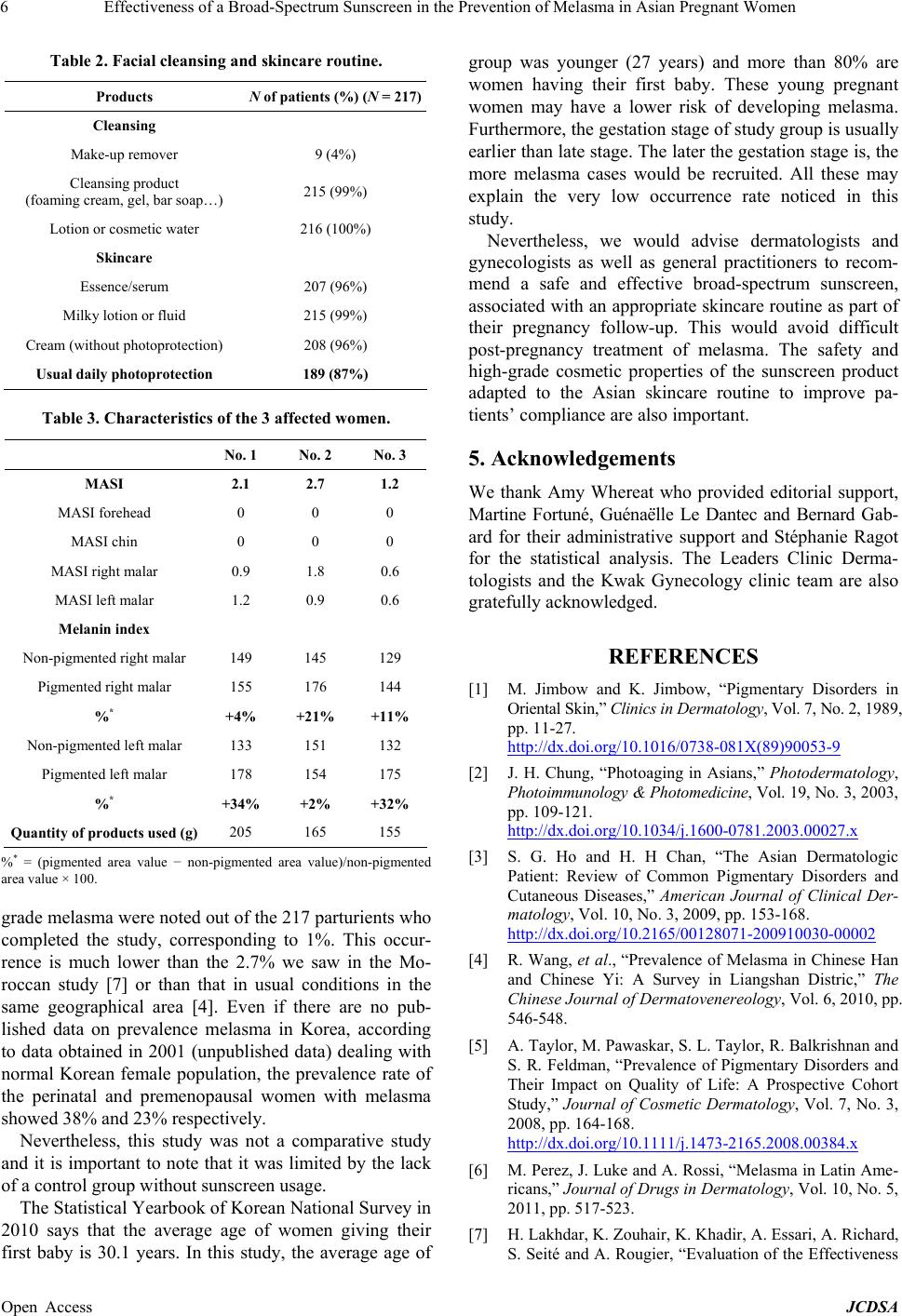 Effectiveness of a Broad-Spectrum Sunscreen in the Prevention of Melasma in Asian Pregnant Women 6 Table 2. Facial cleansing and skincare routine. Products N of patients (%) (N = 217) Cleansing Make-up remover 9 (4%) Cleansing product (foaming cream, gel, bar soap…) 215 (99%) Lotion or cosmetic water 216 (100%) Skincare Essence/serum 207 (96%) Milky lotion or fluid 215 (99%) Cream (without photoprotection) 208 (96%) Usual daily photoprotection 189 (87%) Table 3. Characteristics of the 3 affected women. No. 1 No. 2 No. 3 MASI 2.1 2.7 1.2 MASI forehead 0 0 0 MASI chin 0 0 0 MASI right malar 0.9 1.8 0.6 MASI left malar 1.2 0.9 0.6 Melanin index Non-pigmented right malar 149 145 129 Pigmented right malar 155 176 144 %* +4% +21% +11% Non-pigmented left malar 133 151 132 Pigmented left malar 178 154 175 %* +34% +2% +32% Quantity of products used (g) 205 165 155 %* = (pigmented area value − non-pigmented area value)/non-pigmented area value × 100. grade melasma were noted out of the 217 parturients who completed the study, corresponding to 1%. This occur- rence is much lower than the 2.7% we saw in the Mo- roccan study [7] or than that in usual conditions in the same geographical area [4]. Even if there are no pub- lished data on prevalence melasma in Korea, according to data obtained in 2001 (unpublished data) dealing with normal Korean female population, the prevalence rate of the perinatal and premenopausal women with melasma showed 38% and 23% respectively. Nevertheless, this study was not a comparative study and it is important to note that it was limited by the lack of a control group without sunscreen usage. The Statistical Yearbook of Korean National Survey in 2010 says that the average age of women giving their first baby is 30.1 years. In this study, the average age of group was younger (27 years) and more than 80% are women having their first baby. These young pregnant women may have a lower risk of developing melasma. Furthermore, the gestation stage of study group is usually earlier than late stage. The later the gestation stage is, the more melasma cases would be recruited. All these may explain the very low occurrence rate noticed in this study. Nevertheless, we would advise dermatologists and gynecologists as well as general practitioners to recom- mend a safe and effective broad-spectrum sunscreen, associated with an appropriate skincare routine as part of their pregnancy follow-up. This would avoid difficult post-pregnancy treatment of melasma. The safety and high-grade cosmetic properties of the sunscreen product adapted to the Asian skincare routine to improve pa- tients’ compliance are also important. 5. Acknowledgements We thank Amy Whereat who provided editorial support, Martine Fortuné, Guénaëlle Le Dantec and Bernard Gab- ard for their administrative support and Stéphanie Ragot for the statistical analysis. The Leaders Clinic Derma- tologists and the Kwak Gynecology clinic team are also gratefully acknowledged. REFERENCES [1] M. Jimbow and K. Jimbow, “Pigmentary Disorders in Oriental Skin,” Clinics in Dermatology, Vol. 7, No. 2, 1989, pp. 11-27. http://dx.doi.org/10.1016/0738-081X(89)90053-9 [2] J. H. Chung, “Photoaging in Asians,” Photodermatology, Photoimmunology & Photomedicine, Vol. 19, No. 3, 2003, pp. 109-121. http://dx.doi.org/10.1034/j.1600-0781.2003.00027.x [3] S. G. Ho and H. H Chan, “The Asian Dermatologic Patient: Review of Common Pigmentary Disorders and Cutaneous Diseases,” American Journal of Clinical Der- matology, Vol. 10, No. 3, 2009, pp. 153-168. http://dx.doi.org/10.2165/00128071-200910030-00002 [4] R. Wang, et al., “Prevalence of Melasma in Chinese Han and Chinese Yi: A Survey in Liangshan Distric,” The Chinese Journal of Dermatovenereology, Vol. 6, 2010, pp. 546-548. [5] A. Taylor, M. Pawaskar, S. L. Taylor, R. Balkrishnan and S. R. Feldman, “Prevalence of Pigmentary Disorders and Their Impact on Quality of Life: A Prospective Cohort Study,” Journal of Cosmetic Dermatology, Vol. 7, No. 3, 2008, pp. 164-168. http://dx.doi.org/10.1111/j.1473-2165.2008.00384.x [6] M. Perez, J. Luke and A. Rossi, “Melasma in Latin Ame- ricans,” Journal of Drugs in Dermatology, Vol. 10, No. 5, 2011, pp. 517-523. [7] H. Lakhdar, K. Zouhair, K. Khadir, A. Essari, A. Richard, S. Seité and A. Rougier, “Evaluation of the Effectiveness Open Access JCDSA  Effectiveness of a Broad-Spectrum Sunscreen in the Prevention of Melasma in Asian Pregnant Women Open Access JCDSA 7 of an External Broad-Spectrum Sunscreen in the Pre- vention of Chloasma in Pregnant Women,” Journal of the European Academy of De rmatology and Venereol ogy, Vol. 21, No. 6, 2007, pp. 738-742. http://dx.doi.org/10.1111/j.1468-3083.2007.02185.x [8] K. Khadir, S. Amal, F. Hali, F. Nejjam and H. Lakhdar, “Les Signes Dermatologiques Physiologiques de la Gros- sesse,” Annales de Dermatologie et de Venereologie, Vol. 126, 1999, pp. 15-19 [in French]. [9] T. B. Fitzpatrick, “The Validity and Practicability of Sun- Reactive Skin Types I through VI,” Archives of Der- matology, Vol. 124, No. 6, 1988, pp. 869-887. http://dx.doi.org/10.1001/arch derm.1988.0 167006 0015008 [10] J. H. Chung, W. S. Koh and J. I. Youn, “Relevance of Skin Phototyping to a Korean Population,” Clinical and Experimental Dermatology, Vol. 19, 1994, pp. 476-478. http://dx.doi.org/10.1111/j.1365-2230.1994.tb01250.x [11] S. B. Park, D. H. Suh and J. I. Youn, “Reliability of Self-Assessment in Determining Skin Phototype for Korean Brown Skin,” Photodermatology, Photoimmunology & Photomedicine, Vol. 14, No. 5-6, 1998, pp. 160-163. http://dx.doi.org/10.1111/j.1600-0781.1998.tb00035.x [12] C. K. Kimbrough-Green, C. E. Griffiths, L. J. Finkel, T. A. Hamilton, S. M. Bulengo-Ransby, C. N. Ellis and J. J. Voorhees, “Topical Retinoic Acid (Tretinoin) for Melasma in Black Patients. A Vehicle-Controlled Clinical Trial,” Archives of Dermatology, Vol. 130, No. 6, 1994, pp. 727- 733. http://dx.doi.org/10.1001/arch derm.1994.0 169006 0057005 [13] A. G. Pandya, L. S. Hynan, R. Bhore, F. C. Riley, I. L. Guevara, P. Grimes, J. J. Nordlund, M. Rendon, S. Taylor, R. W. Gottschalk, N. G. Agim and J. P. Ortonne, “Re- liability Assessment and Validation of the Melasma Area and Severity Index (MASI) and a New Modified MASI Scoring Method,” Journal of the American Academy of Dermatology, Vol. 64, No. 1, 2011, pp. 78-83. http://dx.doi.org/10.1016/j.jaad.2009.10.051 [14] J. P. Ortonne, I. Arellano, M. Berneburg, T. Cestari, H. Chan, P. Grimes, D. Hexsel, S. Im, J. Lim, H. Lui, A. Pandya, M. Picardo, M. Rendon, S. Taylor, J. P. Van Der Veen and W. Westerhof, “A Global Survey of the Role of Ultraviolet Radiation and Hormonal Influences in the Development of Melasma,” Journal of the European Academy of Dermatology and Venereology, Vol. 23, No. 11, 2009, pp. 1254-1262. http://dx.doi.org/10.1111/j.1468-3083.2009.03295.x |