

Paper Menu >>
Journal Menu >>
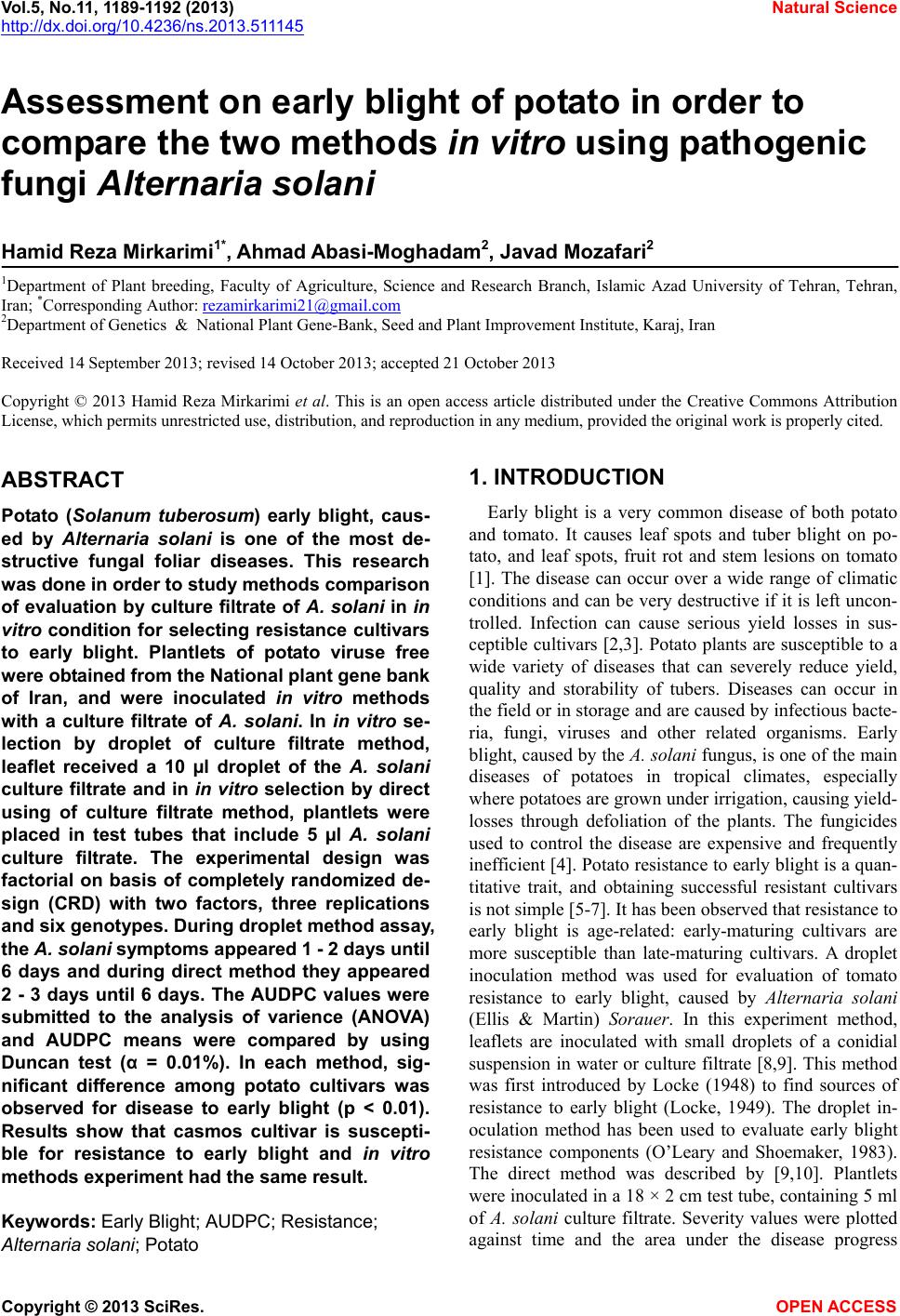 Vol.5, No.11, 1189-1192 (2013) Natural Science http://dx.doi.org/10.4236/ns.2013.511145 Assessment on early blight of potato in order to compare the two methods in vitro using pathogenic fungi Alternaria solani Hamid Reza Mirkarimi1*, Ahmad Abasi-Moghadam2, Javad Mozafari2 1Department of Plant breeding, Faculty of Agriculture, Science and Research Branch, Islamic Azad University of Tehran, Tehran, Iran; *Corresponding Author: [email protected] 2Department of Genetics & National Plant Gene-Bank, Seed and Plant Improvement Institute, Karaj, Iran Received 14 September 2013; revised 14 October 2013; accepted 21 October 2013 Copyright © 2013 Hamid Reza Mirkarimi et al. This is an open access article distributed under the Creative Commons Attribution License, which permits unrestricted use, distribution, and reproduction in any medium, provided the original work is properly cited. ABSTRACT Potato (Solanum tuberosum) early blight, caus- ed by Alternaria solani is one of the most de- structive fungal foliar diseases. This research was done in order to study methods comparison of evaluation by culture filtrate of A. solani in in vitro condition for selecting resistance cultivars to early blight. Plantlets of potato viruse free were obtained from the National plant gene bank of Iran, and were inoculated in vitro methods with a culture filtrate of A. solani. In in vitro se- lection by droplet of culture filtrate method, leaflet received a 10 µl droplet of the A. solani culture filtrate and in in vitro selection by direct using of culture filtrate method, plantlets were placed in test tubes that include 5 µl A. solani culture filtrate. The experimental design was factorial on basis of completely randomized de- sign (CRD) with two factors, three replications and six genotypes. During droplet method assay, the A. solani symptoms appeared 1 - 2 days until 6 days and during direct method they appeared 2 - 3 days until 6 days. The AUDPC values were submitted to the analysis of varience (ANOVA) and AUDPC means were compared by using Duncan test (α = 0.01%). In each method, sig- nificant difference among potato cultivars was observed for disease to early blight (p < 0.01). Results show that casmos cultivar is suscepti- ble for resistance to early blight and in vitro methods experiment had the same result. Keywords: E arly Blight; AUDPC; Resistance; Alternaria solani; Potato 1. INTRODUCTION Early blight is a very common disease of both potato and tomato. It causes leaf spots and tuber blight on po- tato, and leaf spots, fruit rot and stem lesions on tomato [1]. The disease can occur over a wide range of climatic conditions and can be very destructive if it is left uncon- trolled. Infection can cause serious yield losses in sus- ceptible cultivars [2,3]. Potato plants are susceptible to a wide variety of diseases that can severely reduce yield, quality and storability of tubers. Diseases can occur in the field or in storage and are caused by infectious bacte- ria, fungi, viruses and other related organisms. Early blight, caused by the A. solani fungus, is one of the main diseases of potatoes in tropical climates, especially where potato es are grown under irr igation , causing yield- losses through defoliation of the plants. The fungicides used to control the disease are expensive and frequently inefficient [4]. Potato resistance to early blight is a quan- titative trait, and obtaining successful resistant cultivars is not simple [5-7]. It has been observed that resistance to early blight is age-related: early-maturing cultivars are more susceptible than late-maturing cultivars. A droplet inoculation method was used for evaluation of tomato resistance to early blight, caused by Alternaria solani (Ellis & Martin) Sorauer. In this experiment method, leaflets are inoculated with small droplets of a conidial suspension in water or culture filtrate [8,9]. This method was first introduced by Locke (1948) to find sources of resistance to early blight (Locke, 1949). The droplet in- oculation method has been used to evaluate early blight resistance components (O’Leary and Shoemaker, 1983). The direct method was described by [9,10]. Plantlets were inoculated in a 18 × 2 cm test tube, containing 5 ml of A. solani culture filtrate. Severity values were plotted against time and the area under the disease progress Copyright © 2013 SciRes. OPEN ACCESS 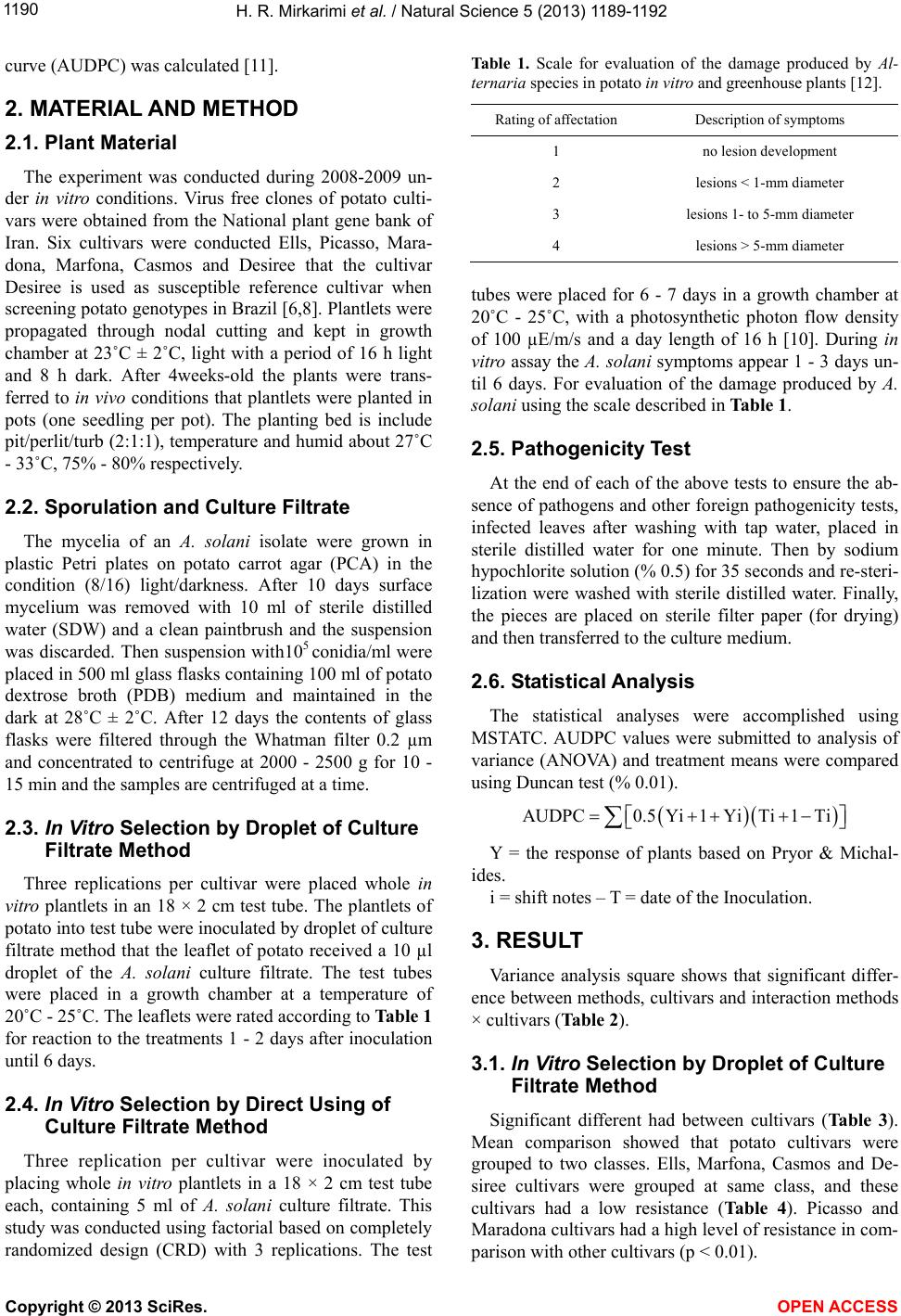 H. R. Mirkarimi et al. / Natural Science 5 (2013) 1189-1192 1190 curve (AUDPC) was calculated [11]. 2. MATERIAL AND METHOD 2.1. Plant Material The experiment was conducted during 2008-2009 un- der in vitro conditions. Virus free clones of potato culti- vars were obtained from the National plant gene bank of Iran. Six cultivars were conducted Ells, Picasso, Mara- dona, Marfona, Casmos and Desiree that the cultivar Desiree is used as susceptible reference cultivar when screening potato genotypes in Brazil [6,8]. Plantlets were propagated through nodal cutting and kept in growth chamber at 23˚C ± 2˚C, light with a period of 16 h light and 8 h dark. After 4weeks-old the plants were trans- ferred to in vivo conditions that plantlets were planted in pots (one seedling per pot). The planting bed is include pit/perlit/turb (2:1 :1), temperature and humid abou t 27˚C - 33˚C, 75% - 80% respectively. 2.2. Sporulation and Culture Filtrate The mycelia of an A. solani isolate were grown in plastic Petri plates on potato carrot agar (PCA) in the condition (8/16) light/darkness. After 10 days surface mycelium was removed with 10 ml of sterile distilled water (SDW) and a clean paintbrush and the suspension was discarded. Then suspension with105 conidia/ml were placed in 500 ml glass flasks containing 100 ml of potato dextrose broth (PDB) medium and maintained in the dark at 28˚C ± 2˚C. After 12 days the contents of glass flasks were filtered through the Whatman filter 0.2 µm and concentrated to centrifuge at 2000 - 2500 g for 10 - 15 min and the samples are centrifuged at a time. 2.3. In Vitro Selection by Droplet of Culture Filtrate Method Three replications per cultivar were placed whole in vitro plantlets in an 18 × 2 cm test tube. The plantlets of potato into test tube were inoculated by droplet of culture filtrate method that the leaflet of potato received a 10 µl droplet of the A. solani culture filtrate. The test tubes were placed in a growth chamber at a temperature of 20˚C - 25˚C. The leaflets were rated according to Table 1 for reaction to the treatments 1 - 2 days after inoculation until 6 days. 2.4. In Vitro Selection by Direct Using of Culture Filtrate Method Three replication per cultivar were inoculated by placing whole in vitro plantlets in a 18 × 2 cm test tube each, containing 5 ml of A. solani culture filtrate. This study was conducted using factorial based on completely randomized design (CRD) with 3 replications. The test Table 1. Scale for evaluation of the damage produced by Al- ternaria species in potato in v itro and greenhouse plants [12]. Rating of affect at ion Description of symptoms 1 no lesion development 2 lesions < 1-mm diameter 3 lesions 1- to 5-mm diameter 4 lesions > 5-mm diameter tubes were placed for 6 - 7 days in a growth chamber at 20˚C - 25˚C, with a photosynthetic photon flow density of 100 µE/m/s and a day length of 16 h [10]. During in vitro assay the A. solani symptoms appear 1 - 3 days un- til 6 days. For evaluation of the damage produced by A. solani using the scale described in Table 1. 2.5. Pathogenicity Test At the end of each of the above tests to ensure the ab- sence of pathogens and other fo reign pathogenicity tests, infected leaves after washing with tap water, placed in sterile distilled water for one minute. Then by sodium hypochlorite solution (% 0.5) for 35 seconds and re-steri- lization were washed with sterile distilled water. Finally, the pieces are placed on sterile filter paper (for drying) and then transferred to the culture medium. 2.6. Statistical Analysis The statistical analyses were accomplished using MSTATC. AUDPC values were submitted to analysis of variance (ANOVA) and treatment means were compared using Duncan test (% 0.01). AUDPC0.5 Yi1YiTi1Ti Y = the response of plants based on Pryor & Michal- ides. i = shift notes – T = date of the Inoculation. 3. RESULT Variance analysis square shows that significant differ- ence between methods, cultivars and interaction methods × cultivars (Table 2). 3.1. In Vitro Selection by Droplet of Culture Filtrate Method Significant different had between cultivars (Ta bl e 3 ). Mean comparison showed that potato cultivars were grouped to two classes. Ells, Marfona, Casmos and De- siree cultivars were grouped at same class, and these cultivars had a low resistance (Table 4). Picasso and Maradona cultivars had a high lev el of resistance in com- parison with other cultivars (p < 0.01). Copyright © 2013 SciRes. OPEN ACCESS 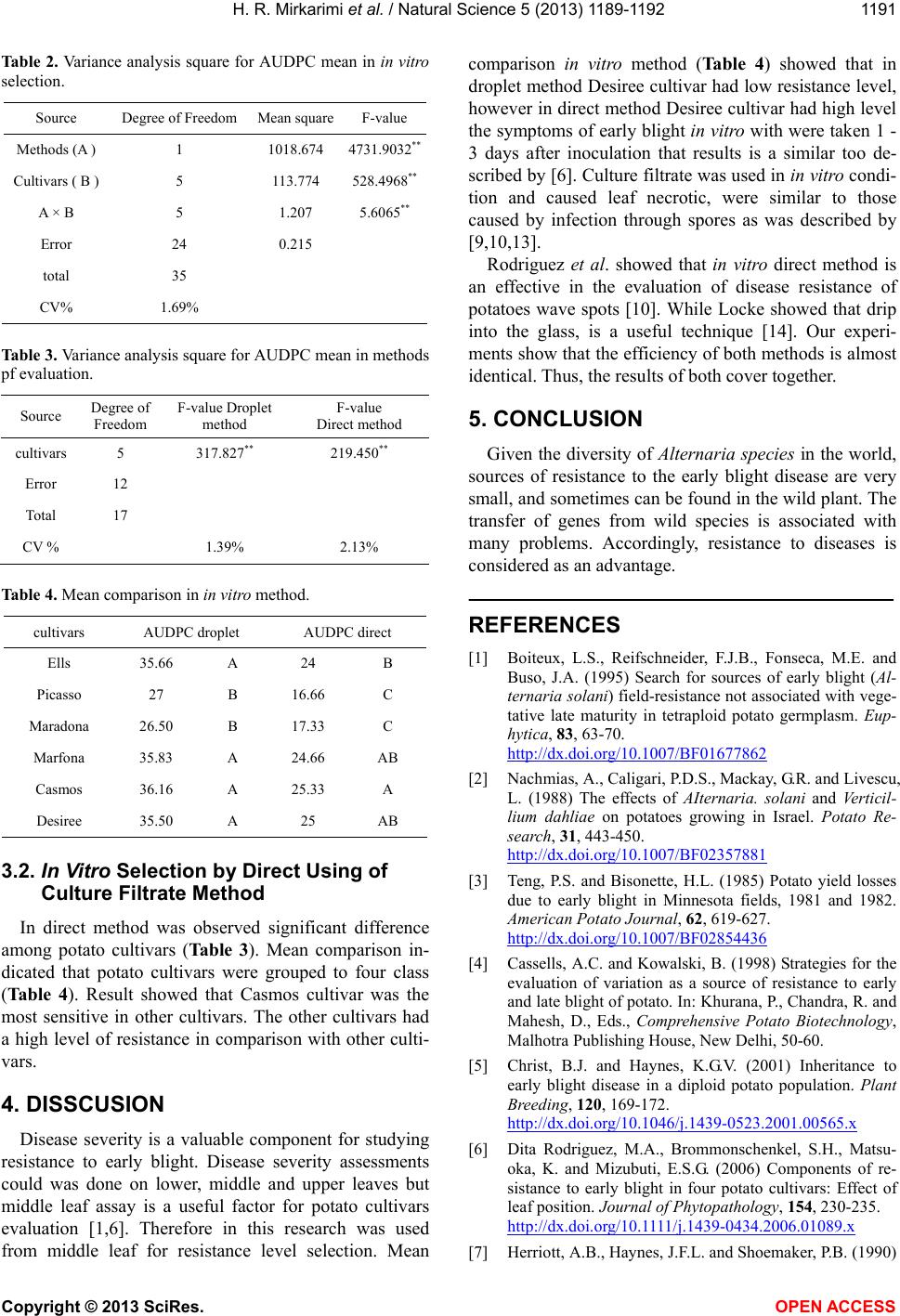 H. R. Mirkarimi et al. / Natural Science 5 (2013) 1189-1192 1191 Table 2. Variance analysis square for AUDPC mean in in vitro selection. Source Degree of FreedomMean square F-value Methods (A ) 1 1018.674 4731.9032** Cultivars ( B ) 5 113.774 528.4968** A × B 5 1.207 5.6065** Error 24 0.215 total 35 CV% 1.69% Table 3. Va riance analysis square for AUDPC mean in methods pf evaluation. Source Degree of Freedom F-value Droplet method F-value Direct method cultivars 5 317.827** 219.450** Error 12 Total 17 CV % 1.39% 2.13% Table 4. Mean comparison in in vitro method. cultivars AUDPC droplet AUDPC direct Ells 35.66 A 24 B Picasso 27 B 16.66 C Maradona 26.50 B 17.33 C Marfona 35.83 A 24.66 AB Casmos 36.16 A 25.33 A Desiree 35.50 A 25 AB 3.2. In Vitro Selection by Direct Using of Culture Filtrate Method In direct method was observed significant difference among potato cultivars (Ta bl e 3 ). Mean comparison in- dicated that potato cultivars were grouped to four class (Table 4). Result showed that Casmos cultivar was the most sensitive in other cultivars. The other cultivars had a high level of resistance in comparison with other culti- vars. 4. DISSCUSION Disease severity is a valuable component for studying resistance to early blight. Disease severity assessments could was done on lower, middle and upper leaves but middle leaf assay is a useful factor for potato cultivars evaluation [1,6]. Therefore in this research was used from middle leaf for resistance level selection. Mean comparison in vitro method (Table 4) showed that in droplet method Desiree cultivar had low resistance level, however in direct method Desiree cultivar had high level the symptoms of early blight in vitro with were taken 1 - 3 days after inoculation that results is a similar too de- scribed by [6]. Culture filtrate was used in in vitro condi- tion and caused leaf necrotic, were similar to those caused by infection through spores as was described by [9,10,13]. Rodriguez et al. showed that in vitro direct method is an effective in the evaluation of disease resistance of potatoes wave spots [10]. While Locke showed that drip into the glass, is a useful technique [14]. Our experi- ments show that the efficiency of both methods is almost identical. Thus, the results of both cover together. 5. CONCLUSION Given the diversity of Alternaria species in the wor ld, sources of resistance to the early blight disease are very small, and sometimes can be found in the wild plant. The transfer of genes from wild species is associated with many problems. Accordingly, resistance to diseases is considered as an advantage. REFERENCES [1] Boiteux, L.S., Reifschneider, F.J.B., Fonseca, M.E. and Buso, J.A. (1995) Search for sources of early blight (Al- ternaria solani) field-resistance not associated with vege- tative late maturity in tetraploid potato germplasm. Eup- hytica, 83, 63-70. http://dx.doi.org/10.1007/BF01677862 [2] Nachmias, A., Caligari, P.D.S., Mackay, G.R. and Livescu, L. (1988) The effects of AIternaria. solani and Verticil- lium dahliae on potatoes growing in Israel. Potato Re- search, 31, 443-450. http://dx.doi.org/10.1007/BF02357881 [3] Teng, P.S. and Bisonette, H.L. (1985) Potato yield losses due to early blight in Minnesota fields, 1981 and 1982. American Potato Journal, 62, 619-627. http://dx.doi.org/10.1007/BF02854436 [4] Cassells, A.C. and Kowalski, B. (1998) Strategies for the evaluation of variation as a source of resistance to early and late blight of potato. In: Khurana, P., Chandra, R. and Mahesh, D., Eds., Comprehensive Potato Biotechnology, Malhotra Publishing House, New Delhi, 50-60. [5] Christ, B.J. and Haynes, K.G.V. (2001) Inheritance to early blight disease in a diploid potato population. Plant Breeding, 120, 169-172. http://dx.doi.org/10.1046/j.1439-0523.2001.00565.x [6] Dita Rodriguez, M.A., Brommonschenkel, S.H., Matsu- oka, K. and Mizubuti, E.S.G. (2006) Components of re- sistance to early blight in four potato cultivars: Effect of leaf position. Journal of Phytopathology, 154, 230-235. http://dx.doi.org/10.1111/j.1439-0434.2006.01089.x [7] Herriott, A.B., Haynes, J.F.L. and Shoemaker, P.B. (1990) Copyright © 2013 SciRes. OPEN ACCESS  H. R. Mirkarimi et al. / Natural Science 5 (2013) 1189-1192 Copyright © 2013 SciRes. OPEN ACCESS 1192 Inheritance of resistance to early blight disease in tetra- ploid x diploid crosses of potatoes. Hortscience, 25, 224- 226. [8] Lopes, C.A. and Reifschneider, F.J.B. (1999) Manejo integrado das doenc as da batata. Inf. Agropec, 20, 56-60. [9] Martinez, P.R. and Sinclair, M. (1994) Selection in vitro of resistance to Early Blight (Alternaria solani Sorauer) in Creole Potatoes (Solanum phureja Junz). Fitopatol Colomb, 18, 90-100. [10] Rodriguez, N.V., Kowalski, B., Rodriguez, L.G., Cara- balloso, B., Suarez, M.A., Perez, P.O., Quintana, C.R., Gonzalez, N. and Ramos, R.Q. (2007) In vitro and ex vi- tro selection of potato plantlets for resistance to early blight. Journal of Phytopathology, 155, 582-586. http://dx.doi.org/10.1111/j.1439-0434.2007.01282.x [11] Shaner, G. and Finney, R.E. (1977) The effect of nitrogen fertilization in the expression of slow-mildewing resis- tance in Knox wheat. Phytopathology, 67, 1051-1056. http://dx.doi.org/10.1094/Phyto-67-1051 [12] Pryor, B.M. and Michailides, T.J. (2002) Morphological, pathogenic, and molecular characterization of Alternaria isolates associated with Alternaria late blight of pistachio. Phytopathology, 92, 406-416. http://dx.doi.org/10.1094/PHYTO.2002.92.4.406 [13] Veitia, N., Dita, M.A., Garcia, L., Herrera, L., Bermu dez, I., Acosta, M., Clavero, J., Orellana, P., Romero, C. and Garcia, L. (2001) Use of tissue culture and the mutagene- sis in vitro for the improvement of the resistance to Al- ternaria solani (Solanum tuberosum Lin.), to var Desiree. Biotecnol Veg, 1, 43-47. [14] Locke, S.B. (1949) Resistance to early blight and Septo- ria leaf spot in the genus Lycopersicon. Phytopathology, 39, 829-836. |