

Paper Menu >>
Journal Menu >>
 Creative Education 2013. Vol.4, No.11, 713-717 Published Online November 2013 in SciRes (http://www.scirp.org/journal/ce) http://dx.doi.org/10.4236/ce.2013.411101 Open Access 713 Science Process Skills in the Kenya Certificate of Secondary Education Biology Practical Examinations Richard Owino Ongow o*, Francis Chisakwa Indoshi Department of E d u cational Communication, Technology and C u rriculum Studies, Maseno University, Maseno, Kenya Email: *[email protected] Received September 10th, 2013; revised Octob er 10th, 2013; accepted October 17th, 2013 Copyright © 2013 Richard Owino Ongowo, Francis Chisakwa Indoshi. This is an open access article distributed under the Creative Commons Attribution License, which permits unrestricted use, distribution, and reproduction in any medium, provided th e o riginal work is properly cited. The purpose of the study was to determine the science process skills included in the Kenya Certificate of Secondary Education (KCSE) biology practical examinations in Kenya for a period of 10 years (2002- 2012). Ex-post facto design was adopted for the study. The content of KCSE Biology Practical Questions (KCSE-BPQ) for the period was analyzed based on 12 categories of science process skills and their de- scriptions. The data were analyzed descriptively using percentages. The five most common science proc- ess skills identified out of the 12 examined in the study are observation (32.24%), communicating (14.63%), inferring (13.13%), experimenting (12.21%) and interpreting data (11.94%). The results also revealed a high percentage of basic science process skills at 73.73% compared to the integrated science process skills at 26.27%. It is recommended that the Kenya National Examination Council should include more integrated science process skills into the KCSE biology practical examinations to enable the stu- dents to develop problem solving abilities and creativity which are important tools for biotechnology. Keywords: Biology; Practical Examinations; Science Process Skills; Kenya Introduction The goal of science education is to enhance all students’ sci- entific literacy; that is to help students grasp essential science concepts, to understand the nature of science, to realize the relevance of science and technology in their lives and to will- ingly continue their science study in school or beyond school (AAAS, 1993). The student-centered active learning process within which the teacher is merely a guide is the focal point of contemporary education systems. The active learning is a learn- ing process in which the learner takes the responsibility of learning and is given the opportunity to make decisions about various dimensions of the leaning process and to perform self- regulation. In an active learning process, learning is no longer a standard process, but transforms into a personalized process where process skills are developed (Akinoglu & Tandogan, 2007). There are three important dimensions of science, viz: 1) con- tent of science, the basic concepts and scientific knowledge 2) the process of doing science and 3) scientific attitudes (Opateye, 2012). One of the domains critical for the development of sci- entific literacy is science process skills. It is natural for science process skills to be learnt since when learners interact with the world in a scientific way, they find themselves using process skills (AAAS, 1993). Understanding of the world around indi- viduals depends on the development of concepts. The devel- opment of concepts depends on the process skills. The concepts and process skills are interrelated. As concepts gradually be- come sophisticated, process skills need to be refined and ex- tended. The implication is that the goal of any science teacher should be to foster the development of science process skills. The application of these science process skills allows the stu- dents to investigate important issues in the world around them. The term science process skills refer to a set of broadly trans- ferable abilities appropriate to many science disciplines and reflective of the behavior of scientists (Padilla, 1990). Accord- ing to Nwosu and Okeke (1995), science process skills are mental and physical abilities and competencies which serve as tools needed for the effective study of science and technology as well as problem solving and individual societal development. Akinbobola and Afolabi (2010) view science process skills as cognitive and psychomotor skills employed in problem solving, problem identification, data gathering, transformation, inter- pretation and communication. According to Ozgelen (2012), science process skills are thinking skills that scientists use to construct knowledge in order to solve problems and formulate results. Implicit in these definitions of science process skills is that these skills are inte- gral and natural to a scientist; they are instruments for the study and generation of scientific knowledge; science learning and development of science process skills are integrated activities. Categories of Science Process Skills The commission on science education of the American As- sociation for the Advancement of Science (AAAS) launched a program named Science A Process Approach (SAPA), which emphasized the laboratory method of instruction and learning of scientific processes by children. SAPA grouped process *Corresponding author.  R. O. ONGOWO, F. C. INDOSHI skills into two types—basic and integrated (AAAS, 1993). According to Rambuda and Fraser (2004), the basic science process skills apply specifically to foundational cognitive func- tioning in especially elementary grades. They represent the foundation of scientific reasoning learners are required to mas- ter before acquiring and mastering the advanced integrated science process skills (Brotherton & Preece, 1995). Funk et al. (Cited in Rambuda & Fraser, 2004), maintain that basic science process skills are interdependent, implying that investigators may display and apply more than one of the skills in any single activity. For instance to measure the area of a habitat, the biol- ogy student may start by observing the habitat, then measure the dimensions and communicate the same using a symbol. Thereafter the student may calculate the area. In this scenario, the student was involved in the skill of observing, measuring and calculating. The basic science process skills include ob- serving, inferring, measuring, communicating, classifying and predicting (Padilla, 1990). From this, it appears the basic sci- ence process skills provide an intellectual groundwork in prob- lem solving. According to Rambuda and Fraser (2004) integrated science process skills are the immediate skills used in problem solving or doing science experiments. As the term integrated implies, learners are called upon to combine basic science process skills for greater expertise and flexibility to design the tools they apply when they study or investigate phenomena. The inte- grated skills include controlling variables, defining operation- ally, formulating hypotheses, interpreting data, experimenting, and formulating models. The Rationale for the Process Approach According to Harlen (1999) and Sevilay (2011), the mastery of science process skills enables students to conceptualize at a much deeper level, the content they do know and equips them for acquiring content knowledge in the future. Content knowl- edge is acquired more efficiently and understood at a deeper level when obtained through inquiry using science process skills. The science curriculum that emphasizes science process skills will be able to help students to improve the skills in criti- cal thinking, creative thinking and decision making. These skills can be transferred to other disciplines (Meador, 2003; Halim and Meerah, 2012). According to Brotherton and Preece (1996) and Sevilay (2011), the basic science process skills helps in providing the intellectual groundwork in scientific inquiry such as ability to order and describe natural objects and events. The ability to apply basic science process skills is at- tributed to the ability to perform empirical inductive reasoning or piagetian concrete operational reasoning. Sevilay (2011), holds that the integrated science process skills are the terminal skills for solving problems or doing science experiments. The ability to carry out integrated science process skills are attrib- uted to hypothetico-deductive reasoning. Sevilay (2011), con- tinues to hold that science process skills help the students to develop a sense of responsibility in their own learning, increase permanency of learning as well as teach them research methods. According to Opateye (2012) and Okere (1997), science proc- ess skills are helpful on the development of favorable scientific attitudes and a disposition in the learners. These include being curious and imaginative, including enthusiasm about inquisi- tiveness. Science Process Skills and Inquiry Approach Science curricula around the world emphasize the philosophy of inquiry in science teaching. In the context of science, inquiry refers to the abilities students should develop to be able to de- sign and conduct scientific investigations. In the context of instruction, inquiry refers to the teaching and learning strategies that enable concepts to be mastered through investigation and practical work (National Research Council [NRC], 2000). Ac- cording to Gagne (1963), scientific inquiry is constituted by a set of activities characterized by problem solving approach in which a newly encountered phenomenon becomes a challenge for thinking. Such thinking begins with a careful set of system- atic observations, proceeds to design of measurements required, clear distinction between what is observed and what is under ideal circumstances, brilliant leaps but always testable and drawing reasonable conclusions. Brickman et al. (2009) ob- serve that in sciences, inquiry based learning increases literacy and skill development. According to Maundu, Sambili and Muthwii (2005), in the inquiry approach, learning is by discovery and is characterized by the development of science process skills. Uno and Bybee (cited in Brickman et al., 2009) hold that inquiry is a laboratory inquiry in which the instructor leads the students to discover a specific concept after being prompted by a basic question or problem. Kim (2007), posits that inquiry based teaching that engages students in various hands on activities in the science laboratory is likely to enhance science process skills. Implicit in these arguments is that science process skills are encompassed in the conduct of scientific inquiry and these skills are devel- oped in the laboratory practical situations. In the Kenyan context, the Kenya Institute of Education (KIE) reorganized and rationalized the current biology curriculum with a strong recommendation for the employment of inquiry approach to teach biology concepts and the development of science process skills and problem solving abilities as some of the broad objectives (KIE, 2002). According to sevilay (2011), students can acquire the science process skills by participating in inquiry in the science laboratory. Ango and Gyuse (Cited in Ango, 2002), argue that practical work engenders not only the science process skills appropriate for scientific inquiry but also inculcates attitudes and conceptual perspectives which are nec- essary for skilled scientific inquiry. The inquiry approach to teaching can only be enhanced through the application of sci- ence process skills. The biology practical skills are science process skills. They are taught as part of the biology curriculum. These skills can be acquired and developed through activities involved in the biol- ogy practical sessions. According to Maundu, Sambili and Muthwii (2005), one of the ways of assessing the objectives of teaching biology is through practical work. In practical work, an opportunity is provided for testing application of scientific procedures, manipulative abilities as well as scientific skills. The Kenya National Examinations Council (KNEC) makes use of practical examinations to test students’ acquisition of various biology practical skills which in essence are science process skills. In these examinations, students are required to carry out biology practical activities following some given in- structions. The performance of students in the Kenya National Examinations Council in Biology practical examinations has been below average. For instance in the years 2008, 2009 and 2010 the students scored means of 17.30, 15.86 and 18.42 re- Open Access 714 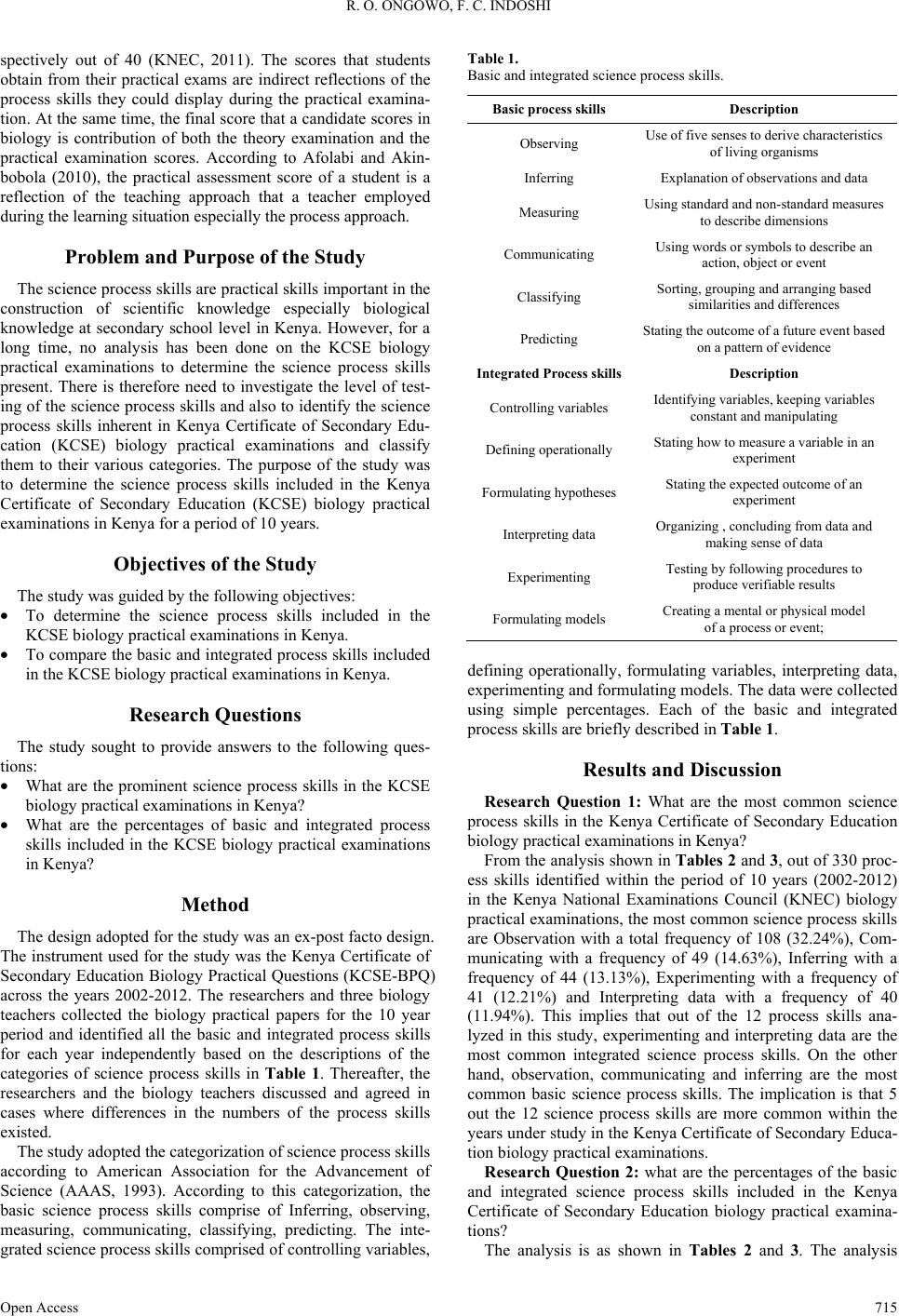 R. O. ONGOWO, F. C. INDOSHI spectively out of 40 (KNEC, 2011). The scores that students obtain from their practical exams are indirect reflections of the process skills they could display during the practical examina- tion. At the same time, the final score that a candidate scores in biology is contribution of both the theory examination and the practical examination scores. According to Afolabi and Akin- bobola (2010), the practical assessment score of a student is a reflection of the teaching approach that a teacher employed during the learning situation especially the process approach. Problem and Purpose of the Study The science process skills are practical skills important in the construction of scientific knowledge especially biological knowledge at secondary school level in Kenya. However, for a long time, no analysis has been done on the KCSE biology practical examinations to determine the science process skills present. There is therefore need to investigate the level of test- ing of the science process skills and also to identify the science process skills inherent in Kenya Certificate of Secondary Edu- cation (KCSE) biology practical examinations and classify them to their various categories. The purpose of the study was to determine the science process skills included in the Kenya Certificate of Secondary Education (KCSE) biology practical examinations in Kenya for a period of 10 years. Objectives of the Study The study was guided by the following objectives: • To determine the science process skills included in the KCSE biology practical examinations in Kenya. • To compare the basic and integrated process skills included in the KCSE biology practical examinations in Kenya. Research Questions The study sought to provide answers to the following ques- tions: • What are the prominent science process skills in the KCSE biology practical examinations i n Kenya? • What are the percentages of basic and integrated process skills included in the KCSE biology practical examinations in Kenya? Method The design adopted for the study was an ex-post facto design. The instrume nt used for the study was the Ke nya Certificate of Secondary Education Biology Practical Questions (KCSE-BPQ) across the years 2002-2012. The researchers and three biology teachers collected the biology practical papers for the 10 year period and identified all the basic and integrated process skills for each year independently based on the descriptions of the categories of science process skills in Table 1. Thereafter, the researchers and the biology teachers discussed and agreed in cases where differences in the numbers of the process skills existed. The study adopted the categorization of science process skills according to American Association for the Advancement of Science (AAAS, 1993). According to this categorization, the basic science process skills comprise of Inferring, observing, measuring, communicating, classifying, predicting. The inte- grated science process skills comprised of controlling variables, Table 1. Basic and integrated science process skills. Basic process skills Description Observing Use of five senses to derive characteristics of living organisms Inferring Explanation of observations and data Measuring Using standard and non-standard measures to describe dimensions Communicating Using words or symbols to describe an action, object or event Classifying Sorting, grouping and arranging b ased similarities and differ ences Predicting Stating the outcome of a future event based on a pattern of evidence Integrated Process skillsDescription Controlling variables Identifying variables, keeping variables constant and manipulatin g Defining operationally Stating how to measure a variable in an experiment Formulating hypotheses Stating the expected outcome of an experiment Interpreting d ata Organizing , conclu di ng from data and making sens e of data Experimenting Testing by fo llowing procedures to produce verifiable results Formulating models Creating a mental or physic al model of a process or event; defining operationally, formulating variables, interpreting data, experimenting and formulating models. The data were collected using simple percentages. Each of the basic and integrated process skills are briefly described in Table 1. Results and Discussion Research Question 1: What are the most common science process skills in the Kenya Certificate of Secondary Education biology practical examinations i n Kenya? From the analysis shown in Tables 2 and 3, out of 330 proc- ess skills identified within the period of 10 years (2002-2012) in the Kenya National Examinations Council (KNEC) biology practical examinations, the most common science process skills are Observation with a total frequency of 108 (32.24%), Com- municating with a frequency of 49 (14.63%), Inferring with a frequency of 44 (13.13%), Experimenting with a frequency of 41 (12.21%) and Interpreting data with a frequency of 40 (11.94%). This implies that out of the 12 process skills ana- lyzed in this study, experimenting and interpreting data are the most common integrated science process skills. On the other hand, observation, communicating and inferring are the most common basic science process skills. The implication is that 5 out the 12 science process skills are more common within the years under study in the Kenya Certificate of Secondary Educa- tion biology practical examinations. Research Question 2: what are the percentages of the basic and integrated science process skills included in the Kenya Certificate of Secondary Education biology practical examina- tions? The analysis is as shown in ables 2 and 3. The analysis T Open Access 715 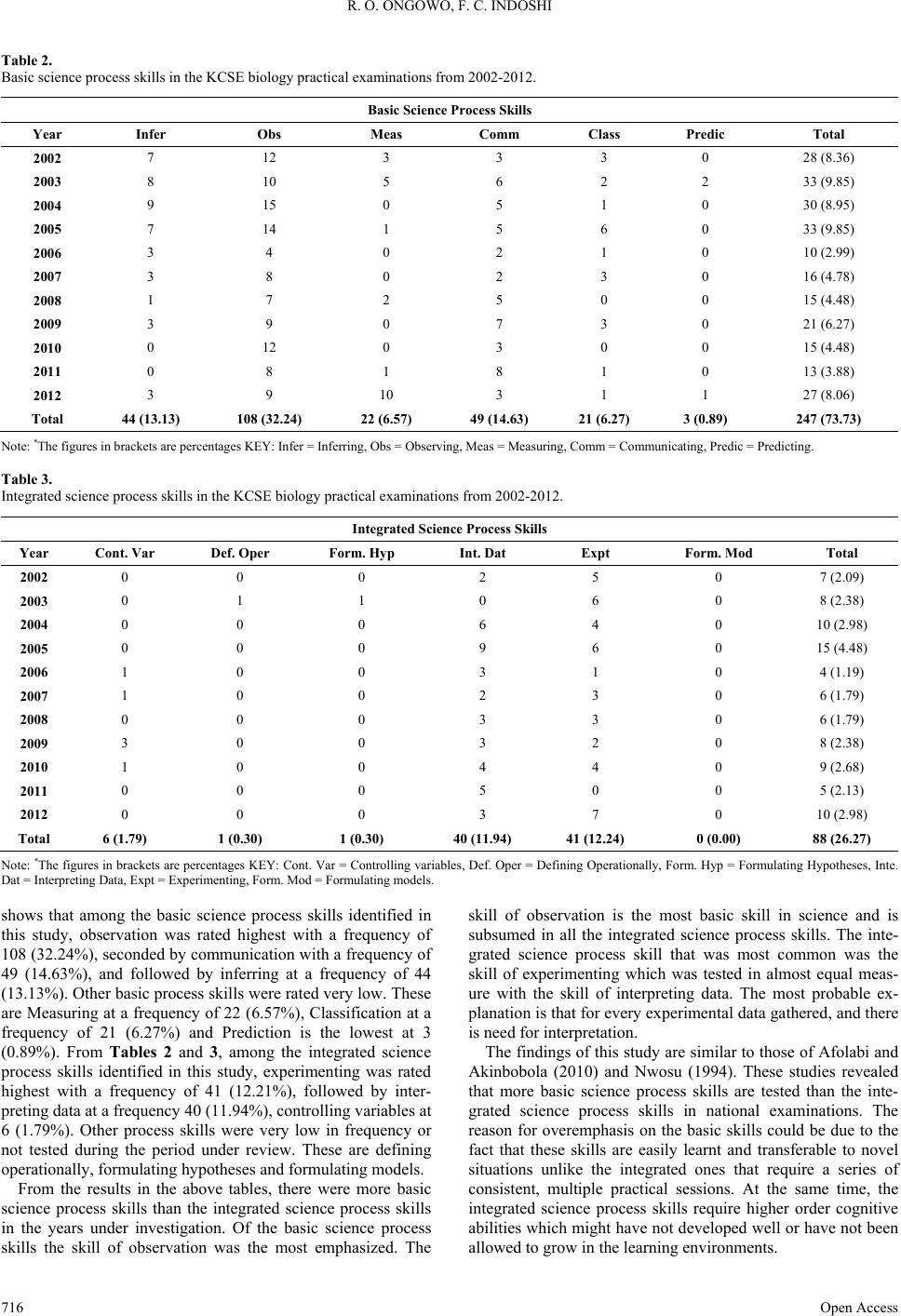 R. O. ONGOWO, F. C. INDOSHI Open Access 716 Table 2. Basic science process skills in the KCSE biology practical examinations from 2002-2012. Basic Science Process Skills Year Infer Obs Meas Comm Class Predic Total 2002 7 12 3 3 3 0 28 (8.36) 2003 8 10 5 6 2 2 33 (9.85) 2004 9 15 0 5 1 0 30 (8.95) 2005 7 14 1 5 6 0 33 (9.85) 2006 3 4 0 2 1 0 10 (2.99) 2007 3 8 0 2 3 0 16 (4.78) 2008 1 7 2 5 0 0 15 (4.48) 2009 3 9 0 7 3 0 21 (6.27) 2010 0 12 0 3 0 0 15 (4.48) 2011 0 8 1 8 1 0 13 (3.88) 2012 3 9 10 3 1 1 27 (8.06) Total 44 (13.13) 108 (32.24) 22 (6.57) 49 (14.63) 21 (6.27) 3 (0.89) 247 (73.73 ) Note: *The figures in brackets are percentages KEY: Infer = Inferring, Obs = Observing, Meas = Measuring, Comm = Communicating, Predic = Predicting. Table 3. Integrated science process skills in the KCSE biology practical examinations from 2002-2012. Integrated Science Process Skills Year Cont. Var Def. Oper Form. Hyp Int. Dat Expt Form. Mod Total 2002 0 0 0 2 5 0 7 (2.09) 2003 0 1 1 0 6 0 8 (2.38) 2004 0 0 0 6 4 0 10 (2.98) 2005 0 0 0 9 6 0 15 (4.48) 2006 1 0 0 3 1 0 4 (1.19) 2007 1 0 0 2 3 0 6 (1.79) 2008 0 0 0 3 3 0 6 (1.79) 2009 3 0 0 3 2 0 8 (2.38) 2010 1 0 0 4 4 0 9 (2.68) 2011 0 0 0 5 0 0 5 (2.13) 2012 0 0 0 3 7 0 10 (2.98) Total 6 (1. 79) 1 (0.30) 1 (0.30) 40 (11.94) 41 (12.24) 0 (0.00) 88 (26.27) Note: *The figures in brack ets are percentages KEY: Cont. Var = Controll ing variables, Def. Oper = Defining Operationally, Form. Hyp = Formulating Hypotheses, Inte. Dat = Interpreting Data, Expt = Experimenting, Form. Mod = Formulating models. shows that among the basic science process skills identified in this study, observation was rated highest with a frequency of 108 (32.24%), seconded by communication with a frequency of 49 (14.63%), and followed by inferring at a frequency of 44 (13.13%). Other basic process skills were rated very low. These are Measuring at a frequency of 22 (6.57%), Classification at a frequency of 21 (6.27%) and Prediction is the lowest at 3 (0.89%). From Tables 2 and 3, among the integrated science process skills identified in this study, experimenting was rated highest with a frequency of 41 (12.21%), followed by inter- preting data at a frequency 40 (11.94%), controlling variables at 6 (1.79%). Other process skills were very low in frequency or not tested during the period under review. These are defining operationally, formulating hypotheses and formulating models. From the results in the above tables, there were more basic science process skills than the integrated science process skills in the years under investigation. Of the basic science process skills the skill of observation was the most emphasized. The skill of observation is the most basic skill in science and is subsumed in all the integrated science process skills. The inte- grated science process skill that was most common was the skill of experimenting which was tested in almost equal meas- ure with the skill of interpreting data. The most probable ex- planation is that for every experimental data gathered, and there is need for interpretation. The findings of this study are similar to those of Afolabi and Akinbobola (2010) and Nwosu (1994). These studies revealed that more basic science process skills are tested than the inte- grated science process skills in national examinations. The reason for overemphasis on the basic skills could be due to the fact that these skills are easily learnt and transferable to novel situations unlike the integrated ones that require a series of consistent, multiple practical sessions. At the same time, the integrated science process skills require higher order cognitive abilities which might have not developed well or have not been allowed to grow in the learning environments.  R. O. ONGOWO, F. C. INDOSHI Conclusion The five most common science process skills identified out of twelve examined in this study are observation (32.24%), communicating (14.63%), inferring (13.13%), experimenting (12.21%) and interpreting data (11.94%). Out of these, the only integrated science process skills are experimenting and inter- preting data. The results also indicate a high percentage of basic science process skill at 73.73% compared to the integrated sci- ence process skills at 26.27%. The results indicate that there was a significantly higher percentage of basic science process skills than the integrated science process skills in the Kenya Certificate of Secondary Education biology practical examina- tions within the years 2002 to 2012. Implications of the Study The study has implications for practice and further research. The findings of this study have indicated that in the years con- sidered, more basic science process skills were tested than inte- grated science process skills. In this state of affairs, there is a likelihood that integrated science process skills are not being emphasized in the teaching and learning process. By extension this means that the learners graduate that from grade 12 in the Kenyan system may not be in a position to participate effec- tively in activities requiring problem solving skills which are developed from the acquisition of integrated science process skills. The implication of this study is that there is a need to make deliberate efforts to develop the integrated science process skills during the teaching/learning process and thereafter test them in the biology national examinations. There is a need to determine from a point of study the extent of mastery of inte- grated science process skills among the secondary school stu- dents. REFERENCES AAAS (American Association for the Advancement of Science) (1993). Benchmarks for scientific literacy: A Project 2061 report. New York: Oxford University Press. Akinbobola, A. O., & Afolabi, F. (2010). Analysis of Science process skills in West African senior secondary school certificate Physics practical examinations in Nigeria. American-Eurasian Journal of Scientific Research, 5, 234-240. Akinoglu, O., & Tandogan, O. R. (2007). The effects of problem-based active learning in science education on students’ academic achieve- ment, attitude and concept learning. Eurasia Journal of Mathematics, Science & Technology E d u cation, 3, 71-81. Ango, M. L. (2002). Mast ery of science p rocess skills an d their ef fe cti ve use in the teaching of science: An educology of science education in the Nigerian context. International Journal of E d uc o logy, 16, 11-30. Brickman, P., Gormarlly, C., Armstrong, N., & Haller, B. (2009). Effects of inquiry based learning on students science literacy skills and confidence. International Journal of Science Education, 3, 1-22. Brotherton, P. N., & Preece, P. F. W. (1996). Teaching science process skills. International Journal of S cience Education, 18, 65-74. http://dx.doi.org/10.1080/0950069960180106 Gagne, R. M. (1963). The learning requirements for inquiry. Journal of Research in Science Teaching, 1, 144-153. Halim, L. E., & Meerah, T. S. (2012). Perception, conceptual knowledge and competency level of integrated science process skill towards planning a professional enhancement programme. Sains Malaysiana, 41, 921-930. KIE (Kenya Institute of Education) (2002). Secondary education syl- labus: Volume two. Nairobi: Kenya Literature Bureau. Kim, M. (2007). Challenges of teaching science as an inquiry process: searching for the emergence of collective knowledge. Cultural Studies of Science Educ ation, 2, 829-834. KNEC (Kenya National Examinations Council) (2011). The year 2010 KCSE examination r eport, Nairobi, Kenya. Maundu, J. N., Sambili, H. J., & Muthwii, S. M. (2005). Biology education: A methodological approach. Nakuru: AMU Pre ss. Meador, K. S. (2003). Thinking creatively about science suggestions for primary teachers. Gifted Child Today, 26, 25-29. NRC (2000). Inquiry in the National science Education standards: A guide for teaching and learning. Washington, DC: National Academy Pre s s. www.Nap.edu Nwosu, A. A. (1994). Levels of acquisition of science process skills among year one senior secondary school students. Journal of the Science Teachers Association of Nigeria, 29, 47-53. Nwosu, A. A., & Okeke, E. A. C. (1995). The effect of teacher sensitization of students acquisition of science process skills. Journal of the Science Teachers Association of Nigeria, 30, 39-45. Ozgelen, S. (2012). Scientists’ science process skills within a cognitive domain framework. Eurasia Journal of Mathematics, Science & Technology Education, 8, 283-292. Okere, M. (1997). Physics education: A textbook of methods for physics teachers. Njoro: Egerton University Education Materials Center & Lectern Publications Limited, Egerton University. Opateye, J. A. (2012). Developing and assessing science and technolog y process skills in Nigerian universal basic education environment. Journal of Education a n d Society Research, 2, 34-42. Padilla, M. J. (1990). The science process skills. Research matters—To the science teacher, No. 9004. Reston, VA: National Association for Research in Science Teaching (NARST). http://www.narst.org/publications/research/skill.cfm Rambuda, A. M., & Fraser, W. J. (2004). Perceptions of teachers of the application of science process skills in teaching Geography in secondary schools in the Free State Province. South African Journal of Education, 24, 1 0-17. Sevilay, K. (2011). Improving the science process skills: Ability of science student teachers using I diagrams. Eurasia Journal of Phys- ics & Chemistry Education, 3, 26-38. Open Access 717 |