

Paper Menu >>
Journal Menu >>
 Engineering, 2013, 5, 314-320 http://dx.doi.org/10.4236/eng.2013.510B064 Published Online Octob er 2013 (http://www.scirp.org/journal/eng) Copyright © 2013 SciRes. ENG Bentonite Adsorption & Coagulation Treatment of Recycled Fiber Pulping Wastewater Tingzhi Liu , Kaiyang Zheng, Defa Wang, Shuai Li, Haoyu Wang School of Material Sci ence& Technol ogy, Tianjin University of Sci ence & Technol ogy, Tianjin Key Laborato ry of Pulp & Paper, Tianjin, China Email: [email protected] Received July 2013 ABSTRACT A bentonite & PAM particle floc culation system was employed in recycled fiber pulp wastewater treatment in t his pa- per. The o ptimum cond itions of the adsorption & coagulation treatment was explored and optimized and effects of the treatment were focused on, especially stickies substances removal. U nd er t he optimal conditions, the removal of MTBE extract and cationic demand reached 91.26% and 86.93%, and the average particle size in the treated wastewater pollu- tants is reduced from 40.95 μm to 0.5 μm. I n this treatment the removal of CODcr, turbidity, SS and color were 89.67%, 99.56%, 95.58% and 93.08%, respectively. The results showed that the particle flocculation system was effective for the treatment of recycled fiber pulp wastewater, especially for controlling the stickies. Keywords: Recycled Fibe r Pulp; Wastewater; Stickies, Bentonite; Coagulation 1. Introduction Increased consumption of recycled fiber in paper indus- try not only reduced the dep endence on for e s t resource require ments, but also the pollution of environment. On the ot her ha nd, the impurities from the waste paper bring about more and more serious problems, and the accumu- lation problems of stickies are especially paid attention. The accumulation of stickies in waste paper stock and follow-up white water system will make drainage in the wet-end of the paper machine become uneven, resulting in paper flaws such as paper hole and stain. Sorting of waste paper, flocculation deinking, screening of pulp, dispersion, process water treatment, chemical agent ap- plication and b io-treatment, all these technologies can be used to control the stickies troubles of recycle fiber pulp [1-5]. All these mentioned technological measures aimed at recycle fiber pulp and pulping process, but reducing the stickies content of pulping wastewater is useful and helpful to control the stickies troubles, too. In this artic le, a bentonite & PAM particle flocculation system was em- ployed in recycled fiber pulping wastewater treatment. Bentonite, clay, coke, activated sludge and some other materials were used as adsorption aids to improve floc- culation efficiency [6, 7 ]. Bentonite, which is available in large quantities, can be used as an adsorbent for the re- moval of dissolved organic compounds from pulp & pa- per mill effluent with appreciably lower cost [8]. 2. Material and Methods The wastewater was collected at a laboratory installation, include wastewater from pulping, floatation deinking. It was stor ed in a refri gerator until use. Its i nitial prope rties were shown in Table 1. The bentonite (800 mesh, Na-bentonite) and the PAM (medium cationic, MW about 10 million daltons) were obtained from YaGuang Development Co., Ltd, Ningbo, Zhejiang province of China. Put appropriate amount recycled fiber pulp wastewater liquor into a beaker and the pH and temperature of the wastewater sample were first adjusted. Then put into Table 1. Index of routine analysis for original wastewater and those after treatment. wastewater Treated water Removal (%) CODcr (mg/L) 3020 312 89.67 SS (mg/L) 860 38 95.58 Turbidity( NTU) 108.00 1.03 99.56 pH 6.4 7.9 - color (C.U.) 867.4 58.2 93.08 MTBE extract ( mg/L) 236.8 20.7 91.26 CD (μmol/L) 1065.4 150.0 85.92 pa r t icle size(μm) 40.95 0.51 -  T. Z. LIU ET AL. Copyright © 2013 SciRes. ENG 315 appropriate amount bentonite and Stiring at 150 rpm for 30 min for adsorption. After adsorption reaction, put PAM int o beake r and stri ng for a few minute s, then con- tent settle for 30 min, the supernatant in the b eaker was taken out and used for the analyse s . The chemical oxygen demand (CODcr) of the water sample was determined by colorimetric methods. The turbidity of the water sample was measured by an ASN 2000 turbidity meter [9]. The MBTE extract of effluent was determined according to the method described in an article [10]. And the Cationic demand (CD), mean di- ameter of particles of wastewater were measured by PCD-03 particle charge analyzer (Mütek). The color of wastewater was determined by spectrophotometer at 465 nm and convert s to Pt -Co C.U. 3. Results and Discussion The op timal conditions of recycled fiber pulp wastewater treatment were studied. This article was focused on ef- fects of bentonite, PAM dosages, pH, temperature of wastewater and the stir speed and time on removal of pollutions. The CD, SS, turbidity and OD of 465 nm were determined to optimize the treatment conditio ns. Table 1 offered an index of routine analysis for original wastewater and those after treatment under the optimal conditions. As shown in Table 1, the results of routine tested of recycled fiber pulp wastewater were: The CODcr was 3020 mg/L, pH was 6.4. The average particle size was 40.95 μm and the turb idity was 108.0NTU. The contents of SS and MTBE extract were 860 mg/L and 236.8 mg/L, respectively. The CD of the wastewater was as high as 1065.4 μmol/L. These anionic constituents were related to the content of stickies i n wa st e wate r [11]. 3.1. Effect o f the Bentonite Dosage As sho wn i n Figure 1, the tur bidity and SS of t he treated wastewater were reduced with the increase of bentonite dosage, and reached the minimum at the same dosage which was about 250 mg/L. It is because that the SS of the treated water was devoted by fines concentration. The light beam will be scattered and reflected by the small particles. This is exactly corresponds with the determina- tion theory of turbidity. So the turbidity of the water in this stud y was linear with the content o f SS. T he CD and 465 nm OD of the treated water were decreased with the increase of bentonite dosage, and reached the minimum at about 150 mg/L dosage, but increased at the dosage of 250 mg/L, then drop again while the dosage reached at 400 mg/L. This was most likely caused by that the re- moval of CD and color substances due to the two ways: adsorption and coagulation mechanism. Figure 1 further showed that the removal of the four index were significant only when the dosage from 50 mg/L to 150 mg/L, and the maximum color and CD re- movals were observed at about 150 mg/L. So the 150 mg/L was the optimal bentonite dosage. 3.2. Effect o f the PAM Dosage The Figure 2 showed that the curve trends of turbidity and SS of the treated wastewater were similar with the increase of PAM dosage. The SS and turbidity of treated water reached the minimum points at the same dosage which was about 50 mg/L PAM, and then increased while the PAM dosage increased to 100 mg/L, the max- imum dosage of this study. The similar result of SS and Turbidity removal with the increase of PAM dosage was also reported by Angela C.R while they used a Fe- culant to treated pulp effluent [12]. The CD of the treated water reduced sharply with the increase of PAM dosage while the dosage lower than 10 mg/L, then increased slightly with the dosage from 20 mg/L increased to 100 mg/L. The changes of color of the treated water with the 150 200 250 300 350 400 0 10 20 30 40 50 050100 150 200 250 300 350 400 200 250 300 350 400 SS(mg·L -1 ) CD SS OD of 465nm Turbidity Dosage of bentonite(mg.L -1 ) CD(umol · L -1 ) 0. 0 0. 1 0. 2 0. 3 0. 4 0. 5 0. 6 0. 7 0. 8 0. 9 1. 0 Turbidity( NTU) 465nm O D Figure 1. Effect of the bentoni te dosage on adsorption & coag ulation t r e atment .  T. Z. LIU ET AL. Copyright © 2013 SciRes. ENG 316 increase of PAM dosage were far more complicated than the other three indexes. The 465 nm OD of the treated water decreased sharply with the increase of the PAM dosage from 2 to 10 mg/L, and then increased from 10 mg/L to 100 mg/ L. The OD had a minimum at the PAM dosage about 10 mg/L and a maximum at about 100 mg/L. This confused c urve tre nd can be explained through understanding ho w t he objects of PAM flocculation. As a kind o f macromolecular flocculant, the function of P AM in the waste water treatment is mainly due to the reaction of adsorption bridging mechanism. This can be explained the sharply decreasing with the increase of the PAM do- sage from 2 to 10 mg/L. When the dosage of PAM was too big, the positive electricity charges of the excessive PAM (medium cationic PAM) will adsorb and coagulate the fines concentration by compression of double charged. It was very difficult to precipitate and demix, because there was so much substantial macromolecular floc in the treated water. It was also explained why the SS, CD, turbidity and 465 nm OD of treated water in- creased with the PAM from 50 mg/L to 100 mg/L. Con- clusions as a result, the 10 mg/L was the choice dosage of PAM. 3.3. Effect o f the Initial pH Figure 3 Showed the effects of initial pH on the bento- nite treatment of recycled fiber pulp wastewater. As a whole, all of CD, SS, 465 nm OD and turbidity of the treated water were increased with the initial pH value increased. The color and CD of the treated water in- creased slightly with the increased of pH, the acidic property of water becomes stronger, the CD and color of treated water will become smaller. It is different that the color of the treated water altered little with the pH from 2 to 6 to that of raw material puling ef fluen t. The color of raw material puling effluent will change very signifi- cantly because the acidic precip itation of lignin that con- tributes to the color of these effluents. The SS of the treated water increased slightly with the pH from 2.0 to 6.0, and from 8.0 to 12.0, but decreased at the pH8.0. The turbidity of the treated water shows two inflection points at pH value 4.0 and 8.0. The turbidity decreased with the pH from 2.0 to 4.0, and then increased fro m pH 4.0 to 8.0, after pH 8.0, with the increase of pH value, the turbidit y increased significantly. It was ma ybe due t o the good dispersion of bentonite at alkaline environment. The dispersion of absorbed water and expanded bentonite in water caused the increasing of turbidity. The above mentioned factors should be under consid- eration choice of pH value. Except for the SS of the treated water, the other three indexes are good enough for the treatment at pH6.0. Choose the pH 6.0 as the op- timal value was under consideration not only the treated efficiency but also the cost of the treatment, because the pH value of the origin water was about 6.0. 3.4. Effect of the Wastewater Temperature The temperature of wastewater will affect the adsorption and coagulation efficiency of bentonite. As shown in Figure 4, the CD, 465 nm OD, SS and turbidity of the treated water decreased with the increase of the tempera- ture from 30˚C to 60˚C, and reached a desired treated effect at 60˚C. The n the C D, 4 65 nm OD, SS and turbid- ity of the treated water increased with the increase of the temperature from 60˚C to 80˚C. Figure 4 also shows that the temperature affects the index of SS and turbidity more weakly than those of CD and 465 nm OD. The CD value of the water was to indicate the negative electric charge. Another perspective reflects the content of nega- tive substances. These substances are mainly composed 120 130 140 150 160 170 180 190 200 0 1 2 3 4 5 6 7 8 9 10 010 20 30 40 50 60 70 80 90100110 150 160 170 180 190 200 210 220 230 240 250 SS(mg · L-1) CD SS O D of 465nm Turbi dity Dosage of PAM(mg.L-1) CD(umol · L-1) 0. 10 0. 12 0. 14 0. 16 0. 18 0. 20 Turbidi ty( NTU) 465nm O D Figure 2. Effect of the PAM dosage on bentonite adsorption & coagulat ion tr e a tme nt.  T. Z. LIU ET AL. Copyright © 2013 SciRes. ENG 317 0 100 200 300 400 0 2 4 6 8 10 12 14 16 2 4 6 810 12 0 100 200 300 400 SS (mg·L -1 ) CD SS O D of 465nm Turbidity pH CD(umol·L -1 ) 0. 0 0. 2 0. 4 0. 6 0. 8 1. 0 Turbidi ty( NTU) 465nm O D Figure 3. Effect of the initial pH on bentonite adsorption & coagulation treatment. 140 150 160 170 180 190 200 5. 0 5. 5 6. 0 6. 5 7. 0 7. 5 8. 0 8. 5 9. 0 30 40 50 60 70 80 80 90 100 110 120 130 140 150 160 SS(mg · L -1 ) CD SS O D of 465nm Turbidity Temperature(℃) CD(umol · L -1 ) 0. 06 0. 08 0. 10 0. 12 0. 14 Turbidity(NTU) 465nm O D Figure 4. Effect of the w ast ewater temperature on bentonite adsorption & coagulati on treatme nt. of soluble and collo idal constituents. The color is mainl y contributed by these soluble and colloidal constituents too. Except effect of adsorption & coagulation of the bentonite, the temperature of water also affects the ener- gy of motion of these soluble and colloidal constituents. The energy of motion of the se soluble and co lloidal con- stituents was up to the status in adsorption & coagulation treatment. So the temperature of water affects the CD and 465 nm OD strongly than those of SS and turbidity. By contrast, the components that influence the detec tio n s of SS and turbidity index were composed of colloidal and dispersive constituents. The energy motion of these col- loidal and dispersive constit uents will be affected slightly by temperature change than it of soluble and colloidal constituents. So tha t the force of gravity and volume fac- tors of these colloidal and dispersive constituents affect the status settlement and separation much more impor- tantly. So 60˚C was the optimal temperature for adsorp- tion & coagulat ion treatment. 3.5. Effec t of the Stir Speed As Figure 5 shown, the CD and 465 nm OD of treated water decreased and then increased with the increase of stir speed, and they all reached the maximum color and CD removals at 200 rpm speed. Figure 5 also s hows that the curve trends of turbidity and SS of the treated waste- water were similar to these of the CD and 465 nm OD with the increase of stir speed. However, the lowest points of the SS and turbidity of the treated water were observed at the 150 rpm. The appearance of the maxi- mum removal speed of CD and 465 nm OD different to that of SS and turbidit y attribu tes to the d ifferent removal mechanism of them. For the removal of CD and color 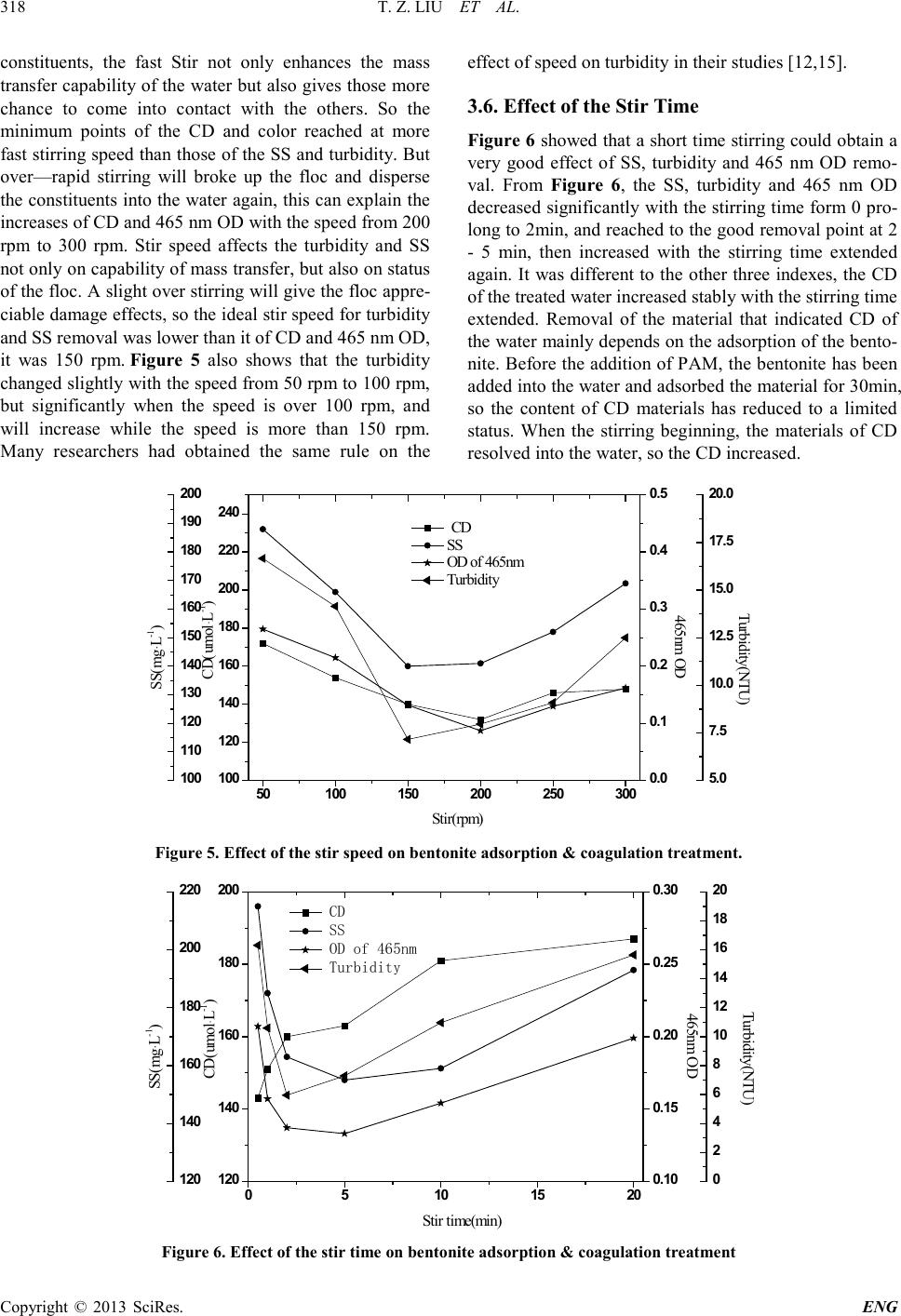 T. Z. LIU ET AL. Copyright © 2013 SciRes. ENG 318 constituents, the fast Stir not only enhances the mass transfer cap ability of the water but also gives those more chance to come into contact with the others. So the minimum points of the CD and color reached at more fast s tirri ng spe ed tha n tho se of t he SS and tur bidi ty. Bu t over—rapid stirring will broke up the floc and disperse the co nstitue nts into the water again, t his ca n explain t he increases of CD and 465 nm OD with the speed from 200 rpm to 300 rpm. Stir speed affects the turbidity and SS not o nly o n ca pab ilit y o f ma ss tr ans fer, but also o n sta tus of the floc. A sli ght over stirri ng will give t he floc app re- ciable damage effects, so the ideal stir speed for turbidity and SS removal was lower than it of CD and 465 nm OD, it was 150 rpm. Figure 5 also sho ws that the turbidity changed slightly with the speed from 50 rpm to 100 rpm, but significantly when the speed is over 100 rpm, and will increase while the speed is more than 150 rpm. Many researchers had obtained the same rule on the effect of speed on turbidity in their studies [12,15]. 3.6. Effec t of the Stir Time Figure 6 showed that a short time stirring could o btain a very good effect of SS, turbidity and 465 nm OD remo- val. From Figure 6, the SS, turbidity and 465 nm OD decreased significantl y with the stirri ng time fo rm 0 pro- long to 2min, and reached to the good removal point at 2 - 5 min, then increased with the stirring time extended again. It was different to the other three inde xes, the CD of the treated water increased stably with the stirring time extended. Removal of the material that indicated CD of the water mainly depends on the adsorption of the bento- nite. Before the addition of PAM, t he bentonite has been added into the water and adsorbed the material for 30min, so the content of CD materials has reduced to a limited status. When the stirring beginning, the materials of CD resolved into the water, so the CD incre ased. 100 110 120 130 140 150 160 170 180 190 200 5.0 7.5 10.0 12.5 15.0 17.5 20.0 50100 150 200 250 300 100 120 140 160 180 200 220 240 SS(mg · L -1 ) CD SS O D of 465nm Turbidity Stir(rpm) CD(umol · L -1 ) 0.0 0.1 0.2 0.3 0.4 0.5 Turbidi ty( NTU) 465nm O D Figure 5. Effect of the stir speed on bentoni te adsorption & coagulati on treatment. 120 140 160 180 200 220 0 2 4 6 8 10 12 14 16 18 20 05 10 15 20 120 140 160 180 200 SS(mg·L-1) CD SS OD of 465nm Turbidity S tir time( min ) CD(umol · L-1) 0. 10 0. 15 0. 20 0. 25 0. 30 Turbidi ty( NTU) 465nm O D Figure 6. Effect of the stir time on bentonite adsorption & coa gulation treat ment 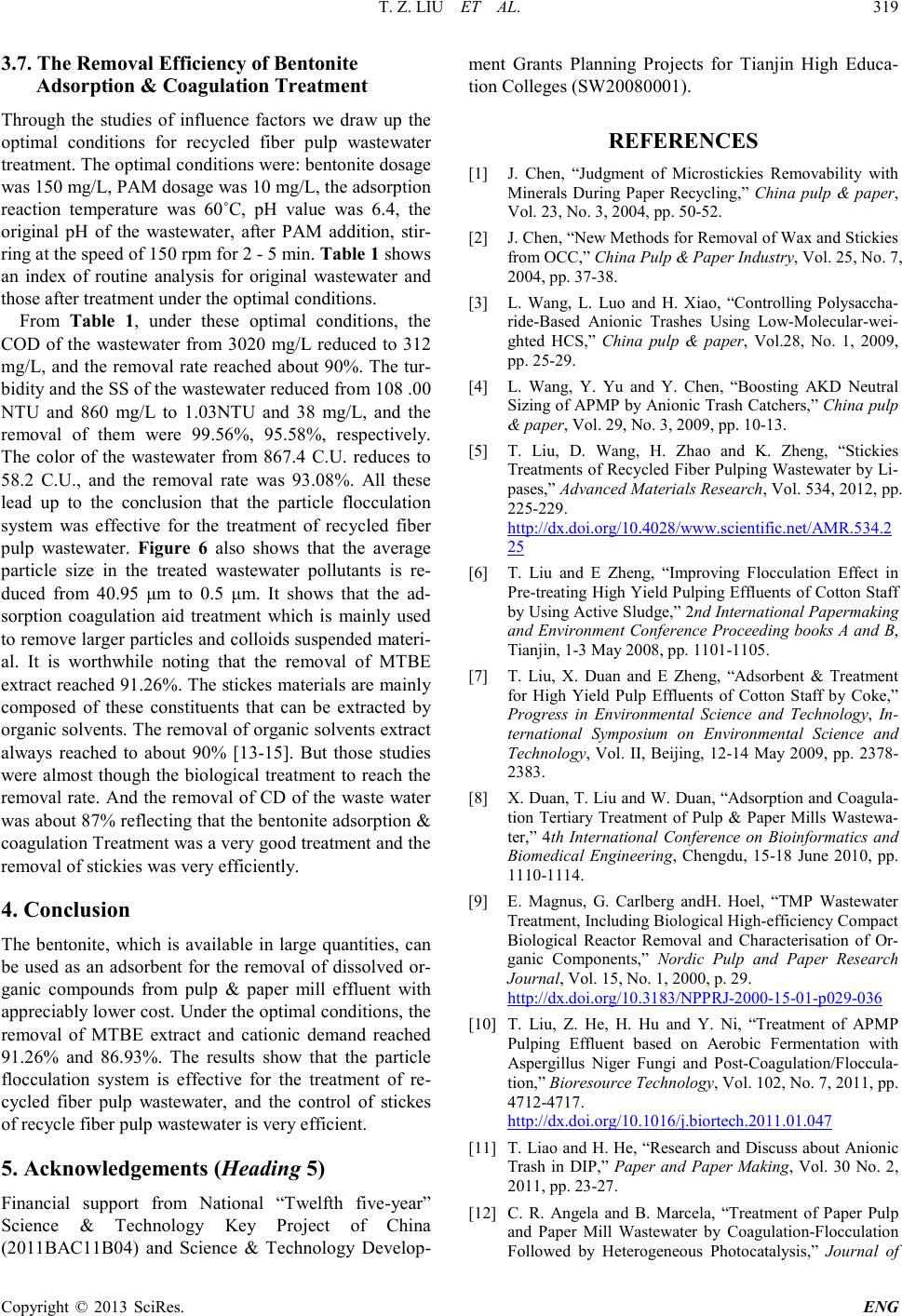 T. Z. LIU ET AL. Copyright © 2013 SciRes. ENG 319 3.7. The Removal Efficiency of Bentonite Adsorption & Coagulation Treatment Through the studies of influence factors we draw up the optimal conditions for recycled fiber pulp wastewater treatment. The optimal co nditi ons were: bentonite dosage was 150 mg/L, PAM dosage was 10 mg/L, the adsorption reaction temperature was 60˚C, pH value was 6.4, the original pH of the wastewater, after PAM additio n, stir- ring at the speed of 150 rpm for 2 - 5 min. Table 1 shows an index of routine analysis for original wastewater and those after treatment under the optimal cond itions. From Table 1, under these optimal conditions, the COD of the wastewater from 3020 mg/L reduced to 312 mg/L, and the removal rate reached about 90%. The tur- bidity and the SS of the waste water red uced from 108 .00 NTU and 860 mg/L to 1.03NTU and 38 mg/L, and the removal of them were 99.56%, 95.58%, respectively. The color of the wastewater from 867.4 C.U. reduces to 58.2 C.U., and the removal rate was 93.08%. All these lead up to the conclusion that the particle flocculation system was effective for the treatment of recycled fiber pulp wastewater. Figure 6 also shows that the average particle size in the treated wastewater pollutants is re- duced from 40.95 μm to 0.5 μm. It shows that the ad- sorption coagulation aid treatment which is mainly used to remove larger particles and colloids suspended materi- al. It is worthwhile noting that the removal of MTBE extract reached 91.26%. The stickes materials are mainly composed of these constituents that can be e xtracted by orga nic so lve nts. T he removal of organi c sol vent s extract always reached to about 90% [13-15]. But those studies were almost though the biological treatment to reach the removal rate. And the removal of CD of the waste water was about 87% reflecting that the bento nite adsor ption & coagulation T r eatment wa s a very good treatment and the removal of stickies was very efficiently. 4. Conclusion The bentonite, which is available in large quantities, can be used as an adsorbent for the removal of dissolved or- ganic compounds from pulp & paper mill effluent with appreciably lower cost. Und er the optimal condition s, the removal of MTBE extract and cationic demand reached 91.26% and 86.93%. The results show that the particle flocculation system is effective for the treatment of re- cycled fiber pulp wastewater, and the control of stickes of recycle fiber pulp wastewater is very efficien t. 5. Acknowledgemen ts (Heading 5) Financial support from National “Twelfth five-year” Science & Technology Key Project of China (2011BAC11B04) and Science & Technology Develop- ment Grants Planning Projects for Tianjin High Educa- tion Colleges (SW 20080001). REFERENCES [1] J. Chen, “Judgment of Microstickies Removability with Minerals During Paper Recycling,” China pulp & paper, Vol. 23, No. 3, 2004, pp. 50-52. [2] J. Chen, “New Methods for Removal o f Wax and Stickies from OCC,” China Pulp & Paper Industry, Vol. 25, No. 7, 2004, pp. 37-38. [3] L. Wang, L. Luo and H. Xiao, “Controlling Pol ysaccha- ride-Based Anionic Trashes Using Lo w-M olecular-wei- ghted HCS,” China pulp & paper, Vol.28, No. 1, 2009, pp. 25-29. [4] L. Wang, Y. Yu and Y. Chen, “Boosting AKD Neutral Sizing of APMP by Anionic Trash Catchers,” China pulp & paper, Vol. 29, No. 3, 2009, pp. 10-13. [5] T. Liu, D. Wang, H. Zhao and K. Zheng, “Stickies Treatments of Recycled Fiber Pulping Wastewater by Li- pases,” Ad vanced Mat erial s Research, Vo l. 534, 2012, p p. 225-229. http://dx.doi.org/10.4028/www.scientific.net/AMR.534.2 25 [6] T. Liu and E Zheng, “Improving Flocculation Effect in Pre-treating High Yield Pulping Effluents of Cotton Staff by Using Active Sludge,” 2nd International Papermaking and Environment Conference Proceeding books A and B, Tianjin, 1-3 May 2008, pp. 1101-1105. [7] T. Liu, X. Duan and E Zheng, “Adsorbent & Treatment for High Yield Pulp Effluents of Cotton Staff by Coke,” Progress in Environmental Science and Technology, In- ternational Symposium on Environmental Science and Technology, Vol. II, Beijing, 12-14 May 2009, pp. 2378- 2383. [8] X . Dua n, T. Li u and W. Duan, “Adsorption and Coagula- tion Tertiary Treatment of Pulp & Paper Mills Wastewa- ter,” 4th International Conference on Bioinformatics and Biomedical Engineering, Chengdu, 15-18 June 2010, pp. 1110-1114. [9] E. Magnus, G. Carlberg andH. Hoel, “TMP Wastewater Treatment , In clud ing Biol ogi cal High-efficien c y Co mpact Biological Reactor Removal and Characterisation of Or- ganic Components,” Nordic Pulp and Paper Research Journal, Vol. 15, No. 1, 2000 , p. 29. http://dx.doi.org/10.3183/NPPRJ-2000-15-01-p029-036 [10] T. Liu, Z. He, H. Hu and Y. Ni, “Treatment of APMP Pulping Effluent based on Aerobic Fermentation with Aspergillus Niger Fungi and Post-Coagulation/Floccula- tion,” Bioresource Technology, Vol. 102, No. 7, 2011, pp. 4712-4717. http://dx.doi.org/10.1016/j.biortech.2011.01.047 [11] T. Liao and H. He, “Research and Discuss about Anioni c Trash in DIP,” Paper and Paper Making, Vo l . 30 No. 2, 2011, pp. 23-27. [12] C. R. Angela and B. Marcela, “Treatment of Paper Pulp and Paper Mill Wastewater by Coagulation-Flocculation Followed by Heterogeneous Photocatalysis,” Journal of 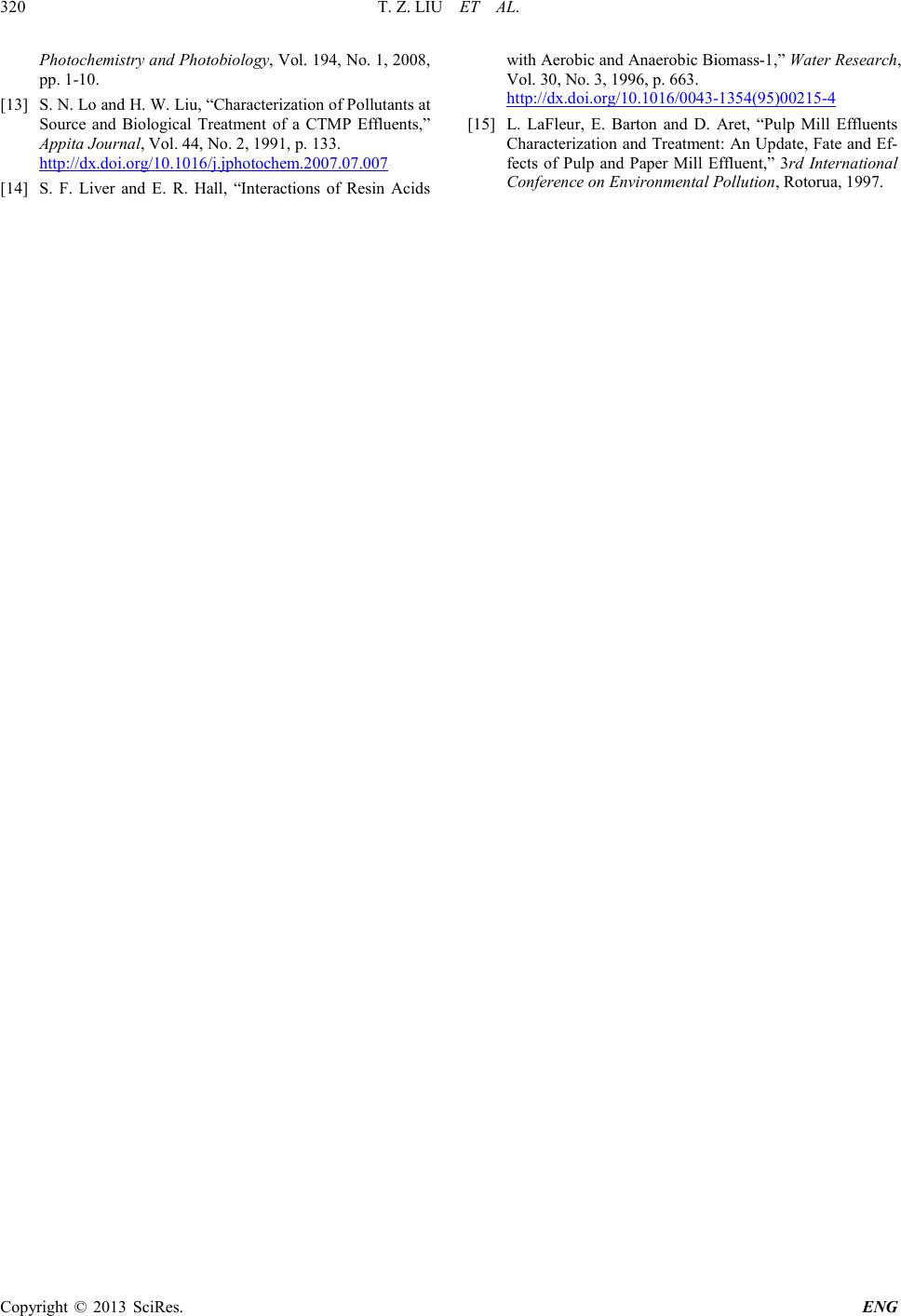 T. Z. LIU ET AL. Copyright © 2013 SciRes. ENG 320 Photochemistry and Photobiology, Vol. 194, No. 1, 2008 , pp. 1-10. [13] S. N. Lo and H. W. Liu, “C haracterizati on of Pollutants at Source and Biological Treatment of a CTMP Effluents,” Appita Journal, Vol. 44, No. 2, 1991, p. 133. http://dx.doi.org/10.1016/j.jphotochem.2007.07.007 [14] S. F. Liver and E. R. Hall, “Interactions of Resin Acids with Aerobic and Anaerobic Biomass-1,” Wat er Resea rch , Vol. 30, No. 3, 1996, p. 663. http://dx.doi.org/10.1016/0043-1354(95)00215-4 [15] L. LaFleur, E. Barton and D. Aret, “Pulp Mill Effluents Characterization and Treatment: An Upd ate, Fate and Ef- fects of Pulp and Paper Mill Effluent,” 3rd International Conference on Environmental Pollution, Rotorua, 1997. |