

Paper Menu >>
Journal Menu >>
 Engineering, 2013, 5, 310-313 http://dx.doi.org/10.4236/eng.2013.510B063 Published Online Octob er 2013 (http://www.scirp.org/journal/eng) Copyright © 2013 SciRes. ENG Effects of Different Types of Verbal Activities on Heart Rate Variability Ping Shi, Youfang Fang, Hongliu Yu* School of Medical Instrument and Food Engineering, University of Shanghai for Science and Technology, Shanghai, China Email: *[email protected] Received July 2013 ABSTRACT In the p resent stud y, the effec ts of d ifferent types o f verbal activitie s on heart rate variability (HRV) were investigated. ECG signals were recorded in ten volunteers during resting (R), reading silently (RS), re ading aloud (R A) and talking freely (TF). Time domain, frequen c y do main a nd Poincaré plot measures of HRV were calculated for analyz ing. Time domain parameter of pNN50, frequency domain parameter of LF (n. u.) and Poincaré plot parameter of SD1/SD2 were found statistica lly difference in RA and TF compared to R and RS. The re sults in this study show that HRV decreased while subjects were reading aloud and talking freely. The results also indicated that verbal activities of reading aloud and talking freely impr ove t he sympathetic ner vous activity. Keywords: Verbal Activities; H e a rt Rate Variabilit y; Time Domain Analys is; Fr e quency Domain Analysis; Poincaré Plot Param eters 1. Introduction Heart rate variability (HRV) has been recognized as a simple and va luable to ol to assess the re gulation o f heart rate behavior. It reflects the homeostatic interplay be- tween perturbations in cardiovascular functions and the dynamic responses of the cardiovascular regulatory sys- tems [1]. There is considerable interest in HRV because their measures such as the standard deviation of the in- terbeat intervals (the RRI), have been shown to be some of the strongest independent predictors of mortality after myocardial infarction [2]. Moreover, other techniques such as spectral analysis and nonlinear analysis (such as Poincaré plot) of the RRI of HR have been widely used in HRV studies [3-5], and on some occasions they have been shown to discriminate between subjects with dif- ferent cardiac c onditio ns as well a s to pr edict mortality in some groups of patients. Several types of verbalization including reading silently, reading aloud and talking freely occurs in our daily life. The aim of this paper is to investigate t he effect of different co nditions of verbaliza- tion on HRV . 2. Method s 2.1. Protocols The study was performed in ten normotensive male vo- lunteers (20.2 ± 1.6 years). None of the subjects was taking medication. The subjects gave written informed consent and the study protocol was approved by the Eth- ics Committee of the University of Shanghai for Science and Technology, China. All the tests were carried out while the subjects rested in the 135 degree sitting position on a co mfortable chair. Subjects were asked a resting period of at least 15 mi- nutes before ECG signals were recording. Recordings were made in random order during: 1) resting; 2 ) reading a text silently (5 min); 3) reading the same text aloud (5 min); 4) normal talking (5 min). 2.2. Measurement of HRV Like many other physiological parameters, HRV is in- fluenced by a variety of factors like sex, age, diurnal rhythms, respiration, fitness levels, posture and physical activity. In 1996, Task Force of the European Society of Cardiology (ESC) and the North American Society of Pacing and Electrophysiology (NASPE) defined and es- tablished standards of measurement, physiological inter- pretation and c linica l use of HRV [ 1]. The time domain measures of HRV are based on sta- tistical or geometric analyses of the lengths of intervals between successive normal complexes. Frequency do- main HRV i ndices are deter mined by calc ulating the pow- er spectral density of the ECG recording using a nonpa- rametric fast Fourier transform (FFT) algorithm. Poin- caré plot as a nonlinear method is a scatter outline of the *Corresponding author. 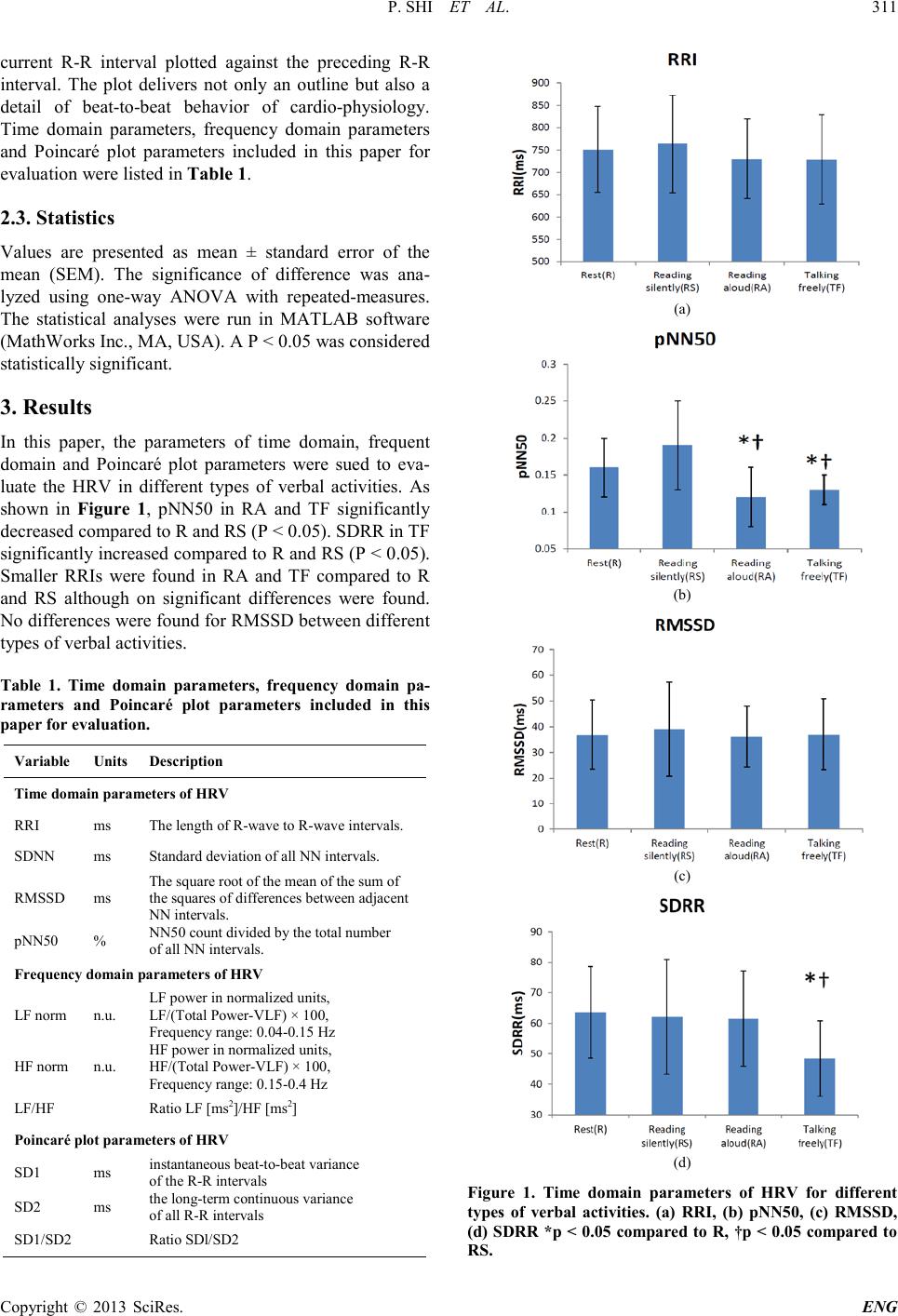 P. SHI ET AL. Copyright © 2013 SciRes. ENG 311 current R-R interval plotted against the preceding R-R interval. The plot delivers not only an outline but also a detail of beat-to-beat behavior of cardio-physiology. Time domain parameters, frequency domain parameters and Poincaré plot parameters included in this paper for evaluation were listed in Table 1. 2.3. Statistics Values are presented as mean ± standard error of the mean (SEM). The significance of difference was ana- lyzed using one-way ANOVA with repeated-measures. The statistical analyses were run in MATLAB software (MathWorks Inc., MA, USA). A P < 0.05 was considered statisticall y significant. 3. Resul ts In this paper, the parameters of time domain, frequent domain and Poincaré plot parameters were sued to eva- luate the HRV in different types of verbal activities. As shown in Figure 1, pNN50 in RA and TF significantly decreased compared to R and RS (P < 0.05). SDRR in TF significantly increased co mpared to R and RS (P < 0.05). Smaller RRIs were found in RA and TF compared to R and RS although on significant differences were found. No differences were found for RMSSD between different types of verba l a c tivities. Table 1. Time domain parameters, frequency domain pa- rameters and Poincaré plot parameters included in this paper for evaluation. Var iable Units Description Time domain parameters of HRV RRI ms The length of R-wave to R-wave intervals. SDNN ms St andard deviation of all NN intervals. RMSSD ms The square root of the mean of the sum of th e squares o f dif f erences betwe en adjacent NN interva ls . pNN50 % NN50 c o unt div i d e d by the tota l number of all NN intervals. Frequency domain parameters of HRV LF norm n.u. LF power in normalized units, LF/(Total Power-VLF) × 10 0, Frequency range: 0.04-0.15 Hz HF norm n.u. HF power in normalized units, HF/(Total Power-VLF) × 100, Frequency range: 0.15-0.4 Hz LF/HF Ratio LF [ms2]/HF [ms2] Poincaré plot parameters of HRV SD1 ms instantaneous beat-to-beat variance of the R-R intervals SD2 ms the long-term continu ous variance of all R-R intervals SD1/SD2 Ratio SDl/SD2 (a) (b) (c) (d) Figure 1. Time domain parameters of HRV for different types of verbal activities. (a) RRI, (b) pNN50, (c) RMSSD, (d) SDRR *p < 0.05 compared to R, †p < 0.05 compared to RS. 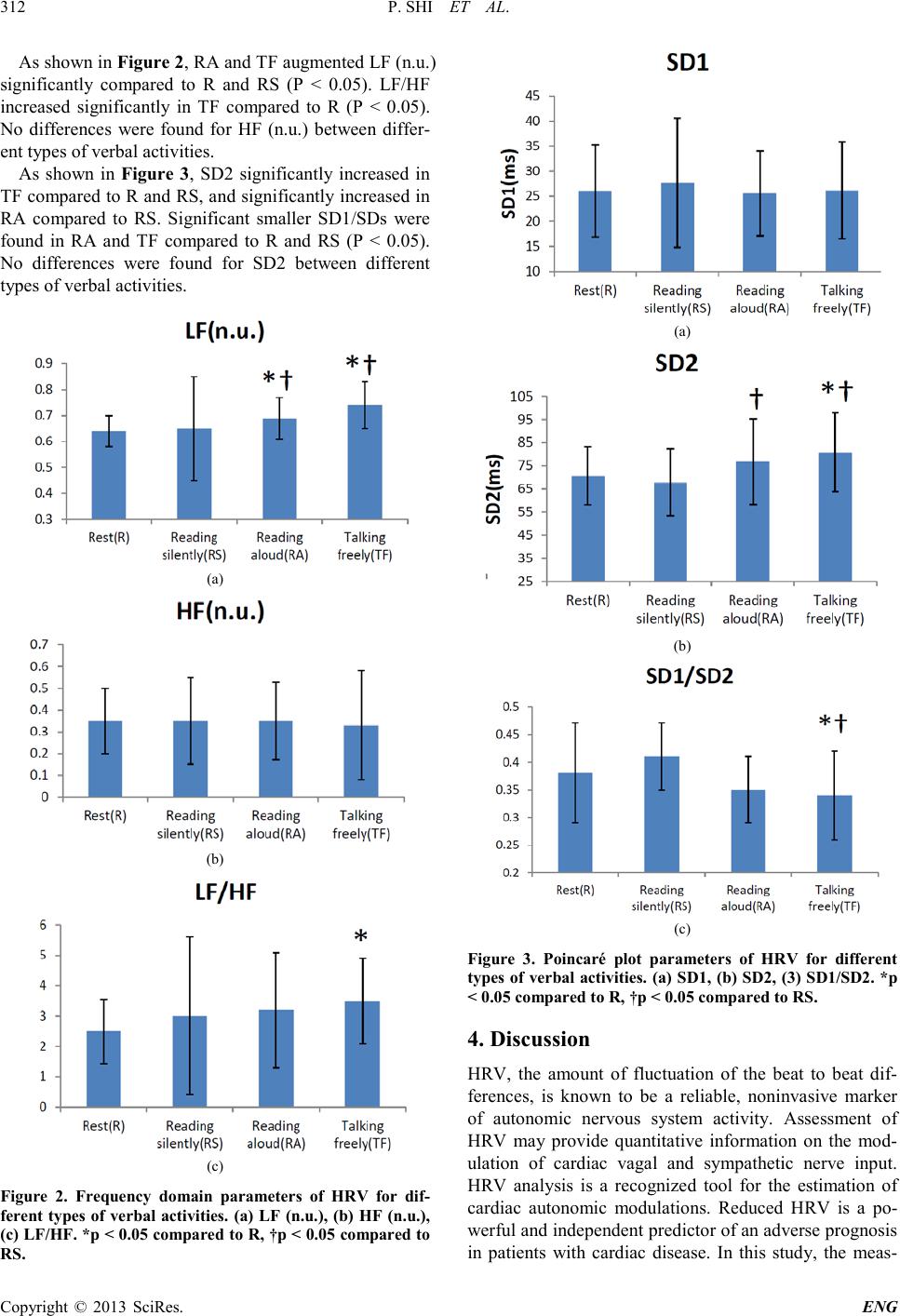 P. SHI ET AL. Copyright © 2013 SciRes. ENG 312 As shown in F igure 2, RA and TF augmented LF (n.u.) significantly compared to R and RS (P < 0.05). LF/HF increased significantly in TF compared to R (P < 0.05). No differences were found for HF (n.u.) between differ- ent types of verbal a c tivities. As shown in Figure 3, SD2 significantly increased in TF compared to R and RS, and significantly increased in RA compared to RS. Significant smaller SD1/SDs were found in RA and TF compared to R and RS (P < 0.05). No differences were found for SD2 between different types of verba l a c tivities. (a) (b) (c) Figure 2. Frequency domain parameters of HRV for dif- ferent types of verbal activities. (a) LF (n.u.), (b) HF (n.u.), (c) LF/HF. *p < 0.05 compare d to R, †p < 0.05 compared to RS. (a) (b) (c) Figure 3. Poincaré plot parameters of HRV for different types of verbal activities. (a) SD1, (b) SD2, (3) SD1/SD2. *p < 0.05 compared to R, †p < 0.05 compared to RS. 4. Discussion HRV, the amount of fluctuation of the beat to beat dif- ferences, is known to be a reliable, noninvasive marker of autonomic nervous system activity. Assessment of HRV may provide quantitative information on the mod- ulation of cardiac vagal and sympathetic nerve input. HRV analysis is a recognized tool for the estimation of cardiac autonomic modulations. Reduced HRV is a po- werful and independent predictor of an adverse prognosis in patients with cardiac disease. In this study, the meas- 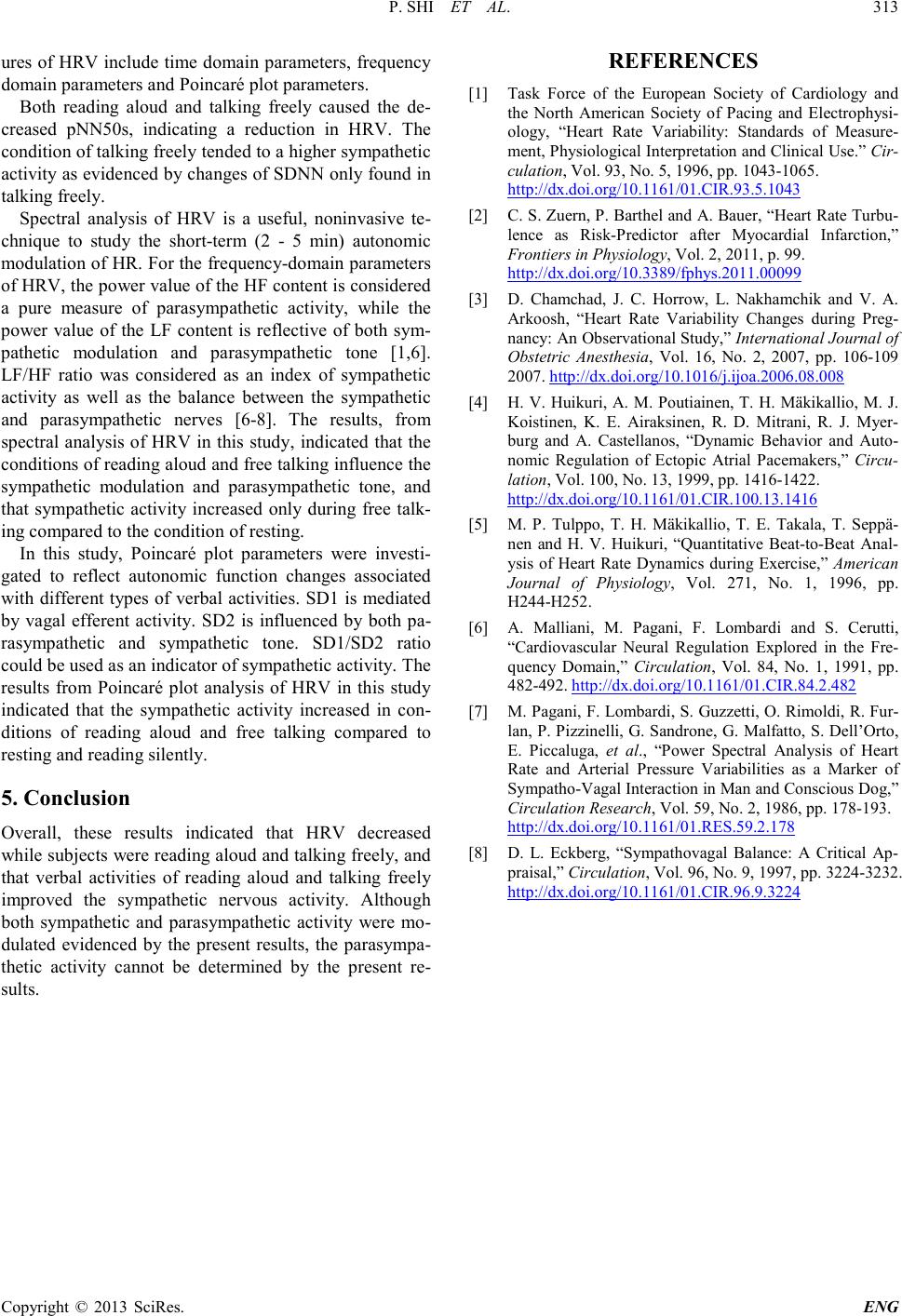 P. SHI ET AL. Copyright © 2013 SciRes. ENG 313 ures of HRV include time domain parameters, frequency domain parameters and Poincaré plot parameters. Both reading aloud and talking freely caused the de- creased pNN50s, indicating a reduction in HRV. The condition of talking freely tended to a higher sympathetic activity as evidenced by changes of SDNN only found in talki ng fr ee l y. Spectral analysis of HRV is a useful, noninvasive te- chnique to study the short-term (2 - 5 min) autonomic modulation o f HR. For the frequency-do main parameters of HRV, the power value of the HF content is considered a pure measure of parasympathetic activity, while the power value of the LF content is reflective of both sym- pathetic modulation and parasympathetic tone [1,6]. LF/HF ratio was considered as an index of sympathetic activity as well as the balance between the sympathetic and parasympathetic nerves [6-8]. The results, from spectral analysis of HRV in this study, indicated that the conditions of reading aloud and free talking influe nce th e sympathetic modulation and parasympathetic tone, and that sympathetic activity increased only during free talk- ing compared to the condition of resting. In this study, Poincaré plot parameters were investi- gated to reflect autonomic function changes associated with different types of verbal activities. SD1 is mediated by vagal efferent activity. SD2 is influenced by both pa- rasympathetic and sympathetic tone. SD1/SD2 ratio could be used as an indicator of sympathetic activity. The results from Poincaré plot analysis of HRV in this study indicated that the sympathetic activity increased in con- ditions of reading aloud and free talking compared to resting and reading silently. 5. Conclusion Overall, these results indicated that HRV decreased while subjects were reading aloud and talking freely, and that verbal activities of reading aloud and talking freely improved the sympathetic nervous activity. Although both sympathetic and parasympathetic activity were mo- dulated evidenced by the present results, the parasympa- thetic activity cannot be determined by the present re- sults. REFERENCES [1] Task Force of the European Society of Cardiology and the North American Society of Pacing and Electrophysi- ology, “Heart Rate Variability: Standards of Measure- ment, Physiological Interpretation and Clinical Use.” Cir- culation, Vol. 93, No. 5, 1996, pp. 1043-1065. http://dx.doi.org/10.1161/01.CIR.93.5.1043 [2] C. S. Zuern, P. Barthel and A. Bauer, “Heart Rat e Turbu- lence as Risk-Predictor after Myocardial Infarction,” Frontiers in Physiology, Vol. 2, 2011, p. 99. http://dx.doi.org/10.3389/fphys.2011.00099 [3] D. Chamchad, J. C. Horrow, L. Nakhamchik and V. A. Arkoosh, “Heart Rate Variability Changes during Preg- nancy: An Observational Study,” International Journal of Obstetric Anesthesia, Vol. 16, No. 2, 2007, pp. 106-109 2007. http://dx.doi.org/10.1016/j.ijoa.2006.08.008 [4] H. V. Huikuri, A. M. Poutiainen, T. H. Mäkikallio, M. J. Koistinen, K. E. Airaksinen, R. D. Mitrani, R. J. Myer- burg and A. Castellanos, “Dynamic Behavior and Auto- nomic Regulation of Ectopic Atrial Pacemakers,” Circu- lation, Vol. 100, No. 13, 1999, pp. 1416-1422. http://dx.doi.org/10.1161/01.CIR.100.13.1416 [5] M. P. Tulppo, T. H. Mäkikallio, T. E. Takala, T. Seppä- nen and H. V. Huikuri, “Quantitative Beat-to-Beat Anal- ysis of Heart Rate Dynamics during Exercise,” American Journal of Physiology, Vol. 271, No. 1, 1996, pp. H244-H252. [6] A. Malliani, M. Pagani, F. Lombardi and S. Cerutti, “Cardiovascular Neural Regulation Explored in the Fre- quency Domain,” Circulation, Vol. 84, No. 1, 1991, pp. 482-492. http://dx.doi.org/10.1161/01.CIR.84.2.482 [7] M. Pagani, F. Lombardi, S. Guzzetti, O. Rimoldi, R. Fur- lan, P. P izzinelli, G. Sandron e, G. Malfatto, S. Dell ’Orto, E. Piccaluga, et al., “Power Spectral Analysis of Heart Rate and Arterial Pressure Variabilities as a Marker of Sympatho-Vagal Interact io n in Man and Conscious Dog,” Circ ulat ion Rese ar c h, Vol. 59, No. 2, 1986, pp. 178 -193. http://dx.doi.org/10.1161/01.RES.59.2.178 [8] D. L. Eckberg, “Sympathovagal Balance: A Critical Ap- praisal ,” Circulation, Vol. 96, No. 9, 1997, pp. 3224-3232. http://dx.doi.org/10.1161/01.CIR.96.9.3224 |