

Paper Menu >>
Journal Menu >>
 Journal of Crystallization Process and Technology, 2013, 3, 163-169 http://dx.doi.org/10.4236/jcpt.2013.34025 Published Online October 2013 (http://www.scirp.org/journal/jcpt) Copyright © 2013 SciRes. JCPT 163 Recrystallization Kin etics and Microstructure Evolution of Annealed Cold-Drawn Low-Carbon Steel Nurudeen A. Raji, Oluleke O. Oluwole Department of Mechanical Engineering, University of Ibadan, Ibadan, Nigeria. Email: [email protected], [email protected] Received July 23rd, 2013; revised August 23rd, 2013; accepted August 30th, 2013 Copyright © 2013 Nurudeen A. Raji, Oluleke O. Oluwole. This is an open access article distributed under the Creative Commons Attribution License, which permits unrestricted use, distribution, and reproduction in any medium, provided the original work is properly cited. ABSTRACT The recrystallization behavior of cold-drawn 0.12 wt% C steel during annealing at temperatures 600˚C and 650˚C was investigated. Hardness tests were used to characterize the recrystallization kinetics. The micrographs of the steel were obtained using optical microscopy (OM) to characterize the grain microstructure of the non-treated and the annealed steel samples. Annihilation of dislocation defects occur within the soaking time of 5 - 10 minutes for all the deformed steel after annealing at 650˚C. Specifically at 5 minutes soaking time the grains elongation is still observed indicating that reformation of grains is not taking place but recovery of the deformed grains. At the 10 minutes annealing time, new grains are observed to begin and full recrystallization is achieved at 15 minutes annealing time. At annealing time between 20 - 25 minutes, grains coarsening are observed indicating the onset of grain growth. The hardness of the ma- terial reduces with increasing annealing temperature for all the degree of cold drawn deformation. On the basis of the experimentally obtained hardness values, recrystallization increases with increasing degree of cold drawn deformation for the annealed steel. Recovery process was found to prolong in the 20% cold drawn steel as compared to the 55% cold drawn steel. The prolong recovery process is due to reduction in the driving force. Full recrystallization of the annealed steel is achieved at different soaking time depending on the degree of the cold drawn steel. Keywords: Drawn Steel; Recovery; Recrystallization; Microstructure; Hardness; Soaking Time 1. Introduction Drawn steel is products of metal drawing process which include bar or rod drawing, tube drawing and wire draw- ing. This drawing process has been widely used to ma- nufacture fine wires, tension loaded structural compo- nents, springs, paper clips, spokes for wheels and plain nails [1,2]. The wire drawing process reduces the cross- section of a wire by pulling it through series of drawing dies of decreasing diameter to produce wires of desired diameters. It is mostly performed at room temperature and thus is classified as cold-work process. The original metal usually consists of strain-free crystal grains [3]. When the metal is deformed by cold drawing, dislocation and other imperfections such as vacancies are introduced into the crystal structure generating microstructure het- erogeneities that exhibit large orientation gradient [4]. The grains then acquire a preferred orientation or texture. The structural changes which occur include the gradual stretching of the grains in the direction of principal de- formation and accumulation of dislocation and some other defects [5]. The accumulation and migration of the dislocation due to the cold drawing process results in strain hardening of the steel allowing for increase in its tensile strength with reduced ductility [6]. The degree of cold-drawn deformation determines whether the steel will attain a brittle nature or remains ductile [7]. The strain hardening also known as work hardening is an in- crement in internal energy associated with an increase in the dislocation density as well as density in point defects, such as vacancies and interstitials [8,9]. Some other ef- fects of such cold work on the properties of polycrystal- line structures have been studied extensively [10-20]. The individual grain of a polycrystalline material chang- es relative to the direction of applied stress during the deformation which is distributed heterogeneously among the individual grains [21]. A typical feature of such de- formed structure is anisotropy of mechanical properties. An initially isotropic material responds by developing anisotropy when subjected to inelastic deformation. The  Recrystallization Kinetics and Microstructure Evolution of Annealed Cold-Drawn Low-Carbon Steel Copyright © 2013 SciRes. JCPT 164 inelastic induced anisotropy includes directional anisot- ropy in cold worked metals [22]. These changes in the mechanical properties of the steel due to the deformation often influence the performance of the resulting product of the process in service. In the case of wire drawing pro- cess for plain nail manufacture, the steel is cold-drawn to sizes at 20%, 25%, 40%, and 55% for the manufacture of 4 inches, 3 inches, 2.5 inches and 2 inches respectively. During the drawing operation the carbon steel experi- ences microstructure changes which affect the mechani- cal properties of the steel and consequently the perform- ance of the resulting product in service [23]. The associ- ated problems include high strain hardening of the steel due to the degree of plastic deformation which causes nail brittleness or poor ductility resulting in buckling of the nail in service. The large amount of internal strain in the form dislocation as a result of the strain hardening means that energy is stored in the metal. This energy can be released through heat treatment, where energy in the form of heat is introduced into the material allowing the release of stored energy in the process of recrystallization [24]. Recrystallization is the reconstruction of the grain structure during annealing of deformed metals. It causes a change in the grain structure of the material that has been previously cold-worked or plastically deformed. The recrystallization process tends to eliminate the dis- locations by means of migration of high-angle grain boundaries driven by the stored energy of deformation and a new grain structure in the deformed material evolved. [25,26]. Thus, new dislocation-free grains are formed within the recovered structure. The new grains then grow at the expense of the old deformed grains, leaving a new structure with low dislocation. The new structure consumes the old grains, resulting in a new grain structure with a very or no low dislocation density [27]. Recrystallization is a function of the amount of strain induced during deformation as well as the time and tem- perature of annealing [28]. In this study, the recrystalli- zation kinetics and the corresponding microstructure evo- lution in annealed cold-drawn low carbon steel is inves- tigated according to annealing time by mechanical test and microstructure characterization. The kinetics of re- crystallization involves determining the fraction of re- crystallized grains with annealing time which is used to describe the evolution of the recrystallized grains with increasing time of annealing at a particular temperature [29]. The studies of the recrystallization kinetics have shown that the mechanical properties of metallic materi- als could be controlled by the microstructure of the mate- rial [28,30,31]. The control of the microstructure of the steel could therefore be used to obtain desired mechanic- cal properties for the steel. The idea of control of me- chanical properties in materials through these processing techniques has been studied [32]. Recrystallization is a thermally activated process, con- sisting of the generation of strain-free grains and their growth at the expense of the deformed grains until the deform grain is entirely consumed [28]. And the driving force for recrystallization is the energy stored in the ma- terial during deformation [33]. The purpose of recrystal- lization is to refine the grains for improved properties and important mechanical properties can be restored after annealing of cold deformed steel allowing for further de- formation. The generally accepted empirical model used to de- scribe recrystallization kinetics is the Johnson-Mehl-Avra- mi-Kolmogorov (JMAK) expressed [28,30,33] as: 1exp n v X kt where v X the volume recrystallized, k is the JMAK variable which is temperature dependent and n is the JMAK exponent and t is the annealing time. The model was developed on the assumption that the recrystallized nuclei form randomly in the cold-worked microstructure and that the growth of the nuclei is iso- tropic but real materials do not exhibit this behavior be- cause of the non-uniform distribution of the stored en- ergy, non-random distribution of the nuclei and anisot- ropic growth of recrystallized nuclei [34]. It is therefore of importance to consider real situation of the recrystal- lization process through experimentation as input for a realistic model. This paper considered the use of the micro hardness property of the annealed cold drawn low carbon steel at different temperature and soaking time to investigate the recrystallization process for desired mechanical proper- ties. 2. Materials and Methods The low carbon steel used for this study is obtained from Nigeria Wire Industry Ltd, Ikeja, Nigeria. The average chemical composition for the steel is as given in Table 1. Samples of wire cold-drawn by 25% and 40% degree of deformation were obtained. A Muffle furnace, Gallen- komp® model SVL-1009 with voltage regulation of 220 V, 50 Hz of temperature range 300˚C ~ 1000˚C obtained in the materials test laboratory of Igbinedion University, Okada was used to annealed the steel at 650˚C and 700˚C for time interval ranging from 5 minutes to 60 minutes. Table 1. Chemical composition of the as-received steel wire material (wt%). C Si Mn P Fe 0.12 0.18 0.14 0.7 98.86 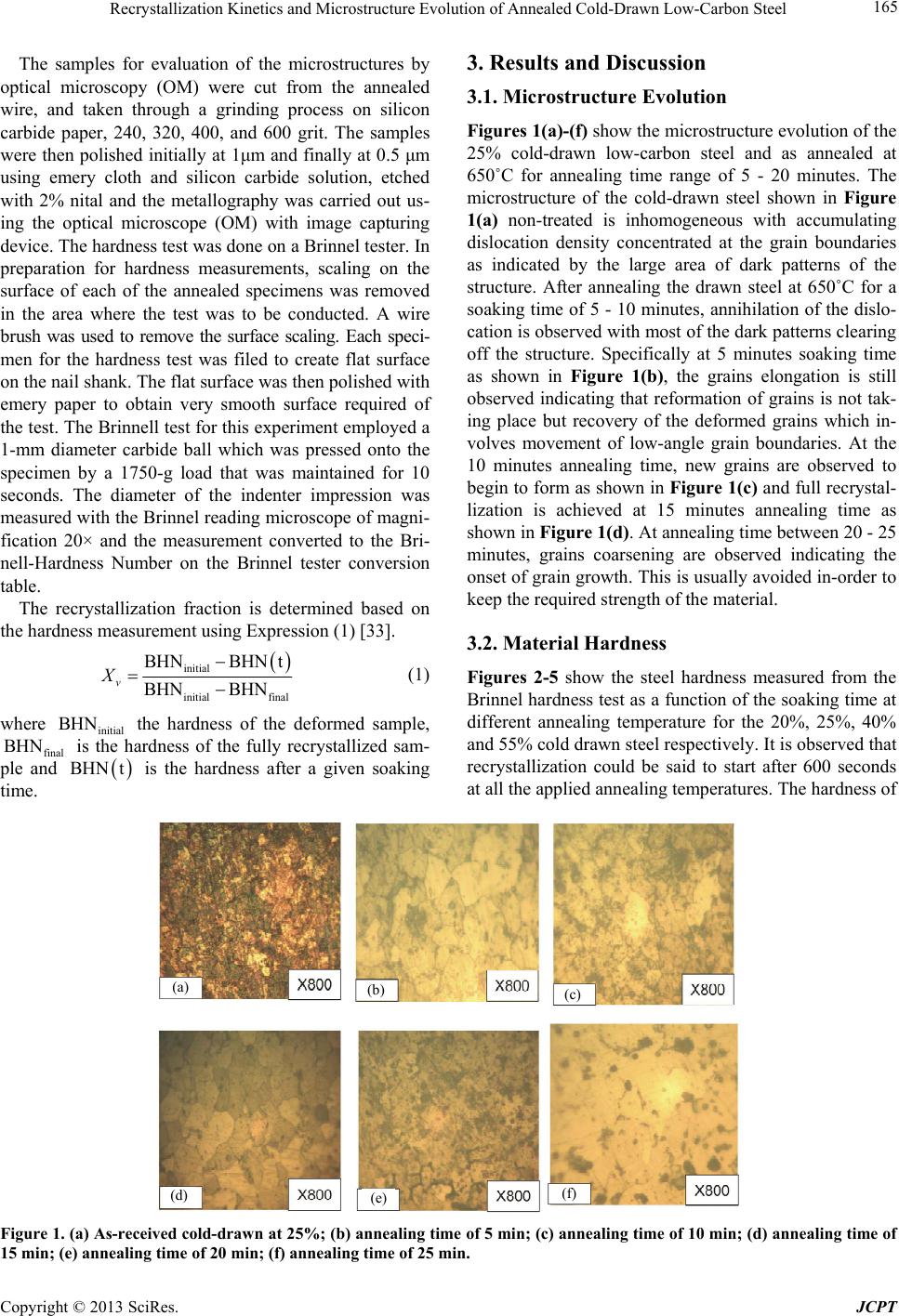 Recrystallization Kinetics and Microstructure Evolution of Annealed Cold-Drawn Low-Carbon Steel Copyright © 2013 SciRes. JCPT 165 The samples for evaluation of the microstructures by optical microscopy (OM) were cut from the annealed wire, and taken through a grinding process on silicon carbide paper, 240, 320, 400, and 600 grit. The samples were then polished initially at 1μm and finally at 0.5 μm using emery cloth and silicon carbide solution, etched with 2% nital and the metallography was carried out us- ing the optical microscope (OM) with image capturing device. The hardness test was done on a Brinnel tester. In preparation for hardness measurements, scaling on the surface of each of the annealed specimens was removed in the area where the test was to be conducted. A wire brush was used to remove the surface scaling. Each speci- men for the hardness test was filed to create flat surface on the nail shank. The flat surface was then polished with emery paper to obtain very smooth surface required of the test. The Brinnell test for this experiment employed a 1-mm diameter carbide ball which was pressed onto the specimen by a 1750-g load that was maintained for 10 seconds. The diameter of the indenter impression was measured with the Brinnel reading microscope of magni- fication 20× and the measurement converted to the Bri- nell-Hardness Number on the Brinnel tester conversion table. The recrystallization fraction is determined based on the hardness measurement using Expression (1) [33]. initial initial final BHNBHN t BHN BHN v X (1) where initial BHN the hardness of the deformed sample, final BHN is the hardness of the fully recrystallized sam- ple and BHN t is the hardness after a given soaking time. 3. Results and Discussion 3.1. Microstructure Evolution Figures 1(a)-(f) show the microstructure evolution of the 25% cold-drawn low-carbon steel and as annealed at 650˚C for annealing time range of 5 - 20 minutes. The microstructure of the cold-drawn steel shown in Figure 1(a) non-treated is inhomogeneous with accumulating dislocation density concentrated at the grain boundaries as indicated by the large area of dark patterns of the structure. After annealing the drawn steel at 650˚C for a soaking time of 5 - 10 minutes, annihilation of the dislo- cation is observed with most of the dark patterns clearing off the structure. Specifically at 5 minutes soaking time as shown in Figure 1(b), the grains elongation is still observed indicating that reformation of grains is not tak- ing place but recovery of the deformed grains which in- volves movement of low-angle grain boundaries. At the 10 minutes annealing time, new grains are observed to begin to form as shown in Figure 1(c) and full recrystal- lization is achieved at 15 minutes annealing time as shown in Figure 1(d). At annealing time between 20 - 25 minutes, grains coarsening are observed indicating the onset of grain growth. This is usually avoided in-order to keep the required strength of the material. 3.2. Material Hardness Figures 2-5 show the steel hardness measured from the Brinnel hardness test as a function of the soaking time at different annealing temperature for the 20%, 25%, 40% and 55% cold drawn steel respectively. It is observed that recrystallization could be said to start after 600 seconds at all the applied annealing temperatures. The hardness of (a) (b) (c) (d) (e) (f) Figure 1. (a) As-received cold-drawn at 25%; (b) annealing time of 5 min; (c) annealing time of 10 min; (d) annealing time of 15 min; (e) annealing time of 20 min; (f) annealing time of 25 min. 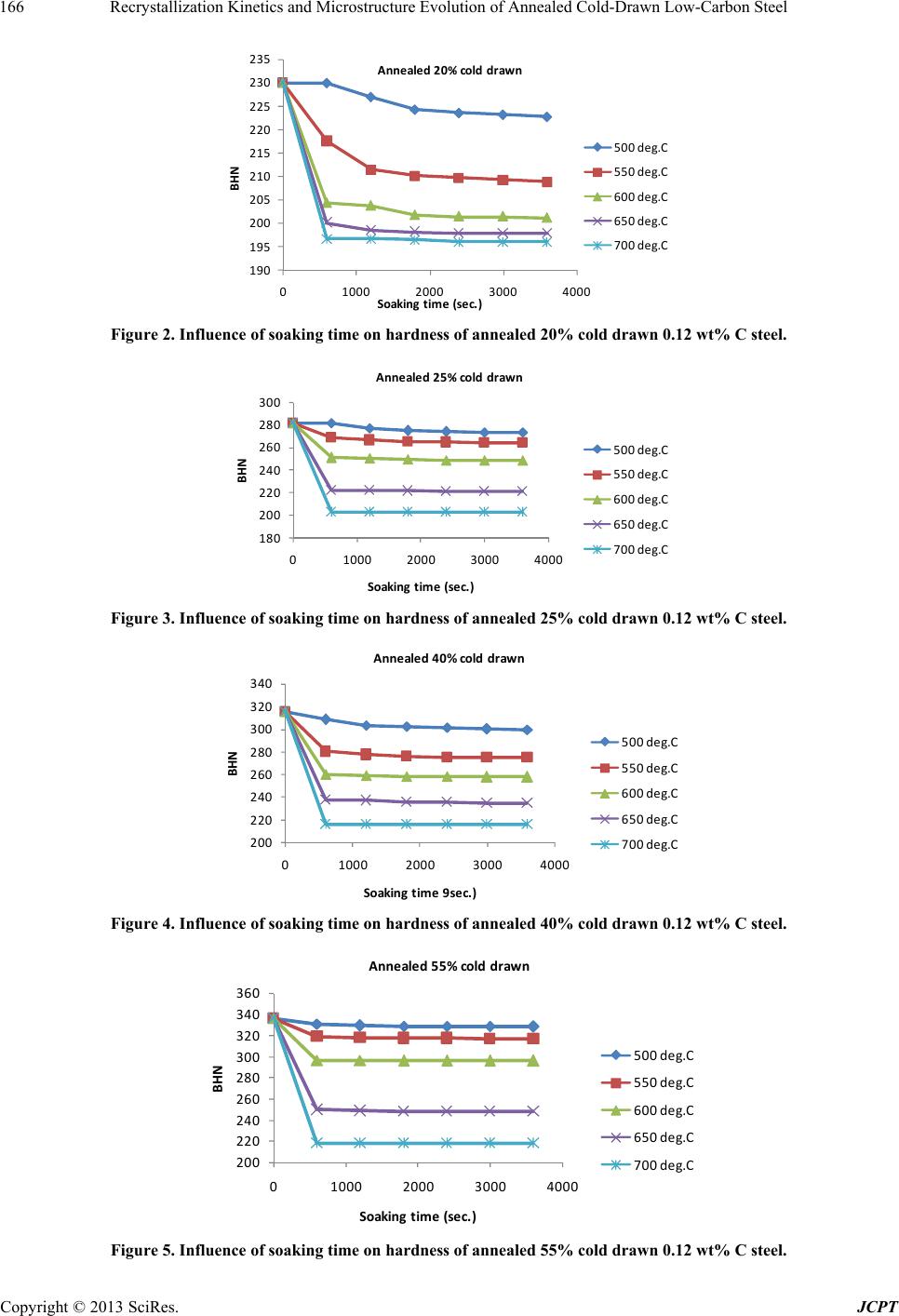 Recrystallization Kinetics and Microstructure Evolution of Annealed Cold-Drawn Low-Carbon Steel Copyright © 2013 SciRes. JCPT 166 190 195 200 205 210 215 220 225 230 235 01000 2000 3000 4000 BHN Soakingtime(sec.) Annealed20%col ddrawn 500deg.C 550deg.C 600deg.C 650deg.C 700deg.C Figure 2. Influence of soaking time on hardness of annealed 20% cold drawn 0.12 wt% C steel. 180 200 220 240 260 280 300 01000 2000 3000 4000 BHN Soakingtime(sec.) Annealed25%colddrawn 500de g.C 550de g.C 600de g.C 650de g.C 700de g.C Figure 3. Influence of soaking time on hardness of annealed 25% cold drawn 0.12 wt% C steel. 200 220 240 260 280 300 320 340 01000 2000 3000 4000 BHN Soakingtime9sec.) Annealed40%colddrawn 500deg.C 550deg.C 600deg.C 650deg.C 700deg.C Figure 4. Influence of soaking time on hardness of annealed 40% cold drawn 0.12 wt% C steel. 200 220 240 260 280 300 320 340 360 01000 2000 3000 4000 BHN Soakingtime(sec. ) Annealed55% col d drawn 500deg.C 550deg.C 600deg.C 650deg.C 700deg.C Figure 5. Influence of soaking time on hardness of annealed 55% cold drawn 0.12 wt% C steel. 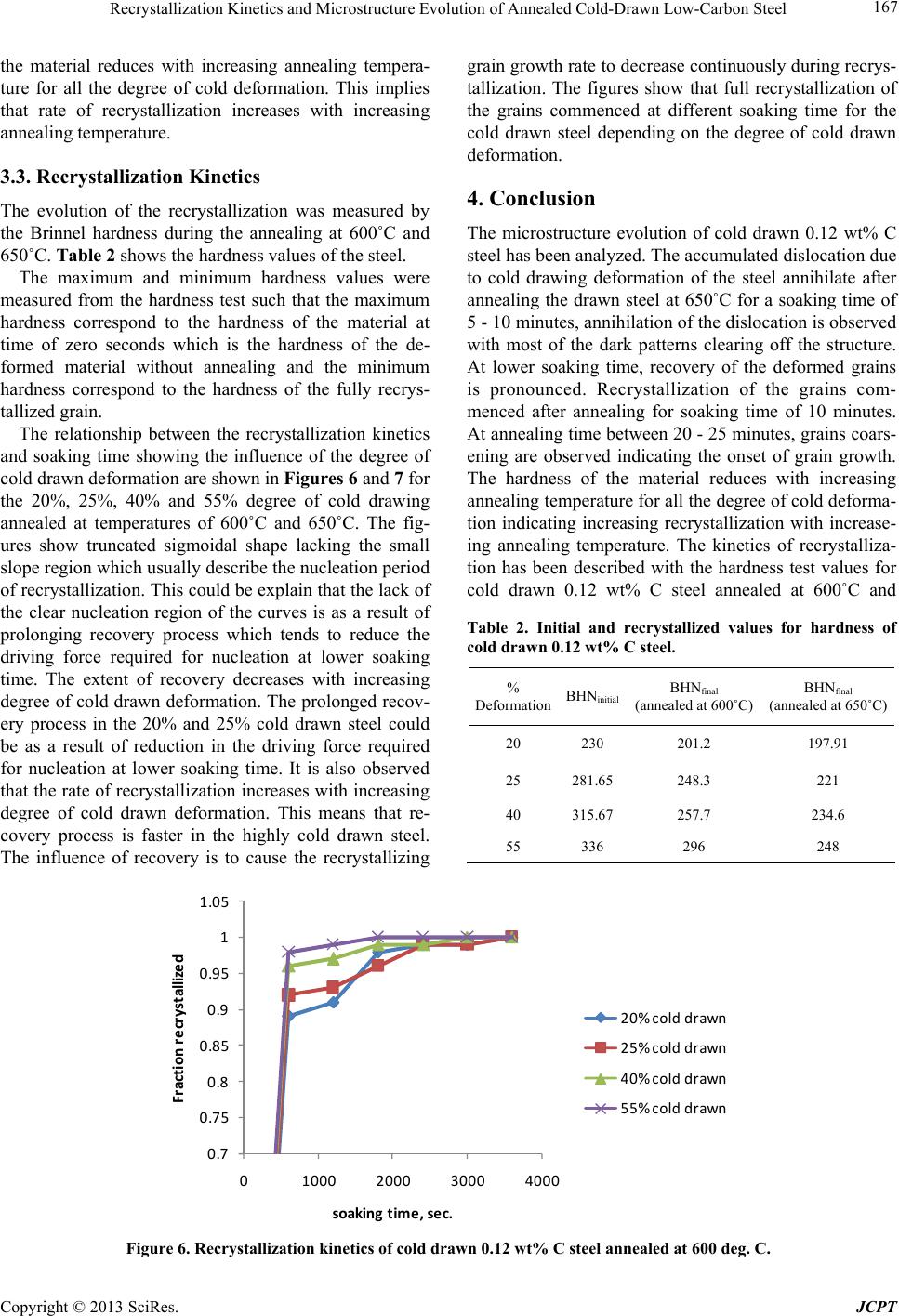 Recrystallization Kinetics and Microstructure Evolution of Annealed Cold-Drawn Low-Carbon Steel Copyright © 2013 SciRes. JCPT 167 the material reduces with increasing annealing tempera- ture for all the degree of cold deformation. This implies that rate of recrystallization increases with increasing annealing temperature. 3.3. Recrystallization Kinetics The evolution of the recrystallization was measured by the Brinnel hardness during the annealing at 600˚C and 650˚C. Table 2 shows the hardness values of the steel. The maximum and minimum hardness values were measured from the hardness test such that the maximum hardness correspond to the hardness of the material at time of zero seconds which is the hardness of the de- formed material without annealing and the minimum hardness correspond to the hardness of the fully recrys- tallized grain. The relationship between the recrystallization kinetics and soaking time showing the influence of the degree of cold drawn deformation are shown in Figures 6 and 7 for the 20%, 25%, 40% and 55% degree of cold drawing annealed at temperatures of 600˚C and 650˚C. The fig- ures show truncated sigmoidal shape lacking the small slope region which usually describe the nucleation period of recrystallization. This could be explain that the lack of the clear nucleation region of the curves is as a result of prolonging recovery process which tends to reduce the driving force required for nucleation at lower soaking time. The extent of recovery decreases with increasing degree of cold drawn deformation. The prolonged recov- ery process in the 20% and 25% cold drawn steel could be as a result of reduction in the driving force required for nucleation at lower soaking time. It is also observed that the rate of recrystallization increases with increasing degree of cold drawn deformation. This means that re- covery process is faster in the highly cold drawn steel. The influence of recovery is to cause the recrystallizing grain growth rate to decrease continuously during recrys- tallization. The figures show that full recrystallization of the grains commenced at different soaking time for the cold drawn steel depending on the degree of cold drawn deformation. 4. Conclusion The microstructure evolution of cold drawn 0.12 wt% C steel has been analyzed. The accumulated dislocation due to cold drawing deformation of the steel annihilate after annealing the drawn steel at 650˚C for a soaking time of 5 - 10 minutes, annihilation of the dislocation is observed with most of the dark patterns clearing off the structure. At lower soaking time, recovery of the deformed grains is pronounced. Recrystallization of the grains com- menced after annealing for soaking time of 10 minutes. At annealing time between 20 - 25 minutes, grains coars- ening are observed indicating the onset of grain growth. The hardness of the material reduces with increasing annealing temperature for all the degree of cold deforma- tion indicating increasing recrystallization with increase- ing annealing temperature. The kinetics of recrystalliza- tion has been described with the hardness test values for cold drawn 0.12 wt% C steel annealed at 600˚C and Table 2. Initial and recrystallized values for hardness of cold drawn 0.12 wt% C steel. % Deformation BHNinitial BHNfinal (annealed at 600˚C) BHNfinal (annealed at 650˚C) 20 230 201.2 197.91 25 281.65248.3 221 40 315.67257.7 234.6 55 336 296 248 0.7 0.75 0.8 0.85 0.9 0.95 1 1.05 01000 2000 3000 4000 Fr actionr ecrystallized soakingtime,sec. 20%colddrawn 25%colddrawn 40%colddrawn 55%colddrawn Figure 6. Recrystallization kinetics of cold drawn 0.12 wt% C steel annealed at 600 deg. C. 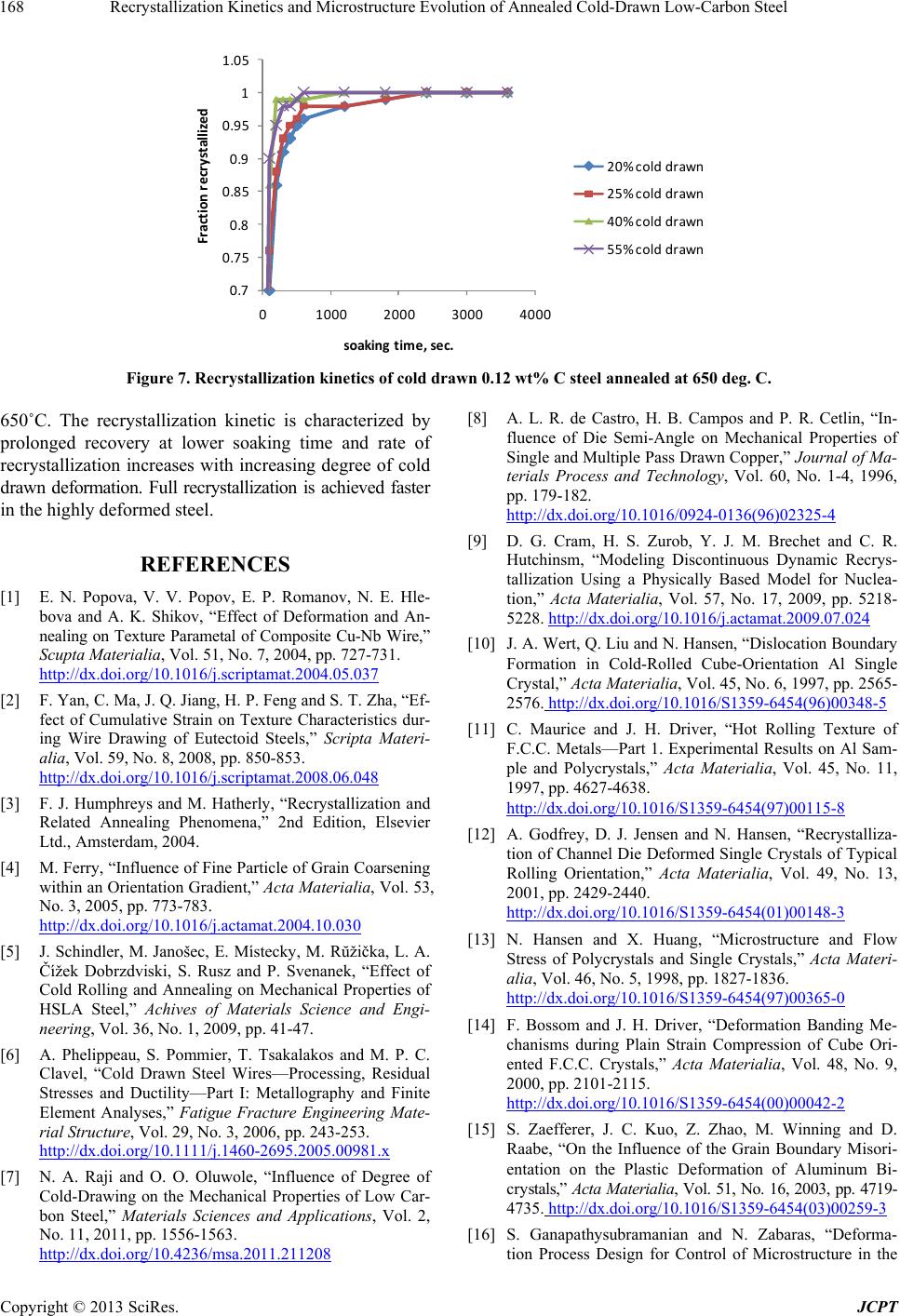 Recrystallization Kinetics and Microstructure Evolution of Annealed Cold-Drawn Low-Carbon Steel Copyright © 2013 SciRes. JCPT 168 0.7 0.75 0.8 0.85 0.9 0.95 1 1.05 01000 2000 3000 4000 Fractionr ecrystallized soakingtime,sec. 20%colddrawn 25%colddrawn 40%colddrawn 55%colddrawn Figure 7. Recrystallization kinetics of cold drawn 0.12 wt% C steel annealed at 650 deg. C. 650˚C. The recrystallization kinetic is characterized by prolonged recovery at lower soaking time and rate of recrystallization increases with increasing degree of cold drawn deformation. Full recrystallization is achieved faster in the highly deformed steel. REFERENCES [1] E. N. Popova, V. V. Popov, E. P. Romanov, N. E. Hle- bova and A. K. Shikov, “Effect of Deformation and An- nealing on Texture Parametal of Composite Cu-Nb Wire,” Scupta Materialia, Vol. 51, No. 7, 2004, pp. 727-731. http://dx.doi.org/10.1016/j.scriptamat.2004.05.037 [2] F. Yan, C. Ma, J. Q. Jiang, H. P. Feng and S. T. Zha, “Ef- fect of Cumulative Strain on Texture Characteristics dur- ing Wire Drawing of Eutectoid Steels,” Scripta Materi- alia, Vol. 59, No. 8, 2008, pp. 850-853. http://dx.doi.org/10.1016/j.scriptamat.2008.06.048 [3] F. J. Humphreys and M. Hatherly, “Recrystallization and Related Annealing Phenomena,” 2nd Edition, Elsevier Ltd., Amsterdam, 2004. [4] M. Ferry, “Influence of Fine Particle of Grain Coarsening within an Orientation Gradient,” Acta Materialia, Vol. 53, No. 3, 2005, pp. 773-783. http://dx.doi.org/10.1016/j.actamat.2004.10.030 [5] J. Schindler, M. Janošec, E. Místecky, M. Rŭžička, L. A. Čížek Dobrzdviski, S. Rusz and P. Svenanek, “Effect of Cold Rolling and Annealing on Mechanical Properties of HSLA Steel,” Achives of Materials Science and Engi- neering, Vol. 36, No. 1, 2009, pp. 41-47. [6] A. Phelippeau, S. Pommier, T. Tsakalakos and M. P. C. Clavel, “Cold Drawn Steel Wires—Processing, Residual Stresses and Ductility—Part I: Metallography and Finite Element Analyses,” Fatigue Fracture Engineering Mate- rial Structure, Vol. 29, No. 3, 2006, pp. 243-253. http://dx.doi.org/10.1111/j.1460-2695.2005.00981.x [7] N. A. Raji and O. O. Oluwole, “Influence of Degree of Cold-Drawing on the Mechanical Properties of Low Car- bon Steel,” Materials Sciences and Applications, Vol. 2, No. 11, 2011, pp. 1556-1563. http://dx.doi.org/10.4236/msa.2011.211208 [8] A. L. R. de Castro, H. B. Campos and P. R. Cetlin, “In- fluence of Die Semi-Angle on Mechanical Properties of Single and Multiple Pass Drawn Copper,” Journal of Ma- terials Process and Technology, Vol. 60, No. 1-4, 1996, pp. 179-182. http://dx.doi.org/10.1016/0924-0136(96)02325-4 [9] D. G. Cram, H. S. Zurob, Y. J. M. Brechet and C. R. Hutchinsm, “Modeling Discontinuous Dynamic Recrys- tallization Using a Physically Based Model for Nuclea- tion,” Acta Materialia, Vol. 57, No. 17, 2009, pp. 5218- 5228. http://dx.doi.org/10.1016/j.actamat.2009.07.024 [10] J. A. Wert, Q. Liu and N. Hansen, “Dislocation Boundary Formation in Cold-Rolled Cube-Orientation Al Single Crystal,” Acta Materialia, Vol. 45, No. 6, 1997, pp. 2565- 2576. http://dx.doi.org/10.1016/S1359-6454(96)00348-5 [11] C. Maurice and J. H. Driver, “Hot Rolling Texture of F.C.C. Metals—Part 1. Experimental Results on Al Sam- ple and Polycrystals,” Acta Materialia, Vol. 45, No. 11, 1997, pp. 4627-4638. http://dx.doi.org/10.1016/S1359-6454(97)00115-8 [12] A. Godfrey, D. J. Jensen and N. Hansen, “Recrystalliza- tion of Channel Die Deformed Single Crystals of Typical Rolling Orientation,” Acta Materialia, Vol. 49, No. 13, 2001, pp. 2429-2440. http://dx.doi.org/10.1016/S1359-6454(01)00148-3 [13] N. Hansen and X. Huang, “Microstructure and Flow Stress of Polycrystals and Single Crystals,” Acta Materi- alia, Vol. 46, No. 5, 1998, pp. 1827-1836. http://dx.doi.org/10.1016/S1359-6454(97)00365-0 [14] F. Bossom and J. H. Driver, “Deformation Banding Me- chanisms during Plain Strain Compression of Cube Ori- ented F.C.C. Crystals,” Acta Materialia, Vol. 48, No. 9, 2000, pp. 2101-2115. http://dx.doi.org/10.1016/S1359-6454(00)00042-2 [15] S. Zaefferer, J. C. Kuo, Z. Zhao, M. Winning and D. Raabe, “On the Influence of the Grain Boundary Misori- entation on the Plastic Deformation of Aluminum Bi- crystals,” Acta Materialia, Vol. 51, No. 16, 2003, pp. 4719- 4735. http://dx.doi.org/10.1016/S1359-6454(03)00259-3 [16] S. Ganapathysubramanian and N. Zabaras, “Deforma- tion Process Design for Control of Microstructure in the 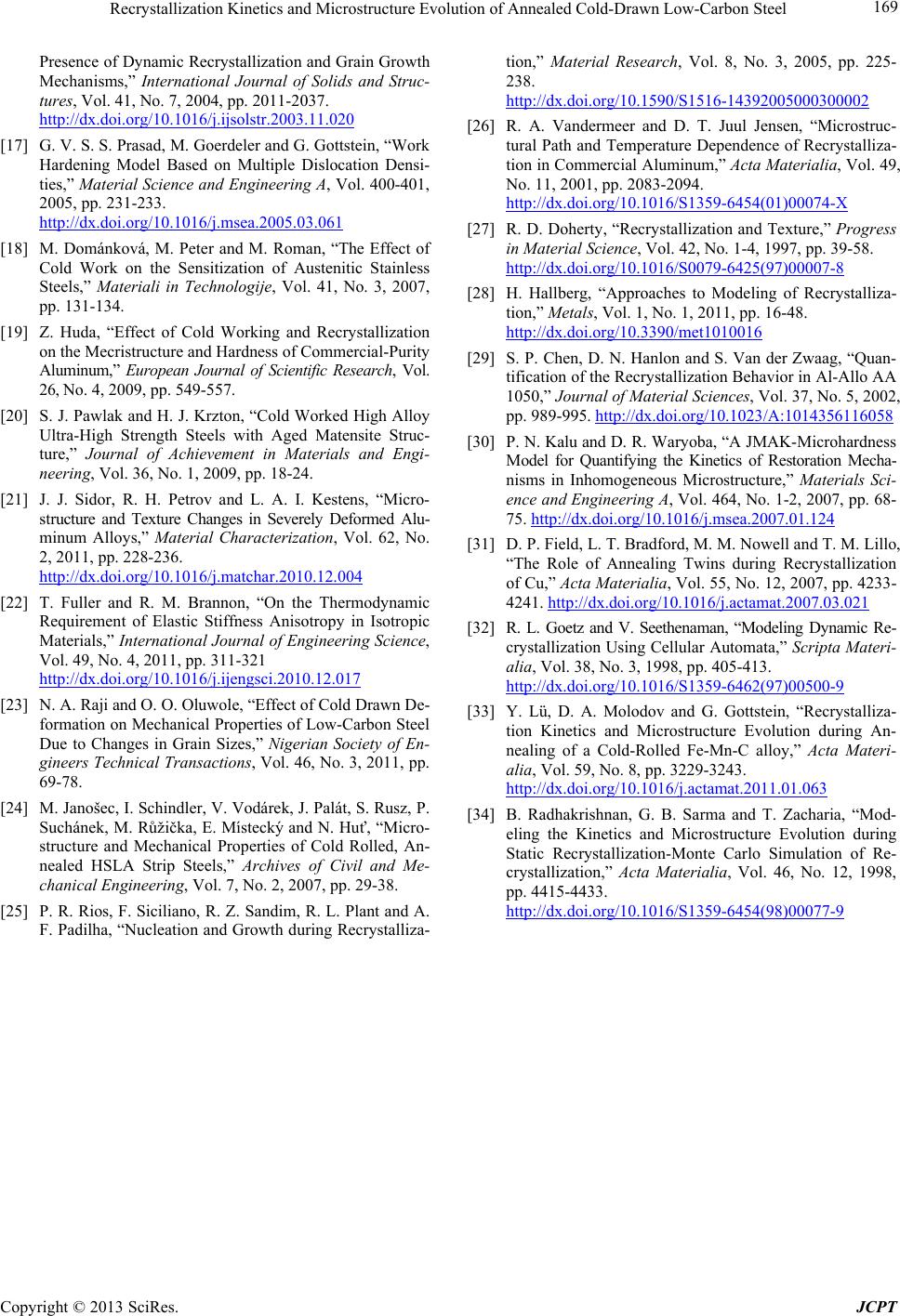 Recrystallization Kinetics and Microstructure Evolution of Annealed Cold-Drawn Low-Carbon Steel Copyright © 2013 SciRes. JCPT 169 Presence of Dynamic Recrystallization and Grain Growth Mechanisms,” International Journal of Solids and Struc- tures, Vol. 41, No. 7, 2004, pp. 2011-2037. http://dx.doi.org/10.1016/j.ijsolstr.2003.11.020 [17] G. V. S. S. Prasad, M. Goerdeler and G. Gottstein, “Work Hardening Model Based on Multiple Dislocation Densi- ties,” Mate rial Science a nd Engineeri ng A, Vol. 400-401, 2005, pp. 231-233. http://dx.doi.org/10.1016/j.msea.2005.03.061 [18] M. Dománková, M. Peter and M. Roman, “The Effect of Cold Work on the Sensitization of Austenitic Stainless Steels,” Materiali in Technologije, Vol. 41, No. 3, 2007, pp. 131-134. [19] Z. Huda, “Effect of Cold Working and Recrystallization on the Mecristructure and Hardness of Commercial-Purity Aluminum,” European Journal of Scientific Research, Vol. 26, No. 4, 2009, pp. 549-557. [20] S. J. Pawlak and H. J. Krzton, “Cold Worked High Alloy Ultra-High Strength Steels with Aged Matensite Struc- ture,” Journal of Achievement in Materials and Engi- neering, Vol. 36, No. 1, 2009, pp. 18-24. [21] J. J. Sidor, R. H. Petrov and L. A. I. Kestens, “Micro- structure and Texture Changes in Severely Deformed Alu- minum Alloys,” Material Characterization, Vol. 62, No. 2, 2011, pp. 228-236. http://dx.doi.org/10.1016/j.matchar.2010.12.004 [22] T. Fuller and R. M. Brannon, “On the Thermodynamic Requirement of Elastic Stiffness Anisotropy in Isotropic Materials,” International Journal of Engineering Science, Vol. 49, No. 4, 2011, pp. 311-321 http://dx.doi.org/10.1016/j.ijengsci.2010.12.017 [23] N. A. Raji and O. O. Oluwole, “Effect of Cold Drawn De- formation on Mechanical Properties of Low-Carbon Steel Due to Changes in Grain Sizes,” Nigerian Society of En- gineers Technical Transactions, Vol. 46, No. 3, 2011, pp. 69-78. [24] M. Janošec, I. Schindler, V. Vodárek, J. Palát, S. Rusz, P. Suchánek, M. Růžička, E. Místecký and N. Huť, “Micro- structure and Mechanical Properties of Cold Rolled, An- nealed HSLA Strip Steels,” Archives of Civil and Me- chanical Engineering, Vol. 7, No. 2, 2007, pp. 29-38. [25] P. R. Rios, F. Siciliano, R. Z. Sandim, R. L. Plant and A. F. Padilha, “Nucleation and Growth during Recrystalliza- tion,” Material Research, Vol. 8, No. 3, 2005, pp. 225- 238. http://dx.doi.org/10.1590/S1516-14392005000300002 [26] R. A. Vandermeer and D. T. Juul Jensen, “Microstruc- tural Path and Temperature Dependence of Recrystalliza- tion in Commercial Aluminum,” Acta Materialia, Vol. 49, No. 11, 2001, pp. 2083-2094. http://dx.doi.org/10.1016/S1359-6454(01)00074-X [27] R. D. Doherty, “Recrystallization and Texture,” Progress in Material Science, Vol. 42, No. 1-4, 1997, pp. 39-58. http://dx.doi.org/10.1016/S0079-6425(97)00007-8 [28] H. Hallberg, “Approaches to Modeling of Recrystalliza- tion,” Metals, Vol. 1, No. 1, 2011, pp. 16-48. http://dx.doi.org/10.3390/met1010016 [29] S. P. Chen, D. N. Hanlon and S. Van der Zwaag, “Quan- tification of the Recrystallization Behavior in Al-Allo AA 1050,” Journal of Material Sciences, Vol. 37, No. 5, 2002, pp. 989-995. http://dx.doi.org/10.1023/A:1014356116058 [30] P. N. Kalu and D. R. Waryoba, “A JMAK-Microhardness Model for Quantifying the Kinetics of Restoration Mecha- nisms in Inhomogeneous Microstructure,” Materials Sci- ence and Engineering A, Vol. 464, No. 1-2, 2007, pp. 68- 75. http://dx.doi.org/10.1016/j.msea.2007.01.124 [31] D. P. Field, L. T. Bradford, M. M. Nowell and T. M. Lillo, “The Role of Annealing Twins during Recrystallization of Cu,” Acta Materialia, Vol. 55, No. 12, 2007, pp. 4233- 4241. http://dx.doi.org/10.1016/j.actamat.2007.03.021 [32] R. L. Goetz and V. Seethenaman, “Modeling Dynamic Re- crystallization Using Cellular Automata,” Scripta Materi- alia, Vol. 38, No. 3, 1998, pp. 405-413. http://dx.doi.org/10.1016/S1359-6462(97)00500-9 [33] Y. Lü, D. A. Molodov and G. Gottstein, “Recrystalliza- tion Kinetics and Microstructure Evolution during An- nealing of a Cold-Rolled Fe-Mn-C alloy,” Acta Materi- alia, Vol. 59, No. 8, pp. 3229-3243. http://dx.doi.org/10.1016/j.actamat.2011.01.063 [34] B. Radhakrishnan, G. B. Sarma and T. Zacharia, “Mod- eling the Kinetics and Microstructure Evolution during Static Recrystallization-Monte Carlo Simulation of Re- crystallization,” Acta Materialia, Vol. 46, No. 12, 1998, pp. 4415-4433. http://dx.doi.org/10.1016/S1359-6454(98)00077-9 |