

Paper Menu >>
Journal Menu >>
 Energy and Power Engineering, 2013, 5, 621-624 doi:10.4236/epe.2013.54B120 Published Online July 2013 (http://www.scirp.org/journal/epe) Intelligent Models of Long-Term Security Correction in Energy Conversion Dispatching Chaochun Luo1, Dunnan Liu2, Qingqi Chen1, Xinming Liu2 1Power Exchange Center, Hunan Electric Power Company, Changsha, China 2School of Economics and Management, North China Electric Power University Email: chchluo@ 163.com, [email protected], chenqq@ hnepc.com.cn Received January, 2013 ABSTRACT This paper is research on the dispatching models for monthly generation plan which is manage the congestion consid- ering the security constrains of the power grid. Since the monthly generation plan is the result of vary monthly power exchange, including long-term power contract, power exchange among provinces and generation constitution exchanges, The application of monthly secu rity constrained dispatching is with significant meaning for the security and stability of power grid. This paper brings forward the purpose and contents of security dispatching and introduces the working procedure and mathematic models. At last, the practical example of the Hunan Province power grid is introduced to explain the models. Keywords: Intelligent Models; Congestion Management; Electricity Market; Monthly Generation Plan 1. Introduction In recent years, environmental protection and climate change have become the world’s most important issue of common concern. Energy conservation, the improvement of energy efficiency and the development of renewable energy sources have become the basic energy policies. China’s “Eleventh Five-Year Plan” made it clears that to the year 2010 the energy consumption of unit GDP and total emissions of major pollutants will reduce by 20% and 10%.respectively compared to the year 2005. The power industry is the key area of energy saving and pollution reduction with great energy-saving poten- tial. In view of this, the National Development and Re- form Commission formulated the “energy generation scheduling (Trial)[1], and has submitted it to the State Council for approval in ear ly 2007. In June of 2007, with “on energy conservation scheduling the implementation of alternative electricity generation guidance” issued by Economic and Trade Commission of Hun an Province[2], Hunan Electric Power Company developed the “Hunan power grid to carry out energy-saving scheduling imple- mentation details the implementation of alternative elec- tricity generation”, to achieve the goals of energy-saving and emission reduction through the market-oriented means. Middle and long-term energy security checking is an important guarantee for the Implementation of generation energy-saving scheduling. The scheduling of Hunan Province needs to consider the power generation capacity of plants, peaking capacity, safe operation of power net- work, net loss and other factors, determine whether the transaction of alternative power generation is effective, and is responsible for the implementation of effective transaction of alternative power generation. Middle and long-term security checking refers to the security con- straint adjustments in terms of power plans, and its main function is to test and adjust the plans of monthly elec- tricity consumption, so as to meet inter-regional security constraints, where the monthly electricity consumption includes annual contracts decomposed to every month, contracts of external transmitting power and bidding power of alternative generation. The imple mentation and operation of middle-long term security checking is es- sential to ensure the safety operation of power network and improve the enforceability of power plans [3,4]. In view of the characteristics of monthly power in- cluding wide time span and strong uncertainty, this paper will use the tie-line stability limit of the average family as the security constraints between areas. To present processes and algorithms of middle-long tern security checking under energy generation scheduling model to verify the actual network data. 2. The Main Transaction Process In order to better describe the relative functions of the middle-long term security checking, it is necessary to introduce the transaction process of alternative genera- tion and power bidding rules briefly. Alternative power Copyright © 2013 SciRes. EPE 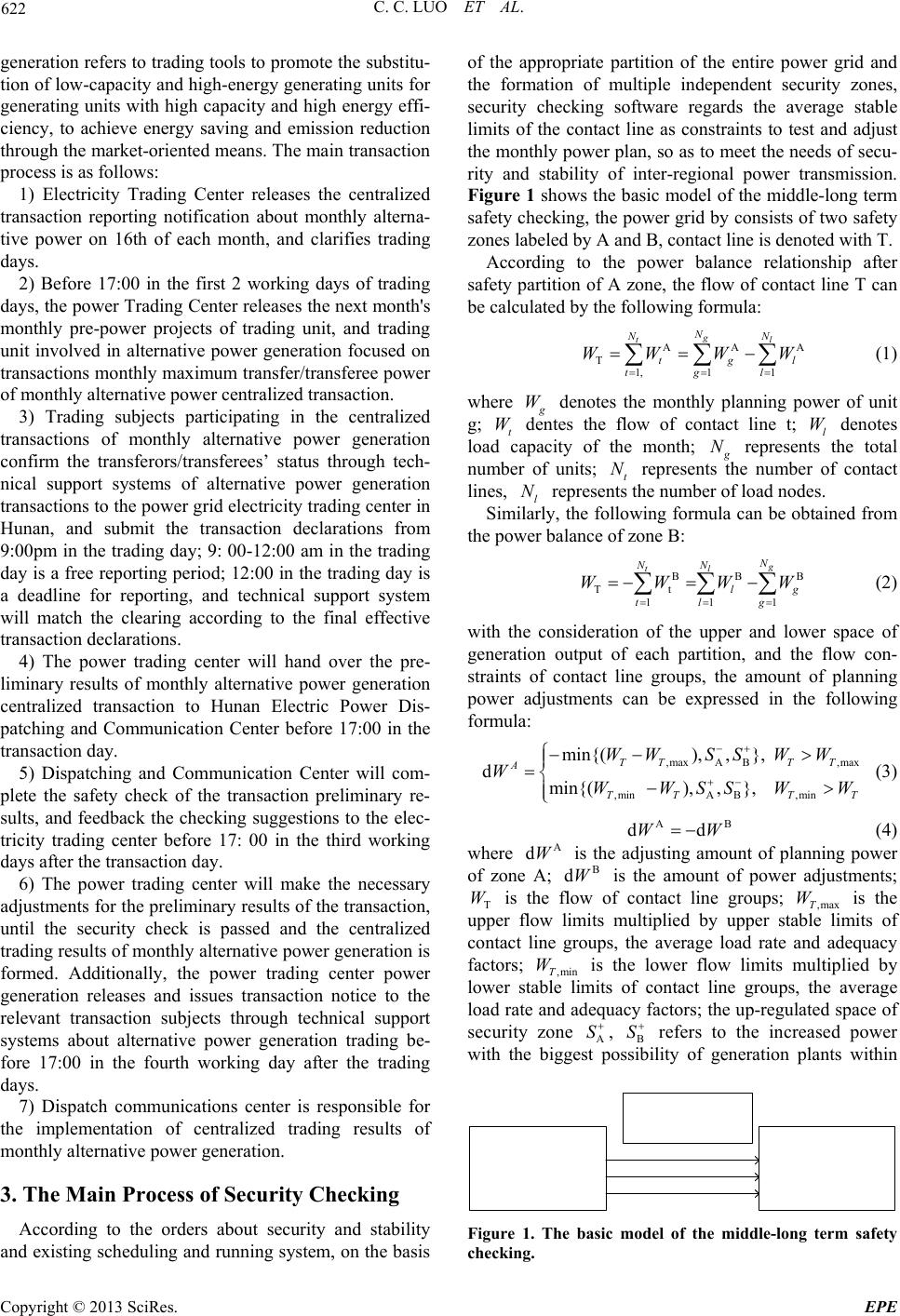 C. C. LUO ET AL. 622 generation refers to trading tools to promote the substitu- tion of low-capacity and high-energy generating units for generating units with high capacity and high energy effi- ciency, to achieve energy saving and emission reduction through the market-oriented means. The main transaction process is as follows: 1) Electricity Trading Center releases the centralized transaction reporting notification about monthly alterna- tive power on 16th of each month, and clarifies trading days. 2) Before 17:00 in the first 2 working days of trading days, the power Trading Center releases the next month's monthly pre-power projects of trading unit, and trading unit involved in alternative power generation focused on transactions monthly maximum transfer/transferee power of monthly alternative power centralized transaction. 3) Trading subjects participating in the centralized transactions of monthly alternative power generation confirm the transferors/transferees’ status through tech- nical support systems of alternative power generation transactions to the power grid electricity trading center in Hunan, and submit the transaction declarations from 9:00pm in the trading day; 9: 00-12:00 am in the trading day is a free reporting period; 12:00 in the trading day is a deadline for reporting, and technical support system will match the clearing according to the final effective transaction d eclarat i o n s . 4) The power trading center will hand over the pre- liminary results of monthly alternative power generation centralized transaction to Hunan Electric Power Dis- patching and Communication Center before 17:00 in the transaction day. 5) Dispatching and Communication Center will com- plete the safety check of the transaction preliminary re- sults, and feedback the checking suggestions to the elec- tricity trading center before 17: 00 in the third working days after the transaction day. 6) The power trading center will make the necessary adjustments for the preliminary results of the transaction, until the security check is passed and the centralized trading results of monthly alternativ e power generation is formed. Additionally, the power trading center power generation releases and issues transaction notice to the relevant transaction subjects through technical support systems about alternative power generation trading be- fore 17:00 in the fourth working day after the trading days. 7) Dispatch communications center is responsible for the implementation of centralized trading results of monthly alternative power generation. 3. The Main Process of Security Checking According to the orders about security and stability and existing scheduling and running system, on the basis of the appropriate partition of the entire power grid and the formation of multiple independent security zones, security checking software regards the average stable limits of the contact line as constraints to test and adjust the monthly power plan, so as to meet the needs of secu- rity and stability of inter-regional power transmission. Figure 1 shows the basic model o f the middle-long term safety checking, the power grid by consists of two safety zones labeled by A and B, contact line is denoted with T. According to the power balance relationship after safety partition of A zone, the flow of contact line T can be calculated by the following fo rmula: AA T1,1 1 g tl N NN tg tgl WW WW A l (1) where g W denotes the monthly planning power of unit g; t dentes the flow of contact line t; l W denotes load capacity of the month; W g N represents the total number of units; t represents the number of contact lines, represen ts the number of load nodes. N l Similarly, the following formula can be obtained from the power balance of zone B: N BB Tt 111 g tl N NN l tlg WWWW B g T B (2) with the consideration of the upper and lower space of generation output of each partition, and the flow con- straints of contact line groups, the amount of planning power adjustments can be expressed in the following formula: ,maxA B,max ,minA B,min min{(),,} , dmin{ (),,}, TTT T A TT T WWSS WW WWWSSWW (3) A ddWW (4) where is the adjusting amount of planning power of zone A; is the amount of power adjustments; T is the flow of contact line groups; ,maxT W is the upper flow limits multiplied by upper stable limits of contact line groups, the average load rate and adequacy factors; ,minT is the lower flow limits multiplied by lower stable limits of contact line groups, the average load rate and adequacy factors; the up-regulated space of security zone A A dWd W B W S W , B S refers to the increased power with the biggest possibility of generation plants within Figure 1. The basic model of the middle-long term safety checking. Copyright © 2013 SciRes. EPE 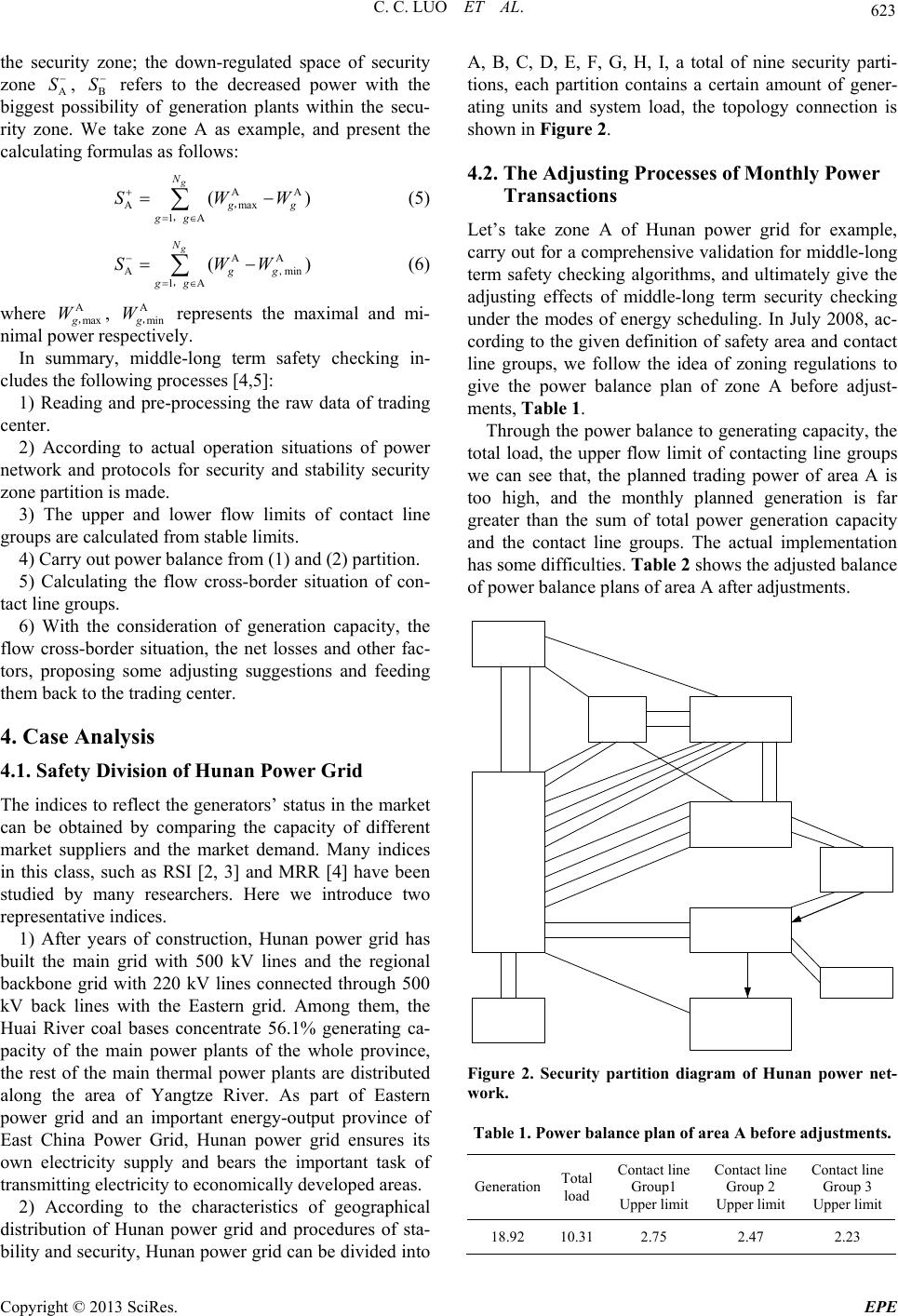 C. C. LUO ET AL. 623 the security zone; the down-regulated space of security zone A, B refers to the decreased power with the biggest possibility of generation plants within the secu- rity zone. We take zone A as example, and present the calculating formulas as follows: SS A Am ax 1A ( g N g gg SW , , A ) g W in ) (5) AA Am 1A ( g N gg gg SWW , , A (6) where , min g represents the maximal and mi- nimal power respectively. Amax g W,W, In summary, middle-long term safety checking in- cludes the following processes [4,5]: 1) Reading and pre-processing the raw data of trading center. 2) According to actual operation situations of power network and protocols for security and stability security zone partition is made. 3) The upper and lower flow limits of contact line groups are calculated from stable limits. 4) Carry out power balance from (1) and (2) partition. 5) Calculating the flow cross-border situation of con- tact line groups. 6) With the consideration of generation capacity, the flow cross-border situation, the net losses and other fac- tors, proposing some adjusting suggestions and feeding them back to the trading center. 4. Case Analysis 4.1. Safety Division of Hunan Power Grid The indices to reflect the generators’ status in the market can be obtained by comparing the capacity of different market suppliers and the market demand. Many indices in this class, such as RSI [2, 3] and MRR [4] have been studied by many researchers. Here we introduce two representative indices. 1) After years of construction, Hunan power grid has built the main grid with 500 kV lines and the regional backbone grid with 220 kV lines connected through 500 kV back lines with the Eastern grid. Among them, the Huai River coal bases concentrate 56.1% generating ca- pacity of the main power plants of the whole province, the rest of the main thermal power plants are distributed along the area of Yangtze River. As part of Eastern power grid and an important energy-output province of East China Power Grid, Hunan power grid ensures its own electricity supply and bears the important task of transmitting electricity to economically developed areas. 2) According to the characteristics of geographical distribution of Hunan power grid and procedures of sta- bility and security, Hun an power grid can be divided into A, B, C, D, E, F, G, H, I, a total of nine security parti- tions, each partition contains a certain amount of gener- ating units and system load, the topology connection is shown in Figure 2. 4.2. The Adjusting Processes of Monthly Power Transactions Let’s take zone A of Hunan power grid for example, carry out for a comprehensive validation for middle-long term safety checking algorithms, and ultimately give the adjusting effects of middle-long term security checking under the modes of energy scheduling. In July 2008, ac- cording to the given definition of safety area and contact line groups, we follow the idea of zoning regulations to give the power balance plan of zone A before adjust- ments, Table 1. Through the power balance to generating cap acity, the total load, the upper flow limit of contacting line groups we can see that, the planned trading power of area A is too high, and the monthly planned generation is far greater than the sum of total power generation capacity and the contact line groups. The actual implementation has some difficulties. Table 2 shows the adjusted balance of power balance plans of area A after adjustments. Figure 2. Security partition diagram of Hunan power net- work. Table 1. Power balance plan of area A before adjustments. GenerationTotal load Contact line Group1 Upper limit Contact line Group 2 Upper limit Contact line Group 3 Upper limit 18.92 10.312.75 2.47 2.23 Copyright © 2013 SciRes. EPE  C. C. LUO ET AL. Copyright © 2013 SciRes. EPE 624 Table 2. Power balance plan of area A after adjustments. Generation Total load Contact line Group 1 Upper limit Contact line Group 2 Upper limit Contact line Group 3 Upper limit 17.76 10.31 2.75 2.47 2.23 Judging from the actual operation situation of the grid, the revised electricity plans have strong operational qual- ity, which guarantees the safe and reliable operation of the grid with the high opinions of operating personnel alike. 5. Conclusions Middle-long term security checking is the key problem about energy generation scheduling. This paper describes the functions, features and its major processes of alterna- tive power trading, and on this basis puts forward ma- thematical models and algorithms about electricity safety checking of partition. Hunan grid’s application examples show that the proposed algorithms can provide important criterions for power trading plans, and are essential to maintain open, fair, equitable principles of the alternative power generation electricity market, to ensure safe op- eration of power grid. REFERENCES [1] H. Q. Zhang, Y. J. Chang, D. Y. Tang, S. Y. Wang, Q. Chen, Z. G. Li, Y. Q. Wang and J. L. Yu, “A Monthly Electric Energy Plan Making Method of Thermal Power Generation Unit in Energy-saving Generation Dispatch- ing Mode,” Dianli Xitong Baohu yu Kongzhi/Power Sys- tem Protection and Control, Vol. 39, No. 4, 2011, pp. 84-89. [2] L. L. Li, Y. B. Guan, J. Geng, J. G. Yao and G. Wang, “Modeling and Solving for Monthly Security Constrained Unit Commitment Problem,” Dianli Xitong Zi- donghua/Automation of Electric Power Systems, Vol. 35, No. 12, 2011, pp. 27-31. [3] E. Ni, P. B. Luh and S. Rourke, “Optimal Integrated Gen- eration Bidding and Scheduling with Risk Management Under a Deregulated Power Market,” IEEE Transactions on Power Systems, Vol. 19, No. 1, 2004, pp. 600-609. doi:10.1109/TPWRS.2003.818695 [4] A. Sankarasubramanian, U. Lall, N. Devineni and S. Espinueva, “The Role of Monthly Up dated Climat e Fore- casts in Improving Intraseasonal Water Allocation,” Jour- nal of Applied Meteorology and Climatology, Vol. 48, No. 7, 2009, pp. 1464-1482. doi:10.1175/2009JAMC2122.1 [5] E. Muneender and D. Kumar, “Optimal Rescheduling of Real and Reactive Powers of Generators for Zonal Con- gestion Management Based on FDR PSO,” 2009 Trans- mission & Distribution Conference & Exposition: Asia and Pacific (T&D Asia 2009), 2009, p. 6. |