

Paper Menu >>
Journal Menu >>
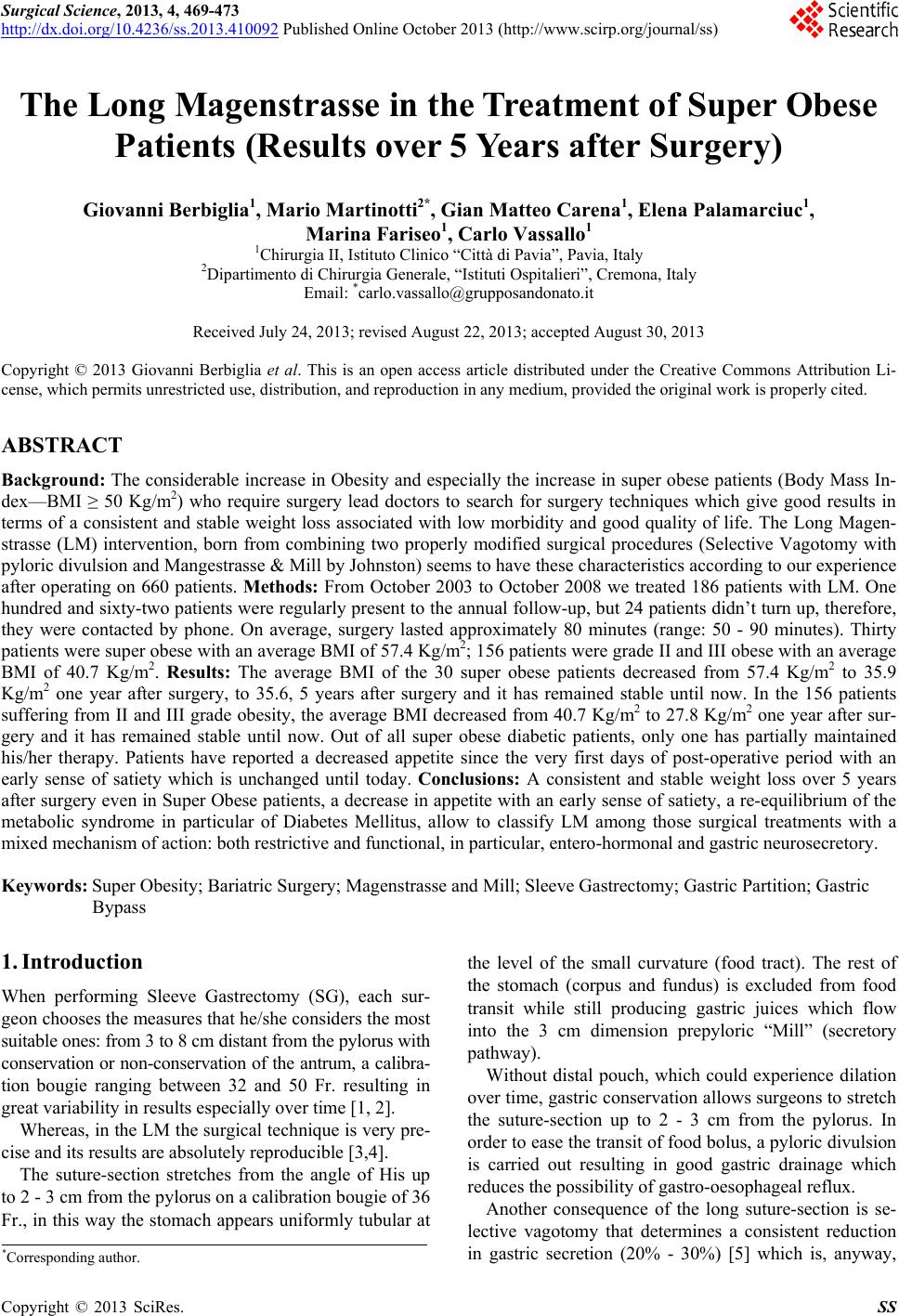 Surgical Science, 2013, 4, 469-473 http://dx.doi.org/10.4236/ss.2013.410092 Published Online October 2013 (http://www.scirp.org/journal/ss) The Long Magenstrasse in the Treatment of Super Obese Patients (Resu lts ov er 5 Years after Surgery ) Giovanni Berbiglia1, Mario Martinotti2*, Gian Matteo Carena1, Elena Palamarciuc1, Marina Fariseo1, Carlo Vassallo1 1Chirurgia II, Istituto Clinico “Città di Pavia”, Pavia, Italy 2Dipartimento di Chirurgia Generale, “Istituti Ospitalieri”, Cremona, Italy Email: *[email protected] Received July 24, 2013; revised August 22, 2013; accepted August 30, 2013 Copyright © 2013 Giovanni Berbiglia et al. This is an open access article distributed under the Creative Commons Attribution Li- cense, which permits unrestricted use, distribution, and reproduction in any medium, provided the original work is properly cited. ABSTRACT Background: The considerable increase in Obesity and especially the increase in super obese patients (Body Mass In- dex—BMI ≥ 50 Kg/m2) who require surgery lead doctors to search for surgery techniques which give good results in terms of a consistent and stable weight loss associated with low morbidity and good quality of life. The Long Magen- strasse (LM) intervention, born from combining two properly modified surgical procedures (Selective Vagotomy with pyloric divulsion and Mangestrasse & Mill by Johnston) seems to have these characteristics according to our experience after operating on 660 patients. Methods: From October 2003 to October 2008 we treated 186 patients with LM. One hundred and sixty-two patients were regularly present to the annual follow-up, but 24 patients didn’t turn up, therefore, they were contacted by phone. On average, surgery lasted approximately 80 minutes (range: 50 - 90 minutes). Thirty patients were super obese with an average BMI of 57.4 Kg/m2; 156 patients were grade II and III obese with an average BMI of 40.7 Kg/m2. Results: The average BMI of the 30 super obese patients decreased from 57.4 Kg/m2 to 35.9 Kg/m2 one year after surgery, to 35.6, 5 years after surgery and it has remained stable until now. In the 156 patients suffering from II and III grade obesity, the average BMI decreased from 40.7 Kg/m2 to 27.8 Kg/m2 one year after sur- gery and it has remained stable until now. Out of all super obese diabetic patients, only one has partially maintained his/her therapy. Patients have reported a decreased appetite since the very first days of post-operative period with an early sense of satiety which is unchanged until today. Conclusions: A consistent and stable weight loss over 5 years after surgery even in Super Obese patients, a decrease in appetite with an early sense of satiety, a re-equilibrium of the metabolic syndrome in particular of Diabetes Mellitus, allow to classify LM among those surgical treatments with a mixed mechanism of action: both restrictive and functional, in particular, entero-hormonal and gastric neurosecretory. Keywords: Super Obesity; Bariatric Surgery; Magenstrasse and Mill; Sleeve Gastrectomy; Gastric Partition; Gastric Bypass 1. Introduction When performing Sleeve Gastrectomy (SG), each sur- geon chooses the measures that he/she considers the most suitable ones: from 3 to 8 cm distant from the pylorus with conservation or non-conservation of the antrum, a calibra- tion bougie ranging between 32 and 50 Fr. resulting in great variability in results especially over time [1, 2]. Whereas, in the LM the surgical technique is very pre- cise and its results are absolutely reproducible [3,4]. The suture-section stretches from the angle of His up to 2 - 3 cm from the pylorus on a calibration bougie of 36 Fr., in this way the stomach appears uniformly tubular at the level of the small curvature (food tract). The rest of the stomach (corpus and fundus) is excluded from food transit while still producing gastric juices which flow into the 3 cm dimension prepyloric “Mill” (secretory pathway). Without distal pouch, which could experience dilation over time, gastric conservation allows surgeons to stretch the suture-section up to 2 - 3 cm from the pylorus. In order to ease the transit of food bolus, a pyloric divulsion is carried out resulting in good gastric drainage which reduces the possibility of gastro-oesophageal reflux. Another consequence of the long suture-section is se- lective vagotomy that determines a consistent reduction in gastric secretion (20% - 30%) [5] which is, anyway, *Corresponding author. C opyright © 2013 SciRes. SS 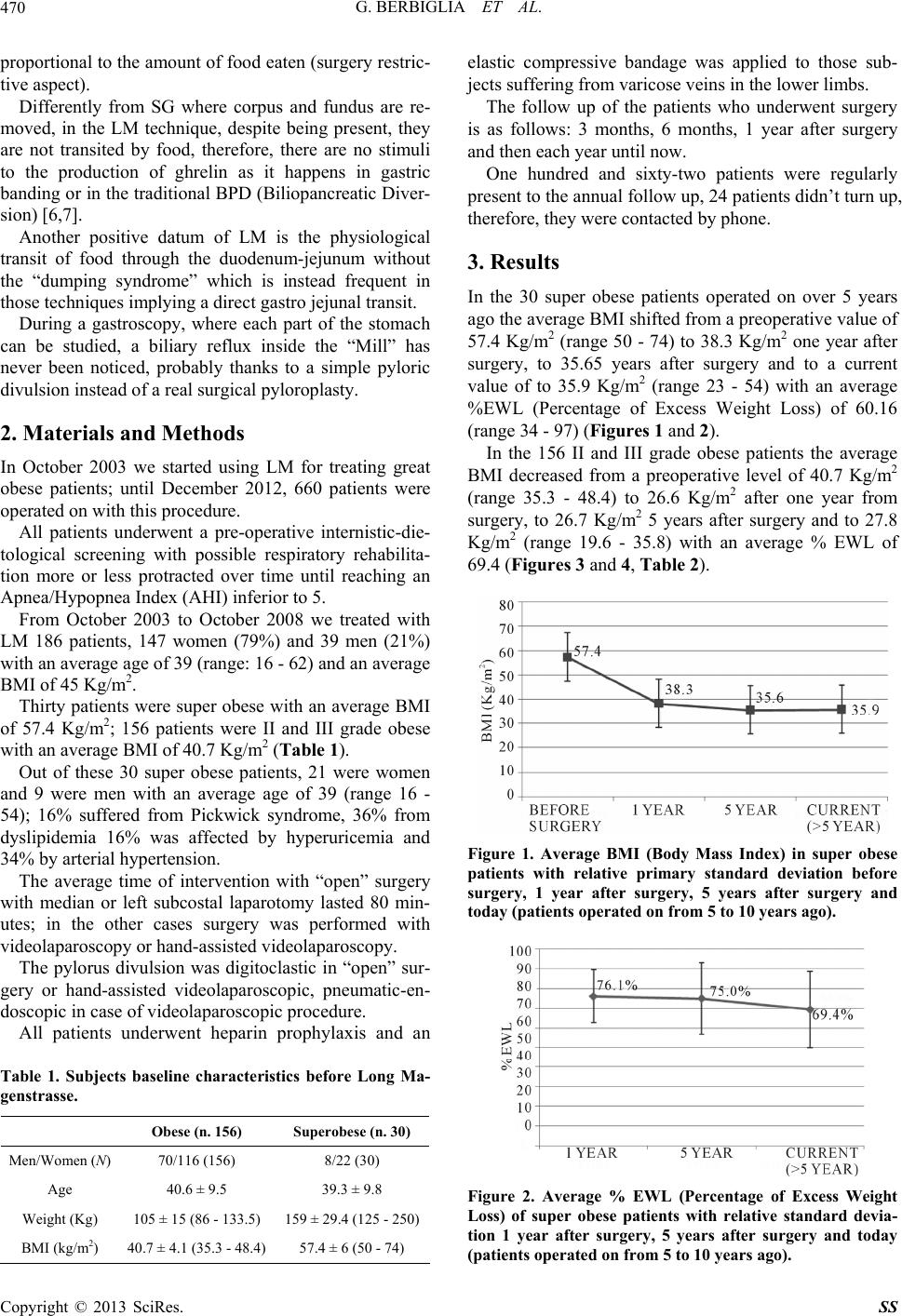 G. BERBIGLIA ET AL. 470 proportional to the amount of food eaten (surgery restric- tive aspect). Differently from SG where corpus and fundus are re- moved, in the LM technique, despite being present, they are not transited by food, therefore, there are no stimuli to the production of ghrelin as it happens in gastric banding or in the traditional BPD (Biliopancreatic Diver- sion) [6,7]. Another positive datum of LM is the physiological transit of food through the duodenum-jejunum without the “dumping syndrome” which is instead frequent in those techniques implying a direct gastro jejunal transit. During a gastroscopy, where each part of the stomach can be studied, a biliary reflux inside the “Mill” has never been noticed, probably thanks to a simple pyloric divulsion instead of a real surgical pyloroplasty. 2. Materials and Methods In October 2003 we started using LM for treating great obese patients; until December 2012, 660 patients were operated on with this procedure. All patients underwent a pre-operative internistic-die- tological screening with possible respiratory rehabilita- tion more or less protracted over time until reaching an Apnea/Hypopnea Index (AHI) inferior to 5. From October 2003 to October 2008 we treated with LM 186 patients, 147 women (79%) and 39 men (21%) with an average age of 39 (range: 16 - 62) and an average BMI of 45 Kg/m2. Thirty patients were super obese with an average BMI of 57.4 Kg/m2; 156 patients were II and III grade obese with an average BMI of 40.7 Kg/m2 (Table 1). Out of these 30 super obese patients, 21 were women and 9 were men with an average age of 39 (range 16 - 54); 16% suffered from Pickwick syndrome, 36% from dyslipidemia 16% was affected by hyperuricemia and 34% by arterial hypertension. The average time of intervention with “open” surgery with median or left subcostal laparotomy lasted 80 min- utes; in the other cases surgery was performed with videolaparoscopy or hand-assisted videolaparoscopy. The pylorus divulsion was digitoclastic in “open” sur- gery or hand-assisted videolaparoscopic, pneumatic-en- doscopic in case of videolaparoscopic procedure. All patients underwent heparin prophylaxis and an Table 1. Subjects baseline characteristics before Long Ma- genstrasse. Obese (n. 156) Superobese (n. 30) Men/Women (N) 70/116 (156) 8/22 (30) Age 40.6 ± 9.5 39.3 ± 9.8 Weight (Kg) 105 ± 15 (86 - 133.5) 159 ± 29.4 (125 - 250) BMI (kg/m2) 40.7 ± 4.1 (35.3 - 48.4) 57.4 ± 6 (50 - 74) elastic compressive bandage was applied to those sub- jects suffering from varicose veins in the lower limbs. The follow up of the patients who underwent surgery is as follows: 3 months, 6 months, 1 year after surgery and then each year until now. One hundred and sixty-two patients were regularly present to the annual follow up, 24 patients didn’t turn up, therefore, they were contacted by phone. 3. Results In the 30 super obese patients operated on over 5 years ago the average BMI shifted from a preoperative value of 57.4 Kg/m2 (range 50 - 74) to 38.3 Kg/m2 one year after surgery, to 35.65 years after surgery and to a current value of to 35.9 Kg/m2 (range 23 - 54) with an average %EWL (Percentage of Excess Weight Loss) of 60.16 (range 34 - 97) (Figures 1 and 2). In the 156 II and III grade obese patients the average BMI decreased from a preoperative level of 40.7 Kg/m2 (range 35.3 - 48.4) to 26.6 Kg/m2 after one year from surgery, to 26.7 Kg/m2 5 years after surgery and to 27.8 Kg/m2 (range 19.6 - 35.8) with an average % EWL of 69.4 (Figures 3 and 4, Table 2). Figure 1. Average BMI (Body Mass Index) in super obese patients with relative primary standard deviation before surgery, 1 year after surgery, 5 years after surgery and today (patients operated on from 5 to 10 years ago). Figure 2. Average % EWL (Percentage of Excess Weight Loss) of super obese patients with relative standard devia- tion 1 year after surgery, 5 years after surgery and today (patients operated on from 5 to 10 years ago). Copyright © 2013 SciRes. SS 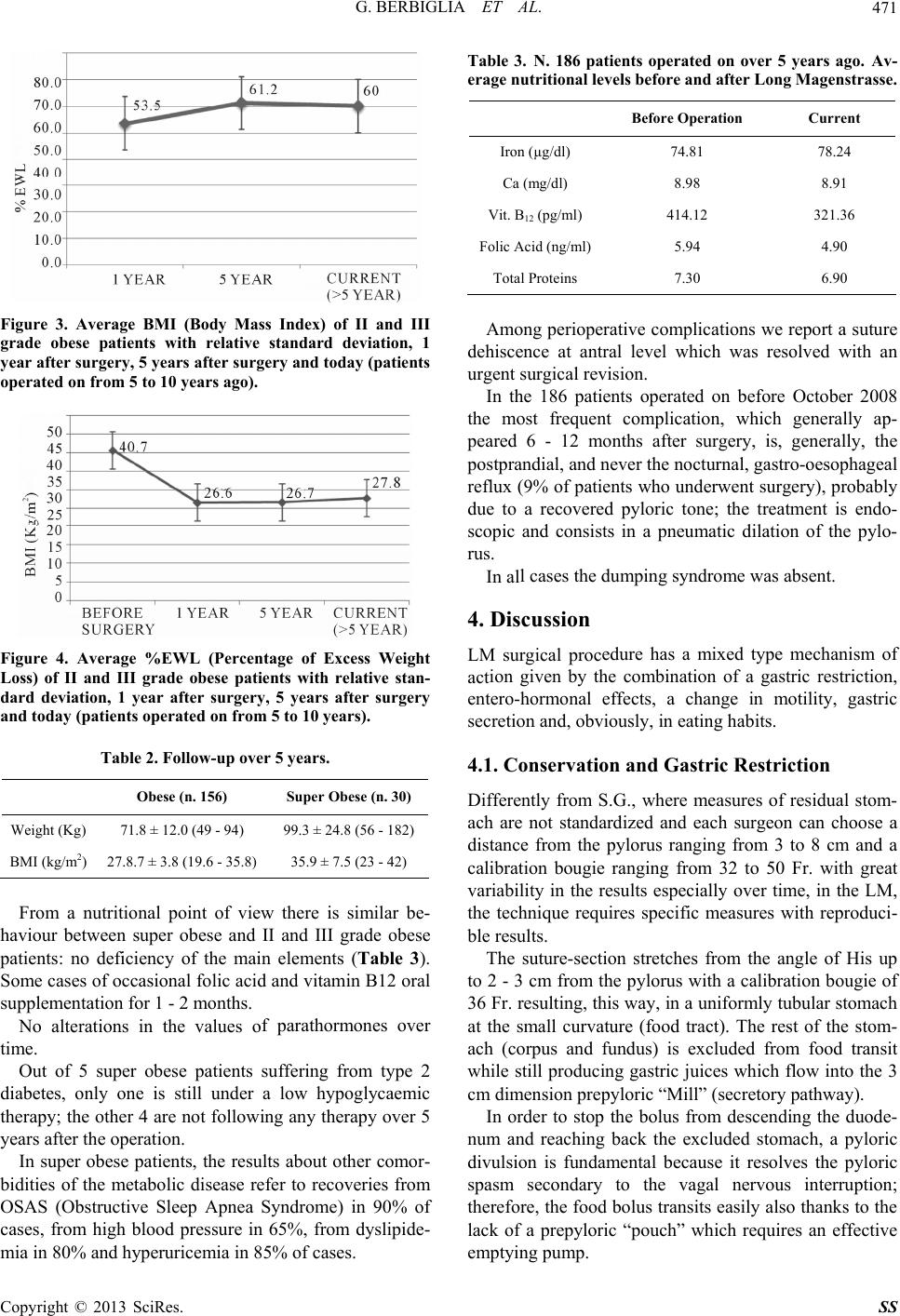 G. BERBIGLIA ET AL. 471 Figure 3. Average BMI (Body Mass Index) of II and III grade obese patients with relative standard deviation, 1 year after surgery, 5 years after surgery and today (patients operated on from 5 to 10 years ago). Figure 4. Average %EWL (Percentage of Excess Weit Table 2. Follow-up over 5 years. Obese (n. 156) Super Obese (n. 30) gh Loss) of II and III grade obese patients with relative stan- dard deviation, 1 year after surgery, 5 years after surgery and today (patients operated on from 5 to 10 years). Weight (Kg) 71. 99.8 ± 12.0 (49 - 94)3 ± 24.8 (56 - 182) BMI (kg/m2) 27. 8.7 ± 3.8 (19.6 - 35.8)35.9 ± 7.5 (23 - 42) From a nutritional point of view there is similar be- ha f parathormones over tim of 5 super obese patients suffering from type 2 di he results about other comor- bi ago. Av- Before Operation Current viour between super obese and II and III grade obese patients: no deficiency of the main elements (Table 3). Some cases of occasional folic acid and vitamin B12 oral supplementation for 1 - 2 months. No alterations in the values o e. Out abetes, only one is still under a low hypoglycaemic therapy; the other 4 are not following any therapy over 5 years after the operation. In super obese patients, t dities of the metabolic disease refer to recoveries from OSAS (Obstructive Sleep Apnea Syndrome) in 90% of cases, from high blood pressure in 65%, from dyslipide- mia in 80% and hyperuricemia in 85% of cases. Table 3. N. 186 patients operated on over 5 years erage nutritional levels before and after Long Magenstrasse. Iron (g/dl) µ74.81 78.24 Ca (mg/dl) 8.98 8.91 V) 43 F it. B12 (pg/ml14.12 21.36 olic Acid (ng/ml)5.94 4.90 Total Proteins 7.30 6.90 Among perioperative complications we report a suture de rated on before October 2008 th l cases the dumping syndrome was absent. 4. Discussion edure has a mixed type mechanism of 4.1. Conservation and Gastric Restriction l stom- tion stretches from the angle of His up to de- nu hiscence at antral level which was resolved with an urgent surgical revision. In the 186 patients ope e most frequent complication, which generally ap- peared 6 - 12 months after surgery, is, generally, the postprandial, and never the nocturnal, gastro-oesophageal reflux (9% of patients who underwent surgery), probably due to a recovered pyloric tone; the treatment is endo- scopic and consists in a pneumatic dilation of the pylo- rus. In al LM surgical proc action given by the combination of a gastric restriction, entero-hormonal effects, a change in motility, gastric secretion and, obviously, in eating habits. Differently from S.G., where measures of residua ach are not standardized and each surgeon can choose a distance from the pylorus ranging from 3 to 8 cm and a calibration bougie ranging from 32 to 50 Fr. with great variability in the results especially over time, in the LM, the technique requires specific measures with reproduci- ble results. The suture-sec 2 - 3 cm from the pylorus with a calibration bougie of 36 Fr. resulting, this way, in a uniformly tubular stomach at the small curvature (food tract). The rest of the stom- ach (corpus and fundus) is excluded from food transit while still producing gastric juices which flow into the 3 cm dimension prepyloric “Mill” (secretory pathway). In order to stop the bolus from descending the duo m and reaching back the excluded stomach, a pyloric divulsion is fundamental because it resolves the pyloric spasm secondary to the vagal nervous interruption; therefore, the food bolus transits easily also thanks to the lack of a prepyloric “pouch” which requires an effective emptying pump. Copyright © 2013 SciRes. SS 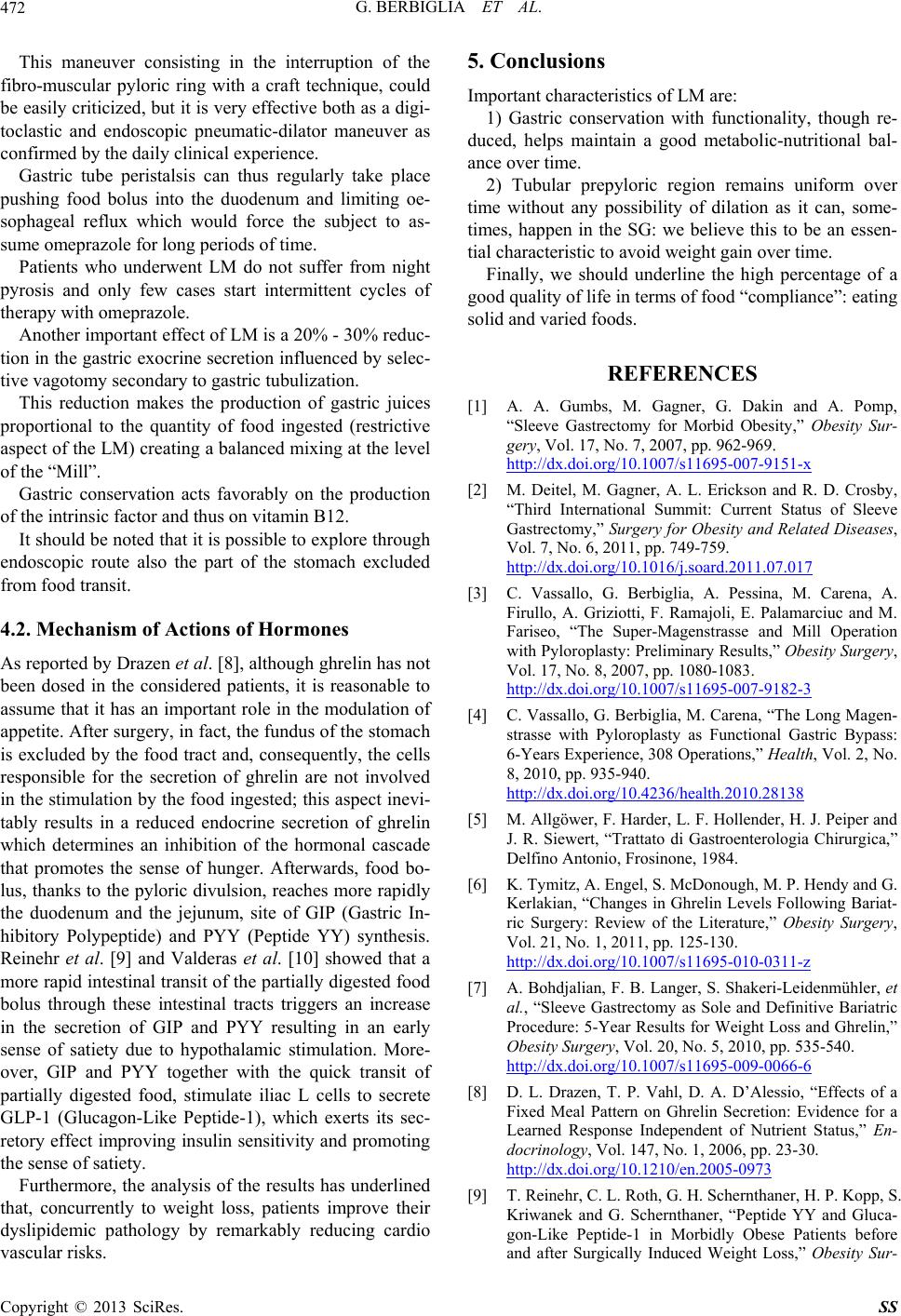 G. BERBIGLIA ET AL. 472 This maneuver consisting in the interruption of the fib y take place pu er from night py LM is a 20% - 30% reduc- tio c juices pr ervation acts favorably on the production of e through en 4.2. Mechanism of Actions of Hormones in has not alysis of the results has underlined th ns istics of LM are: nality, though re- du yloric region remains uniform over tim e of a go REFERENCES [1] A. A. Gumbin and A. Pomp, -x ro-muscular pyloric ring with a craft technique, could be easily criticized, but it is very effective both as a digi- toclastic and endoscopic pneumatic-dilator maneuver as confirmed by the daily clinical experience. Gastric tube peristalsis can thus regularl shing food bolus into the duodenum and limiting oe- sophageal reflux which would force the subject to as- sume omeprazole for long periods of time. Patients who underwent LM do not suff rosis and only few cases start intermittent cycles of therapy with omeprazole. Another important effect of n in the gastric exocrine secretion influenced by selec- tive vagotomy secondary to gastric tubulization. This reduction makes the production of gastri oportional to the quantity of food ingested (restrictive aspect of the LM) creating a balanced mixing at the level of the “Mill”. Gastric cons “Sle the intrinsic factor and thus on vitamin B12. It should be noted that it is possible to explor doscopic route also the part of the stomach excluded from food transit. As reported by Drazen et al. [8], although ghrel been dosed in the considered patients, it is reasonable to assume that it has an important role in the modulation of appetite. After surgery, in fact, the fundus of the stomach is excluded by the food tract and, consequently, the cells responsible for the secretion of ghrelin are not involved in the stimulation by the food ingested; this aspect inevi- tably results in a reduced endocrine secretion of ghrelin which determines an inhibition of the hormonal cascade that promotes the sense of hunger. Afterwards, food bo- lus, thanks to the pyloric divulsion, reaches more rapidly the duodenum and the jejunum, site of GIP (Gastric In- hibitory Polypeptide) and PYY (Peptide YY) synthesis. Reinehr et al. [9] and Valderas et al. [10] showed that a more rapid intestinal transit of the partially digested food bolus through these intestinal tracts triggers an increase in the secretion of GIP and PYY resulting in an early sense of satiety due to hypothalamic stimulation. More- over, GIP and PYY together with the quick transit of partially digested food, stimulate iliac L cells to secrete GLP-1 (Glucagon-Like Peptide-1), which exerts its sec- retory effect improving insulin sensitivity and promoting the sense of satiety. Furthermore, the an at, concurrently to weight loss, patients improve their dyslipidemic pathology by remarkably reducing cardio vascular risks. 5. Conclusio Important character 1) Gastric conservation with functio ced, helps maintain a good metabolic-nutritional bal- ance over time. 2) Tubular prep e without any possibility of dilation as it can, some- times, happen in the SG: we believe this to be an essen- tial characteristic to avoid weight gain over time. Finally, we should underline the high percentag od quality of life in terms of food “compliance”: eating solid and varied foods. s, M. Gagner, G. Dak eve Gastrectomy for Morbid Obesity,” Obesity Sur- gery, Vol. 17, No. 7, 2007, pp. 962-969. http://dx.doi.org/10.1007/s11695-007-9151 y, 11.07.017 [2] M. Deitel, M. Gagner, A. L. Erickson and R. D. Crosb “Third International Summit: Current Status of Sleeve Gastrectomy,” Surgery for Obesity and Related Diseases, Vol. 7, No. 6, 2011, pp. 749-759. http://dx.doi.org/10.1016/j.soard.20 Carena, A. 182-3 [3] C. Vassallo, G. Berbiglia, A. Pessina, M. Firullo, A. Griziotti, F. Ramajoli, E. Palamarciuc and M. Fariseo, “The Super-Magenstrasse and Mill Operation with Pyloroplasty: Preliminary Results,” Obesity Surgery, Vol. 17, No. 8, 2007, pp. 1080-1083. http://dx.doi.org/10.1007/s11695-007-9 ng Magen-[4] C. Vassallo, G. Berbiglia, M. Carena, “The Lo strasse with Pyloroplasty as Functional Gastric Bypass: 6-Years Experience, 308 Operations,” Health, Vol. 2, No. 8, 2010, pp. 935-940. http://dx.doi.org/10.4236/health.2010.28138 [5] M. Allgöwer, F. Harder, L. F. Hollender, H. J. Peiper and h, M. P. Hendy and G. -0311-z J. R. Siewert, “Trattato di Gastroenterologia Chirurgica,” Delfino Antonio, Frosinone, 1984. [6] K. Tymitz, A. Engel, S. McDonoug Kerlakian, “Changes in Ghrelin Levels Following Bariat- ric Surgery: Review of the Literature,” Obesity Surgery, Vol. 21, No. 1, 2011, pp. 125-130. http://dx.doi.org/10.1007/s11695-010 nmühler, et [7] A. Bohdjalian, F. B. Langer, S. Shakeri-Leide al., “Sleeve Gastrectomy as Sole and Definitive Bariatric Procedure: 5-Year Results for Weight Loss and Ghrelin,” Obesity Surgery, Vol. 20, No. 5, 2010, pp. 535-540. http://dx.doi.org/10.1007/s11695-009-0066-6 [8] D. L. Drazen, T. P. Vahl, D. A. D’Alessio, “Effects of a Fixed Meal Pattern on Ghrelin Secretion: Evidence for a Learned Response Independent of Nutrient Status,” En- docrinology, Vol. 147, No. 1, 2006, pp. 23-30. http://dx.doi.org/10.1210/en.2005-0973 [9] T. Reinehr, C. L. Roth, G. H. Schernthaner, H. P. Kopp, S. and after Surgically Induced Weight Loss,” Obesity Sur- Kriwanek and G. Schernthaner, “Peptide YY and Gluca- gon-Like Peptide-1 in Morbidly Obese Patients before Copyright © 2013 SciRes. SS  G. BERBIGLIA ET AL. Copyright © 2013 SciRes. SS 473 gery, Vol. 17, No. 12, 2007, pp. 1571-1577. http://dx.doi.org/10.1007/s11695-007-9323-8 [10] J. P. Valderas, V. Irribarra, C. Boza, R. de l Liberona, A. M. Acosta, M. Yolito and A. M a Cruz, Y aiz, “Medi- . cal and Surgical Treatments for Obesity Have Opposite Effects on Peptide YY and Appetite: A Prospective Study Controlled for Weight Loss,” The Journal of Clinical Endocrinology and Metabolism, Vol. 95, No. 3, 2010, pp. 1069-1075. http://dx.doi.org/10.1210/jc.2009-0983 |